





Insomnia disorder is difficulty falling asleep and frequent or early awakening that affects daytime functioning, despite adequate opportunity to sleep. 1 It affects at least 10% of adults and is associated with reduced quality of life, exacerbation of other psychiatric comorbidities Reference Riemann, Espie, Altena, Arnardottir, Baglioni and Bassetti2,Reference Morin and Jarrin3 and reduced productivity. Reference Chalet, Albanese, Egea Santaolalla, Ellis, Ferini-Strambi and Heidbreder4
The first-line treatment for chronic insomnia disorder in adults is cognitive–behavioural therapy for insomnia (CBTi). This has long-term benefit with or without psychiatric or medical comorbidities. Reference Mitchell, Gehrman, Perlis and Umscheid5 However, some patients have incomplete benefit, lack access or are unsuitable for CBTi. Hypnotics, including benzodiazepines and Z-drugs, are frequently used, but they can cause tolerance, dependence and cognitive side-effects, and are not recommended long-term. Reference Soyka, Wild, Caulet, Leontiou, Lugoboni and Hajak6 Off-licence alternatives, including antihistamines, have higher risk and less evidence. Reference King7
Daridorexant is the first dual orexin receptor antagonist approved for insomnia in the UK and European Union in 2023. 8 It reduces wakefulness and helps sleep maintenance. Reference Onge, Phillips and Rowe9 Guidelines recommend it for those with severe, chronic insomnia despite CBTi, or if CBTi is inaccessible or unsuitable. It is the only hypnotic currently recommended for long-term use in the UK. There are no head-to-head trials against other hypnotics and little long-term data. Reference Robinson, Supra, Downs, Kataria, Parker and Kaye10,Reference Kishi, Ikuta, Citrome, Sakuma, Hatano and Hamanaka11 There is also a paucity of data in those with mental and physical health comorbidities, despite comorbid insomnia disorder being the norm rather than the exception. Reference Riemann, Espie, Altena, Arnardottir, Baglioni and Bassetti2 Few studies have reported outcomes beyond 3 months. We have therefore studied the long-term outcomes of a cohort with comorbid insomnia.
Method
This is a single-centre, retrospective, observational cohort study. Case notes for all patients with a diagnosis of chronic insomnia disorder treated with daridorexant within the Newcastle Regional Sleep Service between April 2024 and January 2025 were analysed. Patients were identified from pharmacy records with a complete data-set of every daridorexant prescription issued between the above dates, with follow-up until 31 August 2025.
All patients were referred from psychiatry or primary care, all had a sleep clinic assessment and initially had treatment of any comorbid obstructive sleep apnoea (OSA) or restless legs syndrome (RLS). Patients were initiated either on daridorexant 25 mg or 50 mg at night within the sleep service, following national and regional prescribing guidelines. 8,12 All patients had typical clinical symptoms of chronic insomnia disorder and were stable on any antidepressant or antipsychotic medication at the point of starting daridorexant. All patients were offered online or face-to-face CBTi before commencing daridorexant. Patients were started on daridorexant, then seen at 4 weeks, 12 weeks and again at 9 months if they stayed on medication. They were discharged after 12 months if they were stable on medication, with primary care taking on regular review. Some with additional sleep disorders were followed up for longer, e.g. if they needed treatment for OSA as well. Data on patient demographics, side-effects, length of treatment, comorbidities and relevant treatments, and other psychotropic medications were collected. Data on symptoms, sleep diaries, Epworth Sleepiness Scale (ESS) scores and Insomnia Severity Index (ISI) scores were reviewed at baseline and at follow-up. The ISI is a widely used, validated, seven-item, self-report questionnaire assessing the severity and impact of insomnia symptoms over the prior 2 weeks. Reference Bastien, Vallières and Morin13 A change in ISI score of six or greater is clinically meaningful. Reference Yang, Morin, Schaefer and Wallenstein14 Data were anonymised for statistical analysis.
Results
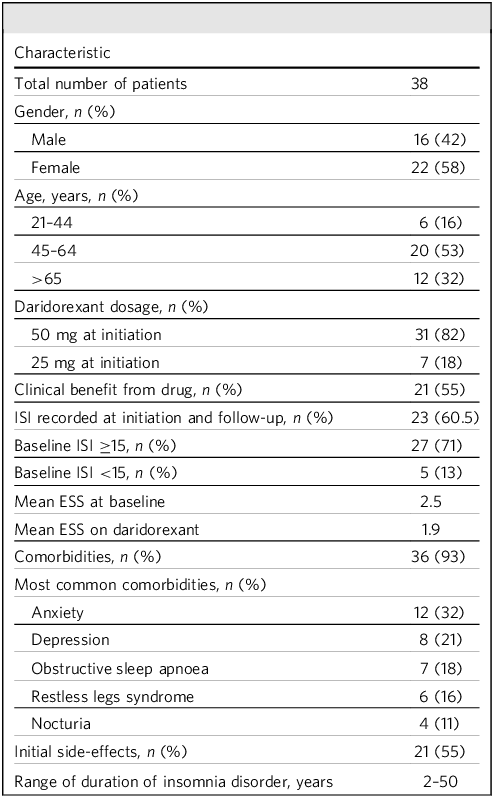
Patient characteristics are described in Table 1. Of the 38 patients included in the study, 58% were female, typically with a low ESS score at baseline. All but two patients had completed prior CBTi, with incomplete or no benefit. The two patients who had not completed CBTi had limited literacy and were given sleep hygiene advice alone. Daridorexant was started at 50 mg in 82% of the cohort, or at 25 mg in cases of older age, hepatic dysfunction and, for one patient, concern about side-effects. Of those patients on 25 mg, four increased to 50 mg because of limited benefit on the lower dose. One patient (>65 years of age) reduced from 50 to 25 mg at 9 months post-initiation because of reduced benefit, and found that 25 mg daridorexant was better tolerated.
Summary of patient characteristics

Table 1 Long description
The table presents characteristics of 38 patients involved in a study. It includes details such as gender distribution, age groups, daridorexant dosage, clinical benefit from the drug, Insomnia Severity Index (ISI) at initiation and follow-up, baseline ISI, mean Epworth Sleepiness Scale (ESS) scores, comorbidities, initial side-effects, and the range of duration of insomnia disorder. The table has 15 rows and 2 columns. Row 1: Characteristic. Row 2: Total number of patients, 38. Row 3: Gender, n (percent). Row 4: Male, 16 (42). Row 5: Female, 22 (58). Row 6: Age, years, n (percent). Row 7: 21-44, 6 (16). Row 8: 45-64, 20 (53). Row 9: >65, 12 (32). Row 10: Daridorexant dosage, n (percent). Row 11: 50 mg at initiation, 31 (82). Row 12: 25 mg at initiation, 7 (18). Row 13: Clinical benefit from drug, n (percent), 21 (55). Row 14: ISI recorded at initiation and follow-up, n (percent), 23 (60.5). Row 15: Baseline ISI >=15, n (percent), 27 (71). Row 16: Baseline ISI <15, n (percent), 5 (13). Row 17: Mean ESS at baseline, 2.5. Row 18: Mean ESS on daridorexant, 1.9. Row 19: Comorbidities, n (percent), 36 (93). Row 20: Most common comorbidities, n (percent). Row 21: Anxiety, 12 (32). Row 22: Depression, 8 (21). Row 23: Obstructive sleep apnoea, 7 (18). Row 24: Restless legs syndrome, 6 (16). Row 25: Nocturia, 4 (11). Row 26: Initial side-effects, n (percent), 21 (55). Row 27: Range of duration of insomnia disorder, years, 2-50.
ISI, Insomnia Severity Index; ESS, Epworth Sleepiness Scale.
A total of 21 patients (55%) had sustained clinical benefit from daridorexant and wanted to continue taking the medication after the first 12 weeks. The mean ISI score before treatment was 20.0 (s.d. = 5.2), decreasing to 9.4 (s.d. = 4.0) at follow-up (see Fig. 1). The mean reduction in ISI score was 10.6 (s.d. = 6.9, t(19) = 6.71, p < 0.001; paired t-test). Changes in ISI scores are shown in Fig. 1. Follow-up ISIs were recorded between 6 and 15 months, at a median of 10.5 months. A total of 15 out of 20 patients had a reduction in ISI of ≥6, and 19 patients had a follow-up ISI score of <15, below the threshold for moderate or severe insomnia disorder. The ESS scores did not change significantly during treatment; all had an ESS score <10, with a mean ESS score of 2.5 before treatment and 1.9 after treatment.
Change in Insomnia Severity Index (ISI) for responders.

Regarding side-effects, 21 (55%) patients had initial side-effects from daridorexant, 10 (26%) of whom tolerated the side-effects because of perceived benefit from the drug (see Fig. 2). The most common side-effects were vivid dreams or nocturnal hallucinations (n = 7, 18%), fatigue (n = 5, 13%), anxiety (n = 4, 11%), cognitive difficulties (n = 4, 11%) and daytime drowsiness (n = 4, 11%). Of the 16 patients (42%) who discontinued daridorexant, 9 (24%) stopped because of side-effects and 7 (18%) did not perceive any benefit from the drug.
Frequency of reported side-effects by benefit status.

Among the more severe side-effects leading to discontinuation was suicidal ideation in a patient with a history of anxiety, obsessive–compulsive disorder and depression, emerging within 2–3 days of initiation and recurring on rechallenge. Additionally, two patients with anxiety had rapidly worsening depression and anxiety, and stopped treatment. In one patient, this occurred after switching from low-dose quetiapine (25 mg), which was being used off-licence for insomnia, to daridorexant. Vivid dreams were often tolerated by patients over time, but one patient stopped treatment at 12 months because of vivid dreams, nightmares and sleep paralysis despite improvement in insomnia severity. These symptoms promptly resolved with discontinuation.
Thirty-six patients (95%) had comorbid insomnia disorder with another mental or physical health problem or sleep disorder. A total of 55% (n = 21) of the cohort had ≥2 comorbidities (mean: 1.7, range: 0–4); 18 patients had another sleep disorder, 8 patients had a comorbid psychiatric condition and 21 patients had a physical health condition. The most common comorbidities are shown in Fig. 3.
Most common comorbidities. OSA, obstructive sleep apnoea.

Twenty patients (53%) were on no drug therapy for insomnia disorder when they started daridorexant. Eleven patients (29%) were switched to daridorexant from a different insomnia medication and seven patients (18%) added daridorexant to their current treatment. The most common medications to be taken concurrently with daridorexant were mirtazapine (n = 3) and amitriptyline (n = 2).
At the time of data collection, 13 patients (34%) had taken daridorexant for longer than 12 months. Of these, 6 completed a follow-up ISI after 12 months and all reported sustained benefit. ISI scores were all ≤13 (absence of, or subthreshold insomnia disorder). All patients who responded to treatment (n = 23) were advised to take a drug holiday break from daridorexant to assess whether insomnia then remained in remission. At the time of reviewing notes, 6 patients had trialled a drug holiday at a median of 7.5 months after starting treatment (range: 3–11 months). Two patients remained well off of treatment, subsequently stopping medication. Four restarted medication because of the return of their insomnia symptoms.
Discussion
The aim of this study was to evaluate the long-term treatment response and side-effect profile of daridorexant in a real-world cohort of UK patients with comorbid insomnia disorder. To the best of our knowledge, this is the first long-term follow-up study reporting UK data, and the first to report daridorexant outcomes in comorbid insomnia.
Daridorexant is a dual orexin receptor antagonist that reduces wakefulness and helps sleep initiation and maintenance. Reference Onge, Phillips and Rowe9 It is reported to lead to little daytime sleepiness, but there are no head-to-head trials against other hypnotics. There are still very few studies looking at long term outcomes. Reference Robinson, Supra, Downs, Kataria, Parker and Kaye10,Reference Kishi, Ikuta, Citrome, Sakuma, Hatano and Hamanaka11
Initial trial data showed that 50 mg daridorexant significantly improved daytime functioning and subjective and objective measures of sleep at 1 and 3 months. Reference Mignot, Mayleben, Fietze, Leger, Zammit and Bassetti15 Lower dosing was recommended for those over 75 years of age. 8 The ISI was used as the key primary outcome in published trials. Daridorexant was reported to have low rates of tolerance and few side-effects compared with existing hypnotics, including in older adults. Reference Mignot, Mayleben, Fietze, Leger, Zammit and Bassetti15,Reference Kunz, Dauvilliers, Benes, García-Borreguero, Plazzi and Seboek Kinter16 Smaller, short-term studies have supported these findings. Reference Williams and Rodriguez-Cué17,Reference Fernandes, Placidi, Mercuri and Liguori18 However some of these studies were of very short duration, with only a month of follow-up.
However, comorbid insomnia is the norm and not the exception. Reference Riemann, Espie, Altena, Arnardottir, Baglioni and Bassetti2 This means that many hypnotic drug trials do not represent the patients with insomnia that typically seen in both primary care and mental health services, where at least 40% will have another psychiatric disorder and 30–50% will have another sleep disorder. Reference Golebiowski, Mansukhani and Kolla19,Reference Sweetman, Lack, McEvoy, Smith, Eckert and Osman20 The UK National Institute for Health and Care Excellence guidelines highlight the need to consider other sleep disorders, including OSA and RLS. The same guidelines recommend daridorexant for long-term use if needed, for up to a year. No other hypnotics are recommended for chronic insomnia apart from melatonin, which is only approved for those aged over 55 years and for up to 13 weeks.
Our cohort of 38 patients was typical of previously published insomnia cohorts. The majority were female and middle-aged or older. Reference Morin and Jarrin3 Daridorexant helped 55% of patients with comorbid insomnia, based on both patient self-report and change in ISI score. Of our cohort, 71% had moderate or severe insomnia disorder, with an ISI score >15. This matches the inclusion criteria in insomnia trials. Reference Mignot, Mayleben, Fietze, Leger, Zammit and Bassetti15 Four out of five patients with lower ISI scores and milder insomnia also perceived benefit. This suggests that the ISI alone may not be the only way to measure who will benefit from daridorexant. Improvement in insomnia was maintained over a prolonged follow-up period for most. Two patients stopped daridorexant after 9 months of therapy, and their insomnia remained in remission. This highlights the benefit of regular drug holidays.
Eighteen patients had insomnia disorder comorbid with another sleep disorder. Of the seven patients diagnosed with OSA, six had benefit from the drug. This aligns with the findings of a crossover study where daridorexant increased total sleep time and shortened awakenings in patients with mild or moderate OSA. It suggests that daridorexant can be helpful in those with comorbid insomnia and OSA. Reference Boof, Ufer, Fietze, Pépin, Guern and Lemoine21 Our sample was too small to see if the presence or absence of RLS predicted a better or worse response to daridorexant. Also, both lifestyle factors and restless leg therapy were initiated before the treatment of insomnia disorder in our cohort.
Daridorexant was also associated with a worse side-effect profile than previously reported: 55% of our patients had side-effects on starting treatment, and 24% of the cohort stopped treatment as a result. This is higher than the 38% adverse event profile from the initial randomised controlled trials with matched placebo groups. It is also higher than a recently reported case series of those with insomnia and substance use disorder. Reference Mignot, Mayleben, Fietze, Leger, Zammit and Bassetti15,Reference Di Nicola, Pepe, Bonomo, Milintenda, Panaccione and Brugnoli22 These studies found that 1.6–4.7% of patients on 25 or 50 mg daridorexant stopped because of adverse events, a much lower rate than observed in our patient group. Reference Mignot, Mayleben, Fietze, Leger, Zammit and Bassetti15,Reference Kunz, Dauvilliers, Benes, García-Borreguero, Plazzi and Seboek Kinter16,Reference Di Nicola, Pepe, Bonomo, Milintenda, Panaccione and Brugnoli22 This may possibly be attributable to our longer follow-up period, patient comorbidities or the small size of our studied population. This is a small study, but results suggest that those with comorbid insomnia may be at higher risk of side-effects. It will be important to look at side-effects in future, larger cohorts.
Some of the side-effects experienced by our patients have been reported before, including fatigue, headache, dizziness and sleep paralysis. Reference Mignot, Mayleben, Fietze, Leger, Zammit and Bassetti15,Reference Kunz, Dauvilliers, Benes, García-Borreguero, Plazzi and Seboek Kinter16 Common side-effects in randomised controlled trials included nasopharyngitis and headache; Reference Mignot, Mayleben, Fietze, Leger, Zammit and Bassetti15 however, we did not see this in our group. The most common side-effect that our patients experienced was vivid dreams (n = 7, 18%). There is only one documented case of this side-effect out of 550 patients in the 40-week extension trial, with no mentions in the phase 3 randomised controlled trial. Reference Kunz, Dauvilliers, Benes, García-Borreguero, Plazzi and Seboek Kinter16 However, a later analysis of individual case reports found that abnormal dreams were experienced by 8% of patients. Reference Cicala, Barbieri, Russo, Salvo and Spina23 This side-effect was experienced up until 12-month review in 5 patients. This is at odds with the European product summary statement, which states that this side-effect usually occurs in the first few weeks of treatment. 24 Many of our patients tolerated this side-effect, but one patient discontinued treatment at 12 months because of persistent vivid dreams, nightmares and sleep paralysis. This resolved after stopping daridorexant. Orexin receptor antagonism is strongly linked to increased rapid eye movement sleep, and this may explain the vivid dreams reported by patients, despite initial trial data suggesting little to no change in sleep architecture. Reference Mignot, Mayleben, Fietze, Leger, Zammit and Bassetti15,Reference Clark, Brian, Drummond, Hoyer and Jacobson25,Reference Roch, Bergamini, Steiner and Clozel26 It is important to explore how common this side-effect is in larger populations, to assess any impact on patient well-being and potentially discuss before starting treatment.
Suicidal ideation only occurred in 2 out of 1232 patients included in the daridorexant arms of phase 3 trials, whereas it was reported by 1 of our 38 patients. The patient who had this side-effect in our cohort had a significant additional psychiatric history and therefore would not have been eligible for the initial published studies. There is some concern about daridorexant use in patients with depression because of this potential side-effect, especially given the high prevalence of insomnia disorder with depression. Reference Morin and Jarrin3,Reference Nobile, Olié and Courtet27 It is important to look at the potential link between daridorexant and suicidal ideation. More research is needed to see if any patient characteristics increase the risk of suicidal ideation with daridorexant treatment.
Four patients had daytime drowsiness, predominantly in the morning; two tolerated this well, as they otherwise responded to treatment. This is consistent with other studies showing that daridorexant’s 8-h half-life can lead to morning sleepiness, but reduces daytime sleepiness overall. Reference Dauvilliers, Braunstein, Zammit, Olivieri and Luyet28 In our cohort, the mean ESS score was low, which is well-described in insomnia, and the ESS score did not increase after therapy.
Most patients who switched to daridorexant from another medication responded well, but one patient who switched from quetiapine had worsening insomnia and anxiety. Further studies are needed to see how patients respond to direct switches in treatment to guide any cross-titration protocols, especially in those with psychiatric comorbidity.
At the time of data collection, 13 patients (34%) had taken daridorexant for longer than 12 months, with sustained benefit. No patients developed tolerance, dependency or rebound insomnia, in line with previous data. Reference Kishi, Ikuta, Citrome, Sakuma, Hatano and Hamanaka11,Reference Kunz, Dauvilliers, Benes, García-Borreguero, Plazzi and Seboek Kinter16 However, UK guidelines still suggest that although considered safe for longer-term use, daridorexant should be used for as short a time as possible, with regular review and drug holidays to check ongoing patient benefit. Insomnia is still not as understood and is undertreated compared with other long-term conditions in primary care. This means that ongoing education is needed to help with diagnosis and management of insomnia, including daridorexant prescribing. Reference Waterman and Selsick29
Study limitations include a retrospective design, a small cohort and a large number of different comorbidities. Sleep diary data were not included in the analysis. This is because they were used for initial diagnosis and first review visit, but not long term if patients reported benefit. However, strengths include a longer follow-up than the initial trials and inclusion of the typical comorbidities seen in primary care and psychiatry. Switching patients from one hypnotic to another is common in daily practice rather than patients being on no medication, and so again, this represents real-life practice.
In conclusion, daridorexant remains a safe and effective treatment option for many with comorbid insomnia disorder; however general practitioners should be aware of the potential side-effects and further long-term studies are needed to assess the benefit in different patient groups.
About the authors
Soumya Saladi is an undergraduate medical student at the Centre for Neuroscience, Newcastle University, UK. Hatem Jouda, MBBS, MRCP, is an internal medicine trainee with the Regional Sleep Service, Newcastle upon Tyne Hospitals NHS Foundation Trust, Newcastle upon Tyne, UK. Teck Yong, MB ChB, is a general practitioner trainee with the Regional Sleep Service, Newcastle upon Tyne Hospitals NHS Foundation Trust, Newcastle upon Tyne, UK. Kirstie N. Anderson, BMedSci, MBBS, DPhil, is a consultant neurologist with the Regional Sleep Service, Newcastle upon Tyne Hospitals NHS Foundation Trust, Newcastle upon Tyne, UK; and Cumbria, Northumberland, Tyne and Wear Mental Health Trust, Newcastle upon Tyne, UK.
Data availability
The data are not available due to their containing information that could compromise the privacy of participants.
Acknowledgements
Artificial Intelligence use: No artificial intelligence tools have been used in the research or writing process for this manuscript.
Author contributions
S.S. contributed to data analysis, statistical analysis, patient consent and writing the original draft of the manuscript. H.J. contributed to data collection and analysis. T.Y. contributed to data collection and patient consent. K.N.A. contributed to study supervision, study design, data collection and manuscript writing.
Funding
This research received no specific grant from any funding agency, commercial or not-for-profit sectors.
Declaration of interest
K.N.A. has received speaker fees and sponsorship for non-promotional educational meetings from the following pharmaceutical or medical technology companies: Jazz Pharmaceuticals, Flynn Pharma, Bioprojet, Idorsia, Takeda, Stowood Scientific, Inspire and Nyxoah; and is a member of the British Sleep Society. All other authors have no conflicts of interest to declare.
Ethical standards
The authors assert that all procedures contributing to this work comply with the ethical standards of the relevant national and institutional committees on human experimentation and with the Helsinki Declaration of 1975, as revised in 2013. Ethics board approval was not required for a retrospective, anonymised case notes review. However, verbal consent was witnessed and formally recorded from all participants.


 Open access


eLetters
No eLetters have been published for this article.