


What does it mean for a voice to sound indifferent? In the last fifteen years, pop music has seen a proliferation of vocal production styles that foreground emotional detachment: blurred lyrics, whispered delivery, and spatial processing effects like reverb and delay that obscure the singer’s body.Footnote 1 This article focuses on one genre in particular, chillwave, which emerged in the late 2000s and became closely associated with what I call the disinterested hipster aesthetic. In chillwave, reverb helps construct a vocal presence that is hazy, hard to locate, and often uninterested in emotional clarity or lyrical intelligibility. Drawing on work in music theory, sound studies, and affect theory, I argue that reverb functions as a timbral marker of genre as well as a semiotic cue for affective distance. Following Sara Ahmed, I treat affect not as an interior emotional state lodged within individual listeners or performers, but as a relational force that circulates between people and sounds; as Ahmed puts it, emotions do things: they “operate” to “make” and “shape” people’s actions and reactions.Footnote 2 This approach allows me to analyze reverb not as a sound that contains emotional meaning, but as a sonic vessel that helps orient listeners toward particular affective responses and stances—distance, coolness, withdrawal—that have already accrued cultural value within indie and chillwave contexts.
Recent scholarship has situated chillwave within a broader constellation of internet-mediated microgenres, including synthwave and vaporwave, that mobilize nostalgia as a central aesthetic resource. Writing about what he calls a “nostalgia genre continuum,” Paul Ballam-Cross argues that these genres rely on “reconstructed nostalgia,” in which musical and visual signifiers evoke collective memories of an imagined past rather than specific lived experiences.Footnote 3 In this context, chillwave’s characteristic sonic haze—its degraded timbres, vintage synthesizers, and heavily reverberant vocals—participates in a broader cultural practice of constructing stylized memory worlds through sound.
Much has also been written about how chillwave and other genres participate in a social contract, a way of cueing listeners’ expectations through instrumentation, rhythm, and lyrical themes.Footnote 4 For example, Evan Malone argues that genres function less like taxonomic containers and more like art-centered practices—social formations in which artists, critics, and listeners negotiate what counts as a legitimate “move” within a genre.Footnote 5 From this perspective, chillwave did not come into existence because a critical mass of artists independently converged on the same sound. Rather, it cohered when critics and fans retrospectively grouped disparate tracks under a shared name; articulated expectations around “haze,” nostalgia, and mood; and began listening to those works through that frame.
Malone’s account resonates strongly with Ballam-Cross’s conception of chillwave’s origin as a blog-coined microgenre, one that many associated artists initially disavowed, even as listeners and critics embraced it as a meaningful category. Chillwave was thus not simply discovered by listeners but made by them through communal uptake. Its boundaries were drawn not only by sonic similarities, but by shared interpretive habits that trained listeners to hear certain production choices—especially reverb-laden vocals—as genre-signifying rather than incidental. This is similar to ethnomusicologist Cornelia Fales’s account of timbre in EDM. In her essay, “Hearing Timbre: Perceptual Learning among Early Bay Area Ravers,” Fales counters the idea that effects are things added to a recognizable source instrument (e.g., guitar).Footnote 6 Rather, she demonstrates through careful study of the language used by EDM fans in the San Francisco Bay community that these listeners perceive the effects themselves to be more significant to identifying tracks as belonging to the EDM genre. Chillwave aficionados similarly embrace hazy reverb as a core component of the genre, rather than as an effect added to vocals, synths, and other instruments.
My account of chillwave’s formation is also in keeping with David Hesmondhalgh’s influential theorization of indie as a genre defined not only by sound but by a historically contingent relationship to the music industry. As he argues, indie is unusually named for its institutional position rather than its musical materials, emerging from punk-era efforts to reconcile aesthetic autonomy with participation in commercial popular culture.Footnote 7 Crucially, he cautions against reading any straightforward correspondence between institutional arrangements and aesthetic outcomes: professionalization and proximity to corporate structures do not automatically determine how music sounds or what it signifies. Instead, indie’s meanings emerge from ongoing negotiations between aesthetic ideals (authenticity, restraint, and seriousness) and the practical conditions of production and circulation. Through applying Hesmondhalgh’s insights a decade later, chillwave can be understood as a late-2000s microgenre that inherits indie’s aestheticized distance after its earlier institutional oppositional force had bent to market forces.
What I am adding to this conversation about genre is the idea that timbre—especially in the form of production effects—can provide a productive way to synthesize previous scholars’ insights regarding chillwave’s nostalgia, its social contract, and its position as an “indie genre.” As David K. Blake, Megan Lavengood, and others have shown, timbral traits help us locate tracks within genre worlds by their “sound,” not just their content.Footnote 8 In this article, I build on that work by foregrounding reverb as a key site of genre recognition in chillwave. I also argue that reverb functions semiotically, carrying affective connotations that vary across genres. In chillwave, reverb often evokes ironic distance or a cultivated apathy, an aesthetic stance I locate within the broader cultural figure of the disinterested hipster.
Recent work by Ajitpaul Mangat on indie discourse and race helps clarify why such affective distance can be heard as an aesthetic within genres like chillwave. Elaborating on a term coined by Fred Moten, Mangat describes a “white avant-gardism” in 2000s and 2010s indie culture, wherein whiteness becomes aligned with experimentation, futurity, and emotional restraint, while Black musical practices are framed as excessive, commercial, or tethered to the past.Footnote 9 Within this critical formation, affective detachment is not heard as absence or failure, but as a marker of artistic intent. Chillwave’s reverb-drenched vocals emerge within precisely this landscape, where technological mediation and emotional opacity are legible as choices. But as I’ll explore later, the same production techniques can signify something quite different in other contexts: not disinterest, but dissociation, trauma, or vulnerability.
My approach to reverb on vocals in particular draws on scholarship that treats technologically mediated voices as sites where affect, labor, and identity are made legible through listening practices. As Catherine Provenzano demonstrates in her work on pitch correction, vocal technologies do not simply alter sonic surfaces; they reshape how emotion, effort, and authenticity are heard in relation to gendered and racialized bodies.Footnote 10 Provenzano emphasizes that such meanings emerge through what Nina Eidsheim terms “performative listening,” an active mode of interpretation that trains listeners to hear the “meaning and value of a particular vocal timbre.”Footnote 11 Following this logic, I do not claim that reverb guarantees emotional distance in chillwave vocals. Rather, I examine how reverberant vocal production participates in a broader field of expectations about who can afford emotional opacity, how effort is obscured through technology, and how such sounds are variously interpreted by listeners within specific genre and identity frameworks. Applied to chillwave, I suggest that reverb’s association with affective distance arises through a complex interplay of technology, listeners’ responses, and in the genre’s privileging of emotional restraint, irony, and nonchalance.Footnote 12
Disinterested Hipster, a Brief History
As an example, consider the IFC sketch comedy series Portlandia, which cemented the link between the disinterested hipster aesthetic and the sonic world of chillwave. Its premiere in 2011 was a moment of cultural crystallization, and Portlandia quickly became a touchstone for the early 2010s hipster aesthetic. Its cold-open sketches often caricatured niche subcultures—from urban homesteaders to fixed-gear cyclists—but before the satire even began, each episode opened with a montage of hazy visuals set to “Feel It All Around” (2009), a chillwave track by Washed Out. The track’s swirling synths and reverb-heavy vocals scored an idealized vision of Portland: bike polo in slow motion, vintage filters, and unbothered men in flannel and oversized sunglasses.
The pairing of the song with the montage produced the crystallization of a cultural figure: the disinterested hipster. Unlike other Portlandia types (the cruelty-free diners, the artisanal picklers), the disinterested hipster appears to perform nothing at all. Their aesthetic is marked by emotional opacity: they drift, they shrug, they barely register the world around them. The connection between this posture and chillwave’s sound was, from the start, embedded in affect as much as image.
But the figure of the disinterested hipster predates Portlandia and even the 2000s. Its deeper roots can be traced back at least to the 1990s slacker archetype, a cultural response to post-Cold War cynicism and neoliberal disaffection. Examples include Ethan Hawke’s laconic musician in Reality Bites (1994) or the deadpan malaise of Seinfeld, whose characters mastered irony as a defensive affect. In both cases, disinterest emerges not as failure to feel, but as a posture of critique, the refusal of emotional labor in favor of stylized detachment. Ahmed’s work helps clarify how disinterest operates here not as a lack of feeling, but as a specific affective orientation. In The Cultural Politics of Emotion, she argues that a position not unrelated to disinterest (what she calls “hardness”) is not the absence of emotion, but rather a specific emotional orientation toward others.Footnote 13 Read through this lens, the disinterested hipster is not emotionally empty but affectively positioned: oriented away from urgency and demand. Chillwave’s reverb-heavy vocals participate in this orientation by placing the voice at a remove, not eliminating affect but redistributing it across perceived space.
Ken McLeod’s analysis of vaporwave helps clarify how such aesthetic distance can function in relationship to its sonic materials. Writing about vaporwave’s radical approach to manipulating preexisting tracks, McLeod emphasizes the genre’s commitment to ambiguity and estrangement rather than affective sincerity.Footnote 14 While vaporwave arguably intensifies these tendencies through sonic extremes of deceleration, looping, and degradation, McLeod nevertheless classifies it alongside other nostalgia-oriented microgenres such as hypnagogic pop and chillwave.Footnote 15 From this perspective, chillwave’s reverberant vocals, even though they are much less sonically disruptive than the typical vaporwave track, signal a characteristically vague emotion, one that is (to the extent that it is present at all) mediated, stylized, and rendered spatially indistinct. The resulting affective posture is ambivalent; it is capable of being heard as critique, comfort, or complicity depending on context and listening position.
Hesmondhalgh’s related account of indie’s institutional trajectory helps explain why vaporwave and chillwave take on these ambivalent facades. As indie moved from oppositional quasi-political practice to fully corporatized genre, the politics of autonomy that once animated its independent production gradually hardened into a style: ironic detachment, muted affect, and cultivated indifference. The disinterested hipster can thus be read not merely as a cultural type, but as the affective residue of indie’s compromises with the mainstream, a figure for whom distance no longer signals resistance but taste.
Of course, the term “hipster” has a much older history, originating in 1940s Black jazz culture as a figure of rebellious cool, later appropriated and aestheticized by white bohemians. Norman Mailer’s infamous 1957 essay, “The White Negro,” casts the white hipster as a romanticized imitator of Black style and affective detachment, what he saw as an “existential” resistance to conformity.Footnote 16 By the time the term re-emerged in early-2000s indie culture, it had shed much of its racial and political context, congealing instead into a mostly white, middle-class aesthetic of studied apathy.
This racialized genealogy matters. As scholars such as Mark Greif and Angela McRobbie have noted, the hipster is a cultural construction that depends on access to economic, racial, and gender privilege.Footnote 17 The disinterested hipster, in particular, is overwhelmingly coded as white, male, and middle-class—a subject position that affords the luxury of apathy.Footnote 18 Notably, hipsters aren’t disinterested in everything. Robin James positions one version of the hipster as a “capitalist [who] makes a living by transforming a purported passion for craft beer or artisanal beauty products or whatever other form of craft production into a small business.”Footnote 19 Mangat’s reading of “white hipsterdom” (once again, following Moten) shows how the posture of disinterest comes to function as a form of cultural power.Footnote 20 He cautions that the experimental legitimacy afforded to certain technologies depends less on their invariant sonic properties than on who is understood to be using them and within what genre formations.Footnote 21 If white indie artists are granted access to futurity through emotional restraint and sonic mediation, others—say, Black rappers—are denied that interpretive generosity. In indie music, emotional remove and technological mediation are often framed as experimental virtues when performed by white subjects: signs of reflexivity, irony, or resistance to commercial sentimentality. This framing helps explain how chillwave’s reverberant vocals can signify cool detachment. The same sonic markers that might register elsewhere as alienation or distress are, within this aesthetic regime, heard as restraint. To appear unbothered or emotionally disengaged often requires a buffer of privilege: economic security, cultural capital, and the presumption that one’s voice will still be heard even when it’s muffled. Chillwave encodes that posture in sound; its reverb-drenched vocals and nostalgic haze mirror the hipster’s cultivated distance from emotional urgency or social accountability.
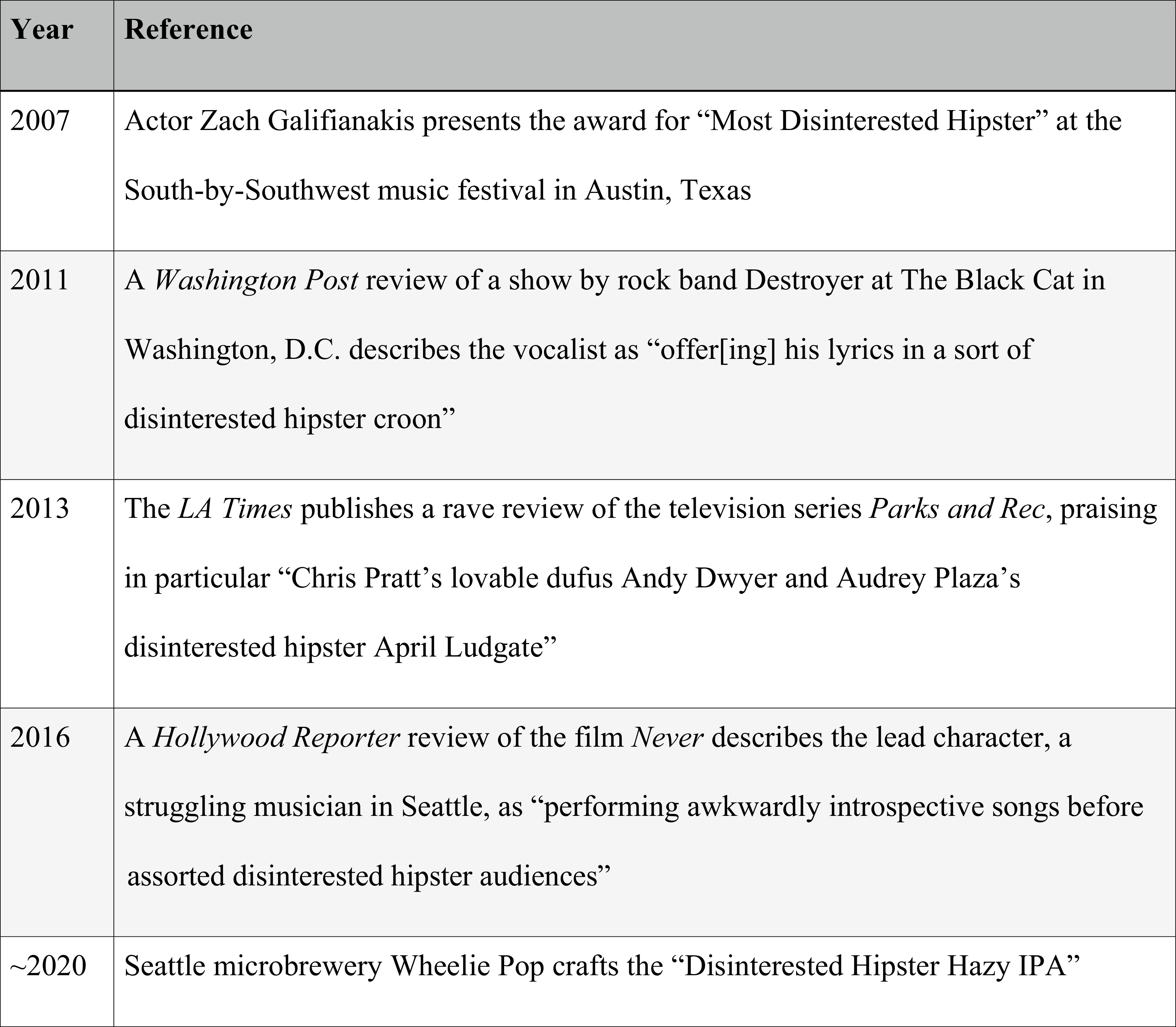
Needless to say, the term “hipster” was already circulating in American pop culture well before Portlandia, and, as previously noted, affective “distance” has always been part of indie music, even after its corporate takeover. Nevertheless, the brief timeline in Figure 1 suggests just how quickly these two positions merged into the caricature of the “disinterested hipster” in the years surrounding Portlandia’s premiere. Seemingly coined by Zach Galifianakis at a 2007 music festival, in the years following it was taken up by the popular press to describe not only music, but also characters in TV and film. As Portlandia’s cultural clout began to decline around 2017, the term began to migrate to uses in the food industry, including complaints about the service staff at a London restaurant and the name of a hoppy brew at a popular Seattle beer establishment.Footnote 22
Selected popular culture references to “disinterested hipster” in the twenty-first century.

That Washed Out Reverb
The Washed Out track that established the link between the hipster aesthetic and chillwave music in the beginning of Portlandia, “Feel It All Around,” became an unofficial anthem for the genre. Writing about lead singer Ernest Greene in Billboard, critic Reggie Ugwu said, “His debut EP Life of Leisure crystallized a movement toward hazy, bedroom-produced daydream pop and aligned him more with hipsters in Los Angeles and Brooklyn than the good ol’ boys in his hometown.”Footnote 23 Ugwu is referencing the fact Greene wrote and recorded this album not in some abandoned warehouse in Bushwick, but rather in his childhood bedroom at his parents’ house in Georgia.
A key element of Greene’s vocal production on his bedroom EP is the prodigious use of reverb, here combined with his lyrics to epitomize chillwave’s disinterested hipster aesthetic. The added spatial depth created by the reverb on his vocals creates a sense of emotional distance between the singing body and the heard lyrics. One of the song’s identifiable lyrical themes is romantic longing. Greene repeatedly invokes love while keeping its object and emotional stakes vague. But the gargantuan reverb makes it nearly impossible to understand the lyrics, which reduces a listener’s interest in them and perhaps even suggests that the vocalist himself is disinterested in their intelligibility. In fact, the lyrics—even as read on paper—might communicate a detachment from immediate feeling: you feel the thought of love again, rather than love itself.
As scholars of vocal mediation have shown, technological processing often intensifies emotional response even as it redistributes responsibility for locating a specific emotion away from the singer, placing it upon the listener. Provenzano observes that vocal technologies also frequently obscure a singer’s effort, a dynamic that is unevenly available across gendered and racialized listening contexts.Footnote 24 In the case of chillwave, reverberant vocals may produce heightened nostalgia or emotional immersion for some listeners, even as they simultaneously support a reading of nonchalance or detachment attributed to the performer. What is at stake, then, is not whether listeners feel anything (they certainly do), but how emotional legibility is assigned: whether affect is heard as sincere labor, stylistic cool, or intentional withdrawal, leaving the listener to make sense of the haze.
Blending scholarly perspectives from both timbre and genre theory provides an understanding of how reverb promotes the disinterested hipster aesthetic in chillwave. Ballam-Cross emphasizes chillwave’s reliance on degraded or atmospheric production techniques. He shows how chillwave is commonly associated with vintage synthesizers, lo-fi textures, and an “echo-and-reverb-laden production aesthetic” that contributes to the music’s distinctive sense of distance and nostalgia.Footnote 25 These timbral choices help produce the hazy sonic environments that critics and listeners alike have identified as central to the genre’s appeal. The reverberant distancing of the voice does more than produce atmosphere. In a manner that evokes Ballam-Cross’s idea of reconstructed nostalgia, the voice resurrects a sonic memory space that listeners recognize as nostalgic even when it refers to no specific lived experience. The resulting affect—nostalgic yet emotionally mediated—aligns closely with the posture of ironic detachment frequently associated with the disinterested hipster.
Scholars have identified reverb as a technology that increases a sound’s perceived depth, and this depth transforms the voice from the expression of an immediately present subject into a mediated sonic object. By producing space between the voice and the listener, reverb mitigates any potential sincerity in chillwave vocals—sincerity being virtually anathema to the disinterested hipster aesthetic. Italian composer Lelio Camilleri says, “reverberation gives the effect of greater depth, the sound sources seem to be floating in sonic space and in the stereo windows, causing the sensation of an unstable motion.”Footnote 26 In a more recent study, Michèle Duguay acts to counter the dominant metaphor of reverb = distance, writing, “as an alternative to distance, I posit that it is the prominence of a sound, not its perceived distance from the listener, that determines its location on the depth axis.”Footnote 27
We might historicize this view of reverb’s affective distance within a frame provided by Paul Théberge in his essay, “The Sound of Nowhere: Reverb and the Construction of Sonic Space.”Footnote 28 Théberge is at pains to point out that, what started in the middle of the twentieth century as an effect that mimicked space relative to a certain object—and this is the conventional view of reverb, that it makes some object (e.g., guitar) sound farther away—has morphed into an effect that is now added so liberally to so many different aspects of recordings that the association with spatial depth or distance altogether has been lost.
Malone’s account of genres-as-practices helps contextualize how reverb may function differently in chillwave than it does in other genres. Rather than treating reverb as an inherently distancing technology, we can understand heavily reverberated vocals as a legitimate “move” within chillwave’s sonic practice, a choice that aligns with the genre’s evaluative norms around mood, affective restraint, and nostalgia.Footnote 29 Reverb gains meaning in chillwave because aficionados of the genre have learned to hear obscured, floating vocals as appropriate—even desirable. This contingency on a cultivated listenership helps explain why similarly reverberant vocals circulate differently across unrelated genres (e.g., black metal and blackgaze, as discussed later) without carrying the same semiotic weight. What matters is not the presence of reverb per se, but whether a genre’s community has authorized that sound to signify irony and emotional deferral. Chillwave’s association with the disinterested hipster is thus not a claim about acoustic uniqueness, but about the social work done by reverb within a particular listening culture.
Chillwave is often identified less by structural musical features (e.g., harmonies, beats) than by a distinctive timbral vocabulary built around adjectives like “hazy.” The link between a specific timbre and certain “indie” music genres has previously been explored extensively by David K. Blake. Drawing from a host of canonical works in phenomenology and ethnomusicology, Blake posits that one of the most immediate ways we can perceive timbre is through a process he calls differentiation. Footnote 30 By mapping the sound we hear onto either an adjective or its antonym, we can start to describe the invariant characteristics of the timbre. Blake’s overarching goal is to yoke timbre to genre, particularly to show how indie music often uses timbres that are antonyms of those heard in mainstream rock music. His methodology immediately came to mind when I read Apple Music’s description of their curatorial playlist Chillwave Essentials; see the description in Figure 2, in which the four adjectives “dreamy,” “blurry,” “blissed-out,” and “hazy” appear prominently. Following Blake, we could say that chillwave is differentiated from other genres by sounds that are, for example, blurry rather than crisp, or hazy rather than clear. Two nouns are placed conspicuously close to one another on the last line of the description—“reverb” and “haze”—the former, of course, working to create the latter.
Screenshot from Apple Music’s Chillwave Essentials playlist (annotations mine).

If chillwave is defined through its haziness, dreaminess, and blurriness, then reverb must be recognized as one of the genre’s defining timbres, rather than a secondary production effect. Megan Lavengood also draws on the methodology of paired antonyms to describe timbre in a more recent article. But Lavengood apologizes for neglecting reverb, writing, “for simplicity’s sake, I am… disregarding mixing and production effects such as reverb….While all these things will affect the timbre of a sound signal, I maintain that the differences are subtle enough to be ignored for my purposes in this article.”Footnote 31 Pace Lavengood, in this article I’m treating the effect itself as a crucial timbre for the recognition of genre in chillwave. As a demonstration, I analyze how three early examples (2010–2012) in the Apple Music playlist highlight the extent to which reverb acts as a necessary condition for a track to be perceived (and categorized) as chillwave, drawing not only from the sonic signature of the track but also any dreamy, hazy, or blurry visual language of the music videos.
Reverb in Chillwave, Three Analyses
Of the three examples, Blackbird Blackbird’s “Pure” (2010) perhaps leans the farthest into lush, ambient layering. The track begins with a sustained synth chord drenched in reverb, which lingers like a fog through which other textures gradually emerge: percussion textures that crackle like a fireplace, a chopped vocal sample, and swirling arpeggiations. The reverb here doesn’t just affect individual elements—it saturates the entire track, creating what Camilleri might describe as “floating in sonic space.” When vocals finally enter, they’re nearly submerged in the mix, more texture than text. The words are barely intelligible, but that seems to be the point: affect over clarity, atmosphere over message. The accompanying music video makes extensive use of slowed footage, light leaks, and VHS-like distortion, visual correlates of chillwave’s hazy affect.
“Polish Girl” (2011) was something of a breakout single for Neon Indian, and its production is more rhythmically assertive than much of early chillwave. Still, its timbral signature bears the genre’s marks: analog synths run through warm tape saturation, layered vocal harmonies smeared with reverb and delay. The verse lyrics, saturated with fricatives and consonant clusters—particularly the repeated th, st, and ks sounds in “overthought,” “understood,” “distant,” and “looks”—give the vocal line a crisp, percussive articulation that contrasts well with the fuzzier instrumentals. Yet the chorus’s lyrics (“Do I still cross your mind?”) are delivered with a kind of nonchalant yearning, the voice processed just enough to blur its emotional intent. The music video reinforces the ambiguity: retro-futurist technology, uncanny domestic scenes, and glitchy VHS aesthetics all contribute to a sense of temporal dislocation. As with “Feel It All Around,” the reverb acts as a distancing agent; we’re meant to feel through the haze, not directly within it.
Small Black’s “Photojournalist” (2010) embodies the most lo-fi, DIY end of chillwave’s early spectrum. The track opens with a rhythmic synth pulse and drum machine groove, over which the vocals—again, soaked in reverb—float in and out of intelligibility. The delivery is subdued to the point of sleepiness, but not quite melancholic; rather, it occupies a space of affective neutrality, the disinterested hipster’s sonic equivalent of a shrug. The chorus hook, “Stop/I’m not ready to know/Who she was,” is delivered with such emotional distance that its meaning becomes secondary to its languid mood. The music video pairs the track with home movie footage and grainy analog textures, reinforcing chillwave’s aesthetic of faded nostalgia. In both sound and image, “Photojournalist” exemplifies how reverb doesn’t just add spatial depth, it contributes to the genre’s posture of passive observation.
Collectively, these examples demonstrate how reverb operates as more than just a stylistic tic in early chillwave; it functions as a genre-signifying tool that sonically enacts emotional distance. Whether dreamy, wistful, or flatly affectless, the voices in chillwave tracks are rarely centered or immediate. They hover in the mix, obscured by haze, as if the act of singing were itself too earnest, too direct, too sincere. This sense of aesthetic remove—the hallmark of the disinterested hipster—emerges not just from performance or lyrical content, but from production choices that blur the line between vocal presence and vocal absence.
And yet, as explored in the next section, reverb’s ability to obscure, to float, to recede, can also signify something much more fraught than hipster detachment. According to Mangat, the same timbral sonic signature can function differently, semiotically, for different (particularly marginalized) groups. The following counterexample addresses precisely that instability. What if the voice sounds distant not because it chooses to be, but because it has to be?
Reverb is Not a Sufficient Condition for Chillwave, or the Alice Glass Counterexample
Although reverb is a necessary condition for the formation of chillwave as a genre, it is far from sufficient. Vocal reverb, like all timbral effects, is semantically unstable: it derives its meaning not from its acoustic properties alone, but from context, genre, and embodiment. If in chillwave reverb signals ironic detachment or nostalgic haze, it can carry very different connotations elsewhere.
One particularly striking counterexample is the music of Alice Glass, whose vocal production is marked by similar processing choices but whose affective and cultural stakes are radically different. While reverb functions in chillwave as a marker of ironic detachment, in Glass’s work, it signifies dissociation and trauma. Where chillwave murmurs, Glass screams—and the reverb that surrounds her voice doesn’t soften it; it shatters it. In briefly considering examples from other genres, I will first show that reverb’s meaning is not intrinsic but contingent, before returning to Glass to demonstrate how similar sonic materials yield radically different affective and cultural interpretations.
Reverb effects have various uses in very disparate genres, several examples of which are considered here. A classic example is from the ranchera genre, “Amor Eterno” (2002) by Vincente Fernández. The immense use of reverb on Fernández’s voice is, to me, communicating a familiar sort of intimacy that we also get from close mic-placement in a lot of crooner genres.Footnote 32 Quite the opposite of Washed Out’s detached lyrics and disinterested vocal timbre, the intimacy in Fernández’s timbre communicates a sense of sincerity, which amplifies the vulnerability in the opening lyrics (translation: “you are the sadness of my eyes/which weep in silence for your love”).
The reverb in Enya’s “Orinoco Flow” (1988) is not limited to her voice; it’s also applied liberally to every instrumental layer, especially the staccato keys and the low rumbly percussion, both of which are synthesized. The blurry sounds all work together to give the track an overall “ambient” haze that suited well the New Age spirituality movement of the late 1980s. As Victor Szabo observes, both New Age and ambient music produce “atmospheric aesthetics and calming effects,”Footnote 33 qualities that “Orinoco Flow” exemplifies through lush, reverberant textures that envelop the listener in a serene sonic environment.
Perhaps no other genre is more associated with reverb than the early ’90s alternative rock genre known as shoegaze. In My Bloody Valentine’s single “Only Shallow” (1991), the vocal processing on Bilinda Butcher’s voice so closely matches that of Washed Out that, in a 2010 essay, Wyatt Williams described the entire genre of chillwave as simply “shoegaze without guitar.”Footnote 34 More than a whiff of My Bloody Valentine’s reverb also survives in the modern band Alvvays; though they are usually categorized as “dream pop,” we could just as easily describe them as “shoegaze revival.” When genres such as dream pop (and, as I will argue later, blackgaze) draw inspiration from shoegaze, they do so primarily through an infatuation with thick reverb, particularly on vocals.
Like Alice Glass, these examples demonstrate the wide semiotic range of reverberant vocals across genres. Despite Glass having provided a powerful counterexample to chillwave’s disinterested hipster aesthetic, many chillwave fans would have been listening to her music in 2010 along with Washed Out, Neon Indian, and the like (even though Crystal Castles are decidedly not chill). Often described as intelligent dance music (IDM)—a different genre entirely due to its highly danceable beats and rough electronic production—Crystal Castles’ music shares with chillwave the same propensity for gargantuan vocal reverb.
Before analyzing Crystal Castles’ 2010 track “Baptism,” I’d like to acknowledge that Glass, their (former) lead singer, wishes fans to no longer access Crystal Castles on streaming services because her abuser and former bandmate, Ethan Kath, receives nearly all of the streaming revenue.Footnote 35 In 2017, as part of the #MeToo movement, Glass posted a statement to her website detailing the physical, emotional, and sexual abuse she survived at the hands of Kath before and during their time as Crystal Castles bandmates, some of which occurred when she was still a minor.Footnote 36 Music theorist Emily Milius’s dissertation, “Vocal Timbre and Sexual Trauma in Women’s Popular Song,” demonstrates “how…reverb…can be used to effectively convey dissociation, or feeling disconnected from oneself and/or surroundings.”Footnote 37 She describes how, in several songs by women who have survived trauma, that “the added reverb paints the aural picture that she is disconnected from parts of her voice.”Footnote 38 Thus, the reverb in Glass’s voice in “Baptism” and other tracks does not connote disinterest, but rather dissociation.
Despite their entirely different musical outcomes, Glass’s vocals use the same reverb-soaked processing as Washed Out. The key difference is Glass’s radically physical vocal delivery, which changes the aesthetic entirely. Following Provenzano’s account of how vocal technologies redistribute emotional labor,Footnote 39 Glass’s reverb does not obscure effort so much as it makes the violence of that effort inescapable, exposing rather than smoothing the work of sounding trauma. This is because she’s screaming, rather than clean singing. Milius’s writing about women’s screaming draws on psychology and trauma studies to assert two key points that seem relevant in studying Glass: first, “in activating the amygdala, screams, like trauma, seem to directly penetrate our biological systems of fear processing;”Footnote 40 and second, “screams seem to mirror the fear and anxiety present in the fight-and-flight responses.”Footnote 41
Although women’s screaming has been receiving more attention in recent metal studies, most scholarship focuses on a particular kind of death metal or metalcore scream technique. Lori Burns’s recent work on Jinjer’s lead screamer, Tatiana Shmayluk, highlights its highly physical/visceral vocal delivery.Footnote 42 The guttural metalcore technique Shmayluk practices is achieved through skillful artificial lengthening of the vocal tract.Footnote 43
But that’s not at all the type of scream that Alice Glass is doing in “Baptism” and in her solo work, and attempting to seem big and powerful is not the aesthetic conveyed by her scream. Her physical type of screaming in “Baptism” is more closely associated with black metal, which is achieved only through a vibration of the false folds. Because the false folds do not exhibit the same sexual dimorphism as the supralaryngeal vocal tract, the black metal style of screaming sounds similar in men and women.Footnote 44 Just as dream pop bands like Alvvays blended alternative rock with a propensity for heavy reverb derived from shoegaze, around 2013 a distinct genre coalesced that married shoegaze’s extreme reverb on both guitars and vocals with the signature blast beat and false fold screamed vocals heard in black metal, to form the genre known as blackgaze. It’s in blackgaze bands like Oathbreaker, with their female screamer Caro Tanghe, that we hear a screaming technique that generates the timbre closest to Glass’s.
Despite the radically different musical outcomes, the means by which Glass’s vocals are recorded in Crystal Castles’ “Baptism” make use of the same reverb-heavy vocal processing heard in Washed Out. But the effect is not one of gentle haze or emotional neutrality—it’s violence. In the chorus, when Glass screams the titular phrase, “This is your baptism,” her voice is not merely loud or distorted, but transformed. The added reverb doesn’t just spatialize her cry, it fragments it. The tail end of her vocal attacks splinters into a wash of sonic detritus, as if her vocal body is being ripped apart by the production itself. Rather than evoking aesthetic distance in the chillwave sense—a voice receding behind a veil of nostalgia—Glass’s voice enacts a kind of sonic self-evacuation. The listener is not left drifting; we are jolted, jarred, and unsettled. Even if we, the listeners, are physically still, Szabo asserts that reverb and other ambient production practices engender disembodied listening practices that are “no less physical or embodied than other modes of listening that involve movement.”Footnote 45
A direct comparison of Glass’s delivery with Washed Out helps underscore the difference in aesthetic positions these two very different uses of reverb create. Ernest Greene’s vocals on “Feel It All Around” are soft, grainy, and texturally lush. Even at their most intelligible, they suggest a person content to murmur their feelings through a layer of dreamlike indifference. The timbral antonyms at play (à la Blake) are telling. If Greene’s voice is breathy, Glass’s is scorched. If Greene’s tone is rounded and smooth, Glass’s is fractured and serrated. Both vocalists float above the mix, but the affective valences couldn’t be more divergent: Greene sounds like he’s remembering a summer romance in a lucid dream; Glass sounds like she’s clawing her way out of a nightmare. These differences aren’t merely aesthetic—they’re existential.
Milius’s framework of vocal dissociation offers a crucial theoretical lens here, as her claim that added reverb can signify a singer’s disconnection from her own voice certainly applies to “Baptism.” Glass’s scream is simultaneously present and displaced, visceral and distant. It doesn’t sit in the mix so much as burst through it, then evaporate into a trail of digital residue. The effect is one of emotional unmooring. The scream becomes the sign of a voice both asserting and escaping itself. This is not the sonic styling of ironic detachment or fashionable ennui—it’s a symptom of trauma. The reverb doesn’t beautify the vocal line or smooth over affect; it renders the pain both inescapable and illegible.
That illegibility is further reinforced by the broader production aesthetic of the track. Unlike chillwave’s tendency toward low-pass filtering, analog synth warmth, and gentle modulation, “Baptism” is cold, clipped, and urgent. The kick drum punches with club-ready force, while synth lines are aggressive and angular. Just like in blackgaze music, the reverb does not mask imperfections or enhance lushness—it multiplies the violence. In this production world, spatial effects don’t suggest emotional remove but instead amplify intensity to the point of psychic fracture. The result is a soundscape of rupture, not reverie. Reverb may be the common denominator, but the surrounding sonic ecosystem shifts its meaning entirely.
The contrast between Washed Out and Alice Glass underscores the limits of treating reverb as a stable signifier. While chillwave normalizes reverberant vocals as markers of ironic distance and aesthetic coolness, Glass’s work reveals how the same sonic technique can instead signify dissociation and trauma. The difference lies not in the deployment of the effect itself, but in the contingent nature of genre and listener expectation. Reverb is therefore not a sufficient condition for chillwave’s affective stance, but a flexible technology whose meaning emerges through culturally specific listening practices.
Hearing Through the Haze
Taken together, my observations about Washed Out and Alice Glass reinforce this article’s broader claim: that reverb, like all timbral effects, is not a fixed signifier but a context-dependent semiotic device. It gains meaning through genre, production aesthetics, performance, and—crucially—the body and identity of the vocalist. When a white, middle-class man sings dreamily into a reverb-drenched mix, the result may be read as ironic detachment or aesthetic coolness. When a trauma survivor screams into a similarly reverberant space, the effect may signal fragmentation, dissociation, or psychic rupture. Reverb is not inherently distancing or intimate, nostalgic, or violent—it is a mutable technology that amplifies the cultural codes already present in the voice.
Thinking of genres as aesthetic practices also helps clarify the listener’s active role in attending to reverberant sounds in chillwave. As Malone suggests, genres do not merely organize sounds; they structure participation, expectation, and evaluation.Footnote 46 To hear a reverberant voice as “chillwave” is to take part in a historically situated practice that encodes the timbre with affects such as emotional neutrality, ironic distance, and nostalgic blur, all while denying the possibility that the timbre might signify something more sincere. In this sense, an artist’s chosen genre functions as a set of permissions: permissions to withdraw, to obscure effort, and to sound disinterested. Chillwave’s reverb-soaked vocals exemplify how these permissions are unevenly distributed, shaped by race, gender, and class, and sustained through collective listening habits rather than sonic essence alone. Ahmed’s concept of “affective economies” also helps articulate what is at stake in these divergent readings. Emotions, she argues, accrue value as they circulate, sticking to some bodies more easily than others.Footnote 47 Within chillwave, affective distance sticks most readily to white, middle-class masculine voices, where coolness and emotional restraint are read as aesthetic choices rather than signs of injury or loss. Reverb becomes one means by which this stickiness is reproduced: a technology through which neutrality, haze, and withdrawal are not only sounded but normalized as desirable orientations.
Recognizing reverb’s divergent meanings resists the flattening tendency to treat vocal timbre as a one-size-fits-all semiotic cue. It demands a deeper listening practice, one attuned not only to sonic texture but to the subject positions that shape how voices are produced and perceived. This is especially vital in genres like chillwave, where affective neutrality is often aestheticized as “cool.” Tracing how reverb operates differently across artists, scenes, and identities demonstrates how genre is not just a set of sounds but a set of permissions: permissions to feel, to retreat, to scream, or to disappear into the mix.
Beyond its specific musical mechanisms, the chillwave phenomenon sheds light on a broader moment in 2010s internet music, in which detachment and irony became aestheticized as forms of cultural capital. As the Portlandia example suggests, the disinterested hipster was only readily available as a parody because it had become such a recognizable social type, one encoded and reinforced through particular sound. Though chillwave’s heyday has come and gone, reverberant haze still participates in a wider economy of feeling and sincerity (or perceived lack thereof). In this sense, my examination of reverb in chillwave has not only served to link a particular timbre to a genre, but has provided an opportunity to examine how an audio effect can help shape—and normalize—particular modes of being in the world.
Brad Osborn is Professor of Music Theory and Affiliated Faculty in American Studies at the University of Kansas. He is the author of Everything in its Right Place: Analyzing Radiohead, Interpreting Music Video: Popular Music in the Post-MTV Era, and, with Larry Starr and Christopher Waterman, American Popular Music, and with Christine Boone, Music Theory Matters. His research has appeared in Music and the Moving Image, Perspectives of New Music, Current Musicology, and Music & Science. Osborn writes and records shoegazey metal as the artist D’Archipelago.


 Open access

