Introduction
Maternal thyroid hormone facilitates a healthy pregnancy and optimal fetal development. Thyroid dysfunction, particularly hypothyroidism (2-3% of pregnancies) and hyperthyroidism (0.1–1%), is a prevalent concern among women of reproductive age. Reference Howley, Fisher, Van Zutphen, Waller, Carmichael and Browne1 Current medical guidelines emphasise the importance of treating these conditions during pregnancy to optimise maternal and fetal outcomes. Reference Alexander, Pearce and Brent2
During the initial stages of gestation, the fetal thyroid gland remains functionally immature until approximately 18–20 weeks. Consequently, the early fetal developmental requirements of the thyroid hormone rely significantly on its transfer from the maternal circulation across the placenta. Dysfunction in maternal thyroid levels correlates with heightened risks of adverse fetal consequences, including fetal growth restriction, preterm birth, and underdevelopment of the fetal brain. Reference Arbib, Hadar, Sneh-Arbib, Chen, Wiznitzer and Gabbay-Benziv3,Reference Chen and Xue4 Additionally, maternal thyroid hormone may influence key processes in placentation by secreting various growth factors and cytokines for endovascular trophoblast invasion and angiogenesis. Furthermore, thyroid hormone might be involved in the development of the fetal heart. Reference Dong, Peng, Li, Xie and Wu5,Reference Chattergoon6
Elevated maternal free thyroxine (FT4) levels were linked to a higher risk of CHD. Reference Dong, Peng, Li, Xie and Wu5 A Danish study following a group of children from birth suggests that a mother’s thyroid function during the last trimester of pregnancy may influence the child’s blood pressure in the long term. Reference Rytter, Andersen and Bech7 Triiodothyronine (T3) may exert influence on cardiac contractility and haemodynamic parameters (blood pressure, blood volume, and heart rate) throughout the prenatal and postnatal periods. Reference Ahmed8 Moreover, maternal hypothyroidism has been associated with cardiac remodelling and altered systolic and diastolic functions in fetuses. Reference Zhang, Zhang and Zhao9 Evidence suggested the link between maternal history of thyroid dysfunction and CHD in offspring, Reference Grattan, Thomas, Hornberger, Hamilton, Midodzi and Vohra10–Reference Liu, Joseph and Lisonkova12 even though some studies yielded conflicting results. Reference Chou, Chiou, Liang, Chen, Lu and Li13,Reference Browne, Rasmussen and Hoyt14
Research investigating the use of thyroid medications during pregnancy often conflated data from women with untreated thyroid disease and those receiving treatment. Due to the biomimicry of natural hormones, teratogenicity from thyroid hormone treatment is considered unlikely. Reference Dolk, McCullough and Callaghan15 However, epidemiological studies have yielded mixed results. Reference Howley, Fisher, Van Zutphen, Waller, Carmichael and Browne1,Reference Norstedt Wikner, Skjöldebrand Sparre, Stiller, Källén and Asker16 Emerging evidence suggested a potential teratogenic effect of anti-thyroid medications, particularly methimazole, with a possible link to more severe birth defects. Reference Howley, Fisher, Van Zutphen, Waller, Carmichael and Browne1,Reference Browne, Rasmussen and Hoyt14
Current existing literature regarding the association between thyroid dysfunction and/or medication use and the risk of fetal CHD seemed to be inconclusive. Hence, this review aims to evaluate whether thyroid disorders during pregnancy correlate with the risk of CHD. We also try to address the link between maternal thyroid medication use and fetal CHD.
Materials and methods
Protocol registration and approval
This review was reported following the Preferred Reporting Items for Systematic Reviews and Meta-Analyses criteria. Reference Page, McKenzie and Bossuyt17 This study synthesised data from electronic databases. Hence, the institutional review board was not compulsory. The protocol had been recorded in the International Prospective Register of Systematic Reviews (PROSPERO) (CRD42024545867).
Eligibility criteria
Both randomised and non-randomised controlled trials and observational studies were considered suitable for inclusion in further analysis. Studies lacking full-text availability were excluded, along with reviews, case reports/series, commentary articles, conference abstracts, and book sections. The study population comprised neonates, children, and adolescents aged 18 years born from mothers with a history of thyroid disorders and use of thyroid medications during pregnancy. No restrictions were imposed based on race, socio-economic status, religion, geographic location, or underlying health conditions. The outcomes of interest were the risk of CHD, including subtypes such as conotruncal defects, septal defects, and ventricular outflow tract obstruction.
Search strategy, sources, and study selection
A comprehensive literature search was conducted across multiple databases, including PubMed/MedLine, Scopus, Cochrane Library, and gray literature repositories such as Google Scholar and WorldCat. Search terms included (“maternal” OR “pregnancy” OR “pregnant”) AND (“thyroid disorder” or “thyroid dysfunction” or “hypothyroid” or “hypothyroidism” or “hyperthyroid” or “hyperthyroidism” or “thyroid hormone” or “thyrotropin” or “thyroid stimulating hormone” or “tsh” or “thyroxine” or “triiodothyronine”) AND (“congenital heart disease” or “congenital heart defect”) along with relevant Medical Subject Headings (MeSH) terms if applicable. Additionally, a snowball search method was employed to identify relevant articles by screening citations of published review articles aligned with the research topic and objectives.
The search process was independently conducted by two authors (GM, NA), followed by a screening of articles using the predefined keywords. Duplicate articles were removed, and the remaining articles were screened based on title and abstract to identify potentially eligible manuscripts. Full-text articles meeting the eligibility criteria underwent a thorough evaluation for data synthesis. Reasons for excluding studies were recorded, and discrepancies were resolved through consensus facilitated by a third party (IWAH, CNRS). All selection procedures were carried out manually by the authors, and the outlined process is summarised in Figure S1.
Data extraction
Two reviewers (GM, NA) independently extracted data from the articles selected during the screening phase. In cases of disagreement, consensus was reached through discussion facilitated by IWAH or CNRS. The extracted data included: (1) first author and publication year; (2) geographical region of the study; (3) study design; (4) type of maternal thyroid disorders and/or thyroid medications investigated; (5) sample size; and (6) number of neonates/children/adolescents with CHD, along with its effect size, if reported. All data extraction procedures were conducted manually by the reviewers.
Risk of bias assessment and confidence in cumulative evidence
Newcastle–Ottawa Scale was used to determine the quality of included studies. Reference Wells, Shea and O’Connell18 Four researchers (GM, NA, IWAH, and CNRS) independently judged the methodological quality of each study manually with any discrepancies resolved through a consensus agreement. Grading of Recommendations, Assessment, Development, and Evaluations was used to evaluate the confidence in cumulative evidence. Reference Schünemann, Oxman and Brozek19 Judgement was made considering the presence of study limitations, consistency, directness, imprecision, and/or reporting bias. Overall certainty of evidence was shown as high, moderate, low, or very low quality.
Data synthesis, presentation, and statistical analysis
Meta-analysis using a random-effect model was conducted and presented in a forest plot. The studies listed in the forest plot were sorted based on the alphabetical order. The effect was considered significant if the value was not equal to 1 with P < 0.05. The heterogeneity of included studies was assessed using Cochrane’s Q Test and Higgins I 2 statistics. Subgroup analysis was conducted to find the possible cause of heterogeneity. A funnel plot was used to assess publication bias visually. An asymmetric funnel plot indicated the possibility of publication bias. The Begg and Mazumdar Rank Correlation Test and Egger’s Test of the Intercept were done to confirm the presence of publication bias statistically. Any missing data required for the analysis were retrieved by contacting the corresponding author of the article. Furthermore, sensitivity analysis was performed to confirm the robustness of this meta-analysis by excluding studies with a high risk of bias into the analysis. All statistical tests were done using Review Manager version 5.4. 20
Results
Search results
After conducting an extensive literature search, 458 studies were identified and screened based on their titles and abstracts. Following this initial screening, 17 studies were assessed for eligibility. Ultimately, 8 studies were included in the review. The search flowchart and study selection process are shown in Figure S1.
Characteristics of included studies
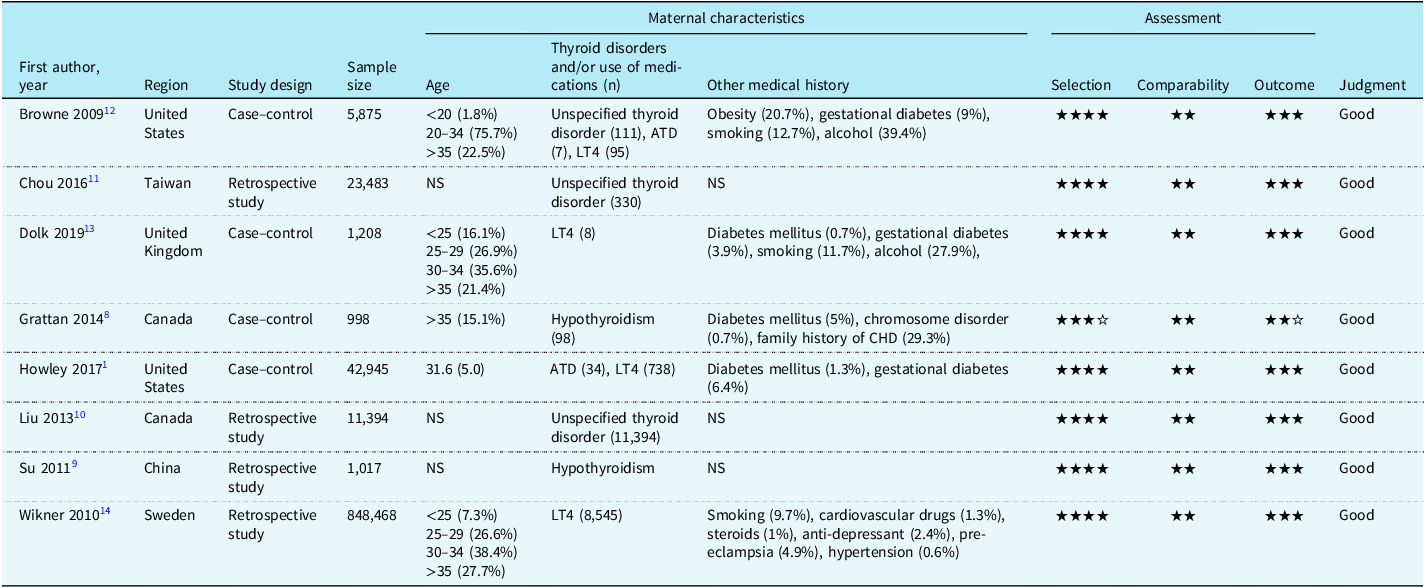
Eight observational studies were included for the analysis. Reference Howley, Fisher, Van Zutphen, Waller, Carmichael and Browne1,Reference Grattan, Thomas, Hornberger, Hamilton, Midodzi and Vohra10–Reference Norstedt Wikner, Skjöldebrand Sparre, Stiller, Källén and Asker16 The studies were conducted in various regions, including America (four studies), Europe (two studies), and Asia (two studies). Included studies enrolled neonates or participants aged 18 years or younger with a history of maternal thyroid disorders and use of medications. The most common thyroid disorder reported was hypothyroidism. Other exposure involved the use of anti-thyroid drugs or levothyroxine (LT4). All studies were judged to have good quality. Table 1 provides detailed characteristics of the included studies.
Characteristics of included studies

Table 1. Long description
Table 1. Characteristics of included studies. Eight observational studies from six countries evaluated maternal thyroid disorders and thyroid medication use. Sample sizes ranged from 998 to 848,468 participants. All studies were rated as good quality.
ATD = anti-thyroid drug; LT4 = levothyroxine; NS = not specified.
Note: A black star indicates 1 point. The study is rated either as “good” (3 or 4 points in selection, 1 or 2 points in comparability, and 2 or 3 points in outcomes), “fair” (2 points in selection, 1 or 2 points in comparability, and 2 or 3 points in outcomes) or “poor” (0 or 1 point(s) in selection, or 0 point in comparability, or 0 or 1 point(s) in outcomes).
Maternal thyroid disorders and risk of CHD
Maternal thyroid disorders were associated with the risk of CHD (odds ratio 1.30, 95% confidence interval 1.07 to 1.57, P = 0.008, I2 = 60%, Figure 1). Pooled studies reporting maternal hypothyroidism showed higher risk of developing CHD; however, it did not reach statistical significance (odds ratio 3.02, 95% confidence interval 0.57 to 16.05, P = 0.20). We performed subgroup analysis comparing studies of various CHD subtypes. Although the results were not statistically significant (P > 0.05), there was a trend of higher occurrence of conotruncal defects (odds ratio 1.52, 95% confidence interval 0.56 to 4.12), followed by left ventricular outflow tract obstruction (odds ratio 1.40, 95% confidence interval 0.95 to 2.07), right ventricular outflow tract obstruction (odds ratio 1.26, 95% confidence interval 0.82 to 1.94), septal defects (odds ratio 1.20, 95% confidence interval 0.98 to 1.45), total anomalous pulmonary venous return (odds ratio 1.20, 95% confidence interval 0.28 to 5.09), and heterotaxy (odds ratio 1.02, 95% confidence interval 0.43 to 2.43) among infants born from mothers with thyroid dysfunction.
Maternal thyroid disorders and risk of CHD. ( a ) Subgroup of thyroid status; ( b ) subgroup of CHD type. The horizontal line indicates 95% CI of a study. The red square represents the result of each individual study. The size of the square varies according to the weight of a particular study. The diamond at the bottom of the plot represents the pooled analysis of all included studies. The outer edges of the diamond indicate the CIs. CI = confidence interval; df = degree of freedom; I2 = test of heterogeneity.

Figure 1. Long description
Figure 1. Maternal Thyroid Disorders and Risk of Congenital Heart Disease. (A) Subgroup of Thyroid Status; (B) Subgroup of CHD type. The horizontal line indicates 95% CI of a study. The red square represents the result of each individual study. The size of the square varies according to the weight of a particular study. The diamond at the bottom of the plot represents the pooled analysis of all included studies. The outer edges of the diamond indicate the CIs. CI, confidence interval; df, degree of freedom; I2, test of heterogeneity
Use of thyroid medications during pregnancy and risk of CHD
Exposure to medications for thyroid disorders during pregnancy appeared to significantly increase the risk of CHD. The risk was even apparent among maternal use of anti-thyroid drugs (odds ratio 4.44, 95% confidence interval 2.25 to 8.77, P < 0.0001, I2 = 7%, Figure 2) compared to use of LT4 (odds ratio 1.22, 95% confidence interval 1.08 to 1.37, P = 0.001, I2 = 7%, Figure 2).
Use of thyroid medications during pregnancy and risk of CHD. ( a ) Anti-thyroid drugs; ( b ) levothyroxine. The horizontal line indicates 95% CI of a study. The red square represents the result of each individual study. The size of the square varies according to the weight of a particular study. The diamond at the bottom of the plot represents the pooled analysis of all included studies. The outer edges of the diamond indicate the CIs. CI = confidence interval; df = degree of freedom; I2 = test of heterogeneity.

Figure 2. Long description
Figure 2. Use of Thyroid Medications during Pregnancy and Risk of Congenital Heart Disease. (A) Anti-thyroid Drugs; (B) Levothyroxine. The horizontal line indicates 95% CI of a study. The red square represents the result of each individual study. The size of the square varies according to the weight of a particular study. The diamond at the bottom of the plot represents the pooled analysis of all included studies. The outer edges of the diamond indicate the CIs. CI, confidence interval; df, degree of freedom; I2, test of heterogeneity.
Confidence in cumulative evidence
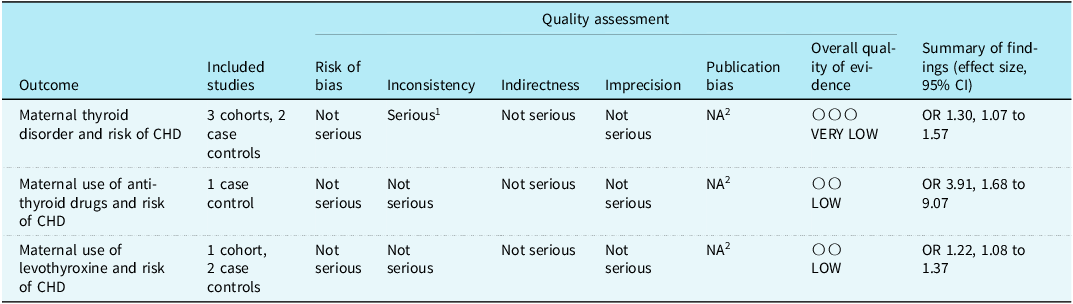
This meta-analysis included observational studies, which provide low-quality evidence for causal inference. We did not downgrade the risk of bias domain’s rating because the included studies appeared to be in good quality. However, we could not rule out the fact that there were residual confoundings remained unadjusted and the studies were not comparable to a well-performed randomised trial. We detected substantial heterogeneity in the analysis of maternal thyroid disorder and the risk of CHD. No serious indirectness or imprecision was found in the current analysis that could affect the whole results. Publication bias could not be evaluated, as the number of included studies was less than 10. Hence, the evidence generated from this meta-analysis was judged to be very low-to-low, as outlined in Table 2.
GRADE evidence profile

Table 2. Long description
Table 2. GRADE evidence profile. Maternal thyroid disorder, anti-thyroid drug use, and levothyroxine use were associated with increased risk of congenital heart disease, with very low-to-low certainty of evidence.
NA = not applicable.
1 There was a moderate level of heterogeneity.
2 Publication bias cannot be evaluated as the number of studies was less than 10.
Discussion
During pregnancy, maternal thyroid hormones play a critical role in fetal development, particularly influencing early organogenesis, including the heart. The fetal thyroid gland does not become functionally mature until 18–20 weeks of gestation. Consequently, the developing fetus relies on the transplacental transfer of maternal thyroid hormones, specifically thyroxine (T4) and triiodothyronine (T3), throughout early pregnancy. Reference Korevaar, Medici, Visser and Peeters21,Reference Barjaktarovic, Korevaar and Chaker22 Disruptions in maternal thyroid function, particularly undertreated hypothyroidism, can lead to abnormal fetal thyroid hormone levels. Reference Huget-Penner and Feig23,Reference Lucaccioni, Ficara, Cenciarelli, Berardi, Predieri and Iughetti24 This deficiency has been implicated as a potential risk factor for CHD in offspring. Reference Chattergoon6
Inadequate control of overt hyperthyroidism in pregnant women also adversely affects fetal health. During pregnancy, hyperthyroidism is associated with an increased risk of fetal loss, restricted growth, premature birth, and low birth weight. These issues can also arise in fetuses of euthyroid mothers who have a history of Graves’ disease and elevated levels of thyroid-stimulating hormone receptor antibodies, which can cross the placenta and cause fetal hyperthyroidism. Reference Huget-Penner and Feig23,Reference Moleti, Di Mauro, Sturniolo, Russo and Vermiglio25
Our meta-analysis indicates a link between maternal thyroid disorders and the risk of developing CHD. Maternal thyroid disorders have been linked to cardiac remodelling and alterations in systolic and diastolic function within the developing fetus. Abnormality in thyroxine level can interfere with the regulation of cardiac embryonic gene activation, which ultimately leads to cardiac remodelling. Maternal hypothyroidism is also linked to disrupted calcium homeostasis, impaired electrophysiological signalling, and cardiomyocyte maturation defects—all of which contribute to impaired ventricular remodelling, resulting in the decreased systolic and diastolic function of the fetal heart. Reference Zhang, Zhang and Zhao9 In the current study, we have yet to demonstrate the extent of maternal thyroid dysfunction and risk of fetal CHD. This might be due to the inadequate sample size for the subgroup analysis leading to the imprecision in the magnitude of the effect. Moreover, most studies did not specifically report the type of thyroid disorders. Hence, it was not clear whether those studies, in fact, involved pregnant women with existing or newly diagnosed hypo-or hyperthyroidism.
This study also highlights the potential link between maternal exposure to thyroid medications and the risk of fetal CHD. Higher risk was observed among subjects with maternal history of using anti-thyroid drugs. Using anti-thyroid drugs during pregnancy poses challenges because all available anti-thyroid drugs (methimazole, carbimazole, propylthiouracil) can cross the placenta and potentially lead to fetal hypothyroidism. Additionally, anti-thyroid drugs have teratogenic risks. Evidence indicates a higher incidence of major anomalies in children of mothers treated with methimazole compared to those treated with propylthiouracil or not exposed to anti-thyroid drugs. Reference Song, Lin, Chen, Zhang and Feng26 However, some studies have found no significant link between thionamide exposure and congenital abnormalities. Reference Gianetti, Russo and Orlandi27,Reference Andersen, Lönn, Vestergaard and Törring28 This meta-analysis reported a relatively lower risk of CHD as a result of maternal exposure to LT4. Maintaining appropriate thyroid hormone levels with LT4 is essential for fetal health, and untreated hypothyroidism poses more significant risks than the treatment itself. Dong et al. demonstrated that elevated FT4 levels, measured between 12 and 18 weeks of gestation, and were linked to a higher risk of CHD. However, this risk was not attributed directly to LT4 use but instead to thyroid hormone levels. Reference Dong, Peng, Li, Xie and Wu5
The findings from this meta-analysis suggest that evaluation of thyroid function should be considered among pregnant women to identify those with the risk of giving birth to a child with CHD. Currently, routine evaluation of thyroid function among pregnant women is not recommended by the American Thyroid Association, American College of Obstetricians and Gynecologists, Royal College of Obstetricians and Gynaecologists, and the Endocrine Society clinical practice guideline. Reference Alexander, Pearce and Brent2,Reference De Groot, Abalovich and Alexander29–Reference Chan, Marsh, Gilbert, Boelaert, Evans and Dhillon-Smith31 Instead, they recommend testing during early pregnancy in high-risk women identified through medical history, physical exam, or prior biochemical data. These groups include those with a personal or family history of thyroid disorders, autoimmune conditions such as type 1 diabetes or systemic lupus erythematosus, previous thyroid surgery or radiation, symptoms or clinical signs suggestive of thyroid hypofunction, prior history of miscarriage or stillbirth, and infertility issues. Reference De Groot, Abalovich and Alexander29,Reference Chan, Marsh, Gilbert, Boelaert, Evans and Dhillon-Smith31
Moreover, this study has several limitations. We included all pregnant women with reported thyroid disorders, but most of the studies did not specify whether they were subclinical or clinical hypo-or hyperthyroidism. Reference Liu, Joseph and Lisonkova12–Reference Browne, Rasmussen and Hoyt14 The studies also did not report the thyroid hormone status (FT4, TT4, or FTT4P), and we are unable to analyse the extent of cut-off level of the hormone which brought the highest risk of congenital malformations. Given the limited data available, we did not consider other maternal underlying diseases, hence contributing to the substantial heterogeneity in this meta-analysis. The included studies did not specifically report the regimen of thyroid-related medications of the subjects. Reference Howley, Fisher, Van Zutphen, Waller, Carmichael and Browne1,Reference Grattan, Thomas, Hornberger, Hamilton, Midodzi and Vohra10–Reference Norstedt Wikner, Skjöldebrand Sparre, Stiller, Källén and Asker16 Whether the subjects had the diagnosis of thyroid disorder and started the therapy before or during pregnancy were not clear. Moreover, there was no report on whether the thyroid disease was adequately treated or not. Due to limited data available, we could not clearly elucidate whether the risk of CHD was due to the undertreated hypo-or hyperthyroidism or the effect of the thyroid medication itself.
In conclusion, maternal thyroid disorders and exposure to thyroid-related medications appear to be associated with an elevated risk of CHD in fetuses. Given the low evidence generated from this study, further trials exploring the cost-effectiveness of the benefits of thyroid function screening among pregnant women are necessary, especially in establishing the cut-off level of thyroid hormones associated with the highest risk of CHD. Further studies are also required to clarify the underlying mechanisms and to explore the risks related to various subtypes of CHDs.
Supplementary material
The supplementary material for this article can be found at https://doi.org/10.1017/S104795112612455X
Acknowledgements
None.
Author contributions
Conceptualization: GM, NA; Methodology: GM, NA, IWAH, CNRS; Formal analysis: GM, NA, IWAH, CNRS; Data curation: GM, NA, IWAH, CNRS; Software: GM, NA; Validation: GM, NA, IWAH, CNRS; Investigation: GM, NA, IWAH, CNRS; Writing—original draft preparation: GM, NA; Writing—review and editing: GM, NA, IWAH, CNRS; Approval of final manuscript: GM, NA, IWAH, CNRS.
Financial support
This research received no specific grant from any funding agency, commercial, or not-for-profit sectors.
Competing interests
None.