1. INTRODUCTION
A design is a plan by which some undesired reality is changed into some desired reality (Chakrabarti, Reference Chakrabarti, Chakrabarti and Subrahmanian2008). It is the plan for creation of an intervention, for example, an artifact, process, or service (termed generically as a product), with which to bring about this desired change. Designing, design process, or product development is taken as the act by which a product is conceived and embodied, starting with the perception of its need.
With the increased capability and use of computers and the rapid rate of globalization and their associated impact, technical products and the processes of their creation have undergone considerable changes over the last decades. Products have become more complex, using new technological developments and integrating knowledge from various disciplines that are often distributed across the globe. Increasing competition, stronger customer awareness, and stricter legislation demand shorter product life cycles and tighter requirements. With complexity, quality pressure and time pressure are increased. New approaches to improve the effectiveness and efficiency of product development are needed to cope with these changes and to remain competitive.
The overall aim of design research is to develop useful knowledge (Pederson et al., Reference Pedersen, Emblemsvåg, Bailey, Allen and Mistree2000; Seepersad et al., Reference Seepersad, Pedersen, Emblemsvåg, Bailey, Allen, Mistree, Chen, Lewis and Schmidt2006) to inform and support practice so as to improve the chances of producing a successful product (Blessing et al., Reference Blessing, Chakrabarti, Wallace and Cross1992, Reference Blessing, Chakrabarti and Wallace1995, Reference Blessing, Chakrabarti, Wallace, Frankenberger, Badke-Schaub and Birkhofer1998; Blessing & Chakrabarti, Reference Blessing and Chakrabarti2002, Reference Blessing and Chakrabarti2009).
1.1. Design teaching and research in India
Teaching design as an independent discipline is relatively new, particularly in India, with relatively few programs for design teaching and research. In recent times, the number of degree-level design teaching programs have grown, from only 2 in the 1960s to about 15 in 2006 (Chakrabarti, Reference Chakrabarti and Krause2007); most of these are at the Masters’ degree level, with only one institution offering a Bachelors’ degree program in design. Research programs in design in India are even more recent; Indian Institute of Science (IISc) introduced the first research program in design in 2003. Since then, the number of design research programs in the country has grown to 5.
1.2. Design teaching and research at IISc
The Centre for Product Design and Manufacturing (CPDM) at IISc, Bangalore, is a department dedicated to teaching, practice, and research in various areas of design as part of the broader tradition of IISc's commitment as a premier postgraduate university to training and research in advanced areas of science and technology. CPDM is the first in India to introduce a program for generic research into design. CPDM has two major programs for training people in design and research:
1. Masters in Design (MDes): This 2-year program takes graduate engineers and architects as input and trains them in all major aspects (technical, aesthetic, ergonomic, and emotional) of a product and its development to prepare them to become product designers who are expected to have a holistic notion of the product, and are able to appreciate and implement a product that balances all these aspects for it to be acceptable to the society. Potential students are short listed based on their performance in national tests. The applicants are subsequently selected with a test at IISc to evaluate their technical and formal analysis and synthesis abilities, and with a personal interview to test their communication skills and motivation. Typically fewer than 5% of the applicants are admitted to the course. The current number of students per year is 24.
2. Research: Applicants with a Bachelor's degree in any area of science, engineering, architecture, or design can enter the program for a 2-year Masters in design research. Those with a Bachelors or Masters degree in science, engineering, architecture, or design can join a PhD in design research. Applicants are short listed based on their results in the last degree or national tests, and they are selected based on their performance in a personal interview that tests technical knowledge and independent thinking. Typically less than 5% of the applicants are admitted to the course. There are currently 28 research students.
The two courses below are specifically geared to training students for design research:
1. Methodology for Design Research [design research methodology (DRM) course]: This is a one-semester, 2:1-credit course (15 weeks with 2 h of lectures and 3 h of laboratory or practical session/week, with an overall effort of 14 h/week) based on DRM (Blessing et al., Reference Blessing, Chakrabarti, Wallace and Cross1992, Reference Blessing, Chakrabarti and Wallace1995, Reference Blessing, Chakrabarti, Wallace, Frankenberger, Badke-Schaub and Birkhofer1998; Blessing & Chakrabarti, Reference Blessing and Chakrabarti2002, Reference Blessing and Chakrabarti2009). This DRM course is a core course for research students in CPDM, and it is meant to be a primer for doing design research. The course is also open to MDes students. Offered since 2002, this is possibly the only regular, credited course offered on the methodology for design research anywhere in the world, which trains research students to use DRM for their research. DRM is also taught as part of a 2-week Summer School on Engineering Design Research offered since 1999 (Blessing & Andreasen, Reference Blessing, Andreasen, Clarkson and Huhtala2005).
2. Design and Society Project: This is a one-semester elective course, primarily meant for MDes students, to give a flavor of design research; the course is also open to research students. The course spans 15 weeks, with 18 h of effort per week, in which a student is expected to carry out a small research study in any topic of design research. The two courses are offered in the above order in consecutive semesters to give students the option of carrying out research in a Design and Society Project after being trained in the DRM course.
1.3. Major issues
In a science and technology institution, although typically many domain-specific courses are offered to familiarize a student to the body of domain knowledge necessary for research in an area, courses are rarely offered to train students in the processes and methodology that can be used to carry out research in an effective and efficient manner. A researcher is usually expected to imbibe this knowledge from the research environment while undergoing the research program. In design research, this situation is even less satisfactory. In the conventional areas of science and technology as well as in economics, management, social sciences, and humanities, a number of textbooks and research monographs are available that could be used as introductory texts for new researchers about “how to do research.” These books typically introduce the research processes and associated methods and tools expected to be followed in the discipline.
In design research, however, barring a handful of approaches promulgated in the recent history of this relatively new area (e.g., Blessing et al., Reference Blessing, Chakrabarti, Wallace and Cross1992, Reference Blessing, Chakrabarti and Wallace1995, Reference Blessing, Chakrabarti, Wallace, Frankenberger, Badke-Schaub and Birkhofer1998; Duffy & Andreasen, Reference Duffy, Andreasen and Hubka1995; Pederson et al., Reference Pedersen, Emblemsvåg, Bailey, Allen and Mistree2000; Blessing & Chakrabarti, Reference Blessing and Chakrabarti2002, Reference Blessing and Chakrabarti2009; Olewnik & Lewis, Reference Olewnik and Lewis2005; Seepersad et al., Reference Seepersad, Pedersen, Emblemsvåg, Bailey, Allen, Mistree, Chen, Lewis and Schmidt2006), there is little available to help a new researcher in starting off and carrying out research. Design research sits at the crossroads of human and natural/technical sciences, and it supports the solution of problems that are as varied in the core domains of the technology used as they are in the nature and detail of the problems solved, embracing all facets of design (people, product, process, tools, environment, microeconomy, and macroeconomy; Blessing & Chakrabarti, Reference Blessing and Chakrabarti2002, Reference Blessing and Chakrabarti2009); thus, the methods and tools used in this discipline will be adapted from both these scientific traditions. What makes it particularly difficult for a new researcher to assimilate literature in design are the methods that are often adapted from different research traditions, and the background of the researcher rarely trains them in methods from both these research traditions.
Unlike research in traditional human, natural, or technical sciences that focus mainly on understanding phenomena related to these systems, design research focuses also on supporting improvement of such systems, with understanding as a necessary but not sufficient step to this improvement. This means that design research methodologies must embrace not only those that are traditionally used in understanding reality but also those that can help develop improvements. Research in the area of design must itself involve designing. All of these further accentuate the difficulties traditionally associated with lack of courses to train students for design research.
2. GOAL OF DESIGN RESEARCH AND ITS CURRENT STATUS
According to Blessing et al. (Reference Blessing, Chakrabarti, Wallace and Cross1992, Reference Blessing, Chakrabarti and Wallace1995) the goal of design research is to develop knowledge to make design more effective and efficient, to enable design practice to develop more successful products. Pederson et al. (Reference Pedersen, Emblemsvåg, Bailey, Allen and Mistree2000) and Seepersad et al. (Reference Seepersad, Pedersen, Emblemsvåg, Bailey, Allen, Mistree, Chen, Lewis and Schmidt2006) have similar a view, as they see scientific knowledge in engineering design as having “usefulness with respect to a purpose.” In design research, the work has to be both academically (i.e., challenging and unsolved) and practically worthwhile (i.e., related to its usefulness to a purpose, i.e., the success of the product). Hence, design research has two related objectives (Blessing & Chakrabarti, Reference Blessing and Chakrabarti2009):
1. formulation and validation of models and theories about the phenomenon of design, and
2. development and validation of support founded on these models and theories to improve design practice and its outcomes.
However, design research is not often carried out to address these objectives in a logically linked manner, leading to several major issues, as identified by Blessing and Chakrabarti (Reference Blessing and Chakrabarti2002):
• Lack of an overview of existing research: It is hard to obtain an overview of the results of design research. There is no agreed terminology (Lowe et al., Reference Lowe, McMahon, Shah, Culley, Culley, Duffy, McMahon and Wallace2001), and little contradiction among the findings of empirical research; all address something different, and few have tried to consolidate the results. Design research is highly fragmented (Horvath, 2001; Samuel & Lewis Reference Samuel, Lewis, Culley, Duffy, McMahon and Wallace2001). There have been attempts to create an overview of design research (e.g., Finger & Dixon, Reference Finger and Dixon1989a, Reference Finger and Dixon1989b; Horváth, Reference Horváth, Culley, Duffy, McMahon and Wallace2001), but these are still far from providing an overview that could help identify major subsets of research (Blessing et al., Reference Blessing, Chakrabarti and Wallace1995). Bringing the results together is a prerequisite to developing comprehensive models and theories.
• Lack of use of outcomes in practice: As design research aims to improve design, its outcomes should influence practice. However, as Cantamessa (Reference Cantamessa, Culley, Duffy, McMahon and Wallace2001) found in his analysis of the papers in two large engineering design conferences, industrial implementation issues are addressed in only a minority of the papers on support development. Research results rarely translate into practice (Reich, Reference Reich1994; Upton & Yates, Reference Upton, Yates, Culley, Duffy, McMahon and Wallace2001). Many proposals for support have weak empirical foundations, both in development and evaluation. Validation is seen as crucial; how this should be carried out in design research is a topic of current research (Pederson et al., Reference Pedersen, Emblemsvåg, Bailey, Allen and Mistree2000; Olewnik and Lewis, Reference Olewnik and Lewis2005; Seepersad et al., Reference Seepersad, Pedersen, Emblemsvåg, Bailey, Allen, Mistree, Chen, Lewis and Schmidt2006). A more rigorous research approach is needed for better realisation of support and their successful utilization in practice.
• Lack of scientific rigor: There is often a lack of scientific rigor, in particular, in applying research methods, interpreting findings, developing support, and validation of results. Scientific rigor requires, among others, falsifiability (Frey, Reference Frey2004) and generality (Pederson et al., Reference Pedersen, Emblemsvåg, Bailey, Allen and Mistree2000; Seepersad et al. Reference Seepersad, Pedersen, Emblemsvåg, Bailey, Allen, Mistree, Chen, Lewis and Schmidt2006) of research outcomes. The multifaceted nature of design is one reason for the diversity of research topics and methods used. Design researchers “are yet to properly grapple with the overwhelming complexity of the discipline” (Samuel & Lewis, Reference Samuel, Lewis, Culley, Duffy, McMahon and Wallace2001), which requires a variety of methods to be applied, often from disciplines unfamiliar to design researchers, leading sometimes to incorrect use, resulting in biased data or conclusions. Blessing and Andreasen (Reference Blessing, Andreasen, Clarkson and Huhtala2005) found many students involved in design research for 1 to 2 years who were unclear about what constitutes design research and how to carry this out. This partly explains the lack of methodological rigor observed.
Overall, the approach to doing design research should clearly connect its goals and deliverables: the development of support to improve (some aspects of) design must be based on a sound understanding of design as currently carried out (i.e., models and theories of the relevant aspects), which must be clearly related to the goals (i.e., criteria for success), to ensure that development and evaluation of support can be more relevant, effective, and efficient. DRM had been proposed to help achieve this (Blessing, et al., Reference Blessing, Chakrabarti, Wallace and Cross1992, Reference Blessing, Chakrabarti and Wallace1995, Reference Blessing, Chakrabarti, Wallace, Frankenberger, Badke-Schaub and Birkhofer1998; Blessing & Chakrabarti, Reference Blessing and Chakrabarti2002, Reference Blessing and Chakrabarti2009). The methodology is presented in the following section.
3. DRM
This methodology stems from what we view as the goal of design research: to inform and support practice by developing knowledge that can improve the chances of producing successful products. As discussed in our earlier papers, this goal raises a number of major questions:
1. What is meant by a successful product?
2. How is a successful product created?
3. How can the chances of being successful be improved?
The first question leads to issues such as what criteria should be used to determine whether a research work has been successful. The second question leads to issues such as what the influences on success are, how these interact with one another, and how these can be assessed. Investigating these will increase our understanding of design, as it currently is, which forms the basis for improving design. The third question leads to issues related to the use of this understanding to develop design support, and its evaluation to determine whether the application of the support leads to more successful products as represented by the criteria for success.
A research methodology is needed to address these issues in an integrated manner; it should aid researchers identify key research issues and select appropriate research methods to address these.
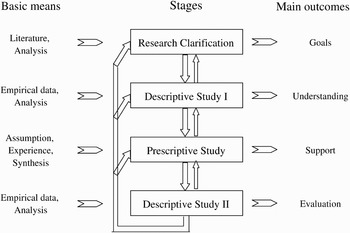
As discussed in Blessing and Chakrabarti (Reference Blessing and Chakrabarti2002), two characteristics of design research require the development of a specific research methodology. First, the selection of research areas is hard because of the numerous influences from the many facets of design, and the interconnectivity among them. Design research has to be multidisciplinary. Second, design research involves both understanding the phenomenon of design and using this understanding to change the way design is carried out, requiring both a theory of what is and a theory of what should be. Because this cannot be predicted, design research involves design (creation of support) and their validation, which require research methods from a variety of disciplines. A variety of research methods have been used to address the multitude of issues involved in design research. DRM has been used to piece these issues together into a generic design research methodology that links their research questions together and systematically addresses them. Figure 1 shows the main stages of DRM and proposes research to proceed through the following steps:
• clarify what is meant by success [research clarification (RC) stage];
• understand relevant aspects of the phenomenon of design and its influences on success [descriptive study I (DS-I) stage];
• based on this understanding, envisage what aspects of design can be improved and develop proposals, referred to as support, for improvement [prescriptive study (PS) stage];
• evaluate proposed support for its influence on success [descriptive study II (DS-II) stage];
• if the results are not acceptable, modify the support (go back to PS stage); and
• if still unacceptable, improve understanding of success and its links to relevant aspects of the phenomenon of design (go back to DS-I or RC stage).
An example from Blessing et al. (Reference Blessing, Chakrabarti and Wallace1995) is used to clarify the above process:
• RC stage: A reduction in time to market is identified as a criterion for success. This is used as the metric against which to judge a design support.
• DS-I stage: A descriptive study, involving observation and analysis, shows that insufficient problem definition relates to high percentages of time spent on modifications, which is assumed to increase time to market. This description provides the understanding of the various factors that influence the criterion, in this case, time to market.
• PS stage: Based on the outcome of the previous stage and introducing assumptions and experience about an improved situation, a support is developed to improve problem definition. As discussed before, developing support is a design process in itself. Support at this stage needs to be evaluated for its internal consistency, as also stressed by several others (Pederson et al., Reference Pedersen, Emblemsvåg, Bailey, Allen and Mistree2000; Olewnik and Lewis, Reference Olewnik and Lewis2005; Seepersad et al., Reference Seepersad, Pedersen, Emblemsvåg, Bailey, Allen, Mistree, Chen, Lewis and Schmidt2006).
• DS-II stage: The support is applied and is evaluated using a descriptive study. This includes two tests. The first test is whether problem definition is supported. The second test is whether less time is spent on modifications, and whether this reduced the time to market. There might be reasons as to why the second test fails, for example, side effects of the support. These tests evaluate how well the support serves its purpose, its external validity (Pederson et al., Reference Pedersen, Emblemsvåg, Bailey, Allen and Mistree2000; Seepersad et al., Reference Seepersad, Pedersen, Emblemsvåg, Bailey, Allen, Mistree, Chen, Lewis and Schmidt2006), where statistical intervention approaches such as those used in medicine can sometimes be useful (Frey & Dym, Reference Frey and Dym2006).
The stages of the design research methodology: the downward arrows connecting the stages show natural progress, the upward arrows indicate possible iterations, and the horizontal arrows indicate means for and outcomes of stages.

Descriptive studies should reveal a network of causes and effects, connecting influencing factors with the success criteria. Support developed in the PS stage would directly address some of these influencing factors, so as to indirectly affect the success factors. However, interference in this network, because of the influence of the support, may result in a different network of causes and effects, making the effects different than expected: side effects may occur. Evaluation of support (DS-II) should therefore take this into account and at least test all the causal links between the influencing factors directly addressed by the support and the success criteria.
Not every step of the methodology will be executed in depth in every single project, because of resource constraints, or availability of existing research. In all cases, however, the methodology should be taken into account, and at least the links between the stages under focus of the research, and the stages related to these should be addressed. A study of some influences on the design process (DS-I) should at least indicate how this can be used to improve the design process.
The specific features of DRM are as follows. First, it integrates all major stages of design research in a systematic way, and provides a nomenclature with which a given piece of design research can be systematically categorized, thereby enabling an overview and comparison of apparently disparate pieces of design research cases. In Blessing et al. (Reference Blessing, Chakrabarti, Wallace, Frankenberger, Badke-Schaub and Birkhofer1998), all the papers presented in a design research workshop were possible to be categorized in terms of the stages of DRM. Wood and Greer (2002) used DRM to classify the papers they reviewed on functional reasoning. An exhaustive set of design research types, using DRM stages and their order of execution as the scheme for categorization, has been proposed in Blessing and Chakrabarti (Reference Blessing and Chakrabarti2009).
Second, the DRM framework provides an overarching, logical order of stages to follow in design research. For instance, if the relationships between the intended area of focus for research (say manufacturability of products) and success criteria (say, customer satisfaction) is not yet understood well, it is not advisable to start developing support to improve manufacturability of products with the goal of increasing customer satisfaction. That is, unless the understanding (as developed in DS-I) is adequate, one should not start carrying out support development (PS). Comparison of the current status of research in the area of focus with the possible design research types helps determine which research type is logical to follow in a particular research.
Third, DRM aims to address each major stage of design research systematically, by providing, for each such stage (e.g., RC, DS-I, etc.), a specific methodical process for carrying out that stage. A list of alternative research methods for use in each major research stage and guidelines for their selection to address various questions and hypotheses have also been provided.
DRM has already been evaluated for its efficacy in various ways. The developers of DRM and their research students have found it useful in their own research, both for reviewing literature and for structuring the research process (e.g., see Nidamarthi, Reference Nidamarthi1999; Ahmed, Reference Ahmed2001; Chakrabarti et al., 2004; Sarkar, Reference Sarkar2007; Vijaykumar, Reference Vijaykumar2009). As assessed from the feedbacks of the European Summer School participants, DRM has been found useful by its participants (Blessing & Andreasen, Reference Blessing, Andreasen, Clarkson and Huhtala2005). DRM has also been used to structure research proposals (Blessing & Chakrabarti, Reference Blessing and Chakrabarti2009).
4. OBJECTIVES OF THE DRM COURSE AND APPROACH TO ITS DEVELOPMENT
The overall objective of the DRM course is to help students understand the design research process, and a variety of approaches and methods on how to carry out design research systematically. This course also aims to help students to carry out the Design and Society course more systematically and rigorously than currently possible.
The specific objectives are the following:
• to teach a course on methodology for carrying out design research to postgraduate students and
• to teach DRM effectively (to help assimilate and apply DRM and associated materials to research problems) and efficiently (in reasonable time and effort) as part of the course.
The overall approach followed to develop and teach the course has been the following:
• Develop the course based on DRM material, now published in Blessing and Chakrabarti (Reference Blessing and Chakrabarti2009): The course was first introduced in 2002, using earlier papers and unpublished material.
• Teach the course: It has been offered to seven batches of over 30 Master's and PhD students.
• Evaluate the course: Informal discussion with students after the course; formal, end of course evaluation forms from students; and analyses of student grades are used.
• Improve the course: Based on the feedback obtained, various modifications have been made.
5. FACTORS TO CONSIDER
The vuDAT guidelines of Michigan State University (http://vudat.msu.edu/design_factors/) recommend the following factors to be considered for designing an effective course:
1. Motivation for the student: Why learn this? Where and when is this used? What are the payoffs for learning? This is discussed in Section 6.
2. Motivation for the teacher: What are the reasons for developing this course? How can you create the best learning experience for the students? This is also discussed in Section 6.
3. Teaching material: What teaching material is to be provided? This is discussed in Section 7.
4. What approaches are undertaken to enhance its assimilation?
• Pedagogical considerations: What pedagogical models and learning theories will be incorporated into the teaching? These are discussed in Sections 7, 10, and 12.
• Orientation: Help the student adjust to the environment or content being taught. This is discussed in Section 7.
• Information: The content the student needs to master. This is discussed in Section 7.
• Application: How will students demonstrate learning? This is discussed in Section 7.
• Evaluation: Assessment of what the student learned, the relevance of the content, and appropriateness of the instructional method. Sections 8, 9, and 11 discuss these.
5. Technical competency: Is the instructor comfortable with the technology used to deliver the course content? Will he need training or support? Because the course was delivered using Microsoft PowerpointTM presentations and white boards, no training or support was needed.
According to these guidelines, the efficiency issues to be addressed are, How efficient is the course for the students and how efficient is it for the teacher? Both are discussed in Section 9.
6. MOTIVATIONS OF STUDENTS AND THE INSTRUCTOR
This course is considered by the department as an essential input for its research students and is therefore offered as a core course for these students. After attending the course, students are expected to be able to apply DRM to carry out their own research in a systematic way. For MDes students, the motivation to attend this course is not as strong, because their career goal is to become designers rather than design researchers. The moderate motivations are the ability to use DRM for research in the initial stages of design, exposure to developing design support as a product, or exposure to research as a career. The experience of teaching this course justifies this: the ratio of the number of research students to MDes students in the course has been about 2:1.
A major motivation for the instructor for developing this course has been the lack of regular courses, and until recently, lack of textbooks on “how to do design research.” It was unclear what the “best learning experience” should be, except that teaching a subject as complex and open-ended as design research should use real research examples, situated research problem solving as a hand-holding journey with experts, and peer learning and peer and expert feedback.
7. TEACHING MATERIAL AND APPROACH
This section gives an overview and details of the course material and the approach to its delivery.
7.1. What is taught and why: An overview
The course material is developed using the DRM and associated material in Blessing et al. (Reference Blessing, Chakrabarti, Wallace and Cross1992, Reference Blessing, Chakrabarti and Wallace1995, Reference Blessing, Chakrabarti, Wallace, Frankenberger, Badke-Schaub and Birkhofer1998) and Blessing and Chakrabarti (Reference Blessing and Chakrabarti2002, Reference Blessing and Chakrabarti2009), and structured around the following modules:
Module 1: How to review literature. To train students to carry out a quick review to check the relevance of a document for their work, carry out a detailed review of a document to gather knowledge about relevant aspects, and place their research against that of others using DRM.
Module 2: How to develop focus and plan for research. To train students to identify an area of research and problems, identify research questions and hypotheses, and develop a research plan.
Module 3: How to carry out research. Training students to develop understanding of some aspects of the phenomena of design as is (DS-I), develop support to improve some of these aspects (PS), and evaluate support to see if the aspects are improved using the support (DS-II).
Module 4: How to document research. To train students to be able to document research on a regular basis, and document research as a report or paper.
Module 5: How to present and defend their own work. To train students to present their own research work to others within a given time, and defend their own research through questions and answers.
7.2. How the course is taught and why: An overview
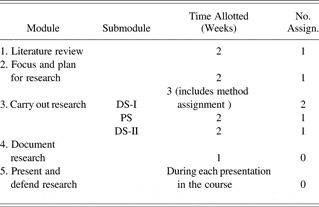
The structure of the course is shown in Table 1. In this 15-week course, each week has two time slots of 2.5 h. In the first 12 weeks the course material is taught and associated exercises are carried out; the last 3 weeks are spent on an individual student project as part of their evaluation.
Distribution of time to the teaching modules and project

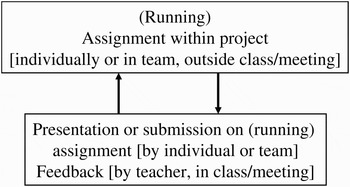
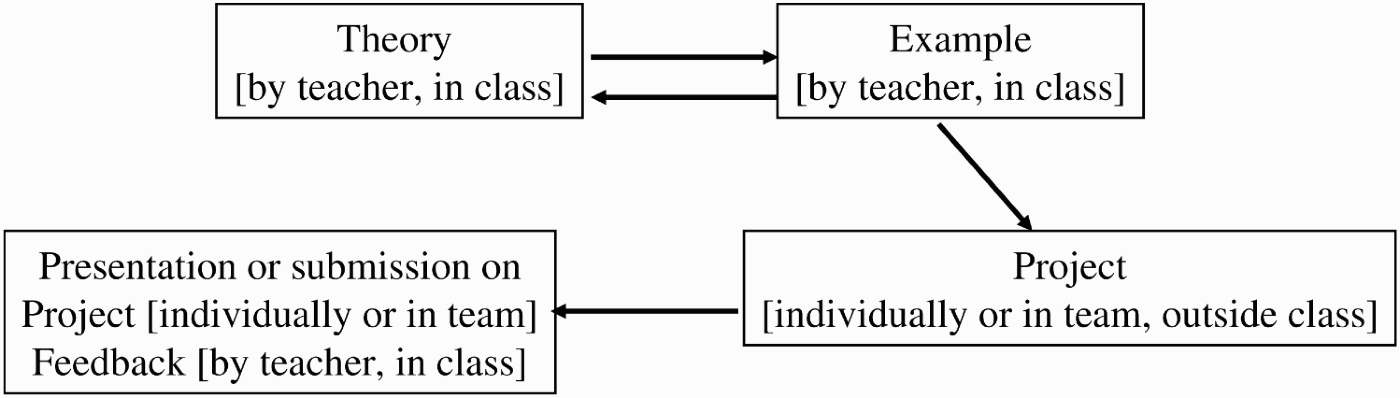
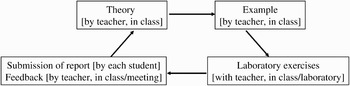
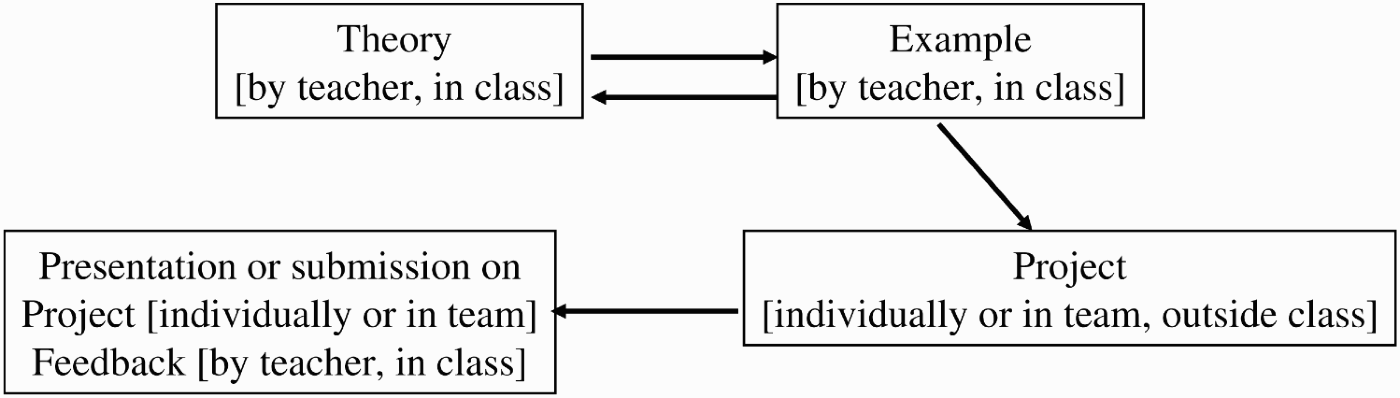
Traditional theory-based courses with little laboratory component are taught using model I (Fig. 2). Every few lectures will be followed by working out examples in the class. In pure project-based courses (e.g., in a research-based Masters thesis) students will carry on a portion of the project on their own (described in Fig. 3 as “assignment within project”) and obtain feedback from the instructor/supervisor based on presentation or a write up. A theory-based course with project component typically will follow model III (Fig. 4) where theories are taught through the course using examples and exercises, and at some point (typically at the end) there is a project to apply all taught material. In a typical theory course with laboratory component (Fig. 5), the instructor presents a portion of the theory, uses some examples and exercises to illustrate the theory; students then work under instruction and guidance of the teacher to carry out the corresponding laboratory component, and often write a report on their findings that will be evaluated by the instructor. This cycle continues through the course.
Model I: teaching in typical theory courses.

Model II: teaching in typical project-based courses.

Model III: teaching in typical theory courses with a project component.
Model IV: theory courses with a laboratory component.

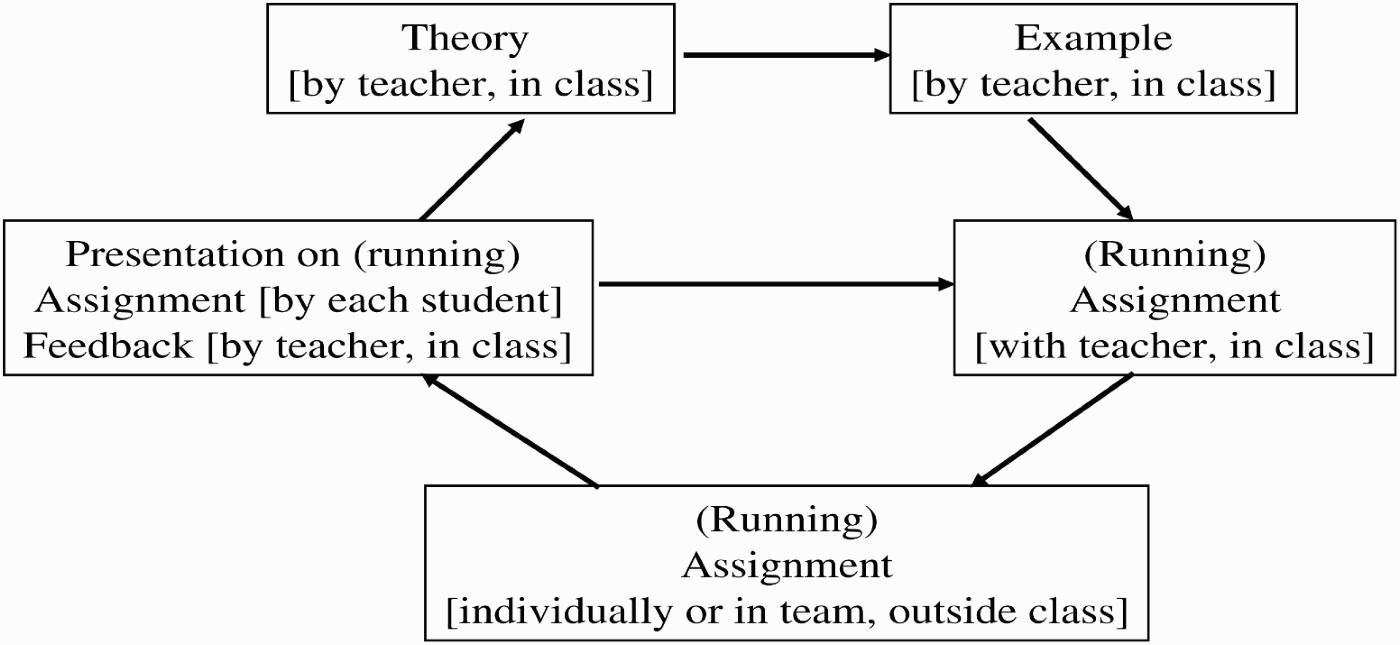
The model followed in the DRM course (model V, Fig. 6) is similar to model IV. A portion of the theory is introduced in the class, followed by illustrative examples. Instead of a laboratory, here a research assignment that is relevant for the theory introduced is taken up in the class, where the instructor acts as a coresearcher and research leader to work with the students to take the research assignment forward. The distinction between model V followed in DRM and model IV is that in model V, this assignment is completed not in the class, but by the students working outside the class, who in the next class would individually present his/her portion of the assignment (even when done in a team). The presentation in both content and form is evaluated by the instructor and the other students; if the assignment is yet to be completed, it is taken further forward by the instructor along with the students. The cycle goes on until the assignment is completed. Then the instructor introduces the next portion of the theory, followed by illustrating with examples, and so on, as before. The other feature of this model is that for much of the course (except in the literature review module) the assignments are part of a running project, where the same research problem is explored through the various stages of the DRM. Typically, a theory portion, an associated assignment and presentation are completed each week.
Model V: the teaching model used in the DRM course.
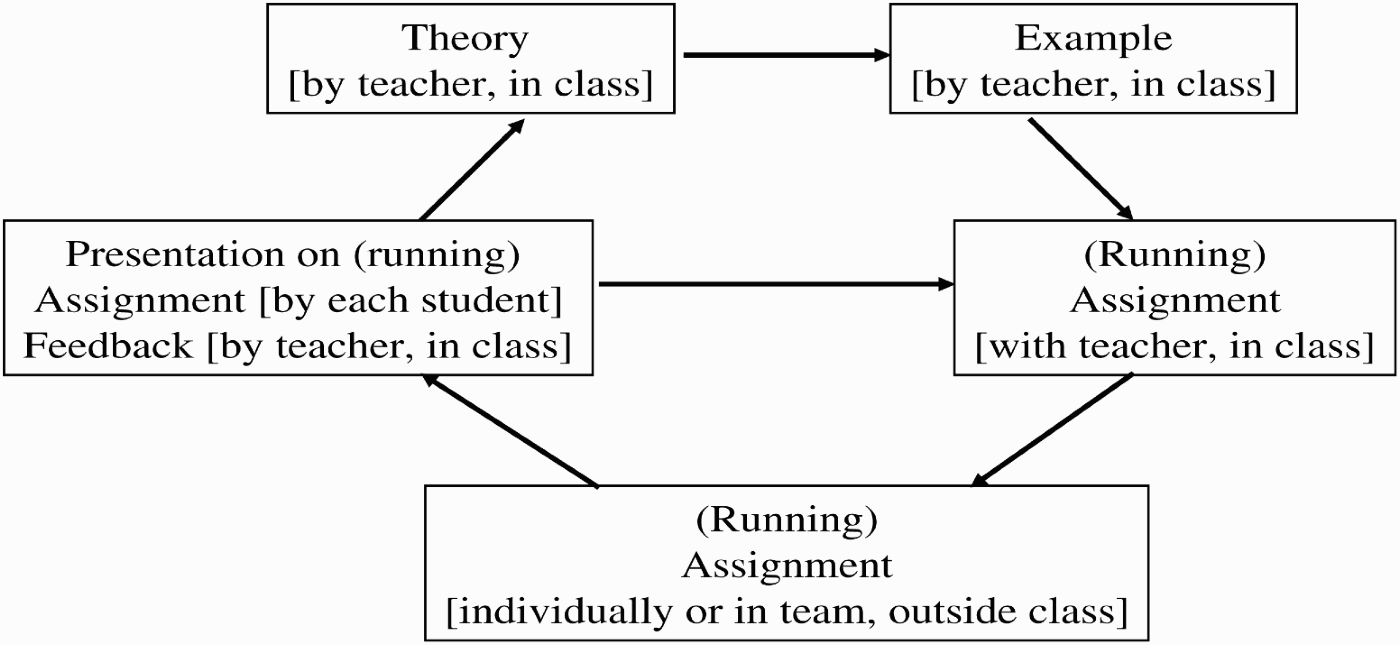
Theory portions are taught using traditional lecture methods; the presentation slides are made available to students after each class. Probing questions are used as a way of gauging attention and superficial understanding of the students during the lectures. Working together with students on the running assignment is carried out in a dialogue with students, and using a chalkboard. The students complete the assignment outside the class typically in teams of three, and often use chalkboards, PowerPoint presentations, and discussion as the means. The presentation of completed work is presented individually (but as part of the team) by each student, using a PowerPoint presentation. Both the students and the instructor give feedback, and together they engage in further dialogues to modify the content as necessary subsequent to the discussion.
The unique features of the model of instruction used are the following:
• The teacher works as a coresearcher and research leader to take the students through a common research project as a linked set of assignments that run through all the DRM stages; the assignments act as running, hands-on applications of the theories taught. Use of the same project across all DRM stages demonstrates continuity and development of research results.
• The model uses the following cycle (Fig. 6): (1) the instructor presents a theory with illustrative examples; (2) the instructor and students work together in the class on a running assignment to apply the theory; (3) the students progress or complete the assignment outside the class and prepare a presentation; (4) the students present their progress in the next class before working together further; and (5) they proceed to step 4 or 1, depending on the status of completion of the assignment.
• The problems for class project and final project remain unchanged each year, but a different set of research papers are used as literature for carrying out the assignment in each year.
• Presentation on assignments is used as a central element in the learning process to enhance student presentation skills (essential for a researcher) and as a focus for discussion feedback.
• Discussion and team-based learning is encouraged through discussions in the class, assignments outside the class, and feedback on presentations by both students and instructor.
• Questioning is encouraged as another central element of research, and each student is encouraged to question the ideas presented in lectures, presentations, and discussions.
• Developing skills for reading research papers, which is another central element of research, is encouraged through review assignments, running assignments, and a final project.
• Application focus is a unique feature of this course, encouraged through class project assignments, involvement in real research via method assignments, and the final projects.
7.3. More detail on module 1: How to review papers
This module contains three submodules:
Submodule 1: Quick review to check relevance of a paper for the researcher's own work/topic. The rationale is that there is little point in getting more detail about a paper if it is not relevant. Quick review is taught as follows: give the same set of research papers to each student; ask each student to read each paper; the abstract and the summary/conclusions portions of a paper are used to identify if the paper is relevant for one's own work: the “what” of the paper (its objectives, research questions, and hypotheses), the “why” of the paper (its relevance or significance), and the “what results” (the findings of the paper).
Submodule 2: Detailed review to gather knowledge, and summarize key points of the paper. Five questions are asked to find the key points about a paper: the “what” of the paper, found primarily in the introduction or objectives portion; the “why: of the paper, also found mainly in the introduction or objectives portion; the “how” of the paper (the research approach), typically found in the research method, approach, or methodology portion; the “what results,” typically found in the results or discussion section of the paper; and the “how good” (what conclusions can be drawn from the findings), typically found in the summary or conclusions portion.
Submodule 3: Placing own work against that of others using DRM framework. This is to enable students to place the work in a paper in the larger canvas of design research, so to obtain a broader, more united picture of design research. This is delivered by introducing the DRM framework to students; asking them to summarize each paper (given earlier in this module) using the DRM stages that are carried out in the work reported in the paper; and finally identifying how comprehensively these stages are carried out. For instance, the paper by Chakrabarti and Bligh (Reference Chakrabarti and Bligh1996), which reports development of support for functional synthesis of a comprehensive set of mechanical design solutions, and its evaluation using experts, focuses comprehensively on the PS and DS-II stages of DRM, whereas the work reported in Vijaykumar and Chakrabarti (Reference Vijaykumar and Chakrabarti2008) focuses primarily on observational studies undertaken in industry on the knowledge processes during design and their efficacy, and hence focuses comprehensively on the DS-I stage only. Being able to see the underlying structure of the papers in terms of their emphasis on clarifying goals, developing understanding, developing support, and evaluating support, is intended to help students see the underlying similarity across apparently disparate pieces of research into design, thereby helping them develop a common identity across research in this area.
The modules are delivered in four successive cycles, to demonstrate how the processes help:
1. Students are asked to make their own summary of the papers and whether these are relevant to a given research topic or problem: typically students make vague connections between the topic or problem and the papers because of lack of focus on the basis for comparison.
2. Students are then asked to summarize the papers using the three questions in submodule 1 to demonstrate how these help identify relevance (submodule 1).
3. Next, students review these in detail and summarize using the five questions (submodule 2).
4. Finally, students summarize the papers using the following classification criteria: the DRM stages used, how comprehensively the stage are carried out, and their order (submodule 3).
7.4. More detail on module 2: How to develop focus and plan for research
The teaching material provides an overall process for carrying out the RC stage, and associated guidelines on carrying out the three submodules below:
Submodule 1: Identify area of research and research problems. The broad steps are (1) identify the area of research and potential research problems; (2) develop the problems using an evolving depiction of the criteria for success, the factors that influence success, how these are currently interlinked (called the reference model, which depicts the understanding of the “current” status of design, and provides the reference against which success of proposed support can be judged), and a depiction of the desired influences and links between these and the success factors (called the impact model, depicting the “desired” status of design to be achieved using any support proposed in this research, that is, the impact of the proposed support).
Submodule 2: Identify research questions and hypotheses. The research questions or hypotheses to address the research problems are identified using the reference and impact models as the basis. For instance, if the goal is to understand the relationship between manufacturability and customer satisfaction, some questions are: What is manufacturability? What is customer satisfaction? How does manufacturability influence customer satisfaction?
Submodule 3: Develop research plan. There are two broad steps. First, identify the order in which the research questions and hypotheses should be answered or evaluated, and the resources likely to consumed; the nature of the questions and hypotheses (descriptive—“how things currently are,” prescriptive—“how things should be,” or evaluative—“whether things are as they should be”), their order of execution, and the amount of resources necessary and likely to be available, determine the type of research to be carried out. For instance, if most research questions are of the descriptive and prescriptive types, both DS-I and PS need to be comprehensively carried out. Second, based on the research type selected and the questions and hypotheses to be addressed, develop a research plan showing the main research questions and hypotheses to be addressed, how and in what order, with allocation of resources for each stage. An inaccurate research plan is better than none, which should be refined as the project progresses.
The modules are delivered using model V (Fig. 6): lectures are delivered on each submodule with examples to illustrate the material, which is applied to assignments from a running research project with the instructor as part of the team in the class and students working in smaller groups outside the class, the group progress is presented or evaluated, until the submodule is completed.
7.5. More detail on module 3: How to carry out research
This section provides more details on how to carry out DS-I, PS, and DS-II stages.
7.5.1. Submodule 1: How to carry out DS-I
A systematic approach for comprehensive empirical studies to answer descriptive research questions or evaluate descriptive hypotheses in DS-I is introduced here. Materials taught are: an overall process for carrying out comprehensive DS-I; general information on available research methods for carrying out a descriptive study, and their resource requirements and benefits; and methods that can be used to evaluate alternative research methods for their suitability in an empirical study to answer or evaluate specific descriptive research questions or hypotheses.
The material is taught using the following steps:
1. A portion of the above material is taught in the class, and examples are discussed to explain the research methods.
2. The students are exposed to research work of a number of existing research students and the methods they use in DS-I.
3. An individual assignment is given to each student where the student applies some observational method (e.g., video protocol analysis) to carry out a portion of the work for a research student in the department, thereby getting a hands-on exposure to at least one method for empirical study.
4. The DS-I research process is introduced to the students in the class with examples.
5. Students work in teams on the descriptive questions or hypotheses in the running research problem in the way depicted in model V (Fig. 6) to execute each step up to planning of research for DS-I. Because it is hard to carry out an observational study within the short time allotted to teaching DS-I, the students envisage alternative possible results from the study (e.g., whether evaluation of a given hypothesis will yield an affirmative or negative answer), and finally, assume one of these options as the potential outcome of this stage. These are depicted in a completed reference model and updated impact model for use in the subsequent, PS stage.
7.5.2. Submodule 2: How to carry out PS
This submodule introduces students to a systematic approach for carrying out a comprehensive PS to answer prescriptive research questions and hypotheses (i.e., to develop a design support and predict how this will influence success) during PS. The materials taught are an overall process for carrying out a comprehensive PS; general information on various research methods for PS, and their resource requirements and benefits; and methods that can be used to evaluate alternative research methods for their suitability of use in prescriptive studies to answer or evaluate specific prescriptive research questions or hypotheses.
The material is taught using these steps:
1. A portion of the above material is taught in the class, and examples are used to explain the research methods.
2. Demonstration by existing research students is arranged for exposing the students in the DRM class to ongoing or completed prescriptive studies; because of limitation in amount of time available, and because in the final project the students would work on developing a support, no hands-on exposure is arranged in this case.
3. The PS research process with examples is introduced to the students in the class.
4. Students work in teams on the relevant prescriptive questions (on developing the support) in the running research problem in the way discussed in model V (Fig. 6) to execute each step up to a conceptual model of the support, and if time permits, to an initial realization. Based on the level of realization achieved, the impact model for use in the DS-II stage is completed.
7.5.3. Submodule 3: How to carry out DS-II
A systematic approach for carrying out comprehensive, empirical studies to answer evaluative research questions and hypotheses (i.e., to evaluate a design support for its influence on success) is introduced. The materials taught are an overall process for carrying out comprehensive DS-II; various types of evaluation in DS-II and how to carry these out; general information on various research methods for DS-II, and their resource requirements and benefits (this is largely based on what is taught in DS-I because both are empirical studies); and methods for evaluating alternative research methods for their suitability of use in studies to answer or evaluate specific evaluative research questions or hypotheses (also largely based on DS-I material).
The material is taught using the following steps:
1. A portion of the above material is taught in the class, and examples are used to explain the research methods. The students are introduced to the work of existing research students to expose them to ongoing or completed studies for evaluation of support. Because of the limited amount of time, no hands-on exposure is arranged in this case.
2. The DS-II research process with examples is introduced.
3. Students work in teams on the relevant questions (on evaluating the support that they developed in the PS stage) in the running research problem (in the way discussed in Model V in Fig. 6) to execute each step up to a plan for evaluating the support, identifying possible, alternative findings envisaged from the evaluation about the influence of the support, and conclusions that can be drawn in each such cases. The evaluation plan, however, is not executed because of the limitations of time.
7.6. More detail on modules 4 and 5: How to document, present, and defend research
7.6.1. Module 4: How to document
This module addresses two aspects: documentation during research, and documentation as a report or an archival publication. For documentation during the process of research, students are recommended to use a notebook specifically for maintaining various details of their research:
1. students are encouraged to note down salient points of any research discussions with supervisor, other stakeholders, and so forth, including the date, time, and people involved;
2. students are encouraged to write a summary of the documents they read, distinguishing their own interpretations from the findings and conclusions made in the documents;
3. the notebook is encouraged to be used to also note down plans for overall research, plans for each stage of research, and all outcomes of research involved, along with alternatives considered and reasons for choices made about the outcomes (questions, methods, findings, conclusions, etc.). Student usage and effectiveness of this module is not tested during the course; notebooks are not checked or evaluated.
For documentation for publication, the following material is taught in lectures and pointed out through the papers and reports handed out to students as examples:
1. the typical structure of a report (it is pointed out that reports contain answers to the five questions discussed and used in module 1),
2. some notes on grammar and punctuations based on the Ashby's guidebook (http://www-mech.eng.cam.ac.uk/mmd/ashby-paper-V6.pdf), and
3. pointers to making citations and references.
The student reports in the course are used for test and feedback on documentation for publication.
7.6.2. Module 5: How to present and defend
Guidelines for presenting and defending a presentation are given in an introductory lecture and is reinforced through the following. As part of the course, students are asked to make individual presentations about their portion of the assignment (even if they worked as part of a team), questions and comments are solicited on each presentation from both the instructor and students, and questions and comments on presentations are given by everyone in the class on the content of the presentation, as described below:
1. the structure of the presentation, as to whether it addresses the five questions of “what,” “why,” “how,” “what results,” and “how good”; and the logical flow;
2. quality of the slides, which is whether there is adequate content in each slide, how good the visual arrangements are, and slide readability; and
3. quality of presentation, which is the clarity of speech, enthusiasm, and how well the students defend the questions asked.
8. EVALUATION OF PROGRESS OF STUDENTS IN THE DRM COURSE
Students are evaluated in two ways: informal evaluation and formal evaluation. The purpose of informal evaluation is to give students feedback for improvement only; these evaluations are not marked. Formal evaluation is used for feedback for improvement as well as for marking.
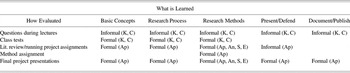
Students are formally evaluated on a total of 100 marks. Fifty marks are on student performance in assignments and class tests; typically 30% are on six assignments distributed to the first four modules as shown in Table 2, and 20% are on two class tests during the first 12 weeks. The remaining 50 marks are on a final research project carried out individually by each student over the last 3 weeks of the course. The marks are converted to a grade using this grading system: S (8 out of 8 points, meaning “outstanding” performance) through A–D (7–4 out of 8, meaning “excellent,” “very good,” “good,” and “satisfactory” respectively), to F (3–0 out of 8, meaning “fail”).
What is learned in the course and how it is evaluated

Note: K, knowledge; C, comprehension; Ap, application; An, analysis; S, synthesis; E, evaluation. According to Bloom's taxonomy (Reference Bloom1956).
The following are what the students are evaluated for in the course:
• Grasp of basic concepts in design research: This includes concepts such as design, design research, research methods, design research methodology, research questions/hypotheses, and evaluation.
• Grasp of various design research methods, their combination into alternatives for carrying out research, their evaluation for suitability, and their application in realistic research projects.
• Grasp of the research processes: overall DRM process and processes for each DRM stage.
• Ability to present and defend results: This includes guidelines for presentation, for example, making slides, preparing a talk, and defending research results.
• Ability to document and publish results: This evaluates how well the student uses the material taught on how to document research into a research report.
The evaluations are carried out using the following means (see Table 2).
• Questions/discussions in the class during lectures: This is used for informal evaluation of students’ understanding of basic concepts, for example, research process, methods, and so forth, and relating these to examples. The evaluation is used to test progress and give feedback for improvement. Using Bloom's (Reference Bloom1956) taxonomy of cognitive dimensions, this constitutes (informal) evaluation of knowledge and comprehension of materials taught in the course.
• Class tests: Two class tests are taken in the DRM course, where students individually answer, in a brief and to the point manner, 15 questions in an hour, as a test of their knowledge of the concepts, processes, and methods taught and how well they can relate these to simple examples. Using Bloom's (Reference Bloom1956) taxonomy, this constitutes (formal) evaluation of knowledge and comprehension of the concepts, processes, and methods taught in the course.
• Literature review and running project assignments: Literature reviews are done individually by the students, whereas running project assignments are done in teams. Each student makes a presentation on each assignment. Each student is formally evaluated for his/her ability to apply the basic concepts and processes taught to research (about methods, processes, etc). The students are informally evaluated for and given feedback on their enthusiasm, skills for presentation, and defense of their work, and for teamwork and individual effort. Using Bloom's taxonomy, this constitutes evaluation of the application of materials taught in the course. Because students analyze research methods, combine them into alternative ways, and evaluate them before selecting the most appropriate ones for use in answering or evaluating specific research questions or hypotheses, for research methods, the evaluation additionally encompasses the cognitive dimensions of application, analysis, synthesis, and evaluation.
• Method assignment: In this assignment, each student applies at least one empirical research method to carry out a part of the project of an existing research student. This is formally evaluated to assess the student's in-depth application of that method. Using Bloom's Taxonomy, this constitutes evaluation of the application of materials taught in the course.
• Individual final project presentations, slides, and report: During the last 3 weeks of the course after completion of all lectures and assignments, students individually carry out a small research project. The same research problem and the same set of research papers are given to each student for carrying out the project. Students are asked to use only the given papers for literature review to construct the outcome of their understanding of the “current” design situation (i.e., carry out a review-based DS-I and develop a reference model); use the conclusions from DS-I to develop a support to address some of the issues raised in DS-I, and develop an impact model describing the desired, improved situation as a result of using the support (comprehensive PS); and develop a plan of how they would evaluate the support to assess the influence of the support in attaining the improved situation. The same research project is given each year, but the four papers given are changed. Students individually meet the instructor each week to present their progress, to ensure they work on a regular basis on the project. Based on the presentation and report, the research is evaluated for its quality of results, documentation, and presentation. This tests each individual student for application of all course materials in a realistic project. Using Bloom's taxonomy, this constitutes evaluation of application of all the materials taught in the course.
9. ASSESSMENT OF THE EVALUATION METHODS USED IN THE COURSE
This is assessed using three metrics as discussed below.
9.1. Effort from instructor and researcher
The following are the estimations of effort based on experience.
Asking informal questions and giving feedback is the least time consuming and is accommodated within the lectures, thereby requiring no additional time outside the class. This effort is reasonably independent of class size (as students are randomly chosen and asked the questions).
For each class test, the class test takes an hour each, and the instructor needs about 1.5 h per person per test. For a typical class of four students, this translates to about 1 day on correcting and marking answer sheets, associated administration, and discussion in the class to clarify marking and mistakes. For two class tests, time spent during the class schedule is about 3 h (2 h for administering the tests, and 0.5 h for each test for discussion on marking), and about 10 h outside the class. The effort scales linearly with the size of the class.
Evaluation of the presentations on literature review and running assignments are scheduled into time slots of the class schedule (see Fig. 6 for the model of teaching followed), and hence, needs no additional time for evaluation. However, as each student makes individual presentations, the amount of time required to carry out this evaluation will scale up linearly with class size and require greater number of class hours and associated instructor time to follow the model.
Method assignment requires time from the researcher for introduction to his/her methods (typically 1 h, common to all students), setting each student up for the assignment (typically 2 h/student), providing them help if necessary during the execution of the assignment (typically 0.5 h/day for 5 days), and evaluating their results along with the instructor during the follow-up student presentations in the class (typically 0.5 h/student). This effort scales up linearly with class size. The instructor only needs to be present during presentations, and hence, no instructor effort outside contact hours of the class is needed. Because time for student presentations scales linearly with class size, the number of class hours to accommodate this and the associated instructor time will also increase linearly with class size.
Evaluation of final projects is based on individual discussions between the instructor and each student (about 0.5 h/student/week, during class hours); final presentations made individually by each student during a class at the end of the project (typically 0.5 h/student, also during class hours of the course); and evaluation of the final report by each student. Evaluation of one report plus associated administration requires about 2 h, requiring a day of work outside the contact hours for the current class size. For the instructor, the number of hours both within and outside contact hours for the course will increase linearly with class size.
9.2. Effort from students
The following are the estimations of effort of students involved in carrying out the assignments, projects, and so forth, based on experience and discussion with students. Answering the questions asked in the class requires minimal effort in, and none outside the class. The time spent on preparation for class tests is unclear, but given the typical student pattern of working in the department, about three evenings are spent for each examination preparation, which is equivalent to about 12 h of preparation per class test. Time for class tests and subsequent discussion on results is included within the class timings. Carrying out assignments related to literature review and the running research project, and preparing presentations to present results from the assignments in the class requires about 6 h on each assignment, and another 2 h for creating presentations per student per week, for 12 weeks. Each student makes a presentation and defends his/her work for about 0.5 h per week.
Working on the method assignment requires about 10 h per student during a 1-week period (when no classes are held; hence class hours are also used for this); preparing its presentation requires about 2 h; and presentation takes about 0.5 h per student.
Working on the final project requires about 10 h per week for 3 weeks; preparing for and carrying out discussions during the project requires about 1 h per week for 3 weeks; preparing for presentation requires about 6 h; making presentation requires about 0.5 h. Because students have to sit through all the presentations and take part in the discussions, they are involved in a 2.5-h class during the final presentation. Altogether, a student spends an average of about 42 h in the 3 weeks of the project.
Many of these are independent of scale, because they are parallel, individual, or group effort outside working hours. What class size will affect are the contact hours for making student presentations, as all students are expected to participate in these presentations and associated discussions.
How does this match with student expectations? According to the guidelines of IISc, a student is expected to spend 4 h (including contact hours) per week per credit of the theory portion of a course, and 6 h per week per credit for the laboratory/practice portion. For the DRM course, which has two credits of theory and one credit of practice per week, the weekly hours of expected effort is 14. Students do not spend more than this at any point of time during the course. However, discussion with students revealed that they feel the course should be given a greater number of credits, as their perceived impression is that it requires more effort than most other courses in the department with an equivalent number of credits and credit distribution. Why is this mismatch? In the author's opinion, the mismatch is because the students compare the effort involved in the course against that required in the other equivalent courses in the department, rather than with the effort expected in a course of this size.
9.3. Quality of evaluation
The evaluation approaches are informal or formal, and evaluate theoretical knowledge or practical application. Using a combination of these, the approaches are assessed. Class questions provide informal evaluation, and are good for evaluating knowledge and comprehension of theory. Class tests provide formal evaluation and are good for testing knowledge and comprehension of theory. Presentations of assignments on literature review and running research project provide formal evaluation of practical application of theories, except the material on presentation and defense that provides informal evaluation. This approach is good for checking application of concepts, methods, and processes. Presentation on method assignment gives formal, in-depth evaluation of application of a specific method. Final project presentation and report gives formal evaluation of detailed application of all the material taught in the course.
10. MODES OF LEARNING IN THIS COURSE
How does learning take place in this course? The major instruments of learning used are by applying: from the act of applying via individual assignments, for example, literature survey, team assignments, individual project, and method assignment; in teams: from other students, in assignments, projects, and so forth; with experts: from instructor in running assignments, and from research students in the method assignment; with DRM as a framework for design research: from the stages, steps, guidelines, and methods of DRM, because in every assignment carried out, DRM is used as the guiding framework; learning from presentations: from the immediate feedbacks from instructor and other students, both as questions and proposals for improvement.
11. EVALUATION OF THE DRM COURSE
The evaluation of the course is carried out in three ways. The first source of evaluation was a face-to-face feedback: after the DRM course is completed, the instructor arranges a group discussion with the outgoing students. The students are asked to respond to these questions: What did you find useful in the course and wish to be retained in the next year and why? What did you find not so useful and wish to be modified, why, and how? Although the approach is potentially unreliable in commenting on highly negative aspects of the course or the instructor (as the students may be reticent in criticizing the course or the instructor), it usually provides more detailed feedback on both positive and moderately negative aspects. The following are some responses.
What should be retained? The high degree of interaction between instructor–student and between students themselves; one-to-one discussions between instructor and students; presentations followed by discussions and dialogues, particularly because of the real-time evaluations and modifications suggested by the instructor during these; project assignments, because of their practicality and interestingness which are of current interest; the assignments on reviewing papers, the effectiveness of midterm tests for reminding students of concepts that should be known well, the enlightening subject matter for students of design, and the structure of the course.
What should be modified? Final project should be given much earlier; some students felt that as various stages of DRM were taught they should carry out corresponding parts of the final project (it was, however, explained to students that this would potentially clash with the running project assignments; the reason the final project is given after introduction of all teaching material is to give an opportunity to students to carry out the project with knowledge and experience of carrying out the entire research process via the running project); rather than giving all students the same running or final project, different aspects of the project should be given to different students, so that a variety in what is carried out by each individual student is increased (it was pointed out to them that this would reduce the amount of learning that each student can currently have because of sharing of the same projects across all students, which enables comparison of their literature reviews, research methods, results, etc.); some of the slides of the instructor are highly textual (this comment has been used to modify the specific slides and associated lectures); rather than stopping at some point during PS in terms of support development, it would be nice to carry out the project in enough detail to be able to develop and evaluate a support (this is a nice idea that has so far not been implemented because of time constraints); the course is very intense (note that this comment and the comment immediately before are in some sense contradictory, which can be because of different people making the comments and the difference in their level of commitment to the course; however, this prompted the instructor to check if the number of hours spent by the students in the course is greater than the maximum allowed, and it was found to be within limits); please procure appropriate reference books for the library (this is a valid comment; now that a book on DRM has been published, this should be possible to address); excellent course even though at times the student who commented this felt he was being subject to interrogation while giving his presentation (the latter part of the comment made the instructor aware of the intensity of questions and feedback during the presentations, and a discussion was undertaken with subsequent batches to ensure they took the questioning in the right spirit).
The second source of evaluation was via a standard, anonymous evaluation form through which each course offered in IISc are evaluated by the outgoing students of the course. The instructor has access to these only after the student grades for the course are finalized and submitted to the office. These forms are long (one student commented on this form: “This questionnaire is tiresome”), often not filled by many students, and are easier for producing statistical conclusions about the course and the instructor than about open-ended evaluation. However, if a student is highly dissatisfied with some aspects of the course or the instructor, this is vented out through comments made in the form. In this sense, it nicely complements the feedback obtained from the face-to-face discussion discussed above. The form has two sections. The first section is on the quality of the course material and how well it is carried out. The specific elements under this section are: test standards, coverage of the syllabus, course organization, how well fundamentals are taught, how up to date the topics covered are, whether text books are available on the course, whether tests are taken regularly, and their usefulness. In this section, the DRM course consistently received an average rating between 4 and 5, where 5 in a scale of 1 to 5 is considered perfect. The second section has a set of questions on how good the instruction quality was. The specific elements under this section are: pace of teaching, command of the instructor on the subject, clarity of expression, level of preparation, quality of interaction, and accessibility of the instructor. In this section also, the course consistently received an average rating between 4 and 5. However, one comment consistently made by the students has been the lack of availability of textbooks that can be used for the course, as also found in the comments made by students in the face-to-face discussion elaborated before.
The third source of evaluation was a comparison between the average grades in the Design and Society course obtained by the MDes students who were taught DRM formally through the course (as well as those who were taught DRM informally, as part of being supervised by the instructor of the DRM course, in the research projects carried out by them in the Design and Society course), with students who were not taught DRM at all. This was to see whether knowledge and application of DRM made a positive difference in the performance of the students in the subsequent Design and Society research course. It was found that, among the 30 students in a span of 5 years who took the Design and Society course, those who learned DRM had a grade point average (GPA) in the Design and Society course of 6.69 (in a scale, as discussed before, of 1–8, where 6 is considered very good, 7 excellent, and 8 outstanding), whereas those who did not learn DRM had a GPA of 5.75 in the Design and Society course, indicating that knowledge of DRM may have had a significant positive effect on the quality of their research. This is further strengthened by the fact that the average overall GPA, across all courses in the MDes program, for those who learned DRM was 6.68 (i.e., they did slightly better in their Design and Society research project than their average performance in all the courses undertaken in the 2 years of their MDes). In contrast, those who did not learn DRM had their average program GPA at 6.33 (which means that they did much worse in their Design and Society research project than their average performance in all courses taken together in the 2 years). There is also a strong correlation (0.82) between the grades obtained in the DRM course and those in the Design and Society research project (p < 0.02).
This correlation is particularly significant in the context of the number of papers in refereed international conferences and journals that came out of the Design and Society Projects taken up by the students. Out of over 30 students who took up the Design and Society research project, 5 put in an additional average of 6 weeks work over and above their Design and Society coursework effort and went on to publish a paper in an international conference or journal (4 in International Conference on Engineering Design conferences, and 1 in Journal of Engineering Design). Because the students involved in these papers had directly or indirectly used DRM in their approach, their success may have been partly because of the efficiency that following of DRM brought to their research.
12. RELATED WORK
The content, structure, and methods of evaluation of the DRM course are related to existing work.
12.1. Related courses
There seems to be no other credited course offered on methodology for design research. However, several short-term courses are offered in sensitizing or training students in the paradigms and methods for design research. The most notable is the 2-week Annual Summer School on Engineering Design Research for PhD students conducted in Europe (Blessing & Andreasen, Reference Blessing, Andreasen, Clarkson and Huhtala2005), where DRM is taught as a major element. As described by the Design Society (http://www.designsociety.org/index.php?menu=15&action= 68&date=2009-05-17), it aims to make participants better equipped for research into design by helping them select a theoretical foundation and develop a research approach, and encouraging discussion and collaboration.
A National Science Foundation funded 4-day summer school was conducted on design research in 2007; the goal was to “engage in lively discussions about the nature of design research, the norms of the field, the open research questions, and the accepted research paradigms” (http://www.cs.cmu.edu/~sfinger/summerschool/faculty.html). Typical courses on research methods in other disciplines use model III (Fig. 4). Research methods are introduced in lectures using theory and examples, and projects or assignments are used to effect practice. For example, the National Science Foundation funded a short course on Methods of Behavioral Observation in 2009 (http://www.qualquant.net/training/scrm.htm). The distinct nature of the DRM course is in its content, level of detail of the instructional material, and the model of delivery (see Fig. 6).
12.2. Relationships to theories of learning
According to Wikipedia [http://en.wikipedia.org/wiki/Learning_theory_(education)], “a learning theory is an attempt to describe how people and animals learn, thereby helping us understand the inherently complex process of learning.” There are three major theories of learning: behaviorism, cognitivism, and constrctivism.
In behaviorism (e.g., Skinner, Reference Skinner1974), three basic assumptions are held to be true: learning is manifested by a change in behavior, the environment shapes behavior, and the principles of contiguity (closeness in time) and reinforcement (repetition) are central to explaining learning.
For behaviorism, learning is the acquisition of new behavior through conditioning. Essentially, it is environment that is seen as central to conditioning.
The cognitivist paradigm argues that to understand learning, the black box of the mind should be opened and understood. The learner is viewed as an information processor (http://www.learning-theories.com/cognitivism.html). This is in reaction to behaviorism that views people as “programmed animals” that merely respond to environmental stimuli. Cognitivism sees people as rational beings who require active participation in order to learn, and whose actions are a consequence of thinking. Learning is defined by cognitivists as a change in a learner's symbolic mental constructions. The learner, rather than the environment, is seen as the key in learning. A major outcome of this paradigm is the component display theory (more recently component design theory) by Merrill (Reference Merrill and Reigeluth1983), which classifies learning along two dimensions: content and performance. The theory specifies four primary presentation forms: rules, examples, recall, and practice (http://tip.psychology.org/merrill.html).
The constructivist paradigm (e.g., Vygotsky, Reference Vygotsky1978) views learning as a process in which the learner actively constructs or builds new ideas or concepts based upon current and past knowledge or experience [http://en.wikipedia.org/wiki/Learning_theory_(education)]. Constructivist learning, therefore, is a personal endeavor, whereby internalized concepts, rules, and general principles may consequently be applied in a practical, real-world context. Learning, according to constructivism, happens via construction of knowledge. People actively construct or create their own subjective representations of objective reality. New information is linked to prior knowledge; thus, mental representations are subjective (http://www.learning-theories.com/constructivism.html). Constructivism promotes a student's free exploration within a given framework or structure; the teacher acts as a facilitator encouraging students to discover principles for themselves and to construct knowledge by solving realistic problems.
Vygotsky's (Reference Vygotsky1978) social development theory is one of the foundations of constructivism, and is particularly important to discuss in the context of the DRM course. It argues that social interaction precedes development; consciousness and cognition are the end products of socialization and social behavior (http://www.learning-theories.com/vygotskys-social-learning-theory.html). Social development theory asserts three major themes: social interaction plays a fundamental role in cognitive development; the influence of the more knowledgeable other, who has a better understanding or higher ability than the learner with respect to a particular task, process, or concept, for example, teacher, coach, and peers; the zone of proximal development is the distance between a learner's ability to perform a task under adult guidance or peer collaboration and his ability to perform the task independently, as the skills developed with adult guidance or peer collaboration exceed those attained alone (http://tip.psychology.org/vygotsky.html).
Vygotsky's theory promotes learning contexts in which students play an active role in learning. Roles of the teacher and student are shifted, as a teacher should collaborate with her students to facilitate meaning construction in students. Another related work is Bandura's (Reference Bandura1977) social learning theory, which emphasizes the importance of observing and modeling the behaviors, attitudes, and emotional reactions of others: “most human behavior is learned observationally through modeling: from observing others one forms an idea of how new behaviors are performed, and on later occasions this coded information serves as a guide for action.” Social learning theory explains human behavior in terms of continuous reciprocal interaction between cognitive, behavioral, and environmental influences.
How do these theories relate to the DRM course (see Section 10 for the learning elements used in the course)? In my opinion, all three paradigms are variously important for developing and delivering teaching material and evaluating progress of students in a course. Cognitivism is useful in constructing the material to be taught, because of the structure it provides to the elements of knowledge that need to be learned and the levels of performance expected in grasping these. Various taxonomies could be used here, for example, Bloom's taxonomy (Bloom, Reference Bloom1956; Anderson et al., Reference Anderson, Krathwohl, Airasian, Cruikshank, Mayer, Pintrich, Raths and Wittrock2001) or Merrill's dimensions (Merrill, Reference Merrill and Reigeluth1983). Constructivism, with its focus on the social interactions through which learning happens, seems naturally suitable in providing appropriate means of delivering the material and its assimilation. Although learning may be internal, any evaluation of learning must be assessed through some external change in behavior; behaviorist theories may be particularly suitable for evaluation. As seen in the structure of the course, the teaching/learning material contains facts, concepts, and procedures, and performance expected is about remembering and using these in practical research problems. The use of running assignments and realistic problems, engagement of the instructor and peers in the application of the material to research processes, and the central role that presentations, feedback, and discussions play strike a chord with those in the constructivist traditions, in particular, those echoed in the theories of Vygotsky and Bandura. In terms of pedagogical leanings, the course is oriented toward andragogy (i.e., experience-based, problem-centered learning; see http://en.wikipedia.org/wiki/andragogy), and activity theory [i.e., a situated set of research activities in the complex, real-world environment of research, along the primary arguments from activity theory in which individuals have active relations to reality, where activities–interactions of individuals with their environment to fulfill needs (as in designing) is seen as complex, situated phenomena resulting in production of tools, see http://en.wikipedia.org/wiki/Activity_theory; Kaptelinin & Nardi, Reference Kaptelinin and Nardi2006], even though both theory and contents are used as instruments that are applied to realistic problems used in the assignments, real problems in which students are situated in ongoing projects, and in the individual, final project of the course.
13. SUMMARY AND CONCLUSIONS
This paper highlights some of the major issues about the status of design research. It describes DRM, a methodology developed earlier to address some of these issues, and details the instructional material, model of delivery, and evaluation of a credited, postgraduate DRM course designed to train students in using DRM for carrying out their research.
Overall, the DRM course is a unique one; the author is not aware of other regular courses offered in training students in design research. The evaluations to assess the effectiveness of the course seem positive: responses from students are highly positive, their grades in this course correlate well with their grades in a subsequent research course, and those who use DRM in their research seem to do in the research course not only better than those who do not use DRM, but also better than their average grade in their whole Masters Program. The author's research students, who had earlier undertaken the DRM course, regularly use DRM in their work and find this useful. On the whole, the course seems to have been successful in imparting some basic knowledge for carrying out design research among students who never did any research before.
However, there are some limitations in the way the current course is structured and conducted. Because of the size of the department, the course currently needs to handle only small batches of students. If it were to be offered to a larger class, scaling would be an issue because of these:
• Scaling the theory and example portions are not an issue, but carrying out a running assignment with a much larger class would be an issue, because for collective progress in the assignment, the views of all students should be brought together into a coherent whole.
• Individual student presentations and feedbacks become an issue, as this can be very time consuming for a single instructor; perhaps the number of instructors have to be increased.
• Project presentations and evaluation would require a lot more time and major restructuring.
There are other limitations. In the running assignments, students do not carry out a full-scale study for developing understanding, support, or its evaluation; in the method assignment, students are exposed in depth to a single research method only; and there is difficulty in finding appropriate example research problems for use in the short span of the course, which are sufficiently open-ended for students to see the richness and ill-structured nature of research problems.
Amaresh Chakrabarti is a Professor at the Centre for Product Design and Manufacturing at the IISc. He led the design synthesis team of the Engineering Design Centre at the University of Cambridge before joining IISc and founded IDeASLab, which is the first laboratory in India for design research. He attained his BEng in mechanical engineering from Calcutta University, MEng in mechanical design from IISc, and PhD in engineering design from the University of Cambridge. His synthesis software FuncSION won an award at the 1994 Morgans–Grampian MIAA Competition. Dr. Chakrabarti is on the editorial boards of Research in Engineering Design, Modern Machinery Science, AI EDAM, Journal of Remanufacturing, and Journal of Engineering Design and is a member of the Advisory Board of the Design Society. His research interests include functional synthesis, design creativity, design methodology, collaborative design, ecodesign, engineering design, design synthesis, requirements management, knowledge management, computer-aided design, DRM, and design for variety. He is a coauthor of DRM.