INTRODUCTION
Organic farmers often favour cultivars bred under organic and low input conditions over modern, elite cultivars with high yields under conventional conditions. It is assumed that the cultivars bred under organic and low input conditions will yield more in those conditions than the modern, elite cultivars. Whilst it is difficult to compare yield performance under conventional and organic conditions in classical trial designs such as a split-plot because organic fields should ideally remain geographically and pedologically separate, several comparisons have been made using different approaches. Some authors conclude that whilst selection for climatic regions is best done using different agronomic systems, no interaction was observed for organic compared with conventional system (Hildermann et al. Reference Hildermann, Thommen, Dubois, Boller, Wiemken and Mäder2009; Annicchiarico et al. Reference Annicchiarico, Chiapparino and Perenzin2010); nor did interaction with other factors such as greater arbuscular mycorrhizal root colonization in organic systems show any cultivar interaction (Hildermann et al. Reference Hildermann, Messmer, Dubois, Boller, Wiemken and Mäder2010). However, detailed analyses of heritable traits and cultivar rankings have suggested that breeding for organic systems should combine information from both organic and conventional systems (Przystalski et al. Reference Przystalski, Osman, Thiemt, Rolland, Ericson, Østergård, Levy, Wolfe, Büchse, Piepho and Krajewski2008; Reid et al. Reference Reid, Yang, Salmon and Spaner2009).
Many cultivars chosen for organic conditions tend to be those used locally which are often older ones, the assumption being that they were bred under either organic conditions and/or lower levels of applied inorganic fertilizer. Thus, in contrast to elite cultivars, they are likely to be better at accessing nitrogen (N) from soil than that from fertilizers (Foulkes et al. Reference Foulkes, Sylvester-Bradley and Scott1998). Foulkes et al. (Reference Foulkes, Sylvester-Bradley and Scott1998) also found that not only was N offtake at optimum input increased in more recent elite germplasm, but also N offtake at low N was reduced compared with older germplasm, suggesting that elite germplasm would not be well adapted for low fertilizer input conditions such as organic farming systems. The need to breed for these and other traits and trait combinations under organic conditions is strongly endorsed by several reviewers (Wolfe et al. Reference Wolfe, Baresel, Desclaux, Goldringer, Hoad, Kovacs, Löschenberger, Miedaner, Østergård and Lammerts van Bueren2008; Lammerts van Bueren et al. Reference Lammerts van Bueren, Jones, Tamm, Murphy, Myers, Leifert and Messmer2011).
There is evidence that progress in yield improvement of modern elite cultivars, whilst perhaps best expressed under conditions of high levels of inorganic fertilizer in intensive, conventional trials, is also expressed as increased yield under other farming systems, including organic systems (Kokare et al. Reference Kokare, Legzdina, Beinarovica, Maliepaard, Niks and Lammerts van Bueren2014; Pswarayi et al. Reference Pswarayi, Kubota, Estrada and Spaner2014). It is argued that such is the level of yield potential progress, estimated at about 1% potential yield gain per year (Fischer & Edmeades Reference Fischer and Edmeades2010), even under organic conditions such cultivars could out-yield the organic-system-preferred older cultivars. However, exceptions to this trend have been reported (Kokare et al. Reference Kokare, Legzdina, Beinarovica, Maliepaard, Niks and Lammerts van Bueren2014). High N trial conditions alone gave poor prediction of yield performance under organic conditions, whilst low N trials were better (Le Campion et al. Reference Le Campion, Oury, Morlais, Walczak, Bataillon, Gardet, Gilles, Pichard and Rolland2014). However, a combination of low input, organic and conventional conditions, and multiple environments was identified as desirable to enable robust selection (Muellner et al. Reference Muellner, Mascher, Schneider, Ittu, Toncea, Rolland and Löschenberger2014). Different traits show different responses to selection environment so, in practice, a combination of environments is needed for selection of balanced new cultivars (Mikó et al. Reference Mikó, Löschenberger, Hiltbrunner, Aebi, Megyeri, Kovács, Molnár-Láng, Vida and Rakszegi2014).
Under low input and organic conditions, profit margins are sometimes smaller and conditions much more variable between sites and seasons as fewer intervention options are available to adjust for such variability. Therefore, maximum yield potential may not be the highest priority and yield stability assumes great importance. Market drivers such as the end-user demands may be different in these markets too and thus the criteria for cultivar choice for low input and organic conditions can be more complex than under intensive and high inorganic input systems. Factors such as weed-competitiveness can assume much greater importance in organic systems (Wolfe et al. Reference Wolfe, Baresel, Desclaux, Goldringer, Hoad, Kovacs, Löschenberger, Miedaner, Østergård and Lammerts van Bueren2008; Piliksere et al. Reference Piliksere, Strazdiņa, Vîcupe, Jansone, Legzdiņa, Beinaroviča and Kronberga2013). Objective assessments of some of these other factors might therefore be very beneficial under different trial conditions. However, these and other traits of particular benefit to some organic systems can be complex and may confound important nutritional differences, so the present study sought to compare them in trials as similar as possible except for source of fertility in the soil.
Cultivar mixtures are a means to improve yield above the mean of their component cultivars, and to enhance yield stability (Finckh et al. Reference Finckh, Gacek, Goyeau, Lannou, Merz, Mundt, Munk, Nadziak, Newton, de Vallavieille-Pope and Wolfe2000; Newton et al. Reference Newton, Begg and Swanston2009). This is achieved through processes of compensation, complementation and facilitation, resulting in improved resource use efficiency (Schöb et al. Reference Schöb, Kerle, Karley, Morcillo, Pakeman, Newton and Brooker2015). Furthermore, reduced yield loss to pathogens is achieved through epidemic control by exploitation of specific resistance in relation to pathogen populations as well as more direct means of slowing the epidemic with some pathogens (Newton & Guy Reference Newton and Guy2011). However, a major reason for growing mixtures in practice is their yield stability compared with single cultivars, a trait of great value in organic agriculture where fewer agronomic intervention options are available (Mundt et al. Reference Mundt, Brophy and Schmitt1995; Czembor & Gacek Reference Czembor, Gacek, Limpert, Finckh and Wolfe1996). Mixing contrasting traits, including traits associated with older germplasm often preferred by some organic growers with those from modern cultivars, could increase resource use efficiency (Fang et al. Reference Fang, Xu, Liu, Gu, Liu, Turner and Li2014). This approach to using diversity to match crops to the challenges of diverse growing conditions may prove advantageous. However, all these processes rely on diversity between the component cultivars for the traits that contribute to resource exploitation and pathogen resistance.
Direct comparisons of organic and conventional farming conditions are constrained by the inability to use conventional trial designs, as studies cannot normally be carried out in the same field. Furthermore, whilst a range of cultivars for conventional use are evaluated by the UK AHDB Recommended List system and are readily available, no similar evaluation or supply system is available for cultivars potentially favourable for organic systems. For the present study, it was possible to source some cultivars favoured by organic growers for cool northern maritime growing conditions in Scotland, and the study sought to evaluate these in terms of yield quantity and stability. The aim was to: (1) identify winter wheat cultivars that yield highly under organic conditions; (2) determine whether these cultivars have similar ranking under conventional conditions (genotype × system interaction); and (3) identify whether cultivar mixtures give yield advantages in either farming system.
MATERIALS AND METHODS
Field trials
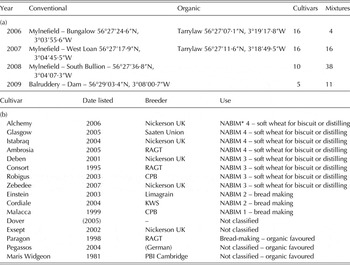
Field experiments on winter wheat cultivars were conducted over 4 years in fields on or near the Carse of Gowrie between Dundee and Perth, Scotland (Table 1). The conventional trials were conducted using a split-plot design, which varied among years. Figure 1(b) shows the 2008 design in which fungicides were applied at the whole plot level, N at the sub-plot level and cultivars were randomized to plots within the sub-plots with one cultivar in each sub-plot. This same structure was used in 2009, but in 2006 and 2007 fungicides were applied at the block level. Organic trials were conducted using a completely randomized block design. There were three conventional blocks in each year and in 2006 there were four organic blocks whilst in 2007 there were six organic blocks. All trials were sown in eight-row plots at 360 seeds/m2 in September or October using a Hege seed drill with an Oyjord cone. Plots were 1·55 × 6·0 m2, reduced to 5·6 m with plot definitions. In conventional plots, fertilizer was applied at two different rates representing the recommended or standard practice (high N) and half of this rate (low N). Standard rates were 93 kg/ha of 0–20–30 nitrogen:phosphorus:potassium (N:P:K) applied at sowing with top-dressings of 115 kg/ha of 30–0–0 N:P:K(19SO3) in March and 115 kg/ha in April. Organic trials received nutrients from fertility-building practices such as legume crops and farmyard manure treatments in the organic farm rotation. Conventional trials were carried out with the UK Recommended List protocol full fungicide programme (https://cereals.ahdb.org.uk/varieties/) and an untreated control. In 2006 and 2007, the full (F1) and no (F0) fungicide treatments and the organic treatment were carried out on separate sites, although the F0 and F1 conventional treatment sites were immediately adjacent. This was because it was not possible to include the organic treatment within a single standard trial design, and therefore fungicide treatment was also considered as a similar high-level treatment for these comparisons, whilst minimizing the effect of site by proximity and similar sandy-loam soil type. Nevertheless, treatment was confounded by site.
(a) Standardized residuals for the 2008 data by row. The dashed line shows the mean of the residuals at 0·0, and the solid line shows the smooth trend in the residuals. (b) The design of the 2008 conventional trial. Blocks, whole plots and sub-plots are arranged along columns, with guard rows in the middle of the blocks, Fungicide was applied at the whole plot level (either none (F0) or full treatment (F1) and nitrogen was applied at the sub-plot level (either low or high). Each sub-plot contains 48 plots arranged as three columns of 16 rows. Cultivars were randomized to plots within sub-plots. 2009 had a similar design, but in 2006 and 2008 fungicide was applied at the block level rather than the whole plot level.

Trial series details. (a) Location and type of wheat trials and numbers of entries (single cultivars and mixtures). (b) Cultivars used in trials

*NABIM, National Association of British and Irish Flour Millers (AHDB 2009).
Common to all trials were five cultivars: Alchemy, Glasgow, Istabraq, Zebedee and Robigus. Both 2006 and 2007 trials (organic and conventional) also had Ambrosia, Consort, Cordiale, Dover, Einstein, Exsept, Deben, Malacca, Maris Widgeon, Paragon and Pegassos. These represented modern elite cultivars, older cultivars and some preferred by organic growers (Table 1). Ambrosia and Consort were also present in the 2008 conventional trial. In all 4 years equal proportion mixtures were sown, including at least three × four-component mixtures. These were chosen as potentially complementary combinations of contrasting cultivars. These are denoted by the first two letters of each component cultivar, for example Al-Is is Alchemy and Istabraq. However, composition of the mixtures varied between years. In addition to these, 11 × two-component mixtures were grown in 2007, 18 in 2008 and seven in 2009, representing many of the above cultivars in combination with either Glasgow or Istabraq, some being common to all 3 years. The remaining mixtures in each year were three- and four-component mixtures.
Yield and disease assessments
All plots were assessed for disease regularly and when they exceeded trace levels were then scored by assessing all leaf layers together approximately fortnightly on a 1–9 whole-plant scale where 1 is no disease and 9 is completely covered with symptoms (Newton & Hackett Reference Newton and Hackett1994) until disease died out, and converted to percentage for subsequent analysis. For yellow rust, which was scored on four occasions, scores were converted to percentage infection, and the area under the disease progress curve was calculated. As heritabilities for overall yield in organic v. conventional comparisons were higher than for yield components (Kokare et al. Reference Kokare, Legzdina, Beinarovica, Maliepaard, Niks and Lammerts van Bueren2014), only overall yield was assessed. Plots were harvested when ripe using a plot combine, grain was dried, weighed and adjusted to tonnes per hectare (t/ha) at 9% moisture content.
Yield and cultivar superiority analysis
A Linear Mixed Model estimated by REsidual Maximum Likelihood (REML) was used to model the yields from the conventional treatments. Nitrogen level, cultivar, fungicide treatment and their interactions were considered fixed effects. Spatial effects, year and any interactions between these and the fixed effects were considered to be random. Initial year-by-year analysis of the data showed strong spatial correlation in the yield (e.g. Fig. 1(a)). Therefore, each year and fungicide treatment of the 2006 and 2007 conventional trials, each year of the 2008 and 2009 conventional trials and each year of the organic trials were considered to be separate experiments in that the structure and the variance of the residuals were estimated independently for each experiment. Random factors of row and column with appropriate spatial correlation in the residual for each experiment were included to account for this. The blocks, whole plots and sub-plots were arranged along the columns (e.g. Fig. 1(b)) and it was not possible to obtain convergence including a random factor for block and one for columns, so the block factor was omitted from the model. With this exception, the randomization structure was included as random factors in the model, whilst other random factors were chosen to give the model with the lowest Bayesian Information Criterion (BIC) when all possible fixed effects were included. Both-ways stepwise regression was used to select the fixed effects starting with only random effects and then with all fixed effects. The resulting models were the same. For both random and fixed effects, selection was subject to the criterion that where an interaction term was included, the contributory effects to that interaction were also included in the model. Where possible the significance of fixed effects was assessed using the Kenward–Rogers adjusted F-test.
A second Linear Mixed Model was used to model all yield data (both organic and conventional) from 2006 and 2007. In this case fungicide treatment was confounded with block so, because the organic treatment never had fungicide applied, the full fungicide treatment data from the conventional trials was excluded and the three different agronomy/nutrient treatments (organic, low and high) were compared where no fungicide was applied. The fixed effects were N level and cultivar (including mixtures) and the random factors were selected in the same manner as for the conventional treatment.
The yield of mixtures relative to single cultivars was assessed by dividing entries into mixtures and mono-cultivars and then using a contrast of the predicted yield from all mixtures to the weighted mean predicted yield of all the constituent mono-cultivar entries. The yield performance of individual mixtures relative to their constituent cultivars was assessed using contrasts between the mean of the predicted yields from the component mono-cultivar samples and the predicted yield from each mixture.
There is insufficient variation in the environment to obtain robust results for stability of yield. However, the possibility of selecting the best cultivar for a given treatment combination reliably using the cultivar superiority (CS) measure of Lin & Binns (Reference Lin and Binns1988), which looks for cultivars that are consistently the best yielding rather than those that have a stable yield (Purchase et al. Reference Purchase, Hatting and van Deventer2000), can be assessed. The CS measure for each cultivar is the sum of the squared differences between the mean of that cultivar in a given environment and the best cultivar there, divided by twice the number of environments. Thus, smaller values indicate better yield and a significantly small value (as assessed using a permutation test) suggests that the cultivar is, in general, high yielding, or more resistant to yield loss through disease. Intrinsic in this definition is the assumption that, however environment is defined, there is no systematic variation within that environment so, in order to account for the spatial trends in yield, splines were used to model the spatial variation and yields adjusted to remove this effect by subtracting the deviation from mean attributable to spatial position. There are some missing data and superiority analysis requires complete balance, so each year and treatment combination was considered to be a separate environment and CS analysis was carried out on the adjusted yields. It is a requirement that cultivars to be compared be present in every environment under consideration, so sub-sets of the data were used to compare cultivar sets across as many years as possible. In addition to the core varieties planted in all 4 years, three further sub-sets of the cultivars wer considered: those planted in 2006, 2007 and 2008; those planted in 2007, 2008 and 2009 and those planted only in 2006 and 2007. All analysis was performed using Genstat 16 (VSN International 2013).
RESULTS
All conventional trials established well. Organic trials appeared more uneven but weed control was not a problem and there were no significant establishment or weed differences associated with cultivars. Fungicides were highly effective and no disease was established in these treatments.
Disease effects
The two disease impacts were yellow rust, causal agent Puccinia striiformis f.sp. tritici, and Septoria Leaf Blotch (SLB), causal agent Zymoseptoria tritici. Yellow rust had most impact on yield of the highly susceptible cultivars Robigus and Pegassos (~25% final whole plant equivalent infection score). This mostly affected the organic trial in 2007 when other cultivars such as Alchemy, Maris Widgeon, Glasgow, Deben, Exsept and Consort only scored 1–5% on the final late-season score (~GS75; Tottman Reference Tottman1987), other cultivars having negligible infection. Septoria only affected the 2009 trial but had some impact on all cultivars late season (~GS75). Mildew infected this trial too, but only at low levels late season (data not shown).
Yield responses
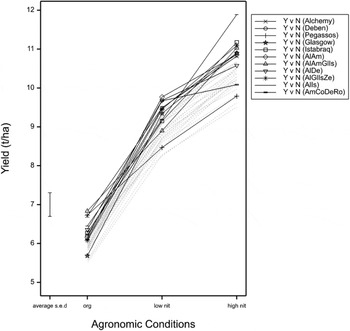
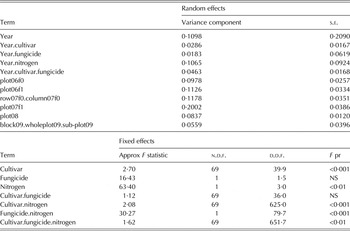
Table 2 shows the terms included in the best model for crops under conventional cultivation. The inclusion of interaction terms year × cultivar and year × cultivar × fungicide suggests that yield performance of cultivars relative to their mean yield depends on year as well as treatment. The estimate of the average standard error of difference (a.s.e.d. = 0·500) should be treated with caution because the best model (the model with the lowest BIC) did not include cultivar × fungicide × nitrogen × year, where N is also a proxy for organic. However, it does provide a lower boundary for the estimate. It is not possible to estimate standard errors of the predicted means because of the correlated residuals, but a.s.e.d. are presented. The significance of year × cultivar and year × cultivar × fungicide means that the yield performance of a cultivar relative to its mean yield depends on both year and treatment. However, there is insufficient evidence to say that cultivars change rank across years. Thus, given the significance of cultivar × fungicide × nitrogen (P < 0·01, F 69,651·7 = 1·62 on 69 d.f.), it makes sense in practice to consider selecting cultivars for planting after deciding what treatment combination will be applied (Fig. 2). The cultivars with the highest predicted yields have been highlighted in Fig. 2. It should be noted that some of the cultivars with high predicted yield were only planted in 1 or 2 years (e.g. Riband and Al-Is, respectively) and this is reflected in the variability of the s.e.d., the maximum s.e.d. at a given level of fungicide being 0·64 t/ha compared with the average s.e.d. of 0·45 t/ha. Therefore, statistical testing of CS is performed using the CS measure discussed below.
Interaction plot showing the expected mean yield of cultivars under organic conditions and with no fungicide applied at different levels of nitrogen (N) treatment in conventional conditions (from the 2006 and 2007 data). The solid black lines represent cultivars with significant cultivar superiority scores (see Table 4). Other cultivars are represented by dotted grey lines. Intersecting lines show a change in the performance of a cultivar compared with other cultivars as conditions change, for instance Al-Is (the mixture of Alchemy and Istabraq) is undistinguished under oganic conditions and low N conventional conditions but does better than other varieties under high N, no fungicide conventional conditions.

Fixed and Random effects for the best fitting model for yield under conventional cultivation

The first five terms relate to changes over time. The remaining terms account for spatial variation and experimental structure. See Fig. 1(b) for an example of the 2008 experimental structure. Plot is a combination of row and column used to model two-way spatial correlation in the residuals based on the Euclidean distance between plots so plot06f0 represents the plots in the 2006 conventional experiment with no fungicide, plot07f1 is the plots in the 2007 conventional experiment with full fungicide treatment, plot08 is the full 2008 experiment. row07f0.column07f0 is the interaction term of rows and columns in the 2007 convienctional experiment with no fungicide used to model two-way AR1 correlation. s.e. is the standard error of the estimated variance component, n.d.f. are the numerator degrees of freedom and d.d.f. the denominator degrees of freedom for the F statistic.
Mixtures of cultivars were not significantly different from the mean of their components in any of the trials. Al-Is performed better than its component cultivars Alchemy and Istabraq and similarly Gl-Ro performed better than Glasgow and Robigus grown separately, but with correction for multiple testing the results were not significant, so these data simply reflected the effect of growing two high-yielding cultivars together. Only mixtures with high yields are shown (Tables 4 and 5).
The inclusion of disease data in the analysis of cultivar yield performance had little impact on the overall conclusions. Yellow rust severity in 2007 and mildew in 2009 showed no correlation with yield. There were two sets of Septoria scores from 24 June 2009 (~GS69) and 6 July 2009 (~GS77). They were highly correlated with each other and the best model for the 2009 (no fungicide) data included the observations from 6 July 2009 (F 1,160·8 = 50·15, P < 0·001; Table 3). This improved the fit marginally from the model without disease, but the effect on the relative and absolute yields was negligible and as disease was generally low or not present in most trials, it was not considered further. The overall effect of disease, mainly yellow rust on the highly susceptible cultivars Robigus and Pegassos, is difficult to assess in the organic trial as there was no fungicide control.
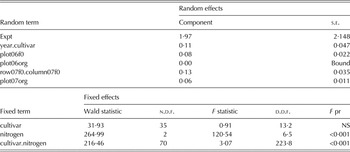
Best model of data from both organic and conventional trials in 2006 and 2007

Plot is a combination of row and column used to model spatial correlation as a power of the Euclidean distance between plots so plot06f0 reprensents the conventional conditions in 2006 with no fungicide, plot06org and plot07org the organic conditions in 2006 and 2007, respectively. row07f0.column07f0 is an interaction term of the rows and columns in conventional conditions in 2007 with no fungicide used to model AR1 correlation along rows and columns.
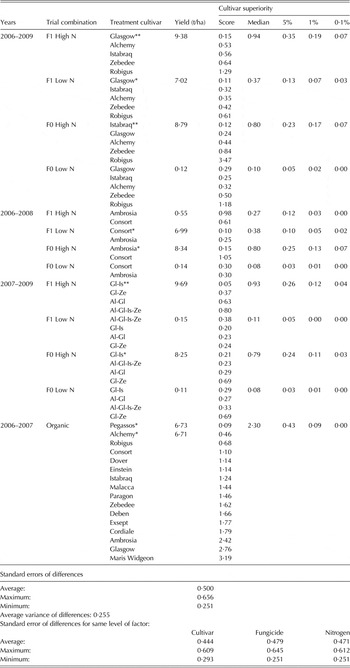
Table 3 shows the terms included in the best model of all the 2006 and 2007 data with no fungicide treatment (both organic and conventional trials). Of the random effects, the best model only included year × cvar. The interaction cultivar × nitrogen was significant (F 70,223·8 = 3·07; P < 0·001), but cvar was not. This is because a number of cultivars that do well under conventional management do poorly under organic management and vice versa (Table 4 and Fig. 2). In particular, Glasgow does poorly under organic management, whereas Pegassos and Alchemy and, to some extent, Robigus yielded highly. Under all conditions, Maris Widgeon recorded the lowest yield and several other entries did poorly under most conditions. In contrast, Alchemy, Istabraq and mixtures involving these commonly ranked highly under all conditions. The single cultivar that most clearly changes relative yield from organic to conventional conditions is Pegassos which changes from the bottom five to second highest yield (Table 4). However, the differences between cultivar means under the different N treatments are small compared with the a.s.e.d. = 0·608.
Cultivar yield and cultivar superiority analysis by treatment combination with 5, 1 and 0·1 percentiles of the cultivar superiority score for each treatment combination

Percentiles 5, 1 and 0·1 are the non-parametric equivalents of the critical values associated with P-values 0·05, 0·01 and 0·001, respectively. Yields are shown only for cultivars with significant cultivar superiority (*P < 0·05; **P < 0·01), or in the absence of a significantly better cultivar, the top yielding cultivar time-span and treatment combination. Yields are taken from the conventional model of all years except for the organic yields, which are taken from the model of the 2006–2007 data. Mixtures are denoted by first two letters of each component cultivar name. Average s.e.d. are shown at the bottom of the table. F0 denotes no fungicide treatment and F1 full fungicide treatment.
Cultivar superiority analysis
In both REML models (all years conventional treatments and 2006/07 all treatments), interactions between treatments are significant so cultivar superiority for each treatment combination is considered separately. As noted in the methods section, cultivars can only be compared with other cultivars planted in all the same environments so some mixtures that have high predicted yield in the REML model such as Riband and Al-Is cannot be compared with others because the former was only planted in 2008 and the latter in 2007 and 2008. Under conventional conditions, Glasgow nearly always out-yielded all the others. This is reflected in the CS value in Table 4, which shows Glasgow being significantly superior to the other cultivars in the full fungicide high nitrogen (F1 high N) treatment, while in the no fungicide high N treatments it was only bettered by Istabraq, but was still significantly better than the other cultivars. Not surprisingly therefore, the mixture of Glasgow and Istabraq was the only mixture to have significant CS values under high N conditions too. Consort also gave a significant CS value under low N conditions when fungicide was used but not without fungicide treatment, reflecting its disease susceptibility. The only other cultivar to have significant superiority under conventional conditions was Ambrosia under high N and no fungicide, reflecting its adequate disease resistance.
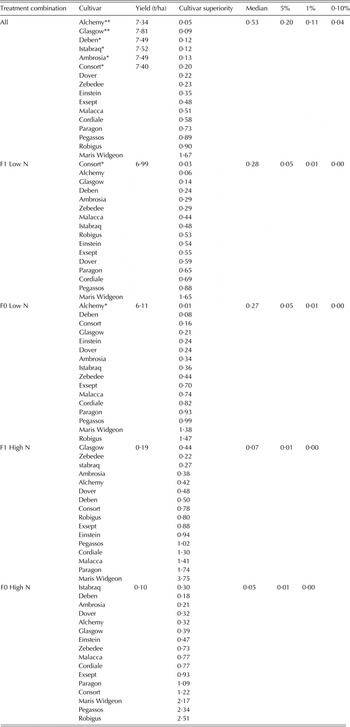
Comparing just the 2006 and 2007 conventional trials, Alchemy, Glasgow, Istrabraq, Deben, Ambrosia and Consort all showed cultivar superiority overall (Table 5). However, under low N and fungicide conditions only Consort was still significant and where there was no fungicide and low N only Alchemy was significant, possibly due to its better disease resistance (AHDB 2009). In similar comparisons of just 2008 and 2009, only Glasgow and a mixture of Glasgow and Istabraq showed overall superiority (data not shown).
Cultivar superiority analysis of 2006 and 2007 conventional trials

Cultivar superiority analysis by treatment combination with 5, 1 and 0·1 percentiles. Yields are shown for the best perfomers and are estimates from data from all the conventional trials (* P < 0·05; ** P < 0·01).
The cultivar superiority yield performance under conventional conditions differed markedly from that recorded under organic conditions. Two cultivars showed significant superiority in the organic trials, Pegassos and Alchemy (see Fig. 2). Robigus, Deben and Istabraq were next highest yielding but not significantly superior (Table 4).
DISCUSSION
Overall, cultivar rankings for yield were similar across both conventional and organic systems, and for N levels within the conventional system. For cultivars used in the current work, cultivar mixtures showed no significant differences from the mean of their components and they showed no interaction with the farming system. However, there were a few exceptions showing significant differences between particular cultivars in the way they responded to conventional v. organic management conditions. Likewise, some cultivars showed a preference for low or high N treatments within conventional conditions.
Several cultivars yielded poorly under all conditions but Maris Widgeon was consistently amongst the poorest. At the other end of the spectrum, Alchemy, Istabraq and mixtures involving these usually yielded highly under all conditions. The differences were expressed as significantly better cultivar superiority scores for yield under the respective systems. Glasgow, Istabraq and their mixtures were consistently found to be superior under conventional conditions. Consort was favoured under the low N full fungicide treatment and Ambrosia under high N and no Fungicide treatment. In contrast, none of these cultivars were classed as superior under organic conditions, but Pegassos and Alchemy were.
One cultivar that clearly changes relative yield from conventional to organic conditions was Pegassos (which changes from bottom five to top two), an old cultivar retained by some organic growers, suggesting that it has traits particularly suited to organic conditions that may be lost from more recent cultivars. Comparing Pegassos with Glasgow, the former is an older cultivar with more primitive germplasm in its pedigree that would have been bred under lower fertility conditions. Foulkes et al. (Reference Foulkes, Sylvester-Bradley and Scott1998) estimated that new cultivars not only had increased N offtake at optimum input from applied fertilizer by 2·1 kg/ha/year over the period from 1969 to 1988, but also reduced soil N by 0·77 kg/ha/year. Therefore it could be expected that Glasgow, as the most extreme of the superior cultivars, and Pegassos as an older cultivar, would reflect clear differences in these trials. Indeed, Glasgow did yield more poorly than expected under organic conditions.
There is much debate as to whether the best breeding progress for organic conditions will be made by breeding under organic conditions. Kirk et al. (Reference Kirk, Fox and Entz2012) reported higher grain yield in lines selected in organic environments. Kamran et al. (Reference Kamran, Kubota, Yang, Randhawa and Spaner2014) found three spring wheat cultivars that gave comparable high yield and grain protein under organic and conventional systems, namely Marquis, Unity and Minnedosa. Marquis was the oldest cultivar in the study, and had higher yield and better protein content under organic conditions. It was bred and selected under organic conditions, but the other two cultivars that had minimum grain yield and grain protein reductions under organic conditions were more recent releases, i.e. 2009 and 2008, respectively. Thus, breeding and selection under low input and/or organic conditions (generally practised more often many years ago) can select some of the best cultivars for organic conditions. However, selection for good yield under conventional conditions can also correlate with good yield under organic conditions. Nevertheless, Pegassos was amongst the best yielding organic cultivars, but yielded very poorly under conventional conditions, a characteristic suggesting specific adaptation to attributes of organic conditions. In spring wheat, a similar reversal of rankings was found for the cultivars AC Barrie and AC Watson, with the former giving higher yield under organic conditions (Nass et al. Reference Nass, Ivany and MacLeod2003). Investigating the basis of this adaptation further may provide clear targets for organic breeding.
Identification of older cultivars such as Marquis and Pegassos and modern cultivars such as Minnedosa and Unity identifies potential parents and sources for identifying further traits for organic breeding. Mason et al. (Reference Mason, Navabi, Frick, O'Donovan and Spaner2007) reported better yield performance of wheat cultivars other than those mentioned above under organic compared with conventional field conditions. Kitchen et al. (Reference Kitchen, McDonald, Shepherd, Lorimer and Graham2003); Carr et al. (Reference Carr, Kandel, Porter, Horsley and Zwinger2006); Murphy et al. (Reference Murphy, Campbell, Lyon and Jones2007) and Kamran et al. (Reference Kamran, Kubota, Yang, Randhawa and Spaner2014) similarly reported significant cultivar × environment interactions or ranking changes for grain yield between conventional and organic trials.
With spring barley, Kokare et al. (Reference Kokare, Legzdina, Beinarovica, Maliepaard, Niks and Lammerts van Bueren2014) found that the top-yielding cultivars under conventional conditions were the ones that yielded best under organic conditions too, favouring the general improvement argument over specific selection for organic conditions. However, when yield stability was included in the evaluation of adaptation of these cultivars to organic conditions these conclusions had to be qualified. This highlights the problems of classifying field conditions so crudely as either conventional or organic, as the nutrient source and management may not be the dominant environmental factor in such comparisons. Indeed, several reports conclude that breeding for organic production should be conducted on organically managed land where the performance of many different traits required for organic production can be evaluated together. One trait, earlier flowering, was correlated with lower grain yields and smaller grain under organic conditions (Kamran et al. Reference Kamran, Kubota, Yang, Randhawa and Spaner2014). However, the characteristics that seem to make most mechanistic sense with respect to accessing nutrients are root characteristics, and Chapagain et al. (Reference Chapagain, Super and Riseman2014) found that older cultivars that yielded better under low input organic conditions as well as having low shoot:root ratios had longer, thinner roots.
For mixtures to give a significant advantage compared with the mean of their component cultivars they need to have traits that are contrasting and complementary (Schöb et al. Reference Schöb, Kerle, Karley, Morcillo, Pakeman, Newton and Brooker2015). These can be with respect to disease resistance or resource utilization such as light interception or nutrient scavenging. For disease, this has been clearly demonstrated recently using genetically transformed lines differing in the number and specificity of powdery mildew resistance genes (Zeller et al. Reference Zeller, Kalinina, Flynn and Schmid2012). Multiple and contrasting traits each contributed to mixture efficacy, significantly reducing infection and increasing yield compared with the monoculture mean. There was little disease in the current trials and when it did occur it predominantly affected just a few cultivars. Thus, there was little scope for beneficial interactions in these traits. Amongst elite wheat cultivars, there are a few obvious trait differences such as leaf habit or height. The older cultivars might have been expected to contribute some more diversity, but these were deployed in too few mixtures to be detected in complementary combinations. This is similar to the situation found in Australian winter barley cultivars where no interactions were detected (Paynter & Hills Reference Paynter and Hills2008), in contrast with UK cultivars where yield responses of up to 17% and disease reductions up to 80% have been recorded in winter barley mixtures (Newton & Guy Reference Newton and Guy2009). Clearly trait–trait–environment interactions cover a wide parameter range and their identification and parameterization offers great potential for designing suitable mixtures for specific crop conditions.
In conclusion, high-yielding elite wheat cultivars that yield highly under conventional cultivation systems, whether using low or high fertilizer inputs, are likely to yield highly under organic conditions too. Likewise, the lowest-yielding cultivars perform poorly under all systems. A few cultivars break this trend, notably Pegassos in the current study, which shows clear adaptation to organic conditions. A few other cultivars, notably Glasgow, tended to the opposite trend, i.e. yielded worse than expected under organic conditions, but the trend was not so strong. Mixtures showed no change in yield from the mean of their components but combinations of the best often gave superior yield under conventional conditions. Therefore, in general there is support for the view that yield improvements selected under any system will improve yield in all systems but some cultivars may have additional traits suited to organic or conventional fertilizer inputs. If these traits are not antagonistic then combining them in a single cultivar could be a strategy for developing robust and sustainable germplasm. However, a wide range of farming systems and environments would be needed to select balanced, robust new cultivars for general sustainable use.
We thank Dr Steve Hoad for provision of germplasm and Mr Brian Kaye of Culfargie Estate, TarryLaw, Balbeggie, Perthshire for access to his organic arable land. We are grateful for financial support for this work from the Rural and Environment Science and Analytical Services (RESAS) Division of the Scottish Government (2011–2016) under its Environmental Change and Food, Land and People Research Programmes.