

INTRODUCTION
Between marine and continental environments there are the coastal zones—wide areas that allow the coexistence of different depositional environments, such as tidal plains, deltas, beaches, dunes, estuaries, lagoons, etc. (Souza et al. Reference Souza, Souza Filho, Esteves, Vital, Dillenburg, Patchineelam and Addad2005). Lagoons constitute 15% of the world’s coastal zone and are among the most productive ecosystems in the biosphere (Barroso and Bernardes Reference Barroso and Bernardes1995). They occur along the whole Brazilian coast, mostly concentrated in the states of Rio de Janeiro and Rio Grande do Sul (Esteves Reference Esteves1998). Coastal lagoons can be freshwater, brackish, marine, or hypersaline environments, depending of water sources, climate and/or season. Hyper-salinity in coastal lagoons can be related to climate changes and human impact (Moreira-Turcq Reference Moreira-Turcq2000). Such environments give origin to stromatolites, organosedimentary structures produced by trapping or capture followed by precipitation of sediments, resulting essentially from the metabolic activity of microorganisms, mainly cyanobacteria (Silva and Silva Reference Silva e Silva2002). The study of the crystalline composition of these organisms and the understanding of their relation to the environment is important for the reconstruction of the paleoenvironment where they have grown. Moreover, this kind of study can give information about past climatic conditions.
In the present work, a stromatolite structure was analyzed by X-ray diffraction (XRD) and radiocarbon accelerator mass spectrometry (14C AMS), with the aim of evaluating its growth rate and to relate it to its mineralogical composition. Combining such information should permit inference of the climatic conditions during the period the stromatolite was developed.
Additionally, since there is no well-stablished sample-preparation protocol in the literature for such material, we discuss the applied methodology for 14C-AMS dating of stromatolites, allied to the XRD technique, in order to contribute to future research on this topic.
MATERIAL AND METHODS
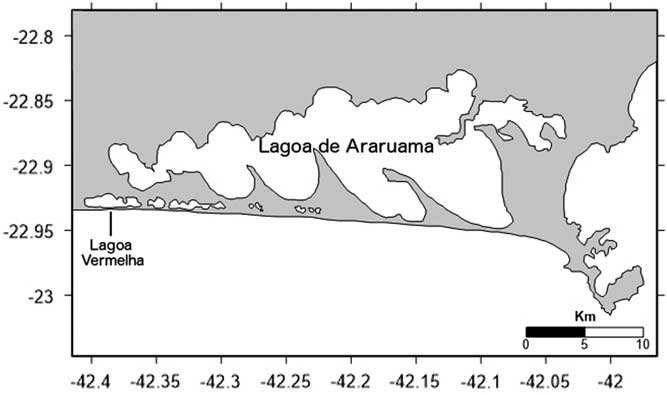
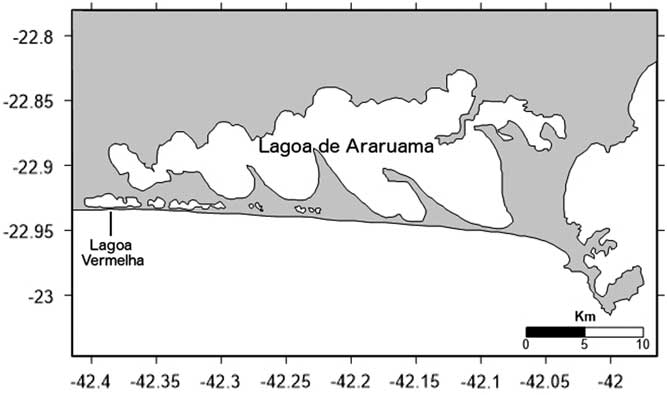
Samples of stromatolites were collected at the southern margin of a hyper-saline lagoon, Lagoa Vermelha (22º55′58″S, 42º23′35″W), in January 2013. This lagoon is located between the municipalities of Saquarema and Araruama in Rio de Janeiro State, Brazil (Figure 1).
Study region on the coast of Rio de Janeiro State.
The lagoon has an area of 2.5 km2, with 4.4 km in extension and width varying from 250 to 800 m, with depths varying from 0.2 to 1.7 m, separated from the ocean by a coastal chain 9 m high and 350 m wide, a barrier developed after a strong transgressive period and subject to a semi-arid climate due the occurrence of an upwelling zone (Barbiére Reference Barbiére1985). Lagoa Vermelha is under the influence of strong winds and the water column is not stratified (Höhn et al. Reference Höhn, Tobschall and Maddock1986), being homogeneous in its whole extension. The lagoon was formed during the most recent Quaternary regression and it is located between two quartz rich sandbanks (Coe Netto Reference Coe Netto1984).
In periods of drought the lagoon experiences a high rate of evaporation, with a 6-m recoil in relation to rainy seasons, leaving the bottom visible, with a cover of algae, gelatinlike and laminated with 2–8 cm in thickness (Santelli Reference Santelli1988). In this same environment flat, laminated gelatinous mats (3–6 cm thick) develop and distribute through the edges of the lagoon up to 30–40 m from the margins (Höhn et al. Reference Höhn, Tobschall and Maddock1986).
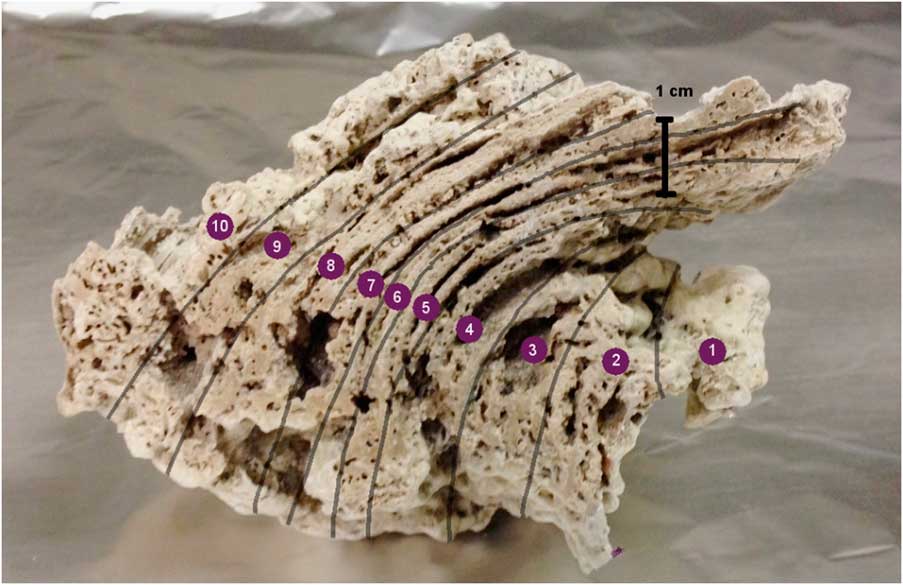
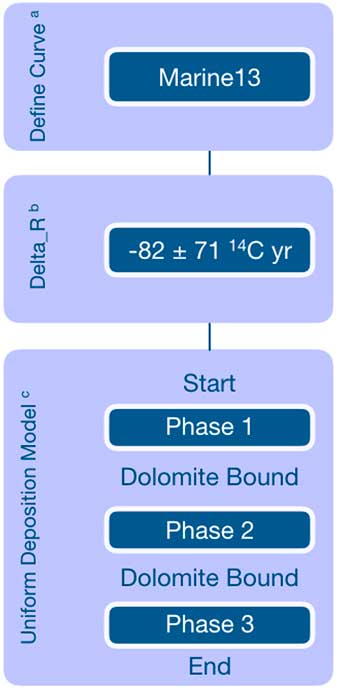
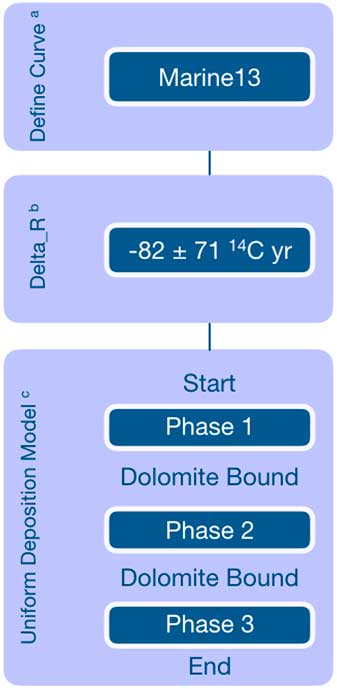
The individual stromatolite analyzed in this work was 20 cm in diameter and 7 cm high. The samples for 14C dating were prepared and analyzed at the Radiocarbon Laboratory of the Fluminense Federal University (LAC-UFF). The stromatolite was subdivided in 10 arbitrarily defined layers (Figure 2) following its growth pattern, from the bottom (oldest layer) to the top (youngest layer). Thickness of such layers (1.0–1.75 cm) were based on operational conditions only. These samples were treated with hydrogen peroxide in order to remove organic matter. Individual subsamples of approximately 40 mg were chemically treated with HCl and converted to CO2 by hydrolysis with H3PO4. Graphitized samples were measured in a NEC 250 kV single stage accelerator system (SSAMS) (Macario et al. Reference Macario, Gomes, Anjos, Carvalho, Linares, Alves, Oliveira, Castro, Chanca, Silveira, Pessenda, Moraes, Campos and Cherinsky2013, Reference Macario, Oliveira, Carvalho, Santos, Xu, Chanca, Alves, Jou, Oliveira, Brandão, Moreira, Muniz, Linares, Gomes, Anjos, Castro, Anjos, Marques and Rodrigues2015). Typical currents were 50 μA12C–1 (measured at the low energy Faraday cup). Graphite standard and calcite blanks yielded average 14C/13C ratios of 6×10–13 and 7×10–13, respectively. The average machine background was around 50 kyr for the unprocessed graphite, while the average precision ranged from 0.3 to 0.5%. Data analyses were carried on LACAMS software (Castro et al. Reference Castro, Macario and Gomes2015). Calibration of each estromatolite 14C age was performed with the OxCal software v4.3 (Bronk Ramsey Reference Bronk Ramsey2009a) using the Marine13 calibration curve (Reimer et al. Reference Reimer, Bard, Bayliss, Beck, Blackwell, Bronk Ramsey, Grootes, Guilderson, Haflidason, Hajdas, Hatté, Heaton, Hoffmann, Hogg, Hughen, Kaiser, Kromer, Manning, Niu, Reimer, Richards, Scott, Southon, Staff, Turney and van der Plicht2013) in the 2σ range. A chronological growth model (Bronk Ramsey and Lee Reference Bronk Ramsey and Lee2013) was constructed assuming uniform growth in separate sections of the stromatolite. Boundaries were set at layers A04 and A07 relative to mineralogical composition changes, with a general outlier model (Bronk Ramsey Reference Bronk Ramsey2009b) with 5% prior probability. The local reservoir offset was assumed to be –82±71 14C yr as the closest determination available in literature from the paired terrestrial and marine samples of the Manitiba archaeological site (22°55′66″S, 42°29′00″W) dated to 4.2–3.6 ka cal BP (95.4%) in Saquarema (Carvalho et al. Reference Carvalho, Macario, De Oliveira, Oliveira, Chanca, Alves, Souza, Aguilera and Douka2015). Old carbon incorporation was not considered since there are no carbonate rocks in this region (Jansen et al. Reference Jansen, Cavalcanti and Lamblém2012).
The studied stromatolite showing the arbitrarily defined sampling layers.

X-ray diffraction (XRPD) analysis was used to investigate the crystalline structure of the powdered samples. The samples preparation and analysis were undertaken at the Laboratório de Difração de Raios X of the Fluminense Federal University (LDRX – UFF). A Bruker AXS D8 Advance (Cu Kα radiation, 40 kV, 40 mA) model was operated in a Bragg–Brentano θ/θ configuration, with the diffraction patterns being collected in a flat geometry with steps of 0.02 degrees and accumulation time of 2.0 s per step using a PSD detector (Bruker AXS LynexEye model). The XRPD data were refined following the Rietveld method with the GSAS-II software (Toby and Von Dreele Reference Toby and Von Dreele2013).
RESULTS
Mineral Composition
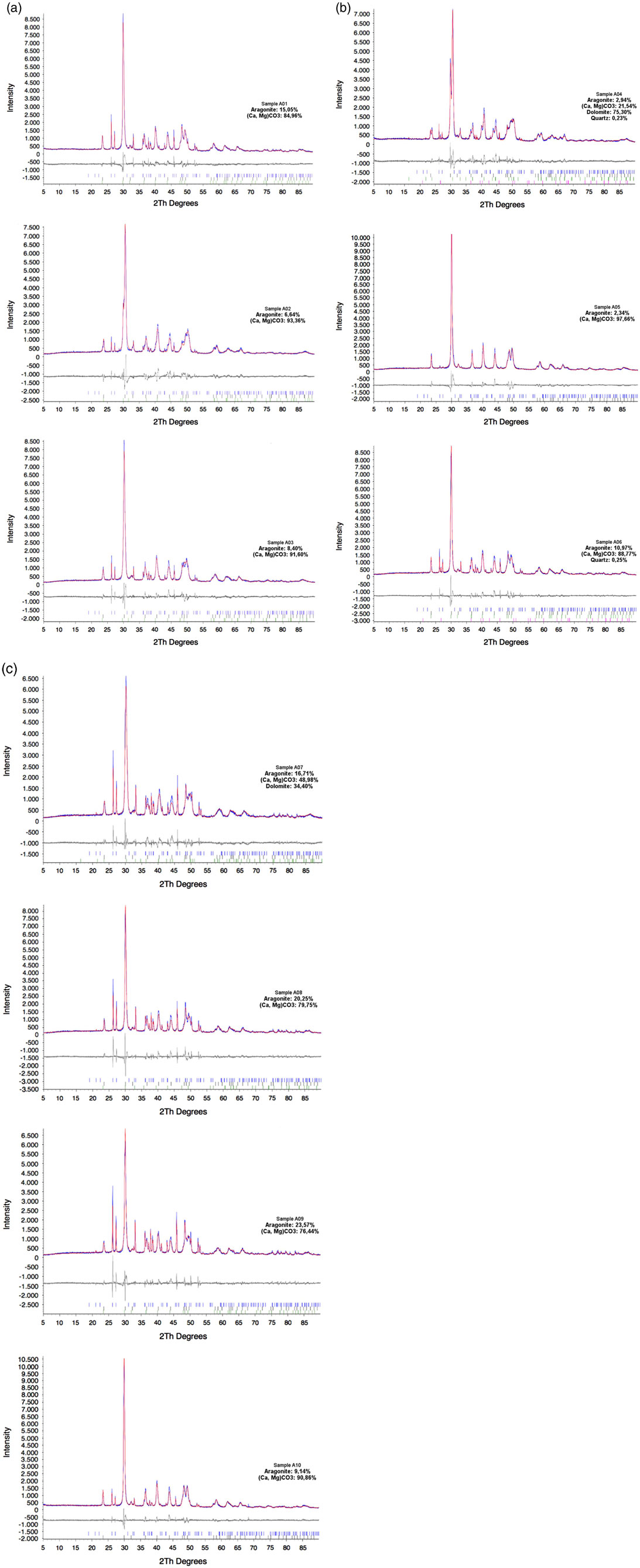
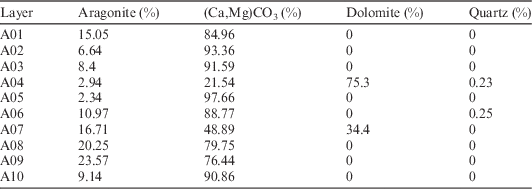
Table 1 and Figure 3 show the results of X-ray diffraction of the different operationally defined layers of the stromatolite shown in Figure 2. High magnesium calcite (HMC), represented by (Ca, Mg)CO3, predominates in most layers. Aragonite was present in all layers, whereas dolomite and quartz were detected in only two of them. No other differences in the mineral composition were found between central layers (A03-A08) and clotted layers (A01-A02, A09-A10).
X-ray diffractograms of each arbitrarily defined layer: (a) samples from A01-A03 layers—section 1 (S1); (b) samples from A04-A06 layers—section 2 (S2); (c) samples from A07-A10 layers—section 3 (S3).

Mineral composition of each arbitrarily defined layer.

The small amounts of quartz found by XRD probably came from the sand grains attached to or embedded within the mineral matrix. Although Lagoa Vermelha is surrounded by sandbanks, authigenic (Ca, Mg)CO3 minerals largely predominated, which shows similarity to Precambrian stromatolites. Recent stromatolite accretion is strongly influenced by the incorporation of a large amount of trapped grains (Spadafora et al. Reference Spadafora, Perri, Mckenzie and Vasconcelos2010).
Growth Rate
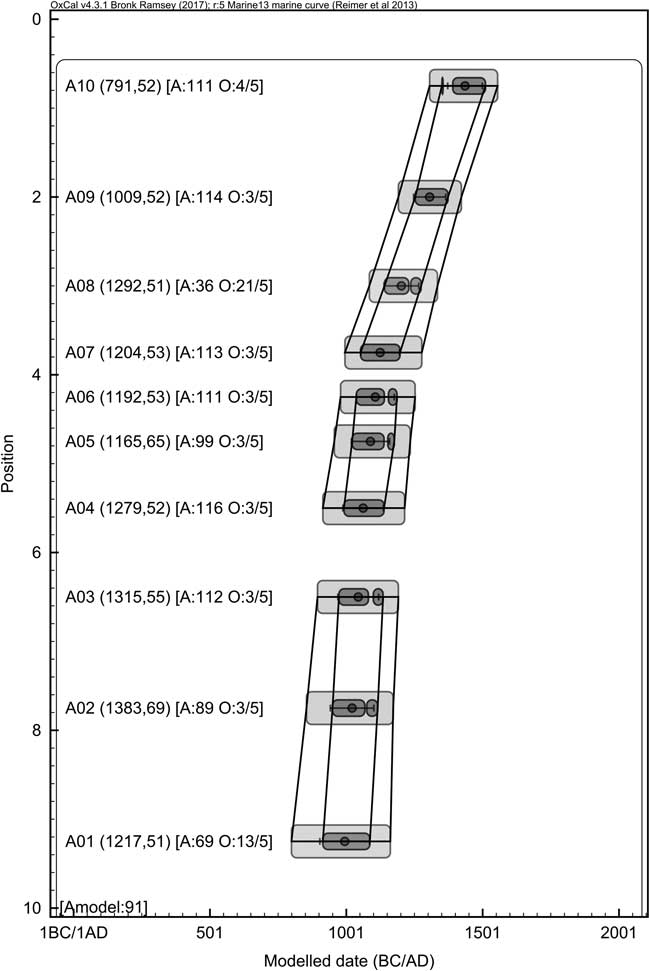
Table 2 shows the results for conventional 14C dates for each layer analyzed as well as calibrated and modeled ages. The model presented in Figure 4 assumes uniform growth in each of three sections. Figure 5 shows a block diagram that represents the computational code used in the growth model on the OxCal software. Boundaries were set at each dolomite increase defining three different growth rates: from A01-A03—section 1 (S1) 0.54±0.08 mm/yr; from A04-A06—section 2 (S2) 0.29±0.05 mm/yr; from A07-A10—section 3 (S3) 0.093±0.015 mm/yr; with a mean growth rate of 0.19±0.03 mm/yr. Model agreement was 91% with posterior outlier probabilities of less than 5%, except for layer 1, with 13% and 8, with 21%.
Growth model considering uniform growth between operationally defined layers: from A01-A03 (Section 1), A04-A06 (Section 2), and A07-A10 (Section 3). Envelopes correspond to 1σ and 2σ ranges and dots represent mean values.

Block diagram that represents the computational code used in the growth model considering uniform growth in each of the defined sections.
Results for conventional 14C age, calibrated and modeled ages (in the 2σ range) for each arbitrarily defined layer.

DISCUSSION
The gross morphology is characteristic of “biscuit” microbialites and the presence of quartz in the diffractograms indicate the autochthonous origin of the stromatolite. Lamination is evidenced only by color differences and the two upper layers seemed to fuse in a denser region. Growth rate in this region is difficult to evaluate because the natural layering is not well-defined. If color variations are taken as evidence for layering, then each layer would form in 20–30 yr. On the other hand, denser regions show a smaller empty volume, and thus the mass increase partially counterbalances the decrease in the number of natural layers.
Carbonate sedimentation studies conducted by Vasconcelos (Reference Vasconcelos1988) in Lagoa Vermelha indicated that the most abundant fractions in top sediments are aragonite and Mg-calcite. According to the authors, Mg-calcite after its deposition can be converted to dolomite that is formed in dryer environmental conditions. Dolomite formation is a result of the coalescence of carbonate nanoglobules around degraded organic matter nuclei (biomineralization) (Spadafora et al. Reference Spadafora, Perri, Mckenzie and Vasconcelos2010). Several authors have shown that the formation of dolomite is favored when there is high availability of Mg+2 (van Lith et al. Reference Van Lith, Vasconcelos, Warthmann, Martins and McKenzie2002; Dupraz and Visscher Reference Dupraz and Visscher2005; Spadafora et al. Reference Spadafora, Perri, Mckenzie and Vasconcelos2010). Following van Lith et al (Reference Van Lith, Vasconcelos, Warthmann, Martins and McKenzie2002) in Lagoa Vermelha, high Mg-calcite is formed before dolomite. This can be confirmed in the present work by the high content of Mg-calcite (Ca, Mg)CO3 in different layers of the stromatolite. Indeed, many factors are important for dolomite formation such as temperature increase that may contribute to evaporation, resulting in salinity enhancement. Anjos (Reference Anjos2004) investigated salinity and δ18O seasonal variations for Lagoa Vermelha waters and found salinity between 45 and 120, higher than sea water as expected, and δ18O indicated intense evaporation periods. However, those results do not confirm seasonal variations, showing that they can be due to local climatic events.
Lagoa Vermelha water has a typical seawater Mg/Ca molar ratio of 5 indicating a seawater origin, modified by evaporation and dilution processes (van Lith et al. Reference Van Lith, Vasconcelos, Warthmann, Martins and McKenzie2002; Moreira et al. Reference Moreira, Walter, Vasconcelos, McKenzie and McCall2004). According to Müller et al. (Reference Müller, Irion and Förstner1972) HMC can be expected when Mg/Ca ratios exceed 2. Moreover, the concomitant occurrence of aragonite and HMC in all layers may reflect different seasonal conditions during the formation of the stromatolite. In Coorong Lagoon, Australia (Botz and Borch Reference Botz and Von Der Borch1984), the occurrence of aragonite was related to periods of lower salinity. The hypothesis of dolomite dilution by groundwater inflow into the Lagoa Vermelha has already been addressed by Höhn et al. (Reference Höhn, Tobschall and Maddock1986) and Moreira et al. (Reference Moreira, Patchineelam and Rebello1987) interpreting pore-water chemistry and mineral occurrence. However, such hypotheses are not exclusive, they are complementary. The presence of dolomite in layers A04 and A07 endorses some climate change, going through a more arid period, while its absence may be due to greater precipitation and groundwater flow in the region.
Arid conditions in the Late Holocene were also described for fish bones found in archaeological shellmounds (calibrated 14C ages ranging between 4632 and 3211 cal BP) in Rio das Ostras (RJ) (22°31′40″S, 41°56′22″W) and Saquarema (RJ) (22°55′66″S, 42°29′00″W) (Aguilera et al. Reference Aguilera, Belem, Angelica, Macario, Crapez, Nepomuceno, Paes, Tenório, Dias, Souza, Rapagnã, Carvalho and Silva2015). Diagenesis, which depends primarily on climate conditions (Marean Reference Marean1991), can be recognized from several geochemical alterations that occur at different stages after the burial. The diagenetic imprints in bones observed in Saquarema suggested even drier depositional environmental conditions in comparison to Rio das Ostras showing that Lagoa Vermelha region was also subject to this kind of environmental changes.
Environmental conditions can also be evaluated by the analysis of growth rate. The range of observed values of growth rate were similar to those obtained in other studies. Petryshyn (Reference Petryshyn, Corsetti, Berelson, Beaumont and Lund2012) estimated the growth rate of sub-fossil stromatolites from alkaline Walker Lake in Nevada varying between 0.07 to 0.39 mm/yr, at the borders and center of the stromatolite, respectively. Paull et al. (Reference Paull, Neumann, Bebout, Zabielski and Showers1992) estimated stromatolite growth in a coastal hyper-saline lagoon as one natural layer in 21 yr or 0.16 mm/yr. Andersen et al. (Reference Andersen, Sumner, Hames, Webter-Brown and McKay2011) estimated the growth of stromatolites from freshwater Lake Untersee (Antarctica) as 1 mm in 40 yr or 0.025 mm/yr. Bahniuk et al. (Reference Bahniuk, Mckenzie, Montluçon, Eglinton, França, Matsuda, Anjos and Vasconcelos2013) estimated the growth of a recent sub-fossil stromatolite (2300–200 BP) from the coastal hyper-saline Lagoa Salgada to be about 0.1 mm/yr.
The chronological model shows the growth evolution of each layer and indicates a change in the stromatolite growth rate about 1060 cal AD, reflected in the composition of layer A04 with 75% dolomite. An even more pronounced decrease in growth rate is observed at 1120 cal AD, related to layer A07 with 34% dolomite. The lower growth rates corroborate the scenario of a more arid environment, with higher temperatures and consequently promoting water evaporation and salinity enhancement. The stomatolite then grew until approximately 1440 cal AD with a rate of 0.09 mm/yr.
At that time, a global climatic event took place, the so-called Little Ice Age (LIA). During approximately 1400–1800 AD, non-tropical Northern Hemisphere continents suffered significant cooling, affecting atmospheric circulation and causing episodes of wetter or drier conditions recorded in several parts of the world (Mayewski et al. Reference Mayewski, Rohling, Stager, Karlén, Maasch, Meeker, Meyerson, Gasse, van Kreveld, Holmgren, Lee-Thorp, Rosqvist, Rack, Staubwasser, Schneider and Steig2004; Mann et al. Reference Mann, Zhang, Rutherford, Bradley, Hughes, Shindell, Ammann, Faluvegi and Ni2009). Low-latitude continental areas became more arid as the trade winds strengthened and the Intertropical Convergence Zone (ITCZ) shifted southward (Goni et al. Reference Goni, Aceves, Benitez-Nelson, Tappa, Thunell, Black, Muller-Karger, Astor and Varela2009; Gutierrez et al. Reference Gutierrez, Sifeddine, Field, Ortlieb, Vargas, Chavez, Velazco, Ferreira, Tapia, Salvatteci, Boucher, Morales, Valdes, Reyss, Campusano, Boussafir, Mandeng-Yogo, Garcia and Baumgartner2009). A few studies in the southeastern Brazilian coast report strong storm events at 1560–1700 AD (Oliveira et al. Reference Oliveira, Macario, Simonassi, Gomes, Anjos, Carvalho, Linares, Alves, Castro, Souza and Marques2014; Almeida et al. Reference Almeida, Barbosa, Cordeiro, Seoane, Fermino, Silva and Turcq2013) and increase in upwelling in the last 700 yr (Mahiques et al. Reference Mahiques, Bícego, Silveira, Sousa, Lourenço and Fukumoto2005; Souto et al. Reference Souto, Lessa, Albuquerque, Sifeddine, Turcq and Barbosa2011). The increase in aridity indicated by both mineral composition and decrease in growth rates of the stromatolite of Lagoa Vermelha, leading to its eventual death at about 1440 AD may be a reflection of the local atmospheric changes following LIA.
CONCLUSION
The study of stromatolite growth rate by 14C dating using AMS associated with mineralogical characterization by X-ray diffraction has allowed the development of a palaeoenvironmental study in the Lagoa Vermelha in the State of Rio de Janeiro, Brazil. The authors were able to correlate possible climate changes that could increase preferential precipitation of specific minerals. Based on the observed results, we conclude that a possible increase in local aridity may have been responsible for the observed increase in dolomite concentration within the stromatolite structure and that LIA could be responsible for the end of stromatolite growth. For the chemical preparation of stromatolites for 14C-AMS analysis, standard carbonate protocols could be applied, provided organic matter was previously removed with hydrogen peroxide.
ACKNOWLEDGMENTS
The authors would like to thank Brazilian financial agencies CNPq (Conselho Nacional de Desenvolvimento Científico e Tecnológico, 311354/2016-5, 305079/2014-0) and FAPERJ (Fundação de Amparo à Pesquisa do Estado do Rio de Janeiro, E-26/111.278/2014, E-26/110.138/2014, and INCT-FNA 464898/2014-5) for their support. KD Marcario would like to thank Dr Mike Dee for discussion of OxCal modeling.