Introduction
Transition to the maternal role is one of the most important developmental events in life (Shin & White-Traut, Reference Shin and White-Traut2007). This transition requires the transformation of goals, behaviours and responsibilities in order to achieve a new concept of self (Mercer, Reference Mercer2004; Rafii et al., Reference Rafii, Alinejad-Naeini and Peyrovi2020). When preterm labour occurs, stress is added to the developmental crisis of motherhood, and the situation becomes more complicated when the baby is admitted to a neonatal intensive care unit (NICU) (Lee et al., Reference Lee, Long and Boore2009).
Parenting a preterm neonate is a challenging task (Boykova & Kenner, Reference Boykova and Kenner2015). Numerous studies have emphasized the effect of patterns on maternal perception of maternal role attainment. McBride and Shore (Reference McBride and Shore2001), in their study of different populations, concluded that maternal role attainment can be influenced by cultural perspectives. While childbirth is a biological event, the experience is influenced by social structure, which is shaped by cultural perceptions and practices (Kaphle et al., Reference Kaphle, Hancock and Newman2013). Culture can be defined as an integrated pattern of human behaviours, including language, thoughts, communications, practices, customs and beliefs – and values of racial, ethnic, religious and social groups (Lewallen, Reference Lewallen2011). Cultural beliefs affect all aspects of our lives. The ‘culture of childbearing’ is what happens to women in a society during childbirth. For example, now and historically, in some societies, childbirth is treated as a disease, and in others it causes little change in the daily life of the family (Moore, Reference Moore1972).
Every society has specific cultural practices and beliefs related to childbirth, and what is considered a vital practice in one culture may not be considered significant in another. In order to provide the highest quality health care, the religious, cultural and language needs of mothers must be considered (Fraser & Cooper, Reference Fraser and Cooper2003). The majority of women progress into the process of childbearing in a way that is largely predetermined by the culture in which they have been socialized. At the same time, however, this experience is shaped by the pressures of economics, religion and kinship, and the increasing complexity of communication and technology (Steinberg, Reference Steinberg1996).
Due to the structure of Iranian culture, which values ‘perfection’, having a preterm neonate baby in an NICU makes parents disappointed – especially the mother, who considers her ‘abnormal baby’ to be a source of social stigma and shame (Heidari et al., Reference Heidari, Hasanpour and Fooladi2012). These negative social reactions may prevent a healthy transition to motherhood (Shin, Reference Shin2004). According to a study by Ahmadifaraz et al. (Reference Ahmadifaraz, Abedi and Azarbarzin2014), Iranian women are emotional and child-centred and have always been concerned with the ‘proper’ mothering role. In Iranian and Islamic culture, the concept of the family finds meaning with childbearing (Behjati-Ardakani et al., Reference Behjati-Ardakani, Navabakhsh and Hosseini2017), which is considered to be a source of family stability, security, identity and pride. In addition, parenting is recognized as a source of economic, social and credit support, and of marital security and care in old age. (Abbasi-Shavazi et al., Reference Abbasi-Shavazi, Inhorn, Razeghi-Nasrabad and Toloo2008).
The main role of nurses is to provide safe and evidence-based care to promote optimal delivery outcomes for all women. Nurses should treat each woman as an individual (Lewallen, Reference Lewallen2011). Understanding women’s experiences of preterm birth in a particular cultural context will help understand how cultural context affects women’s health, family relationships and the gender experience. This information can also help caregivers and nurses provide sensitive and supportive care for the mothers of premature babies (Lee et al., Reference Lee, Norr and Oh2005). The purpose of this study was to explore the cultural context of maternal role attainment in Iranian mothers with preterm infants and its high importance in achieving the role of mothering using a qualitative approach.
Methods
Study setting and design
This study formed part of a qualitative grounded theory study aimed at exploring the process of maternal role attainment in Iranian mothers with preterm neonates. Qualitative analysis of physiological, psychological and cultural aspects of maternal role attainment was made to obtain information from the perspective of mothers (Aktaş & Aydın, Reference Aktaş and Aydın2019).
The study was setting was three level III NICUs affiliated to the Iran University of Medical Sciences in Iran. NICUs in Iran consist of two spaces: NICU and Post NICU. Preterm neonates are admitted after birth to an NICU if they have life-threatening conditions and need intensive medical care. When the neonate’s condition is stabilized, they are transferred to the Post NICU for weight gain and preparation for discharge. Both areas are considered as intensive care areas, and in order to prevent infection transmission, access is limited to the neonate’s parents, who are allowed to be with the baby at any time. The main principles and policies in both areas are the same, so in the present study, participants were selected from both areas. Data were collected from April 2019 to January 2020.
Study participants
Data collection lasted approximately 11 months. The main participants in this study were the mothers of preterm neonates admitted to the NICU recruited based on purposive sampling; the secondary participants were NICU nurses, who were recruited by theoretical sampling. Maximum variation in sampling was considered in terms of maternal age, type of delivery, education level, neonatal gestational age, admission date and participant’s (mothers and nurses) selection from NICUs and Post NICUs. Eligibility criteria for participation in the study were: primiparous mother aged over 18 years, living with spouse, Persian speaking, hospitalization of her infant for at least 2 weeks, willingness to participate in the study and not having any physical or mental illness.
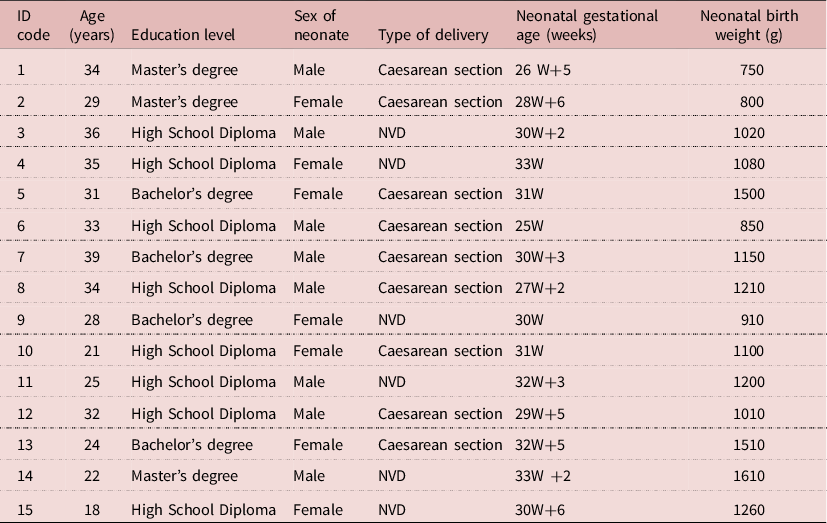
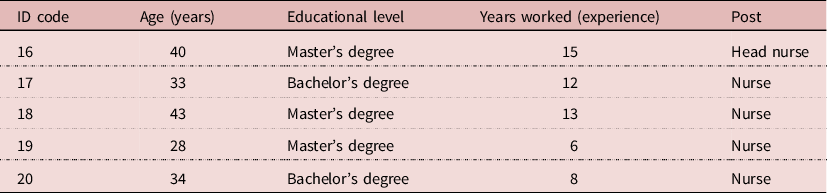
The first participant was a mother of a preterm neonate who was selected purposefully based on the goals of the study and with the help of the NICU head nurse, who had long contact with the mothers admitted to the NICU. Also, given that taking full care of the baby and staying with her/him for 3 months, and being able to maintain a good relationship, was considered to provide the richest information. Sampling continued theoretically to achieve data and conceptual saturation (Corbin & Strauss, Reference Corbin and Strauss2014). A total of 20 interviews with 20 participants (15 with mothers of preterm neonates in NICUs and 5 with NICU nurses) were conducted. The participants’ characteristics are shown in Tables 1 and 2.
Participant mother characteristics

NVD: Normal Vaginal Delivery.
Participant neonatal nurse characteristics

Data collection
Data collection and analysis proceeded concurrently until data saturation was achieved. Data were collected by the principal researcher using a semi-structured interview technique and making observations. Semi-structured interviews allow respondents to relay their experiences and observations without the restrictions imposed by quantitative data gathering methods (Smith et al., Reference Smith, Steelfisher, Salhi and Shen2012).
Interviews lasted about 75 minutes on average, and were carried out individually in a convenient and quiet location in the NICU, taking into account environmental and time conditions and the degree of tolerance and willingness of the participants (mothers and nurses). At the beginning of each interview session, participants were informed about the aim of the study, confidentiality of data collection and the voluntary nature of participation in the study. The participants (mothers and nurses) were informed that the interviews would be recorded were ensured of the confidentiality of the information and the recorded audiotapes. They were informed that they could withdraw from the study whenever they wanted to. There were no consequences for individuals who did not want to participate in the study. Participants (mothers and nurses) were time to read the informed consent form thoroughly before signing.
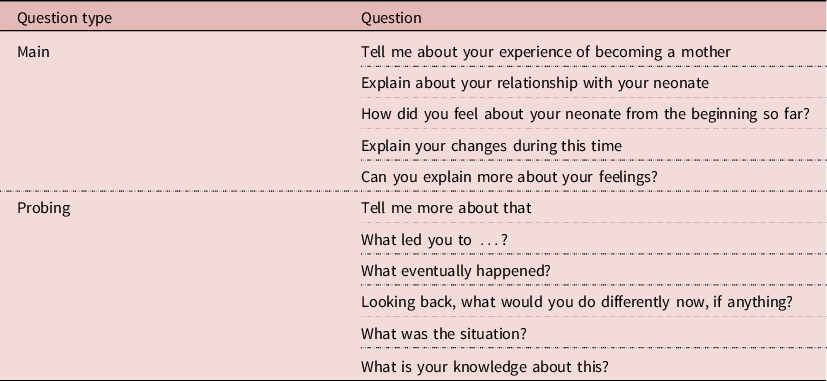
All non-verbal behaviours, facial expressions and eye contact were monitored during the interview. The interviews were transcribed verbatim simultaneously after data collection, and observations were made during the interview, including interactions between the mother and neonate, which were recorded. Interviews usually began by asking the mothers the main questions. The more general questions gave participants the opportunity to guide and lead the direction of the interview. The interview guide was developed based on a literature review and discussions with supervisors (Table 3). Interview topics included participants’ sense of mothering. The transcripts were analysed concurrently with data collection, and the interview guide was continually refined and adapted based on participant responses. Probing questions were also asked depending on the participants’ responses.
Interview guide

Data analysis
A constant comparative analysis technique was used to analyse the data. Once each interview was completed, the first author transcribed it verbatim, wrote memos, familiarized herself with the data by multiple readings and generated initial codes. All coding was double checked against the original transcripts by the senior coauthors. Codes were repeatedly compared by the research team in order to search for themes, and these themes were further reviewed and defined, and ultimately formed the structure of this report. This technique allows the codes to be freely generated (Corbin & Strauss, Reference Corbin and Strauss2014). Data saturation was determined when no new themes emerged from three additional interviews.
Guba and Lincoln (Reference Guba and Lincoln1994) recommended four criteria for ensuring the trustworthiness of qualitative research: credibility, dependability, confirmability and transferability. To ensure credibility, other possible meanings in the data were always looked for. The first author discussed the themes that emerged and the interpretations with the second author, and his comments were taken into consideration throughout the study. Prolonged engagement with the research participants (mothers and nurses) was also performed. To confirm the dependability and confirmability of the data, some of the interview texts, codes and extracted categories were examined by a panel of experts. Also, the study aimed to provide a rich description of the data to enhance the vividness and the transferability of the findings. Transferability was achieved by providing descriptions of women’s social context, so giving a sense of their life experiences.
Results
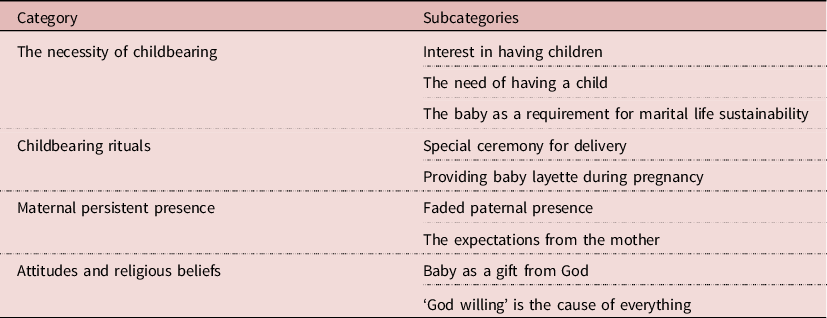
The concept of ‘childbearing culture’ emerged in the context of maternal role attainment in the mothers of preterm neonates. This comprised four categories: ‘The necessity of childbearing’, ‘Childbearing rituals’, ‘Maternal persistent presence’ and ‘Attitude and religious beliefs’ (Table 4). Also, the grounded theory study, of which the present study was a part, indicated that mothers’ main concern was their baby’s health and normal growth and development, and ‘Concern-oriented mothering’ was also taken as a core variable.
Childbearing culture categories and subcategories

Category 1: The necessity of childbearing
The category ‘Necessity of childbearing’ had three sub-categories: ‘Interest in having children’, ‘The need of having a child’ and ‘The baby as the requirement for marital life sustainability’. The need for childbearing has always been considered a feature of Iranian and Islamic culture, and many participants (mothers and nurses) emphasized the need, and in some cases the compulsion, to have children. One of the reasons for this was the importance of forming a family in Iranian culture and having an extended family:
… not to say it is compulsory, but after a few years, you both want to have child, and your family members tell you … You feel the need for it … In Iran, it is like this … Now it is better than before, before there were more coercions and interferences, but anyway, it does not seem like you do not have children. (P7)
One NICU nurse described the absence of a baby as a ‘disaster in life’ for some families due to the need to have a child in Iranian culture, from her experience in the NICU:
In general, in any society, culture affects the whole life of individuals; as in Iranian culture, which seems much more and more important due to the necessity of forming a family. Of course, our culture is composed of a whole subculture that each has its own customs, and we, the referral hospital, see these things more. Paying attention to the child and the importance of having the child in some families is too much; for example, they consider not having a child as a disaster for themselves. And they cannot cope without having children at all. (P18)
Of course, in addition to the need to have a child, many participants expressed an interest in having a baby, saying that both they and their families expressed an interest in having a baby sometime after marriage:
Anyway, a few years after marriage, you both want to have children and others tell you. I loved it myself. I realized that both my mother and my mother-in-law would love to have children. In Iran, eventually, almost everyone likes to have grandchildren. (P7)
On the other hand, many mothers reported that having, and wanting, a baby was a factor in the continuation of their marriage, and they considered that not having children would destroy their marriage. They referred to their baby as a ‘point of hope in life’ and saw the potential loss of their preterm baby as a great threat to the future of their marriage. One NICU nurse stated:
We had a mother who had a preterm baby with an anomaly, but even though the doctor told her that staying with this child would only be a problem for you, she would say no… I want this child… My wife is going to get married, maybe I can live with a disabled child, but what can I do without my spouse and income? … Where can I go back? … These worries all stem from our culture as well as our social problems. … (P16)
Another mother said:
After my preterm baby was born … the doctors had to remove my uterus … this was my last chance to have a baby … if this baby is not alive, my life will be ruined … (P2)
Category 2: Childbearing rituals
The category ‘Childbearing rituals’ had two subcategories: the ‘Special ceremony for delivery’ and the ‘Providing baby layette during pregnancy’. Childbearing rituals in a culture include customs and behaviours that are performed in the family before, during and after childbirth, which in Iranian culture include providing the baby’s layette, preparing the baby’s room and rituals specific to certain subcultures. For a mother with a premature baby and who has experienced a sudden and unprepared birth, these might not have been done not been done, or will have been delayed – and sometimes the women themselves are blamed:
I had the baby room ready early in the pregnancy. We have a tradition of bringing layette, which of course did not get there, but everything was ready. We thought we had two more months. I wanted to do a lot of things later. None of them happened at all … I’m very upset now. (P11)
Also, many mothers talked about planning and preparing themselves, their baby equipment and the home environment before giving birth, which was often left half-done due to the prematurity of the baby:
… I was getting ready, I was cleaning the house. I had bought her clothes. I had already prepared everything, but I was not thinking about this event at all, what could be done! This is what happened. When we brought the baby home, I wanted to invite the family to come and see the layette, which, of course, the premature baby should not meet, and not everything is perfect. But again, I thank God. It is good that the child is healthy. (P4)
Category 3: Maternal persistent presence
The category ‘Maternal persistent presence’ had two subcategories: ‘Faded paternal presence’ and ‘Expectations from the mother’. Caring for a preterm infant requires spending a long time in hospital and long-term care involvement, which can present great difficulties for the mother. Also, in Iranian culture the baby’s father is usually busy outside the home and it is the mother who is the main caregiver for the baby. In the case of a preterm baby, the burden of prematurity is more on the mother and will affect her more, and she is usually alone in this responsibility:
… I always think that this burden is on me now. I know well that my husband is also being harassed, but I still think to myself that all the children’s care is with me. And I’m much more annoyed than my husband as a father. (P14)
An NICU nurse also spoke about the low involvement of fathers in child care in Iranian culture and the negative emotional influences of this on the mother:
In my opinion, the burden of child responsibility in our culture lies with the mother, which means that the father is responsible for making the money outside the home and the mother is responsible for what should be done inside the home. From the moment a child is born, most of the baby care is the responsibility of the mother. The same goes for preterm neonates. It is true that the father also comes and worries, but what I have seen in these years is that mothers always take care of a premature baby and fathers are always a few steps behind mothers. The mother herself knows that first and foremost, caring for this child is her own business, and this feeling of loneliness is not very good and does not have good effects. In our culture, there is little father presence and it cannot be hidden. (P18)
Many mothers pointed to the high expectations others have of mothers in caring for their baby and expecting her to be ‘the best’ when providing care. They stated that this was a well-established culture in Iran, and this, along with the prematurity of the baby, put a lot of pressure on these mothers:
Everyone expects me to be the best. If something happens to the baby at any time, everyone blames me. I do my best to take good care of the baby, but overall the expectations from the mother is high. (P13)
Category 4: Attitude sand religious beliefs
The category ‘Attitudes and religious beliefs’ had two subcategories: ‘Baby as a gift from God ‘and ‘God willing’ to be the cause of everything’. Many mothers considered pregnancy, and even the birth of a preterm baby, to be a gift from God, and believed that while the birth of their preterm baby had made many changes in their lives and relationships, is was very propitious. They considered the baby to be a blessing for themselves and their families; some referred to the baby as a ‘new energy in their lives’ that had brought goodness and blessings:
Within the few months since the baby was born, there have been many changes in our lives. It is true that we all had a hard time, but this baby is a gift from God and his existence was very good for us. From the first time I found out I was pregnant, my husband’s job got much better, we had financial problems before I got pregnant, it was very bad, until I got pregnant, my husband’s business got better and prospered. Thank God everything is better. The hospital expenses were even met … God helped us. (P6)
As the mothers of preterm babies realized that they could not change what had happened, they attributed everything to God’s will. Even if their baby had problems, they still put God’s will before everything else and considered everything to be the result of destiny, and by relying on God’s will and destiny, they calmed down:
I have endured so much hardship and uncertainty since this happened to me in these few months. I really came to the conclusion that this was the hardest thing in my life and it really made me very tired. Of course, I do not want to be ungrateful, all these events were God’s will and we are satisfied with God’s will. (P7)
Discussion
The findings of this study show that the concept of ‘childbearing culture’ is a major part of the maternal role attainment process in Iran. The cultural context in which a childbirth takes place includes the necessities, do’s and don’ts, beliefs and special childbearing rituals that can affect motherhood, including that of preterm babies. In this study, mothers and nurses identified childbearing as one of the social and cultural necessities of Iranian society and many felt the need to have a child in their family. Along with their desire to become a mother, the baby was considered an essential in married life. They knew that having a preterm baby, and potentially losing it, would be a threat to their marriage.
Childbearing in many cultures has become a social expectation and is a key factor in explaining and evaluating the situation of individuals in a society. In many different civilizations and societies, myths, rituals and traditions (cultural norms), as well as references in literature and art reflecting the values and cultural norms of societies, are related to the concepts and symbols of reproduction and fertility (Behjati-Ardakani et al., Reference Behjati-Ardakani, Navabakhsh and Hosseini2017). Thus, a wide range of cultural behaviours and beliefs about fertility in all parts of the world stress the importance of childbearing and reproduction as a constant human desire for survival and immortality, and for most people the concept of family is formed with the birth of children (Behjati-Ardakani et al., Reference Behjati-Ardakani, Akhondi, Mahmoodzadeh and Hosseini2016).
Socio-cultural theories claim that childbearing is influenced by values such as gender roles, self-sufficiency, hedonism, religion and other norms (Rijken & Liefbroer, Reference Rijken and Liefbroer2009). In any culture, childbearing begins with the concept of the ‘the necessity of childbearing’ and is sometimes defined as a factor for the continuation of marital life. Fertility is considered an important event for a couple during their marriage. In many cultures around the world, fertility is a necessary and desirable goal, as well as the ultimate ideal in life. Despite the expansion and development of societies, and their economic growth and technical advances, the inability to have children is still a main factor in the disruption of relationships between couples and families (Behjati-Ardakani et al., Reference Behjati-Ardakani, Navabakhsh and Hosseini2017). The instinctive, emotional and social needs of people after marriage lead couples to have children. In the human mind and instinct, the concept of evolution and immortality is intertwined with the power of reproduction and childbearing, and therefore biological, psychological and social success in life depends on the power of the reproduction of individuals and the fulfillment of the expectations of societies (Pazandeh et al., Reference Pazandeh, Sharghi Somae, Karami Nouri and Alavi Majd2005).
Bagheri and Saadati’s study in Iran concluded that one of the most important responsibilities of the family is childbearing (Bagheri & Saadati’s, Reference Bagheri and Saadati2018). However, this is not the only reason to have children, and for parents, children are a source of happiness, joy and love, and can have social or economic benefits (and costs). Khadivzadeh et al. (Reference Khadivzadeh, Latifnejad Roudsari, Bahrami, Taghipour and Abbasi Shavazi2015), in their study in Iran, found that all couples were highly motivated to have children, which was expressed as ‘caring for family integrity’. It is noteworthy that social norms after marriage and having children reinforce the expectation that couples should have children (Khadivzadeh et al., Reference Khadivzadeh, Latifnejad Roudsari, Bahrami, Taghipour and Abbasi Shavazi2015). In traditional societies, infertile women have imperfect and worthless sexual identities. These women can be exposed to violence, marginalization and divorce, or the remarriage of their husbands (Behjati-Ardakani et al., Reference Behjati-Ardakani, Navabakhsh and Hosseini2017). The Family Protection Act of Iran (1974) also indicates the importance of fertility in Iranian society. According to Article 8 of the Act, infertility can be one of the reasons for divorce and if one of the spouses applies for divorce, it is permitted (Behjati-Ardakani et al., Reference Behjati-Ardakani, Navabakhsh and Hosseini2017). In Iranian and Islamic culture, marriage is considered a positive value and the ultimate goal for couples is to become parents within the family framework. Hence, women who fail to achieve motherhood are considered failed women, and therefore try to solve the problem by any possible means (Behjati-Ardakani et al., Reference Behjati-Ardakani, Navabakhsh and Hosseini2017). Thus, for many Iranian mothers with preterm neonates, pregnancy and the birth of a baby that is likely to die, is seen as a failure and fruitless, and results in the unfulfillment of dreams and aspirations. Sometimes they might want their baby to survive under any circumstances.
In Iranian culture, childbearing rituals include many ceremonies, beginning with the mother’s pregnancy and continuing after childbirth. Study participants pointed to the disruption of these rituals due to the prematurity of their baby. Each culture has unique meanings and customs associated with pregnancy and childbirth (Lewallen, Reference Lewallen2011). In many societies, childbirth is a time of transition and social celebration, which reflect adaptation to cultural responsibilities (Raven et al., Reference Raven, Chen, Tolhurst and Garner2007).Traditional customs related to pregnancy, childbirth and the postpartum period are believed to provide psychosocial support to women and thus reduce the risk of postpartum depression, and are considered protective for the mother (Bina, Reference Bina2008).
The family and its culture play an important role in childbearing. For many families, traditional customs and beliefs are integral to their daily lives (Chandrachood & Chandekar, Reference Chandrachood and Chandekar2014). Unlike the birth of a full-term neonate, which is considered a happy event and triggers special ceremonies, the birth of a preterm baby leaves parents feeling sad and scared. Thoughts about the child’s future are no longer focused on long-term planning, but instead on ambiguities about survival, growth retardation and future challenges (Griffin & Abraham, Reference Griffin and Abraham2006). The mother misses many of these ceremonies due to the hospitalization of her baby and the uncertainty of the baby’s survival, and can suffer from despair and a feeling of being different.
In this study, ‘Maternal persistent presence’ means the expectation that the mother of a preterm baby will perform all the maternal responsibilities without much help from the baby’s father, as is expected in Iranian culture, and this can put the mother under emotional and physical strain. As stated by Walzer (Reference Walzer2010), ‘Gender, marriage, motherhood and fatherhood are built in and between people. We do it. We recognize in certain ways, we interact in certain ways, and our society has laws and rules in certain ways that create and perpetuate certain forms of difference between men and women.’ This method of conceptualizing gender is often referred to as the ‘Doing gender’ perspective. In general, men are expected to participate fully in the economic sphere, to act as breadwinners, and are encouraged to build their individual personalities as men through their work role. Couples who have traditional images of themselves from the beginning resist other images of mother and father (Walzer, Reference Walzer2010).
Cultural factors can also play a role in the process of caring for a preterm baby – personality, individuality, culture and beliefs. The notion that women are primarily responsible for household chores, home care and childrearing still exists in many societies. Thus, although some men have changed their position to be more active and participatory in family life, the responsibility of caring for children remains with women (Rodrigues et al., Reference Rodrigues, De Lima, Neto, De Oliveira, De Paula Corrêa and Higarashi2017). Ncube et al.’s (Reference Ncube, Barlow and Mayers2016) study in southern Africa showed that the occasional absence of fathers is not uncommon, given that in that cultural context fathers do not play an active role in the primary care of newborns. Numerous studies, however, have emphasized the importance of father involvement in the care of premature infants (Fegran et al., Reference Fegran, Helseth and Fagermoen2008). Differences between the roles of men and women in everyday family life are still related to gender perspective, and it is clear that traditional power structures affect parenthood (Plantin, Reference Plantin2001). A study by Clarke et al. (Reference Clarke, McCarthy, Downie, Ashley and Anderson2009) reported that father involvement in caring for a sick child may have a positive effect on marital outcomes, as it reduces the caregiver burden (Clarke et al., Reference Clarke, McCarthy, Downie, Ashley and Anderson2009). Arockiasamy et al. (Reference Arockiasamy, Holsti and Albersheim2008), in their study in Canada, reported a father stating that he had more barriers to caring for his child because of work and other external commitments, and that he often could not spend as much time as a mother in the NICU and may feel incapable of controlling the situation According to Deutsch (Reference Deutsch2001), it is interesting to think that a ‘preterm birth can provide an opportunity for fathers to equalize the parenting experience’.
In this study, attitudes and religious beliefs were considered in the context of maternal role attainment because these are known to have a great impact on mothers and families. Many participants reported the religious beliefs of knowing that their baby was a divine gift, or believing in God’s destiny and will. In most cultures, religious beliefs are one of the strongest beliefs and are an integral part of a culture (Griffith, Reference Griffith1982). Moloney (Reference Moloney2007) stated that ‘miraculously and historically, pregnancy and childbirth have been understood as spiritual events due to the miraculous processes involved’. Religion is a belief system that forms the essence of power and is an independent variable that affects all aspects in addition to individual and social life. Public culture in Iranian society is religiously and historically very important in terms of childbearing. Children are considered a blessing from God, and childlessness is unpleasant (Behjati-Ardakani et al., Reference Behjati-Ardakani, Navabakhsh and Hosseini2017).
Bawadi and Al’Hamdan (Reference Bawadi and Al-Hamdan2017) showed that Muslims in Jordan believed that God was the author of their lives, that He was the only one who had control over them and that death and life were in His hands. Their sensitivity to God’s grace was present in all their interviews. If He blesses them with a baby, the parents must keep it. The mother must accept the will of God (Bawadi & Al-Hamdan, Reference Bawadi and Al-Hamdan2017). Callister and Khalaf (Reference Callister and Khalaf2010), in their study of Muslim woman in Tongan, found that women related a strong belief in God’s will, and felt they must be satisfied with what God had provided for them. Arzani et al. (Reference Arzani, Valizadeh, Zamanzadeh and Mohammadi2015), in Iran, found that mothers sought recourse to spirituality and entrusted the destiny determined by God, and thus struggled with the stressful event of premature birth. Behaviours such as trust in God, recourse to the prophets, adherence to the Qur’an and seeking help from God were reported by most mothers. They knew that the birth of a premature baby was God’s will and providence. In Wilkinson and Callister’s (Reference Wilkinson and Callister2010) study, most women believed that God could influence the outcome of their pregnancies. They reported that they relied on God to ensure the positive consequences of birth. This was especially common among women living in developing countries with high maternal and infant mortality rates.
The study has some strengths and limitations that should be considered when interpreting the results. One of its strengths was that it was conducted in three different NICUs in Iran, meaning diversity in sampling. Also, the exploration of the experiences of both mothers and nurses helped understand the experiences of the mothers more deeply. Also, the research team discussed and collaborated to determine the emerging codes and reach a consensus, and all team members comprehensively reviewed the participants’ interviews. One of the limitations of this study was that, as it was only conducted in limited context of NICUs in Iran, the results have limited transferability. Also, in Iranian culture, talking about family issues is sometimes difficult, although the researchers tried to minimize this by expressing empathy and with the help of communication techniques.
In conclusion, this study of maternal role attainment in the mothers of preterm infants in Iran showed that special beliefs and practices within their culture affect all their reactions to mothering process. Culture is one of the most important factors affecting the development of motherhood. Health care providers, as facilitators of this process, should be aware of the context that facilitates the process of maternal role attainment in these cultural groups. Also, in order to provide sensitive and culturally appropriate care, nurses should be aware of the general impact of cultural norms and values on the process of motherhood and be able to meet the cultural and spiritual needs of mothers. Comprehensive care occurs when culture is recognized not as a barrier to health care, but as a bridge to the best care.
Acknowledgments
The authors are grateful to the participating NICU mothers and nurses for sharing their time and experiences.
Funding
This work was supported by Iran University of Medical Sciences under Grant number 97-4-3-13845.
Conflicts of Interest
No potential conflicts of interest are reported by the authors.
Ethical Approval
The research proposal was approved by the Research Committee in Medical Research of Iran University of Medical Sciences under the code IR.IUMS.REC.1397.1312.