Much has been made of the role of the native language (L1) in learning a second language (L2). While some researchers posit that the L1 has little impact on L2 acquisition and L2 processing more generally (e.g., Clahsen & Felser, Reference Clahsen and Felser2006), others argue that the L1 plays a more prominent role (e.g., Hartsuiker & Bernolet, Reference Hartsuiker and Bernolet2015; MacWhinney, Reference MacWhinney, Gass and Mackey2012; see also Jarvis & Pavlenko, Reference Jarvis and Pavlenko2008; Odlin, Reference Odlin1989, Reference Odlin2005). Traditionally, this research has focused on the binary distinction between whether a given linguistic feature is part of the L1 grammar, and whether its presence or absence in the L1 impacts the acquisition of that feature in the L2 (e.g., Tokowicz & MacWhinney, Reference Tokowicz and MacWhinney2005; see Foley & Flynn, Reference Foley, Flynn, Herschensohn and Young-Sholten2013, for review). In recent years, researchers have adopted a more fine-grained approach by investigating whether the preference for different L1 structural alternatives influences real-time L2 comprehension (e.g., Dussias & Cramer Scaltz, Reference Dussias and Cramer Scaltz2008; Lee, Lu, & Garnsey, Reference Lee, Lu and Garnsey2013) and production (e.g., Carroll, Murcia-Serra, Watorek, & Bendiscioli, Reference Carroll, Murcia-Serra, Watorek and Bendiscioli2000; Flett, Branigan, & Pickering, Reference Flett, Branigan and Pickering2013; Gerwien & Flecken, Reference Gerwien and Flecken2015). This question addresses larger debates regarding the extent to which speakers’ prior linguistic experiences shape language production and, relatedly, language learning (e.g., Chang, Dell, & Bock, Reference Chang, Dell and Bock2006; Dell & Chang, Reference Dell and Chang2014; MacDonald, Reference MacDonald2013).
The phenomenon of structural priming, in which a speaker reuses the same linguistic structure she has recently heard or produced, is one situation in which recent linguistic experience can shape subsequent production. A repeated finding in L1 structural priming research is the inverse frequency effect, whereby one sees stronger priming with less frequent structures than more frequent structures, even among children as young as 3 years of age (e.g., Bernolet & Hartsuiker, Reference Bernolet and Hartsuiker2010; Bock, Reference Bock1986; Jaeger & Snider, Reference Jaeger and Snider2013; Peter, Chang, Pine, Blything, & Rowland, Reference Peter, Chang, Pine, Blything and Rowland2015). Such effects can be cumulative, supporting accounts of structural priming as a form of implicit learning (e.g., Hartsuiker & Westenberg, Reference Hartsuiker and Westenberg2000; Kaschak, Kutta, & Jones, Reference Kaschak, Kutta and Jones2011). However, few studies have investigated whether such inverse frequency effects extend to L2 production, and if they do, whether such effects are driven by the frequency of alternative structures in the L1, the L2, or a combination of both languages. Several recent studies have addressed this question with highly proficient L2 speakers (e.g., Flett et al., Reference Flett, Branigan and Pickering2013; Ruf, Reference Ruf2011; Shin & Christianson, Reference Shin and Christianson2012), often concluding that L1 frequency has only minimal impact on the magnitude of L2 priming. However, it remains an open question whether L1 frequency matters among less proficient L2 speakers, a timely question in light of models positing that L2 learners initially rely on L1 representations when acquiring the L2 grammar (e.g., MacWhinney, Reference MacWhinney, Gass and Mackey2012).
To address the role of L1 frequency in L2 priming, the present study investigates the priming and subsequent production of word order variation (adverb–verb–subject vs. subject–verb–adverb order) with temporal and locative phrases among intermediate English–German L2 learners. Whereas placing nonsubject constituents in sentence-initial position is common in German, such constructions are less common in English, with the added caveat that L1 English speakers are more likely to place temporal phrases at the beginning of a sentence than locative phrases (Jackson, Reference Jackson2012). By manipulating the type of prime sentence to which English–German L2 learners are exposed, the present study capitalizes on these different fronting tendencies between English and German to investigate whether the preference for certain constructions in the L1 influences the magnitude of priming effects in L2 production among intermediate L2 learners. In addition, the inclusion of a postpriming phase allows for the measurement of both short-term priming and learners’ subsequent production in the absence of immediate priming, to address whether priming can facilitate learning. In so doing, the present study advances our understanding of the mechanisms that lead to L2 structural priming and what role L1 frequency may play in supporting such mechanisms, especially among less proficient L2 learners.
STRUCTURAL PRIMING
Structural priming refers to a speaker's tendency to repeat structures she has recently heard or produced (Bock, Reference Bock1986). For example, after encountering a passive sentence, like The elephant was transported by the truck, L1 English speakers are more likely to use a passive construction to describe a new event, like The church was struck by the lightning, rather than its active alternative, as in The lightning struck the church (Bock, Reference Bock1986; Bock, Dell, Chang, & Onishi, Reference Bock, Dell, Chang and Onishi2007). Structural priming has been documented in many languages with a wide variety of structures (see Pickering & Ferreira, Reference Pickering and Ferreira2008, for review), using both experimental techniques and through the analysis of more naturalistic corpus data (Gries, Reference Gries2005; Weiner & Labov, Reference Weiner and Labov1983).
Several theories have been posited to explain such effects. The lexicalist account explains structural priming via the residual activation of abstract syntactic representations or combinatorial nodes (Pickering & Branigan, Reference Pickering and Branigan1998). Nodes representing lexical items (e.g., verbs) are linked to nodes representing how these lexical items can be combined (e.g., noun phrase + noun phrase for double object dative constructions, like The man sends the woman a letter). During production, the node for the particular verb used (e.g., send), the node for the grammatical rule used (e.g., noun phrase + noun phrase), and the link between these two nodes are activated. These nodes and links remain active for several seconds, which leads to the repeated use of this same construction over multiple sentences. While this account can successfully explain short-lived priming effects, and the phenomenon that short-term priming is magnified in the presence of lexical overlap between prime and target sentences (i.e., the lexical boost effect), the lexicalist account has greater difficulty explaining priming effects that can extend across at least 10 intervening sentences (e.g., Bock & Griffin, Reference Bock and Griffin2000) or across multiple testing sessions that are separated by as much as a week (Kaschak, Kutta, & Coyle, Reference Kaschak, Kutta and Coyle2014).
To account for such longer lasting effects, other researchers propose that structural priming represents a form of implicit learning (e.g., Bock & Griffin, Reference Bock and Griffin2000; Chang et al., Reference Chang, Dell and Bock2006; Chang, Dell, Bock, & Griffin, Reference Chang, Dell, Bock and Griffin2000; but see Malhotra, Pickering, Branigan, & Bednar, Reference Malhotra, Pickering, Branigan, Bednar, Love, McRae and Sloutsky2008; Reitter, Keller, & Moore, Reference Reitter, Keller and Moore2011, for alternative accounts based on additional empirical data and computational modeling). More specifically, Chang et al. (Reference Chang, Dell and Bock2006) characterize priming as error-based learning and use a connectionist model to illustrate how such learning mechanisms can account for the structural priming effects seen in experimental research. In their model, when one produces a construction like a double object dative, the model weights are adjusted in favor of that construction, resulting in an increased likelihood of producing the same construction the next time such a sentence is uttered. Over time, these weight adjustments can lead to cumulative changes in the language production system, thereby promoting learning.
Further evidence to support implicit learning accounts of priming come from inverse frequency effects, whereby priming is stronger with structures that are less common (e.g., Bernolet & Hartsuiker, Reference Bernolet and Hartsuiker2010; Bock, Reference Bock1986; Jaeger & Snider, Reference Jaeger and Snider2013; Kaschak et al., Reference Kaschak, Kutta and Jones2011; Peter et al., Reference Peter, Chang, Pine, Blything and Rowland2015), or even the same structure produced in a less preferred context (Ferreira, Reference Ferreira2003). In this sense, priming mimics learning in that something that is less well known should lead to greater learning than something that is already well known. In addition, in studies that include both a baseline and a postpriming phase, production of the primed structure often remains higher during the postpriming phase than it was at baseline (e.g., Hartsuiker & Westenberg, Reference Hartsuiker and Westenberg2000).
More recently, researchers have taken a multifaceted approach to explain the mechanisms that drive structural priming (e.g., Ferreira & Bock, Reference Ferreira and Bock2006; Pickering & Ferreira, Reference Pickering and Ferreira2008). Ferreira and Bock (Reference Ferreira and Bock2006) discuss a two-locus account of structural priming whereby long-term priming results from implicit learning, while short-term effects (especially those arising from lexical repetition across the prime and target) may stem from explicit memory of the prime sentence, which can facilitate the retrieval and subsequent repetition of the prime sentence's structure (see also Hartsuiker, Bernolet, Schoonbaert, Speybroeck, & Vanderelst, Reference Hartsuiker, Bernolet, Schoonbaert, Speybroeck and Vanderelst2008, for empirical evidence supporting this account).
STRUCTURAL PRIMING AND LEARNING AMONG L2 SPEAKERS
Research investigating priming among L2 speakers has primarily focused on cross-language priming, in which the prime sentence is presented in one language and the target sentence in another language, to discern whether syntactic representations are shared across languages (e.g., Bernolet, Hartsuiker, & Pickering, Reference Bernolet, Hartsuiker and Pickering2013; Chen, Jia, Wang, Dunlap, & Shin, Reference Chen, Jia, Wang, Dunlap and Shin2013; Shin & Christianson, Reference Shin and Christianson2009; see Hartsuiker & Bernolet, Reference Hartsuiker and Bernolet2015; Hartsuiker & Pickering, Reference Hartsuiker and Pickering2008, for review). Beyond investigating the nature of L2 syntactic representations, structural priming research can also shed light on how L2 speakers come to acquire these representations over time (McDonough & Trofimovich, Reference McDonough and Trofimovich2009; Shin & Christianson, Reference Shin and Christianson2012).
In an L2 priming study with L2 English speakers in the United States from a variety of L1 backgrounds, who had obtained Test of English as a Foreign Language scores categorizing them as intermediate to highly proficient L2 English speakers, McDonough (Reference McDonough2006) found priming for prepositional object (PO) datives, as in The man takes the doll to his friend, but no significant priming for double object (DO) datives, as in The man takes his friend the doll, even after providing an input flood of DO sentences. However, those speakers who produced at least one DO sentence during the baseline phase produced more DO sentences during the priming phase than those who did not produce any DO sentences at baseline. McDonough concluded that priming may not be possible unless the L2 speaker has fully acquired the structure in question (see also McDonough & Fulga, Reference McDonough and Fulga2015).
Equally important for understanding L2 structural priming is whether the preference for a particular structure in a speaker's L1 affects the priming and subsequent learning of that structure in the L2. Shin and Christianson (Reference Shin and Christianson2012) investigated short- and long-term priming in L2 English among highly proficient Korean–English L2 speakers in the United States, with two structures that varied in their syntactic complexity and whether the same structure existed in Korean: syntactically complex DO datives, a construction present in both Korean and English, and syntactically simple phrasal verbs (e.g., The girl is turning the heater down), a construction present only in English. Long-term priming was measured using an immediate posttest and a delayed posttest 1 day later. Participants exhibited similar increases in their production of the syntactically simple phrasal verbs during the immediate and delayed posttests, relative to a baseline phase prior to the priming task. In contrast, the magnitude of priming effects on the immediate and delayed posttest was more varied with the complex DO construction, and only those participants assigned to a long-lag condition, in which the prime and target sentences were separated by four to five filler sentences, sustained their production of DO sentences on the delayed posttest. Participants assigned to no-lag conditions produced significantly fewer DO sentences on the delayed posttest than the immediate posttest. These findings suggest that structural priming involves implicit learning, even among L2 speakers. More critical for the present study, simple phrasal verbs, the construction absent from the participants’ L1, exhibited more consistent short-term and long-term priming than DO sentences, the construction present in the participants’ L1. Thus, at least among highly proficient L2 speakers, structural complexity may have a larger impact on a construction's learnability than its presence in the L1.
Flett et al. (Reference Flett, Branigan and Pickering2013) also report that L1 experience has little impact on within-language L2 priming among L2 English speakers in the United Kingdom, who were characterized as being of advanced proficiency (on average at the C1 level or above on the Common European Framework of Reference Scale). In a study investigating the priming of English PO and DO dative constructions, Spanish–English and German–English L2 speakers exhibited priming effects of similar magnitude to L1 English speakers. Critically, Spanish only allows PO datives, whereas English and German allow both types of dative constructions, although the DO construction is the more frequent alternative in German (Callies & Szczesniak, Reference Callies, Szczesniak, Grommes and Walter2008; Drenhaus, Reference Drenhaus2004; Liamkina, Reference Liamkina, Tyler, Kim and Takada2008; Meinunger, Reference Meinunger, Abraham, Hole and Meinunger2006). Thus, if L1 experience matters, the L1 Spanish speakers should have exhibited different priming patterns compared to the L1 German and L1 English speakers. However, all speakers displayed similar priming patterns, leading Flett et al. (Reference Flett, Branigan and Pickering2013) to conclude that at least among highly proficient L2 speakers, L2 priming is not influenced by the presence of particular structural alternatives in the L1.
Hartsuiker and Bernolet (Reference Hartsuiker and Bernolet2015) propose a model of shared syntax between an L2 speaker's two languages, and how such cross-language representations develop over time. They propose that, initially, L2 speakers’ representations are lexically based, with no strong links to L2 syntactic information or the combinatorial nodes that specify the grammatical rules governing how given lexical items can be used in a sentence. In this initial stage, L2 speakers rely on existing L1 representations to guide L2 speech production. They may also imitate recently heard L2 structures, as produced by native speakers or proficient L2 speakers. With increased exposure to L2 input, L2 speakers develop links between individual L2 lexical items and their corresponding L2 syntactic representations (or combinatorial nodes), with such links occurring earlier for structures that are more frequent in the L2 input. In these earlier stages, priming effects stem largely from explicit memory of a previously encountered sentence, rather than the activation of abstract syntactic representations. In such cases, priming effects are stronger when there is greater lexical overlap between a prime and a target sentence, although in certain circumstances such explicit memory strategies could operate even in the absence of such overlap. In later stages, L2 combinatorial nodes become generalized across items, but only within the L2. At the final stage, these combinatorial nodes are shared across a speaker's two languages. Only in these final two stages, at the point L2 speakers’ syntactic representations are generalized across items and, eventually, across languages, can abstract priming occur, namely, significant priming in the absence of lexical overlap and priming that stems from residual activation of abstract combinatorial nodes rather than explicit memory of recently heard sentences.
While designed to explain how cross-language priming is modulated by L2 proficiency, Hartsuiker and Bernolet's (Reference Hartsuiker and Bernolet2015) model can also account for proficiency-based modulations in within-language L2 priming (e.g., Bernolet et al., Reference Bernolet, Hartsuiker and Pickering2013; Gámez & Vasilyeva, Reference Gámez and Vasilyeva2015; McDonough, Reference McDonough2006; Ruf, Reference Ruf2011). At the same time, the model in its current form is based on a limited number of studies, many of which investigated only short-term priming among more proficient L2 speakers. By investigating short-term priming in the presence and absence of lexical overlap, alongside long-term priming through the inclusion of a postpriming phase, the present study can advance our understanding of the mechanisms that drive within-language L2 structural priming, especially among less proficient L2 speakers.
TARGET STRUCTURE
The present study investigates word order variation with temporal and locative adverbial phrases in L2 German. In both English and German the option exists to place phrases at the beginning of a sentence for emphasis, or for other discourse-related reasons, but this occurs more often in German than in English (Doherty, Reference Doherty2005; Hasselgård, Reference Hasselgård, Aarts, Meijs and Ljung1996). Although the frequency with which nonsubject constituents are placed in sentence-initial position in German varies according to genre, corpus analyses reveal that adverbial phrases, including temporal and locative phrases, appear sentence initially between 17% and 60% of the time in spoken and written German (Bohnacker & Rosén, Reference Bohnacker and Rosén2008; Engel, Reference Engel1974). As seen in (1) and (2), German is also a verb-second (V2) language, meaning that the finite verb is placed in V2 position in main clauses (SVX), regardless of whether the clause begins with the subject or another constituent.
-
(1)

-
(2)


In early stages of L2 German acquisition, speakers often rely on subject–verb–object (SVO) order, and if they place adverbial phrases sentence initially, they will likely place the subject before the verb, leading to ungrammatical verb-third sentences (XSVO; Pienemann, Reference Pienemann1998). Thus, when acquiring the V2 principle in L2 German, learners are confronted with two related difficulties. First, they must acquire the grammatical principle of V2 word order, meaning that precisely one constituent may appear preverbally in German main clauses. Second, they must acquire the discourse-pragmatic principles that characterize the fronting of nonsubject constituents in German discourse.
Ruf (Reference Ruf2011) took advantage of this word order variation in German to investigate whether L1 German speakers, highly proficient English–German L2 speakers, and intermediate English–German L2 learners would exhibit priming of XVS order with fronted locative phrases (LPs; e.g., Auf dem Tisch steht eine Lampe “On the table stands a lamp” vs. Eine Lampe steht auf dem Tisch “A lamp stands on the table”). In this study, the highly proficient L2 speakers were advanced undergraduate and graduate students studying German in the United States, who were all at the high B2 level or above on the Common European Framework Reference Scale. The intermediate L2 speakers were all enrolled in third- through sixth-semester German language courses at the same university. The study employed the confederate scripting technique (Branigan, Pickering, & Cleland, Reference Branigan, Pickering and Cleland2000), in which a participant and a confederate, who is not an actual participant, describe pictures to one another in a picture-matching task. During this task, the confederate's picture descriptions serve as scripted prime sentences for the actual participant. Participants in Ruf's study were assigned to either a condition in which prime–target sentence pairs shared the same LP or a condition in which there was no lexical overlap between the prime and target sentence. Whereas all three proficiency groups were more likely to produce fronted-LP sentences after hearing a fronted-LP prime sentence than a nonfronted-LP prime sentence, only the L1 German speakers and highly proficient L2 speakers exhibited significant priming in the absence of lexical overlap (for similar effects with fronted locatives in L1 Dutch, see Hartsuiker, Kolk, & Huiskamp, Reference Hartsuiker, Kolk and Huiskamp1999).
Further, the L1 German speakers and highly proficient L2 speakers in both the lexical overlap and no lexical overlap conditions exhibited a significant increase in the proportion of fronted-LP sentences in a postpriming phase immediately following the priming task compared to a baseline phase that preceded the priming task. In contrast, the intermediate L2 learners produced few, if any, fronted-LP sentences once the prime sentence was removed in the postpriming phase, regardless of whether they were in the lexical overlap or no lexical overlap condition. Connecting these findings to the L2 developmental model proposed by Hartsuiker and Bernolet (Reference Hartsuiker and Bernolet2015), the highly proficient L2 speakers in Ruf (Reference Ruf2011) had acquired an abstract representation for fronted-LP constructions and exhibited abstract priming for this construction, resulting in both short-term priming in the absence of lexical repetition and long-term priming, as measured by the postpriming phase. In contrast, such representations among the intermediate L2 learners were still item specific in nature, resulting in no significant priming effects beyond short-term priming in the presence of lexical overlap.
At the same time, without additional experiments involving other types of XVS sentences, it is difficult to ascertain whether such item-specific representations of fronted locative constructions among the less proficient L2 learners in Ruf (Reference Ruf2011) would extend to all types of XVS sentences in L2 German. Fronted locative constructions, although fairly common in German, are generally avoided in L1 English (Carroll et al., Reference Carroll, Murcia-Serra, Watorek and Bendiscioli2000; Jackson, Reference Jackson2012). Placing nonsubject constituents in sentence-initial position represents an important discourse-pragmatic difference between English and German, the acquisition of which can be difficult as L2 speakers often struggle in cases where a structural alternation is optional (Sorace, Reference Sorace, Cornips and Corrigan2005). Only at advanced proficiency levels do L2 German speakers produce XVS word order in spoken and written discourse with similar frequency and in similar contexts as L1 German speakers, and even then subtle differences in information organization may still remain (Carroll et al., Reference Carroll, Murcia-Serra, Watorek and Bendiscioli2000; Ruf & Larson-Guenette, Reference Ruf and Larson-Guenette2010).
While previous studies have focused on fronting tendencies in L2 German more broadly, Jackson (Reference Jackson2012) explored precisely what types of adverbial phrases are placed in sentence-initial position by English–German L2 speakers. In an oral story description task, she found that regardless of proficiency level, English–German L2 speakers produced fewer XVS sentences than L1 German speakers. Additional analyses revealed that the proportion of fronted temporal phrases (TPs) was similar for L1 and L2 German speakers. The largest between-group difference occurred with fronted LPs. Whereas the L1 German speakers fronted TPs and LPs at similar rates, the L2 German speakers were significantly less likely to place a LP in sentence-initial position than were the L1 German speakers. An analysis of comparable L1 English data revealed a similar pattern. L1 English speakers were more likely to produce subject-first sentences, and when they placed a nonsubject constituent sentence initially, this constituent was most often a TP. Only in rare cases did the L1 English speakers front LPs. In the absence of larger corpora, one should be cautious in generalizing such findings, because the principles of discourse-level information organization can vary according to modality and genre. However, these findings provide preliminary evidence that when English–German L2 speakers produce XVS sentences, they are more likely to do so by fronting a TP than a LP. This raises the possibility that even though the syntactic representation for both fronted TP and fronted LPs is identical, because syntactically speaking both are XVS word order, L2 speakers may represent fronted TPs and fronted LPs as two separate constructions in memory, and keep track of the frequency of each construction individually. Further, the strength of each construction's representation may be influenced by the frequency with which these different types of adverbial phrases appear sentence initially in speakers’ L1 English.
PRESENT STUDY
Building on Ruf (Reference Ruf2011) and Jackson (Reference Jackson2012), the present study compares the magnitude of short-term and long-term priming for fronted TPs (Experiment 1) versus fronted LPs (Experiment 2) among intermediate English–German L2 learners to investigate whether construction-specific frequencies have an impact on L2 within-language priming and the mechanisms that drive structural priming among less proficient L2 speakers. If the frequency of a given construction in learners’ L1 plays a role in the magnitude and longevity of priming effects among less proficient L2 learners, and the direction of such frequency effects parallels the inverse frequency effects reported in the L1 priming literature (e.g., Bernolet & Hartsuiker, Reference Bernolet and Hartsuiker2010; Bock, Reference Bock1986; Jaeger & Snider, Reference Jaeger and Snider2013; Peter et al., Reference Peter, Chang, Pine, Blything and Rowland2015), then one would see greater priming, and possibly even long-term priming, when the priming task involves fronted LPs, because this construction is less preferred in the learners’ L1 English (Jackson, Reference Jackson2012), as compared to fronted TPs. Conversely, if the frequency of a given construction in learners’ L1 facilitates the development of abstract L2 syntactic representations and, subsequently, the magnitude and longevity of L2 priming, then one would predict stronger priming, and possibly even long-term priming, when the priming task involves fronted TPs, a construction that is more preferred in the learners’ L1 English (Jackson, Reference Jackson2012), as compared to fronted LPs. Finally, if the frequency of a given L1 construction has no impact on the development of abstract L2 syntactic representations and, subsequently, the magnitude and longevity of L2 priming, then one would predict smaller or nonsignificant priming in the absence of lexical overlap, and no long-term priming, regardless of whether the priming task involves fronted TPs or fronted LPs, thereby paralleling the results for fronted LPs among the intermediate L2 learners in Ruf (Reference Ruf2011).
EXPERIMENT 1
Method
Participants
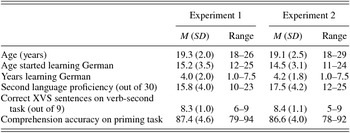
Twenty-three students from third- and fourth-semester German classes at a large American university participated for payment. Four participants performed below chance on the V2 task described below, producing the correct XVS word order on fewer than five of nine XVS sentences, so they were excluded from all analyses reported here.Footnote 1 Thus, all results are based on data from 19 participants (11 female, 8 male). Their biographical information is presented in Table 1.
Biographical information for all participants in Experiment 1 and Experiment 2

Materials
PRIMING TASK
Experimental items consisted of 40 critical prime–target sentence pairs, 5 prime–target sentence pairs for the baseline phase, 5 prime–target sentence pairs for the postpriming phase, and 100 prime–target sentence pairs that served as filler items. In the priming portion of the task, each prime and target sentence consisted of a subject, object, verb, and TP. Prime sentences varied according to syntactic structure (fronted vs. nonfronted TP) and lexical repetition of the TP between the prime and target sentence (lexical overlap vs. no lexical overlap). We chose to repeat the TP across prime–target pairs in the lexical overlap condition, rather than another constituent in the sentence (e.g., the subject or the verb) to parallel the manipulation used by Ruf (Reference Ruf2011) and to maximize the form and meaning overlap of the critical constituent under investigation. The target sentence was the same for all prime sentence conditions. Example sentences are provided below (the complete list of experimental items is available on the IRIS database: https://www.iris-database.org/; Marsden, Mackey, & Plonsky, Reference Marsden, Mackey, Plonsky, Mackey and Marsden2016).
-
(3)
-
(4)
-
(5)
-
(6)
-
(7)


All direct objects were introduced using either the indefinite article, ein “a.NEUT,” einen “a.MASC,” or eine “a.FEM,” or if the direct object was a mass noun or action they were presented without any article (e.g., Tee “tea” or Fußball “soccer”), such that for nonfronted sentences, TP-direct object word order would be the preferred word order in German, although the reverse word order (i.e., direct object-TP) is still grammatically correct (Helbig & Buscha, Reference Helbig and Buscha2001).
The target sentences in the baseline and postpriming phases were similar to sentence (7) but the prime sentence consisted of a subject and intransitive verb, with no TP, as in Example (8).
-
(8)

Filler items consisted of a variety of different structures, including sentences with intransitive verbs, sentences with one object, sentences with two objects, and sentences with separable prefix verbs or reflexive verbs. No filler items contained any TPs or LPs.
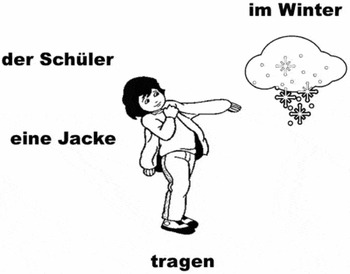
Separate pictures were designed for all prime and target sentences. All pictures were black-and-white or grayscale drawings representing the subject and action of the sentence. For all experimental items, TPs were depicted using separate drawings, which were placed in the upper left-hand or right-hand corner of the screen. Because picture location can influence word order in speech production (Griffin & Bock, Reference Griffin and Bock2000), with speakers more likely to place items on the left-hand side earlier in the sentence, the location of the TP image was counterbalanced across experimental items during the priming phase and always placed in the upper right-hand corner during the baseline and postpriming phases. To facilitate target sentence production, all critical items in the target pictures were labeled with the appropriate vocabulary word (see Figure 1). Verbs were presented in their infinitive form at the bottom of the picture. All nouns were presented with the appropriate article in its base form in nominative case. Prime pictures were not labeled with any vocabulary.
Sample target picture for the priming task (temporal phrases: Experiment 1).

For all prime pictures, the participants had to decide whether the picture matched the meaning of the prime sentence they had just seen and heard. Across the entire experiment, including the filler items, half of the prime pictures matched the meaning of the prime sentence (50% ja “yes” responses). In the prime pictures for all experimental items, for which the correct response was always nein “no,” some portion of the picture was modified so that the comprehension picture did not match the meaning of the target sentence (e.g., instead of drinking hot chocolate, an older man was finishing a plate of food). The TP image always matched the TP from the prime sentence, to avoid directing extra attention to the TP in the prime sentence.
All experimental items were divided into four lists, such that participants saw 10 prime–target sentence pairs in each of the four prime conditions but only one version of any given prime–target pair. Within each prime condition, participants saw 5 items with the TP image in the upper left-hand corner and 5 items with this image in the upper right-hand corner. For each prime condition, which items were presented with the TP image in the upper left-hand corner versus the upper right-hand corner was counterbalanced across participants. All participants saw the same 5 experimental prime–target sentence pairs in the baseline phase and a different set of 5 experimental prime–target sentence pairs in the postpriming phase. Experimental items were pseudorandomized, such that no two consecutive experimental items were from the same prime condition. Each experimental item was separated by two filler items in all task phases. Two different randomizations were created for each experimental list.
V2 TASK
This task contained a series of pictures, and participants were instructed to describe the picture beginning with the provided phrase. In nine sentences the provided phrase was an adverbial phrase, consisting of three sentences each that began with a TP (e.g., Jeden Tag “every day”), a LP (e.g., Auf dem Tisch “on the table”), or a manner phrase (e.g., Mit dem Löffel “with the spoon”). Of primary interest was whether participants placed the verb immediately after the adverbial phrase in these sentences, thereby producing a grammatically correct XVS sentence. In an additional eight sentences the provided phrase was the subject of the target picture, and in three sentences the provided phrase was the direct object of the target picture.
Procedure
Participants completed the experiment in a quiet room on a computer using E-Prime 2.0 (Psychology Software Tools, 2012). Participants completed the priming task first. Then they completed the V2 task, followed by a language background questionnaire and a German proficiency task. The German proficiency task consisted of 30 multiple-choice items targeting German grammar and vocabulary aimed at assessing L2 proficiency at low and intermediate levels (University of Wisconsin Testing and Evaluation, 2006).
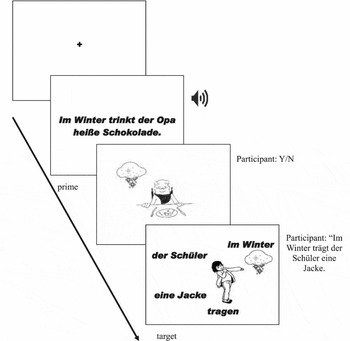
For the priming task, the participants sat in front of a computer monitor and a microphone attached to a digital recorder. The experimenter read the directions aloud to the participant, and they were also displayed on the computer screen. As seen in Figure 2, each trial began with a fixation point on the screen for 500 ms. When the fixation point disappeared, participants saw a sentence on the computer screen and heard a recording of the sentence produced by a female German native speaker. To more closely parallel the confederate scripting paradigm used by Ruf (Reference Ruf2011), in which participants heard the prime sentence but did not repeat it out loud, participants were not instructed to repeat the prime sentence (see, e.g., Bock et al., Reference Bock, Dell, Chang and Onishi2007; Flett et al., Reference Flett, Branigan and Pickering2013; Ivanova, Pickering, McLean, Costa, & Branigan, Reference Ivanova, Pickering, McLean, Costa and Branigan2012, for similar procedures). Then they saw a picture and decided whether the picture matched the meaning of the sentence they had just heard by pressing a key labeled ja “yes” or nein “no.” After participants made their decision, the target picture appeared and remained on the screen until participants finished producing their sentence. The experimenter then clicked the mouse to proceed to the following trial. Participants completed four practice trials at the beginning of the experiment.
Sample trial for the priming task (temporal phrases: Experiment 1).

For the V2 task, the experimenter told participants to describe the picture on the screen, and they had to begin their sentence with the phrase provided. Participants were encouraged to provide as complete a sentence as possible, and if they did not know a specific word to describe the picture, to use the most appropriate alternative word possible. Each trial began with a fixation point for 1000 ms. Then the target picture appeared and remained on the screen until the participant had produced a complete sentence. The experimenter then clicked the mouse to proceed to the following trial.
Scoring
Responses on the priming task were transcribed and scored as (a) TP-V-S-O (TP–verb–subject–other); (b) TP-S-V-O (TP–subject–verb–other); (c) S-V-TP-O (subject–verb–TP–other); (d) S-V-O-TP (subject–verb–other–TP); or (e) miscellaneous responses. Miscellaneous responses included sentences with one or more target words missing or sentences with a word order other than the target word orders listed above (see online supplemental material for example responses for all categories for both Experiment 1 and Experiment 2). Responses on the V2 task were transcribed and scored as correct if participants produced the correct word order (SVX, OVS, or XVS) and incorrect if they produced the incorrect word order.
Results of Experiment 1
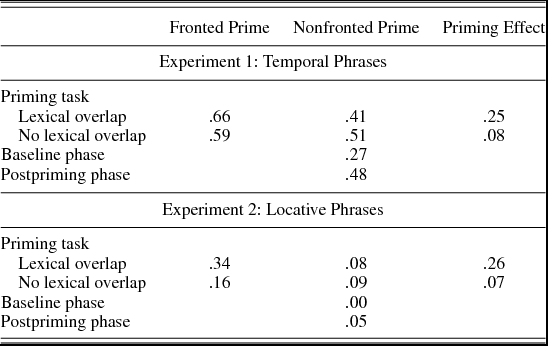
Including all phases of the priming task, participants produced 468 (49.2%) TP-V-S-O sentences, 14 (1.5%) TP-S-V-O sentences, 69 (7.3%) S-V-TP-O sentences, 387 (40.7%) S-V-O-TP sentences, and 12 (1.3%) miscellaneous responses. For all statistical analyses, S-V-TP-O and S-V-O-TP sentences were grouped together into a single category of nonfronted sentences. Because sentences with a fronted adverbial phrase followed immediately by the subject are ungrammatical in German, the TP-S-V-O sentences, along with the miscellaneous responses, were excluded from all statistical analyses. A second set of statistical analyses that included the ungrammatical TP-S-V-O sentences as fronted-TP responses revealed the same pattern of results reported here. Descriptive results from Experiment 1 and Experiment 2 are presented in Table 2.
Proportion of fronted sentences by condition and in the baseline and postpriming phases in Experiment 1 (temporal phrases) and Experiment 2 (locative phrases)

Analyses were conducted using mixed-effect logistic regression models (Jaeger, Reference Jaeger2008) with the lme4 package in R version 2.15.3 (R Development Core Team, Reference Development Core Team2013). For all analyses, placement of the TP in the target sentence (fronted vs. nonfronted) was the dependent variable.
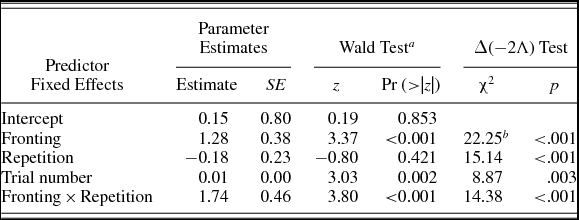
For the analysis of the priming portion of the task, fronting in the prime sentence (fronted vs. nonfronted TP) and repetition of the TP between the prime and target sentence (lexical overlap vs. no lexical overlap) were entered as fixed effects using contrast coding of .5 and –.5. To account for possible changes in TP placement over the course of the task, trial number was included as an additional fixed effect, centered at the sample mean of 61.6. In preliminary models we included the two- and three-way interaction terms between trial number and the other two variables. However, none of these interaction terms improved the overall model fit (ps > .5), so they are not reported here. The random effect structure included random intercepts for items and participants, and by-participant random slopes for fronting. The inclusion of additional random slopes did not significantly improve the model fit (all ps > .9); however, all results also hold if the model includes the maximal uncorrelated random effect structure supported by the design.
As seen in Table 3, in the priming portion of the task there was a significant effect of trial number because the proportion of fronted sentences increased as the task progressed. There was a significant effect of fronting because the proportion of fronted sentences was greater when the prime sentence contained a fronted TP than when it did not. There was no simple main effect of repetition, as indicated by the small parameter estimate for this variable in the model and its nonsignificant Wald test, because the overall proportion of fronted sentences, independent of whether the prime sentence contained a fronted or nonfronted TP, did not vary as a function of lexical overlap (see Kam & Franzese, Reference Kam and Franzese2007, for further discussion of model comparison of simple main effects in the presence of significant interaction terms). However, the effect of repetition was significant when the Fronting × Repetition interaction term was included in the model because the priming effect with fronted-TP primes was greater in the presence of lexical overlap (25%) than in the absence of lexical overlap (8%).
Summary of the mixed logit model for priming with temporal phrases (Experiment 1)

a Test of individual coefficients.
b Likelihood ratio tests for simple main effects are based on omitting the simple main effect and any two-way interaction terms involving that simple main effect.
To investigate whether in the proportion of fronted sentences increased from the baseline phase to the postpriming phase, we ran a second model on just the sentences from these two portions of the task. Task phase (baseline vs. postpriming) was entered as a fixed effect using contrast coding of .5 and –.5. The random effect structure included random intercepts for items and participants, and by-participant random slopes for task phase, so the maximal uncorrelated random effect structure was supported by the design. There was a significant effect of task phase (β = 3.26, SE = 1.23, Wald Z = 2.65, p = .008; χ2 = 6.83, p = .009) because the proportion of fronted sentences was greater in the postpriming phase than in the baseline phase.
Discussion of Experiment 1
The intermediate L2 German learners in Experiment 1 exhibited significant short-term priming, because they were more likely to produce a fronted-TP sentence after hearing a fronted-TP prime than a nonfronted-TP prime. This effect was largest in the presence of lexical overlap between the prime and target sentence TP, but there was still a small increase in the proportion of fronted-TP sentences in the absence of lexical overlap. There was also cumulative priming, because the proportion of fronted-TP sentences produced increased as the experiment progressed. Critically, the participants produced fronted-TP sentences over 20% of the time in the baseline phase, and this increased to 48% in the postpriming phase, even after the immediate prime sentence was removed. This latter finding parallels previous research with more proficient L2 speakers (Ruf, Reference Ruf2011; Shin & Christianson, Reference Shin and Christianson2012), in which short-term priming led to increased production of the target structure in a subsequent postpriming phase or on a delayed posttest. The results from Experiment 1 contrast with those from the intermediate L2 German learners in Ruf (Reference Ruf2011), who were of similar proficiency to the L2 German learners in the present study, because these learners in Ruf showed no significant priming for fronted-LP phrases in the absence of lexical overlap and no evidence of long-term priming in a postpriming phase. Contrasting the fronted LPs in Ruf with the results from Experiment 1, containing fronted-TPs, this provides preliminary evidence that at least at lower proficiency levels, L2 learners may keep track of the frequency of fronted-TP and fronted-LP constructions separately in memory, even though both constructions, syntactically speaking, have the same XVS word order. As a result, the magnitude of long-term priming effects in particular may differ across constructions. Further, L1 preferences for a given construction (in this case a preference for fronted-TP constructions over fronted-LP constructions) may contribute to such frequency statistics, a hypothesis that will be explored further in the General Discussion.
However, there were additional methodological differences between Experiment 1 and Ruf (Reference Ruf2011) beyond the type of fronted adverbial phrases (TP vs. LP). First, while both Ruf and the present study investigated the priming of XVS word order in L2 German, the target sentences in Ruf involved intransitive sentences containing only a subject, a verb, and an adverbial phrase (e.g., Auf dem Tisch steht eine Lampe “On the table is a lamp”), whereas the sentences in the present study involved transitive sentences containing a subject, a verb, an object, and an adverbial phrase. Second, the manipulation of lexical overlap was a between-participants manipulation in Ruf, whereas it was a within-participants manipulation in the present study. To rule out the possibility that such methodological differences were responsible for the short-term, long-term, and cumulative priming in Experiment 1, in Experiment 2 we used the same experimental paradigm, but replaced all TPs with LPs in the experimental items.
EXPERIMENT 2
Method
Participants
Twenty-four students from third- and fourth-semester German classes at a large American university participated for payment, none of whom participated in Experiment 1. Five participants did not perform above chance on the V2 task, so they were excluded from all analyses reported here. Thus, all results are based on data from 19 participants (7 female, 12 male). Table 1 presents the biographical information for the participants in Experiment 2. The t tests revealed no significant differences between the participants in Experiments 1 and 2 on any measure (all ps > .2).
Materials
PRIMING TASK
Experimental items consisted of 40 critical prime–target sentence pairs, 5 prime–target sentence pairs for the baseline phase, 5 prime–target sentence pairs for the postpriming phase, and 100 prime–target sentence pairs that served as filler items. As seen in Examples (9)–(13), the experimental items were the same as in Experiment 1, except that the TPs were replaced with LPs (the complete list of experimental items is available on the IRIS database at https://www.iris-database.org/; Marsden et al., Reference Marsden, Mackey, Plonsky, Mackey and Marsden2016).Footnote 2
-
(9)
-
(10)
-
(11)
-
(12)
-
(13)


In contrast to Experiment 1, all nonfronted sentences used direct object-LP word order, because there is a tendency to place LPs toward the end of the clause in German, although the reverse word order (i.e., LP-direct object) is still grammatically correct (Helbig & Buscha, Reference Helbig and Buscha2001).
As in Experiment 1, the target sentences in the baseline and postpriming phases were similar to sentence (13). The prime sentences in the baseline and postpriming phases were identical to those in Experiment 1. Filler items were identical to the filler items in Experiment 1. The composition of the prime and target sentence pictures was identical to Experiment 1, except for using new black-and-white drawings to depict the LPs. The list distribution and pseudorandomization procedures were identical to Experiment 1.
V2 TASK
This task was identical to the V2 task used in Experiment 1.
Procedure
The procedure was identical to that of Experiment 1.
Scoring
The scoring procedure was identical to that of Experiment 1.
Results of Experiment 2
Including all phrases of the priming task, participants produced 128 (13.5%) LP-V-S-O sentences, 8 (0.8%) LP-S-V-O sentences, 11 (1.2%) S-V-LP-O sentences, 778 (81.9%) S-V-O-LP sentences, and 20 (2.1%) miscellaneous responses. Five sentences (0.5%) from the nonfronted-lexical overlap condition for one item were coded as technical errors because the LP in the recording of the prime sentence did not match the LP in the target sentence, thereby eliminating the lexical overlap. As in Experiment 1, S-V-LP-O and S-V-O-LP sentences were grouped together into a single category of nonfronted sentences for all statistical analyses, and LP-S-V-O, miscellaneous responses, and technical errors were excluded from all statistical analyses. As in Experiment 1, a second set of statistical analyses that included the ungrammatical LP-S-V-O sentences as fronted-LP responses revealed the same pattern of results reported here.
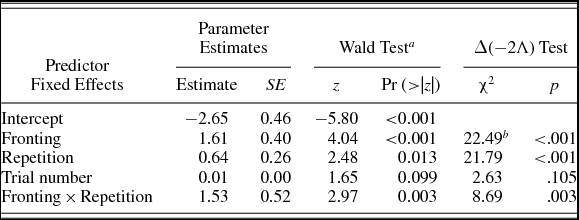
Analyses were conducted in the same manner as for Experiment 1. Trial number was included as an additional fixed effect, centered at the sample mean of 62.0. In preliminary models we included the two- and three-way interaction terms between trial number and the other two variables. However, none of these interaction terms improved the overall model fit (ps > .3), so they are not reported here. The random effect structure included random intercepts for items and participants, and by-participant and by-item random slopes for fronting. The inclusion of additional random slopes did not significantly improve the model fit (all ps > .5); however, all results also hold if the model includes the maximal uncorrelated random effect structure supported by the design.Footnote 3
As seen in Table 4, in the priming portion of the task, there was no significant effect of trial number. There was a significant effect of fronting because the proportion of fronted sentences was greater when the prime contained a fronted LP than when it did not. There was a significant effect of repetition because the proportion of fronted sentences was greater in the presence of lexical overlap between the prime and target sentence than in the absence of lexical overlap. There was also a significant Fronting × Repetition interaction because the priming effect with fronted-LP primes was greater in the presence of lexical overlap (26%) than in the absence of lexical overlap (7%).
Summary of the mixed logit model for priming with locative phrases (Experiment 2)

a Test of individual coefficients.
b Likelihood ratio tests for simple main effects are based on omitting the simple main effect and any two-way interaction terms involving that simple main effect.
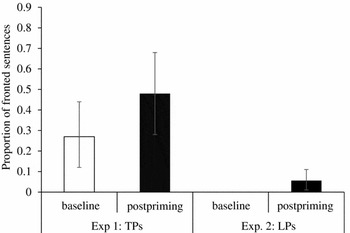
Comparing the proportion of fronted sentences in the baseline phase versus the postpriming phase, there were no fronted sentences produced in the baseline phase and only five fronted sentences produced in the postpriming phase. Because of the low number of fronted sentences produced overall, a standard mixed-effect logistic regression model is not appropriate for these data (Jaeger, Reference Jaeger2008). However, one sees in Figure 3 that the lower bound of the 95% confidence interval approaches zero, highlighting that the change in the proportion of fronted sentences from the baseline to the postpriming phase was minimal.
Proportion of fronted sentences in the baseline and postpriming phases for Experiment 1 and Experiment 2. Error bars represent the bootstrapped 95% confidence intervals.

Combined results from Experiments 1 and 2
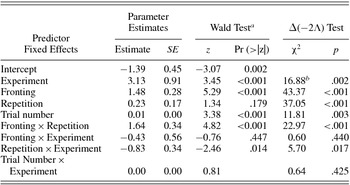
In a final model, we directly compared the results from the priming phase in Experiments 1 and 2. Fronting in the prime sentence (fronted vs. nonfronted phrase), repetition of the adverbial phrase between the prime and target sentence (lexical overlap vs. no lexical overlap), and experiment (Experiment 1 TPs vs. Experiment 2 LPs) were entered as fixed effects using contrast coding of –.5 and .5. Trial number was included as an additional fixed effect, centered at the sample mean of 61.9. The random effect structure included random intercepts for items and participants, and by-participant and by-item random slopes for fronting. The inclusion of additional random slopes did not significantly improve the model fit (all ps > .9); however, all results also hold if the model includes the maximal uncorrelated random effect structure supported by the design. An initial model including the Fronting × Repetition × Experiment interaction term revealed that this three-way interaction did not significantly improve the overall model fit (p > .8), so it was not included in the final model reported here.
As seen in Table 5, there was a significant effect of experiment because, overall, participants produced more fronted sentences in Experiment 1 with TPs than in Experiment 2 with LPs. There was a significant Experiment × Repetition interaction, which captures the fact that in Experiment 1, the effect of lexical repetition only became significant with the inclusion of the Fronting × Repetition interaction term, whereas in Experiment 2, there was a significant effect of lexical overlap, both as a simple main effect and via the significant Fronting × Repetition interaction term. There was a significant effect for trial number, but no interaction between trial number and experiment, because the pattern of participants producing an increased proportion of fronted sentences as the experiment progressed was similar across both experiments, even if the individual analyses for each experiment revealed that this pattern was only statistically significant in Experiment 1. It is critical there was no significant interaction between fronting and experiment, because the magnitude of the overall priming effects in the priming phase was similar across both experiments (17% in Experiment 1, 16% in Experiment 2).
Summary of the mixed logit model for Experiment 1 (temporal phrases) versus Experiment 2 (locative phrases)

a Test of individual coefficients.
b Likelihood ratio tests for simple main effects are based on omitting the simple main effect and any 2-way interaction terms involving that simple main effect
Discussion of Experiment 2
The intermediate L2 German learners in Experiment 2 exhibited significant short-term priming, because they were more likely to produce a fronted-LP sentence after hearing a fronted-LP prime than a nonfronted-LP prime. This effect was largest in the presence of lexical overlap between the prime and target sentence, but there was still an increase in the proportion of fronted-LP sentences in the absence of lexical overlap. Contrasting with Experiment 1, the participants produced no fronted-LP sentences in the baseline phase and few fronted-LP sentences in the postpriming phase, resulting in only minimal long-term priming. There was little cumulative priming, because the proportion of fronted-LP sentences produced did not significantly increase as the experiment progressed. A combined analysis revealed that participants in Experiment 1 produced more fronted sentences overall, compared to participants in Experiment 2. However, the magnitude of short-term priming was similar in both experiments.
Comparing these results to the intermediate L2 German learners from Ruf (Reference Ruf2011), where lexical overlap between the prime and target sentences was a between-participants manipulation, the results from Experiment 2 suggest that including a wider variety of prime–target sentence pairs can increase the magnitude of short-term priming among intermediate L2 learners. More specifically, the intermediate L2 learners in the present experiments were primed to produce fronted sentences via the inclusion of the lexical overlap manipulation, paralleling the intermediate L2 learners assigned to the lexical overlap condition in Ruf. This primed production of fronted sentences via lexical overlap may have facilitated the production of fronted sentences more generally (see McDonough & Mackey, Reference McDonough and Mackey2006, for a detailed discussion of primed production), providing the context in which short-term priming, even in the absence of lexical overlap, could emerge. However, there was no corresponding increase in the cumulative proportion of fronted sentences produced as the task progressed, suggesting that even if the inclusion of prime–target sentence pairs both with and without lexical overlap facilitated short-term priming, such effects were more fleeting in nature. Thus, any direct link between priming with and without lexical overlap must remain tentative, although it warrants additional research.
At the same time, the short-term priming in Experiment 2 translated into only minimal long-term priming, as measured by the proportion of fronted-LP sentences in the postpriming phase. This suggests that the long-term priming with fronted-TPs in Experiment 1 was not the result of methodological differences between Experiment 1 and previous L2 priming research (Ruf, Reference Ruf2011). Rather, the mechanisms that underlie short-term priming, and the potential for such short-term priming to modulate subsequent L2 production among less proficient L2 learners hinges less on the strength of learners’ general syntactic representation of a given L2 structure and more on the lexical–semantic content with which they are prompted to build such structures, and the strength of such semantically constrained constructions in memory.
This line of reasoning finds parallels in L1 and L2 research into the relationship between conceptual structure and structural priming. Conceptual overlap in event structure between a prime and target sentence increases the likelihood that speakers will encode both path and manner information when describing motion events in L1 English, suggesting that priming at the level of message planning can have an impact on the linguistic structure of a target sentence (see Bunger, Papafragou, & Trueswell, Reference Bunger, Papafragou and Trueswell2013; see also Griffin & Weinstein-Tull, Reference Griffin and Weinstein-Tull2003). Gerwien and Flecken (Reference Gerwien and Flecken2015) also show that in contrast to L1 Dutch speakers, German–Dutch L2 speakers exhibit no significant conceptual priming effects in the encoding of progressive aspect in L2 Dutch, a finding they attribute to the absence of comparable grammatical means for encoding aspect in speakers’ L1 German. Along similar lines, previous production studies report that fronted LPs are generally avoided in L1 English compared to L1 German, due largely to differences in principles of information organization between the two languages (Carroll et al., Reference Carroll, Murcia-Serra, Watorek and Bendiscioli2000; Jackson, Reference Jackson2012). Thus, the absence of robust long-term and cumulative priming with fronted LPs in Experiment 2 compared to the presence of such effects with fronted-TPs in Experiment 1 could reflect not only lexical–semantic constraints in how these L2 learners store XVS constructions in memory but also that they lack sufficient links between German-specific information structural principles and the grammatical means for encoding such preferences via placing locative information in sentence-initial position.
GENERAL DISCUSSION
By investigating the priming of word order variation with TPs and LPs phrases in L2 German, the present study provides important insights into the relationship between short-term, long-term, and cumulative priming among intermediate L2 learners, and whether the magnitude of such effects is influenced by the preference for a given construction in learners’ L1. While the participants in Experiment 1, which involved TPs, produced more fronted sentences overall compared to the participants in Experiment 2, which involved LPs, the magnitude of short-term priming was similar across both experiments, with the largest priming effects occurring in the lexical overlap condition. In Experiment 1 participants produced fronted-TP sentences 20% of the time in the baseline phase at the beginning of the task, and this percentage increased significantly in the postpriming phase. The overall proportion of fronted-TP sentences produced also increased over the course of the priming task. Together, these findings provide evidence for both long-term and cumulative priming in Experiment 1. In contrast, the participants in Experiment 2 produced no fronted-LP sentences in the baseline phase and virtually no fronted-LP sentences in the postpriming phase, nor did the overall proportion of fronted-LP sentences increase significantly over the course of the priming task, resulting in only minimal long-term or cumulative priming in Experiment 2.
L1 preferences and their impact on L2 priming
The magnitude of short-term priming effects was similar across the two experiments. Thus, if one looks only at short-term priming, the results from the present study could suggest that L1 preferences have little impact on L2 production (cf. Flett et al., Reference Flett, Branigan and Pickering2013; Ruf, Reference Ruf2011). However, the robust long-term and cumulative priming seen with fronted-TPs in Experiment 1 and the lack thereof with fronted LPs in Experiment 2 reveal a different story. This critical difference between Experiment 1 and Experiment 2, combined with the fact that the participants in Experiment 1 produced fronted-TPs in the baseline phase at the beginning of the experiment, suggests that these L2 learners may have possessed stronger representations for XVS word order with fronted-TPs than with fronted LPs prior to the start of the experiment. This pattern bolsters the claim by McDonough (Reference McDonough2006) that L2 structural priming is contingent on having previously acquired the target structure in that only with fronted-TPs was there significant long-term and cumulative priming. However, in McDonough's original study, the structural alternation under investigation involved DO versus PO dative constructions, where both word order and syntactic complexity differ between the two structural alternatives. In contrast, the grammatical structure in the present study, namely, XVS word order, was identical across both experiments. This would imply that at least at lower proficiency levels, the presence of long-term and cumulative priming may depend on the strength of specific semantically constrained constructions rather than more generalized syntactic representations per se.
This then leads to the question of why this distinction (specifically, the difference between TPs and LPs) led to different long-term and cumulative priming effects between Experiments 1 and 2. Already in the baseline phase, the participants in Experiment 1 placed TPs in sentence-initial position, whereas the participants in Experiment 2 never placed an LP in sentence-initial position in the baseline phase. This suggests that even prior to the study, these L2 learners could produce fronted-TP sentences outside of a priming context. While differences exist in how temporal information is organized at the discourse level in English versus German (e.g., Carroll, von Stutterheim, & Klein, Reference Carroll, von Stutterheim, Klein and Lenz2003), under certain circumstances, L1 English speakers still front TPs in natural discourse in ways similar to L1 German speakers (e.g., Carroll et al., Reference Carroll, von Stutterheim, Klein and Lenz2003; Doherty, Reference Doherty2005; Jackson, Reference Jackson2012). Thus, L2 German learners, even at relatively low proficiency levels, can build upon these L1 preferences to produce fronted-TP sentences in free discourse, laying the foundation for priming to further boost such production, as evidenced by the cumulative and long-term priming in Experiment 1.
As for fronted LPs, there are substantial differences with regard to the principles underlying the organization of locational information in English versus German. Even in German, sentence-initial placement of locational information serves the distinct information structural role of emphasizing the location of an item or event over the existence of the item itself (e.g., In the center is an old fountain), but at the same time, this more spatially oriented perspective is preferred over a more object-oriented perspective, the preferred perspective in English (e.g., There is an old fountain [in the center]; Carroll et al., Reference Carroll, Murcia-Serra, Watorek and Bendiscioli2000). This distinct function of fronted LPs in German, when combined with a preference for different information organization principles regarding locational information in English, would lead the L2 learners in the present study to avoid fronting LPs in more naturalistic speech, as evidenced by the complete absence of fronted-LP sentences in the baseline phase of Experiment 2 (see Jackson, Reference Jackson2012). More important, the lack of robust long-term and cumulative priming with fronted LPs indicates that even the flood of fronted-LP sentences during the priming phase of the experiment and the significant short-term priming effects during this phase of the task were not sufficient to overcome this bias against producing fronted-LP sentences in the postpriming phase once the fronted-LP primes were removed.
An alternative explanation for the present findings is that the L2 input these learners receive is biased toward fronted-TP sentences, rather than L1 preferences necessarily driving the differential long-term and cumulative effects in Experiment 1 versus Experiment 2. Many introductory German textbooks, including the one used in the German program in which these L2 learners were enrolled (Lovik, Guy, & Chavez, Reference Lovik, Guy and Chavez2013), use primarily fronted-TP sentences to introduce the V2 rule and XVS word order more generally. If the oral input L2 learners hear in the classroom is similarly skewed, this could reinforce the perceived naturalness of fronted-TP sentences over other types of fronted adverbial phrases among less proficient L2 learners. Investigating the relative impact of L1 structural preferences, the distribution of structural alternatives in L2 input, and their potential interaction on L2 priming across different proficiency levels remains an important empirical question for future research.
The variation in priming patterns across Experiments 1 and 2, and the fact that these differential priming effects parallel differences in the preference and frequency for sentence-initial TPs versus sentence-initial LPs in the learners’ L1 English, highlights the complexities of determining how L1 and L2 structural frequency influences L2 within-language priming. If one considers XVS word order independent of the type of fronted adverbial phrase to be the less frequent structure in both German and English, as compared to SVX word order (Bohnacker & Rosén, Reference Bohnacker and Rosén2008; Engel, Reference Engel1974; Jackson, Reference Jackson2012), then the significant priming of fronted sentences in both experiments would support the idea that even less proficient L2 learners exhibit inverse frequency effects during L2 priming. More specifically, one sees in Table 2 that, descriptively, the surprisal effect of encountering a fronted prime sentence increased the likelihood of producing a fronted target sentence, relative to the baseline phase. In contrast, the presence of a nonfronted prime sentence did not result in a parallel increase in the likelihood of producing a nonfronted target sentence, relative to the baseline phase. Descriptively, in both Experiment 1 and Experiment 2, the lowest proportion of fronted target sentences (and, conversely, the highest proportion of nonfronted sentences) was actually produced in the baseline phase at the beginning of the experiment, not in response to nonfronted primes during the priming phase of the task (see, e.g., Hartsuiker & Westenberg, Reference Hartsuiker and Westenberg2000; Segaert, Menenti, Weber, & Hagoort, Reference Segaert, Menenti, Weber and Hagoort2011, for similar findings). However, if one adopts a more construction-specific approach, a different pattern emerges because it was the more frequent fronted-TP construction in Experiment 1, more frequent when based on L1 preferences (Jackson, Reference Jackson2012) and when based on the L2 input to which the learners had likely been exposed, that exhibited more robust cumulative and long-term priming.
Implications for L2 priming mechanisms
The present findings support the model of shared syntax proposed by Hartsuiker and Bernolet (Reference Hartsuiker and Bernolet2015) whereby L2 syntactic representations are initially item specific and become more generalized and abstract over the course of L2 development. The present results also suggest a larger role for L1 representations in the development of such L2 representations, and the priming mechanisms that such representations support, than currently proposed in Hartsuiker and Bernolet's model. Hartsuiker and Bernolet hypothesize that in the earliest stages of L2 acquisition, L1 representations may facilitate L2 priming through explicit memory strategies. At advanced proficiency levels, L1 representations also feature prominently in their model through the notion of shared syntax, where combinatorial nodes are shared across an L2 speaker's two languages. However, their model in its current form does not specify a role for L1 representations in the intermediate stages of L2 development. The cumulative and long-term priming with fronted-TP constructions, when contrasted with the absence of such effects with fronted-LP constructions, suggests that these L2 learners had already developed an abstract L2 representation for fronted-TP constructions prior to the experiment, while their L2 representation for fronted-LP constructions was still more item specific in nature, thus limiting the potential for abstract or long-term priming to take place. Because the present study only involved within-language L2 priming, we cannot speak to whether the learners’ representations for fronted-TP constructions were truly shared between their L1 English and L2 German. However, we would argue that at the very least, the higher frequency of and preference for fronted-TP constructions compared to fronted-LP constructions in the learners’ L1 English, perhaps in combination with the distribution of fronted-TP versus fronted-LP constructions in the L2 input to which these learners had been exposed, facilitated the development of an abstract representation for fronted-TP constructions in their L2 German.
Turning to the mechanisms that drive L2 structural priming, the inclusion of a postpriming phase and the differential performance in this portion of the task with fronted-TP versus fronted-LP constructions also helps to tease apart competing explanations for the loci of short-term priming effects among L2 speakers, and the potential for short-term priming to extend to long-term or cumulative priming. The presence of robust long-term and cumulative priming in Experiment 1 supports accounts that characterize structural priming as a form of implicit learning (e.g., Bock & Griffin, Reference Bock and Griffin2000; Chang et al., Reference Chang, Dell, Bock and Griffin2000, Reference Chang, Dell and Bock2006), in that it would be difficult to attribute these longer term effects to residual activation of an L2 structural node. Along similar lines, this would suggest that explicit memory strategies cannot be the sole explanation for the combination of effects in Experiment 1. At the same time, one should be cautious in characterizing the present findings as demonstrating a form of implicit learning in its strongest sense, given that the long-term priming reported here was still within the context of a postpriming phase that occurred immediately after the priming task itself, rather than on a task that occurred 1 or more days later. Moving forward, these results also provide insight into how one might incorporate implicit learning accounts of structural priming into the model proposed by Hartsuiker and Bernolet, while also highlighting the need for more research into the longer term impact of priming on subsequent L2 production.
In contrast, the absence of robust long-term and cumulative effects with fronted-LP constructions in Experiment 2 suggests that any priming with this construction was driven by either explicit memory of recently heard sentences or residual activation of some sort of structural node for fronted-LP constructions. Especially if one allows for explicit memory strategies to promote priming even in the absence of lexical overlap between the prime and target sentence (cf. Hartsuiker & Bernolet, Reference Hartsuiker and Bernolet2015), identifying precisely which mechanism (residual activation vs. explicit memory) led to the significant short-term priming in both the lexical repetition and no lexical repetition conditions in Experiment 2 is difficult. However, when combined with the absence of robust cumulative or long-term priming in Experiment 2, and the resulting implication that the participants’ representations for fronted-LP constructions were more item specific in nature, we hypothesize that the short-term priming effects in Experiment 2 are best explained by learners’ ability to retrieve and reuse previously heard sentence from explicit memory. As such, the present study also highlights ways in which significant short-term priming, even in the absence of lexical overlap, may not necessarily coincide with robust long-term or cumulative priming, a possibility that warrants future research.
The contribution of the present findings to our understanding of how priming mechanisms change over the course of L2 development must necessarily remain tentative in the absence of comparable data with the same two experiments from L1 German speakers and more advanced L1 English–L2 German speakers. However, based on the L1 German speakers and highly proficient L2 German speakers in Ruf (Reference Ruf2011), who exhibited abstract short-term and long-term priming with fronted LPs in intransitive sentences similar to those tested in Experiment 2, we hypothesize that L1 German speakers and more advanced L2 German speakers would exhibit short-term priming in the presence and absence of lexical overlap, as well as significant long-term and cumulative priming with fronted-LP sentences in Experiment 2 (see Hartsuiker et al., Reference Hartsuiker, Kolk and Huiskamp1999). The more interesting question is whether they would exhibit significant short- and long-term priming with fronted-TPs, like those in Experiment 1, and whether such effects would be similar in magnitude to priming effects with fronted LPs, because this would provide insight into whether the construction-specific patterns we observe in the present study would extend to L1 and advanced L2 German speakers. Such research, perhaps in combination with more extensive corpus analyses that take into account the lexical–semantic content of fronted adverbial phrases in L1 German, would have important implications for our understanding of how the mechanisms that support structural priming change with increased language proficiency, and the role of semantic–conceptual information in structural priming, even among L1 speakers (Bunger et al., Reference Bunger, Papafragou and Trueswell2013; Gerwien & Flecken, Reference Gerwien and Flecken2015; Griffin & Weinstein-Tull, Reference Griffin and Weinstein-Tull2003).
Conclusion
Overall, the results from the present study reveal a divergence between short-term and long-term priming for different types of fronted sentences among intermediate English–German L2 learners, a finding that we attribute to differences in the preferred patterns of specific semantically constrained constructions in the participants’ L1 English, which may be further bolstered by the distribution of these different semantically constrained constructions in the L2 input learners receive. As such, the present study reveals how for less proficient L2 learners, L1 preferences, combined with L2 input, can have a significant impact on the underlying mechanisms that support short-term structural priming in the L2, and the potential for long-term or cumulative priming, insofar as more frequent or preferred constructions in the L1 can facilitate the development of abstract representations for such constructions in the L2. In this manner, the present study highlights how, moving forward, L2 priming research must continue to investigate both short-term and long-term priming, because only then can we more fully understand the precise mechanisms that drive within-language L2 priming and how factors like L1 preferences and L2 proficiency interact with such mechanisms to shape learning.
ACKNOWLEDGMENTS
Portions of this work were presented at the Germanic Linguistics Annual Conference in 2014 and the CUNY Conference on Human Sentence Processing in 2015. We thank Jack DiMidio, Julia Hotchner, Marta Millar, Bradley Morabito, Alaisha Sayed, and Ted Smith for their help in collecting and transcribing the data; Laurel Brehm and John Jackson for their helpful suggestions regarding the statistical analyses; and the three reviewers for their helpful comments and suggestions.
SUPPLEMENTARY MATERIAL
To view the supplementary material for this article, please visit http://dx.doi.org/10.1017/S0142716416000205.