Village poultry production systems
Rural households keep various poultry species (chickens, ducks, guinea fowls, geese and pigeons), although chickens largely dominate flock composition. Poultry are usually raised together with other livestock (e.g. other monogastric species such as pigs and rabbits, and small and large ruminants) and in some cases with fish. Depending on the level of inputs provided, three types of village poultry production system can be distinguished:
The free range system: the birds find the main part of their daily ration by scavenging. There is generally little intervention in the life cycle of the birds (Sonaiya et al., Reference SONAIYA, BRANCKAERT and GUÈYE1999).
The backyard system: the birds are partly confined within a fenced yard or merely within an improved overnight shelter; they are fed and watered.
The semi-intensive system: (generally found in Asian countries) the chickens are fed balanced feed, either produced by large feed companies or by local feed mills (Aini, Reference AINI1999). In this system, flock size varies between 50 and 500 birds on average (Sonaiya et al., Reference SONAIYA, BRANCKAERT and GUÈYE1999). The use of specialized rather than indigenous breeds is quite common (Roberts, Reference ROBERTS1999).
The two first management systems frequently overlap; the free range system is sometimes coupled with overnight shelter and/or feed supplementation which consists of household wastes or cereal grains, according to the farmers’ ability (Chrysostome et al., Reference CHRYSOSTOME, BELL, DEMEY and VERHULS1995); the backyard system may involve night confinement but no feeding. However, for both systems, there is almost no formal health care.
importance and roles of village poultry production
More than 80% of the world poultry population is in village production systems, contributing up to 90% of poultry products in some developing countries (Guèye, Reference GUÈYE1998). Village poultry makes a substantial contribution to household food security throughout the developing world. It helps diversify incomes, provides high-quality food and fertilizer, and acts as form of household savings and insurance. As keeping scavenging poultry is an activity that is generally carried out by women, it also contributes to women's empowerment. A study in the Niger Delta (Alabi et al., Reference ALABI, ESOBHAWAN and ARUNA2006) showed that family poultry husbandry contributes 35% of the income of household women, and it is estimated at about 25% and 50% of Nigerian minimum wage and per capita income, respectively (Alabi et al., Reference ALABI, ESOBHAWAN and ARUNA2006). Furthermore, experiences in Bangladesh and other countries have shown that village poultry can be used as a tool for poverty alleviation (Jensen and Dolberg, Reference JENSEN and DOLBERG2002). Therefore, all over the developing world, these low-input, low-output poultry-husbandry systems are an integral component of the livelihoods of most of rural and peri-urban, and some urban, households, and are likely to continue to meet this role for the foreseeable future.
major constraints of village poultry production
Village poultry production is constrained by poor access to markets, goods and services, weak institutions, and lack of skills, knowledge and appropriate technologies (Guèye, Reference GUÈYE2002). The productivity of scavenging chickens is limited by both poor nutrition and health problems. Newcastle Disease has been recognized as the major constraint to scavenging chicken production (Aini, Reference AINI1990). The disease seems to be endemic. Vaccination has, until recently, been ineffective due to the nature of the production systems (scavenging), the epidemiological factors of the disease and the heat lability of the vaccine (Spradbrow, Reference SPRADBROW2001). The outbreaks of the highly pathogenic H5N1 avian influenza in Asia and Africa are of great concern for human as well as animal health as village chickens mingle freely with wild birds and household members, especially children.
It is worth noting that significant losses of village poultry are due to predation and theft, as most of the households do not provide housing for their birds.
Village poultry genetic resources
Village poultry are mainly indigenous or local, but commercial hybrids and crosses between these two genotypes also exist. According to The State of the World for Animal Genetic Resources for Food and Agriculture (FAO, Reference FAO2007), 1644 local, 85 regional trans-boundary and 157 international trans-boundary avian breeds have been reported to FAOFootnote 1. The latter group includes the commercial breeds. These figures clearly indicate that indigenous or local breeds make up most of the world's poultry genetic diversity.
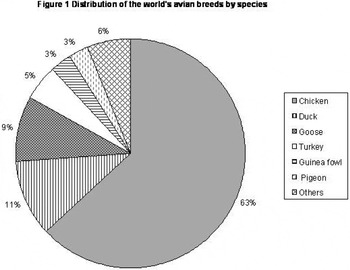
Figure 1 shows that chicken breeds make up the vast majority (63%) of the total number of avian breeds, followed by ducks (11%), geese (9%) and turkeys (5%). Most of the examples and developments described in the following sections are related to chickens – despite our efforts to cover all major poultry species.
The very large number of indigenous chicken breeds/ecotypes in the rural areas of most developing countries in Africa and Asia, and the large proportion of the total chicken population that they represent in each of these countries, about 80% according to Guèye (Reference GUÈYE1998), are due to their adaptation to village conditions, but also to the preference given to their meat and eggs by the local population, both in rural areas and in the cities. Although the meat and eggs produced by indigenous birds are more expensive than those produced by commercial broilers or layers, the latter are still beyond the purchasing power of the rural poor, who continue to rely on their own indigenous birds for subsistence (Guèye, Reference GUÈYE1998; Sonaiya et al., Reference SONAIYA, BRANCKAERT and GUÈYE1999).
Despite their importance, indigenous breeds are under threat due to various factors, such as changing production systems and indiscriminate cross-breeding. Europe and the Caucasus, and North America are the regions with the highest proportion of their breeds classified as at risk – 49% and 79% of avian breeds, respectively (FAO, Reference FAO2007). These are also the regions where the highest numbers of breed extinctions have been recorded. These regions have the most highly specialized poultry industry. In the developing world, indiscriminate cross-breeding has been, and still is, undertaken through dissemination of hybrid commercial males by large private hatcheries or by NGOs with the support of local authorities. The genetic impact of these formal and informal cross-breeding schemes and practices is unknown.
Distribution of the world's avian breeds by species.
Avian species with more than 50 recorded breeds are displayed separately; the remaining avian species are aggregated as ‘others’. Source: FAO (Reference FAO2007).

current knowledge about indigenous and local chicken breeds
A village chicken is invariably a coloured bird. The plumage colour is almost as variable as it could be, varying from white to black with all kind of plumage patterns in between. According to farmers, multiple colours serve as camouflage against aerial predators. Another reason for this variation is cockerel exchange programmes (see below). However, studying Vietnamese H'mong chicken populations, Cuc et al. (Reference CUC, MUCHADEYI, BAULAIN, EDING, WEIGEND and WOLLNY2006) found no significant genetic differences among the plumage colour based populations.
A village chicken is very alert and has long shanks with which to run away from predators. If necessary, they even fight with predators to safeguard their chicks. Hens incubate their eggs and brood their chicks, enabling them to reproduce without any assistance.
Indigenous chickens have an inherent scavenging and nesting behaviour. Years of natural selection, under scavenging conditions, have made them robust and tolerant/resistant to various diseases, especially to those caused by bacteria, protozoa and other internal and external parasites; they have a better survival rate than commercial hybrid strains under village production conditions (Minga et al., Reference MINGA, MSOFFE and GWAKISA2004; Sonaiya et al., Reference SONAIYA, BRANCKAERT and GUÈYE1999). However, the village chicken is a poor egg producer, laying on average 40 to 60 eggs per year in three or four clutches, with an average egg weight of around 35–45 grams (Guèye, Reference GUÈYE1998). This low rate of lay is due to several factors: low genetic potential; seasonal effects; low levels of nutrition; and broodiness. Indigenous chickens generally have small body size; for various African and Asian chicken breeds, mature body weight varies between 1.3 and 1.9 kg for males and between 1.0 and 1.4 kg for females (Musharaf, Reference MUSHARAF1990; Shanawany and Banerjee, Reference SHANAWANY and BANERJEE1991). Given this level of productivity, the relative contribution of indigenous chickens to meat and egg production is lower than their numerical contribution. The approximate estimates produced by Pym et al. (Reference PYM, GUERNE BLEICH and HOFFMANN2006) suggest that the contribution of indigenous genotypes to egg consumption is probably quite low in most countries, but that the contribution to meat production and consumption is likely to be quite substantial.
The use of molecular tools such as microsatellite markers provides new insight into the genetic structure and diversity of indigenous chicken populations. The first large-scale study (Hillel et al., Reference HILLEL, GROENEN, TIXIER-BOICHARD, KOROL, DAVID, KIRZHNER, BURKE, BARRE-DIRIE, CROOIJMANS, ELO, FELDMAN, FREIDLIN, MAKI-TANILA, OORTWIJN, THOMPSON, VIGNAL, WIMMERS and WEIGEND2003) was conducted within the framework of the European Project AvianDiv. Five types of populations, the wild ancestor, unselected populations, standardised breeds, commercial lines and inbred lines were studied using 22 microsatellite markers. The range of heterozygosity varied from 10% to 65%. The unselected populations were generally among the most variable but the standardised breeds exhibited a wide range of situation, from 20% to 65%, depending on population history and population size. In a second large scale study (Granevitze et al., Reference GRANEVITZE, HILLEL, CHEN, CUC, FELDMAN, EDING and WEIGEND2006), the genetic diversity of 64 chicken breeds including commercial populations, local breeds from Asia, Europe, Mediterranean countries and the Middle East, with a wide range of origins and histories, was assessed using 29 autosomal microsatellites. On average, there were 11.4 alleles per locus and 3.6 alleles per population across loci. Within populations, the average heterozygosity was 46%, ranging between 20% and 64%. Dagu, a Chinese population, and the Red Jungle Fowl had the highest average heterozygosity. Assuming that the populations in this study form a fair representation of the species, the results showed that genetic diversity within chickens is slightly lower than the diversity found in other species (Granevitze et al., Reference GRANEVITZE, HILLEL, CHEN, CUC, FELDMAN, EDING and WEIGEND2006).
Using the same set of markers as in Granevitze et al. (Reference GRANEVITZE, HILLEL, CHEN, CUC, FELDMAN, EDING and WEIGEND2006), Cuc et al. (Reference CUC, MUCHADEYI, BAULAIN, EDING, WEIGEND and WOLLNY2006) and Muchadeyi et al. (Reference MUCHADEYI, WEIGEND, EDING, WOLLNY, MAKUZA and SHAMSELDIN2006) assessed the genetic diversity of indigenous chicken populations in Vietnam and Zimbabwe. In both studies, over 90% of the total genetic variation was due to within village or eco-zone populations, which implies high levels of gene flow among villages or eco zones resulting in admixed populations.
evaluation of indigenous and local breeds
There are a large number of indigenous or local breeds, and many of them are claimed to be unique to a particular region or eco-zone but, as we have seen, several molecular studies showed no differentiation between these breed or eco-zone populations. This raises two questions: is there any genetic difference among the various breeds in a given country? As resources are always limited and compromises are inevitable, which breeds should be developed, and which ones need to be conserved?
In order to answer these questions, we need to obtain better knowledge of the populations, their present and potential future uses in prevailing environments, and their current state as distinct breed populations. An accurate characterisation of these indigenous populations will therefore support their development and will lead to monitored cross-breeding programmes, avoiding uncontrolled absorption which might result in the loss of the local resource.
Data on production systems, phenotypes and molecular markers should be used together in an integrated approach to characterisation. A comprehensive description of production environments is needed in order to better understand the comparative adaptive fitness of specific animal genetic resources. In addition, defence mechanisms against pathogens should be a priority, given the significance of the threats posed by epidemics and climate change. Field and on-station phenotypic characterisation is therefore needed.
Geo-referencing is a useful tool for providing an accurate view of the geographic distribution of local populations. Furthermore, it allows overlay of further biophysical data from the environment (climate, soil, vegetation cover, water availability, type and level of disease challenges) with the morphological or performance data.
Breeding for performance under village conditions
There are very few examples of breeding programmes for indigenous or local poultry breeds around the world, and those that exist are mainly in Europe and for specialised production traits only. Therefore, one may legitimately question whether the genetic improvement of these populations is a serious and viable option. In other words why not simply make use of the high-yielding commercial hybrids to get more eggs or meat?
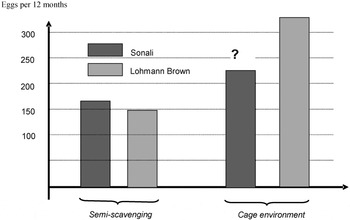
We partly answered this question when we discussed the constraints of village production systems. Under the ‘favourable’ conditions of high-input production systems, no one questions the superiority of commercial stock. However, under the harsh conditions of low-input village poultry production systems, this superiority is less obvious, especially in terms of cost effectiveness, as shown by various studies (Rahman et al., Reference RAHMAN, SORENSEN, JENSEN and DOLBERG1997; Singh et al., Reference SINGH, JOHRI, SINGH, NARAYAN and SINGH2004; Tadelle et al., Reference TADELLE, ALEMU and PETERS2000). This is a classical situation of genotype by environment interaction. The Lohmann Brown, for example, produced 303 eggs in 12 months under the optimal conditions of the German Random Sample Test (Sørensen, Reference SØRENSEN1997), but only 140 eggs under semi-scavenging conditions, while the Sonali produced 156 eggs under the latter conditions (see Figure 2). The Sonali was never entered in the German Random Sample Test, but its production would very likely be slightly higher than 200 eggs (Sørensen, personal communication). The genetic make up of the Sonali is described below.
Breed × environment interaction for egg production in 12 months in Bangladesh (Sørensen, Reference SØRENSEN1999).

Furthermore, the utilization of these local populations is the best means to ensure that they remain available for future generations. To be sustainable, this utilization must efficiently meet current economic and social objectives without compromising the natural environment and resources. It is also the safest way to conserve them, as cryo-preservation of semen has only shown moderate success.
breeding goals and criteria
There is evidence to show that there is considerable scope for improving the performance of indigenous or local breeds. However, these breeds cannot compete with highly selected commercial hybrids. Thus, a breeding programme involving indigenous or local breeds should identify alternative breeding goals and capitalise on the breeds’ specific attributes. The breeding goal would be to improve the efficiency of indigenous populations raised under village conditions. This implies improving performance, reproduction capacity and liveability or survival.
Unlike commercial breeds, indigenous or local breeds are dual-purpose; therefore, improving their performance will be achieved through increasing both the body weight and the egg production of a single population. However, the emphasis given to each of these traits depends on the region in question. In Africa, it is often chicken meat that is of primary interest and so more emphasis will be put on body weight at a given age than on numbers of eggs laid. Conversely, in Asia and South America, egg production is more important, and more emphasis is put on egg production than on meat production capacity. Several studies (Yeasmin and Howlider, Reference YEASMIN and HOWLIDER1998; Njenga, Reference NJENGA2005) have shown that various genes with major effects, such as the naked neck, the frizzle and the dwarfism genes, are segregating in indigenous populations. As these genes have a positive effect on egg production and growth under high temperature (Mérat, Reference MÉRAT1990), one might, depending on the specific conditions, try to increase their frequency by selecting birds carrying these genes from among the candidates for breeding.
While it is considered to be hindrance to high egg yield under commercial production, brooding and natural incubation capacity is an important criterion under village conditions, as it is not possible to utilise artificial incubation. There is evidence that smaller broody hens incubate and raise their chicks better than larger ones. The use of the dwarfism genes may be of interest in this regard. Njenga (Reference NJENGA2005), in his survey study with farmers in Costal Kenya, found that dwarf hens had better reproductive capacity, and in particular had better mothering ability. This explains why dwarf hens are kept in regions where poultry meat is of major interest. Several genes are known to cause dwarfism in chickens. In most indigenous populations, the dwarf form is due to autosomal genes. There is another form of dwarfism which is due to the sex-linked recessive gene dw. This gene was used to produce a French broiler (Vedette) in which the broiler mother was dwarf. One might consider a similar scheme if a cross-breeding programme is to be implemented.
Under village conditions, birds are continuously exposed to pathogens. Survival or longevity under these conditions is an indication of the bird's ability to withstand bacterial or viral infections and should be used as a selection criterion for increased genetic resistance to diseases, especially for comparing progeny of different parents with different survivability. Such an empirical approach, in which the birds are exposed to the pathogen and the survivors are used to produce next generation, allowed Cole (Reference COLE1968) to obtain Marek's disease resistant and susceptible lines within four generations. However, such an approach has never been applied by commercial breeders for two reasons; 1) it is a costly, risky and harmful approach and 2) the development of vaccines reduced the economic interest of genetic resistance to the Marek's disease virus. To our knowledge; no breeder has yet a formal programme to directly select for a specific disease resistance, even though some breeders have been screening for Major Histocompatibility Complex (CMH), known as the B locus, in their lines for a long time. Without speaking about general resistance to pathogens, which increasingly appears as an utopia, the influence of MHC on the resistance to certain pathogens is well proven (Lamont et al., Reference LAMONT, PINARD-VAN DER LAAN, CHANER, VAN DER POEL and PARMENTIER2003)
breeding strategies
Once a breeding goal and selection criteria have been established, a selection strategy must be proposed and implemented. This section presents different scenarios based on past experiences of genetically improving indigenous and local populations, but also on the lessons learned from commercial poultry breeding programmes.
Structured cross-breeding programmes
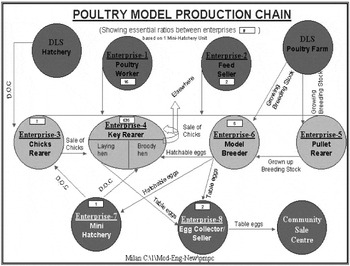
Such programmes are based on a two-way cross between an improved exotic and a local breed, with the aim of combining the better production capacity of the former with the latter's adaptability to harsh environments. Such a scheme maximises cross-breeding effects. Two examples are presented for illustration: the Bangladeshi and the Indian programmes. The cross-breeding programme in Bangladesh (Figure 3) is run by the Directorate of Livestock Services (DSL) and is based on two pure breeds, the Fayoumi and Rhode Island Red. The company either produces the F1 chickens and transfers them to the rearing farm (Enterprise 4) or transfers the pure-bred parents, the Fayoumi females and the Rhode Island Red (RIR) males, to the breeding farm (Enterprise 6). The Fayoumi is an Egyptian breed which has moderate egg production under difficult environments, but it is renown for its resistance to diseases. The RIR is an American breed which became the main brown-egg high-yielding breed used by most commercial companies. The RIR used in Bangladesh has not undergone this selection for pure laying. The cross-bred chicken is called Sonali and has proved to be the highest yielding and most profitable breed combination in several comparisons under semi-scavenging conditions (Rahman et al., Reference RAHMAN, SORENSEN, JENSEN and DOLBERG1997).
The Bangladesh cross-breeding programme.

The Central Animal Research Institute in India developed a cross-bred hen for smallholder farmers in India which would be able to withstand village production conditions (Singh et al., Reference SINGH, JOHRI, SINGH, NARAYAN and SINGH2004). The cross-bred hen, called CARI Nirbheek, is a two way cross between the male Aseel, which is well adapted to tropical conditions, and the female CARI Red which is improved for egg production capacity under the tropical condition. The native breed, Aseel, is known for its high majestic gate and its dogged fighting qualities that make it very well able to protect it self from predators. It has shown the best response in immune competence tests among various breeds. In the field, with around 30 g of supplemented feed per day, the CARI Nirbheek hens were able to produce 163 eggs annually with a survival rate of 90-95%.
Introgression and cockerel exchange
Another strategy for improving the performance of local populations is through introgression of genetic material. This can be achieved though a back-crossing or cockerel exchange programmes.
There are several African reports of continuous back-crossing with high-yielding commercial laying stock, leading to improved early growth rate. In Uganda, for example, the F1 and the back-crosses (25% Bovan Brown) generated from the crossing between Bovan Brown and local chickens, were distributed among ten farms. These crosses were superior to the local chickens in terms of daily gain, but the superiority decreased gradually to zero at six months of age with the 25% Bovan crosses (Sørensen and Ssewannyana, Reference SØRENSEN and SSEWANNYANA2003). No report on reproductive capacity and general fitness of the hens with Bovan genes has been obtained, but higher mortality was observed in the hens as the project went on.
Another cross-breeding strategy, which has been practised for many years in some African countries, is the cockerel exchange programme (FAO, Reference FAO2004). This type of scheme involves distributing cocks of improved breeds to smallholders. However, several reports have concluded that this type of improvement has not changed the basic populations, except for contributing to a larger variation in plumage colour.
Structured straight-breeding programmes
The nucleus flock is maintained either in a central station or in a breeding farm. This flock could have been established during the on-station characterization of local breeds. In this case, the superior breed according to the outcomes of this characterisation is maintained, although more birds of the chosen breed or ecotype might need to be gathered to have a sufficiently large base population. All the animals of the breeding nucleus are identified (full pedigree) and recorded for growth and egg production. Sire-pedigreed offspring of candidate sires are produced and distributed among smallholders in different villages, preferably in different regions, where they are recorded for egg production, market body weight, number of eggs set for natural incubation, number of chicks hatched and survival. The recording should be as simple as possible. Field and on-station data are then used to select the best candidate sires to remain in the nucleus. Non-selected sires are sold to smallholders to disseminate the genetic progress into the local populations. This will also be done through distribution of non-pedigreed offspring of elite animals. These chicks, as well as those produced for testing candidate males, are sold at three weeks of age to ensure that they are vaccinated and have acquired the minimum body weight and vigour needed to survive in village conditions.
When establishing the breeding nucleus and running the selection programme it is important to be aware of the possibility of G × E interaction. Therefore, the housing conditions should be close to rural free-range ones. For example, one should not provide artificial ambient conditions (temperature, humidity); most of all, housing elite birds in cages should be avoided. Similarly, the feed provided at the breeding farm should not be too different from that found in the villages.
Gaps and challenges in implementing structured breeding programmes
Most breeding programmes, aimed at improving the productivity of indigenous chickens, have used cross-breeding. This approach has provided significantly higher productivity, but has resulted in a loss or dilution of the indigenous birds’ morphological characters and instinct for broodiness. For example, the Sonali in Bangladesh was a high-yielding breed combination under semi-scavenging conditions (Rahman et al., Reference RAHMAN, SORENSEN, JENSEN and DOLBERG1997). However, smallholders’ acceptance declined when they discovered that they had no success in reproducing the breed. Similarly, when they received the CARI cross-bred hens, the Indian villagers complained about the dilution of morphological characters.
The best way to improve the productivity of indigenous chickens, without altering any of the morphological characteristics that are appreciated by the villagers, is to select for production traits within a given population. In terms of rate of improvement, this is a slow process compared to crossbreeding with a genetically superior breed. Iyer (Reference IYER1950) conducted selection in a non-descript flock of Indian Deshi fowl and was able to increase the annual egg production from 116 eggs to about 140 eggs per hen through six generations of selection. The average egg weight of the flock also increased from 43 to 49 g.
Experience has made it clear that the structure of the crossbreeding programmes was too complex for village conditions, where crucial inputs, such as feed and medication, were not readily available. The need for periodic re-supply of cross-bred chicks to the villagers presents a challenge. This has to be carried out either by an NGO or by a government agency, which has to maintain the pure lines of the indigenous birds as well as of the exotic birds on an appropriate selection programme. A mechanism for re-supplying the birds, providing minimum inputs, and marketing the eggs and culled birds, has to be put in place in order to achieve success with programmes of this type.
Conclusions
In breeding poultry for improved performance under village conditions, there is a debate as to whether to start with high-producing breeds and adapt them to the environment, or start with the low-producing local breeds and try to improve their performance. In most cases the choice has been to utilize high-yielding breeds to upgrade local ones. These breeds were often introduced with the assumption that the environment would be improved. In general, this assumption did not prove to be realistic, and the overall result has been a clear lack of success; smallholders are left with their non-improved local breeds which are not indigenous anymore.
Poultry genetic diversity and options for its utilization are usually discussed in terms of breeds. ‘Breeds’ are typically cultural concepts rather than physical entities. Indeed, several genetic diversity studies showed little differentiation between local breed or eco-zone populations, which, unless specific functional traits are identified, gives some flexibility for choosing the base population for the breeding programme. Such studies revealed high polymorphism and genetic variation within breed or eco-zone population coupled with low level of inbreeding, which constitutes a good basis for selection.
Genetic improvement of these populations is a challenging but not impossible task. Guidelines for the design and implementation of improvement programmes need to be developed. But, perhaps, the most urgent task is to increase awareness of the values of these populations, especially among policy-makers.