As policy studies have indicated, the backgrounds of policy actors who release information and the predisposition of recipients are factors that shape the credibility of policy information. On the one hand, advocacy information released by different policy actors will alter the public’s attitudes towards policy (Druckman and Bolsen Reference Druckman and Bolsen2011). How stories are told and who told them will also change public perception of policy issues (Shanahan et al. Reference Shanahan, Jones, McBeth and Lane2013; Brewer and Ley Reference Brewer and Ley2013; Jones and Song Reference Jones and Song2014; Jones Reference Jones2014b). The backgrounds of policy actors, thus, affect the credibility of their policy information. On the other hand, the existing studies on public opinion and framing suggest that the public’s predispositions will affect the way they perceive the credibility of information released by different policy actors (Chong and Druckman Reference Chong and Druckman2007). These variances caused by policy actors are particularly prevalent when policy information is related to science, such as environmental policy. Disagreement exists among scientists (Montpetit Reference Montpetit2011), which increases uncertainty and flexibility for the information receivers to interpret information related to science (Brewer and Ley Reference Brewer and Ley2013). Information receivers’ predispositions, then, affect their interpretations of the policy information related to science.
Despite the importance of understanding what affects the credibility of policy actors and actor disclosed information, it has not been included in the existing nonprofit organisations (NPOs) advocacy studies. NPOs have become crucial policy actors by directly influencing governmental decisions, associating with celebrities (de los Salmones and Dominguez Reference de los Salmones and Dominguez2016; Ilicic and Baxter Reference Ilicic and Baxter2014) and increasing public awareness and participation in the policy process (Casey Reference Casey2014; Balassiano and Chandler Reference Balassiano and Chandler2010). A wide variety of NPOs have undertaken information campaigns to attract public attention and to gain public support for policies. For example, environmental nonprofit organisations (ENPOs) have become key actors in environmental policy by releasing environmental information in attempts to influence public opinion in favour of pro-environmental causes (Liu Reference Liu2018a). Whether advocacy NPOs can provide policy information that effectively persuades the public determines whether they can be influential in policy advocacy, yet little attention has been drawn to investigating the credibility of policy information released by NPOs.
To bring the features of policy information credibility – the influence of policy actors’ background and information recipients’ worldviews – into nonprofit advocacy studies, this research focuses on ENPOs, a type of NPO that promotes policies related to scientific information. To measure the influence of policy actors’ backgrounds in nonprofit advocacy studies, ENPOs’ public faces were used. When the public views ENPOs, they may not know who is behind each organisation, but they do see the people who are publicly associated with the ENPO. Therefore, ENPOs’ public faces in this research refer to people who are publicly associated with ENPOs, communicate information for the ENPOs as spokespeople, or publicly endorse the ENPOs. The public, then, is the information recipients.
Moreover, regardless of ENPOs’ capabilities to conduct research and write policy platforms, the actors they choose to communicate with the public position their organisations in different places along the science-advocacy continuum. For example, there may be no significant differences in ENPOs’ abilities to cite scientific information for their advocacy. However, when ENPOs rely on environmental scholars to communicate information with the public, they are viewed as using a more scientific approach; when ENPOs choose local residents or celebrities to convey information, they may be perceived as relying more on community influence. Leaning toward the science-oriented approach or towards the community influence approach may result in different public perceptions of the ENPOs. This study aims to investigate how the choice of the “messenger” and “public face” affects the public perception of the information credibility given by ENPOs.
Two main research questions were answered in this research – 1) how do ENPOs’ public faces affect public perception of the credibility of the information released by their organisations? 2) how does public predisposition/worldview affects trust in information released by ENPOs with different public faces? Specifically, to measure the predispositions/worldviews of the public, this study adopts Douglas and Wildavsky’s Cultural Theory (CT), which has been demonstrated as a powerful theory to explain public perception on environmental information and information released by different policy actors (Lachapelle et al. Reference Lachapelle, Montpetit and Gauvin2014; Jenkins-Smith et al. Reference Jenkins-Smith, Silva, Gupta and Ripberger2014; Jones Reference Jones2014b, Reference Jones2011).
Instead of focusing on environmental nonprofits in the USA, this research focuses on environmental nonprofit organisations in Taiwan. Among all East Asian countries, environmental nonprofit organisations play a vital role in environmental governance in Taiwan. Yet, studies on ENPOs in Taiwan are relatively limited (Liu Reference Liu2018a, Reference Liu2018b). Moreover, compared to the USA and other Western countries, public perceptions of environmental information released by different types of ENPOs are likely to be particularly important in East Asian countries, like Taiwan, that are influenced by Confucianism which values academic professionalism (Kim Reference Kim2015; Shi Reference Shi2001). Whether the mass public in Taiwan considers environmental information released by non-scholars to be credible is worth investigating. Thus, by focusing on Taiwanese ENPOs, this research expects to not only fill the theoretical gap but also provide practical implications.
Nonprofit advocacy and its credibility
NPOs play key roles in policy advocacy but have varying participation and effectiveness in their advocacy initiatives, which has not been adequately investigated or explained in the literature (Grønbjerg and Prakash Reference Grønbjerg and Prakash2017). Specifically, NPO advocacy studies to date have been limited and have focused mainly on strategies (Baron Reference Baron2003; Balassiano and Chandler Reference Balassiano and Chandler2010; Johansen and LeRoux Reference Johansen and LeRoux2013; Grønbjerg and Prakash Reference Grønbjerg and Prakash2017; Handy Reference Handy2001), organisational characteristics (Child and Grønbjerg Reference Child and Grønbjerg2007), and stakeholders (MacIndoe and Whalen Reference MacIndoe and Whalen2013; McKeever Reference McKeever2013), which provide an incomplete understanding of NPO advocacy effectiveness.
Moreover, NPOs have increasingly relied on information campaigns to increase public awareness of policy issues (Verschuere and De Corte Reference Verschuere and De Corte2015; Casey Reference Casey2014; Balassiano and Chandler Reference Balassiano and Chandler2010). NPOs’ reliance on information campaigns for policy advocacy creates a need for examining the factors that shape the credibility of NPOs and information released by them in order to understand the effectiveness of NPO policy advocacy comprehensively. However, public perceptions of NPO credibility and policy information released by NPOs are understudied. General findings of NPO credibility have revealed that NPOs as a whole are considered more trustworthy than for-profit organisations (Hansmann Reference Hansmann1981; Aaker et al. Reference Aaker, Kathleen and Mogilner2010). Studies have further investigated credibility within the nonprofit sector by investigating the use of the internet and social media (Bates et al. Reference Bates, Romina, Ahmed and Hopson2006; Auger Reference Auger2013; Kenix Reference Kenix2008), celebrity endorsements (Wheeler Reference Wheeler2009), and the impact of scandals and cases of wrongdoing (Gibelman and Gelman Reference Gibelman and Gelman2004).
Few studies of NPO credibility have specifically investigated features of senders and receivers of information, but those that have done it find compelling connections. Worthington, NussBaum, and Parrott (Reference Worthington, NussBaum and Parrot2015) analysed the effectiveness of advocacy messages by examining receiver characteristics, message characteristics, and perceived credibility. They found a positive relationship between these factors, which increased the success of advocacy effectiveness. Yet, none of the characteristics were defined by NPOs’ public image or by information receivers’ cultural worldviews. Investigating these features is crucial for understanding NPOs’ effectiveness of policy advocacy by providing insight into factors that influence public perception of advocacy information. Moreover, investigating these features is particularly important to NPOs that advocate for issues intertwined with political controversies related to scientific information, such as ENPOs.
Currently, ENPOs are discussed in the literature as being particularly important policy advocates due to the resistance of the federal government in environmental action and the need for organised mobilisation of the public (Hall and Taplin Reference Hall and Taplin2010). The existing research has found ENPOs can be more successful than governmental organisations in influencing local residents about the value of environmental protection than governmental organisations due to their grass-roots characteristics (Auer Reference Auer2000; Biermann & Bauer Reference Biermann and Bauer2005; Winchester Reference Winchester2009). However, without examining how the public perceives environmental information released by ENPOs, it is inappropriate to assume how influential ENPOs can be.
The determinants of policy actors’ credibility
Scholars have focused on developing theories about how policy actors affect public perceptions. Among these studies, policy studies, such as the narrative policy framework, hypothesise that as trust in the narrator increases, individuals are more likely to believe the narratives. That is, the credibility of policy actors who provide the policy information will affect the policy recipients’ trust in the policy information (Ertas Reference Ertas2015). Framing theory is also vital for understanding how policy actors communicate information to the mass public. Defining the communicative process and framing the issues are crucial for the public to receive and use the information as a heuristic to form their preferences on these issues (Chong and Druckman Reference Chong and Druckman2007). More precisely, an issue can be interpreted from several perspectives, and individual-level traits affect individuals’ acceptance of the information they receive (Zaller Reference Zaller1992). Whether the information released by policy actors successfully influences the mass public depends on whether the information is accepted by individuals’ political predispositions – the individual-level traits on political issues (Chong and Druckman Reference Chong and Druckman2007; Zaller Reference Zaller1992).
Moreover, scholars have indicated other variables that should be incorporated into the analytical model of understanding the effect of policy information. For example, the extent that individuals are affected by policy actor discourse is influenced by their own political predispositions (Zaller Reference Zaller1992). That is, the individuals’ political experiences and political awareness determine whether they accept or resist the policy actor discourse. Moreover, the credibility of policy actors who disclose information also affects whether the mass public is influenced by the information (Druckman Reference Druckman2001). When the public thinks a policy actor is credible, the public is more likely to trust and be affected by the information disclosed by the elite, regardless of whether the information is manipulated or not. In this case, how individuals perceive policy actors’ credibility is also another moderating effect.
The narrative policy framework, framing theory studies, and public opinion studies indicate the possible variables that may affect the way the mass public perceives policy actor discourse; however, these studies are not sufficient to understand comprehensively how the mass public perceives policy information released by ENPOs. First, policy information recipients’ personal and political predispositions matter, but the current measurement for these predispositions is not sufficient or comprehensive. For example, it is hard to measure every recipient’s personal experience with regard to every political issue. Second, most of the existing studies investigate the effect of contradictory policy information from at least two competing policy coalitions instead of focusing on the effect of the similar policy information disclosed by different actors in the same coalition. That is, the existing studies are powerful in explaining the variation of public perception on policy information released by two competing coalitions, but not the variance within the same coalition.
Third, environmental issues are more complicated than other political issues because they are often intertwined with controversies related to science and policy. When these controversies are presented, the mass public’s biases regarding the interpretation of scientific evidence will inevitably influence the effect of the information they receive (Jones Reference Jones2014a; Xue et al. Reference Xue, Hine, Marks, Phillips and Zhao2015). Measuring the mass public’s demographic attributes is not sufficient to measure how their basic values are intertwined with their personal predispositions. Environmental issues are often intertwined with more controversial views related to scientific information than are other political issues. Therefore, the way individuals process scientific evidence should be considered another predisposition (Lachapelle et al. Reference Lachapelle, Montpetit and Gauvin2014; Montpetit Reference Montpetit2011; Levi and Holder Reference Levi and Holder1988) that affects how they perceive environmental policy actors’ discourse.
Fourth, with regard to policy actors’ credibility, each individual perceives credibility differently. Perception of credibility is not only based on a policy actor’s authority in their respective area but also by individual worldviews of who the expert is (Lachapelle et al. Reference Lachapelle, Montpetit and Gauvin2014). Fifth, the traditional way of measuring individuals’ political predisposition may work in the USA but cannot work in countries like Taiwan where political ideology and partisan differences on environmental issues are obscure (Liu Reference Liu2018a, Liu Reference Liu2020). A better way of measuring information receivers’ predispositions is needed.
To answer the research questions about how the mass public perceives information released by ENPOs with different member composition, this study argues that CT can better measure individuals’ personal and political predispositions because CT explains how individuals with different cultural biases assess credibility, react to scientific uncertainty, and define which actors have expertise (Lachapelle et al. Reference Lachapelle, Montpetit and Gauvin2014; Brewer and Ley Reference Brewer and Ley2013).
Cultural influences and information recipients’ perceptions
CT is a two-dimensional framework – the grid and the group dimension – that allows researchers to precisely measure variation across individuals’ worldviews (Chai et al. Reference Chai, Dorj, Hampton and Liu2011). The group dimension measures to what extent individuals consider themselves part of the social group; the grid dimension measures to what extent individuals are constrained by socially imposed rules (Liu Reference Liu2018a). These two dimensions sort individuals into four different worldviews: hierarchism (high group, high grid), egalitarianism (high group, low grid), individualism (low group, low grid), and fatalism (low group, high grid). These worldviews in turn generate functionally related cultural biases; values and beliefs that are compatible with and help sustain each of the four institutional patterns. In other words, each cultural bias/worldview can be considered as a combination of social relations, belief systems, and practices (Ney and Verweij Reference Ney and Verweij2014). People with different cultural biases have different preferences for social order and perceptions of information released by different policy actors.
CT can explain why individuals process environmental information released by policy actors differently. Based on CT, because hierarchical cultural institutions are highly structured (Swedlow Reference Swedlow2014), they believe everyone in society has his or her own position and people who have the proper authority should make decisions. Hierarchs believe that only people who were trained and recognised to have a specialty in certain areas have the authority to speak for the issue (Jones Reference Jones2014a, Reference Jones2011). For example, based on the worldview of hierarchs, only people who have been trained professionally in environmental science, such as environmental scholars, have the proper authority to provide information about environmental issues. Scholars from other fields, such as economists, are not considered by hierarchs to have proper authority on environmental issues. Therefore, they are more likely to trust the information provided by environmental experts regardless of whether the information is correctly framed (Lachapelle et al. Reference Lachapelle, Montpetit and Gauvin2014). Thus, this study hypothesises:
Hypothesis 1: Individuals’ degree of hierarchism is positively associated with their perceptions of the credibility of information released by policy actors with the relevant authority, such as ENPOs that are associated with environmental scholars.
Those with egalitarian cultural bias also value the importance of groups and collectivism, but egalitarians retain their personal autonomy and think everyone in the group should be equal (Swedlow Reference Swedlow2011a, Reference Swedlow2012). That is, for egalitarians, no one should be considered to have more authority than the others (Jones Reference Jones2011). Instead of perceiving who discloses the information, egalitarians are more likely to accept information that enhances fairness and equality but resist information that may be harmful to these values, regardless of who gives the information (Lachapelle et al. Reference Lachapelle, Montpetit and Gauvin2014). Also, egalitarians seek a common interest, not only for human society but also for the natural environment. They tend to take environmental risks seriously and to believe and worry about information related to these risks (Jones Reference Jones2014a; Xue et al. Reference Xue, Hine, Marks, Phillips and Zhao2015). Therefore, they are more likely to believe information beneficial to environmental risk prevention and environmental protection regardless of whether the information is released by people who have the relevant authority or not. Thus:
Hypothesis 2: Individuals’ degree of egalitarianism is positively associated with their perceptions of the credibility of information released by policy actors that may support environmental protection, such as ENPOs that are associated with environmental scholars, celebrities who support environmental protection, and local residents.
Similar to egalitarians, individualists also do not believe certain people have more authority than others (Jones Reference Jones2011, Reference Jones2014b; Ripberger et al. Reference Ripberger, Gupta, Silva and Jenkins-Smith2014). However, contrary to egalitarians, individualists think the relationship between people should be like a network within which individual choice is valued. Because individualists value personal freedom more than social collectivism, they tend to resist information that may enhance external regulations, which in turn threatens freedom (Swedlow Reference Swedlow2009). Thus, they are less likely to trust information that promotes environmental protection. Based on this discussion, this study hypothesises:
Hypothesis 3: Individuals’ degree of individualism is positively associated with their perceptions of the credibility of information released by policy actors that may not support environmental protection regulation, such as ENPOs that are associated with economists.
The fourth cultural type, fatalism, has been considered to have very little connection with environmental issues and often left out from empirical testing when predicting how cultural biases affect individuals’ perception (Ellis and Thompson Reference Ellis and Thompson1997; Jones Reference Jones2014a; Johnson and Swedlow Reference Johnson and Swedlow2019). How fatalism affects issues related to environmental protection remains agnostic (Kosunen and Hirvonen-Kantola Reference Kosunen and Hirvonen-Kantola2020). Fatalists, similar to individualists, are also not part of social collectivism (Swedlow Reference Swedlow2011b; Liu Reference Liu2018b). However, unlike individualists, “fatalists consider themselves subject to binding external constraints” (Ripberger et al. Reference Ripberger, Gupta, Silva and Jenkins-Smith2014). In other words, fatalists do not believe they can make decisions for themselves. They rely on others to make decisions and believe they do not have any choice but to follow the decisions of others (Ney and Verweij Reference Ney and Verweij2014; Swedlow et al. Reference Swedlow, Ripberger, Liu, Silva, Jenkins-Smith and Johnson2020). That is, fatalists tend to believe that other people have more authority than them when it comes to rule-making. Based on this discussion, this study hypothesises:
Hypothesis 4: Individuals’ degree of fatalism is positively associated with their perceptions of the credibility of information released by all policy actors.
Methods and data collection
Data collection
An online survey was distributed in July 2016; 500 respondents were drawn from qualified Taiwanese voters, who were recruited through Pollcracy Lab in Taiwan. Pollcracy is run by the Election Study Center (ESC) at National Chengchi University. Over the years, the ESC’s Pollcracy Lab has built a nationally representative online panel from its telephone survey respondents. All online panel valid respondents received the email and chose to opt in. To cope with the issue of representativeness, post-stratification adjustment was created based on gender and age (see Appendix A for the comparison between unweighted data and weighted data).
Dependent variables
The dependent variables in this study are individuals’ perceptions of the credibility of information released by different policy actors, specifically by ENPOs with different perceived characteristics. As mentioned, the public usually does not know ENPOs’ leadership or member composition. Therefore, to capture ENPOs’ social images, we use the ENPOs’ public faces – the people who are publicly associated with the ENPOs, communicate information for the ENPOs as spokespeople, or publicly endorse the ENPOs. Moreover, instead of using existing ENPOs’ names in the survey, this study creates experimental/hypothetical ENPOs with four different types of public faces to control for the effects of respondents’ past experiences with certain existing ENPOs. These experimental/hypothetical ENPOs were not given fabricated names.
To operationalise the four types of public faces, first, we adopted the experiments designed by Lachapelle et al. (Reference Lachapelle, Montpetit and Gauvin2014) indicating that people with proper authority are experts whose training background aligns with the scientific information he/she is releasing. That is, if the advocacy information is related to environmental protection and science, only an expert who is trained in an environmental protection-related discipline is considered a proper authority. Second, to make sure the operationalisation is valid in the Taiwanese context, we based our design on Taiwanese environmental activism studies. According to the history of Taiwanese environmental movement, scholars, economists, grass root groups (local residents), and celebrities all play crucial roles in the environmental advocacy subsystem (Ho Reference Ho2001, Reference Ho2006). Based on Chen (Reference Chen2014), in Taiwan, academic experts/scholars have more authority on science-related information than other policy actors (politicians, celebrities, and the public), especially on environmental protection policy. Authority, under East Asian context, is often associated with academic expertise (Kim, Reference Kim2015). In fact, people in Taiwan often refer to scholars as scholar-experts. Therefore, although local residents and celebrities are also important actors in Taiwanese environmental activism (Ho, Reference Ho2006), these two actors are not considered “authority” under the research context unless their profiles specify their education training.
Moreover, according to Ho (Reference Ho2001), the pro-environmental coalition in Taiwan tended to collaborate with environmental scholars to increase the credibility of their information, while the antiregulation coalition tended to quote economists to increase the legitimacy of their arguments. In other words, although environmental scholars and economists both are considered people with authority due to their academic training, environmental scholars are considered a proper authority when it comes to environmental protection-related issues. Economists, on the other hand, are considered antiregulators due to the environmental activism history in Taiwan.
Based on the discussion above, the four types of public faces include scholars who do environment-related studies, celebrities who support environmental protection, local residents at pollution zones, and economists. Scholars who conduct environment-related studies represent policy actors with proper authority who support environmental protection, while celebrities who support environmental protection and local residents at pollution zones represent policy actors without proper authority. Economists represent policy actors that weigh economic development over environmental protection. These represented images of these four types of characters are created based on the outcomes of the Taiwan Social Change Survey (TSCS). Specifically, as mentioned, proper authority to hierarchs refers to those who are trained and recognised to have specialised expertise in the relevant area, such as environmental scholars. Based on the TSCS survey, respondents believe that economic development is not compatible with environmental protection, and economists weigh economic development over environmental protection. Thus, economists are considered an authority in economic development but may not have proper authority on other issues. Neither local residents nor celebrities have training in environmental issues, but both are designed to be pro-environmental protection in this research.
In reality, it is very rare that ENPOs are run solely by any of these four characters but may use them to communicate information with the public, creating public faces that influence perceptions. To obtain dependent variables for testing the Hypotheses, this study asked respondents the degree to which they believed the information given by ENPOs that are associated with scholars who do environment-related studies, celebrities who support environmental protection, economists, and local residents at the pollution zones, respectively. Respondents were asked to place their answers on a five-point Likert scale. Again, this association refers to these four characters (environmental scholars, economists, celebrities, and local residents) acting as public faces for the ENPOs.
Key explanatory variables
To obtain the information for the key explanatory variables of individual cultural biases, this study provided four measurements developed by Jenkins-Smith and collaborators, which include hierarchical, individualistic, egalitarian, and fatalistic statements. Respondents were asked to rate each statement on a 10-point scale based on the extent to which each statement described their way of life. If a respondent rated two or more statements the same, he/she was asked to rank these statements based on which statement came closest to their way of life.
Control variables
Demographic attributes
The survey questionnaires asked the respondents’ gender (male = 1, female = 0), age (sorted in scales based on a ten-year cycle), income (measured by NTD and sorted in ordinal scales), education level (sorted in scales), and party affiliation – Kuomintang (KMT = 1, others = 0) and Democratic Progressive Party (DPP = 1, others = 0).
New environmental paradigms
This study measured respondents’ perceptions of the relationship between humans and ecology by using the seven measures of the New Environmental Paradigms revised by Dunlap et al. (Reference Dunlap, Van Liere, Mertig and Emmet2000). The seven measures were combined into one index that acts as the control variable while testing Hypotheses 1 through 3.
Data analysis process
An analysis of variance (ANOVA) and a series of OLS regressions were estimated using Stata 15. Because the dependent variable is an ordinal level variable, we also estimated a series of ordered logit regressions to cross-check the validity of the statistical results. The estimation method was Maximum Likelihood. Chi-square was used to test the lack of fit. Approximate likelihood-ratio tests and Brant tests were used to examine the proportional odds assumption.
Results
Overview of key explanatory and dependent variables
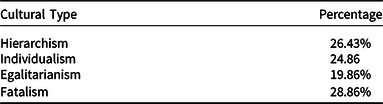
To obtain an overview of the Taiwanese general public’s worldviews and perceptions of environmental information given by ENPOs with different public faces, a series of descriptive statistics were calculated. After applying weights to the sample and sorting respondents’ cultural biases into the four cultural types by identifying the statement they rated/ranked the highest, as Table 1 presents, 28.86% of the general public in Taiwan were fatalists, 26.43% were hierarchs, 24.86% were individualists, and 19.86% were egalitarians.
Distribution of cultural biases in Taiwan

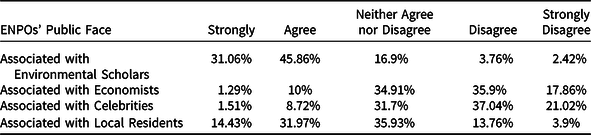
Next, with regard to public perceptions of environmental information given by different ENPOs, 76.9% of the general public considered information given by ENPOs that are associated with environmental scholars to be credible, 21.1% believed that information released by ENPOs associated with economists is credible, 10.2% considered information given by ENPOs associated with celebrities who support environmental protection to be credible, and 46.4% believed that information given by ENPOs that are associated with local residents at pollution zones is credible (Table 2).
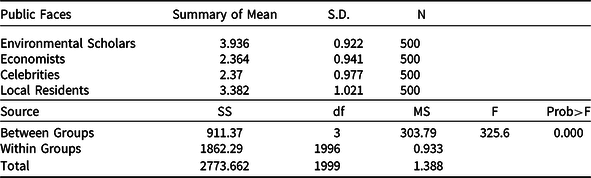
To further test whether the variances are statistically discernible from zero, we conducted a one-way ANOVA test. As displayed in Table 3, the mean differences among these ENPOs that are associated with four different public faces are statistically discernible from zero.
Distribution of public perception on information released by different ENPOs

Estimates from analysis of variance (ANOVA)

Bartlett’s test for equal variance: chi2(3) = 6.099 Prob>Chi2 = 0.107.
Hypotheses testing
To test the hypotheses, this study first ran four OLS regressions and ordered logit regression models that regressed the degree of trust in different types of environmental information sources on the rating of cultural statements: hierarchism, individualism, egalitarianism, and fatalism. Post-stratification weights were applied to the estimation. If the hypotheses are valid, hierarchism should have a positive association with the degree of trust in environmental information released by environmental scholars; egalitarianism should have a positive association with the degree of trust in environmental information released by environmental scholars, celebrities, and local residents; individualists should have a positive association with the degree of trust in information released by economists, and fatalists should have a positive association with the degree of trust in information released by all actors.
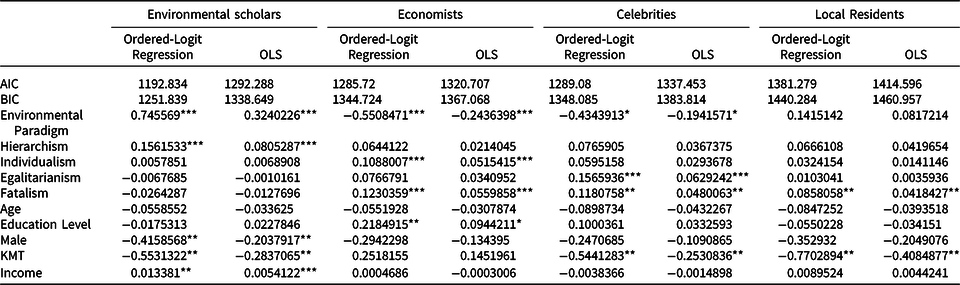
Table 4 summarises the results of the four OLS and four ordered logit regressions. The results of OLS and ordered logit regressions are compatible with each other. The results of this preliminary estimation reveal that Hypotheses 1 and 3 are valid. The more hierarchical a person was, the higher degree of trust he/she had in environmental information released by ENPOs that are associated with environmental scholars, while the more individualistic a person was, the higher degree of trust he/she had in environmental information released by ENPOs that are associated with economists. The results also support part of Hypothesis 2 that the more egalitarian a person was, the higher degree of trust he/she had in environmental information released by ENPOs associated with celebrities, while there was no evidence that supported the association between egalitarianism and the degree of trust in environmental information released by ENPOs that are associated with environmental scholars and local residents. Hypothesis 4 is also partially valid; fatalism has a positive association with the degree of trust in information released by economists, celebrities, and local residents, but has no relationship with the degree of trust in information given by environmental scholars.
Estimates from four ordered logit /OLS regressions that regressed the degree of trust in different types of environmental information sources on the rating of cultural statements

*p<.10 **p<.05 ***p<.01.
To further test these three hypotheses, this study then conducted another four OLS regressions and four ordered logit regression models that regressed the degree of trust in the different types of environmental information sources on the rating of cultural statements: hierarchism, individualism, and egalitarianism. In addition to these four key explanatory variables, this study also incorporated control variables, such as environmental paradigms, age, education level, sex, party affiliation, and income. Post-stratification weights were applied to the estimations.
Table 5 summarises the results of the selected model. The results of OLS regressions and the results of ordered logit regressions are compatible with each other. People who were members of or leaned toward Kuomintang (KMT) were more likely to have a negative association with environmental information released by ENPOs that are associated with environmental scholars, celebrities who support environmental protection, and local residents. Education level had a positive association with trust in environmental information released by ENPOs that are associated with economists. Males were less likely to trust information released by environmental scholars, while people with higher income were more likely to trust information released by environmental scholars. In addition, the public’s environmental paradigm score had a positive association with its trust in environmental information given by ENPOs associated with environmental scholars and celebrities who support environmental protection but had a negative association with its trust in environmental information given by ENPOs that are associated with economists.
Estimation from four ordered logit regression/OLS models that regressed the degree of trust in the different types of environmental information sources on the rating of cultural statements with control variables

*p<.10 **p<.05 ***p<.01.
With regard to cultural influences, the results of these regressions reveal Hypothesis 1 is valid in that the degree of hierarchism had a positive association with the degree of trust in environmental information given by ENPOs that are associated with environmental scholars. The evidence also supports Hypothesis 3 that the degree of individualism had a positive association with the degree of trust in environmental information given by ENPOs that are associated with economists. Part of Hypothesis 2, that the degree of egalitarianism had a positive association with the degree of trust in environmental information given by ENPOs that are associated celebrities who support environmental protection, is valid; however, there is no evidence to support that egalitarianism was positively associated with information released by ENPOs associated with environmental scholars and local residents. Hypothesis 4 is also partially valid that the degree of fatalism had a positive association with the degree of trust in information given by ENPOs that are associated with economists, celebrities, and local residents.
Discussion
The existing policy studies have examined factors that affect policy information by focusing on policy actors’ backgrounds and information recipients’ predispositions. However, these features have not been incorporated into the study of nonprofit advocacy. To fill the gap in the existing literature, this study focuses on how public perceptions of policy information credibility are affected by ENPOs’ public faces and the predispositions of the public.
Specifically, public perceptions of different sources of environmental information vary. Most Taiwanese considered environmental information to be credible if given by ENPOs that are associated with environmental scholars, and more than half of the Taiwanese trusted environmental information given by ENPOs that are associated with local residents. Most Taiwanese did not consider environmental information to be credible when it was given by ENPOs that are associated with celebrities who support environmental protection or economists. These results reveal that the Taiwanese public tends to believe the information given by people who have the proper authority or people who have personal experience with environmental problems. Also, the perception that economic growth is incompatible with environmental protection may be the reason that the public in Taiwan considers information from ENPOs that are associated with economists to lack credibility. These differences in the perceptions of credibility were not due to random chance. ENPOs’ public faces significantly affect public perception of the information they release. Moreover, perceiving policy information released by scholar credibility is consistent with what Kim (Reference Kim2015) has argued that countries, which are influenced by Confucianism, tend to value academic professionalism.
Based on the results of hypotheses testing, individual party affiliation and environmental paradigm scores show clear patterns in explaining trust in various environmental information sources. People who are members/leaners toward KMT tend to distrust any information given by pro-environment sources, such as environmental scholars, celebrities who support environmental protection, and local residents at pollution zones. This result is consistent with the conventional belief in Taiwan that KMT weighs economic development over environmental protection (Liu Reference Liu2020). On the contrary, people who have a high environmental paradigm score are more likely to consider the information given by environmental scholars to be credible.
Moreover, as CT predicted, hierarchs tend to believe the information given by policy actors who have the proper authority, such as ENPOs that are associated with environmental scholars. Individualists tend to believe in the information given by policy actors that may favour economic growth over environmental protection, such as economists. The evidence for egalitarian cultural influence is relatively weak compared to the other two cultural influences. Specifically, even though the evidence supports the idea that egalitarians tend to believe the information given by celebrities, the evidence does not prove that being egalitarian is associated with trust in information given by environmentalists or local residents.
The lack of association between egalitarianism and the credibility of environmental scholars and local residents was an unexpected finding. A possible explanation for this is that the majority of respondents perceived these types of public faces to be credible. Less than 8% of the respondents considered information given by ENPOs that are associated with environmental scholars to not be credible, and less than 18% of the respondents perceived information given by ENPOs that are associated with local residents to not be credible. In this regard, respondents’ perceptions of the credibility of these two types of ENPOs are relatively homogenous. Although egalitarianism did have a positive association with the trust in environmental scholars and local residents, the association could not stand out as being statistically significant.
Moreover, even though an association between egalitarianism and these two variables was not found, this result may still confirm what CT predicts. Based on CT, egalitarians believe in all information that could balance equality between human society and the natural world (Coyle Reference Coyle, Coyle and Ellis1994). Egalitarians also do not rely on authority as hierarchs do. Therefore, egalitarians are more likely to trust the information given by actors that may not be perceived as credible by those of other cultural types. In other words, egalitarians are more likely to stand out when it comes to environmental information sources that are pro-environment but do not receive a high degree of trust, such as celebrities. Based on the survey results, the information given by ENPOs that were associated with environmental scholars and local residents received more trust from the public in Taiwan than ENPOs that are associated with celebrities. In other words, egalitarians and other cultural types were less likely to have differences in the degree of trust in information given by environmentalists and local residents. Compared to other cultural types, egalitarians were more likely to have a positive association with the degree of trust in information given by celebrities.
Although fatalism has often been left out of existing studies that measure effects of CT and public perception of environmental issues, this study included fatalism and the results confirmed what CT suggested – that fatalists are subject to the constraints of external rules and believe they have no choice but to follow the decisions of others. Thus, fatalism had a positive association with the level of trust in economists, celebrities, and local residents. However, fatalism was not associated with trust in information given by ENPOs that are associated with environmental scholars. A possible reason for this may be similar to the lack of significant associations between egalitarianism and trust in information given by environmental scholars. That is, over 90% of respondents considered the information to be credible when it was given by ENPOs associated with environmental scholars. Due to this, the association between fatalism and trust in environmental scholars may not stand out as significant when compared to the general public. However, as mentioned, the effect of fatalism on environmental issues has remained unknown in the existing CT studies. More empirical research is needed to investigate the influence of fatalism on environmental issues.
Conclusion
Public perception of the credibility of policy information is a key determinant in the success and legitimacy of NPOs when engaging in advocacy efforts. This study sought to explain whether the public face of an ENPO affects public perceptions of credibility and how this differs according to information recipients’ cultural worldviews. In reality, it is unlikely that ENPOs rely solely on any of the four spokespeople to write policy platforms or gather information. Instead, there may be professional staff who are writing the policy and information, and the research capacity among ENPOs may not contain huge discrepancies. However, based on the results, public support and effectiveness of environmental advocacy efforts are impacted by who the organisation chooses to act as spokespeople, regardless of the degree to which the information is based on scientific research.
This study found different levels of trust in information given by ENPOs associated with different actors. Information given by ENPOs that are associated with environmental scholars was perceived more credibly than information given by ENPOs associated with local residents or celebrities. Information was given by ENPOs with economists as their public faces were not considered to be less credible than other ENPOs. However, when taking respondents’ cultural worldviews into consideration, the absolute level of trust in these four types of ENPOs is not consistent across respondents with different worldviews. This study found that individuals’ cultural worldviews affect their perceptions of the credibility of information released by ENPOs composed of different public faces. Hierarchism was associated with trust in information released by those with proper authority, while individualism was associated with trust in information released by economists. People with higher degrees of egalitarianism were more likely to trust the information given by ENPOs associated with celebrities, and fatalism was associated with higher degrees of trust in information given by economists, celebrities, and local residents.
The comparison between the absolute levels of trust in different public faces and the relative levels of trust by different citizen groups provides implications for more substantial actionable advocacy strategies for ENPOs. Specifically, if we only look at the public’s absolute level of trust in different public faces, it is clear that ENPOs should use environmental scholars and take a research-oriented approach to communicate with the public. However, when taking the effects of cultural worldviews into consideration, ENPO advocacy strategies can be designed contingently to reach certain groups within the public. This may be particularly important when designing strategies to reach citizen groups that are traditionally more resistant to scientific information or environmental policy issues. For example, if an ENPO would like to target people with individualist values, with lower New Environmental Paradigm scores, and with higher education level, choosing economists to be their spokespeople will be a more effective strategy than choosing other actors. In other words, the findings on the relative levels of trust by different citizen groups can help ENPOs design strategies that are tailored towards their target audience.
NPOs, as policy actors, may benefit from self-awareness of how their public faces will affect perceptions of the policy information they share, depending on who they are sharing it with. Further understanding these factors has implications for advocacy strategies because it points to the need to understand the importance of who is sharing the information, rather than solely focusing on the “what” and “how” of information sharing. The findings also suggest that awareness of different public worldviews is essential for policy actors to develop information campaigns in ways that appeal to the cultural bias of targeted groups.
As mentioned, countries like Taiwan that value academic professionalism should have more homogenous views of scientific information given by experts with proper backgrounds, such as ENPOs connecting with environmental scholars. However, based on the results, one can see that even in Taiwan, there is still variability in how people perceive policy information released by ENPOs associated with environmental scholars due to the variation of information recipients’ worldviews. Future research can adopt the same framework to study NPOs’ policy information credibility in countries where individual perceptions of scientists are relatively heterogeneous, and therefore could be even more significant.
Data availability statement
Data Availability Statement: Replication materials are available in the Journal of Public Policy Dataverse at https://doi.org/10.7910/DVN/JYNDWX
Supplementary material
To view supplementary material for this article, please visit https://doi.org/10.1017/S0143814X2100009X