


Introduction
Ten per cent of people over the age of 65 years seen in primary care have clinically significant depression (Unutzer, Reference Unutzer2007). Depressive symptoms that do not meet the criteria for major depression are also common in older adulthood, with prevalence estimates of 18% within the community (Judd & Akiskal, Reference Judd and Akiskal2002). Late-life depression is often chronic or recurrent (Unutzer et al. Reference Unutzer, Katon, Callahan, Williams, Hunkeler, Harpole, Hoffing, Della, Hitchcock, Lin, Areán, Hegel, Tang, Belin, Oishi and Langston2002) and if left untreated can lead to reductions in quality of life and increased mortality (Blazer, Reference Blazer2009).
There are a number of risk factors linked to late-life depression. These include co-morbid physical health problems (Chang-Quan et al. Reference Chang-Quan, Bi-Rong, Zhen-Chan, Yuan, Yu-Sheng and Qing-Xiu2009), cognitive impairment (Adams & Moon, Reference Adams and Moon2009) and problems with social support (Fiske et al. Reference Fiske, Loeback-Wetherell and Gatz2009). Depressive symptoms in older adults may also present differently from those of younger adults (Fiske et al. Reference Fiske, Loeback-Wetherell and Gatz2009); relative to younger adults, older adults are more likely to endorse physical symptoms and less likely to endorse affective symptoms (Arean & Ayalon, Reference Arean and Ayalon2005). Older adults with depression are also at increased risk of death by suicide compared to younger adults (Caine & Conwell, Reference Caine and Conwell2001). These differences suggest that it may be necessary to consider specific treatment issues for older adults when developing psychological treatments for depression (Zeiss & Steffen, Reference Zeiss and Steffen1996).
In this paper we document the process and adaptations made while developing a Behavioural Activation (BA) manual for older adults.
There are many variants of behavioural treatments for depression, but at the theoretical level most share the assumption that depression is maintained by a lack of positive reinforcement. Others also emphasize the role of negative reinforcement in that avoidance behaviours, which temporarily relieve unpleasant internal states (e.g. anxiety), maintain depression in the long term by blocking access to sources of positive reinforcement (Ekers et al. Reference Ekers, Curran, McMillan, Houghton and Dryden2012). At the practical level, behavioural treatments also show some variability, but the monitoring and scheduling of activities are common components in all treatment protocols used in randomized studies of the approach (Kanter et al. Reference Kanter, Manos, Bowe, Baruch, Busch and Rusch2010; Rhodes et al. Reference Rhodes, Richards, Ekers, McMillan, Byford, Farrand, Gilbody, Hollon, Kuyken, Martell, O’Mahen, O’Neill, Reed, Taylor, Watkins and Wright2014).
Proponents of behavioural approaches to depression have argued that they are simpler to deliver than other more complex psychological interventions such as CBT (Ekers et al. Reference Ekers, Richards, McMillan, Bland and Gilbody2011b) and as a result may be more cost-effective (Ekers et al. Reference Ekers, Godfrey, Gilbody, Parrott, Richards and Hammond2011a). The simplicity of this treatment may be particularly beneficial for older adults who may be experiencing cognitive difficulties (Porter et al. Reference Porter, Spates and Smitham2004) as there is evidence to suggest that cognitively impaired individuals do not do as well in cognitively focused interventions (Graham et al. Reference Graham, Rockwood, Beattie, Eastwood, Gauthier, Tuokko and McDowell1997).
Additional reasons to consider BA as a suitable treatment for older adults include that it conceptualizes the onset of depression as being associated with situational factors and changes in a person's environment (Quijano et al. Reference Quijano, Stanley, Petersen, Casado, Steinberg and Cully2007). Depressive behaviours are seen as being linked to the individual's attempts to cope with these shifts, which are often characterized by a lack of positive reinforcement opportunities (Jacobson et al. Reference Jacobson, Martell and Dimidjian2001). This may be particularly relevant for the treatment of depressive symptoms in older adults who can experience life events such as financial difficulties, bereavement and physical illness, as well as changes in social roles and living situations (Fiske et al. Reference Fiske, Loeback-Wetherell and Gatz2009).
Clinical effectiveness of psychological treatments for older adults with depression
While evidence for the effectiveness of psychological interventions for adults is substantial, there is less robust evidence for their effectiveness in older adults. However, what evidence there is suggests that a range of psychological interventions may be effective in this population. For example, a meta-analysis by Cuijpers et al. (Reference Cuijpers, van Straten and Smit2006) reported moderate to large controlled effects sizes [d = 0.72, 95% confidence interval (CI) 0.59–0.85] in 21 studies for psychological treatments compared to a control condition in older adults with depression. In addition, a further meta-analysis by Pinquart et al. (Reference Pinquart, Duberstein and Lyness2007) found a large effect size for CBT (d = 0.79, 95% CI 0.45–1.13) in 35 treated subsamples at follow-up compared to a control group. A Cochrane Review of psychotherapy for older adults with depression (Wilson et al. Reference Wilson, Mottram and Vassilas2008) identified seven trials with 153 participants that met inclusion criteria for CBT vs. a control condition. Five trials compared CBT against a waiting-list control; CBT was more effective than control [weighted mean difference (WMD) −9.85, 95% CI −11.97 to −7.73) when using the Hamilton Depression Rating Scale. Three trials compared CBT to active control interventions; CBT was superior when using the Hamilton Depression Rating Scale (WMD −5.69, 95% CI −11.04 to −0.35), but no significant difference was found when using the Geriatric Depression Scale (WMD −2.00, 95% CI −5.31 to 1.32).
The existing evidence, therefore, suggests that a range of psychotherapies, and in particular CBT, which has been most widely evaluated, may be effective for depression in older adults.
Clinical effectiveness of BA
Over the last decade there has been an increased interest in purely behavioural treatments for depression (Ekers et al. Reference Ekers, Richards and Gilbody2008). A number of meta-analyses have indicated that BA is an effective treatment that compares well with other psychological interventions at post-treatment and at follow-up, including CBT (Cuijpers et al. Reference Cuijpers, van Straten and Warmerdam2007; Ekers et al. Reference Ekers, Richards and Gilbody2008; Mazzucchelli et al. Reference Mazzucchelli, Kane and Rees2009). Although the majority of studies have focused on working-age adults, a meta-analysis by Samad et al. (Reference Samad, Brealey and Gilbody2011) concluded that behavioural therapy for older people is also a potentially effective treatment. However, these authors noted, that there was a need for further large-scale research using longer term follow-up to strengthen the evidence base in this area. They also noted that as the numbers of the oldest old are increasing in the population, studies of BA in this group may be particularly useful.
Adaptations of psychological treatments for older adults
CBT models and theories for adaptation have been developed for older adults (Laidlaw et al. Reference Laidlaw, Thompson and Gallagher-Thompson2004; Satre et al. Reference Satre, Knight and David2006; Knight & Poon, Reference Knight and Poon2008). These models acknowledge and seek to accommodate factors such as cohort beliefs, sociocultural status, cognitive changes and physical health as an adjunct to the core CBT model.
A number of papers have discussed the use of a modified conceptual model which utilizes gerontological knowledge to develop a comprehensive framework for use with older adults. Laidlaw et al.'s (Reference Laidlaw, Thompson and Gallagher-Thompson2004) CBT conceptual framework includes elements such as expectancies and beliefs about ageing, transitions in role investments, socio-cultural context and physical health. The therapist's recognition of such elements and how they may connect with the standard CBT model can facilitate engagement and aid identification of appropriate adaptations. Satre et al. (Reference Satre, Knight and David2006) also proposed similar adaptations to help optimize treatment effectiveness. They developed a maturity-specific challenge model which acknowledges challenges more prevalent in older age such as chronic illness, disability and grief in addition to cohort and social context differences. Particular adaptations suggested include recognizing cohort beliefs and normalizing such beliefs within the cohort while highlighting that these beliefs may not be widespread in other cohorts. Interestingly, it has been suggested that differences in cognitive ability may require modification of work on dysfunctional beliefs, which require attitudinal flexibility, owing to the possibility of increased rigidity in this particular area (Knight & Poon, Reference Knight and Poon2008).
While a number of the suggestions about adaptations made by the models may be equally applicable to many psychological treatments, not just CBT, many of the adaptations are specific to CBT in that they specify how cognitive work may need to be adapted for work with older adults, such as acknowledging expectancies and beliefs about ageing. While this is of value when delivering a cognitively orientated intervention, it may be of less value to practitioners delivering BA, a treatment model that does not share this cognitive emphasis.
Adaptations to BA for older adults
A small number of studies have documented changes made to BA interventions in light of the differences in the presentation of depression in older compared to younger adults. For instance, Yon & Scogin (Reference Yon and Scogin2009) adapted their manual from Martell et al. (Reference Martell, Addis and Jacobson2001) by increasing the number of written examples that are more relevant to older adults and increasing the print size of handouts. Additionally, Cernin & Lichtenberg (Reference Cernin and Lichtenberg2009) encouraged the involvement of care workers in the behavioural treatment of older people in assisted-living settings. Samad et al. (Reference Samad, Brealey and Gilbody2011) recognized that there is a lack of detail given in studies specifically related to BA for older adults about any adaptations made to interventions or efforts made to remove treatment barriers.
Aims
The aim of this paper is to describe in detail adaptations made to a general adult BA manual developed by Richards et al. (Reference Richards, Hughes-Morley, Hayes, Araya, Barkham, Bland, Bower, Cape, Chew-Graham, Gask, Gilbody, Green, Kessler, Lewis, Lovell, Manning and Pilling2009) for a multi-centre randomized controlled trial of collaborative care for depression in working-age adults (the CADET trial). More specifically, the aim is to provide a summary of both the generic changes that were made and to identify modality-specific changes, linking these to the behaviour theory foundations of BA. A central theoretical idea used in the adaptation is that of functional equivalence, the idea that behaviours which may look different can in fact serve the same function for a person. We used previous literature on specific treatment issues for older adults (such as physical health problems and cognitive impairment) as an organizational framework to identify potential adaptations to the existing manual.
This study formed the developmental phase of a planned trial of a psychosocial intervention for older adults with depression (the CASPER trial ISRCTN 02202951). BA sits at the centre of this trial as the evidence-supported psychological treatment which is delivered to participants by ‘case managers’. This developmental phase was conducted within the conceptual framework for complex interventions as outlined in the Medical Research Council Complex Interventions Framework (Craig et al. Reference Craig, Dieppe, Macintyre, Michie, Nazareth and Petticrew2008). This guidance states that in advance of feasibility or pilot data being collected the existing evidence and the theoretical basis for the intervention should be considered. This paper aims to document this first stage of the development-evaluation-implementation process and could be considered a case study which illustrates the way in which existing recommendations regarding suitable adaptations can be applied.
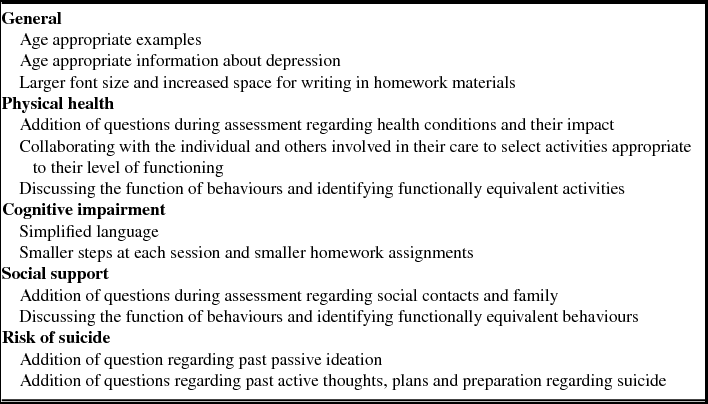
Table 1 summarizes the main changes made to the original manual to adapt it for work with older adults.
Summary of adaptations

General
General changes were made to the manual in accordance with adaptations made in previous studies (e.g. Yon & Scogin, Reference Yon and Scogin2009). First, examples that were more relevant to the lives of older adults were added. For example, after the assessment the case manager is asked to agree a summary statement with the participant. An example statement appropriate to older people was added here: ‘Your main difficulty is that you’re tired and lacking in energy and are less able to do things you used to enjoy due to physical health problems. The consequence of this is that you’re finding it hard to socialize and to keep on top of your housework.’
The psycho-education material given to participants was modified to include information about depressive symptoms in older adulthood and particular issues that may relate to this such as bereavement and physical health problems. The case study example was changed to reflect a situation that older adults were more likely to identify with, in this instance that of an older person who has become less motivated to do things he used to do after recovering from an operation. Additionally, details of treatment issues for older adults such as loss or change of role and being a carer were added to the case manager instructions with the aim of increasing their awareness of these factors when delivering the intervention.
All participant information and worksheets were changed to a minimum font size of 14 point to make them easier to read. Supplementary materials such as diaries and worksheets were also enlarged to give as much writing room as possible. For example, in the original diary sheet there were spaces for participants to fill in activities in the morning, afternoon and evening. This was changed to just morning and afternoon in order to allow for larger boxes that would be easier to write in. Additionally, the original diary sheet prompted participants to fill in details of ‘what, where, when, who’ related to each activity. This was removed to save space and also simplify the diary.
Physical health problems
Older adults are more likely to experience long-term and significant medical conditions (e.g. heart disease, diabetes) that are risk factors for depression (Carney & Freeland, Reference Carney and Freeland2003; Djernes, Reference Djernes2006; Li et al. Reference Li, Ford, Strine and Mokdad2008). Not only do older adults experience more health problems, their psychological status is often closely linked to their physical functioning (Zeiss et al. Reference Zeiss, Lewinsohn, Rohde, Kato and Mann1996). This factor leads to specific treatment considerations when delivering BA to older people as they could find it increasingly difficult to engage in activities they used to enjoy due to failing health and physical limitations (Yon & Scogin, Reference Yon and Scogin2009).
In order to take physical health and mobility into account, a specific question was added to the initial assessment section which aimed to ascertain the extent of the participant's functional impairment and the impact this has on their everyday life. Case managers were also encouraged to establish what impact long-term physical health conditions may have on the person's activities through collaboration with the GP and other health professionals involved in their care. They were also reminded to take physical health problems into account when helping the participant to schedule activities. This included advice regarding breaking down activities into manageable steps. For example, if a participant had previously enjoyed going for walks but since having an operation on their hip has not been doing this, the patient could be encouraged to start off with short walks (e.g. to the end of the road) and build these up over time. They could also ask someone to accompany them on walks at first until they feel they are able to go on their own. Case managers were encouraged to liaise with professionals involved in the participant's care in areas such as pain management to enable them to best support the participant to undertake as many of their desired activities as possible.
BA pays particular attention to the function the behaviour holds for an individual (Jacobson et al. Reference Jacobson, Martell and Dimidjian2001) and that reinforcement is determined functionally (Martell et al. Reference Martell, Addis and Jacobson2001). An important consequence of this view is the idea of functional equivalence. A specific form of a behaviour may have served a particular function for a person; however, that behaviour may no longer be possible due to physical health problems. In this situation an aim of treatment may be to identify a functionally equivalent behaviour that is different and therefore still possible despite physical changes, but which may serve the same function for a person. This idea may be particularly beneficial in the treatment of older people who, for example, may find themselves less able to take part in previously enjoyed activities due to physical limitations (Yon & Scogin, Reference Yon and Scogin2009).
Guidance was added to the case manager information highlighting the importance of helping patients to identify functionally equivalent activities. Case managers were reminded that, if a participant is unable to undertake a previously rewarding activity, they should ask the person why they enjoyed doing it, what else it offered them over and above just doing the activity and what made them keep on doing it and use this information to identify alternative activities with the participant that while looking different may serve the same function for the person. An example was added to illustrate this: a participant is no longer able to play golf due to physical health restrictions; however, it may be that this activity also served an important social function for the person. In this case the patient may be able to meet with their golf friends for coffee or lunch instead. Additionally, within the BA material given to participants a note was added stating ‘Remember, if there are things you can't do anymore due to physical health problems, you can discuss alternative activities with your case manager’.
Depressive symptoms have been found to be associated with activity restriction due to fear of falling in older adults (Arfken et al. Reference Arfken, Lach, Birge and Miller1994). With this in mind, the anxiety management sections of the original manual were adapted to be more focused on managing the fear of falling. The manual reminds case managers to help the participant to consider functionally equivalent activities and suggests that case managers provide the participant with a leaflet containing information about fear of falling. Case managers are also advised to consider signposting the participant for a physical assessment by an occupational therapist or similar.
Cognitive impairment
Depression is associated with cognitive impairment in older people (Vinkers et al. Reference Vinkers, Gussekloo, Stek, Westendorp and van der Mast2004) and studies have found that some people with early stage cognitive impairment report feelings of inadequacy and low self-esteem (Clare, Reference Clare2003). Cognitive impairment could have a potential impact on treatment because problems associated with memory and the recall of information may lead to difficulties in the learning of new material (Zeiss & Steffen, Reference Zeiss and Steffen1996).
The manual was adapted to take cognitive difficulties into account. Language and explanations were simplified throughout, particularly in the participant information sheets and psycho-education material. For instance, when explaining the aims of BA, ‘to regain functions which have been lost’ was changed to ‘to help us to keep doing things that we find rewarding’. Questions were also added to help the case manager assess the participant's understanding of the treatment principles. For example, when the manual focuses on activities that a person may have stopped doing, the participant is asked to think of their own examples, as well as to imagine how these behaviour changes might make someone feel. Guidance is also given to case managers to make it clear to participants that they can ask for clarification at any stage.
Additionally the session schedule was modified to allow for slower pacing of the material. The manual indicates that just one BA step need be covered in each session to take into account any possible difficulties the participant may have in retaining information. For example, in session 1 participants are asked to look over psycho-education and BA information and fill in an activity and mood diary. In session 2 participants are asked to list routine, pleasurable and necessary activities and in session 3 they are asked to make this list into a hierarchy from the most difficult to the easiest of the activities. It is then in session 4 where the participant is asked to use a diary sheet to plan how to start doing some of these things, starting with easier activities. Sessions after this involve further scheduling and reviewing of activities.
Social support
Depression in older populations is associated with impaired social support (Blazer, Reference Blazer2009) and loneliness, which is commonly related to transitions or changes in routine such as moving house (Blazer, Reference Blazer2002) or caring for a loved one with a physical or neurological condition (Anashensel et al. Reference Anashensel, Pearlin, Mullan, Zarit and Whitach1995). It is also common for older adults to have experienced loss of a loved one (Adams & Moon, Reference Adams and Moon2009) and be living alone (Illiffe et al. Reference Illiffe, Haines, Gallivan, Booroff and Morgan1991).
Adaptations were made to the manual to take these issues into account. First, a question about friends and family was added to the initial assessment questions to ascertain whether the participant is isolated from others. Case managers are also encouraged to compile a list of local council or voluntary sector groups, clubs and events appropriate for older people that participants could access as part of their activity scheduling. Additionally, general guidance was added for case managers to help participants who are experiencing social isolation or financial difficulties to identify functionally equivalent alternative activities. One example added to the manual is that if a patient is no longer able to visit their friends and family due to mobility restrictions, the case manager could encourage alternative ways of being in touch such as by telephone or ‘Skype’. Similarly, if a participant is restricted in what they can do due to their responsibilities as a carer for a spouse or loved one, the case manager is advised to help them think of functionally equivalent activities and also to help them get in touch with local agencies that may be able to offer them some added support. A further addition to the manual was to suggest that if a participant has their own carer then it may be helpful for the case manager to get the carer involved with the BA programme with the participant's permission.
Risk of suicide
Suicide is almost twice as frequent in the elderly compared to the general population (Alexopoulos et al. Reference Alexopoulos, Bruce, Hull, Sirey and Kakuma1999) and depression is a significant risk factor (Blazer, Reference Blazer2009). Additionally, older adults have higher rates of death ideation, including a passive wish to die (Fiske et al. Reference Fiske, Loeback-Wetherell and Gatz2009). Although older people are less likely to warn others of their suicidal plans and are more likely to use lethal methods and greater planning (Conwell et al. Reference Conwell, Duberstein and Caine2002), studies have also shown that they are more likely than younger adults to have visited a doctor shortly before they die (Luoma et al. Reference Luoma, Martin and Pearson2002).
Some adaptations were made to the risk assessment questions in the manual with these factors in mind. The question ‘Have you ever had thoughts that you’d be better off dead?’ was added with the aim of assessing any passive ideation. Questions about past suicidal thoughts, plans and preparations were also added due to past suicidality being a risk factor for current suicidal behaviour (Joiner et al. Reference Joiner, Conwell, Fitzpatrick, Witte, Schmidt, Berlim, Fleck and Rudd2005).
Summary of conclusions
There are a number of treatment considerations for older adults with depression, including cognitive difficulties and impaired social support. Some factors are particularly relevant to BA treatments such as poor physical health and mobility problems as these can lead to changes in activity levels (Yon & Scogin, Reference Yon and Scogin2009). Despite this, little or no detail about modifications is given in previous studies in this area (Samad et al. Reference Samad, Brealey and Gilbody2011). In this paper we have suggested a number of adaptations that may need to be made to a behavioural treatment manual for older adults. These have included changes to guidance and information given to case managers, modifications to participant psycho-education materials and alterations to assessment questions. The adaptations include both generic changes that may be applicable to many psychological treatments, but also includes a number of specific adaptations that are modality specific and are linked to the behavioural emphasis of the therapy itself and the behavioural theoretical foundations of the intervention.
BA treatment has been found to be a cost-effective intervention (Ekers et al. Reference Ekers, Godfrey, Gilbody, Parrott, Richards and Hammond2011a) that can be successfully delivered by generic mental health professionals without previous experience as therapists (Ekers et al. Reference Ekers, Richards, McMillan, Bland and Gilbody2011b). Documenting modifications made to this manual may therefore be particularly beneficial in helping mental health professionals when using behavioural therapy to treat older adults with depression.
This paper provides a theoretical rationale for the development and adaptation of a BA intervention for older adults with depression. This preliminary work is consistent with the first stage of development advised by the MRC guidance on developing and evaluating complex interventions (Craig et al. Reference Craig, Dieppe, Macintyre, Michie, Nazareth and Petticrew2008). As this stage precedes the collection of pilot or feasibility data this paper provides essential building blocks for these subsequent stages.
Acknowledgements
The paper was funded as part of the CASPER study by the National Institute of Health Research – Health Technology Assessment programme (reference 08-19-04). The funding source had no involvement in the writing of this paper or the decision to submit the paper for publication.
Declaration of Interest
None.
(1) To understand the specific treatment considerations which may affect the delivery of Behavioural Activation in older adults.
(2) To recognize the need to make self-help materials relevant and accessible to older adults.
(3) To recognize the value of identifying the functions of behaviours and functionally equivalent activities in older adults whose activities may be affected by factors such as physical limitations.
(4) To understand the need for the inclusion of an assessment of current passive and past suicidal ideation in older adults.



Comments
No Comments have been published for this article.