

Introduction
An examination of the literature, with its extensive synonymy, shows that distinctions between Gagea Salisb. and Lloydia Salisb. ex Rchb. and specific delimitation within genera based solely on morphological characters have been fraught with difficulty. Recent molecular work (Peterson et al., Reference Peterson, John, Koch and Peterson2004, Reference Peterson, Levichev and Peterson2008; Peruzzi et al., Reference Peruzzi, Peterson, Tison and Peterson2008a, Reference Peruzzi, Tison, Peterson and Peterson2008b; Zarrei et al., Reference Zarrei, Wilkin, Fay, Ingrouille, Zarre and Chase2009) has, perhaps unsurprisingly, shown that the distinctions between Gagea and Lloydia are artificial and that a single genus should be recognised. Gagea (Salisbury, Reference Salisbury1806) being the earlier name, the species of Lloydia should all be transferred to it.
Gagea in this wide sense occurs in Eurasia and North Africa, the only exception being the widely distributed G. serotina (L.) Ker Gawl., which also occurs in North America (Jones & Gliddon, Reference Jones and Gliddon1999; Zarrei et al., Reference Zarrei, Wilkin, Fay, Ingrouille, Zarre and Chase2009, Reference Zarrei, Wilkin, Ingrouille and Chase2010a, Reference Zarrei, Wilkin, Ingrouille and Chase2010b). The most recent treatment of Gagea (excluding Lloydia) is by Uphof (Reference Uphof1958–60), but that was based largely on the early 20th-century work of A. Pascher (1881–1945) and A. Terracciano (1861–1917), reviewed in Zarrei et al. (Reference Zarrei, Zarre, Wilkin and Rix2007, Reference Zarrei, Wilkin, Fay, Ingrouille, Zarre and Chase2009). The number of species recognised in the two genera has varied greatly in recent accounts: Mabberley (Reference Mabberley2008) has c.90 species of Gagea and c.20 of Lloydia; Peruzzi et al. (Reference Peruzzi, Peterson, Tison and Peterson2008a) quoted 275 species, but this figure appears to be based on the 240–250 species of Gagea (sensu stricto) estimated by Levichev (Reference Levichev1999), the remaining 25 presumably being those until recently included in Lloydia. More than 550 specific and interspecific combinations have been published (Govaerts et al., Reference Govaerts, Dransfield, Zona, Hodel and Henderson2006) and every year further new species are described (Zarrei et al., Reference Zarrei, Wilkin, Ingrouille and Chase2010a, Reference Zarrei, Wilkin, Ingrouille and Chase2010b).
It is clear that a general lack of understanding of this large genus is one among several reasons for the different estimates. Recent studies by the first author (M.Z.), combining fieldwork and anatomical and molecular work, have proved successful in helping to clarify the situation, and led to the realisation that many species are not worth retaining (certainly at specific rank): for example, Gagea tehranica Gand. and G. perpusilla Pascher have recently been found to be synonymous with G. reticulata (Pall.) Schult. & Schult.f. and G. setifolia Baker, respectively (Zarrei et al., Reference Zarrei, Zarre, Wilkin and Rix2007). Another source of confusion arises from problems in typification. Gagea specimens, including types, are scattered in a large number of herbaria, particularly in Central Asia and in St Petersburg (which probably houses the highest number). Access to types and other important historical specimens is therefore problematic and, as a result, authors continue to take the easy option of describing new species without possessing sufficient knowledge of existing species, including their typification and nomenclature. Further problems are the inevitable result. In recent years, L. Peruzzi, J.-M. Tison, M. Zarrei and others have typified several, mostly Mediterranean, species of Gagea (Tison, Reference Tison2001; Levichev & Tison, Reference Levichev and Tison2004a, Reference Levichev and Tison2004b; Peruzzi & Tison, Reference Peruzzi and Tison2004, Reference Peruzzi and Tison2005, Reference Peruzzi and Tison2006, Reference Peruzzi and Tison2007; Tison & Perret, Reference Tison and Perret2004; Peruzzi, Reference Peruzzi2007; Peruzzi & Zarrei, Reference Peruzzi and Zarrei2007; Peruzzi & Jarvis, Reference Peruzzi and Jarvis2009), but for many other species types have yet to be identified and designated.
This paper is the result of re-examination of several already known types, and, in the case of Lloydia kunawurensis Royle, the study of a previously overlooked one. Morphological data have allowed a better understanding of a group of five species previously treated for Iran (Zarrei et al., Reference Zarrei, Zarre, Wilkin and Rix2007).
Materials and Methods
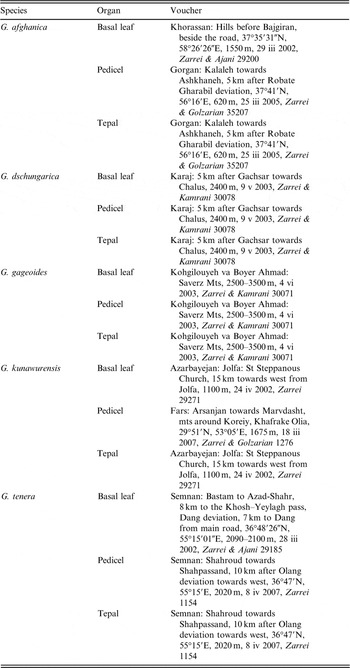
This study used comparative morphological methods and employed specimens of Gagea deposited in BM, GB, K, M, MSB, P, W and WU. Transverse sections of the basal leaf, pedicel and tepal were obtained using material from herbarium specimens collected on recent field trips in Iran. The species were also studied live in the field. Vouchers for anatomical studies (Table 1) are deposited in K, TUH and Shahed University Herbarium. Sections were stained using methyl blue and acetocarmine according to the method described by Gerlach (Reference Gerlach1977). Several slides were studied and photographed using a light microscope (Olympus Vanox AHBS3). Line drawings of such preparations are presented for three of the taxa.
Voucher specimens used for anatomical study of Gagea kunawurensis and its related species. All material was collected in Iran

Results and Discussion
A: Gagea kunawurensis and G. stipitata
The fortuitous appearance for sale on the internet of a letter from David Don to John Forbes Royle concerning his work on Lloydia for the latter’s Illustrations of the Botany of the Himalayan Mountains (Royle, Reference Royle1839–40) led to a renewed interest in the subject by the third author (H.N.). H.N. had previously worked on the genus for the Flora of Bhutan (Noltie, Reference Noltie1993, Reference Noltie1994), when it was discovered that the types of the two species concerned, Lloydia kunawurensis and L. himalensis, were missing from Royle’s own herbarium at LIV. These were cited as types (i.e. lectotypified) by Dasgupta & Deb in their revisions of Gagea (1986a) and Lloydia (1986b) respectively, and the ‘!’ following the citations shows that they were obtained on loan by, and seen by, the authors. However, as these have still not been returned to Liverpool (Wendy Atkinson, pers. comm.) they must be presumed permanently lost. Fortunately, previously overlooked duplicates of both are in Hooker’s herbarium at K and as these form part of the original material they can be taken as replacement lectotypes.
The analytical (and therefore validating) illustration (t. 93 f. 3) of Lloydia kunawurensis was published by Royle in 1839, the associated text (p. 388) not until 1840. It should be noted that although Royle attributed the description to Don, the name was his own, so cannot be attributed to ‘D. Don in Royle’ (as done by Dasgupta & Deb, Reference Dasgupta and Deb1986a). No type was cited by Royle, merely the collecting locality ‘Hab. Chango, in Kunawur’; the original material consisted of specimens in his own herbarium, duplicates given to Hooker, and the published plate. Greuter (Reference Greuter1970) made the new combination Gagea kunawurensis (Royle) Greuter. He cited no type, and had seen no original specimens, the combination being made more or less incidentally in a paper chiefly concerned with the Mediterranean species Gagea graeca (L.) A.Terracc. and G. trinervia (Viv.) Greuter. Greuter stated that ‘L. kunawurensis Royle, has generally been referred to Gagea persica Boiss. (G. gageoides (Zucc.) Vved.), whose correct name consequently is G. kunawurensis’. The ‘generally been referred to’ was presumably a reference to E. Boissier’s treatment in Flora Orientalis (5: 210, 1882) and J. D. Hooker’s in Flora of British India (6: 355, 1892), practically the only treatments of this taxon until recent times.
Dasgupta & Deb (Reference Dasgupta and Deb1986a) followed Greuter’s treatment of Gagea kunawurensis, but their account was based only on gross morphological characters of herbarium specimens, leading to the misunderstanding, and misapplication of names, of several species of Gagea from northern India and Pakistan. The aim of the present study is to clarify the typification of Gagea kunawurensis and related species.
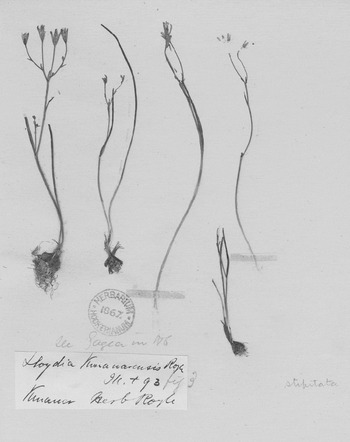
The recently discovered sheet at Kew (Fig. 1) is annotated ‘Lloydia kunawurensis Royle, Ill. t. 93 [Fig. 1]. Kunawur. Herb Royle’ and bears five individual plants. The left-hand specimen is mature and complete (with four flowers, a basal leaf, and bulb). One of the individuals is immature and incomplete (lacking flowers). Two individuals lack bulbs, and on these the flowers have been destroyed by insects. Zarrei et al. (Reference Zarrei, Zarre, Wilkin and Rix2007) did not see this sheet, but on the basis of the published illustration (Royle, 1839–40) concluded that Lloydia kunawurensis was, indeed, a species of Lloydia (and excluded it from Gagea). The published illustration, a hand-coloured lithograph, is similar to the individual on the left-hand side of the K sheet, but shows pale creamy flowers typical of Lloydia. Although the colour on the herbarium specimen has faded, the tepals appear to have been pale yellow with darker tips. However, it is now recognised that flower colour is not a diagnostic character between Gagea sensu stricto and Lloydia (as discussed in Zarrei et al., Reference Zarrei, Wilkin, Ingrouille and Chasein press). For example, Gagea ova (a synonym of G. stipitata, as suggested by Zarrei et al., Reference Zarrei, Zarre, Wilkin and Rix2007) possesses creamy to pale yellow flowers similar to those of some species of Lloydia.
Lectotype of Gagea kunawurensis (Royle s.n., K).

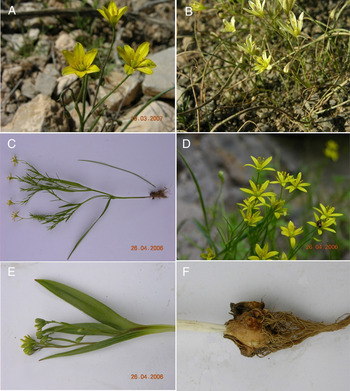
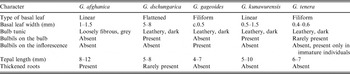
As noted above Greuter (Reference Greuter1970) stated that Gagea kunawurensis was the correct name for G. gageoides, but critical study shows this not to be the case: G. gageoides is a distinct species with several morphologically distinct character states (see below and Table 2). On the other hand Gagea stipitata and G. kunawurensis do form a single taxonomic entity. Both taxa possess a cymose inflorescence with more than three flowers (Fig. 2A–B). Their tepals are adaxially yellow, with longitudinal green abaxial stripes, and are purple at the tip (rarely in Gagea stipitata, but visible on the type of G. kunawurensis). Both possess only a single basal leaf. The bulb tunic is brown-leathery in both species and envelops small (1–2.5 × 1–2 mm) bulbils. The bulbils are ovoid to pyriform, dark in colour, with foveolate surfaces (one bulbil is present on the type of Gagea kunawurensis). They also share the following characters: tunic neck short (to 0.5 cm); roots all normal, none thickened; tepals narrowly elliptic, obtuse to acute at the tip, glabrous. We therefore conclude that Gagea stipitata is synonymous with G. kunawurensis.
A–B, Gagea kunawurensis; C–D, G. gageoides; E–F, G. dschungarica.

Summary of diagnostic characters of Gagea kunawurensis and its related species

B: Clarification of the typification of Gagea persica and G. gageoides
Gagea gageoides was described, as Bulbillaria gageoides, by Zuccarini from Mount Lebanon in 1843. The holotype of Gagea gageoides is Roth & Erdl 245, M!, comprising three specimens, only one of which has a bulb. The basal leaf is absent from all three specimens. The main diagnostic characters of this species are the clusters of bulbils in the axils of the cauline leaves and bracts, and the cymose inflorescence (Fig. 2C–D). The basal leaves are filiform (0.5 mm in diameter) and delicate, and for this reason are lacking from most herbarium specimens as they easily become detached during collection or drying.
Gagea persica was described by Boissier (Reference Boissier1846: 108) based on two collections (syntypes) from Iran (Persia): ‘prope Ispahan Aucher 5404’ and ‘ad ruinas Persepolis [between Astragalus shrubs, 15 iv 1842] Kotschy No. 237’. Boissier later (1882: 210) realised that Kotschy 237 was a mixed collection, splitting it into ‘Ky 237 A’, which he assigned (with Aucher 5404) to the bulbiliferous Gagea persica [var. persica], and ‘Ky 237’, one of the collections (syntypes) cited under his Gagea persica var. ebulbillosa Boiss., which lacked inflorescence bulbils (Boissier typified neither name). It is possible, however, that the distinguishing supplementary letter has not been placed after the number in duplicates in all herbaria.
Two sheets of Kotschy ‘237’ have been found at K, one at M and, according to Levichev (Reference Levichev2006), there is a duplicate at LE.
Individuals on the sheet at M do not possess inflorescence bulbils and are therefore Kotschy 237. Individuals on one of the K sheets do possess inflorescence bulbils and are therefore Kotschy 237A (formerly filed under Gagea amblyopetala Boiss. & Heldr. var. bulbifera Boiss.), whereas the second one (and a duplicate at BM!) does not show this character and is therefore Kotschy 237 (s.s.). Levichev (Reference Levichev2006) selected the sheet of Kotschy 237A at LE as lectotype of G. persica.
Dasgupta & Deb (Reference Dasgupta and Deb1986a) cited the type of Gagea persica as ‘Kotschy 237 – BM! CAL! G! K – photo!’. It is not clear if they realised that 237 was a mixed collection (they did not treat Boissier’s Gagea persica var. ebulbillosa), but as they took G. persica to be bulbiliferous, this specimen 237 (s.s., rather than 237A) is in conflict with the protologue and their lectotypification should be rejected (Art. 9.12, 17, McNeill et al., Reference McNeill, Barrie, Burdet, Demoulin, Hawksworth and Marhold2006). Dasgupta & Deb excluded the other syntype of Gagea persica, Aucher 5404, referring it to G. kunawurensis (see below). They also reduced Gagea stipitata and G. afghanica to synonymy with G. persica. That Gagea stipitata differs from G. persica has been discussed above; the status of G. afghanica is treated below.
Gagea persica is morphologically indistinguishable from G. gageoides, the latter name having priority. On the other hand, the variety Gagea persica var. ebulbillosa has the morphological characters of G. kunawurensis, to which it is here referred as a synonym.
C: Status of Gagea dschungarica Regel, G. afghanica A.Terracc. and G. persica var. kashmirensis (Turrill) S.Dasgupta & Deb
Gagea gageoides and G. dschungarica were both treated as synonyms of G. kunawurensis by Dasgupta & Deb (Reference Dasgupta and Deb1986a). For the former they were following the treatment of Greuter (Reference Greuter1970), now known to be incorrect; the latter synonymy was new, and also incorrect. In order to clarify the situation, the typification of Gagea gageoides and G. dschungarica is discussed below.
Gagea dschungarica was typified by Wendelbo & Rechinger (Reference Wendelbo, Rechinger and Rechinger1990: 20) with an un-numbered specimen collected by Regel at Jugantasch (Turkmenistan), WU!. This lectotypification was confirmed by Zarrei et al. (Reference Zarrei, Zarre, Wilkin and Rix2007), the collection consisting of four well-preserved and complete individuals (there are isotypes at K! and BM!). Dasgupta & Deb (Reference Dasgupta and Deb1986a) cited China-Dzungarian, 3–6000 ft, Regel (LE) as type without further clarification. This specimen was not mentioned in the original description of the species and is rejected here as lectotype. The main characters that distinguish Gagea dschungarica from G. gageoides are the shape of the basal leaf and absence of inflorescence bulbils. The former species possesses a flattened basal leaf (5–8 mm wide, Fig. 2E), whereas that of the latter is filiform (c.0.5 mm wide, Fig. 2C). The presence of inflorescence bulbils in Gagea gageoides (Fig. 2C) and their absence in G. dschungarica (Fig. 2E) is another diagnostic feature. Therefore, the statement of Dasgupta & Deb (Reference Dasgupta and Deb1986a) that these two species are morphologically similar is misleading. Moreover, their interpretation of Gagea kunawurensis as the correct name for G. gageoides is not accepted here. Their observation that no bulbils are present on the bulb of Gagea gageoides, but numerous ones under the tunic of G. dschungarica, is correct.
Two types of bulbils may be present in the studied Gagea species. They are situated either under the tunic, in the space between the storage mass of the bulb and the tunic (Gagea kunawurensis and G. dschungarica), or on the inflorescence (G. gageoides and G. tenera Pascher).
It should be noted that the plants shown under the name Gagea kunawurensis as fig. 2a–e in Dasgupta & Deb (Reference Dasgupta and Deb1986a: 86) represent several taxa. Figure 2a, with a flattened basal leaf and inflorescence with six flowers and no inflorescence bulbils, represents Gagea dschungarica. Figure 2b erroneously combines features of Gagea gageoides and G. dschungarica. The inflorescence (with one flower and several clusters of bulbils) belongs to the former, whereas the flattened basal leaf is that of G. dschungarica; no Gagea species possesses this combination of characters. The reason for the confusion of these authors was probably the fact that the narrow basal leaf of Gagea gageoides is absent from most herbarium specimens and they ‘reconstructed’ it in the wrong form. The tepals of both these species are in the same length range (Table 2).
Dasgupta & Deb (Reference Dasgupta and Deb1986a) reduced Gagea persica to a synonym of G. kunawurensis based on Aucher 5404 (BM!), a syntype of G. persica. Based on the evidence in this paper, we disagree with this. On the basis of Kotschy 237 they accepted Gagea persica as a distinct species. However, Kotschy 237, as noted above, does not possess inflorescence bulbils.
Dasgupta & Deb (Reference Dasgupta and Deb1986a) also reduced both Gagea stipitata and G. afghanica to synonyms of G. persica. The status of Gagea persica and G. stipitata has been discussed above. There are some morphological resemblances between Gagea kunawurensis and G. afghanica, particularly in inflorescence form, which is cymose in both. The tepals of Gagea afghanica are usually purple at the tip and because the type of G. kunawurensis possesses this feature, Dasgupta & Deb (Reference Dasgupta and Deb1986a) synonymised them. However, these species belong to two different sections of the genus: the former to section Didymobulbos K.Koch, the latter to section Plecostigma Pascher. There are enough morphological differences between them to support their status as distinct taxa. The tunic is leathery and dark in Gagea kunawurensis, but loosely fibrous in G. afghanica. Thickened roots are the main diagnostic character of Gagea afghanica. All the roots are unthickened in Gagea kunawurensis. Bulbils are present on the bulb of Gagea kunawurensis and absent in G. afghanica. Thus we accept Gagea afghanica and G. kunawurensis as distinct species.
Dasgupta & Deb (Reference Dasgupta and Deb1986a) considered Gagea kashmirensis Turrill as G. persica var. kashmirensis (Turrill) S.Dasgupta & Deb. The holotype, Stokoe 2, K!, has been re-examined. The sheet has seven individual specimens of which only one is complete with two basal leaves; the others lack basal leaves or bulbs. The filiform basal leaves, sub-umbellate to cymose inflorescence, and broadly lanceolate lower cauline leaf show this species to be closely related to Gagea tenera. However, an immature individual with a cluster of bulbils (each bulbil with an apical green leaflet) is present on the type of Gagea kashmirensis. These bulbils resemble those found in immature individuals of Gagea tenera in northeastern Iran. The only difference between Gagea kashmirensis and G. tenera is that the former species has longer tepals (7–11 mm) than the latter (tepals 6–7 mm long). We conclude that Gagea kashmirensis is not a synonym of G. kunawurensis, but that it is a synonym of G. tenera.
D: Diagnostic key to the species
1a. Basal leaf flattened in transverse section, ≥ 5 mm wide 1. G. dschungarica
1b. Basal leaf terete, semicircular or circular in transverse section, ≤ 2 mm wide 2
2a. Bulbils present in clusters in axils of cauline leaves and bract 2. G. gageoides
2b. Bulbils absent in clusters in axils of cauline leaves and bract 3
3a. Lower cauline leaves broadly lanceolate, flattened, differing from basal leaves in shape and width 3. G. tenera
3b. Lower cauline leaves filiform or narrowly lanceolate, resembling the basal ones 4
4a. Tunic leathery, non-fibrous, dark; thickened roots absent 4. G. kunawurensis
4b. Tunics not leathery, readily separating into fibres, pale; thickened roots present 5. G. afghanica
E: Enumeration of species
1. Gagea dschungarica Regel, Trudy Imp. S.-Peterburgsk. Bot. Sada 6: 513 (1879). – Type: Turkmenistan, in Jugo Dschungarico Jugantasch inter Kersken-terek et Borochudsir, 6000–7000 ft, 25 v 1878, Regel s.n. (lecto WU!, designated by Wendelbo & Rechinger, Reference Wendelbo, Rechinger and Rechinger1990; isolecto BM!, K!, LE). Fig. 2E–F.
Distribution. Iran, Turkmenistan, Afghanistan, Pakistan, C Asia, ?India (Kashmir).
2. Gagea gageoides (Zucc.) Vved., Fl. Turkmen. 1, 2: 261 (1932). – Bulbillaria gageoides Zucc., Abh. Math.-Phys. Akad. Wiss. Munchen, ser. 3, 1: 230, t. 2 f. 1 (?1843) [Pl. Nov. Fasc. 4]. – Type: Lebanon, crescit in subalpinis umbrosis montis Libani, Roth & Erdl 245 (holo M!, sole original specimen). Fig. 2C–D.
Gagea persica Boiss., Diagn. Pl. Orient. 1(7): 108 (1846). – Hornungia persica (Boiss.) Rouy in G.Rouy & J.Foucaud, Fl. France 12: 381 (1910). – Type: in rupestribus pr. Ruinas u. Persepolis, 15 iv 1842, Kotschy 237A (lecto LE, designated by Levichev, Reference Levichev2006; isolecto K!; syn Aucher 5404 BM!).
Distribution. Turkey and other eastern Mediterranean countries through the Caucasus, Iran and Turkmenistan to Kashmir.
3. Gagea tenera Pascher, Lotos 24: 128 (1904). – Type: Uzbekistan, Waterfall near the reservoir of Siyab, in the vicinity of Samarkand, 4 iii 1869, Fedchenko (holo LE, photo seen, sole original specimen).
Gagea kashmirensis Turrill, Bull. Misc. Inform. Kew 1928: 77 (1928). – Gagea persica var. kashmirensis (Turrill) S.Dasgupta & Deb, J. Bombay Nat. Hist. Soc. 83: 87 (1986). – Type: India, Kashmir, 5100 ft, iii 1926, Canon Stokoe 2 (holo K!).
Distribution. Turkey, NE Iran, Afghanistan, C Asia, India (Kashmir).
4. Gagea kunawurensis (Royle) Greuter, Israel J. Bot. 19: 155 (1970). – Lloydia kunawurensis Royle, Ill. Bot. Himal. Mts. 388 (1840), t. 93 f. 3 (1839). – Type: Chango in Kunawur, Royle s.n. (lecto LIV, designated by Dasgupta & Deb, Reference Dasgupta and Deb1986a, presumed lost; replacement lecto K!, designated here). Figs 1,2A–B.
Gagea stipitata Merckl. ex Bunge, Mém. Sav. Étr. Acad. St. Pétersbourg 7: 512 (1851). – Type: Auf dem Dioritplateau zwischen Juss-Chuduk und Bakali, 25 iv 1842, Lehman (syn LE); bei Bakali, 27 iv 1842 (deflorata et fructificans), Collector unknown (syn LE).
Gagea ova Stapf, Denkschr. Kaiserl. Akad. Wiss., Wien. Math.-Naturwiss. Kl. 50: 16 (1885). – Type: Iran, Lorestan, in monte Karaghan (media), ad Schurab, 1882, Pichler s.n. (lecto K!, designated by Zarrei et al., Reference Zarrei, Zarre, Wilkin and Rix2007; iso WU!).
Gagea ebulbillosa (Boiss.) Levichev, Bot. Zhurn. (Moscow & Leningrad) 91: 947 (2006). – Gagea persica var. ebulbillosa Boiss., Fl. Orient. 5: 210 (1882). – Type: in rupestribus pr. Ruinas u. Persepolis, 15 iv 1842, Kotschy 237 (lecto K!, designated here; iso BM!, M!).
Distribution. Iran, Turkmenistan, Afghanistan, Pakistan, C Asia, India (Himachal Pradesh, ?Kashmir).
5. Gagea afghanica A.Terracc., Boll. Soc. Orto Palermo II, 3: 3 (1904). – Type: Afghanistan, Hari-Rud Valley, 15 iv 1885, Aitchison 1130 (lecto FI, designated by Wendelbo & Rechinger, Reference Wendelbo, Rechinger and Rechinger1990; iso BM!, K!).
Distribution. Iran, Afghanistan, C Asia.
Note. In view of the differing species concepts, Indian records from Dasgupta & Deb (Reference Dasgupta and Deb1986a) have not been included in the above distributions. In fact there are very few recent collections from the western Himalaya (Kashmir or Himachal Pradesh), and fieldwork in this area is to be encouraged.
F: Anatomy
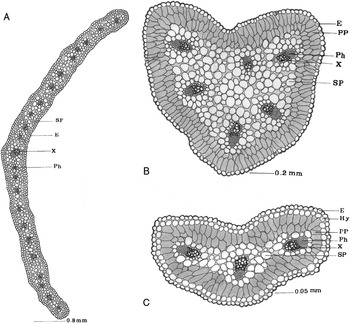
Anatomical characteristics of the basal leaf, pedicel and tepal of all five taxa (Gagea afghanica, G. dschungarica, G. gageoides, G. kunawurensis and G. tenera) have been investigated (Fig. 3, Table 3). No collenchymatous tissue was found in any of the organs studied (except hypodermis in Gagea tenera). The basal leaf does not possess sclerenchyma whereas the pedicel does. The anatomy of the tepals is similar in all five species. There are no obvious differences between species based on tepal anatomy. However, the basal leaf demonstrates enough anatomical variation to distinguish four taxa, but is not enough to distinguish between Gagea afghanica and G. kunawurensis. These characters are summarised in Table 3. The outline of the transverse section of the basal leaf, the mesophyll cell shapes of the basal leaf, and the presence/absence of hypodermis are of taxonomic importance. The outline of the transverse section of the basal leaf is V-shaped (5–8 mm wide) in Gagea dschungarica (Fig. 3A) but circular in G. afghanica (Fig. 3B), G. kunawurensis and G. gageoides. Gagea tenera possesses a V-shaped basal leaf outline in transverse section (0.4–0.6 mm wide, Fig. 3C), and is the only species with a layer of collenchymatous hypodermis (Fig. 3C). The mesophyll is composed of both palisade and spongy parenchyma in Gagea tenera (Fig. 3C), G. afghanica (Fig. 3B) and G. kunawurensis, whereas spongy parenchyma alone is present in G. gageoides and G. dschungarica (Fig. 3A).
Transverse section of basal leaf: A, Gagea dschungarica; B, G. afghanica; C, G. tenera. SP – spongy parenchyma, E – epidermis, X – xylem, Ph – phloem, PP – palisade parenchyma, Hy – hypodermis.

Summary of diagnostic characters for Gagea kunawurensis and its related species

a Basal leaf.
b Pedicel.
Pedicel anatomy does not demonstrate the same level of variation as basal leaf anatomy. The outline of the transverse section is similar within all five species (circular). There is a circle of sclerenchyma covering only the phloem in most species except Gagea gageoides (Table 3).
Acknowledgements
The support of the Iran Society (UK), the Calleva Trust, the Norman Scarfe Charitable Trust, and Mr Paul Miles is gratefully acknowledged. We thank N. Amiri for preparing the line drawings. We also thank Lorenzo Peruzzi and Martyn Rix for their helpful comments on the manuscript.