1. Why identify different visions of international law?
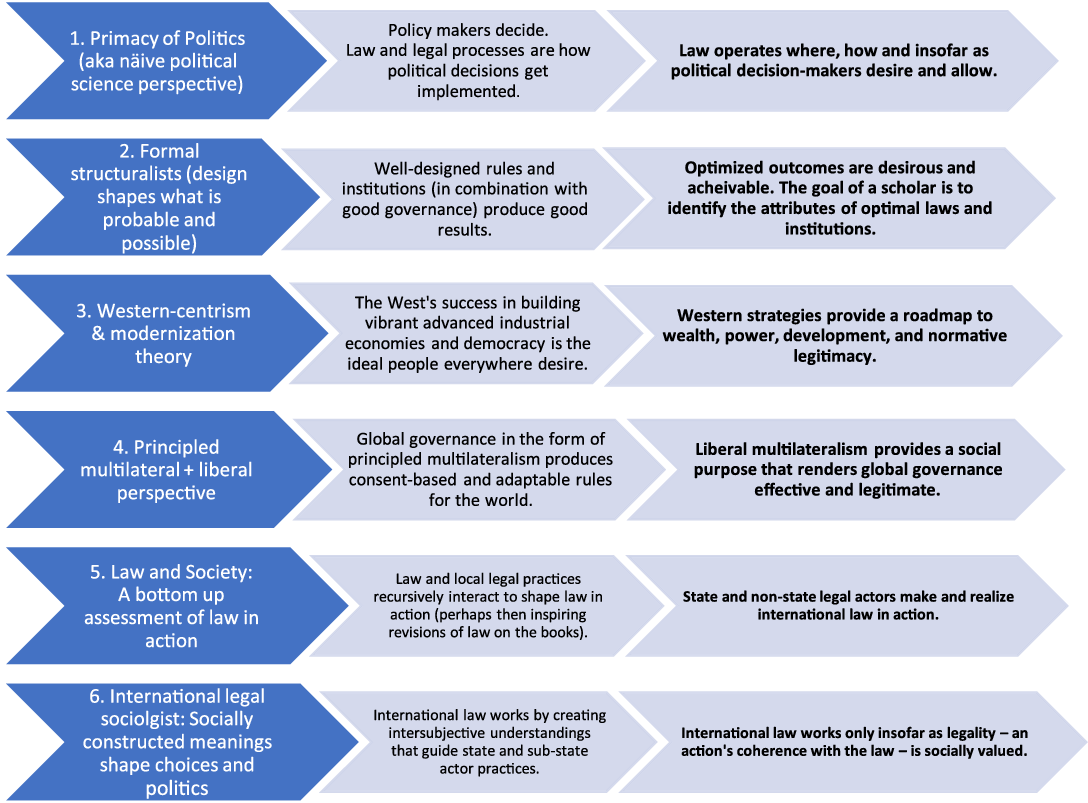
This article identifies six visions of international law: (i) the political scientist who imagines law as a fixed reflection of political choices; (ii) the formal and structural theorist who expect formal rules, institutions, and processes to generate similar outcomes in different parts of the world; (iii) the Western centric scholar who relaxes the assumptions of formal and structural theorists yet nonetheless expects what happened in the West to be replicated in other contexts; (iv) the liberal internationalist who draws insight about international law from the post-Second world War experience with multilateralism; (v) the law and society scholar who perhaps overcorrects in their focus on local factors that shape how law operates; and (vi) the international legal sociologist who focuses on how meanings and practices constitute international law. There are surely more visions of international law.Footnote 1 One might therefore take this article as a starter-kit discussing six common ways of investigating the dynamics animating how international law works.
The six visions are treated as my home discipline – political science – approaches contrasting paradigms. This approach suggests a utility in keeping coherent perspectives analytically distinct rather than employing a more ‘pragmatic’ idea of mixing and matching perspectives. By using the labels of ‘visions’ and ‘perspectives’ I signify that that the visions are not actually paradigms, yet the article treats them as paradigms, explaining how each vision offers a distinct, coherent, and defensible approach that is commonly embraced – explicitly or implicitly, intentionally or unintentionally – by scholars, policy-makers, and practitioners as they explicate the history, role, influence, and best practices of international law. Lingering within a single vision is useful insofar as it allows one to probe how far a particular variable may matter. Indeed, even if elements of all six visions ‘matter’, which is to say that they all help us understand aspects of international law, pushing paradigmatic thinking is still preferred over creating what social scientists might derogatorily refer to as a ‘laundry list’ where every item matters. The emphasis placed on one factor over another, and what each vision ignores or misses, represent the stakes in adhering to one vision or another. The ultimate objective is to push readers to consider how the factors excluded from each perspective undermine core claims in the perspective, and thus how much is lost when a scholar adheres to a particular vision. The remedy to this problem is for scholars to openly recognize and name the boundaries beyond which they cannot see or are not seeing, and to write in ways that are comprehensible and engage people outside of one’s silo. Self-identifying choices and boundaries actually widen your audience. Readers will know that you are not being clueless. Instead, you are making a choice for a (hopefully good) reason.
This article is constructed as a personal retrospective. An invitation to write a lead article is a freeing and daunting opportunity. I chose to engage a topic that I would never write about in the normal course of publishing: my early and perhaps ongoing ignorance. As I will explain, I find myself at a crossroad that is leading me to think about my prior ways of thinking about international law. The first two visions are from the beginning of my scholarly career, when I was trying to master a single discipline while finding a job and earning tenure. The later visions represent ideas and perspectives I did not originally understand, in large part because they were not part of my disciplinary training or the canon of texts I was reading. Maybe I was not reading the right texts, but I did look far and wide and I asked for help, so I think it fair to say that a big part of my ignorance was because the literature that might help did not exist. Scholarship has evolved greatly over my years in the academy. Interdisciplinary approaches to law – a rare thing when I earned my PhD in 1996 – have become commonplace; new voices and perspectives have joined the conversation; and top journals and presses have become much more open to a diversity of viewpoints. The greater intellectual pluralism has, however, muddied the water in that young scholars may not understand how the multiplicity of different perspectives relate to each other. Why are scholars talking past each other, emphasizing some pieces of the puzzle while ignoring others? Where is there agreement despite a different focus? Where is there disagreement? This article addresses these questions.
Having written from each of the six perspectives, I have empathy for why all six visions persist. I try to be ecumenical, which is to say that I present the strongest case I can for each vision. Moreover, I respect that there are good reasons to speak to and from a single perspective. While the visions are not mutually exclusive perspectives, neither are they fully compatible. Because the visions are very different, it is impossible to faithfully inhabit four, six, or more visions simultaneously. In terms of writing, it is hard for a scholar to add multiple layers and still make a coherent argument. It is difficult if not impossible for a reader to assimilate many disparate points and subtle ideas. This is especially so for policy-makers and politicians, who have very little room for subtlety and complexity. Because most audiences will not engage unless you talk in terms familiar to them, and because frequently audiences do not grasp nuances within an intellectual amalgamation, a final reason to avoid the inclination to mix and match is that your readers will not let you. If my experience is any guide, you will be pigeonholed by others, even if you do not want to be.
I have defended this article’s approach in scholarly and pragmatic terms, and later I will do so in policy terms. My ultimate objective as a scholar is to make sense for myself and for others of the crazy and contradictory world we live in. At the end of the day, the only way we can individually and collectively understand the hybridity and complexity of international law today is if we each endeavour to speak to and engage multiple visions. One key argument of this article is that drawing insight from various perspectives and embracing a diversity of perspectives is an intellectual good in and of itself. To be intellectually pluralistic is different from embracing legal pluralism (e.g., the idea that different types of legal systems can productively coexist together). I am saying that a multiplicity of ideas is good; I am not saying that multiple truths exist or that every choice is equally valid or defensible.
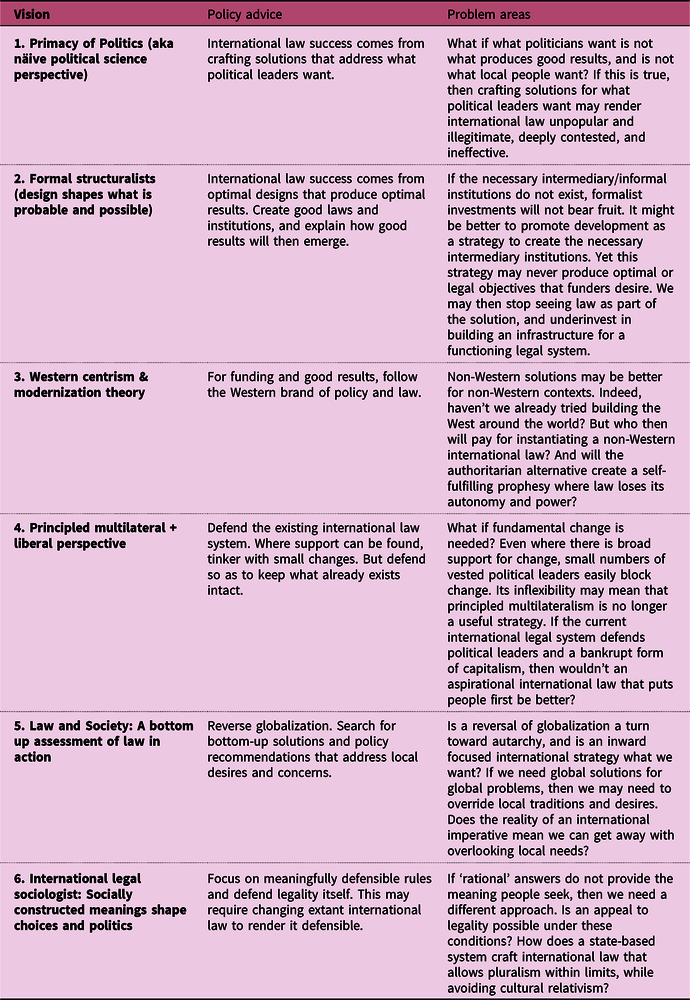
For readers who indulge me on this retrospective, I offer what I think is a really valuable tool of my political science trade: engaging a single object of study from multiple contrasting vantage points. The rest of this article proceeds as follows: Section 2 lays out the six visions, explaining why they persist, identifying what they get right, and what they miss. Section 3 provides the payoff. I put the six visions side by side, walking through the presumption-diagnosis-recommendation pathway implicit in each vision and showing how the prescriptions generated by each vision are inconsistent, and how adhering to each perspective impacts the future of international law. Section 4 returns to the retrospective element of this article, offering a few concluding thoughts for ecumenical, interdisciplinary, and intellectually pluralistic scholarship.
2. Six alternative visions of international law
My goal in this section is to state each case in strong terms. This is the opposite of what critical scholars, who try to complicate the pat answers, try to do. By identifying six visions, and indicating what each vision misses, I will complicate the story. For now, what follows simplifies starkly, greatly, and intentionally.
2.1 The naïve political scientist: Law is primarily an emanation of politics
The most naïve political science vision sees law as a mere reflection of politics.Footnote 2 As little more than an emanation, there is no particular reason to study law or legal processes as a separate force shaping politics. Yet because sometimes it seems that law and legal rulings actually do matter, political scientists have also tried to treat law as a variable thrown into the mix, to see if the legal variable generates an independent finding. As a variable, law becomes a fixed entity. This tendency to treat law as irrelevant or fixed comes from political science theories, and from efforts to make law conform to the types of variables that political scientists are used to working with. Why might political scientists reasonably presume that law is primarily an emanation of politics?
Law is mostly irrelevant: Political science has long presumed that policy-makers make decisions that are then directly translated into policy and practice. This presumption corresponds to classical answer to the question of ‘who decides’? For Machiavelli, the Prince got to decide. For Hobbes, the Leviathan should decide. For China, the Communist Party decides. For international relations scholars, the Sovereign – a King or a head of state – decides. If the ruler – which could be an individual or a corporate body – gets to decide, then we can treat the state as a unitary actor and reasonably conflate the articulated political preferences with the state view on what law is.
Once democracy entered the scene, then the people participating in the democratic process got to decide. For Robert Dahl, who titled his famous book ‘Who Governs?’ only policy makers and organized actors had any input into decision-making. The lone individual had no influence; nor did lawyers or judges render decisions of consequence. Democratic pluralism dominated my doctoral training. Policy was made by the interaction of policy-makers and organized interests, who were shaped by state-society-economy relations. Meanwhile, foreign policy remained the realm of the executive branch. Even if realist and liberal theories of international relations presumed that some set of underlying domestic political interests shaped foreign policy, political decisions were what mattered. Marxists differed from democratic pluralists, yet they too saw politics as class struggle, and law as an emanation of this struggle in that law reflected the will of the ruling-class. In all of these renditions, law as an independent force becomes causally and substantively irrelevant. Politicians or the political process make the decisions, and law has no significant independent influence.
Law as fixed: Those who think that politicians drive decisions might still factor law in, treating law as a variable to consider alongside other variables. For international relations and law and economics scholars, international law becomes a convenient focal point. Where states or political actors are largely indifferent (e.g., they don’t have a strong policy preference one way or another), political actors might choose to coalesce around the ‘legal solution’ as the path of least resistance. International law could also be created as a type of international regime, one that either reflected pre-existing state interests or – if states were largely indifferent – international law might be an outcome of international co-operation that co-ordinates inter-state policies. The co-ordinative role of international regimes involved the idea that international law reflected power politics, so that any influence of international law emanated either from a collective benefit in having a fixed focal point, or the fact that this focal point reflected the preferences of powerful actors.Footnote 3
The idea that the law is (mostly) epiphenomenal is longstanding. The rise of quantitative methods reinforced the desire to see law as a single fixed entity. By fixed I mean that there was a moment where policy-makers made decisions about how to write the law, or how to design a legal institution, and this single moment determined what the law is. Quantification then translates complex ideas – like the rule of law, common law as compared to civil law, whether there is a constitutional court, and even the formal or substantive content of the law – into a binary or scalable codable entity. For example, in recent years, international institutions have created the ‘rule of law’ as a composite measure that is aggregated into an independent variable, arguing that a rule of law contributes to economic development and political stability.Footnote 4 Many scholars have suggested that protecting property, or protecting investor rights, contributes to investment and economic development.Footnote 5 Contestable as these claims may be, they led political scientists to factor law in as a fixed independent variable that could have its own political influence.
Even when law is not being turned into a codable data point, naïve political scientists still want to see law as something stable that can be studied just like we study political parties, firms, policy proclamations etc. For lawyers, this idea of law as a single, clear, fixed entity may seem absurd. The lawyer may try to explain that law is indeterminant and flexible, and that its meaning can evolve and be changed by legal rulings. This counter is not enough to unseat the political science desire to see law as fixed. Every variable has an element of indeterminacy and dynamism. Firm strategies adjust to markets, and political parties respond to changing politics. So, the mere fact that legal understandings can change does not mean that law cannot be fixed as an independent variable used in an analysis. Indeed clearly, when politicians choose to change the law, then the analyst would need to update what law is. Ever resourceful, the political scientist will then strive to periodize or fix law for a particular span of time, or for a substantive or geographical domain. This urge to fix the law is partly a methodology-driven desire, but it is also a reflection of the deeper belief that that actors and interest drive politics, with law serving as an emanation or a focal point of underlying preferences and interests.
There are important political science exceptions to what I am saying. Scholars examining the judicialization of politics consider how law and courts cast a shadow over political decision-making.Footnote 6 Historical institutionalism, which was constituting itself as an alternative to rational institutionalism in the 1990s, allows for institutions – including legal institutions – to shape politics.Footnote 7 Political scientists also openly critique claims that language (speech-acts) represent cheap-talk, arguing that norms and language constitute preferences and politics.Footnote 8 That said, my disciplinary training provided pretty much no firm bases to consider how law or legal processes might operate independent of political decision-making, or how legal process may be politically important for decision-making across a range of political issues. The meta-concepts may have been floating around, but the practical applications and the information needed to operationalize them were not.
Times have changed fundamentally. Constructivism has become a paradigm in international relations that provides a way to think about and investigate how norms, including legal norms, shape politics.Footnote 9 Literature on the judicialization of politics has advanced.Footnote 10 Yet most legal scholarship still does not answer the questions that political scientists need in order to factor law into their thinking. There will be moments, issues, and contexts where economics and politics rule supreme, and thus where the importance of law recedes, and moments where law and legal categories become important. The times and contexts when law becomes important are surely more numerous and consequential than naïve political science presumptions presume, but insofar as legal scholars fail to identify scope limitations for their claims about how law matters, they render their claims implausible to mainstream political science.
I began as a naïve political scientist, and I dwelled in this vision for longer than I might have liked because I could not find readings to help bring me out. I believed legal scholars who claimed that European law and the European Court of Justice was important, but I struggled to find explanations for why European law was so influential. It was hard to find any scholarship that explained what about the Treaty of Rome or the European Economic Community made it sui generis or literature that explained the legal hierarchies, appointment politics, and politically important activities of national legal systems. Today I find similar limitations when researching law and politics in Latin America and Africa. Lacking bearings, my personal naïve political science moment involved taking what lawyers were saying far too seriously. Basically, I wanted lawyers to tell me what the law required. If lawyers said that the preamble of the Treaty of Rome promised an ever-closer union, then I presumed that lawyers as a category saw preambles as an important sources of law. When former ECJ judges wrote that Article 5 of the Treaty of Rome required European judges to rule in ways that would make European law effective, I took the argument at face value.Footnote 11 It took me a long time to figure out that these were not legal determinations. Indeed, they were fundamentally contested claims.
Hopefully legal readers now understand why political scientists are often so naïve about the law. But there is also some fundamental truth behind the political science presumptions.
2.1.1 What the naïve political science perspective gets right and what it misses
Political scientists are correct that politics often drives, and always influences, the interpretation and application of law. And international relations realists and post-colonial critics of international law are correct when they point out that power and politics work through international law, even if these scholars underplay how law and legal processes also (sometimes) effectively push back against this power.
The larger point is that legal interpretation and legal decision-making cannot stray beyond what peoples and politicians will tolerate without fomenting rebellion. This idea has often been modeled as a principal–agent relationship where the principals hold all the power.Footnote 12 One can disagree about the mechanisms and the extent to which judges are rendered politically quiescent, but the political scientist’s presumption of the primacy of politics contains a kernel of truth. There will always be a careful legal-political balance that must be maintained, and high court judges understand this. Judges are therefore responsive to the types of political feedback that shape most, if not all, political decision-making, namely concerns about legitimacy and maintaining political support (which in the legal context means maintaining political support for an independent courts and the rule of law). In this sense lawyers who insist that legal methodology determines judicial decision-making, and those who imagine that legal ideas, judges or political decision-makers live in a world of far-reaching interpretive possibilities, are in denial: a point that legal realists and post-colonial critics openly recognize.Footnote 13
The naïve political science perspective is also correct that legal rulings do not on their own transform politics and policy. For Americans, this point is self-evident. Yes, the US Supreme Court’s Brown v. Board of Education ruling (that racially segregated education inevitably creates an unequal education) was monumental and important.Footnote 14 But the national guard had to intervene to implement the decision; structural racism ensures that integrated also does not mean equal; and inequality as well as school segregation levels are arguably worse today than when the Brown ruling was penned.Footnote 15 Pointing out the limited transformative abilities of legal rulings was the subject of my very first publication, which created a counterfactual understanding of what a judicial implementation of the European Court of Justice’s market-integrating Cassis de Dijon doctrine would have looked like, and explained how political mobilization and counter-mobilization is why this ruling led to significant policy change.Footnote 16 That article, which began by putting the political science and legal perspectives in conversation, launched my career.
As I have come to understand law and legal actors more, I think that this political science perspective misses a fundamental core that aspirational lawyers work hard to retain.Footnote 17 Removed from the political science conversation is a deeper appreciation of the normative bases and values that many lawyers associate with the law. Lon Fuller, for example, argues that attributes of the law can create an internal morality that is persuasive to lawyers and non-lawyers alike.Footnote 18 Some lawyers deeply admire persuasive law-based reasoning, and some lawyers see a sort of majesty in the law. For example, in explaining how the Court of Justice of the European Union could make constitutional changes to the European legal system, Joseph Weiler argued that:
Part of the answer rests, of course, in the fact that [this transformation] was judicially driven, thus attaching to itself that deep seated legitimacy that derives from the mythical neutrality and religious-like authority with which we invest our supreme courts.Footnote 19
For these lawyers, law is not a simple political speech act, akin to the President’s State of the Union address or an executive order, nor is law an institution like a firm. Law imparts its own, perhaps unmeasurable, normative valence. There is something to this idea, if only because many lawyers and people cherish the idea that governments and individuals are not above the law. Lawyers are also correct that legal processes matter, even if they then refuse to explicate how, when or why legal processes are important.Footnote 20
Especially in a time of populism and the existential insecurity of a pandemic, it is clear that the many presumptions about law, its independence, and the value that people associate with the rule of law, cannot be taken for granted. I still believe that the legitimacy that the rule of law imparts, and that a social value associated with legality are important normative values that extend well beyond the legal community.Footnote 21 One might even say that the rule of law, and the normative value of legality, has been an important social glue holding liberal democracies together. So, while we cannot presume that law’s normative core will exist, nor can we presume that it does not exist.
To be sure, the strong version of this vision goes too far. Yet even if you dismiss what I am labeling the ‘naïve political science’ perspective, you can learn from it because the political science challenges its critics to clarify how, when, and why law (sometimes) trumps economics and power. I would be remiss, however, if I did not point out that faith in the rule of law is a very Western liberal perspective. In most developing countries, average people and legal scholars are extremely sceptical that law has an independent force. Instead, the prevailing view is that law is political domination by another means. One might even say that the notion of a rule of law is as much, if not more, an ideology or culture shared by Western lawyers as it is an empirical reality.Footnote 22 Certainly for people living on the margins, the rule of law is primarily a tool used by the powerful to keep them subjugated and marginalized.
2.2 The a-contextual legal formalist and structural theorist: Texts and formal structures define the law
This vision combines formalist with structural theories that presume that the forms and structures of laws and legal institutions shape how these institutions function. In other words, I am using formalism to mean that formal legal rules, the words and textual organization of these rules, and the texts that create formal mandates and procedures for legal and international institutions are causally important. Economists and legal scholars are the primary adherents of this vision, and their enthusiasm attracts political scientists by providing a clear way to factor law into political science theories. To be sure, no one believes that dropping beautifully crafted laws and legal institutions into a lawless context will magically transform the law of the jungle into the rule of law. Rather, the focus on form, text, and institutional design suggests a top-down conception where the creation of formal rules and institutions meaningfully shapes the practices and politics that then follow. Compared to its Western-centric alter-ego (discussed next), the a-contextual formalist vision appears less ideologically laden insofar as the laws and institutions are presented in functionalist terms that apply to many cultures and contexts.Footnote 23
There are good reasons to focus on formal institutions and rules. Rules and institutions are something policy-makers intentionally design. If policy-makers have choices to make, it is helpful to know how the various options on the table matter. It is also sometimes clear that existing institutions are problematic. We then want to know which part of the institution is a problem and how might we make changes to achieve better outcomes. For example, if we believe that judicial independence is important, it is helpful to know what rules and institutions help to protect judges from political influence. These understandable concerns lead to the focus on how formal rules and institutional designs matter.
Social scientists have translated formalism into theories about how formal law and institutional designs matter. The economic version of a-contextual formal theorizing flattens institutions, norms, cultures, and practices into ascetic descriptions. By flattens, I mean that just like a dollar is a unit of currency with little intrinsic meaning, value or personality, law becomes a unit. Similarly, structured law is akin to a currency unit; differently structured laws allow for comparing across different types of units. In the analytical world constructed by economists, humans care most about efficiency, profit, growth, and utility. Law becomes an independent variable – something that man creates and can manipulate – with the question becoming whether writing the law as X or as Y triggers homo economicus, thereby generating a certain outcome. Economists use this vision in pursuit of an optimal formulation of the law, one that generates jobs or economic growth. Of course, most of the findings generated by this approach are purely correlational; scholars make conjectures about why a formal law leads to the optimal outcome, and they might even validate this conjecture through a large-N statistical analysis and experiments. This type of formalist analysis famously led a group of economists to declare that American systems of corporate law produced the best economic outcomes.Footnote 24 While the idea that US corporate law is the best might be rather extreme, there are lots of law and economics versions where laws and legal institutions become highly formalized.
The legal version of a-contextual theorizing translates laws into a set of legal logics. Instead of efficiency and wealth, a well-ordered legal system and well written law is valued, with the expectation that that logical, coherent, equally applied law produces an inherent legitimacy. Legal practitioners negotiate long and hard to create model laws, hoping that ready-made law will be domestically incorporated but also believing that how the law is crafted is important. Legal scholars also debate the most normatively defensible formulation of the law, with the presumption that the right text and form of law helps to generate the desired outcome – whatever this desire might be (e.g., justice, coherence, accountability). To some extent the global constitutionalism literature is part of this formalist vision. Scholars debate the optimal formula for achieving the justice, checks and balances, and accountability objectives, often imagining that formal attributes (e.g., bills of rights, judicial protections, advise and consent administrative procedures) significantly contribute to making a policy, law or institution more legitimate.Footnote 25
Bringing a-contextual formalism to the world of comparative and international law leads to a presumption that well-crafted law combined with quality governance will or should operate in similar ways despite differences in context. To return to the American-centric finding that US corporate law is the best, the apparent lesson to draw is that all countries would be wise to adopt US systems of corporate governance. In the international realm we might believe that common banking rules could help track money laundering and human trafficking around the world.
While the idea that a formal law will perform similarly in different contexts is surely naïve, it is nonetheless the case that law is an extremely mimetic discipline. I often joke that law is a discipline where plagiarism – outright copying and borrowing of legal forms – is advocated, encouraged, and widely embraced. The transplantation of laws and institutions is seen as a means to promote legal certainty across a range of contexts. Indeed, a belief that certain legal structures meaningfully contribute to certain outcomes played a role in the proliferation of international courts, and in particular the proliferation of European-style regional courts.Footnote 26
The attraction of a-contextual legal formalism is that it puts the authors of the law in control. If we can just figure out the magic formula for writing the law and designing legal institutions (constitutions, courts etc.), then all might be right in the world. Of course, we know that this is absurd. Yet why not do what we can to stack the deck in the right direction? If we can solve a problem through legal tinkering, so much the better. A-contextualized theorizing about the law has proliferated alongside the growth of empirical legal studies and law and economics.Footnote 27 Much of this literature focuses on domestic workings of law and legal systems, but comparative law and law and economics literature generates broad deductively-justified hypotheses that are then empirically tested by translating law, legal institutions, and legal practices into codable variables. And international relations scholars in particular,Footnote 28 but also (as mentioned) advocates of global constitutionalism and global administrative law, see the design of international institutions as intentional and politically consequential. A-contextual legal formalism is tailor-made for these strategies and this vision provides an easy way for political scientists to factor law in.
2.2.1 What formalist and structural approaches get right and what they miss
Without a doubt, institutions and formal rules matter. For certain situations, a formal rule or institution may even be a necessary element for generating legal certainty and the rule of law. For example, it matters if non-consensual sexual intercourse (e.g., rape) is considered a criminal act. Specific features of the rule also matter. For example, if a rape victim must provide three eyewitness testimonies to establish the fact of a rape, the ability of victims to seek justice may be irreparably compromised. The same can be said of judicial independence. Unless judges are protected from arbitrary removal or arrest, the slashing of their budgets, or the replacement of judicial decisions with political decisions, judicial independence will not meaningfully exist.Footnote 29 Because formal rules and institutions matter, it is important to understand the relationship between formal rules, institutions, and legal and political outcomes.
It may also be that formal rules and institutions are a necessary first step. The situation of criminal law provides an example. Only where something is explicitly prohibited can legal sanctions be applied. This means that a first step in diffusing preferred practices (e.g., ending slavery, prosecuting war crimes, stopping corruption) requires creating a legal prohibition regime. In a non-criminal context, the allocation of property rights is seen as incentivizing property holders and discouraging property takers. Because formal rules and institutions matter, and given that we have learned quite a lot about best practices and how legal lacunae might be exploited, it makes sense to simultaneously query which regimes tend to work best while constructing the first-mover law-crafting or law-reforming strategy.
Written down legal rules and mandates also provide important information. Moreover, these rules and mandates can mobilize actors to fulfil and realize the mandate, and they can provide some institutional cover. Mandates encourage legal actors – advocates, administrators, judges, etc. – to ask public actors to step up and fulfil the scope of the mandate, and formal mandates supplemented by statements of intent provide a ready defence should critics question the right of a public official to make demands on political actors or private citizens. In this respect, being a legal formalist that hews closely to the text can be a prudent strategy in politically turbulent contexts, deflecting criticism of the judge by shifting the onus to the actors who wrote the law.Footnote 30 To be sure, if a government wants to punish an actor or an institution, formal rules and mandates are easily penetrated. That said, the protective nature of the formal rules and mandates are why international institutions repeatedly invoke formal rules and mandates to justify the validity and legitimacy of their decisions. This invocation, in turn, lends credence to the naïve political science supposition that the political choices embodied by the formal rules are driving legal decision-making.
The next step is where the problem begins. Because institutions, rules, and mandates matter, analysts treat the range of formal rules and institutional designs as a laboratory to see what might generate better or worse results. For economists, rules that correlate with greater growth rates tend to be ‘optimal’. My preference would be to combine formalism with normative theorizing, where the goal is to write formal rules and create institutions that promote more just outcomes. Whatever your optimal goal is, theorizing about the relationship between formal rules and institutions and important outcomes allows us to better understand how variation in formal rules and regime designs might matter.
What is then not said is the problem. Formalist approaches often suggest that having rules is enough. This presumption is exactly what law and society approaches (vision 5) criticize, and the criticism is justified. Even if formal rules are necessary to realize an objective (e.g., criminalizing rape), they will never be sufficient to achieve the desired goal. Indeed, nothing about law and politics is automatic. Legal rights only operate where actors claim the rights, and third parties respect or help enforce these rights.Footnote 31 Moreover, normative support for applying formal rules and for the values that rules promote needs constant renewal and positive reinforcement, or the rules and institutions wither away.
In this respect, scholarship that validates a formalist claim by finding a correlation between formal rules and institutions may actually be misleading. Formalist approaches usually fail to identify how informal norms and practices that are not amenable to formal methods of study are equally or more important in shaping legal processes and outcomes.Footnote 32 Equally problematic is the lawyer’s version of legal formalism that sometimes suggests that legal doctrines drive outcomes, a claim that the discussion of the naïve political science perspective challenged.
Moreover, too often scholars and policy-makers focus on formal rules and institutions because they are more easily observed, measured, and addressed. When policy-makers and scholars focus only on formal attributes, they may not see the factors impeding the efforts of well-intentioned actors, and they may underinvest in informal elements, leading the formal strategies to fail. For example, returning to the example of rape, if we do not consider how the police respond to victims of rape we may never understand why well-designed formal rules and institutions nonetheless fail to function.Footnote 33
Even worse, governments may insincerely suggest that formal compliance with international norms is enough. To the extent that scholars and policy-makers stop their analysis at the level of finding a formal rule or institution, they may be abetting those actors that want to perform rather than realize respect for the rule or institution.
My own formalist moment followed from my efforts to build from my dissertation by generalizing lessons learned from Europe to other international legal contexts. I did not end up publishing my first effort to consider how the design of international legal institutions was important. I was far from alone in thinking about how the design of legal institutions interacted with the strategy of judges to shape the effectiveness of international law and international legal institutions.Footnote 34
If we believe that politics and social norms have some impact on legal understandings, legal interpretations, and legal outcomes, then we are going to need non-formalist ways to study the interaction between law, politics, and outcomes. This means that, alongside a focus on formal laws and institutions, we need to investigate social and normative understandings that allow the system to work. Meanwhile, we know that understandings and preferences can shift irrespective of any change in legal rules or institutions, so that contextual factors beyond the control of institution-makers and judges are important. In this respect, focusing on formal rules rather than how legal processes and outcomes get realized may be a mistake. Equally problematic are studies that stop their analysis once they have considered the relevant formal laws and legal rulings, so that we never learn how these laws and rulings get communicated to and understood by non-legal audiences – the media, the public, the police, policy-makers etc. – who are precisely the actors that must change their behaviour in order to realize the objectives of the laws and legal rulings.
Having just devastated the conceptual framework of formalist approaches, I need to return back to the beginning point. There are moments where institutions are designed and changed. Because these moments can be very consequential, we cannot ignore the questions that formalist and structuralist approaches investigate. Indeed, as Barbara Koremenos has demonstrated, we can learn a lot from studying formal design choices.Footnote 35 We just need to be very prudent in what we claim and expect from these moments and choices, and we need to always be attentive to changing contexts and the manipulations of actors who will use formalism to mask their bad intent.
2.3 The Western-centric scholar: Western practices are the lodestar indicating how legal and political processes ideally work
Formalist and structural theories become problematic when they slip into the idea that design is destiny, and when they lead to under-investment in critical intermediary factors that allow formal institutions to function as intended. The Western centric myopia is different. This vision believes in the importance of a constellation of synergistic laws, values, and institutions. The Western-centric myopia is the expectation that transplanting a range of Western attributes, and thus reproducing the Western context, will produce positive results everywhere.
Western-centrism is a pathology that transcends any one discipline, and it goes by many names, most of which have negative connotations. For developing countries, Western centrism is a form of imperialism. Meanwhile modernization theory is the name for theories that expect countries to follow similar patterns of development. One often finds an implicit modernist teleology wherein scholars suggest that countries may progress through levels of industrialization, democratization, state-building, civilizational development etc. The final destination of these trends is usually the Western form of democracy, underpinned by a rule of law. For example, a somewhat Weberian idea is that legal development moves from systems of traditional law or systems governed by charismatic leaders towards the ideal of rational legalism.Footnote 36 It is not a coincidence that the patterns and stages are drawn from Europe, or that the highest stage of development puts Europe or the US at the apex.Footnote 37
It is easy to understand why Western centric theorizing became dominant in social science and law. Most social science theories of how states develop, how industrialization affects politics and society, and how capitalism and democracy work, began with the laboratory that is Europe (and later the Americas) because important phenomena – industrialization, development, revolution, and state-building – developed first and farthest in the West.Footnote 38 In law, Eurocentrism dominated because powerful European countries used the language of law to justify their claims and actions in the developing world.Footnote 39 Eurocentrism was then sustained at least in part because European actions were easier to study. European governments wrote their agreements and proclamations down, leaving a paper trail that scholars could review. Also, important international legal treatises were written by European scholars and then critiqued and debated by generations of law scholars, so that the greatest body of written discourse involving international law emerged in conversation with European ideas. Elsewhere in the world, either less was written down or what was written was harder to access (because of language barriers, or closed/disorganized archives).
Liberalism underpins this Eurocentric modernist perspective. Liberals believe that human beings around the world are the same in that they desire a set of priorities that Western liberals value, including individualism, freedom, human rights, democracy, and the economic prosperity reflected by private property. If humans forever strive for what the West promises, the hand of time pushes in a Western direction. The more educated and capable people become, the more wealth contributes to the emergence of a middle class, the more people will agitate for liberal values and liberal political systems, or so the logic goes.
Undeniably, power created and sustains Western-centrist thinking. For better and worse, imperial powers were incubators of European models, planting and nurturing European institutional seeds wherever they went. European traders and colonizers set up systems of rules, institutions (including schools, administrative structures, hospitals, and adjudicatory institutions), and laws in the lands they frequented. Europeans demanded that local governments respect the rights that traders had come to expect in Europe, and quite often local actors came to appreciate aspects of these institutions and rules, also associating European ways with a modern and civilized sensibility. Local adaptations of European models were usually not fully faithful to the European lodestar, but one could find enough similarities to suggest that European models were shaping national strategies. To the extent that countries developed, as nearly every country does, an association between European models and development could be plausibly claimed.
The problem with Western-centrism is not that scholars study Europe and the US but rather that scholars often assert their claims in universal terms. Historically European scholars wrote as if the authors were discovering fundamental truths that should apply everywhere. To be sure, this Western-centrism is increasingly confronted by high quality critiques that emphasize or recover institutions and strengths from the developing world, that highlight how European models have been erroneously credited for local developments, and that demonstrate the dark sides of European practices.Footnote 40 Yet for scholars who look to the past to unlock insight into the present and the future, the deepest and most detailed accounts of the past are still most readily found in studies of Europe and the United States.
To some extent Western-centrism remains structurally induced and hard to resist. Western states remain powerful actors, and many scholars are focused on understanding and trying to influence the most powerful actors on the international stage. Also, scholars write about the systems they know best, and in Europe and the United States academia is a professional vocation that pays bills and supports families. This means that Europeans and Americans have the luxury of time, research budgets, and insider mentorship networks that help Westerners publish detailed, empirically rich, and sophisticated accounts of how European and American states, societies, and legal institutions operate. While it is not popular to say, Europe and the US are still where one can find the most developed literatures, archives, and theories. Add in that top scholars from around the world generally pass through European and American institutions of higher learning, that publication in Western journals and presses remains a career advancing strategy, and that such publication requires knowledge of debates the scholar is contributing to, and we can see how Western-centrism is structurally reinforced. Western-centrism is also structurally reinforced by the reality that Europe and the US still pay for training and projects that, intentionally or not, export European and American models, approaches, and ideas. Add in that law is an incredibly mimetic discipline. Add in that Western investors will feel more at home with rules and institutions that look familiar. All of this contributes to producing a global system littered with European and American replicants. Western-centric presumptions expect these replicants to act and behave as they do in the West.
2.3.1 What Western-centrism gets right and what it misses
Scholars of the West are right that there is a wealth of high-quality scholarship, theories, data sources, and archives involving Western institutions and Western development. For these reasons alone, building upon what Western scholars have investigated and discarded is a reasonable starting place – though by no means the only starting place – for developing plausible expectations for how legal and market institutions can vary and develop. Western countries also remain powerful and important actors, and for better or worse countries around the world continue to borrow from and emulate Western practices. Meanwhile, there is nothing wrong with including Western experiences in a comparative analysis, especially because there is much rich variation across European countries, American states, and across time, to build on. If only to avoid reinventing the wheel, it makes sense to spend some time exploring the laboratory that is Europe and the United States.
I also must confess that being a social scientist makes me partial to Western research methodologies. Western scholarship emphasizes careful definitions of key concepts, clear specification of theories and causal claims, and a methodology designed to demonstrate the validity of an argument. In addition, political science emphasizes the need to investigate and rule out plausible counter-arguments. I often find well-constructed social science analysis easier for me to follow (because the claims are clearly stated), and more convincing (because alternative explanations are addressed). That said, I realize that these very standards may obviate the study of localized non-Western variables that are not legible using Western methodologies.
What Western-centric and modernization theorizing struggles to deliver is a sensibility regarding the important permissive conditions that shaped European and American development. When one returns to earlier writings about European development, authors clearly note that Europe and the US developed their economy and governance systems under particular social and geopolitical conditions.Footnote 41 These caveats are often lost as theories get transposed and reapplied across time. Also, in retrospect it is clear that European countries and European settlers were numerically small enough that they could move across borders and pollute their way into development. This means that the European strategy is interesting and important, but it is hard to replicate and it cannot – and perhaps should not – scale up to encompass the globe. More could be said but the point is that it is wrong to presume without investigating that the West is the model to be followed. Also, a problem is the Western-centric presumption that Western success was an inevitable outcome of superior choices and behaviours.
My entire scholarly training was Western-centric, and like many scholars of the past and today, I looked to American and European experiences as a lodestar and a guide. For me, the only way to emerge from this Western-centrism was to start studying international law in a developing country context. Only then could I name what about the European experience was unique.Footnote 42 Only then could I fully appreciate the cleverness of international judges operating in an inhospitable developing country context.Footnote 43
These critiques are hardly new. The idea that modernity is attractive, and that modernization inevitably brings good things and leads in a common direction, has been debunked many times. But like a hydra, you can cut off one head but modernization theory grows back. Powerful actors inevitably appreciate their accomplishments, believing that they were the masters of their success, and believing that others can benefit from following their recipe. The neoliberalism of the 1990s, which suggested that unleashing markets would solve the world’s problems, is just the latest version of this Western-centric modernization approach. Meanwhile many forces still push in a Western-centric direction, towards the idea of a universal path to development that first the West and now the Rest should follow. Indeed, nationalism is arguably resurrecting the most intolerant Western tropes.
Implicitly, I am making the same critique of Western-centric thinking as I made with respect to formal and structural arguments, suggesting yet again that contextual resources and constraints matter as much as the enlightened thinking and decision-making of some rulers and entrepreneurs. I am also bringing in critical theories that highlight how power shapes our scholarly theories and thinking.
Western-centric blinders make it impossible to see the permissive conditions that allow wealthy and privileged actors to make the choices they make, or the conditions that helped the choices and behaviours be successful. The flip side of these blinders (which hopefully I did not replicate) involves discounting and denigrating equally valid choices, and failing to valourize how resistance to Western dominance fundamentally shapes the decisions of the powerful. As Anthony Anghie, Arnulf Becker Lorca, Balakrishnan Rajagopol, Sundjya Pahuja, and Third World Approaches to International Law scholars have pointed out, left to their own devices European and American proponents of international law develop rules and practices that are unduly costly, self-interested to the point of being counter-productive, and normatively indefensible. The most defensible aspects of international law were helpfully shaped by those actors who resisted European domination, forcing compromise, legal evolution, and better arguments to justify international law.
Studying other parts of the world has (hopefully) helped me move past Western-centrism. Because the gravitational pull of Western dominance continues to influence scholarship, we need to be especially attentive to avoiding Western groupthink. The remedy is to remember that dominant narratives are likely to be Western-centric, and that such narratives likely unduly naturalize important permissive, contextual, and structural conditions that are not easily replicated (nor necessarily desirable). An additional remedy is to look for the influences of non-Western forces and interests, and to create diversity of scholars and perspectives within collaborative projects, because only by including non-Western critics will scholars be able to recognize the mental blinders that shape their thinking.
I leave for others the question of whether my agreement with the many compelling critical critiques of Western approaches renders the outputs of the West, including international law, inherently illegitimate. Often an examination of how the sausage is made looks a lot like Upton Sinclair’s book The Jungle.Footnote 44 The more we learn about the production process, the less we want to eat sausage. We should fix problematic processes, but sometimes we should also be willing to eat sausage produced in less than perfect conditions.
2.4 The liberal internationalist who believes that principled multilateralism generates consent-based agreements and outcomes
One of the most significant world changes since the end of the Second World War has been the proliferation of international institutions and international law. This proliferation is largely, although not exclusively, a result of the American decision to use its post-Second World War hegemonic power to lead through multilateralism. My thoughts on this issue are greatly shaped by the writings of John Ruggie. In his article ‘Multilateralism: The Anatomy of an Institution’, Ruggie defined what I have re-labeled as principled multilateralism, calling it an institutional form wherein three or more states co-ordinate behaviour on the basis of general principles ordering relations among the states.Footnote 45 Principled multilateralism is different from collective decision-making to solve a specific problem (e.g., countries come together to decide how to manage a specific river resource), and it is not simply about the number of states that participate. Principled multilateralism creates general principles to guide all members’ behaviour. To be sure, the United States did not invent this institutional form; indeed scholars have identified many legal and institutional antecedents.Footnote 46 Yet Ruggie argues that ‘[w]hen we look more closely at the post-Second World War situation … we find that it was less the fact of American hegemony that accounts for the explosion of multilateral arrangements than it was the fact of American hegemony’.Footnote 47 Ruggie supported this claim by arguing that the world that might have emerged had the Germans won the Second World War, or had the Soviet Union succeeded in exporting its socialist revolution, would look very different. He also suggests that ‘[i]nstitutional arrangements of the [principled] multilateral form have adaptive and even reproductive capacities which other institutional forms may lack and which, therefore, may help explain the roles that multilateral arrangements play in stabilizing the current international transformation’.Footnote 48 To the extent that theories of how international law emerges and works are based on the principled multilateralism historical moment, we may be conflating international law with principled multilateralism and the American Century.
International law is intended to be a consent-based system of collective rules according to law-based principles, and as such contemporary international law is the essence of principled multilateralism. I want to be clear about this claim, as I am not credulous. Anything that is built through politics – international or otherwise – will reflect the power dimensions of the day. I would therefore never expect principled multilateralism to approximate the deliberative democracy ideal of a deep normative consent. Nor would I presume that political bargains by states would necessarily be just, or that they would enjoy popular legitimacy, thereby earning the consent of people. The only claim is that principled multilateralism is sometimes capable of producing consent-based outcomes that are not entirely driven by what the powerful want.
This vision links principled multilateralism and liberal internationalism. Ruggie also argues (elsewhere) that institutions are manifestations of political authority that fuse power and social purpose.Footnote 49 International law, and the rule of law more generally, fits hand to glove with liberal priorities including free and voluntary social contracting, a preference for democratic procedures, and a faith in the rule of law over the rule of men. The combination of (i) consent-based; (ii) principled; and (iii) American inspired is the package that liberal internationalism promotes.
Let me be more specific. This principled multilateralism package includes elements that are not necessarily liberal, including formal legal equality for sovereign states, and a right to self-determination; a requirement for consent in the form of signing and ratifying treaties; and a requirement to negotiate and maybe even to mediate or arbitrate unresolved disputes. These ideas were crafted between 1870 and 1935, but they became integral to international law during the principled multilateral American Century.
The principled multilateralism package also includes a set of policy preferences that are liberal, such as international policies promoting human rights and free trade; the metaphors of liberal theory constitutional contracts, individuals as important actors with inalienable rights, the idea that unenumerated rights revert to states (because rights reside in states and individuals unless they are contracted away); the humanist idea of peremptory legal norms (e.g., jus cogens, customary international law) to protect human life and minority rights; and preferences for checks and balances, and for law-based solutions to global problems.
The liberal internationalist vision believes that because the treaties, laws, and institutions were manufactured via principled multilateralism, modern international law is consent-based. Even if you reject this claim, it is nonetheless true that the United States by explicit and tacit endorsement facilitated a massive international transformation that created an unprecedented set of powerful international institutions and a detailed set of international legal rules, many of which promote Western liberal priorities. Most of these institutions and rules will endure because changing existing institutions is very hard, and because the political opportunity that allowed for such a massive international institutional transformation was (hopefully) unique.Footnote 50 American power has passed its unrivalled prime, and the younger generation may be correct in questioning the decisions of a generation that has brought the world to the brink of despair and climate disaster. But the relatively blank canvas upon which the Allies built the post-Second World War order is now replete with institutions and laws. Absent a cataclysm like the period of 1919–1945, there will not be another opportunity to truly start anew.
There are good reasons to question whether the American liberal internationalist formula still holds. Liberal internationalism suggests that people actually want a rule of law, global commerce, and individual rights. Yet people might happily trade these values for security and economic improvement. This is exactly the package that authoritarian governments are today putting on offer – a promise of security and improved economic outcomes if people give up their rights and the rule of law. To the extent that liberal internationalism provides internal legitimacy (in Ruggie’s words, a ‘social purpose’) that remains valuable, one can wonder if the institutional form of principled multilateralism can survive or have a legitimating narrative if it is divorced from its liberal internationalist package. Equally, one can ask if liberal internationalism can retain its appeal should other economic models perform better, and should illiberal leaders corrupt the brand that is liberal democracy. These questions are being increasingly asked, and the alternative of an authoritarian international law is becoming visible.Footnote 51
2.4.1 What liberal internationalism gets right and what it misses
I am of a generation that believes that the post-Second World War system delivered more than we thought possible. Americans used principled multilateralism to promote the demise of colonialism, the value of human rights, self-determination for former colonies, and the creation of global markets based on capitalist principles. This liberal principled multilateralism helped rebuild destroyed economies and societies, and it delivered a long period of international peace, economic expansion, and a decline of interstate war, violence and battle deaths.Footnote 52 This is a liberal result insofar as an international system based on Kantian principles contributed in important ways to these outcomes.Footnote 53 As a liberal beneficiary, China’s incorporation into the global economy helped to deliver a significant reduction in global poverty, and an improved life expectancy in many parts of the world. These successes, which occurred alongside the disaster of climate change, the current populist backlash, and sustained underdevelopment in many parts of the world, lead me to wonder what the better alternative to liberal internationalism might be.
Even if you do not credit liberal policies, the principled multilateral vision is correct when it says that multilateralism is a distinct mode of global governance that in the inter-war and post- Second World War era became infused with American priorities, norms, and values. To be sure, America did not build the post-War international order alone, and we can only understand the current system by investigating and valuing the contributions generated by the active participation and adherence of diverse countries in the world. In other words, the criticism that Western centrism gives too much credit to the West applies to the liberal part of this vision. Yet the stabilizing features of principled multilateralism remain important. Because these laws and institutions were a collective enterprise, international law is more likely to remain the fundamental guide for what international institutional actors can and will do. Moreover, insofar as political leaders are concerned with maintaining a rule of law appearance, principled multilateralism including its many liberal elements will continue to be a means to legitimate legal state behaviour.
Liberal internationalism contains elements that are perennially destabilizing (or, one might conversely argue, rejuvenating). Giving people a say in who governs, and how they are governed, will lead to political challenges that can be destabilizing. To the extent that liberal international policies require constant updating, the difficulty of changing existing rules or building new international policies may induce states and stakeholders to work around or against existing multilateral institutions and rules. The ideas animating liberal internationalism may even be contradictory, and the practice of liberal internationalism may inevitably engender a reflexive contestation.Footnote 54 Moreover, the current moment of political backlash suggests that not every liberal is willing to support social, economic, and political changes that elevate many at the expense of some.
Liberal internationalism may also not be up to the task of addressing important world problems. A requirement of multilateral assent and consensus policy-making may make it impossible to deal with global spoilers. Clearly liberal internationalism is exacerbating inequalities and failing to address the problems generated by climate change. But the fact that liberal internationalism is not a sufficient remedy vis-à-vis global spoilers, and an insufficient means for all problem-solving, is not a reason to reject principled multilateralism per se. This reality only means that principled multilateralism is at best a partial solution for many issues.
One reason to distrust liberal principled multilateralism is that it is based on a number of mistruths. International institutions have locked in inequality, and quite often negotiation structures are designed to favour the powerful. One can therefore question the extent to which consent underpins international institutions and international law. And perhaps we should expect principled multilateralism to fail to address valid concerns of the weak, which would explain why many people have no stake in the current system.
Moreover, liberal internationalist policies often fail to deliver. Sometimes legally justifiable international intervention prolongs war and misery, and sometimes liberal policies such as pro-market shock therapy make situations worse. One can reasonably believe that sometimes the more moral and correct strategy will be to ignore international institutions and international law.
Also problematic is that liberal internationalism privileges states. This reality helps perpetuate a number of disfunctions; for example, liberal internationalism perpetuates a world in which heads of state get to declare what ‘their people’ want or need. One can also question the notion that international rules, defined by the powerful, should trump collective decisions of local actors. These concerns mean that not only is principled multilateralism not enough, it may be anti-democratic (e.g., locking in policies that are domestically illegitimate) and precisely the wrong tool for certain problems.
Finally, and very importantly, the liberal internationalist vision fails in that it encourages scholars and practitioners to focus on what is collectively done, while largely ignoring what is not done. For example, when the World Trade Organization (WTO) is failing, the topic of conversation becomes how to shore up the existing system. This status quo bias in favour of liberal internationalist institutions may not be the best approach. And what may be dooming the WTO is not what is done, but rather what is not done to ensure that the free trade system produces fair and just outcomes, and that it addresses critical issues such as climate change and the need to help people and societies adjust to the forces generated by global capitalism.
While there is much to criticize in how liberal principled multilateralism operates today, and in the past, a better alternative is yet to emerge. Winston Churchill’s quip that ‘[d]emocracy is the worst form of government except for all those other[s] …’ may well apply to principled multilateralism. The fundamental question before us is whether liberal internationalism provides a path forward. For those who enjoy peace and relative security in the current system, the cost of scrapping what we have – of tearing up the rules and institutions – may be abhorrent. I do not personally subscribe to the perspective of destroy first, which presumes that what comes after will inevitably be better. What comes next could actually be a whole lot worse. But to disagree with those who want to destroy and then build is not to say that liberal international multilateralism is working well. The next two visions remind us that global solutions will never substitute for local solutions, and that foreigners do not necessarily know best.
2.5 Law and society: Transforming law on the books into law in action
Law and society developed as a scholarly movement seeking to bring social science methods to the study of law. Law and society is a fairly young scholarly tradition, even if the larger category of socio-legal approaches to understanding law is not. The timing of its emergence – in the 1960s – and the backgrounds of the founders led this movement to have a sociological and anthropological bent.Footnote 55 What matters most to law and society scholars is the lived law, and especially the lived experiences of everyday people, and thus bottom-up approaches that explore law in action. In this respect, the law and society vision is the opposite of the top-down formal and structural perspective. Formal, doctrinal, institutionalist approaches often stop at the moment that top-down decisions are made. By contrast, law and society approaches generally begin from the insight that law on the books differs from law in action.
Many law and society scholars are also fundamentally sceptical of global approaches to building and studying international law. This scepticism is a response to doctrinal and positivist international law perspectives that suggest that the tomes written by European scholars, the treaties signed in distant lands, and the rulings of distant international courts have important local meaning and impact. Instead, for many law and society scholars, the real question is how the law gets realized, and who wins and loses from the ways in which the law is brought to life. Even when policy implementation is considered, the ‘who wins and who loses’ question is too often ignored. The predictions, presumptions and omissions of mainstream international law scholars for many years led law and society scholars to ignore international law.
Traditionally, law and society literature focused on local (e.g., city), issue area (e.g., employment law), the larger national level (e.g., federal or national law), or what occurs in the constellation of a single large institution. The virtue of these levels is that they are finite enough to be able see societies making and living the law in a recursive loop wherein legal behaviours and social reactions iteratively shape what the law becomes. A fundamental stumbling block in internationalizing the law and society approach is to figure out how to draw a line around the society that international law might be affecting? International relations theories do think about international society,Footnote 56 and liberal scholars have thought about an international law of liberal states.Footnote 57 The idea of an ‘international society of states’ or ‘civilizational societies’ is not something that law and society scholars embrace. Law and society scholars expect significant local variations within a national system, so that the idea of some sort of meaningful international society adhering in a homogenous way to international law would be fanciful. Moreover, to the extent that international law never reaches to the local level, affecting daily life of societies of people or the legal profession writ large, it is not always clear whether one can or should systematically study international law in action.
I was never trained in law and society approaches, nor was I aware of law and society debates that may have been generalizable to the phenomenon that interested me. I researched and wrote my dissertation/first book between 1993 and 2000; the more internationalized law and society debates had not yet begun. Yet my research on Establishing the Supremacy of European Law unwittingly employed a law and society sensibility.Footnote 58 Indeed this sensibility may be why European law scholars initially took issue with my early work. I was arguing that the European Court of Justice’s arguments about why European law was supreme were never accepted, and that neither among European lawyers nor judges was there a cross-national, widely-shared belief in the compelling legal bases for European law supremacy. My study fit with the law and society tradition but was completely disengaged from law and society debates, and pedantically political science in its theorizing.
Beginning in the early 2000s, law and society scholars started to address internationalization, expanding existing methods and theories to encompass international legal developments and practices. One strategy involves identifying and focusing on the backgrounds and beliefs of an international legal society whose practices and interactions shaped international law.Footnote 59 A second strategy employs the law and society methodology to study everyday life within international institutions.Footnote 60 A third and perhaps most comprehensive effort to expand the law and society method to the global level is Terence Halliday and Gregory Shaffer’s conception of transnational legal orders (TLO), ‘a perspective that places processes of local, national, international and transnational public and private lawmaking and practice in dynamic tension within a single analytical frame’.Footnote 61 The comprehensive nature of their TLO definition and measure is both a virtue and a vice. The TLO concept is capacious so as to allow local, national, transnational, international, public, and private participants to engage in law-making, and in this sense the TLO framework is a corrective to international law approaches that focus exclusively on states and international institutional actors. But the bottom-up TLO approach is better at identifying how this myriad of actors becomes part of global rulemaking, and less helpful at explaining how these rules are then implemented. And the framework is so capacious that it can be a theory in which every interaction seems to matter. It is therefore hard to locate how some actors have much more influence, or how some examples of TLOs in action are trivial and others extremely consequential.
2.5.1 What law and society approaches, including TLOs, get right and what they miss
I have great sympathy for the key claims of law and society approaches. A flaw of top-down studies of international law is that they fail to recognize that many laws are ignored, or they do not work as their creators intended. Top-down approaches persist, in part, because they involve much less work. Understanding how law actually works requires diving into the empirical trenches to see how international law is implemented, experienced, and lived. I appreciate that law and society scholars are willing to jump into this time-consuming enterprise, especially because I agree that international law in action is more interesting, important, and politically consequential than static comparisons of law on the books.
I also think that the law and society critique of Austinian presumptions is correct. The classic Austinian presumption is that a fear of coercion is why people follow the law. This presumption led generations of legal and international relations scholars to assert that international law is irrelevant because there is no centralized international system of coercive enforcement. Law and society approaches, by contrast, suggest that most people obey the law for a variety of reasons, including a fear of coercion and identarian, moral, and instrumental motivations.Footnote 62 Oona Hathaway and Scott Shapiro’s idea of international law being enforced by social outcasting reflects the law and society sensibility that concerns about social sanctions also motivate international law compliance.Footnote 63 My arguments about compliance constituencies operating domestically and internationally to promote international law compliance also reflects this sensibility.Footnote 64
Also, of the visions discussed thus far, law and society is the most amenable to investigating the many ways in which law and legal processes influence policy-making and politics. Law and society, precisely because of the focus on more local and circumscribed levels, is better able to address Yasuaki Onuma’s criticism of the Anglo over-focus on adjudication. Onuma argues that litigation is the pathology not the physiology of the law. Law’s physiology involves avoiding and working out legal disagreements. The participants in this physiology – those who help to realize law’s regulative function – include committed politicians and bureaucrats, experts, activists, journalists, media institutions, and non-governmental organizations. This broader set of actors promotes international law by helping international law to serve its justificatory, legitimating, and communicative role.Footnote 65 This is, at its core, a law and society perspective.
Law and society’s focus on how the social context matters helps to correct for formal and institutionalist approaches that can presume the importance of context away. This was a lesson I learned in researching the operation of the Andean Tribunal of Justice (ATJ) from the 1980s to the present. Laurence Helfer and I had both engaged in Western-centric theorizing, developing arguments about how international law works by extrapolating from European legal models.Footnote 66 The ATJ presented us with the natural experiment of transplanting the European Court of Justice into the Andean context. Not only were the legal texts and institutional designs of the two legal systems extremely similar, a prima facie analysis suggested that the ATJ was following the European trajectory in declaring the direct effect and supremacy of Andean law, and because the vast majority of cases adjudicated originate in the form of preliminary ruling references from national courts. Yet the deeper we looked, the more we were forced to revisit our understandings of why international courts in Europe were so successful. We also began comparing the ATJ’s operation to similarly designed international courts operating in Africa. International courts operating in Africa face their own specific set of challenges, including underdeveloped national legal systems.Footnote 67 But our research on the Andean Tribunal’s law in action also demonstrated how international courts can operate quite effectively in a developing country context, even if their operation and influence is very different from what one finds in Europe.Footnote 68
As law and society scholars expect, it can be difficult to scale localized insights up into a general theory that applies across very different social and political contexts. In a collaborative research project, a group of interdisciplinary scholars considered how factors related to the context in which international courts operate might fundamentally shape the law and politics of specific international courts. We were able to decisively reject formal and structural presumptions, but many of the more context-dependent presumptions proved difficult to generalize across international courts. For example, we hypothesized that international courts operating in contexts where numerous alternatives to international adjudication existed would have a harder time establishing their authority across the various metrics we considered. We ended up with mixed results; some international courts struggled with the competition, whereas others benefited from it.Footnote 69 Yet some generalizations are both possible and consistent with law and society perspectives. I leave this discussion for the final vision, which I call an international legal sociologist perspective. This final vision attempts to grapple with some of the shortfalls of the law and society perspective.
A primary shortfall of law and society approaches is that in looking at how local agency matters, and thus on the important choices of citizens, local lawyers, police, and local judges, the law and society approach may overly discount the importance of global structural forces. External/international structural forces can decisively define the menu that legal actors select from, which is to say that by studying law in action from the ground up, one might miss the many places where law does not operate because international structural factors preclude certain options. This is one of the liabilities of the TLO approach, especially because the bottom-up TLO methodology focuses on areas where transnational actors are coalescing to shape a transnational legal order. One can compare within and across TLO contexts, as Gregory Shaffer has done when he considered the accumulation of local expertise to adjudicate international trade related cases.Footnote 70 But the general impact of systemic factors that close or severely limit options is harder to recognize.
Some law and society scholars embed their localized accounts into narratives that consider how international structural forces animate the local changes.Footnote 71 But I am not sure that law and society approaches are up to the task of examining systemic structural forces as they influence international law. The presence of systemic factors such as the inter-state system, the global economy, and gender and race inspired presumptions can be so ubiquitous, omnipresent, and enduring that the standard social science methodology of examining variation across contexts cannot be deployed. We can sometimes use diachronic (e.g., cross-temporal) analysis to identify changes in structural features, yet a lack of written or geographic markers of alternative possibilities that were never realized can critically hamper a cross-temporal analysis.
The final vision cannot fully correct for the blinders that systemic factors and a lack of variation perpetuate. Instead, the final vision focuses more on the global level, providing a corrective to the localized bottom-up strategy of law and society scholarship.
2.6 The international legal sociological perspective wherein meaning and practices constitute the world of global law
What I am calling this last vision is the least worked out and consolidated of the bunch. Throughout my career I have been an eclectic theorist, drawing insight from different disciplines and literatures.Footnote 72 This does not mean, however, that I do not subscribe to a paradigmatic view of the world. I do not find myself fully at home in any of the first five visions. I think the lack of fit relates to the category of my doctoral training that is my true home.
In my doctoral training, four paradigms were constantly compared. I already discussed the liberal paradigm wherein individuals, motivated by a single stable set of desires, are considered to be the fundamental unit of analysis. Liberal assumptions animate the acontextual formalism, Western centric and liberal internationalist visions. While I have an affinity for Kant and the liberal internationalist perspective, I have never believed that individuals everywhere desire what liberals claim as self-evident truths. A second paradigm, folded into the naïve political science discussion, is international relations realism, where states are the fundamental unit of analysis, and states are presumed to value national interests and leadership survival above any other priority. The international relations realist paradigm is motivated by a Hobbesian vision of human nature and international society, wherein humans are power-seeking by nature and necessity. Some people seek power as an end in itself, and perhaps the people who fight to become state leaders and people with authoritarian predispositions are power-seeking in the extreme. But as a general ontology, I do not think that a lust for power or domination is what most people – men or women – want. Nor do I believe that these assumptions help us understand most international politics, let alone international law and politics. Instead, I agree with feminist theorists who see realist thinking as validating and perpetuating a self-fulfilling prophesy that maintains patriarchy.Footnote 73
I mostly skipped the third paradigm, the largely discredited Marxist materialist paradigm that expects economic classes to be key units of analysis, and material conditions to define what people individually and collectively desire. Especially today, not all Marxist thought fits this description. But the most paradigmatically distinct versions of Marxism do tend to be materialist and teleological in their expectations for classes and for the future. If class interests are relationally defined and unchanging, then significant political change must be externally induced (by technological change, coercion, capitalist imperialism etc). To be sure, people who are starving and scared tend to be fundamentally shaped by their material circumstances. But beyond this statement, I disagree with material determinism (which liberals sometimes also parrot) and with those who expect change to come primarily via technological or other exogenous forces. Instead, my deep connection to the fourth paradigm comes from my belief that people have agency and choice, and the choices people make matter a lot.
The fourth social science paradigm, the sociological paradigm, considers societies uniting people around shared beliefs to be the key unit of analysis. What unites societies is a search for meaning, with the idea that meanings/social values are what human beings as a species seek. The sociological paradigm can encompass other perspectives. Whereas liberals believe that individuals have a static intrinsic desire for freedom and property, and economists believe that people want to maximize their own personal material and leisure elements captured by the concept of ‘utility’, sociological theories believe that what people value gets constructed by the society in which they live. People living in liberal capitalist societies may seek material wealth, but this would be because social values, and perhaps also social status, are linked to wealth and material accumulation. People living in a Marxist society – such as the post-War Communist city of Bologna – may identify with their economic class, letting the social class define the set of objectives they value because class provides community. People living in a fundamentalist religious society may value living the life defined by the godly interpreters, even if this life involves penury and self-sacrifice, and this different perspective in itself belies liberal and Marxist presumptions.
The sociological tradition builds from classic sociological understandings of state, economy, and society. It draws from Weber who thought (without what we would today require as proof) that a Calvinist ethic provided a ‘spirit of capitalism’ that fuelled European industrial development.Footnote 74 This paradigm’s international relations version is constructivism,Footnote 75 which is a natural way to think about the importance of international law.Footnote 76 Indeed a constructivist legal vision fits with the socio-legal ‘realistic theory’ of the law discussed by Brian Tamanaha.Footnote 77 If you go back through the visions and my critiques of them, you will see that I consistently see merit in criticisms that identify the alternative set of values that might lead lawyers to venerate the law, or individuals to choose the legal course, or scholars in a post-colonial context to question the appeal of Western modernity.
To a great extent, the difference between this and the previous vision comes down to a different object of study. Law and society scholars share the sociological paradigm’s socio-legal assumptions, but law and society scholars generally want to draw a line around a given society, exploring how law operates within that society. This method allows scholars to focus on the bottom-up lived law. What I am calling the international legal sociological vision is focused on the international first, and law second, with the understanding that international law operates simultaneously on individual, national, regional, inter-state, and systemic levels. What I am calling the international legal sociological perspective embraces the notion that there probably is no definable society uniting the various levels in which international law must operate, and thus no shared sense of what international law is or a shared commitment to the importance of adhering to international law. In this respect, international society might operate as a systems theory.Footnote 78
The international legal sociological perspective offers a new and more legally focused approach to an older topic, namely the topic of how international orders operate. Older Western-centric studies of international order focused on the Concert of Europe, empires, and the operation of the balance of power. These power-based European and global orderings are what modern international law was designed to replace. Historic orders, including non-Western orders that are being recovered, were top-down entities, shaped by kings, queens, emperors, prophets, and (later) presidents and prime ministers. In the post-Second World War period, global governance supplanted all of these older forms of global order.Footnote 79 The post-Second World War institutionalized and legalized global order; this is an empirical reality. This reality first led scholars to ask why states choose to co-operate internationally, and then it led scholars to investigate the phenomenon of state and non-state actors that have international authority, and on how international authorities develop and sustain their legitimacy.Footnote 80
The international legal sociological challenge comes from locating something we might want to call ‘law’ in conversations about global ordering. An early sociological international relations theorist – Hedley Bull – cared not at all if international order emerged through law versus ‘rules’. In fact, Bull, and the English school he helped to create, was far more interested in norms and shared understandings than whether or not something was legal in nature.Footnote 81 But international law depends on a preference for legality, meaning a preference for coherence with the law. What has become a widely shared emphasis on legality may be why critics of Eurocentric international law are at pains to find a law inside of civilizations, so that a non-Western trans-civilizational international law might emerge. In any event, to pull on a belief system wherein the attribute of being legal has a social meaning, there must be a minimum agreement about core features of international law. This paradigm tries to uncover where, how, and when this shared legal sensibility exists, what this sensibility means in practice, and how this sensibility becomes politically potent. To ask these questions is to reject a unified theory of international law, but not the possibility of a convergence around core human values that can be reflected and sustained by international law.Footnote 82
Even if what matters most to individuals and social groupings are meanings, law compliance can be motivated by instrumental, ideational, and identity-based reasoning. Indeed, it does not really matter which of these reasons motivate an actor to follow the law, and if all are operating simultaneously it may be impossible to know which matters in a given context. To be sure, how beliefs, identities, instrumental incentives, and a fear of coercion motivate actors is an important and interesting question. If we can understand how these different forces contribute to law compliance, we can better design legal systems to pull on all four levers.Footnote 83 But because all four forces matter, I have been comfortable examining the practices of a range of actors as an indicator of what actors see to be worthwhile, essentially bracketing whether the incentive is instrumental, coercive, identarian or belief based. These insights can be deployed to understand international law.
As mentioned, international law strives to encapsulate a world lacking deeply shared social understandings. There are groups of people – societies – committed to international law, and intellectual histories of international law and analyses of the ‘international legal field’ focus on these actors.Footnote 84 But international law must also reach beyond this society of supporters. The broader group of actors who use the language of international law to discuss policy matters, or who encourage compatriots to follow international law, may not share similar international legal beliefs, and they may be motivated by instrumental rather than shared beliefs about the importance of adhering to international law.Footnote 85 We do not know what leads a heterogeneous and cacophonous set of actors to coalesce behind international law. Some actors are committed to the rule of law. Some actors may agree that principled multilateralism is the best of the alternatives – better than untethered nationalism, better than an international concert of powerful hegemons, and better than a pact among heads of state to respect the absolute sovereignty of each other. Some may be fair-weather friends who embrace international law when it is a helpful means to reach their goal. Or, the backing of powerful states and economic actors may also be important and even essential for the operation of international law in the past and today. In other words, beliefs, identities, instrumental objectives, coercion, and a distaste for the alternative may all be important drivers generating support for international law.
We do need to understand how, when, and why international law helps the world hang together.Footnote 86 I am increasingly trying to understand how the Post-Second World War order worked. Yet the past will determine the future only so long as we embrace the social values of the past. If international law is to be part of a future or better world order, then we need to understand why international law, and the quality of international legality, is chosen and valued as a guide for international and domestic decision-making. Liberalism provides one argument for why legality matters. In a post-liberal world, we might need another answer. The fundamental sociological insight that meanings can define interests and trump instrumental incentives provides the intellectual path forward.
2.6.1 What international legal sociologists get right and what they miss
The emergence of a what I am calling an international legal and sociological sensibility may be surfing on the tail of this historical trend. There are many signs that the post-Second World War global order is contested, and maybe even crumbling. Scholars who study the growing appeal of right-wing populists focus on a new cleavage that has emerged, leading to political contestation between cosmopolitan elites (the winners of globalization) and the displaced, more localized working classes.Footnote 87 This emphasis is a return to the naïve political science view (and perhaps even a Marxian view) in that it suggests that international law’s rise was fuelled by globalist interests, and its demise will come because of the counter-reaction of working class interests. China is also increasingly confident, and it is profiting from the vacuum that the American abdication of international leadership has created. As John Ruggie long ago opined,Footnote 88 and scholars who are trying to divine China’s international objectives concur,Footnote 89 China will try to reshape the international system to suit its vision of a peaceful, profitable, and less domestically intrusive international order, one that permits authoritarian rule in its beneficent, problematic, and cruel forms. Mother nature is also asserting herself in the form of climate change and the current coronavirus pandemic. Technological change in the form of cyber warfare and digital surveillance may also contribute to a reassertion of state power and control over society. And, the powerful are once again exhorting people to follow the logic of power in the hopes that the idea of a law-based global order loses its appeal. All of this is to say that the social purpose that extant international law promised – a requirement of multilateral assent and the (partial) subordination of power to law – may no longer be what sustains it in the future.
The aforementioned forces will generate lasting substantive and structural changes in domestic and international politics, and therefore they will impact substantive international law. We are not going to return to post-Second World War American-led liberal internationalism, if only because trust in the United States and the democratic form of governance has reached a new low. In this sense, the liberal internationalist vision may become an anachronism that some seek to recover. Yet it is far from clear that liberal internationalism, principled multilateralism, or international relations shaped by international law will be discarded. The flaws in the current system may be increasingly apparent, but nationalism and realism have been tried before. Even if authoritarian leaders want to return to an idealized heyday of spheres of influence dominated via hegemony and informal empire, it is not clear that this is possible or desirable, especially because actors who prefer consent-based international law, and actors whose rights were suppressed in the past may refuse to acquiesce anew. So, the system may be crumbling, or it may be adapting and rejuvenating in an altered form.Footnote 90
Precisely because an international legal sociology lets a cacophonous and disparate group of actors shape international law and politics in incoherent ways, while being mindful of how power and international structures also matter, I see this vision as an intellectually fertile way to understand the present and future of international law. I try to grapple with structural constraints and systems effects by envisioning global governance as an international regime complex,Footnote 91 and I am looking across time to better understand global capitalism as a structural force shaping state, society, and international law.
2.7 Why six visions? A conclusion to this section
This section has defined six different ways to conceptualize and study international law. I called these alternative visions, never claiming that the visions are mutually exclusive. I acknowledged that some scholarly approaches are more focused on the origins of international law (e.g., formalist and principled multilateral visions), while others are more interested in what happens once international laws and institutions are operational (law and society vision). Some approaches focus on pieces of the puzzle that are easier to examine, whereas other approaches are willing to make a methodological trade-off so as to investigate phenomenon that are not easily measured or empirically captured.
My object of study – international law – and my social science background shaped the scholarly traditions I engaged. Every one of the six of the visions is implicitly critiquing legalism by rejecting the idea that one can understand international law and international legal processes via a systematic examination of texts and legal decisions. The complexity of international law – its origins, modes of implementation, various evolving meanings, and various impacts – is why we need to explore this topic in an interdisciplinary fashion.
The larger claim is that each vision reveals only a piece of the international legal elephant.Footnote 92 For each vision, I identified areas and claims where the vision promotes an essential and convincing perspective. I also identified important gaps that the vision either poorly captures, or that it was unable to capture. Even if I think that certain visions include fatal flaws, I explained why dwelling in each approach is worthwhile. I hope that all scholars will become journeymen who travel beyond a single vision, and that we work together to better understand the whole elephant. In any event, I think that we should know and name the blinders we put on, so that new scholars and unfamiliar readers better understand what a scholar’s approach can and cannot see, acknowledge or reveal.
I want to name a missing key element in this discussion. As an empirical scholar, I tend to look backwards because this is where the data lies. I also tend to want to translate ideas into empirically verifiable phenomena. Forward-looking critical and philosophical discussions of alternative imaginaries are essential for debates about international law. Indeed, the international legal sociological perspective focuses on choices, and it also considers what was not chosen. As such, it anticipates that widespread imaginaries can shape future choices, and thereby shape the future. Generating these imaginaries may require moving beyond existing empirical realities. And a yet to be articulated imaginary may be the only way to reach a truly consent-based international law with broad appeal.
The payoff of journeying with me through these six visions comes from putting each vision side-by-side so that we can make more informed choices. The next section considers the trade-offs these six visions present.
3. The payoff: Putting the visions side-by-side
Even if your scholarly objective is not to develop policy recommendations, what each vision obscures is important because scholars and practitioners who are trying to devise solutions will base their prescriptions on diagnoses of how law and legal systems work. In other words, your belief that a particular tradition provides insight, and your omission of factors that are ‘outside’ of your purview, inform understandings that you and policy-makers draw on in deciding where to invest limited resources. If we, as scholars, downplay or ignore the importance of factors outside of our framework, or fail to think about the implicit policy prescription that then follows, then policy-making and prescriptive theorizing will inevitably be fundamentally flawed. By sticking with a vision, by doubling down problematic presumptions, by refusing to look beyond our blinders, we may be destined to repeat errors of the past.
Figure 1 puts the six visions side by side, identifying key presumptions in stark reductionist terms so that we can see how they vary. The boxes are suggestive rather than exhaustive. The final arrow is the vision’s unarticulated prescriptive lesson, boiled down in overly simplistic ways, which is often how policy-makers distil complex ideas. Because the lessons vary, we can begin to see how the visions may generate incompatible prescriptions. For example, if law can only ever operate as political actors desire and allow (the naïve political science perspective), then optimal laws and institutions (the acontextual formalist perspective) will not produce optimal outcomes should prescriptions run counter to what political actors desire and allow. Also, if meanings are what matters most (the sociological internationalist vision), then what worked in the West (the Western-centric vision) may be neither appealing nor successful as a roadmap for positive change in a non-Western or increasingly globalized context. If the law and society perspective is correct, then investing in designing ideal global rules and institutions, or one-size-fits-all global prescriptions will be a mistake. Instead, perhaps policy-makers should focus on menus of options for local actors to select from, while keeping the resource taps open for choices that formal optimalists might disfavour.
The Core Presumptions in Each Vision.

We need to remember what is left out. Vision 1 fails to grapple with the power and autonomy that comes from law itself. Vision 2 fails to consider how intermediary institutions and values underpin formal institutions and rules. Vision 3 puts too much faith in Western values that were never embraced or as influential as Westerners imagined. Visions 4 and 5 may miss the larger structural forces of powerful states and capitalism. Vision 6 may be focusing on the value of legality precisely when this value is evaporating.
Policy recommendations often proceed in a recursive loop from diagnoses of a problem to a prescriptive solution and back again. Table 1 again puts the visions side by side, translating the diagnosis of how international law works (Third arrow in Figure 1) into policy lessons (Table 1; Second column). I then draw from discussions of what each vision misses, identifying what pursuing the prescriptive lesson might imply for the future of international law (Third column). My only point in this exercise is to demonstrate how sticking within a vision may reasonably generate a prescription that might not help, or that might actually undermine the future of international law. There are more and different policy lessons one could draw, and additional problem areas, so that Table 1 is merely suggestive. If you find the prescriptions problematic, then you might want to help scholars from outside of your silo think about international law in more sophisticated ways.
Prescriptions and their problems

These are hard problems with no clear answers. My larger point is that our visions of international law lead to destinations regardless of whether an author wants them to. I admit that my method is empirically positivist, focused on causal interactions. I often find myself very frustrated with scholarship where the primary goal appears to be critique without a proposed remedy. In this respect, I am also frustrated when the goal is to liberate the reader’s mind, or complexify our conversations. I am open for liberation, but I want to have a reason to believe that what will then follow will be better. As I said earlier, if emancipation means destroy on the hope that what comes next is better, then I’m not sure I want the gamble. Meanwhile, like most reasonably smart people, I know that the world is complex. By all means, destabilize my taken-for-granted presumptions. But if the only lesson is that ‘the situation is more complex than you are saying’, this is not helpful. You need to take the next step. Add your own perspective to Figure 1 and Table 1 by specifying what then follows from the important complexity you want me to pay more attention to.
4. Final thoughts: International law at a crossroad
I took this invitation provided by the Leiden Journal of International Law to reflect on what I have learned in my 30 years of journeying in the sandbox of international law, and to communicate a few priorities that remain dear to me. One objective is to continue to further interdisciplinary conversations about international law. A second more personal objective is to engage in a bit of reflexivity. As the introduction noted, I find myself at a crossroads perhaps because the project of using international law to frame international relations is itself at a crossroads. I am taking on board a lot of historical and critical scholarship about empire and international law. I am also living in a country that is being torn apart from within, and a country where our students are demanding that we speak more openly about how race infuses academia.Footnote 93 I am trying to reconcile critique with my ongoing commitment to international law and the ontology of social science. I am also thinking about how what individuals do impacts the future of international law. My final thoughts will address these points.
4.1 Writing to educate people who reside outside of your silo
If you are paying attention to the news these days, then you surely realize that the future of global order, multilateralism, international law, and life as we know it, is at stake. Now more than ever you should care about the policy stakes of writing only for those who see the world as you do. After tenure,Footnote 94 every scholar who has been funded or educated with public monies (and thus all of us) should do more than stay in its comfort zone and sing in a friendly choir. If you want to write for another silo, then you need to understand the questions that interest scholars in these silos. This article is intended to help the uninitiated understand scholars outside of their silo, so that they can more effectively speak to scholars who will never be part of their choir.
I have written a lot about how international law works; I have invested a lot in speaking accurately about the law; I have ventured unwisely into domains of international law in action that others know far better, areas where the literature is non-existent, fragmented, and unconsolidated, or too vast for a dabbler like me to master. The extent of my legal dabbling leads many people to think that I am a lawyer, and some have suggested that I have gone native. But my intellectual fascination remains focused on politics, and I do not personally have a stake in one legal interpretation versus another. Instead, I read widely because I am searching for usable insights and lessons.
I understand the value and stakes of having purely legal conversations about better and worse legal interpretations and rulings. So, I am not saying that everything has to be written to answer non-lawyer questions. Yet the future of international law implicates us all. We need to understand international legal dynamics, and we need to be able to converse beyond the converted. I hope that scholars residing in undiscussed silos will write their own roadmaps for the uninitiated.
4.2 Thinking about the future of international law: The social scientist’s contribution
The issues I explicated in my first four books seem like history. The supremacy of European law is frequently challenged and questioned, as it should be in a system committed to democracy. International court authority appears more fragile than ever, and this is not necessarily for any good reason. A particularly choice example of how my writing is about history comes from The New Terrain of International Law where I explained:
Of course the importance of international legal norms is everywhere apparent. Governments do not cross borders and seize commodities they want, nor do they annex valuable lands. Chemical and biological weapons are considered politically off limits, even though they may be militarily effective. And tariffs are seldom the protectionist tool of choice, even though they bring revenue and provide clear evidence of a political commitment to protecting jobs at home.Footnote 95
Every example in that list has been flagrantly reversed in the past five years by populist leaders who relish challenging the status quo, and showing people like me how little I know.
Nationalist-populist leaders are issuing a challenge to us all, and I know what side I choose. In times like these, one has to pick a side and figure out how to contribute as a scholar and as a citizen of the world. As a scholar, I can contribute by helping to understand and explicate what has made people in different times and circumstances value or reject international law and the quality of international legality, even if the answers are not always very pretty. As I get older, I am also more open to normative theorizing. Indeed, I think it is far better to be transparent, compared to hiding the normative ball by dressing up values as theoretical propositions or empirical observations. Thus, for international law and the future of global governance, I want to also understand how to create a more desirable and thus a more politically sustainable globalism (this is the future trajectory of my research). This sense of urgency may be why I have so little patience for pure criticism. The world is a mess, and the past was not so great either. And the world is heterogenous, complex, and noisy. We need to cut through this to reach a diagnosis that might lead somewhere useful. Scholars are in the business of creating and debating ideas. So, let’s all help the discussion advance.
The small contribution imparted in this article (I hope) is to translate the key idea of my political science training – thinking across paradigms – to the community of law that has been so welcoming to me. I tried to do so in a way that revealed the stakes of the endeavour, because I very much believe that the peaceful world I grew up in and benefited from as a woman and a member of a small minority (Jews) hangs in the balance. It could go either way, and those of us who have picked the side of law and international order must change the status quo that brought us to this brink. We can only go backwards if we all acquiesce. We can only go forward if the future is different in important ways. We need multiple and more visions of international law, and we need to communicate our ideas across visions.