Implications
Castration of young piglets is a routine procedure in swine husbandry that is usually carried out without any form of pain relief. In recent years, substantial evidence has been provided that this surgical procedure is painful and societal debate has arisen whether this is acceptable. This study provides evidence that on-farm pain relief with local anaesthesia decreases the pain responses of piglets. Administration of meloxicam (non-steroidal anti-inflammatory drug) has no beneficial effect on the technical performance of piglets after castration. It is therefore recommended, to include local anaesthesia in castration of piglets to relieve pain, until castration can be completely banned in swine husbandry.
Introduction
In most pig producing countries in the European Union, male pigs are castrated at a young age. Castration is primarily carried out to prevent boar taint in pork, but also to prevent aggressive behaviour and handling difficulties (European Food Safety Authority, 2004). Although castration is usually performed without analgesia, strong evidence exists that castration induces pain. Pain is not only present during the procedure (Weary et al., Reference Weary, Braithwaite and Fraser1998; Taylor and Weary, Reference Taylor and Weary2000; Taylor et al., Reference Taylor, Weary, Lessard and Braithwaite2001), but also afterwards (McGlone et al., Reference McGlone, Nicholson, Hellman and Herzog1993; Hay et al., Reference Hay, Vulin, Genin, Sales and Prunier2003; Kluivers-Poodt et al., Reference Kluivers-Poodt, Hopster and Spoolder2007). However, ‘on-farm’ options for the use of pain relief in young piglets during castration are limited. Interventions should be easy to administer, safe, effective, cost-effective and short acting. Compared with the current situation, application of pain relief will increase labour, as well as costs related to castration (Kluivers-Poodt et al., Reference Kluivers-Poodt, Hopster and Spoolder2007). Since piglets are only a few days old at the time of castration, it is undesirable that they miss several suckling bouts or run the risk of being crushed by the sow. Therefore, providing analgesia by local anaesthesia to the testicles could be a more appealing option than general anaesthesia. Local anaesthesia with lidocaine in castration of piglets is practised in Norway since 2002. Lidocaine is a membrane stabilizer that abolishes the ability of an electrical stimulus to elicit an action potential and therefore prevents pain stimuli to reach the central nervous system (Pugh, Reference Pugh1991). The anaesthesia is reversible, and recovery occurs when lidocaine is absorbed from its site of administration and action. Lidocaine is injected intratesticularly, often combined with a subcutaneous depot of the same drug, to anaesthetize the skin and subcutaneous tissue. It diffuses from the testicles into the spermatic cord and provides anaesthesia at that site within 10 min after administration (Ranheim et al., Reference Ranheim, Haga and Ingebrigtsen2005). Haga and Ranheim (Reference Haga and Ranheim2005) have shown injections with lidocaine to be less painful than castration without local anaesthesia, based on electroencephalogram and cardiovascular responses. On the basis of measurements of heart rate and vocalization, White et al. (Reference White, DeShazer, Tressler, Borcher, Davey, Waninge, Parkhurst, Milanuk and Clemens1995) reported that castration of 8-day-old piglets with lidocaine was less painful compared with castration without anaesthesia. Castration can lead to behavioural as well as physiological changes. Several studies have shown that vocalizations of piglets submitted to castration, differ from those of piglets that are submitted to sham castration (SHAM) or castration with local anaesthesia. Piglets castrated without anaesthesia squeal more frequently and calls are longer, louder and higher in pitch (White et al., Reference White, DeShazer, Tressler, Borcher, Davey, Waninge, Parkhurst, Milanuk and Clemens1995; Weary et al., Reference Weary, Braithwaite and Fraser1998; Puppe et al., Reference Puppe, Schon, Tuchscherer and Manteuffel2005). Castration also leads to an activation of the hypothalamic–pituitary–adrenal axis and the sympathetic nervous system (White et al., Reference White, DeShazer, Tressler, Borcher, Davey, Waninge, Parkhurst, Milanuk and Clemens1995; Prunier et al., Reference Prunier, Mounier and Hay2005; Carroll et al., Reference Carroll, Berg, Strauch, Roberts and Kattesh2006). During this ‘fight-or-flight response’, blood glucose level increases due to mobilization of glycogen from the liver and muscles. Anaerobic metabolism of glycogen then leads to an increase in plasma lactate (Prunier et al., Reference Prunier, Mounier and Hay2005). Creatine kinase (CK) is an intracellular enzyme that mediates trans-phosphorylation from phosphocreatine to ATP. Leakage of CK reflects damage to tissue, and circulating levels can thus be used as markers of tissue lesions (Minematsu et al., Reference Minematsu, Nakagami, Sari, Akase, Sugama, Nagase and Sanada2010). Several authors have stated that cortisol is a useful stress parameter (Morton and Griffiths, Reference Morton and Griffiths1985; Prunier et al., Reference Prunier, Mounier and Hay2005; Rutherford et al., Reference Rutherford, Robson, Donald, Jarvis, Sandercock, Scott, Nolan and Lawrence2009). In pigs of 7 to 8 days of age, Prunier et al. (Reference Prunier, Mounier and Hay2005) have shown that cortisol reaches its maximum around 30 min after castration. Castration has been shown to have an effect on behaviour lasting several days after the procedure (Wemelsfelder and van Putten, Reference Wemelsfelder and van Putten1985; Hay et al., Reference Hay, Vulin, Genin, Sales and Prunier2003; Llamas Moya et al., Reference Llamas Moya, Boyle, Lynch and Arkins2008). These behavioural responses include changes in suckling behaviour, which may have a major impact on young piglets. Several studies have shown castrated piglets to spend less time massaging and/or suckling the udder (McGlone and Hellman, Reference McGlone and Hellman1988; McGlone et al., Reference McGlone, Nicholson, Hellman and Herzog1993; Hay et al., Reference Hay, Vulin, Genin, Sales and Prunier2003). This could result in reduced milk intake and thereby in reduced growth. Meloxicam is a non-steroidal anti-inflammatory drug (NSAID) of the oxicam class, that inhibits prostaglandin synthesis via relatively selective inhibition of cyclo-oxygenase-2, imparting analgesic, antipyretic and anti-inflammatory properties (Engelhardt et al., Reference Engelhardt, Homma, Schlegel, Utzmann and Schnitzler1995). It is registered for use in piglets during minor surgery and is intended to relieve post-operative pain. In this study the effect of meloxicam on growth after castration was measured. Meloxicam was administered at 15 min before castration, as was lidocaine, to facilitate practical use. In practical circumstances, it is undesirable to catch piglets twice around castration, or to keep them separated from the sow for a long period.
The aim of this study was to investigate whether on-farm use of lidocaine and meloxicam during castration of piglets is able to reduce pain responses and improve technical performance of piglets.
Animals, material and methods
Animals and treatments
The research protocol was reviewed and approved by the Animal Experimental Committee of the Animal Sciences Group in Lelystad, the Netherlands.
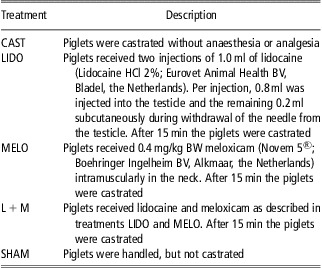
A total of 160 male crossbred piglets from 32 litters were used in this study. All piglets were born in a controlled farrowing unit with 10 units per room. Every week, piglets from four to six litters, aged 3 to 5 days, and born in the same farrowing unit, entered the experiment. No procedures were performed on the piglets before the experiment. Within each litter, five male piglets were randomly selected, numbered and randomly assigned to one of five treatments (see Table 1).
Description of treatments

CAST = castration without anaesthesia or analgesia; LIDO = castration after local anaesthesia with Lidocaine; MELO = castration after administration of meloxicam; L + M = castration after lidocaine and meloxicam; SHAM = sham castration.
Piglets were confined in a small crate and remained in this crate until all experimental piglets of the litter were blood sampled at 20 min after castration or SHAM. They were removed from the crate only during short periods of time to take a blood sample, administer medication and perform the castration or handling. Fifteen minutes before castration, piglets assigned to treatments LIDO (castration after local anaesthesia with Lidocaine), L + M (castration after lidocaine and meloxicam) and MELO (castration after administration of meloxicam) received injections with lidocaine and/or meloxicam. Meloxicam was administered also at 15 min before castration to facilitate on-farm use. In practical circumstances it is undesirable to catch piglets twice, or separate them from the sow for a long period of time. After administration of lidocaine or meloxicam, piglets were put back in the crate with the other piglets awaiting castration. After 15 min, castration was performed. During castration, piglets were restrained in dorsal recumbence in a castration clamp (Schippers, Bladel, the Netherlands). After disinfection of the scrotum with alcohol (70%, methylated), a horizontal incision over both testes was made with a scalpel. Testes were externalized, and the spermatic cords cut with the scalpel. After the procedure, piglets were placed back into the crate. After the last piglet was blood sampled for the second time, all piglets were returned to the sow in the farrowing pen. Lidocaine and meloxicam were administered by a veterinarian, and castration was performed by a skilled technician.
Blood collection
Fifteen minutes before castration, a blood sample of all piglets was taken. In treatments LIDO, L + M and MELO, samples were taken just before administration of lidocaine and/or meloxicam. Twenty minutes after finishing castration, a second blood sample was taken. During blood sampling, piglets were restrained in the castration clamp and blood was drawn by jugular venepuncture with a 5-ml syringe. Blood was divided over two tubes (BD Vacutainer®, Becton Dickinson B.V., Breda, the Netherlands), one ethylenediaminetetraacetic acid tube and one heparin tube, and stored on ice until arrival in the lab. In the lab, samples were centrifuged for 10 min at 3000 r.p.m. at 4°C. Plasma was divided over aliquots and stored at −20°C until analysis. Samples were all analysed at the same time for glucose, lactate, CK and cortisol.
Measurements
Vocalizations
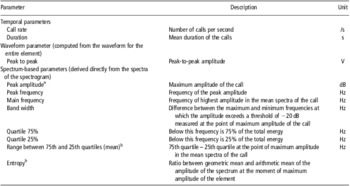
During treatment, all vocalizations of the piglets were recorded. The microphone (Sennheiser MKH106, Sennheiser Benelux, Almere, the Netherlands) was kept at a distance of 0.5 m from the head of the piglet. The vocalizations were digitalized with Avisoft software (Avisoft-RECORDER, version 4.40) at 24 bit and a sampling rate of 22 050 Hz. Only the vocalizations during the surgical phase were analysed, in order to establish the direct effects of castration. The start of the surgical phase was characterized by making the incision in the scrotum, the end by finishing the severing of the second spermatic cord. SHAM piglets were removed from the crate and kept in hand, in front of the microphone, during a time frame comparable to that in the castration clamp in other treatments. The ‘surgical phase’ started at the moment they were in front of the microphone, and ended at the moment they were moved from the microphone back to the holding crate. Calls were automatically identified by Avisoft SASlab pro (version 4.40) as continuous vocalizations separated by episodes without vocalization. In cases of ambiguous noises, an experimenter manually identified the calls in Avisoft. From each call, 27 measures were automatically calculated to describe the specific call properties. A selection of the most relevant parameters was made (see Table 2), based on literature. Means of all measures were calculated separately for each animal. In line with the commonly used classification system (Weary et al., Reference Weary, Braithwaite and Fraser1998), we divided the calls into two types: ‘high calls’ (⩾1000 Hz) and ‘low calls’ (<1000 Hz). However, initial analysis showed that the number of piglets with low calls was too low for a statistical analysis. Therefore, all analyses were carried out on high calls only.
Definitions of vocal parameters

aAmplitude values are negative; higher values are louder.
bMeasure of the pureness of the sound.
Blood parameters
Plasma concentrations of glucose, lactate and CK were measured automatically (SYNCHRON LX® Systems, Beckman Coulter Ireland Inc., Mervue, Ireland). Total cortisol was measured by direct radioimmunoassay (Coat-a-Count Cortisol RIA, DPC/Siemens, the Hague, the Netherlands).
BW and mortality
Piglets were weighed at three times: the day of castration (at 3 to 5 days of age), the day of weaning (at 24 to 26 days of age) and 4 weeks after weaning. Growth rates were calculated for the periods between: (1) castration and weaning, (2) weaning and 4 weeks after weaning and (3) castration and 4 weeks after weaning. Mortality of piglets was recorded until last weighing, at 4 weeks after weaning.
Statistical analyses
Vocalizations
In order to compare the differences between the five treatment groups, a Generalized Linear Model procedure was used for repeated measures (with littermates within the different conditions as replicates), in the statistical software package SPSS (version 12.0.1). The Greenhouse–Geisser univariate test was used. Where necessary, a logarithmic transformation was applied to parameters, in order to ensure normal distribution. Estimated marginal means were calculated, and their differences were pairwise tested in a post-hoc Bonferroni test. Piglets that made no sound during the surgical period were included in analysis of the call rates (as zero). However, they could not be included in the analysis of parameters for characterizing call quality, hence the variation in degrees of freedom (see Table 2).
Blood parameters
For both sampling times, histograms of the measurements were produced and the skewness coefficients calculated using the data from the blood parameters (glucose, lactate, CK and total cortisol). Logarithmic transformation was applied, in order to obtain more symmetrically distributed data and to stabilize the variance. Further analyses were carried out for the log10 values. The change in log(conc) of the blood parameters between 15 min before and 20 min after castration was analysed using the linear mixed model:

In the model, the litter is considered a random effect and treatment a fixed main effect. Litter and residual e are assumed to be independently normally distributed with mean 0 and variance  and
 . The model was fitted to the data using Restricted Maximum Likelihood analysis. The importance of treatment effects has been examined using the multiple comparisons Fisher's protected LSD (least significant difference) test. First, treatment effects were tested using an F-test for the F-statistic (Wald statistic/degrees of freedom treatment). Second, in case treatment effects were found significant (P < 0.05), all pairwise differences between treatment means were tested, using the two-sided LSD test at significance level α = 0.05.
Results
Vocalizations
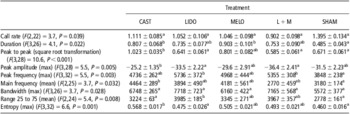
During the castration phase, 1471 calls were emitted by 147 piglets. Thirteen piglets were silent during castration: four SHAM piglets, six LIDO piglets and three L + M piglets. None of the CAST (castration without anaesthesia or analgesia) and MELO piglets were silent. Table 3 presents the most important vocal measurements of piglet calls during castration.
Vocal parameters in the surgical phase (estimated marginal mean ± s.e.)

CAST = castration without anaesthesia or analgesia; LIDO = castration after local anaesthesia with Lidocaine; MELO = castration after administration of meloxicam; L + M = castration after lidocaine and meloxicam; SHAM = sham castration.
Different superscripts within a row indicate a significant (P < 0.05) difference between treatments.
CAST and MELO piglets have significantly longer calls (higher mean duration) than SHAM piglets. The peak-to-peak measure shows clearly that CAST piglets scream significantly louder than the SHAM, LIDO and L + M piglets. The main frequency (pitch of the call) of the CAST piglets is also significantly higher than that of the SHAM piglets. Both the SHAM and the LIDO piglets differed significantly in four vocal parameters from the CAST piglets, and in three parameters from the L + M piglets. MELO piglets showed no significant differences compared with CAST piglets.
Blood parameters
The histograms and the calculated skewness coefficients showed that the measured concentrations of the blood parameters were asymmetrically distributed. Therefore, a logarithmic transformation was applied. There were no significant treatment effects for glucose and CK. The overall predicted means are 0.0042 (s.e. = 0.077) and 0.134 (s.e. = 0.059), respectively. These show no significant overall change for glucose, and a significant overall rise for CK. Treatment effects were significant for lactate and cortisol. Predicted means, standard error of the means (s.e.m.), LSD-value and P-value of the F-test for treatment effects are presented in Table 4.
Treatment effect on lactate and cortisol (predicted treatment means of change in log(conc), s.e.m., LSD and P-value for treatment effects)

CAST = castration without anaesthesia or analgesia; LIDO = castration after local anaesthesia with Lidocaine; L + M = castration after lidocaine and meloxicam; MELO = castration after administration of meloxicam; SHAM = sham castration; LSD = least significant difference.
The s.e.m. and the predicted means of lactate show that for MELO there is a significant rise in concentration after castration. The LSD-value shows that the mean of LIDO is significantly different from the mean for MELO, showing a significantly stronger rise for MELO than for LIDO. The s.e.m. value of cortisol shows that for all treatments the rise in concentration is significant. The LSD-value for cortisol shows that the mean of SHAM is significantly higher than for the remaining treatments, that is, a significantly smaller rise is present in SHAM than in the other treatments.
Body weight, growth and mortality
Analysis of BW and growth performance shows that there is a litter effect on BW and growth performance, but no treatment effect. None of the piglets in the experiment died.
Discussion
The results of this study fit, in line with several other studies, with the assumption that castration without pain relief is painful. The differences in vocal characteristics of the piglets that were castrated without lidocaine or meloxicam (CAST) and those of the control piglets (SHAM) were largely consistent with the differences described in other studies. The high calls (>1000 Hz) of CAST piglets are longer, louder and higher than those of SHAM piglets. These changes in vocal characteristics are suggested to be indicative of pain by several studies (Weary et al., Reference Weary, Braithwaite and Fraser1998; Marx et al., Reference Marx, Horn, Thielebein, Knubel and Von Borell2003; Puppe et al., Reference Puppe, Schon, Tuchscherer and Manteuffel2005). Both of the groups treated with lidocaine (LIDO and L + M) show most resemblance to the calls of the SHAM group. In contrast to other studies (Weary et al., Reference Weary, Braithwaite and Fraser1998; Taylor and Weary, Reference Taylor and Weary2000), but in line with Puppe et al. (Reference Puppe, Schon, Tuchscherer and Manteuffel2005), in this study no clear differences were found in the number of calls (call rate) between treatments, a parameter that is supposed to increase in the event of stress and pain. Compared with SHAM piglets, the calls of CAST piglets were significantly longer, which may be indicative of greater pain (Marx et al., Reference Marx, Horn, Thielebein, Knubel and Von Borell2003; Puppe et al., Reference Puppe, Schon, Tuchscherer and Manteuffel2005). The length of calls in both groups that received lidocaine (LIDO and L + M) was in between that of CAST and SHAM, and did not differ significantly from MELO. Parameters that reflect the loudness of calls showed a consistent pattern, in line with Marx et al. (Reference Marx, Horn, Thielebein, Knubel and Von Borell2003). Piglets treated with lidocaine (LIDO and L + M) squealed significantly less loudly, indicative of less pain. There are indications that piglets experiencing pain, squeal at higher frequencies (White et al., Reference White, DeShazer, Tressler, Borcher, Davey, Waninge, Parkhurst, Milanuk and Clemens1995; Puppe et al., Reference Puppe, Schon, Tuchscherer and Manteuffel2005). In this study, we found no clear differences in peak frequency (frequency at the loudest part of the call), but the results for the mean main frequency were clearly in line with Puppe et al. (Reference Puppe, Schon, Tuchscherer and Manteuffel2005): CAST piglets screamed significantly higher than SHAM piglets. Bandwidth, interquartile range and entropy are all indicative of the distribution of energy over the frequencies in the call and of the ‘pureness’ of the call. A decrease in these parameters is suggested to indicate pain (Puppe et al., Reference Puppe, Schon, Tuchscherer and Manteuffel2005). Although the interquartile range was lowest in the SHAM group, the CAST group was also low and did not differ significantly from the SHAM group. SHAM and LIDO piglets had significantly lower entropy than CAST piglets, with the other groups in between. This is quite opposite to the findings of Puppe et al. (Reference Puppe, Schon, Tuchscherer and Manteuffel2005), but the direction of differences fits with what we found in the other parameters. As only Puppe et al. (Reference Puppe, Schon, Tuchscherer and Manteuffel2005) have reported on this parameter, we will refrain from drawing further conclusions. Taken together, the vocal parameters are indicative of a pain reducing effect of lidocaine. It is also apparent, however, that not all pain is relieved. This could be due to the fact that intratesticularly applied local anaesthesia probably does not provide full anaesthesia of the cremaster muscle, scrotal ligament and intra-abdominal part of the spermatic cord (Haga and Ranheim, Reference Haga and Ranheim2005). As expected, administration of meloxicam did not lead to signs indicative of acute pain relief during castration. Several authors have concluded from their findings that cortisol is a useful stress parameter (Morton and Griffiths, Reference Morton and Griffiths1985; Molony and Kent, Reference Molony and Kent1997; Prunier et al., Reference Prunier, Mounier and Hay2005). However, plasma cortisol shows a delayed response when a stressor is administered. In pigs of 7 to 8 days of age, Prunier et al. (Reference Prunier, Mounier and Hay2005) have shown that cortisol reaches its maximum around 30 min after castration. In our study, due to practical reasons, blood sampling was performed 20 min after castration. However, cortisol measurements already showed a clear increase at that time point in all treatments. In our study, the cortisol increase in the SHAM piglets was significantly lower than in all other treatments. In relation to the CAST and MELO piglets, LIDO piglets showed a significantly lower increase in cortisol. L + M piglets did not differ from these groups. In their study, Zöls et al. (Reference Zöls, Ritzmann and Heinritzi2006) found the increase in cortisol 1 h after castration in animals treated with procaine to be greater than in animals castrated without anaesthesia, which is indicative of more pain. Lidocaine is known to have double the anaesthetic potency of procaine, a more rapid onset of action, better diffusing ability and twice the duration of action when compared with procaine (Pugh, Reference Pugh1991). This might explain the difference in pain relieving effect of procaine and lidocaine. In the same study, 1 h after castration, the group treated with meloxicam showed cortisol levels comparable to the sham-castrated group. In our study, such an effect was not observed with samples taken 20 min after castration. The elevation of cortisol in SHAM piglets in our study, is not in line with Prunier et al. (Reference Prunier, Mounier and Hay2005) and Zöls et al. (Reference Zöls, Ritzmann and Heinritzi2006). In the latter studies, no increase in cortisol was seen in animals that were not castrated. This inconsistency could be due to a different method of handling the piglets, although Weary et al. (Reference Weary, Braithwaite and Fraser1998) found no difference in vocal response between piglets restrained in different ways, suggesting that different ways of handling are equally stressful. Another possible explanation could be that the increase has, in part, been caused by the new environment (crate) the piglets were kept in during treatment, as well as the blood sampling procedure they underwent. It is also possible that the piglets’ previous experiences play a role in this finding. In our experiment, no other procedures had been carried out on the piglets, whereas in the study of Zöls et al. (Reference Zöls, Ritzmann and Heinritzi2006) it is described that tail-docking, tooth-clipping and ear-tagging had been carried out on the first day after birth. In our study, there is no influence of castration on glucose levels. This is in line with the findings of Prunier et al. (Reference Prunier, Mounier and Hay2005) and Zöls et al. (Reference Zöls, Ritzmann and Heinritzi2006). A possible explanation for the lack of response is the low glycogen level in the liver of new-born piglets (Prunier et al., Reference Prunier, Mounier and Hay2005), so that in a stressful situation there is no glycogen available for mobilization. Lactate is produced during anaerobic glycolysis in the muscles during increased exertion. In our study, there was an overall increase in lactate concentrations after castration, except in the LIDO group, where a decrease was found. However, only the MELO and LIDO groups differed significantly from each other. The decrease in lactate in the LIDO group cannot be readily explained on the basis of existing literature. Zöls et al. (Reference Zöls, Ritzmann and Heinritzi2006) found a significant increase in lactate 1 h after castration in the group treated with procaine, but also found no significant differences between the groups. CK is an enzyme that occurs when tissue is damaged; levels in the blood can increase as a result of physical stress. Although the LIDO group showed a considerable increase in CK after castration, no significant differences between treatment groups were found due to the large individual variation. Zöls et al. (Reference Zöls, Ritzmann and Heinritzi2006) found a maximum CK concentration in the blood 4 h after castration. However, at that stage the standard deviation in the group castrated without anaesthesia also showed a marked increase. This indicates that individual reactions vary widely and finding significant differences between treatments will prove difficult. The absence of significant differences in growth performance between the treatment groups is in line with the findings of Hay et al. (Reference Hay, Vulin, Genin, Sales and Prunier2003). McGlone et al. (Reference McGlone, Nicholson, Hellman and Herzog1993) observed an age effect on growth performance. They reported that pigs castrated at 14 days of age weighed more at weaning than piglets castrated at the age of 1 day. It is possible that castration affects growth performance to a lesser extent if the piglets have already determined their suckling hierarchy. Kielly et al. (Reference Kielly, Dewey and Cochran1999) found that growth rate was lower in piglets castrated at 3 days of age, but this effect was no longer present at weaning. In this study, castration had no negative impact on growth, when compared with SHAM. No positive effect of meloxicam or lidocaine on post-operative performance could be established.
Conclusion
On the basis of vocal parameters and plasma cortisol, the present study shows that local anaesthesia with lidocaine during castration of piglets is associated with decreased pain responses. Vocalization characteristics of piglets that are castrated after having received local anaesthesia most resemble those of piglets that are only handled. Cortisol increase is reduced by lidocaine, although not to the level of piglets that are only handled. The results indicate that intra-operative pain is reduced by local anaesthesia with lidocaine, yet not completely prevented. Castration has no effect on growth performance or mortality of the piglets, independent of the use of lidocaine or meloxicam.
Acknowledgements
The authors thank the staff of De Tolakker research facilities of the Veterinary Faculty of Utrecht University for their technical support, Pieter Vereijken for the statistical analyses and Joop van der Werf for his finishing touch. This study was funded by the Dutch Ministry of Economic Affairs, Agriculture and Innovation.