Introduction
Digital transformation has become inevitable in organisations and society forcing diverse transformations to remain competitive. The activities of digital transformations have further given rise to such terms as digitisation and the digital economy (Bharadwaj, Sawy, Pavlou, & Venkatraman, Reference Bharadwaj, Sawy, Pavlou and Venkatraman2013; Ejemeyovwi & Osabuohien, Reference Ejemeyovwi and Osabuohien2020; Heavin & Power, Reference Heavin and Power2018; Nwaiwu, Reference Nwaiwu2018; Shafique & Beh, Reference Shafique and Beh2017; Wade, Reference Wade2017; Westerman, Bonnet, & McAfee, Reference Westerman, Bonnet and McAfee2014). The entire ambience of societal and individual systems interactions and use of digital transformation is referred to as a digital economy. Put into perspective, digital economy refers to a technology-driven economic system where digital technology, such as platforms, and diverse components and applications of information technology are used to achieve economic sustenance at the individual, firm and national levels (Afonasova, Panfilova, & Galichkina, Reference Afonasova, Panfilova and Galichkina2018; Domazet & Lazić, Reference Domazet and Lazić2017; Karakara & Osabuohien, Reference Karakara and Osabuohien2019, Reference Karakara and Osabuohien2020; Solis, Li, & Szymanski, Reference Solis, Li and Szymanski2014). It is an economy where digital transformation has the potential to become part of the social arrangement, providing alternatives and resilient approaches to addressing complex socio-economic problems.
This study explores the role of digital transformation in the strive to attain United Nations' Sustainable Development Goals (SDGs) 4 and 9, which focuses on educational development at all levels, industrial collaborations and improvements, respectively (Unterhalter, Reference Unterhalter2019). This involves the broad adoption of digital technologies such as e-payment gadgets, cloud computing, data analytics and artificial intelligence, to facilitate connectivity and social interactions on a global scale (Aldhaheri & Rajan, Reference Aldhaheri and Rajan2019; Ndulu, Joseph, & Tryphone, Reference Ndulu, Joseph and Tryphone2021).
The United Nations Millennium declaration in 2000 aimed to reduce extreme poverty. It was focused on the United Nations records, on a significant achievement in terms of world-wide reduction in the level of poverty, improvement in basic education enrolments, women empowerment and awareness and gender equality (Oleribe & Taylor-Robinson, Reference Oleribe and Taylor-Robinson2016). However, the millennium declaration did not achieve the set goals in Nigeria due to contextual factors such as the emergence of crises like the Boko Haram insurgency, the Niger Delta crisis and other economic challenges such as corruption (Aduba, Reference Aduba2021; Ojimba, Reference Ojimba2012; Olujobi, Reference Olujobi2021a; UNICEF, 2019). Other opposing challenges included neglect from the government, and strike actions by labour unions, lack of government commitment, girl child discrimination and poverty (Adepoju & Fabiyi, Reference Adepoju and Fabiyi2007; Alabi, Bahah, & Alabi, Reference Alabi, Bahah and Alabi2014; Dapo-Asaju & Bamgbose, Reference Dapo-Asaju and Bamgbose2016).
Following the millennium declarations, the Sustainable Development Goals (SDGs) initiative was introduced by the United Nations in 2015 as part of a broad agenda for global social advancement, targeting 2030 as its year of accomplishment. It comprised of a non-binding agreement among members of the United Nations to develop sustainable strategies to achieve 17 categories of development goals (SDGs); focused on an agreement among the United Nations member nations to develop sustainable strategies to achieve these goals – especially among the poor countries (McCollum et al., Reference McCollum, Echeverri, Busch, Pachauri, Parkinson, Rogelj and Riahi2018; Pizzi, Caputo, Corvino, & Venturelli, Reference Pizzi, Caputo, Corvino and Venturelli2020; Sachs, Schmidt-Traub, Kroll, Lafortune, Fuller, & Woelm, Reference Sachs, Schmidt-Traub, Kroll, Lafortune, Fuller and Woelm2020; Wu, Guo, Huang, Liu, & Xiang, Reference Wu, Guo, Huang, Liu and Xiang2018). The implementation which took off in January 2016, and the process is reviewed regularly at global and local levels by various stakeholder groups, driven by the UN High-level Political Forum on Sustainable Development (HLPF) as the highest review organ.
The strive to attain the broad United Nations' 2030 agenda requires affective commitment and collaboration among members and development of understanding of contextual factors that may affect the implementation. This arguably requires the embrace of the facilitative support such as digital transformation (Bebbington & Unerman, Reference Bebbington and Unerman2020; Faniran & Olaniyan, Reference Faniran and Olaniyan2009; Ndemo & Weiss, Reference Ndemo and Weiss2017). According to Rosato, Caputo, Valente, and Pizzi (Reference Rosato, Caputo, Valente and Pizzi2021), the commitment of key stakeholders such as business enterprises in various sectors to the pursuit of 2030 agenda has the potential to attract business advantages and broad preservation of the environment through positive contributions towards the pursuit of SDGs from their sectorial perspectives.
The main objective of this study is to ascertain the role of digital transformation in facilitating the attainment of the SDGs 4 and 9 in Nigeria. Hence, this study focuses on SDG 4 (quality education) and SDG 9 (industry, innovation and infrastructure). The choice of these two SDGs is based on their centrality to the attainment of most of the other goals (Adeniran, Onyekwena, Onubedu, Ishaku, & Ekeruche, Reference Adeniran, Onyekwena, Onubedu, Ishaku and Ekeruche2019; Osabuohien, Reference Osabuohien2020; Schmidt-Traub, Guido, Schmidt-Traub, Sachs, Mazzucato, Messner, Nakicenovic, & Rockström, Reference Schmidt-Traub, Sachs, Mazzucato, Messner, Nakicenovic and Rockström2019). A critical question raised in the current study is how can the adoption of digital transformation support the drive to attain SDGs 4 and 9, focused in this study?
The concept of digital transformation varies among scholars and practitioners (Matt, Hess, & Benlian, Reference Matt, Hess and Benlian2015; Nadeem, Abedin, Cerpa, & Chew, Reference Nadeem, Abedin, Cerpa and Chew2018; Warner & Wäger, Reference Warner and Wäger2019). Nadkarni and Prügl (Reference Nadkarni and Prügl2021) define digital transformation as an actor driven organisational transformation triggered by the adoption of technology-driven digital disruptions. In this study, digital transformation is viewed as the cultural, organisational and operational change of an organisation, industry or ecosystem through a smart integration of digital technologies, processes and competencies across all levels and functions in a strategic way to yield improvement and advance new development (I-SCOOP, 2020). Similarly, innovation and infrastructure constitute some of the elements of the digital economy (World Bank Group, 2019; Zhu, Kraemer, & Xu, Reference Zhu, Kraemer and Xu2006). It is evident, therefore, that a digital economy built on such pillars will be robust and inclusive, and will deliver high prospects of attaining SDG 9. The advantages of electronic/technical know-how for the SDGs are comparatively incorporated into the 2030 outline, especially, the SDG 9 (Electronic technical know-how for the sustainable development goals, 2018). The place of human input must be duly recognised by key stakeholders such as government institutions in the process of innovation (Bajpai & Biberman, Reference Bajpai and Biberman2021; Olokundun, Ibidunni, Ogbari, Falola, & Salau, Reference Olokundun, Ibidunni, Ogbari, Falola and Salau2021). It is argued in this research that a meaningful engagement among these stakeholders and the digital transformation process can facilitate an effective implementation that embraces the contributions of different participating stakeholders, towards the attainment of SDGs 4 and 9 in Nigeria (Hess, Matt, Benlian, & Wiesböck, Reference Hess, Matt, Benlian and Wiesböck2016; Ibidunni, Ufua, Okorie, & Kehinde, Reference Ibidunni, Ufua, Okorie and Kehinde2019; Sabai & Ho, Reference Sabai and Ho2019).
Overview of SDGs 4 and 9
SDG 4: Guarantee comprehensive and equitable education and encourage enduring learning opportunities for all
The importance of goal 4 is underscored by the recognition that encouraging quality education is critical for enhancing people's lives and advancing sustainable development. To guide implementation, goal 4 (four) is structured into 10 (ten) targets (SDG Tracker, 2020). The 10 (ten) targets are listed below:
(a) 4.1: Free primary and secondary education.
(b) 4.2: Equal access to quality pre-primary education.
(c) 4.3: Equal access to affordable technical, vocational and higher education.
(d) 4.4: Increase the number of people with relevant skills for financial success.
(e) 4.5: Eliminate all discrimination in education.
(f) 4.6: Universal literacy and numeracy.
(g) 4.7: Education for sustainable development and global citizenship.
(h) 4.A: Build and upgrade inclusive and safe schools.
(i) 4.B: Increase the supply of qualified teachers in developing countries.
(j) 4.C: Expand higher education scholarships for developing countries.
These key aims align with the views of researchers and practitioners who emphasise on participatory use of e-governance and digital technology in the Nigerian economy. However, the process requires continual evaluation by critical stakeholders to ensure the fairness and avoidance of breaches (Eden & Ackermann, Reference Eden and Ackermann1996; Edewor, Imhonopi, & Urim, Reference Edewor, Imhonopi and Urim2014; Gregory, Atkins, Midgley, & Hodgson, Reference Gregory, Atkins, Midgley and Hodgson2020; Ojo, Reference Ojo2014).
SDG 9: Build resilient infrastructure, promote sustainable industrialisation and foster innovation
This goal underscores the need to ensure that everyone can enjoy the benefits from SDGs and is incorporated into the 2030 programme especially, the SDG 9 (Digital technology for sustainable development goals), which is essential for African countries such as Nigeria (Ejemeyovwi, Osabuohien, & Bowale, Reference Ejemeyovwi, Osabuohien and Bowale2021; Karakara & Osabuohien, Reference Karakara and Osabuohien2019, Reference Karakara and Osabuohien2020). This is further emphasised by the World Bank's report on Nigeria which calls for the availability of affordable information and communication technology (ICT) access as a precondition to partake in and benefit from emerging digital transformational efforts, that can lend support to the achievement of these SDGs in Nigeria (Koehler, Reference Koehler2016; UNCTAD, 2019; World Bank Group, 2019).
The key focuses of SDG 9 are:
(a) 9.1: Develop sustainable, resilient and inclusive infrastructures.
(b) 9.2: Promote inclusive and sustainable industrialisation.
(c) 9.3: Increase access to financial services and markets.
(d) 9.4: Upgrade all industries and infrastructures for sustainability.
(e) 9.5: Enhance research and upgrade industrial technologies.
(f) 9.A: Facilitate sustainable infrastructure development for developing countries.
(g) 9.B: Support domestic technology development and industrial diversification.
(h) 9.C: Promote universal access to information and communications technology.
(Source: Sustainable Development Goals (SDG) Tracker, 2020.)
Towards the understanding of digital transformation
Digital transformation is not a new phenomenon, considering that technology has historically transformed society and business, starting with the steam engine in the 17th century, and computers since the mid-20th century (Bukht & Heeks, Reference Bukht and Heeks2018; Cziesla, Reference Cziesla2014; Huarng & Rey-Martí, Reference Huarng and Rey-Martí2019; Ibidunni, Reference Ibidunni2020; Nadeem et al., Reference Nadeem, Abedin, Cerpa and Chew2018). There seems to be no clear definition of digital transformation. Researchers tend to refer to the concept in various ways, usually based on the context and the sector where it is applied. According to Barefoot, Curtis, Jolliff, Nicholson, and Omohundro (Reference Barefoot, Curtis, Jolliff, Nicholson and Omohundro2018), the concept of digitalisation or digital economy refers to the broad use of the internet in the appropriation of social and economic activities. They note that the use of ICT is key to economic digitalisation. They highlight three key ways to classify the usage of digital in crucial social and economic activities, including: (1) the digital infrastructure such as the computer, (ii) the substance that digital economy operators generate and access and (iii) the digital businesses that occur utilising the system (Bukht & Heeks, Reference Bukht and Heeks2018; Foster, Reference Foster2017; Pizzi, Corbo, & Caputo, Reference Pizzi, Corbo and Caputo2021).
Researchers identified leading technologies informing and shaping the digital economy as internet technology: analytical technology, mobile technology and cloud technology. Others include digital replicas (cloud computing, digital platforms and digital facilities); customer gadgets (mobile phones, smartphones, tablets, netbooks, laptops and 3D printers); big data and robotics technologies (Bukht & Heeks, Reference Bukht and Heeks2018; Henriette, Feki, & Boughzala, Reference Henriette, Feki and Boughzala2016). The continuous spread of the digital transformational activities has also been witnessed across sectors of the Nigerian economy. At the hub of this is big data. As Noah (Reference Noah2018) puts it, ‘those who own the data own the future’ (p. 76). If this is so, then it matters where the control of global data flows lies, and the potential implications for sustainable growth in developing economies such as Nigeria. Also, Nwaiwu (Reference Nwaiwu2018) identified 10 different frameworks of digital transformation. This highlights the trans-disciplinary view of digital transformation and the universality of its applications.
Electronic governance in Nigeria
Extant literature reckons e-government as the utilisation of information technology by the government in exchange for services and information. It is also the procedure by which skills are utilised to offer and share information, services and transact businesses between the various agencies of government and the citizens. The purpose of e-governance is to drive greater transparency, accountability, timeliness and efficiency in government businesses (Abasilim, Reference Abasilim2015; Ajibade, Ibietan, & Ayelabola, Reference Ajibade, Ibietan and Ayelabola2017; Fatile, Reference Fatile2012). The stake of this research is that all stakeholders should be duly involved to ensure a fair process of acceptance and void of marginalisation (Ufua, Papadopoulos, & Midgley, Reference Ufua, Papadopoulos and Midgley2018).
Governments in all climes exist for the common good of their populace, and the means for achieving set governance objectives is fundamentally reliant on governmental system (Gberevbie, Ayo, Iyoha, Duruji, & Ugochukwu, Reference Gberevbie, Ayo, Iyoha, Duruji and Ugochukwu2018, p. 57; Weizi, Kecheng, Maksim, Abby, & Nicholas, Reference Weizi, Kecheng, Maksim, Abby and Nicholas2016). Thus, it may be said that e-government, made possible by digital technology, exists to facilitate this mandate. Effective governance equally embraces educational and industrial advancement in its structure as fundamental factors required for economic viability (Ojeka, Iyoha, Ibidunni, Ayo, & Gberevbie, Reference Ojeka, Iyoha, Ibidunni, Ayo and Gberevbie2016; Raweewan & Kojima, Reference Raweewan and Kojima2020). This arguably brings the key constructs focused in this study (stakeholder engagement, digital transformation and SDGs 4 and 9), in tandem with the e-governance.
According to Abasilim, Gberevbie, and Ifaloye (Reference Abasilim, Gberevbie and Ifaloye2016), e-governance adoption in Nigeria has the potential to assist the development and promotion of citizen participation in governance. However, with the often reported challenge of the digital divide, incessant power failure and low professional workforce, the engagement of these members of the society becomes a difficult and unable to achieve the intentions (Agbele, Azeez, Abidoye, Adesina, Venter, & Oyewole, Reference Agbele, Azeez, Abidoye, Adesina, Venter and Oyewole2012; Ajibade, Ibietan, & Ayelabola, Reference Ajibade, Ibietan and Ayelabola2017; Gberevbie et al., Reference Gberevbie, Ayo, Iyoha, Duruji and Ugochukwu2018; Olujobi, Reference Olujobi2020). Much of these challenges seemed to focus on the Nigeria public sector, it is also imperative to mention that the private sector also shares in the challenges (Nchuchuwe & David, Reference Nchuchuwe and David2016). This calls for a critical understanding of the Nigerian business environment to effectively understand contextual issues challenging the digital transformational process across sectors in Nigeria, beyond the typical environmental challenges such as electrical power supply, theft and other criminalities. Knowledge of these issues can inform the development of a suitable approach to address digital transformational challenges (Olujobi, Reference Olujobi2017; Mohammed, Hassan, & Zakari, Reference Mohammed, Hassan and Zakari2021; Yakubu, Reference Yakubu2019). For instance, Ezeokoli, Okolie, Okoye, and Belonwu (Reference Ezeokoli, Okolie, Okoye and Belonwu2016) suggest collaboration between the government and private sector in a joint effort to develop an approach that can substantially enhance the digital transformation project in Nigeria. Similarly, the World Bank Group (2019) notes that ‘despite some progress on the implementation of the goals in the Nigerian economy together, the Information Communication Technology Road Map and e-government master plan continue to be accepted for comprehensive practice in Nigeria’. This aligns with the regulatory policies harmonisation, enactment of due respect for operational privacy among participating stakeholders and Data Protection Act, scrutinising the superiority of digital services and the strive for the implementation of Open Government Partnership (Ufua, Olujobi, Ogbari, Dada, & Edafe, Reference Ufua, Olujobi, Ogbari, Dada and Edafe2020a, Reference Ufua, Salau, Dada and Adeyeye2020b; World Bank Group, 2019, p. 2).
Conceptual proposition
From a theoretical viewpoint, the disruptive impacts of digital transformation on SDGs 4 and 9 have been established. However, existing literature is limited by investigations that explain the characteristics and predictive linkages about digital transformations and developing nations' industrial and educational advancements (Ibidunni, Ibidunni, Akinbola, Olokundun, & Ogunnaike, Reference Ibidunni, Ibidunni, Akinbola, Olokundun and Ogunnaike2020; Iivari, Sharma, & Ventä-Olkkonen, Reference Iivari, Sharma and Ventä-Olkkonen2020; Jackson, Reference Jackson2019; Nguyen, Reference Nguyen2018; Tronvoll, Sklyar, Sörhammar, & Kowalkowski, Reference Tronvoll, Sklyar, Sörhammar and Kowalkowski2020). Yet, given the enormous potentials of emerging economies, especially for high density of youth and children population that constitute a growing skilled workforce, this economic region should form a strategic cluster for investigating the impacts of digital transformations on the appropriation of educational development and industrial advancement, embedded in Nigeria (Oludayo & Ibidunni, Reference Oludayo and Ibidunni2019). Although researchers and practitioners acknowledge the importance of digital transformation for effective operations, especially in the industry and educational advancement, there are inherent environmental complex issues that can affect the implementation of digital transformation and the attainment of SDGs (Berg, Furrer, Rani, & Silberman, Reference Berg, Furrer, Rani and Silberman2018; Warner & Wäger, Reference Warner and Wäger2019). These can include resistance from certain stakeholders who are either affected or involved in the process of digital transformation and implementation of SDGs. Such may be as a result of marginalisation of some minority stakeholders in the process, whose interest may not be duly considered in the process of digital transformation and SDG implementation (Foote, Midgley, Ahuriri-Driscoll, Hepi, & Earl-Goulet, Reference Foote, Midgley, Ahuriri-Driscoll, Hepi and Earl-Goulet2021).
This study is predicated on a systems approach which is based on the recognition of the connectivity of the various parts of a structure and the purpose for which they function (Ufua, Papadopoulos, & Midgley, Reference Ufua, Papadopoulos and Midgley2018). It also creates an effective platform for stakeholder participation that can inform commitment and contributions towards a jointly defined course of interest. This is broadly focused on addressing the key research question raised in this study. Systems approach can facilitate the creation of acceptable boundary demarcations that are void of visible resistance, through the engagement of the relevant stakeholders in the pursuit of digital transformation and SDGs 4 and 9 implementations in Nigeria (Ufua, Reference Ufua2020).
This study specifically examines the intervening roles of digital economy practices and stakeholder inputs as well as other supportive factors such as e-governance initiative and use of technology, on the prospects of digital transformation to support the implementation of goals 4 and 9 of United Nations' SDGs. However, to the best of our knowledge, little research attention has been paid to conceptualising these constructs, digital transformation, SDGs 4 and 9 and stakeholder engagement in Nigeria, especially from the perspective of the contextual factors from the environment and the attendant human inputs. The consideration of these perspectives could project active learning across boundaries by participants in the process of digital transformation (African Union Commission, 2021; Olokundun, Ogbari, Obi, & Ufua, Reference Olokundun, Ogbari, Obi and Ufua2019).
Methodology
The context of this study is Nigeria, which is the largest economy in sub-Sahara Africa. The objective of this study is to explore the role of digital transformation in achieving the SDGs 4 and 9 which are socially aspirational targets in education and infrastructure, innovation and industry, respectively, as part of the United Nation's Agenda 2030. This study also aims to explore supportive extent of technological facilitation and institutional stakeholder engagement approach, in facilitating digital transformation and the strive to achieve SDGs 4 and 9 in Nigeria.
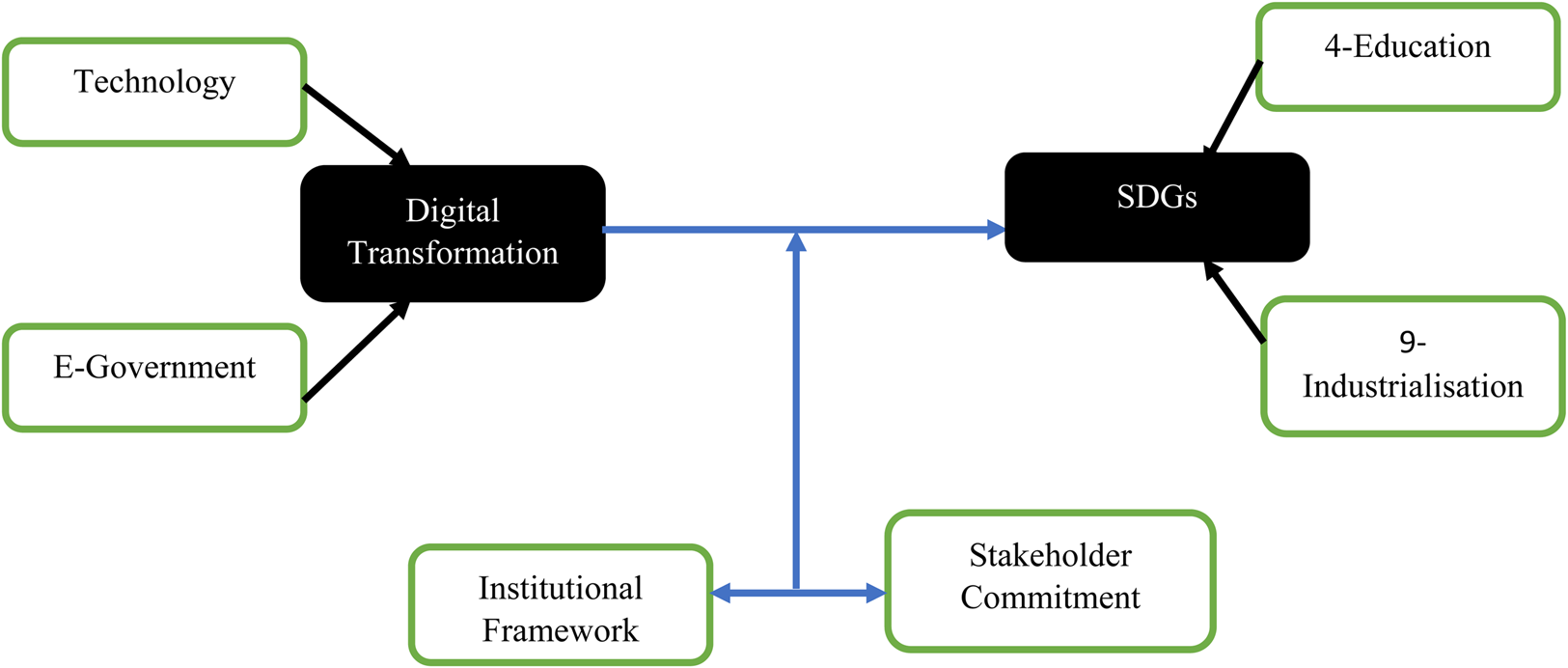
The research adopted a conceptual review of extant literature on the topic. This was aimed to situating relevant literature in reflection to current practices in the Nigerian context, regarding digital transformation and the implementation of SDGs 4 and 9 focused in this study (Saunders, Lewis, & Thornhill, Reference Saunders, Lewis and Thornhill2003; Vaismoradi, Jones, Turunen, & Snelgrove, Reference Vaismoradi, Jones, Turunen and Snelgrove2016). Data were sourced primarily from Google Scholar database and published reports by reputable development agencies such as the United Nations. Search keywords included, digital transformation, technology, e-government, SDG4, SDG9 stakeholder theory and institutional theory. Following Maguire and Delahunt (Reference Maguire and Delahunt2017) and Pizzi et al. (Reference Pizzi, Caputo, Corvino and Venturelli2020), a content review of the literature was applied to ascertain their potential roles in facilitating the implementation of digital transformation and SDGs 4 and 9 in Nigeria. This was also meant to integrate thoughts from different indicators focusing on both the past, present and future research about digital transformation and SDG in Nigeria (see, Caputo, Pizzi, Pellegrini, and Dabić, Reference Caputo, Pizzi, Pellegrini and Dabić2021; Figure 1; Collis and Hussey, Reference Collis and Hussey2009; Creswell, Reference Creswell2014; Ufua, Osabuohien, Ogbari, Falola, Okoh, and Lakhani, Reference Ufua, Osabuohien, Ogbari, Falola, Okoh and Lakhani2021).
Due to the variability of views about digital transformation, this study adopts two key variables to operationalise the concept of digital transformation: technology and e-governance. It adapts this operationalisation from Nadkarni and Prügl (Reference Nadkarni and Prügl2021) who mapped digital transformation research along two aggregate dimensions of Technology and Actor, and described digital transformation as actor-driven organisational transformation triggered by the adoption of technology-driven digital disruptions. They noted that actor-driven transformation includes, transformative leadership; managerial and organisational capabilities; company culture and work environment. The stake of this study is that effective interaction of these factors can support the process for implementation of digital transformation and SDGs 4 and 9 that can facilitate the commitment of relevant stakeholders and project a platform for useful innovation and improvement (Braun & Clarke, Reference Braun and Clarke2012; SDG Tracker, 2020; Figure 1).
Based on Van Zanten and van Tulder (Reference Van Zanten and van Tulder2018) and Parmar, Freeman, Harrison, Wicks, Purnell, and De Colle (Reference Parmar, Freeman, Harrison, Wicks, Purnell and De Colle2010), we developed a conceptual framework covering the relevance of the key variables for effective digital implementation in Nigeria. This is presented in Figure 1.
Conceptual framework for digital transformation and the implementation of SDGs 4 and 9 in Nigeria.

Institutional stakeholder engagement and the implementation of digital transformation and SDGs 4 and 9 in Nigeria
The conceptual framework presented in Figure 1 asserts that technological and e-government indicators of digital transformation are formative constructs that enhance the actualisation of SDGs 4 and 9. This study proposes that a broad framework for institutional stakeholder involvement can help reduce the organisational barriers that limit adopting digital transformation and support SDGs 4 and 9, especially by business organisation in Nigeria. Although Pizzi et al. (Reference Pizzi, Caputo, Corvino and Venturelli2020) note that this can result to positive awareness, it is also arguable to state that Nigerian businesses as institutional stakeholders are more likely to commit to the SDGs 4 and 9, if these SDGs align with their business interests and ambitions. The Nigerian government is keen on stimulating and providing the enabling environment for raising the global competitiveness of Nigeria's digital economy. For instance, although the Nigerian government at various levels, in collaboration with foreign agencies such as UNICEF, has emphasised on compulsory basic education for all children, which apparently reflects the coverage of SDG 4. Arguably, this can encourage the institutional stakeholders to contribute towards the attainment of SDGs 4 and 9 in Nigeria. Rosato et al. (Reference Rosato, Caputo, Valente and Pizzi2021), although recognising the independence among institutional stakeholders, suggest collaborative relationships among institutional stakeholders in order to effectively explore and exploit mutual opportunities in broad transformative projects such as the implementation of SDGs 4 and 9 and digital transformation. They note that the collaborative approach can enhance positive end to end effects such as sustainable safe environmental with minimal negative effects such as pollution.
The relevance of institutions
These are formal and informal rules of influence on organisational activities (Van Zanten & van Tulder, Reference Van Zanten and van Tulder2018). They are fundamental political, social and legal ground rules that form the basis for production, exchange and distribution, be it at the international, national or organisational level (Peng, Reference Peng2002). Institutions may be viewed as formal (political rules, judicial decisions and economic contracts) or informal (social norms of behaviour embedded in culture and ideology). They may also be categorised as regulatory, normative and cognitive (Hinings, Gegenhuber, & Greenwood, Reference Hinings, Gegenhuber and Greenwood2018; Peng, Reference Peng2002; Wade, Reference Wade2018). Signalling forms, the nexus between institutional rules and stakeholder actions, such that, where formal constraints fail for instance, informal constraints set in to reduce uncertainties and unwanted consequences such as illegal appropriation of digital transformation and SDGs. Stakeholders respond to institutional signals by finding answers to the questions of how value should be created and traded; what the ethical boundaries are and what management orientations are most suited to deliver the greatest value within the institutional and organisational constraints, and support to the process of digital transformation and SDG implementation (Ebekozien & Aigbavboa, Reference Ebekozien and Aigbavboa2021; Parmar et al., Reference Parmar, Freeman, Harrison, Wicks, Purnell and De Colle2010; Pizzi et al., Reference Pizzi, Caputo, Corvino and Venturelli2020).
A composite view of institutional and stakeholder theories leads to certain assumptions that form the basis of the framework for this study. First, through signalling, regulatory and normative institutions may be perceived as weak if negative values and norms such as corruption (Olujobi, Reference Olujobi2021b), cronyism and disrespect for rule of laws are prevalent. Second, given that the digital transformation and SDGs 4 and 9 are non-binding, weak institutions may discourage stakeholder from committing to sustainability oriented (business) practices. Third, at 160 out of 193 in the latest 2020 Global SDG Ranking, Nigeria's consistent poor performance may be due, at least, to its widely believed weak institutions. The implication is that Nigeria may be severely challenged to mobilise the needed stakeholder commitment (beyond superficial corporate social responsibility projects), especially with environmental issues such as pandemic exerting pressures on business resources and priorities (Sesan & Siyanbola, Reference Sesan and Siyanbola2021; Ufua et al., Reference Ufua, Osabuohien, Ogbari, Falola, Okoh and Lakhani2021).
Findings and discussion
Stakeholder engagement and attainment of SDGs 4 and 9
An important platform for driving digital transformation and the implementation of SDGs is stakeholder engagement. Stakeholders include groups and individuals who are either involved or affected by the process of digital transformation and the implementation of SDGs 4 and 9. For instance women, children and youth, NGOs, local authorities, workers and trade unions, business and industry, scientific and technological community and farmers are stakeholders that could be incorporated as partners towards Agenda 2030 (Van Zanten & van Tulder, Reference Van Zanten and van Tulder2018). The government, therefore, needs to project a proper documentation system that would become a source of reference for effective innovation and decision making.
Ban Ki-moon, the former secretary General of the United Nations was quoted as saying that ‘while governments take the lead, the private sector is counted on to drive success’. It is, however, debatable how the private sector is standing up to this expectation, especially in the context of a developing economy such as Nigeria (Annan-Diab & Molinari, Reference Annan-Diab and Molinari2017; Ufua, Olokundun, Ogbari, & Atolagbe, Reference Ufua, Olokundun, Ogbari and Atolagbe2019). It is further argued in this study that one way to minimise the challenges of marginalisation and imposition of vital socio-economic transformation, including those of digital transformation and SDGs, is by having an effective multi-stakeholder engagement strategy that dynamically balances the differences in value perceptions, organisational constraints and managerial orientations. These stakeholders can also be engaged in the use of technology through a structured educational approach that can enhance the better commitment to the pursuit of SDGs 4 and 9 in Nigeria.
The role of electronic governance
Nigeria's e-government initiatives include the central web portal for Government Services launched in 2019 to ‘offer access to government data and utilities, to enhance transparency, and to improve the provision and value of civic services’ (Bal, Reference Bal2017; World Bank Group, 2019, p. 2). E-governance has been recognised as a tool to help government remodel itself, run (more) economically, efficiently and generate novel outcomes. However, effort is still required to further project e-governance practices, to enhance its broad acceptance among stakeholders in the Nigerian economy (Nwaiwu, Reference Nwaiwu2018; Schwer, Hitz, Wyss, Wirz, & Minonne, Reference Schwer, Hitz, Wyss, Wirz and Minonne2018; van der Velden, Reference van der Velden2018).
The argument of this study is for the strive by the government, being a key stakeholder and other participants to embrace and support the usefulness of e-government practices in the pursuit of critical developmental initiatives such as the SDGs 4 and 9, especially in the period of unfavourable emerging environmental incidences such as COVID-19 pandemic effects. The use of e-governance would facilitate positive changes in government services provisions and enhance the attainment of advantageous effects such as accountability, times discharge of obligations and reliable evaluation of governmental services in the process of service deliveries (Ufua et al., Reference Ufua, Osabuohien, Ogbari, Falola, Okoh and Lakhani2021). E-governance would therefore create a useful systems approach that provides due process for the identification and addressing key issues in the implementation of SDGs 4 and 9 in Nigeria. It can also serve as a pointer to areas of urgent needs for advancement and improvement across the entire economy as well as create caveat against the chance for unwanted incidences such as marginalisation and unfairness among stakeholders in the pursuit of SDGs 4 and 9 in Nigeria (see Yakubu, Reference Yakubu2019).
Conclusion
This paper explored the implementation of digital transformation in Nigeria, focusing on its effects on the pursuit of the SDGs 4 and 9 on a stakeholder engagement approach. Our study affirmed that digital technology can certainly facilitate the attainment of the SDGs generally, and SDGs 4 and 9 in particular. Findings from current research showed that access to improved educational system for everyone by 2030 (SDG 4) can be expedited with these digital transformational services.
The study paid attention to stakeholders' involvement in the process that can enhance awareness and commitment of the usefulness of digital transformation across sectors. It also emphasises the enactment of e-governance processes and the widespread use of technology for sustained quality education and industry innovations. A conceptual model was developed in the research, relying on extant literature covering these aforementioned key factors affecting digital transformation and the strive to attain SDGs 4 and 9 in Nigeria.
A key theoretical contribution of the study is the system function of interactions among stakeholders on the basis of attainment of set goals. The study emphasised enacting a fair platform of participation that is void of marginalisation of interests of those who either involved or affected in the process of digital transformation and the strive to attain the goals of SDGs 4 and 9. It is broadly argued that the government institutions who assume facilitating stakeholder roles, need to take due responsibility to provide a fair platform for engagement that can enhance the implementation of digital transformation and the attainment of SDGs 4 and 9 in Nigeria.
A limitation of this research is the sole reliance on extant literature to explore the topic. It is, therefore, recommended to consider an empirical approach, especially from the perspective of a developing economy where there is an inherent challenge of social and economic fault lines and where political decision making is unconventional. It is also recommended for further research to focus on the level of government acceptance and commitment to digital transformational practices in Nigeria. A critical suggestion for further research is how digital transformational practice can provide the needed support for economic transformation across regions in Africa and how its practices can facilitate the pursuit of broad macro-economic reforms such as the African free trade initiative and other development drives that can benefit across boundaries and sectors within African continent. This can provide a resilient platform for progressive government commitment and engagement with various stakeholder groups, both in the strive for developmental effects such as the attainment of SDGs 4 and 9 and the use of technology in other sectoral demarcations, including reforming the legal system reform to combat emerging challenges such as cybercrimes.
Acknowledgements
The authors acknowledge the support from Covenant University Centre for Research, Innovation and Discovery (CUCRID) and the Centre for Economic Policy and Development Research (CEPDeR) of Covenant University, Ota, Nigeria, during the preparation of this manuscript.
Conflict of interest
The authors declare no conflict of interest.