It is particularly à la mode to marry contemporary metaphysics with issues in the philosophy of religion. Setting aside whether this current fashion can be justified, this article investigates just such a model of the Trinity allowing for the filioque clause (i.e. allowing for the Spirit to proceed from the Father and the Son). The first section introduces the details of filioque, as well as some difficulties levelled against it. Next I introduce the two components of the model: that the relations between the Divine Persons are causal (which solves some of the problems introduced in the first section) and that each Divine Person is caused to exist by the other two (which solves the remaining problem of the Spirit being subordinated to the Father and the Son). I then extend the model to show how it can nevertheless allow for the Father being, in some sense, ‘elevated’ compared to the other two Divine Persons. I end by discussing the problematic, revisionary, components of the model.
The proposed model depends upon the possibility of backwards causation and time travel. That said, throughout I assume that time travel is metaphysically possible. I don't deny that if time travel (and associated phenomena like backwards causation, causal loops, bootstrapped objects, etc.) were metaphysically impossible, then the model of the Trinity presented here would not work. Important as this assumption is, I won't defend it because time travel's metaphysical possibility has been widely defended/endorsed elsewhere.Footnote 2 Given the extensive endorsement of its possibility, it seems fruitful to investigate the Trinity based upon such an assumption (something which I've done elsewhere – see Effingham (Reference Effingham2015); see also Leftow (Reference Leftow2004) ).
Filioque
The Nicene Creed reads:
I believe in one God, the Father Almighty . . . And in one Lord Jesus Christ, the only-begotten Son of God, begotten of the Father before all worlds; God of God, Light of Light, very God of very God; begotten, not made, being of one substance with the Father, by whom all things were made. . . . And I believe in the Holy Ghost, the Lord and Giver of Life, who proceeds from the Father and the Son . . .
The final clause of the quote is the filioque clause (Latin for ‘and [from] the son’). A sixth-century addition to the original 325 Nicene Creed, it was the popularized public culprit for the 1054 split between the Western Church and the Eastern Church. The Western Church endorsed the clause; the Eastern Church vigorously opposed it. The growing divide between them became ever more entrenched and irresolvable, leading to the split. Much of the criticism of filioque concerned the theological justifications for its inclusion, as well as worries that the history of the debate was being warped. I take no stand on such issues in this article and am interested only in the purely philosophical criticisms levelled against filioque. That said, I focus on three such objections levelled by the Eastern Church.
Objection One: Filioque involves ‘double procession’ whereby the Spirit proceeds twice and in two distinct spirations (one from the Father and another, separate, spiration from the Son).
Objection Two: The filioque clause posits something superfluous. Why cannot the procession be from the Father alone given that the Father is omnipotent? Indeed, if the Father can't proceed the Spirit alone, surely that threatens His omnipotence? Photius of Constantinople (in the Encyclical to the Eastern Patriarchs) raises these concerns:
If his [i.e., the Spirit's] procession from the Father is perfect and complete – and it is perfect, because he is perfect God from perfect God – then why is there also procession from the Son? (quoted in Siecienski (Reference Siecienski2010), 101)
(Others, e.g. Theodore Mouzalon, follow up on this sentiment (ibid., 141).)
Objection Three: Filioque subordinates the Spirit to the Son. Photius of Constantinople's Encyclical again contains this objection:
By the teaching of the procession from the Son also, the Father and the Son end up being closer to each other than the Father and the Spirit, since the Son possesses not only the Father's nature but also the property of his person. (quoted ibid., 101)
This third objection challenges the supposed equality of the Divine Persons – that is, it challenges:
Equality: The Divine Persons are all equal.
The next section deals with the first two objections. The third objection is a bigger hurdle, which receives a section of its own.
The divine physics
The genus of divine physical relations
The Son is generated from the Father. The Son is begotten from the Father. The Spirit is spirated jointly by the Father and the Son. Neither generated nor begotten, the Spirit proceeds from the two. The underlined words pick out the different relations between the different Divine Persons; call them the ‘divine physical relations’. It is part of the proposed model that these relations are causal relations. So generation, spiration, etc. are different species of the causal genus in the same way that that pushing, pulling, gravitational attraction, electromagnetic repulsion, etc. are species of the causal genus; whilst they are different relations, they are the same kind of relation.
That the relations are causal was not an entirely uncommon view amongst the Greeks (ibid., 47) (and it was also the view of many others, e.g. Gregory of Nazianzus, John Damascus, and Anselm of Havelberg inter alios (ibid., 41, 90, 121–122) ). Further, one of the main alternatives to thinking that the relations are causal is to think they are some sort of metaphysical dependency relation; if, like myself, you believe metaphysical dependency is a type of causation (Schaffer (Reference Schaffer2016); Wilson (Reference Wilsonforthcoming) ) the divine physical relations will be causal anyhow.
I'll canvass two objections to the divine physical relations being causal.
Objection: If the divine physical relations are causal then it implies a temporal ordering amongst the Trinity for causer must come before causee. Since the Divine Persons did not come into existence at different times, I must be wrong. (We can find this complaint in early sources, such as Aquinas's Summa Theologica 1.q33.a1.2, through to today e.g. Baber (Reference Baber2008), 152).)
Rejoinder: Usually causal relations indicate the presence of temporal relations (e.g. if c causes e then usually this means that c occurs earlier than e), but this isn't true by necessity. We can construct a metaphysical possibility within which one event causes another even though they're not temporally related. Given the assumption made in the introduction, cases of backwards causation are possible. So it's possible that c causes e and yet c happens after e (for instance, a case of time travel in which one steps into a time machine in the future and causes the event of someone stepping out of a time machine in the past). Imagine a variant case of backwards causation where causation is simultaneous.Footnote 3 At some possible world, w 1, c causes e at time t and c and e both occur only at t. Given any reasonable principle of recombination, if w 1 exists then there's another world, w 2, which is a qualitative duplicate just of time slice t from w 1. Effingham and Melia (Reference Effingham and Melia2007) have argued that such a world would qualify as a timeless world. Therefore, at w 2 the causal relations would hold between c and e even though there are no temporal relations. Thus there can be causation without any temporal ordering or temporal relations.
Objection: Causal relations are relations between events and not things. The Divine Persons, in not being events, cannot be related by causal relations.
Rejoinder: There is an interesting debate to be had about which things are fundamentally connected by causal relations and whether facts or events (or what have you) are the fundamental causal relata. But it's simply false to say that non-events don't stand in some sort of (possibly non-fundamental) causal relation: balls cause windows to smash; the fire's property of heat causes the room to heat up; the fact that there's no oxygen in the room causes people to die. So it's true that objects, properties, and facts cause things, even though it might not be fundamentally true that objects, properties, and facts cause things. No-one ever said that the divine physical relations, and facts about the Divine Persons and the relations between them, were metaphysically fundamental facts. Thus I can say with impunity that the Divine Persons cause, and are caused by, one another. Note that this doesn't mean that they're unimportant facts. When I say that the facts aren't fundamental I merely mean that they aren't metaphysically fundamental (compare: facts about the political situation in Syria are, as of 2018, very important, but no such fact is metaphysically fundamental). Nor do I mean that these facts aren't in some sense ‘prior’ to the rest of the world (compare: the laws of nature might be thought to be in some sense prior to the rest of the world even though it's commonplace to think that facts about the laws aren't metaphysically fundamental and are instead explained by, e.g., relations between universals). Nor does the non-fundamentality of these facts somehow impugn the Godhead. Just because facts about the Divine Persons aren't fundamental doesn't mean that God or the Divine Persons aren't themselves fundamentalFootnote 4 (compare: if electrons are fundamental then the fact that two electrons are spatially related would be a non-fundamental fact – grounded in facts about spatiotemporal relations – which is nevertheless solely about fundamental things).
Resolving the problem of the double procession
Two problems for filioque can be solved if the divine relations are causal. Consider the first problem: if the Spirit proceeds from the Son and the Father then this amounts to ‘double procession’ whereby the Spirit proceeds twice over. It's not entirely clear why this is problematic, but I'll treat solving the problem as a desideratum given that Catholicism explicitly denies double procession (as made clear by the 1428 Council of Florence, in Laetentur Caeli: Bulla Unionis Craecorum, and repeated in the Catechism of the Catholic Church).
And that desideratum can easily be met if divine physical relations are causal. Imagine a case of regular causation whereby I am not strong enough to lift a table and so engage the help of Robert and Adrian. Together, we lift the table. In that case the causal relation ‘__ lifts __’ takes a plurality of entities (namely: myself, Robert, and Adrian) as its first relatum. And the plurality lifts the table even though no given person amongst that plurality lifts the table – it's misleading to say that Nikk lifted the table for, at best, I helped to lift the table. A predicate like ‘__ lifts __’ is a ‘collective predicate’, in that it can apply to pluralities/collections without applying to everything amongst that plurality/collection. If spiration is a causal relation then it can also be collective. So a plurality of entities can spirate a single thing in a single act of spiration. Just as myself, Robert, and Adrian lifting a table isn't three separate liftings, the Father and the Son can spirate the Spirit without there being two distinct spirations.
Resolving the problem of the Father's omnipotence
The second objection to filioque was that the Father's omnipotence means that He can spirate the Spirit without the Son's help and so either the Son's role in the spiration is superfluous or (worse) the Son is required (which offends the Father's omnipotence).
Again, given that the divine physical relations are causal this worry can be dispatched. Imagine a master chef baking a cake with his daughter. He has it within him to cook an excellent cake on his own. This is no impediment to him and his daughter collectively cooking the cake – he is not a worse chef because of it nor are his cooking skills slighted by working alongside his child. And the father might have an excellent reason to cook a cake with his daughter even though he could nevertheless cook it alone (e.g. because it's a bonding experience). Similarly, then, for God. God already causes some things alongside other agents even though God could cause them alone. For instance, God brings about a miracle to aid Jehoshaphat in his war against the Moabites (2 Kings 3: 16–20). Clearly God could defeat the Moabites alone even though the actual fact is that God and Jehoshaphat collectively defeat the Moabites. This neither threatens God's omnipotence nor is it that mind boggling that there might be some value in the act of collective causation which could not be captured by God doing it alone. Similarly, then, for the Father jointly spirating the Spirit along with the Son: it's no offence against either's omnipotence and there can be reasons other than merely accomplishing the spiration as to why it should be a collective spiration – for instance, as I'll argue below, their jointly spirating the Spirit could be part and parcel of guaranteeing Equality, which is reason enough for the Father to not do it alone.
Filioque and subordination
The third objection was that filioque threatens the equality of the Divine Persons. This is clearly a problem if we think that divine physical relations are causal, since one entity being caused by another prima facie indicates some sort of inferiority. (This argument was advanced by Gregory of Nazianus (Beeley (Reference Beeley2007), 212), as well as later theologians like Meijering (Reference Meijering1975), 232–234).) It's also a specific example of a broader worry that applies also to the Son: if the Father spirates or generates another Divine Person then it seems prima facie plausible that they must be subordinate to the Father. That broader problem was the crux of a dispute amongst the Cappadocians: Eunomius argued that Son and Spirit were subordinated, whilst Gregory of Nyssa and Basil argued for Equality (Giles (Reference Giles2012), 122–138).
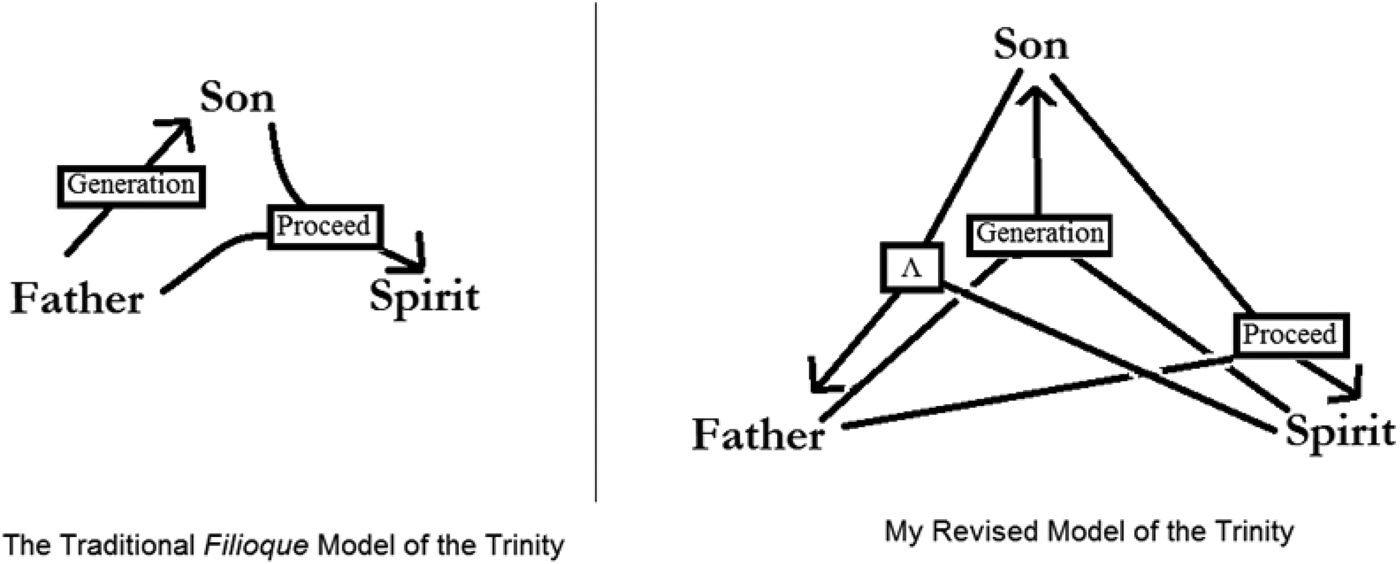
The key to the solution is to introduce an extra divine physical relation into the Trinity. We should say not just that the Father causes the Son and that the Father and Son (collectively) cause the Spirit but (i) that the Father and Spirit collectively generate the Son and (ii) that the Spirit and Son collectively cause the Father. (Boff and Evdokimov already endorse something like (i) (Boff (Reference Boff1988), 202–207) and one might loosely interpret them as endorsing something like (ii); note, though, that they treat the divine physical relations as non-causal.)Footnote 5 See Figure 1 for how we should understand the Trinity on this model. I call the new divine physical relation of the Spirit and Son causing the Father ‘Λ’. The idea would be that, in the same way as we have over time come to understand that there are different types of causal relation in the physical world (e.g. discovering there was electromagnetic attraction), this model commits to there being a further, as yet unrevealed, type of divine physical relation (which is nonetheless causal, just like the other divine physical relations).
Comparison of models.

If this were the case then the Divine Persons would form a causal loop with no first cause. Even though one Divine Person was caused by the others they would not be inferior to them for the other Divine Persons would, in turn, be caused by them. Son and Spirit are both equal to the Father for He is now caused by both Spirit and Son; the Spirit is not subordinated to the Son and Father as the Spirit plays a role in causing both the Son and also the Father.
This would require divine physical relations to form causal loops. Anselm denies that this is possible. He says in De Processione Spiritus Sancti:
But God the Son cannot exist from the Son (i.e., from Himself), because the one who exists from someone and the someone from whom he exists are not identical . . . Nor does God the Father exist from the Son; for the Son exists from Him, and thus He cannot exist from the Son. (Hopkins & Richardson (Reference Hopkins and Richardson2000), 472)
That is: if an entity stands in a divine physical relation to another entity, that latter entity doesn't stand in a divine physical relation to the former. Represent the divine physical relations (like generating, spirating, Λ, etc.) as R 1, R 2 . . ., etc. Exclude their converse relations (such as relations like ‘being spirated by’, ‘being grounded by’, etc.) from being amongst the Rs. Anselm's worry is driven by a commitment to:
Asymmetric: For all x and y (and for all m and n) if xR ny then it's not the case that yR mx.
Given the proposed model, Asymmetric would have to be false. But if divine physical relations are causal relations then it's not surprising that Asymmetric is false and that Anselm is wrong. Imagine I arrive from the future and tell myself how to make a time machine. I then build the time machine and travel back in time to tell myself how to build a time machine (which my earlier self then builds in order to go back in time and . . .). In such a case there is an event e 1 (the event of me appearing in the past and telling myself how to build a time machine) which causes future intermediate events (e.g. the building of the time machine) that cause the final future event, e 2, of me stepping into the time machine. The final future event then causes me to build a time machine, i.e. e 1 causes e 2 and e 2 further causes e 1. Given the possibility of time travel we can see that causation is non-symmetric, not asymmetric. Hence, because divine physical relations are causal relations, there's no reason to think that Asymmetric is true. (One may object that drawing analogies with time travel is fruitless because the Divine Persons are nothing like time travellers; I've argued elsewhere that they might be (Effingham (Reference Effingham2015); see also Leftow (Reference Leftow2004).)
The Father's Monarchy
Maximus on the Monarchy
Thus in at least one sense no Divine Person need be subordinated to another. This final section explains how, in some other sense, the Father can nevertheless be elevated above, rather than equal to, the other Divine Persons. This was the historical position of the Greeks, who thought that the Father is the Monarch of the Trinity. And we find in Augustine that, whilst the Spirit proceeds from both Father and Son, the Spirit principally proceeds from the Father (De Trinitate XV 17.29). In either case the Father is somehow elevated over and above the Spirit and Son. Call this claim
Monarchy: The Father is elevated over and above the Son and the Spirit.
The trickiness of reconciling Monarchy with Equality is obvious (and has oft been noted – see, e.g., Baber (Reference Baber2008), 149). We could drop Monarchy, and claim that in no sense is the Father elevated over the other Divine Persons, but given that some believe it, it would be better for the model to allow for it.
My answer is similar in some respects to an already extant solution offered by Maximus the Confessor. Maximus says that the Father is greater than the Son and the Spirit in the sense that he is ‘greater by cause’ but – with an eye on their being equal – says that this does not imply their being ‘greater by nature’. In one sense the Divine Persons are equal (and in that sense Equality is true and Monarchy is false); in another sense the Divine Persons are unequal and the Father is superior (and, in that sense, Equality is false and Monarchy is true). I believe that Maximus has the right strategy but the wrong details. Maximus's claim that the Father is greater by cause than the Spirit and the Son won't work for me given that I am explicit that each Divine Person is caused to exist by the other two. Nevertheless, I think Maximus correctly identifies that the resolution of Equality with Monarchy requires two senses/contexts such that in one Equality is true (and Monarchy is false) and, in the other, Monarchy is true (and Equality is false). Certainly it seems true that there can be two contexts in which one's value/status varies. Imagine we were talking about the worth of people. In one sense we might be picking out the Kantian notion of ‘intrinsic value’ whereby we are all as worthy as one another. In another sense we might focus instead on moral worth as moral fibre and correctly inculcated virtues. In that sense one person (e.g. a charitable aid worker) is more worthy than someone else (e.g. me). So there can be two senses of ‘moral equality’ according to which, in one, I am equal to another man whereas, in the other, I am not. But where Maximus says the two senses are ‘greater by nature’ and ‘greater by cause’ I must offer an alternative.
One of the senses/contexts is easy to establish for it is simply the context we are in when considering the issues from the previous section. In that context, the Divine Persons are equal in the sense that they have the same divine attributes (omnipotence, omniscience, etc.) and stand in similar causal relations to one another. These are non-modal facts about how the Divine Persons actually are, so this is a non-modal context.
The second context – the context within which the Father is elevated compared to the Son and Spirit – is a modal context in which the following is true:
Counterfactual Dependence: If the Father did not exist then neither the Son nor the Spirit would exist. Further, if the Son and Spirit did not exist then the Father would still exist.
Given Counterfactual Dependence, even though the Father actually causes – and is caused by – the Spirit and the Son, they asymmetrically counterfactually depend upon the Father. If the Father doesn't counterfactually depend upon the Son/Spirit but they counterfactually depend upon him, then He is elevated in a way that would make it appropriate to identify him as Monarch (cf. Hasker (Reference Hasker2013), 221). Counterfactual Dependence prima facie captures the Eastern Church's belief that the Father was the Monarch of the Trinity.
Similarly, if one believes Monarchy is true because the Father is the ‘principal’ cause of the Spirit, whereas the Son is not, Counterfactual Dependence guarantees that claim as well. Return to the example of the chef cooking with his daughter. If the daughter did not exist then the chef could still bake the cake; if the chef did not exist then his daughter could not bake the cake. Whilst the chef and his daughter collectively cause the cake to be baked, the chef's causal role is elevated – it is true to say that the chef is the principal cause of the cake. Similarly, then, for the Father: If the Father did not exist then the Son would not exist and so could not cause the Spirit to exist; if the Son did not exist then the Father would still exist and could cause the Spirit to exist; hence, the Father is the principal cause of the Spirit.
So is Counterfactual Dependence true? I have two things to say about motivating it. First: I don't need to offer an independent motive for believing Counterfactual Dependence. There's a problem, namely reconciling Monarchy with Equality. A model including Counterfactual Dependence resolves that problem. Assuming Counterfactual Dependence has no independent problems of its own, that's reason enough to motivate it since it is standard to accept models which solve problems and provide benefits when such a model doesn't come with overly worrying costs. So the question is whether Counterfactual Dependence is itself problematic (i.e. does a model endorsing it incur unbalancing costs). Second: There is an independent motivation for Counterfactual Dependence. Under the old view of the Trinity, whereby the Father didn't stand in relation Λ to the other Divine Persons but nevertheless caused the Son and the Spirit to be, Counterfactual Dependence looks plausible. Just as I counterfactually depend upon my parents existing since they cause me to exist, if the Father causes the Spirit and the Son to exist then they counterfactually depend upon him. And just as my parents don't counterfactually depend upon my existing, it seems intuitive to think that the Father wouldn't counterfactually depend upon either the Son or Spirit. (Indeed, theologians like Zizioulas (Reference Zizioulas1985, 18) say just this.) But I say that the old view is false! One might suspect that because I think the Divine Persons form a causal loop, I must revise the intuition that Counterfactual Dependence is true. The end of this section argues that, to the contrary, we can retain the intuition.
The necessity of the Divine Persons
The rest of this section discusses two problems for Counterfactual Dependence. The first problem is that the Divine Persons are logically necessary. Whilst I think there's room for thinking that each Divine Person does not, in fact, exist by the strongest necessity, for charity's sake assume otherwise. Say a ‘counterpossible’ is any counterfactual with an antecedent false by metaphysical necessity. Received wisdom is that counterpossibles are defective in some fashion, being either all trivially true or all trivially false (cf. Lewis (Reference Lewis1973) ). Counterfactual Dependence, being a conjunction of counterpossibles, would likewise be defective.
To solve this problem we must deny received wisdom and say that counterpossibles need not have trivial truth values. We'll have to (e.g.) be more liberal about what worlds there are, acknowledging that there are multiple metaphysically impossible worlds which vary as to how close they are to the actual world. Not everyone will be happy with this (and admittedly such people shouldn't entertain the arguments presented here for the Father's elevation), but enthusiasm for the philosophy of the impossible is on the riseFootnote 6 and it's not as if only a tiny minority of people take it seriously nowadays. For those of us who are happy with non-trivially true counterpossibles (and impossible worlds etc.) Counterfactual Dependence won't be trivially false. One anonymous referee worried that not every such theory of counterpossibles would work for my purposes. For instance, they worried that Brogaard and Salerno's (Reference Brogaard and Salerno2013) theory would be unsuitable, since it builds an epistemic element into evaluating counterpossibles and isn't suitably ‘metaphysically robust’. But I don't think this is a problem. Above I argued that the facts about the divine relations between the Divine Persons might be non-fundamental and, further, that this was not a problem. I think the same thing applies here. Endorsing Monarchy is one thing; endorsing Monarchy and claiming that it's true in virtue of ‘metaphysically robust’ facts seems to be another. I see my business as being allowing for the first thing, not the second thing; that said, I've no particular worries about which theory of counterpossibles is used. (And those particularly perturbed by these concerns could probably find a suitable theory. The aforementioned anonymous referee suggested that Pearce's (Reference Pearce2016) theory of counteressentials could probably do the trick and make the relevant counterpossibles true in virtue of ‘metaphysically robust’ facts.)
Bootstrapped objects
The second problem is that if the Divine Persons are in a causal loop then the Father could not have existed without the Son or the Spirit (and thus Counterfactual Dependence is false), i.e. necessarily things in a casual loop all symmetrically depend upon one another. But I deny that merely because objects form a causal loop that all objects in that causal loop must symmetrically counterfactually depend upon one another. To see why, consider cases of causal loops involving time travel. Forget about the Trinity for a moment and consider the case of ‘bootstrapped objects’, i.e. objects whose origin involves themselves. The common example is from Heinlein's 1958 short story ‘ “– All You Zombies –” ’. A baby is left on the doorsteps of an orphanage and grows up to be a woman who meets a mysterious man. They sleep together and she gets pregnant. The baby is then kidnapped (and, it later transpires, travels in time and is placed on the doorstep of the orphanage – the baby is, in fact, her own mother!). Later the woman has gender reassignment surgery and ends up time travelling back to seduce their earlier self and getting themselves pregnant (the baby, then, is also her own father!). Thus we have a person – call them ‘Protagonist’ – who exists solely because they brought themselves into existence. They have ‘bootstrapped’ themselves into existence!
Consider Protagonist's temporal stages. Some stages form a causal loop, i.e. those stages from Protagonist's birth to the point at which Protagonist is a male impregnating his earlier female self (the remaining stages, whilst caused by each stage in the loop, are not themselves within the loop). For instance, if Protagonist returned at age 35 to impregnate themselves then stages from the first 35 years of Protagonist's life would form a causal loop (and the remaining years would not).
Focus on just the stages in the causal loop. Some such stages asymmetrically counterfactually depend on other such stages. For instance, had Protagonist instead returned to impregnate themselves at age 27, the first 27 years of their life would have formed a causal loop. If they'd then died aged 28, the temporal parts between their 28th and 35th year of life would never have existed. So if the 28th year stages didn't exist, nor would the 35th year stages, and so the latter counterfactually depend on the former. Yet the former don't counterfactually depend on the latter for were the 35th year stages to not exist, it might be the case that the 28th year stages do. For example, the 35th year stages might not exist because Protagonist died at the age of 29 – in that case, the 28th year stages would exist without the 35th year stages. Some stages in the loop asymmetrically counterfactually depend on others.
Consider the same reasoning sketched out using possible worlds. The Stalnaker–Lewis analysis of the would counterfactual ‘ϕ □→ ψ’ is:
ϕ □→ ψ iff some [ϕ&ψ]-world is closer to the actual world than any [ϕ&~ψ]-world.
Say Earlier is the proposition that the earlier temporal parts of Protagonist exist, Later is the proposition that the later temporal parts of Protagonist exist, and ρ is the world at which (35-year-old) Protagonist exists. It follows that:
Protagonist's later temporal parts asymmetrically counterfactually depend on their earlier parts iff
(i) Some Earlier&~Later world is closer to ρ than any ~Earlier&~Later world; and
(ii) Some ~Earlier&~Later world is closer to ρ than any ~Earlier&Later world.
For consistent combinations of Earlier, Later, and their negations, there are worlds at which that combination is the case. Obviously, there are ~Earlier&~Later worlds at which Protagonist doesn't exist at all – after all, we live in one. The question is whether some such world is closer to ρ than any Earlier&~Later world. That doesn't appear to be the case since a world where Protagonist is slightly different – and, say, dies younger than they did at ρ – appears to be closer to ρ than a world at which Protagonist doesn't exist at all. The only reason I can see to deny this would be if a particularly strict version of origin essentialism was true. If one endorsed a principle of origin essentialism such that not just ancestry/parentage was essential to a person but so too was the qualitative profile of one's parents at the point of conception, then Earlier&~Later worlds would be metaphysically impossible. It's reasonable to believe that in this context such metaphysical impossibility makes for dissimilarity between worlds and that (at least in this context) any metaphysically impossible world is further away than any metaphysically possible world. In that case Earlier&~Later worlds would be further from ρ than metaphysically possible ~Earlier&~Later worlds like our own and (i) would be false. However, I think a principle this strict is somewhat implausible, so I'll proceed as if (i) is true.
Consider (ii). ~Earlier&Later worlds are of two types. The first type consists of worlds at which Protagonist sprang forth ex nihilo as a fully formed adolescent. The second type consists of worlds at which Protagonist is a non-procreative bootstrapped person. Imagine an amnesiac, appearing to be aged 27, awakes on a beach. They hit upon the idea of using a time machine to find out how they ended up on the beach with no memories. Travelling to a few minutes before the point at which they awoke, they're surprised to see that they're not there and slip, bang their head, and contract amnesia. They then wake up and hit upon a plan of using a time machine to find out how they ended upon on a beach . . . That would be a non-procreative bootstrapped person and ~Earlier&Later would be true. But whilst I believe ex nihilo people and non-procreative bootstrapped people are metaphysically possible, I doubt Protagonist could have been one of them. Whilst I have little sympathy for strong versions of origin essentialism, the claim that it's essential to someone that they have certain parents – or, at the least, have some parents – seems quite plausible. In that case, ~Earlier&Later worlds would be metaphysically impossible (and, again, in this context further from ρ than ~Earlier&~Later worlds where Protagonist simply doesn't exist).
Even if one is unmoved by these worries about Protagonist's origin, there's still good reason to endorse (ii). Something appearing ex nihilo is either a (quite big!) miracle or the result of some exceedingly unlikely quantum events – what, in Lewis's words, is called a (quite big!) ‘quasi-miracle’ (Lewis (Reference Lewis and Lewis1986) ). Big (quasi-)miracles make for substantial dissimilarity between worlds when evaluating counterfactuals. Just as worlds at which I appear from the void for no reason are far from actuality (and don't threaten my later stages’ counterfactual dependence on my earlier stages), worlds at which Protagonist appears ex nihilo will be worlds further from ρ than those worlds at which Protagonist simply doesn't exist, i.e. (ii) is still true in light of such worlds. When considering worlds at which Protagonist is a non-procreative bootstrapped person, I believe similar worries apply. Non-procreative bootstrapped people don't need miracles to exist, but I believe they are nevertheless very unlikely to exist – even were time machines to be plentiful, you would have next to no chance of coming across such a person. I defend that claim in full elsewhere (Effingham (Reference EffinghamMS) ). If that were the case, Protagonist's being a non-procreative bootstrapped person would be a quasi-miracle and, again, such worlds would be further from ρ than those worlds at which Protagonist simply doesn't exist. So, again, (ii) would be true.
We can return to contemplating the Trinity. Protagonist's temporal stages show that you can have some things which are in a causal loop whereby some of those things can exist without the others but the others cannot exist without it, i.e. a causal loop of objects whereby some asymmetrically counterfactually depend upon others. I say that the Trinity is just such a loop. But instead of temporal parts it is Divine Persons, and rather than parts later in Protagonist's personal time counterfactually depending upon earlier parts, it is the Son and the Spirit counterfactually depending upon the Father.
So the Divine Persons forming a causal loop is not itself a reason to think they cannot asymmetrically counterfactually depend upon one another. So it is not a reason to think the proposed model comes with costs nor that we should deviate from thinking (as we should given the old view) that Counterfactual Dependence is true.
Problems
Before finishing, I'll consider two problems facing the model.
Λ’s lack of mention
Λ has never been mentioned. The only reason to believe in the interdependence of Divine Persons is the philosophical argument presented here. A reasonable concern is that, were this the model, something in scripture should have alerted us to that fact. Since nothing does, the model is implausible.
But given a view on theology such that Christian theology has not, as yet, been completed, there's little reason to think that every fact about the Trinity (specifically, their divine inter-relationship) must have been revealed to us via scripture, or other means. Indeed, were the model correct, there are excellent reasons not to have had facts about Λ revealed to us and for the interdependence of the Divine Persons to have remained unstated. Consider Anselm's commitment to Asymmetric. Anselm seemingly thought this to be obvious (and doubtlessly many readers of this article will too). Presumably, people throughout history would have been disposed to believe it. So imagine how much harder it would have been to get people to adopt Christianity if an explicit commitment to Asymmetric’s denial was part of orthodox thought. Moreover, the best case for thinking that Asymmetric is false draws analogies with time travel. The possibility of time travel is mainly a subject of post-nineteenth-century thought and would have struck the contemporaries of the Church Fathers as, at best, an outlandish and exotic oddity. (Bigelow (Reference Bigelow, Preyer and Siebelt2001, 58) says that time travel is never mentioned prior to the nineteenth century. That's not quite true since the Talmud (Menahot 29b) relates a tale of Moses apparently travelling through time; nevertheless, it's clear that imagining the possibility of time travel is a peculiarly modern activity.) In short: discussion of any of these facts would have thrown a spanner in the works of spreading Christianity – it might be true, but its revelation would be a practical impediment. So the lack of mention of the Divine Persons’ interdependence is not a problem. Indeed, if the model were true, then it should be expected.
This requires – as an anonymous referee points out – one to nail one's colours to a particular theological mast such that Christian theology is incomplete and unfinished. This is true. That might be wrong to do, but this article is firmly placed within that body of literature which takes it to be fruitful to engage in that sort of speculation.
The causeless Father
It is traditional to say that the Father was not caused. Gregory of Nazianus says in the Orations that the Father is the Source who is without Source – Source in the sense of cause, fount, and eternal light’ (20.7; as quoted in Beeley (Reference Beeley2007, 208) and St Athanasius says similar things (that ‘the Father has no cause’) in Three Discourses of Athanasius against the Arians.Footnote 7 But my model clearly has it that the Father is caused to exist, namely by the joint activity of the Son and Spirit.
I can't see any way to resolve this and I don't think any resolution can be had. Clearly, then, this model appeals only to those within a tradition who think such claims are negotiable, rather than inviolable, and that philosophical theology can be emendatory. Make no bones about it: this model is revisionary and is only open to those who believe philosophical argument can redact and revise theological belief. Even then, three things can be said to make this claim less revisionary/more palatable.
First, don't mistake the claim that the Father is caused for the claim that the Father is a created thing. Being a created thing has two components: being caused to exist and having a beginning. The Father, being a wholly timeless entity, exists outside space and time and has no beginning – that is, there is no instant at which the Father starts existing. So the Father is not a created thing even though He is caused to exist. Similarly for the Spirit and the Son. (Hasker (Reference Hasker2013, 152–154) provides a discussion of Swinburne's views, which are along similar lines.)
Second, allowing that the Father has a cause gels with 1 Corinthians 8:6: ‘yet for us there is but one God, the Father, from whom all things came and for whom we live; and there is but one Lord, Jesus Christ, through whom all things came and through whom we live’. Taken literally, ‘all things’ must include the Father. The proposed model of the Trinity bears out such an interpretation, although at the cost of the heterodox claim that the Father is caused.Footnote 8
Third, the model still allows that the Father has no principal cause even though He is the principal cause of everything else. One might wish to spin the claims that the Father is uncaused as claims that He is merely without principal cause.