Although studies suggest overall rates of blood and body fluid (BBF) exposures among healthcare workers have decreased,Reference Beekmann and Henderson 1 surgical personnel have not experienced such a decreaseReference Laramie, Pun, Fang, Kriebel and Davis 2 and remain among the occupations at greatest risk.Reference Babcock and Fraser 3 – Reference Bakaeen, Awad and Albo 6 According to Jagger et al,Reference Jagger, Berguer, Phillips, Parker and Gomaa 7 although sharps injuries in the nonsurgical setting have decreased substantially since the passage of the Needlestick Safety and Prevention Act of 2000, reported sharps injuries in the surgical setting have actually increased 6.5%. BBF exposures, therefore, remain a common health risk among healthcare workers, particularly for surgical staff members.Reference Bakaeen, Awad and Albo 6 , Reference Jagger, Bentley and Tereskerz 8 – Reference White and Lynch 12
Many studies focusing on risk of BBF exposures in operating rooms (OR) have examined the effectiveness of safety measures such as double-gloving, the use of blunt suture needles or other safety devices, and neutral instrument passing zones.Reference Doebbeling, Vaughn and McCoy 4 , Reference Gerberding, Littell, Tarkington, Brown and Schecter 13 – Reference Vose and McAdara-Berkowitz 24 Although some studies have examined the characteristics of the surgical procedures,Reference Gerberding, Littell, Tarkington, Brown and Schecter 13 – Reference Quebbeman, Telford and Hubbard 15 , Reference White and Lynch 18 other studies of BBF exposures have been mostly descriptive, focusing on the distribution of events by categories such as type of exposure, surgical service, occupation, and device type.Reference Bakaeen, Awad and Albo 6 , Reference Jagger, Bentley and Tereskerz 8 , Reference White and Lynch 12 , Reference Goob, Yamada, Newman and Cashman 25 – Reference Venier, Vincent and L’Heriteau 27 The current study presents descriptive statistics of BBF exposures occurring in the OR and examines properties of the procedures, gathered in administrative data sources, to determine whether these predict the risk of exposure during surgical procedures. Regression models were produced separately for exposures caused by suture needles, which are the devices most commonly involved in exposures in the OR,Reference Bakaeen, Awad and Albo 6 , Reference Jagger, Bentley and Tereskerz 8 , Reference White and Lynch 12 , Reference Tokars, Bell and Culver 17 and those caused by all other surgical instruments to determine whether risk factors differed by device type.
This study is an extension of a pilot study in which 2 years of similar data were gathered and analyzed.Reference Myers, Epling, Dement and Hunt 28 The analysis presented here reflects an expansion of the previous study to a total of 10 years of data gathered at the same institution, extracted in a similar manner, and including variables similar to those examined in the pilot study. Because 10 years of data were available for this study, trends of rates are reported here that could not be done in the pilot study.
METHODS
Data were derived from the health and safety surveillance system (hereafter referred to as the surveillance system) developed at the institution in 2001 and updated annually throughout the study period. This data set is the product of several ongoing programs that gather data from human resources, occupational medicine, workers’ compensation, employee health promotion, and other sources.Reference Dement, Pompeii and Ostbye 29 Linkage of data across data sets permits individual-level data analyses; data are deidentified after linkages are made. This surveillance system provided BBF exposure events, and variables describing them, which occurred in 2001–2010 at the study site. Only events which occurred in the OR were included.
Perioperative data sources providing characteristics of all surgical cases occurring in 3 divisions of the institution were gathered and merged to supplement the surveillance data. BBF exposure events gathered in the surveillance system were matched to the surgical cases in which they occurred. The exposures were restricted to percutaneous events; splashes were excluded. The perioperative data provided the following variables: estimated patient blood loss; urgency of surgical case; department performing the procedure; number and job classifications of OR personnel; procedure start and stop times (used to determine duration and shift); and date.
Estimated patient blood loss for each surgical case was grouped into 3 categories: none, 1–500 cc, 501–1,000 cc, and >1,000 cc. Urgency of the procedure, which considers the maximum time allowed between posting of the case and start of the procedure, was categorized according to study institution’s criteria as the following: elective; level 1 (“stat”–within 1 hour); level 2 (within 4 hours); level 3 (within 12 hours); level 4 (within 24 hours); and level 5 (nonelective cases not deemed as of urgency levels 1–4; organ harvesting and transplant procedures included).
The surgical services were grouped as follows: dental surgery, general surgery, obstetrics/gynecology, cardiac surgery, neurosurgery, otolaryngology, orthopedics, ophthalmology, plastic surgery, pediatric surgery, thoracic surgery, and urology. The time that procedures began was used to categorize surgical cases into 3 shifts as follows: 7:00 AM–3:00 PM (first shift), 3:00 PM–11:00 PM (second shift), and 11:00 PM–7:00 AM (third shift). Procedure duration was calculated using start and end times and was categorized into less than 2 hours, 2 to less-than-4 hours, 4 to less-than-6 hours, and 6 or more hours.
OR staff members were categorized with regard to their potential for BBF exposure, namely, as those identified as working in the surgical field. Occupations included in this group included attending surgeon, anesthesiologist, certified nurse anesthetist, scrub nurse, circulator nurse, fellow/resident/student, OR/surgical technician, and other technician.
Finally, calendar year of procedures was identified. Trends by year are reported descriptively; trends are also controlled for in multivariate modeling.
These data were gathered retrospectively from administrative sources not intended for an epidemiologic study. Therefore, some measures that might have been useful for a detailed and theoretically guided assessment of BBF exposure etiology, and potential preventive strategies, were not available for examination.
Data Analysis
The number of surgical procedures and BBF exposures, stratified by potential risk factors, are presented as descriptive statistics. Rates of BBF exposures were calculated per 1,000 surgical procedures, and rates per 1,000 procedure hours were also calculated. Exact binomial and Poisson 95% confidence limits were calculated for these rates, respectively.
Since procedure duration was attainable, Poisson regression models were used to examine associations between BBF exposure rates and the risk factors described above. An “ungrouped” approach to Poisson regressionReference Loomis, Richardson and Elliott 30 was used to assess properties of procedures while still providing unbiased incidence rate estimates. Events were stratified by device type (suture needles and all other types); separate models were generated to analyze risk of BBF exposure. The annual trend variable was included in models to adjust for possible confounding. This was modeled as a set of indicator variables representing each year. Procedure duration was used as the offset variable; results were reported as adjusted incidence rate ratios and 95% CIs. Likelihood ratio tests were conducted to determine the statistical significance of variables modeled as classes of indicator variables. All statistical analyses were conducted using Stata, version 11 (StataCorp). 31 This study was reviewed and approved by the Duke University Medical Center Institutional Review Board.
RESULTS
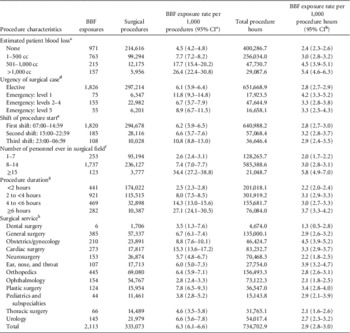
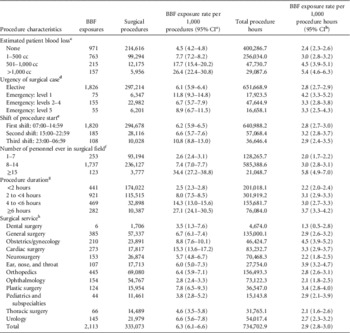
A total of 333,073 surgical cases were analyzed (Table 1). The overwhelming majority of surgical cases were elective (89.2%); a similar majority occurred during the first shift (88.5%). Roughly half (52.2%) were less than 2 hours in duration. Orthopedics represented the highest proportion of surgical services (20.7%), followed by general surgery (17.2%). Most cases (70.9%) involved 8–14 personnel in the surgical field during the procedure.
Surgical Procedure Characteristics and Associated Blood and Body Fluid (BBF) Exposure Rates
a Binomial exact confidence interval.
b Poisson exact confidence interval.
c With 1,057 missing data.
d With 351 missing data.
e With 276 missing data.
f With 0 missing data.
g With 276 missing data.
h With 30 missing data.
A total of 2,113 BBF exposure events were reported by OR personnel during the study period. Most occurred during elective procedures (86.4%), on the first shift (86.1%), and during procedures with 8–14 workers appearing in the surgical field (82.2%). Exposures occurred most often during procedures lasting 2 to 4 hours (43.6%). Orthopedics had the highest proportion of exposures (21.1%), followed by general surgery (18.2%).
The overall rate of BBF exposures was 6.3 per 1,000 procedures, or 2.9 per 1,000 procedure hours. Associations with procedure characteristics appear stronger when considering rates per procedures, regardless of duration. However, when rates were calculated per 1,000 procedure hours, crude rates varied less among variable categories. These risk rates, which account for procedure duration, rose steadily across categories of blood loss, number of surgical field personnel, and duration of procedures. The rates of BBF exposures varied among surgical services and were elevated for the obstetrics/gynecology; plastic surgery; and ear, nose, and throat specialties.
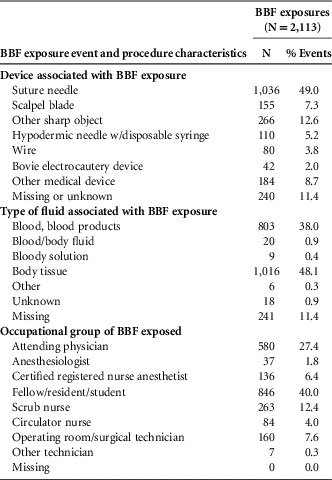
Properties of the BBF exposure events and occupation groups of the staff exposed are described in Table 2. Half (49.0%) of the exposures involved suture needles. Fellow/resident/student represented the largest proportion of events (40.0%), followed by attending physician (27.4%).
Characteristics of Blood and Body Fluid (BBF) Exposure Events and Surgical Staff Injured

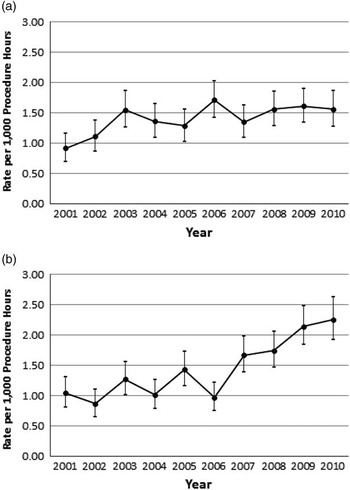
Annual trends of BBF exposures rates, stratified by device type, are reported in Figure 1. For each device category, the rate per 1,000 procedure hours is shown (with 95% CI error bars). Suture needle events show a modest increase over the study period. The rate of non–suture needle exposures increased more sharply, particularly after 2006.
Rates of blood and body fluid exposures per 1,000 surgical procedure hours by year, with 95% CI error bars. A, for suture needles; B, for non–suture needle devices.

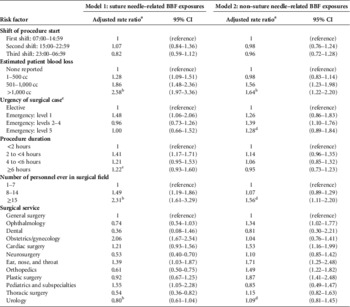
Poisson regression model results are presented in Table 3. Both models reported include adjustment for calendar year, which, in both models, was statistically significant at the α=.05 level (data not shown). The first Poisson regression model presents results for percutaneous BBF exposures involving suture needles only (n=1,036). Statistically significant increases were observed with blood loss and number of personnel in the surgical field. The rate varied significantly by procedure duration, but the rate did not increase monotonically across categories. Rates did not significantly vary across categories of procedure urgency (P=.15), but risk of BBF exposures was elevated among the emergency (level 1 or “stat”) category compared with elective procedures. When urgency was recoded into a single variable representing “stat” vs all other levels, the rate ratio was 1.48 (95% CI, 1.07–2.06) (not shown). The rate also varied significantly among surgical services; 3 of the 11 surgical services showed elevated risks compared with the general surgery referent category. Risk of suture needle–related exposures did not vary across shift.
Poisson Regression Model Results for Percutaneous Blood and Body Fluid (BBF) Exposures: Models Stratified by Device Type

a Model is also adjusted for calendar year (not shown).
b Likelihood ratio test P values for class of indicator variables: <.001.
c To model the effect of urgency of the surgical case, levels 2, 3, and 4 were grouped together since statistical power did not allow for analysis of these levels separately.
d Likelihood ratio test P values for class of indicator variables: <.05.
e Likelihood ratio test P values for class of indicator variables: <.01.
The second Poisson regression model presents results for BBF exposures involving surgical devices other than suture needles (n=1,077). Blood loss, number of personnel in the field, and surgical service were associated with risk of exposure involving these other device types. All levels of case urgency had rate ratios higher than the elective referent category, but the pattern differed from that found with suture needle–related exposures. Recoding urgency to a single variable contrasting elective procedures with all nonelective procedures (regardless of level) produced a rate ratio of 1.26 (95% CI, 1.04–1.53). Rate ratios for non–suture needle–related BBF exposures varied by surgical service; ophthalmology, cardiac, otolaryngology, orthopedics, and plastic surgery all had elevated rate ratios compared with general surgery. Also, blood loss, number of personnel in the field, and surgical service were all significantly associated with risk of BBF exposures due to non–suture needle devices. Exposure rates due to these devices did not vary across shift in the adjusted model.
DISCUSSION
During the 2001–2010 study period, 49% of BBF exposures that happened during surgical procedures in the OR were associated with the use of suture needles. Another report done at a teaching hospital showed nearly identical results, reporting that 50% of OR BBF exposures involved suture needles.Reference Tarantola, Golliot and L’Heriteau 16 Approximately 28% of all BBF exposures in our study occurred to attending physicians/surgeons. This is similar to results reported by Jagger et alReference Jagger, Bentley and Tereskerz 8 that showed that residents and attending physicians accounted for 36% and 28% of exposures, respectively, and a French study that observed approximately 35% of BBF exposures occurred among surgeons.Reference Tarantola, Golliot and L’Heriteau 16
Consistent with our results, previous studies have shown procedure duration and estimated blood loss to be risk factorsReference Gerberding, Littell, Tarkington, Brown and Schecter 13 – Reference Quebbeman, Telford and Hubbard 15 , Reference White and Lynch 18 ; at least 1 prior study found an association with number of personnel in the surgical field.Reference Quebbeman, Telford and Hubbard 15 Also, another prior study has demonstrated differences in BBF exposures rates across surgical services.Reference Tokars, Culver and Mendelson 32
Although the lack of association between shift and BBF exposures may be surprising, this finding is consistent with 1 study that examined all BBF exposures at a university hospital and found no association with time of day. However, in that study exposures were not limited to percutaneous exposures and the setting was not restricted to the OR.Reference Macias, Hafner, Brillman and Tandberg 33
The device-stratified results show differing effects of procedure duration by device categories. Procedure duration was found to be associated with exposures involving suture needles but not with those involving all other device types. Because length of procedure may be correlated with complexity and the greater opportunity for using various devices, this was a rather unexpected finding. Regarding suture needles, the association does not show a steady rise in risk with procedure duration. Rather, in the adjusted model, the highest risk appears in procedures lasting 2 to 4 hours in duration. It is possible that this unexpected pattern is due to the inclusion of estimated blood loss and number of personnel in the surgical field, which may reflect procedure complexity, and the amount of suturing required, as well as duration. Greater complexity is a previously observed risk factor.Reference Puro, De Carli, Petrosillo and Ippolito 26
It is possible that blood loss is modestly correlated with the degree of suturing required during a procedure and that this association represents exposure to the suturing task. It is also possible that blood loss represents confounding by complexity. Risk of suture needle–related exposures also trended upward across the number of personnel in the surgical field. This could represent greater procedure complexity or it may suggest that the physical crowding of the surgical field increases the risk of exposures involving suture needles.
Because 1 study found that emergency procedures had greater risk of exposure than scheduled operations,Reference White and Lynch 18 we expected level 1 (“stat”) urgency of the procedure would be associated with elevated risk of BBF exposure compared with elective procedures and those of lesser urgency. Emergency level 1 procedures had a higher level risk of suture needle exposures compared with all other emergency levels. When case urgency was grouped by elective vs nonelective cases, nonelective cases showed an elevated risk of BBF exposure involving devices other than suture needles. However, the pattern of rates across urgency categories differed by device types.
Risk of BBF exposures varied significantly among surgical services. This was true of both suture needle–related events and of events related to other device types. However, there were differences in the pattern of risk among specialties by device type. Obstetrics/gynecology, pediatrics and subspecialties, and ophthalmology all had significantly elevated rates of suture needle–related events compared with the general surgery referent group. These results may reflect more suturing performed in these services. However, obstetrics/gynecology, pediatrics and subspecialties, and ophthalmology again had significantly elevated rates of non–suture needle–related events as well as rates of events associated with suture needles. Although there are other possible explanations, the elevated risk of both kinds of events in these 3 surgical specialties suggests the possibility of better reporting in these groups. The cardiac and the orthopedic specialties were also found to have elevated risk of non–suture needle–related events. The elevated risk observed for these specialties may be due to the more frequent use of certain devices.
The increase in rates of BBF exposures over time was statistically significant for each device stratum. However, the meaning of this is not clear. It is possible that procedures are becoming more dangerous, but it is also possible that efforts to promote safety interventions and to encourage reporting of events may be responsible for this observed increase across the study period.
A major strength of this study was the availability of a very large number of surgical procedures and reported BBF exposures. The ability to match BBF exposure events to surgical procedures enabled an analysis of procedure characteristics; access to procedure duration allowed us to examine rates of exposures. The low rate of missing values of the study variables is also a strength of this study. The large number of BBF exposures included provided considerable power even when stratifying by device type.
A limitation of this study is its use of self-reported BBF exposures, as these events are gathered when surgery department personnel report their exposures to employee health staff. The actual number of exposures occurring in this workplace is undoubtedly higher than reported here. Some of the findings reported here may be due in part to differential reporting among occupationsReference Doebbeling, Vaughn and McCoy 4 , Reference Voide, Darling, Kenfak-Foguena, Erard, Cavassini and Lazor-Blanchet 34 and surgical services.Reference Au, Gossage and Bailey 35 However, 1 study recently suggested the importance of setting, noting that dermatologists working in academic settings may report exposures at higher rates than those working in solo or group practice contexts.Reference Donnelly, Chang and Nemeth-Ochoa 36 Reporting at this academic institution, therefore, might be better than in other settings.
The device-stratified analysis demonstrated commonalities and differences in the associations between properties of procedures and the risk of BBF exposure. However, because this study took place in a single institution, future research is needed to confirm whether such differences exist in other settings to understand how risk factors might influence BBF exposures involving different devices. Future studies, if large enough, should also consider conducting analyses stratified by surgical specialty.
These findings suggest that future studies of BBF exposures in the OR consider examining events related to suture needles separately from those associated with other surgical instruments. Differences by surgical specialty might also be considered if statistical power allowed.
Intervention measures were implemented during the study period, including the promotion of double-gloving and use of blunt suture needles, and a policy requiring the hands-free transfer of sharps, all of which were found to be the most proven measures of prevention in a recent literature review by DeGirolamo et al.Reference DeGirolamo, Courtemanche, Hill, Kennedy and Skarsgard 37 In addition, these measures have been recommended by the American College of SurgeonsReference Berguer and Heller 38 and the Association of Perioperative Registered Nurses, 39 as well as the National Institute for Occupational Safety and Health. 40 Nonetheless, results show exposure rates of both suture needle and non–suture needle–related BBF exposures increased steadily over the study period.
It is not clear whether this increase is due to a greater frequency of BBF exposure events or an increase in reporting because the reporting of events at the study site had been repeatedly encouraged during the study period and in conjunction with the intervention measures. It is possible that the higher increase in exposure rates over time for events involving devices other than suture needles reflects an increase in the complexity or multitude of the surgical instruments, the procedures in which they are being used, or both. Such changes in the OR might call for evolving hazard prevention measures.
Regardless of what might be driving this increase in BBF exposures in the surgical theater, this finding is consistent with a recent study of 87 hospitals in the United States reported by Jagger et al.Reference Jagger, Berguer, Phillips, Parker and Gomaa 7 The challenge of improving safety during surgical procedures, therefore, remains widespread and may require novel approaches centered on certain devices, surgical departments, or properties of surgical procedures.
ACKNOWLEDGMENTS
Financial support. National Institute for Occupational Safety and Health (grant 7K01OH009657).
Potential conflicts of interest. All authors report no conflicts of interest relevant to this article.