Other impure animals, which have no sign of purity, from where do I derive their prohibition? You can say a kal vachomer [that is, an a fortiori argument] to derive their prohibition [from the prohibition in the Written Law of animals with one sign of purity].
—RashiFootnote 1This kal va-chomer, however, is [merely used] to reveal the existing [Oral] [L]aw.
—MaimonidesFootnote 2[A]ny animal [with no sign of purity] is covered by this prohibition [in the Written Law of animals with one sign of purity], and there is no need for a kal vachomer derivation [or for ascribing it to the Oral Law] at all.
—NaḥmanidesFootnote 3INTRODUCTION
This article discusses the answers given to a question of kashrut, or Jewish dietary law, by three medieval Jewish sages: Rashi, Maimonides, and Naḥmanides. In doing so, it sheds light on the influence exercised on these sages by Muslim and Christian philosophers. The question of kashrut is why eating horse meat—and, more generally, the meat of any mammal that neither has split hooves nor chews its cud—subjects Jews to corporal punishment. The Torah expressly allows the consumption of mammals that have hooves that are completely split in two halves from front to back and that also regurgitate partially digested food from their stomachs into their mouths for further breakdown via chewing, such as cattle, sheep, or goats. It also expressly forbids the consumption of mammals that have split hooves but do not chew their cud, such as pigs, or that chew their cud but do not have split hooves, such as camels. However, the Torah does not appear to expressly forbid the consumption of mammals that lack both of these signs of purity, such as horses. Why, then, does eating horse meat subject Jews to punishment?
The problem may initially seem to be a trivial one: If the consumption of mammals that lack only one sign of purity subjects Jews to punishment, all the more should the consumption of mammals that lack both signs of purity subject Jews to punishment. This is, in essence, the ḳal ṿaḥomer logic—or a fortiori argument—employed first by sages of the Talmudic era and later by Rashi (the name is an acronym for Rabbi Shlomo Yitzchaki, 1040–1105 CE) to derive the missing prohibition and, presumably, the punishment for transgressing it. But inherent in this solution is a problem: According to a generally accepted principle of Jewish hermeneutics, one may not derive a punishable prohibition from logical argument. Maimonides (also called by the acronym “Rambam” for Rabbi Moshe ben Maimon, 1137/38–1204 CE), who lived in Muslim Spain and Northern Africa, therefore argues that “[t]his kal va-chomer, however, is [merely used] to reveal the existing [Oral] [L]aw,”Footnote 4 which—according to tradition—was given to Moses at Sinai together with the Written Law of the Torah. Thus, Torah-based ḳal ṿaḥomer logic does not establish crime and punishment here: It merely reminds us of what the Oral Law independently prohibits and punishes. By contrast, Naḥmanides (also called “Ramban” for Rabbi Moshe ben Naḥman, 1194–1270 CE), who lived in Christian Spain, observes that the Torah “stated explicitly concerning the prohibition of the [camel] that it is [prohibited] because its hoof is not split, and concerning [the prohibition of] the pig that it is prohibited because it does not bring up its cud.”Footnote 5 Contrary to Rashi, he argues “[t]his being so, any animal that does not bring up its cud and does not have a split hoof is covered by this prohibition, and there is no need for a kal vachomer derivation at all,”Footnote 6 and contrary to Maimonides, he argues that there is no need to ascribe the prohibition of such an animal to the Oral Law.
This article offers an answer to the following question: Given the simple elegance of Naḥmanides's solution, why did Rashi and Maimonides fail to arrive at this solution? The answer offered here is that this difference is explained by the history of logic and, more specifically, the history of logical disjunction, which in English is imperfectly expressed by the word or.Footnote 7 Naḥmanides's solution hinges on first reading the Torah as expressly prohibiting the consumption of any mammal that does not have split hooves or that does not chew its cud. It further hinges on then interpreting this disjunctive prohibition “inclusively” to prohibit also any mammal that does not have split hooves and that does not chew its cud, rather than interpreting it “exclusively” to prohibit only those mammals that lack one or the other of these signs of purity but not both. Even if Rashi or Maimonides had read the Torah as establishing a disjunctive prohibition, they would not have been able to anticipate Naḥmanides's solution, because unlike him they did not have access to an inclusive interpretation of disjunction. It is argued that Naḥmanides adopted this interpretation from the Christian logicians of his world of Christian northeastern Spain. Maimonides, living in the Muslim world of central southern Spain and North Africa, had access only to an exclusive interpretation of disjunction through the Muslim logicians of his world. Although Rashi, like Naḥmanides, lived in the Christian realm, he had only the exclusive interpretation at his disposal: The inclusive interpretation of the Christian logicians had not yet been developed during his time.
Different answers to questions of logic are thus a source for different answers to questions of Jewish law. Whether the medieval Jewish sage lived in the Muslim or Christian realm or before or after the development of inclusive disjunction is not merely a geographic and historical accident without consequences for his legal reasoning: It is a significant circumstance that pervasively influenced his reasoning.
Finally, this article adduces several examples to show that the choice between inclusive and exclusive disjunction continues to be of importance in modern American law, where it can make the difference between civil or criminal conviction and acquittal.
SOURCES OF JEWISH lAW AND PRINCIPLES FOR ITS INTERPRETATION
Jewish law rests on the twin pillars of the Written Law of the Torah and the Oral Law of the Talmud. The Talmud interprets the Torah with the help of hermeneutical principles, some of which have counterparts in modern hermeneutics and some of which do not. The following discussion provides a brief introduction to these sources of Jewish law and the principles for their interpretation.
The Torah (תּוֹרָה “teaching”) is also known as the Pentateuch or the Five Books of Moses. As the latter name suggests, it consists of five books—Genesis, Exodus, Leviticus, Numbers, and Deuteronomy—that, according to tradition, were written down by Moses upon dictation from God at Sinai in the thirteenth century BCE. This position is still adhered to by Orthodox Judaism.Footnote 8 By contrast, Conservative JudaismFootnote 9 and Reform JudaismFootnote 10 have more or less adopted what is known as the documentary hypothesis of secular source criticism, which holds that different parts of what came to be the Torah were written down separately by different authors during approximately the first half of the first millennium BCE, and that these separate documents were redacted into a single document only towards the end of that period or slightly thereafter.Footnote 11 In the Hebrew Bible (תַּנַ׳׳ךְ tanakh), the Torah is followed by the Prophets (נְבִיאִם nevi'im), which is made up of the books of Joshua, Judges, Samuel I and II, Kings I and II, and the books of the prophets; and by the Writings (כְּתוּבִים ketuvim), which consists of the books of Psalms and Proverbs and the other books that complete what is known to Christians as the Old Testament. Unlike the Torah, the Prophets and the Writings are not independent sources of Jewish law, because “we do not derive words of [law] from the words of the Prophets [or the Writings].”Footnote 12
Further, according to tradition, parts of the Oral Law were also received by Moses from God at Sinai. However, it is believed that they were not written down at that time but were transmitted orally from generation to generation until they were finally collected and redacted over the first two centuries CE, as described below. Maimonides identifies two categories of the Oral Law that were received by Moses from God at Sinai and transmitted through later generations in this fashion:
(1) Received Explanations given by Moses which also have an indication in the verses [of the Written Law] and can thus be extracted [from them] through analytical means. Such laws are not contested. Once someone should state, “so have I received,” there is no room for disagreement.
(2) Laws called, “Halacha L'Moshe MiSinai,” [הֲָלָכה ְלמֶשֹׁה מִסִּינַי “law of Moses from Sinai,”] which have no … indications [in the Written Law]. These, likewise, are not contested.Footnote 13
Other parts of the Oral Law were not similarly received by Moses and transmitted through the generations, but were extracted by later sages on their own by analytical means from indications in the Written Law or were simply decreed by them in the absence of such indications to “erect a fence” around—that is, prevent violation of—the laws of the Torah, or for yet other purposes.Footnote 14
The Oral Law was collected by sages known as tana'im (תַּנָּאִם “teachers,” singular תּ ַנָּא tana) over the first two centuries CE and redacted by Rabbi Yehudah HaNasi at the end of that period. The resulting work is known as the Mishnah (מְִשׁנָה “restatement”). In addition, certain tanaic statements that were not included in the Mishnah, called baraitot (בַָּרְיתוֹת “external [teachings],” singular בָּרְַיָתא baraita), are also regarded as authoritative. Many baraitot were collected in separate works, such as the Sifra (סְִפָרא “book”), which inter alia contains the “Baraita of Rabbi Ishmael” (a listing of some of the “analytical means” mentioned by Maimonides above) and a ruling regarding the consumption of, for example, horse meat. (Both of these are discussed further below.)
For the next two hundred years in Palestine and Babylonia, and for another two hundred years thereafter in Babylonia alone, sages known as amora'im (אָמוֹרָאִים “speakers,” singular אָמוֹרָא amora) discussed the mishnayot and baraitot and added to them legal rulings of their own. These discussions and rulings are recorded in the Gemara (גְָּמָרא “study”) of the Palestinian and Babylonian Talmudim (תְַּלמוּדִים “instructions,” singular תְַּלמוּד Talmud), of which the latter is the more authoritative one, to the point that the word “Talmud,” by itself, now refers to the Babylonian Talmud. In all modern editions of the Talmud, each portion of the Gemara is printed after the portion of the Mishnah to which it is—sometimes very loosely—related, so that the resulting combination of Mishnah and Gemara is now known as the Talmud. The Talmud should not be understood solely as a code of Jewish law as it existed at that time. Rather, it must be understood as a course of study (hence the name Gemara) that teaches the principles for interpreting Jewish law—Maimonides's “analytical means”—by applying them in a multitude of examples. As such, it transcends the specific laws it discusses. This explains why it is still studied by thousands of Jewish scholars every day, hundreds of years after the publication of “proper” codes of Jewish law, such as the Rambam's Mishneh Torah (“Repetition of the Torah”)Footnote 15 or Rabbi Yosef Karo's (untranslated) Shulḥan Arukh (“Set Table”). Thus the Talmud largely teaches a method.
According to the Babylonian Talmud,Footnote 16 the Written Law and the Oral Law together are made up of 613 laws or mitsṿot (מִצְווֹת “commandments,” singular מְִצָוה mitsṿah), of which 248 are positive laws or obligations “to do” (עֲשֵׂה aseh) somethingFootnote 17 and 365 are negative laws or prohibitions “not to do” (לֹא תַעֲשֶׂה lo ta'aseh) something.Footnote 18 Nonperformance of an obligation never results in court-imposed punishment. By contrast, transgression of a prohibition may subject the perpetrator to the default punishment of up to forty lashes to the back, if no other form of punishment is explicitly stated in connection with the prohibition,Footnote 19 or in the death penalty,Footnote 20 if that form of punishment is explicitly stated in connection with the prohibition.Footnote 21
Like the Written Law and the Oral Law themselves, the principles for their interpretation that are applied throughout the Talmud were, according to tradition, received by Moses from God at Sinai.Footnote 22 One of the best known lists of such hermeneutical principles, the “Baraita of Rabbi Ishmael,” can be found in the introduction to the aforementioned Sifra. The continued importance of these principles is illustrated by the fact that they are still included as part of the daily morning service in OrthodoxFootnote 23 and ConservativeFootnote 24 prayer books, although they were removed in the nineteenth century from Reform prayer books together with the “outdated” references to sacrifices with which they appeared.Footnote 25 The first two of the thirteen principles listed in the Baraita of Rabbi Ishmael, which will become relevant below, state that “the Torah is interpreted [1] by means of an a fortiori argument [and] [2] by means of a[] [verbal] analogy.”Footnote 26
The concept of an a fortiori argument “from greater strength,” known in Jewish law as a ḳal ṿaḥomer (קַל ָוחוֹמֶר “light and heavy”), is also known to American law. Black's Law Dictionary defines it thusly: “A term used in logic to denote an argument to the effect that because one ascertained fact exists, therefore another, which is included in it, or analogous to it, and which is less improbable, unusual, or surprising, must also exist.”Footnote 27 Justice Brennan used the following a fortiori logic to invalidate a New York statute that prohibited the distribution of contraceptives to anyone under the age of sixteen: “Since the State may not impose a blanket prohibition … on the choice of a minor to terminate her pregnancy, the constitutionality of a blanket prohibition of the distribution of contraceptives to minors is a fortiori foreclosed.”Footnote 28 According to this logic, because a state may not completely prohibit a more drastic form of birth control (that is, abortion) to minors, which inability is more “improbable, unusual, or surprising,” it also may not completely prohibit a less drastic form of birth control (that is, contraceptives) to them, which inability is less “improbable, unusual, or surprising.” The Complete ArtScroll Siddur offers another definition and the following examples of ḳal ṿaḥomer logic in Jewish law:
Logic dictates that if a lenient case has a stringency, the same stringency applies to a stricter case [and, vice versa, that if a stringent case has a leniency, the same leniency applies in a more lenient case]. Another way of putting it is that laws can be derived from less obvious situations and applied to more obvious situations. For example, if it is forbidden to pluck an apple from trees on festivals (when food may be prepared by cooking and other means that may be prohibited on the Sabbath), surely plucking is forbidden on the Sabbath. Conversely, if it is permitted to slice vegetables on the Sabbath [when food may not be prepared by means that may be allowed on festivals], it is surely permitted on festivals.Footnote 29
The application of ḳal ṿaḥomer logic in Jewish law is limited by the related principles that “we cannot establish a [punishable] prohibition on the basic of logic” (אֵין מַזְהִירִין מִן הַדִּין en maz'hirin min hadin)Footnote 30 and that “we cannot establish punishment on the basis of logic” (אֵין עוְֹנשִׁין מִן הַדִּין en ‘onshin min hadin).Footnote 31 The first principle effectively prevents the imposition of the default punishment of flogging for the transgression of any prohibition that is not explicitly stated in the Written or Oral Law, even if that prohibition can be logically derived from another that is explicitly stated therein. The second principle effectively prevents the imposition of the special punishment of death for the transgression of any prohibition, including those that are explicitly stated in the Written or Oral Law, unless the death penalty is explicitly stated for this transgression in the Written or Oral Law, even if that punishment can be logically derived from the fact that it is explicitly stated for another transgression therein. The first of these principles will become relevant below. A modern editor of the Babylonian Talmud comments, “The obvious explanation [for these principles] is that fallible human reason cannot be trusted to impose capital or even corporeal punishment, no matter how logical the argument may seem, since there may after all be some refutation of the kal vachomer.”Footnote 32
With these concepts in mind,Footnote 33 I turn to the question why eating horse meat is a punishable offense that subjects the perpetrator to flogging.
THE WRITTEN LAW REGARDING THE CONSUMPTION OF MAMMALS
In Leviticus 11:2–8, the Torah first states the law governing which mammals the Israelites may eat and which they may not eat:
These are the creatures that you may eat from among all the land animals: any animal that has true hoofs, with clefts through the hoofs, and [וְ ṿe] that chews the cud—such you may eat. The following, however, of those that either chew the cud or [וּ u]Footnote [34] have true hoofs, you shall not eat: the camel—although it chews the cud, it has no true hoofs: it is impure for you; the damanFootnote [35]—although it chews the cud, it has no true hoofs: it is impure for you; the hare—although it chews the cud, it has no true hoofs: it is impure for you; and the swine—although it has true hoofs, with the hoofs cleft through, it does not chew the cud: it is impure for you. You shall not eat of their flesh or touch their carcasses; they are impure for you.Footnote 36
The Torah first defines as a class the mammals that the Israelites may eat. It then gives several examples of mammals that the Israelites may not eat, but it does not straightforwardly define them as a class. Instead, it states that some of these animals may not be eaten because they do not have “true hoofs” and others because they do not “chew the cud.” However, it does not appear to explicitly prohibit the consumption of mammals, such as the horse, that neither have split hooves nor chew their cud: It does not mention these animals at all.Footnote 37
In Deuteronomy 14:4–8, the Torah repeats this law in slightly different form:
These are the animals that you may eat: the ox, the sheep, and the goat; the deer, the gazelle, the roebuck, the wild goat, the ibex, the antelope, the mountain sheep, and any other animal that has true hoofs which are cleft in two and brings up the cud—such you may eat. But the following, which do bring up the cud or have true hoofs which are cleft through, you may not eat: the camel, the hare, and the daman—for although they bring up the cud, they have no true hoofs—they are impure for you; also the swine—for although it has true hoofs, it does not bring up the cud—it is impure for you.Footnote 38
Here, the Torah again gives the same examples of mammals that the Israelites may not eat, and it again does not straightforwardly define them as a class. Moreover, the Torah again does not appear to explicitly prohibit the consumption of mammals that neither have split hooves nor chew their cud but leaves them unmentioned. Nevertheless, since at least the time of the Talmud, all Jewish sages have regarded the consumption of such animals as a punishable offense,Footnote 39 albeit for different reasons. These reasons are discussed below, in the next three sections.
THE ḲAL ṾAḤOMER-BASED SOLUTION OFFERED BY THE SIFRA AND RASHI
The Sifra begins its inquiry into the prohibition against mammals with neither sign of purity with the observation that this prohibition, like that against mammals with one sign of purity but not the other, can be derived from the positive commandment that “[t]hese,” that is, mammals that have both signs of purity, “are the creatures that you may eat from among all the land animals”Footnote 40:
I know only that the prohibition of eating an unclean beast [that does not have both signs of purity] is subject to a positive commandment <[that is, “these are the creatures”] “which you may eat,” meaning the others [that do not have both signs of purity] may not be eaten; eat these [with both signs of purity] only>.Footnote 41
Here, the Sifra infers from the emphatic use of the demonstrative pronoun zot (זֺאת “these”) in Leviticus 11:2 that only “these … creatures,” that is, those that have both signs of purity, may be eaten by Jews “from among all the land animals,” and that all other mammals, including those that lack both signs of purity, are prohibited to Jews.
However, “any prohibition that is derived from the implication of a positive commandment has only the force of a positive commandment.”Footnote 42 Moreover, as discussed above, nonperformance of a positive commandment never results in court-imposed punishment.Footnote 43 Accordingly, “[t]he general principle is that a prohibition which is implied from a positive commandment is counted as a positive commandment, and one is not punished by lashes” for transgressing it.Footnote 44 Thus, the prohibition against mammals that lack both signs of purity must also be derivable from a different source if it is to expose a violator to punishment.
The Sifra therefore goes on to observe that the prohibition against mammals that lack one sign of purity is also explicitly stated in a negative commandment and that the prohibition against mammals that lack both signs of purity can be derived from that negative commandment by way of a ḳal ṿaḥomer or a fortiori argument:
How do I know that unclean beasts are subject also to a negative commandment? Scripture says, “The camel … the [hyrax] … the hare … the pig … of their flesh you shall not eat.” I know that is the case only for these that have been specified alone [and that have one sign of purity]. How do I know that that is the case for other unclean domesticated beasts [that have no sign of purity, such as the horse]? It is accessible through a logical argu[m]ent: if these [that is, the camel, the hyrax, the hare, and the pig], which possess some of the indicators of cleanness, lo, they are subject to a negative commandment against eating them, [then] those [for example, the horse] that lack any of the indicators of cleanness surely should be subject to a negative commandment against eating them. Thus the rule governing the camel, [hyrax], hare, and pig derives from Scripture, and the rule governing other unclean beasts [such as the horse] from an argument a fortiori.Footnote 45
Rashi quotes this a fortiori argument in his Commentary on the Torah:
You may not eat their flesh. All I have is these, i.e., on the basis of this passage, I know only that the specific impure animals mentioned [which have one sign of purity] are included in this prohibition. Other impure animals, which have no sign of purity, from where do I derive their prohibition? You can say a kal vachomer to derive their prohibition as follows: Now, if these animals mentioned specifically[,] which have some signs of purity, i.e., they either chew their cud or have split hooves, are forbidden, [all the more are animals that have no signs of purity, i.e., that neither chew their cud nor have split hooves, forbidden].Footnote 46
Neither the Sifra nor Rashi address the fact that their derivation of the presumably punishable prohibition against eating mammals with no sign of purity by means of a ḳal ṿaḥomer violates the principle that “we cannot establish a punishable prohibition on the basic of logic” (אֵין מַזְהִירִין מִן הַדִּין en maz'hirin min hadin).Footnote 47 Maimonides and Naḥmanides, by contrast, both address this fact and derive the prohibition in question by other means, as discussed below, in the next two sections.
MAIMONIDES'S SOLUTION BASED ON THE ORAL LAW
In his Book of Commandments (Sefer Hamitsṿot), Maimonides first quotes the Sifra's and Rashi's ḳal ṿaḥomer reasoning for prohibiting the consumption of mammals with no sign of purityFootnote 48 and then offers a solution to the problem with that reasoning noted above, namely, that “we cannot establish a punishable prohibition on the basic of logic”:
Listen to what the Sifra says about this subject: “The verse ‘That one you may eat,’ teaches that only that kind you may eat, and you may not eat one which is non-kosher. This teaches us the positive commandment; what is the source of the prohibition? The verse, ‘These are the ones that you may not eat from among the cud-chewing <[or split-]hoofed animals … >.’” This teaches only these particular species; what is the source of other non-kosher species [that neither chew their cud nor split their hoofs]? It is a logical inference: “if there is a prohibition against eating these animals, which have one sign of being kosher, certainly there is a prohibition against eating other animals which have no kosher sign whatsoever. … This kal va'chomer, however, is [merely used] to reveal the existing [Oral] [L]aw, as we explained regarding <the prohibition of incest with> a daughter, as explained in the appropriate place. [¶] Therefore,Footnote [49] one who eats a[n] [olive's size]Footnote [50] of meat from any species of non-kosher [mammal] receives lashes by [the Oral] [L]aw. Keep this in mind.Footnote 51
The prohibition of incest with a daughter, like the prohibition against eating mammals with no sign of purity, is not stated explicitly in the Written Law. However, just as the latter prohibition can be inferred from a ḳal ṿaḥomer, so also can the former prohibition be inferred from a verbal analogy or gezerah shaṿah (גְּזֵיָרה ָשָׁוה “similar decrees”), the second of the hermeneutical principles for the interpretation of the Written Law listed in the “Baraita of Rabbi Ishmael.”Footnote 52 Pursuant to this principle, “[i]f the same word or phrase appears in two places in the Torah, and a certain law is explicitly stated in one of these places, we may infer on the basis of a ‘verbal analogy’ that the same law must apply in the other case as well.”Footnote 53 The gezerah shaṿah in questionFootnote 54 infers the prohibition of incest with a daughter from the common occurrence of the word henah (הֵנָּה “they are”) in the explicit prohibition of sexual relations with one's son's daughter or one's daughter's daughterFootnote 55 and the explicit prohibition of sexual relations with a woman and her daughter.Footnote 56
The details of this gezerah shaṿah are beyond the scope of this article. “[I]n the appropriate place,”Footnote 57 Maimonides explains after summarizing the gezerah shaṿah:
Tractate Kerisus [of the Babylonian Talmud] says, “Do not treat a gezeirah shavah lightly, because <the prohibition of incest with> a daughter is part of the main body of the Torah,Footnote [58] and nevertheless the verse does not teach it to us <explicitly> except through a gezeirah shavah—‘compare the two occurrences of the word heinah. …’” [¶] Think closely into the wording of the Sages, “the verse does not teach it to us,” rather than, “we have not learned it.” They said it in this way because all teachings of this category have been handed down to us through [Moses], and they are part of the Tradition we have received, as we explained in the introduction to our explanation of the Mishneh. Footnote [59] [¶] The verse does not mention this prohibition explicitly because it can be derived from a gezeirah shavah. This is their intention in saying, “the verse does not teach it to us <explicitly> except through a gezeirah shavah.” And their statement, “main body of the Torah” is sufficient <to teach us that this mitzvah counts as one of the 613 [commandments of the Written and Oral Law]>.Footnote 60
Maimonides thus places both the prohibition of incest with a daughter and the prohibition of mammals with no sign of purity within the first “division[] of the Oral Law,” that is, the “Received Explanations given by Moses which also have an indication in the verses [of the Written Law] and can thus be extracted [from them] through analytical means.”Footnote 61 As such, they are part of “the main body of the Torah” and count as one of the 613 mitsṿot. While both laws can be “extracted” from the verses of the Written Law “through analytical means,” neither the gezerah shaṿah nor the ḳal ṿaḥomer are employed to establish these laws in the first place, but are merely used “to reveal the existing [Oral] [L]aw.”Footnote 62 As a mere reminder of the existing Oral Law, the ḳal ṿaḥomer at issue here does not run afoul of the principle that “we cannot establish a punishable prohibition on the basic of logic.”
There is, however, an important difference between a gezerah shaṿah, on the one hand, and a ḳal ṿaḥomer, on the other, that makes reliance on the latter as a reminder of existing Oral Law somewhat more problematic than reliance on the former for the same purpose. A gezerah shaṿah is subject to the limitation that “‘one cannot infer a [gezerah shaṿah] on one's own,’ i.e., only a [gezerah shavah] based on ancient tradition is valid.”Footnote 63 By contrast, a ḳal ṿaḥomer is not subject to any such limitation. It is one thing to rely on a gezerah shaṿah, which is itself necessarily an ancient tradition, to serve as a reminder of another ancient tradition, that is, a prohibition that is part of the Oral Law. It is a different thing to rely on a ḳal ṿaḥomer, which is not an ancient tradition, to do so. The latter approach carries with it the danger of supporting an allegedly “ancient” prohibition that may, in fact, not always have been part of the Oral Law.
Next, we consider a third approach that neither employs a ḳal ṿaḥomer to establish the prohibition against mammals with no sign of purity, as do the Sifra and Rashi, nor uses this ḳal ṿaḥomer as a mere reminder of the existing Oral Law, as does Maimonides, but that instead attributes this prohibition directly to the Written Law, with no need for a ḳal ṿaḥomer at all.
NAḤMANIDES'S SOLUTION BASED DIRECTLY ON THE WRITTEN LAW
In his Commentary on the Torah, Naḥmanides notes the by now familiar problem with the Sifra's (and Rashi's) logical derivation of the prohibition against, and punishment for, consumption of mammals with no sign of purity:
However, in my opinion <this Baraisa> [in the Sifra] does not conform with the view of the Sages in the relevant Talmudic discourse. For if it is so that the negative commandment is derived via kal vachomer reasoning, one should not be liable to lashes for eating any other nonkosher [mammal], which has neither kosher sign, since the prohibition against eating it is derived via kal vachomer reasoning. For the rule in the Talmud is, “A punishable prohibition cannot be established through a logical deduction, i.e., a kal vachomer.”Footnote 64
Naḥmanides digresses to summarize the “classic example”Footnote 65 used in the Talmud to illustrate this rule:
And <the Sages> said this concerning the cohabitation of a brother with his sister, where Scripture prohibited him from cohabiting with his half sister who is the daughter of his father or his half sister who is the daughter of his mother … Footnote [66]and it was necessary for Scripture to include, through an additional verse, Footnote [67] the prohibition of a brother cohabiting with his full sister who is the daughter of his father and the daughter of his mother, even though it could have been derived by logical inference through a kal vachomer, and moreover <a full sister> has within herself the designation of both of <these half sisters>, and Scripture does this in order to inform us of the principle that “A punishable prohibition cannot be established through a logical deduction, i.e., a kal vachomer,” as is taught in [the Babylonian Talmud] in Tractate Yevamos in the chapter Keitzad (22b).Footnote 68
Naḥmanides finally returns to the problem with the Sifra's (and Rashi's) reasoning:
Rather, we must conclude either that this Baraisa [in the Sifra] was taught according to the words of <the dissenting opinion> who says that a punishment maybe established through a logical deduction, found [in the Babylonian Talmud] in Tractate Sanhedrin (54a),Footnote [69]or that it is unsustainable. Footnote 70
Note, however, that it is not possible to conclude, as Naḥmanides first suggests, that the Sifra follows the dissenting opinion that holds that “a punishment may be established through a logical deduction” and thus does not accept the principle that “we cannot establish punishment on the basis of logic.” This principle, which effectively prevents the imposition of the special punishment of deathFootnote 71 for the transgression of any prohibition unless the death penalty is explicitly stated for this transgression in the Oral or Written Law, is not at issue here.Footnote 72 Rather, in order to be “sustainable,” the Sifra would have to follow a dissenting opinion that does not accept the principle that “we cannot establish a punishable prohibition on the basic of logic.” Only that principle, which effectively prevents us from imposing the default punishment of flogging for the transgression of any prohibition that is not explicitly stated in the Written or Oral Law,Footnote 73 is at issue here. Yet there is no such dissenting opinion, because “even according to the one who says that we can establish punishment on the basis of the logic of ḳal ṿaḥomer, it is clear that we cannot establish a [punishable] prohibition on th[at] basis.”Footnote 74 Accordingly, it must be concluded, as Naḥmanides suggests in the alternative, that this reasoning “is unsustainable.”
Naḥmanides does not mention Maimonides's solution to our problem, according to which the prohibition against consumption of mammals with no sign of purity is part of the Oral Law. Naḥmanides instead ascribes this prohibition directly to the Written Law:
And the reason for the penalty of lashes for eating other unclean [mammals] is because Scripture stated explicitly concerning the prohibition of [the camel,] the hyrax[,] [and the hare] that it is [prohibited] because its hoof is not split, and concerning the pig that it is prohibited because it does not bring up its cud. This being so, any [mammal] that does not bring up its cud and [וּ u]Footnote [75] does not have a split hoof is covered by this prohibition, and there is no need for a kal vachomer derivation at all.Footnote 76
In stating that “Scripture stated explicitly concerning the prohibition of the [camel] that it is [prohibited] because its hoof is not split, and concerning the pig that it is prohibited because it does not bring up its cud,” Naḥmanides in each case disregards half of each prohibition, given that the quoted verse states that the camel is prohibited “because [כִּי ki] it chews the cud and [וּ u] has no true [that is, split] hooves”Footnote 77 and that the pig is prohibited “because [כִּי ki] it has true hooves … and [וּ u] does not chew the cud.”Footnote 78 Crucially, he also disregards part of the introductory statement that “[t]he following, however, of those that either chew the cud or [וּ u] have true hooves, you shall not eat.”Footnote 79 Support for disregarding the language italicized above can be found in the Midrash Rabbah, an amoraic midrash (מִדְרָשׁ “study”) or textual interpretation of the Torah, which explains that these half-sentences are interjected not to contribute meaning, but merely to soften the “indelicate” mention of impurity:
Of every clean beast thou shalt take to thee … and of the beasts that are not clean, etc. <Genesis 7:2>. R. Judan in R. Joḥanan's name, R. Berekiah in R. Leazar's name, and R. Jacob in R. Joshua's name said: We find that the Holy One, blessed be He, employed a circumlocution of three words in order to avoid uttering an unclean <indelicate> expression: It is not written, ‘And of the unclean beasts,’ but … That are not clean. [Similarly,] R. Judan said: Even when <Scripture> comes to enumerate the signs of unclean animals, it commences first with the signs of cleanness <which they possess>: it is not written, ‘The camel, because he parteth not the hoof,’ but, Because he cheweth the cud but parteth not the hoof … [Leviticus 11:4].Footnote 80
Naḥmanides's solution to the problem can be summarized as follows: The Torah prohibits the camel because it does not have split hooves and the pig because it does not chew its cud. The Torah thereby more generally prohibits all mammals that do not have split hooves or that do not chew their cud. This includes mammals, such as the horse, that fall into the intersection of both categories, namely, that do not have split hooves and that do not chew their cud. Naḥmanides thus first reads the Torah to establish a disjunctive prohibition (“you must not eat mammals that do not have split hooves or that do not chew their cud”), and he then reads that disjunctive prohibition to be inclusive (“including those that do not have split hooves and that do not chew their cud, which you also must not eat”), rather than exclusive (“excluding those that do not have split hooves and that do not chew their cud, which you may eat”).
The novelty of Naḥmanides's interpretative approach bears emphasis by way of comparison with that of Rashi and Maimonides. Rashi and Naḥmanides adhere to a literal interpretation of the Torah and give full force and effect to the introductory statement that “[t]he following, however, of those that either chew the cud or have true [that is, split] hoofs, you shall not eat.”Footnote 81 Accordingly, the prohibitions that follow this introductory statement cannot directly tell us anything about the status of mammals that neither chew their cud nor have split hooves. Instead, their status must either be indirectly derived from these prohibitions via ḳal ṿaḥomer logic (Rashi) or ascribed to an entirely different source, namely, the Oral Law (Maimonides). By contrast, Naḥmanides, encouraged by the Midrash Rabbah, offers a nonliteral interpretation of the Torah that disregards the introductory statement as merely euphemistic. This allows him first to state that “Scripture stated explicitly concerning the prohibition of the [camel] that it is [prohibited] because its hoof is not split, and concerning the pig that it is prohibited because it does not bring up its cud.” It then allows him to generalize, through inclusive disjunction, that “[t]his being so, any [mammal] that does not bring up its cud and does not have a split hoof is covered by this prohibition, and there is no need for a kal vachomer derivation [or recourse to the Oral Law] at all.”Footnote 82 Both a nonliteral interpretation of the Torah and an inclusive understanding of disjunction are therefore essential to Naḥmanides's direct attribution of the prohibition of mammals with no sign of purity to the Written Law.
The question arises: Why, given the simplicity and elegance of this solution, did the Sifra, Rashi, and Maimonides fail even to consider it, let alone adopt it?Footnote 83 In the next section, it is suggested that the reason may be found in the history of logic. Inclusive disjunction had not yet been developed anywhere when the Sifra was written during tanaic times in the Greco-Roman realm, nor when Rashi's commentary was written almost a thousand years later in the Christian realm. Likewise, inclusive disjunction had not yet been developed in the Muslim realm when Maimonides wrote his Sefer Hamitsṿot there. By contrast, inclusive disjunction had already been developed in the Christian realm when Naḥmanides wrote his commentary there. As a result, only Naḥmanides, but not the author(s) of the Sifra, Rashi, or Maimonides, had access to inclusive disjunction, and only he, but not these earlier sages, could have thought of this solution.
EXCLUSIVE AND INCLUSIVE DISJUNCTION IN THE LOGIC OF THE SIFRA, RASHI, MAIMONIDES, AND NAḤMANIDES
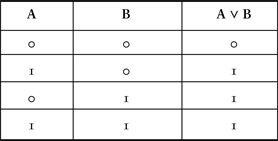
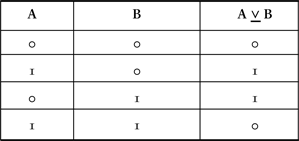
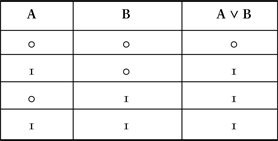
As stated in the previous section, the key to Naḥmanides's solution to the problem of mammals with no sign of purity is that he first reads the Torah to establish a disjunctive prohibition against mammals that lack one sign of purity, and that he then reads this disjunctive prohibition to be inclusive of mammals that lack both signs of purity, rather than exclusive of such mammals. Modern logic captures the difference between inclusive and exclusive disjunction in the following truth-condition tables, according to which an inclusively disjunctive proposition is true if one, the other, or both of its parts are true, and false if both are false, and according to which an exclusively disjunctive proposition is true if either one of its parts is true but the other is false, and false if both are false or both are true. This is shown in Tables 1a and 1b, where truth is denoted by the number 1, falsehood by the number 0, the inclusive disjunctive operator by the symbol ∨, and the exclusive disjunctive operator by the symbol ∨.
Inclusive Disjunction
Exclusive Disjunction
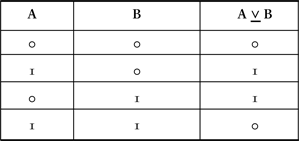
There is no one-to-one correspondence between these logical operators and any linguistic (“natural language”) operators. The English word “or,” for example, is ambiguous: Depending on the context, it can be read as denoting inclusive disjunction (“you should drive carefully when it rains or at night,” including when it rains at night) or exclusive disjunction (“you may have a cookie or a candy,” but not both).Footnote 84 Modern logic usually understands simple disjunction, without more, to be inclusive,Footnote 85 as does Naḥmanides in his solution to our problem above.
Not so Maimonides. In his Treatise on Logic, Maimonides recognizes only exclusive disjunction when discussing the “hypothetical disjunctive syllogism”:
The hypothetical disjunctive syllogism is when we say “This number is either even or odd” or “This water is either hot or cold or lukewarm”; we then exclude by saying in the first example, “But it is odd”, and it follows “It is not even”, or we exclude in the second example by saying, “But this water is hot”, and it follows, “It is neither cold nor lukewarm”. Every syllogism so composed is called a hypothetical disjunctive syllogism.Footnote 86
For Maimonides, the two parts of a disjunctive proposition must be “contraries,” so that only one of them, but not both, can be true at any given point in time, in order for the hypothetical disjunctive syllogism to be valid:
When two qualities are such that when one is present in a subject the other is removed, we call them contraries, e.g., heat and cold … . Some of these contraries have an intermediate state[,] e.g., hot and cold; for between them there is the lukewarm. But some of them have no intermediate state, e.g., even and odd in numbers, for every number is either even or odd.Footnote 87
Note that the hypothetical disjunctive syllogism holds only for exclusive disjunction, but not for inclusive disjunction: If it is known that an animal has split hooves or chews its cud, qualities that are not contraries, and it then becomes known that it has split hooves, it does not follow that it does not chew its cud. There is, however, a “negative” hypothetical disjunctive syllogism that, unlike the “positive” hypothetical disjunctive syllogism discussed above, holds not only for exclusive disjunction, but also for inclusive disjunction: Just as a whole number must be either even or odd, and if it is not even, it follows that it is odd; so also if it is known that an animal has split hooves or chews its cud, and it becomes known that it does not have split hooves, it follows that it chews its cud. Maimonides, however, does not discuss this type of syllogism, and he also does not otherwise mention inclusive disjunction.
In this, Maimonides's Treatise mirrors the works of the Muslim philosophers from whose works he learned logic. Avicenna (Ibn Sina, ca. 980–1037 CE), for example, writes in his Treatise on Logic,
The disjunctive conditional is a proposition in which the antecedent can have one or many consequents. An example of one with a single consequent is: “This number is either even or odd.” An example of one with several consequents is: “This number is either equal to that number or less than that number or greater than that number.”Footnote 88
Avicenna's modern editor comments that “from both examples [above] and from the definition provided by Avicenna, it seems that he uses disjunction in an exclusive sense” and that the editor “could not see any evidence” that “Avicenna's examples of disjunction would [ever] be compatible with an inclusive construction.”Footnote 89
Like Maimonides, Avicenna states that “the disjunctive antecedent is not in harmony with [or, in Maimonides's terms, “contrar[y]” to] its consequent, such as either odd or even in the sentence, ‘Every number is either odd or even.’”Footnote 90 Unlike Maimonides, Avicenna discusses not only the positive hypothetical disjunctive syllogism, which holds only of exclusive disjunction, but also the negative hypothetical disjunctive syllogism, which holds also of inclusive disjunction:
When the disjunctive premise is composed of only two parts, and the hypothetical premise is identical to one or the other part, then the conclusion will be the contrary of the part of the disjunctive not taken as a premise. For example, “This number is either even or odd.” “But it is even,” it then follows that “It is not odd.” Again, “This number is even or odd,” “but it is odd,” therefore “It is not even.” When the hypothetical premise is contrary to one or the other part of the disjunctive, the conclusion will be identical to the part of the disjunctive not taken as a premise. For example, if the hypothetical is “But it is not odd” the conclusion will be “It is even.” Again, if the hypothetical is “But it is not even,” the conclusion will be “it is odd.” (What I have said, however, is true only of “true disjunctives.[”] With regard to “unreal disjunctive[s]” there are some exceptions to the principles I have laid down.) Footnote 91
Avicenna's modern editor comments:
The [first] example [in the previous quote] corresponds to {(P ∨ Q) ∧ P} → Q̅ [that is, “P or Q, and P, therefore not Q”], which is not valid if we take disjunction in its inclusive sense. However, it is valid if we take disjunction in its exclusive form … . “True disjunctive” as Avicenna calls it corresponds to exclusive and “unreal [disjunctive]” corresponds to inclusive disjunction.Footnote 92
Avicenna could have explained that, with regard to “unreal”—that is, inclusive—disjunctives, only the second of the principles he has laid down in the next to last block quote above (corresponding to {(P ∨ Q) ∧ Q̅} → P, that is, “P or Q, and not Q, therefore P”) holds true, but that the first does not. Instead, Avicenna merely notes in passing that inclusive disjunctives do not fit into his logical system, otherwise disregarding them as, apparently, unimportant.
Al-Farabi (ca. 872–951 CE), the Muslim philosopher on whom Maimonides most directly relies for information regarding what is essentially Greek logic, and the only such philosopher he mentions by name in his Treatise on Logic,Footnote 93 likewise focuses on exclusive disjunction in his Short Commentary on Aristotle's Prior Analytics:
The second <kind of> conditional syllogisms is called a disjunctive conditional [or, in Maimonides terms, “hypothetical”]. This can have many forms. For example: “Either the world is eternal or it is originated, but the world is originated, so it necessarily results that the world is not eternal”. The conditional of these two <premisses> is the statement beginning with “either”, which presents the alternative of one of two items to the other, and opposes it to, and disjoins it from the other. … The two “parts” of a conditional here are always two <mutually incompatible> alternatives [or, in Maimonides's terms, “contraries”].Footnote 94
Al-Farabi goes beyond Avicenna in distinguishing between “complete” and “imperfect” exclusive disjunctives:
Every <disjunctive statement> is of one of the following two types: either it is a complete (i.e., exhaustive) alternative or it is incomplete [or imperfect] (i.e., non-exhaustive) alternative. A complete <i.e., exhaustive> alternative is one that includes within itself all the <possible> alternatives whatsoever … like the statement “The world is either eternal or originated”, or the statement, “This water is either hot or cold or lukewarm”. But an [incomplete or] imperfect <i.e., non-exhaustive> alternative is one that does not include within itself all of the [possible] alternatives, like the statement “Zaid is either in Iraq or in Syria.”Footnote 95
Al-Farabi explains the different behavior of complete and incomplete/imperfect disjunctives in a hypothetical or conditional syllogism as follows:
Every disjunctive conditional <syllogism> whose alternatives are two only, and whose alternatives are complete, <is such that> when either one of them <viz., the two alternatives> is “excluded”, the conclusion [necessarily] agrees with the opposite of the other alternative; and if the opposite of either one of them is “excluded”, then this yields the other alternative itself.Footnote [96] An example of this is: “The number is either even or it is odd”. Because it <i.e., a number> is either even, and consequently it is not odd, or it is odd, and consequently not even; or is not even and consequently odd, or it is not odd, and consequently even. … If the alternative is imperfect, then if one of the two <alternatives> is “excluded”, then [as in the case of complete alternatives] <the conclusion> necessarily agrees with the opposite of the other <alternative>. <On the other hand> if one “excludes” the opposite … of <viz., one of the two imperfect alternatives, say the [first]>, there [in contrast to the case of complete alternatives] does not necessarily follow anything whatever, neither the [second alternative] <itself>, nor the opposite of the [second alternative]. An example is <the argument>: “Zaid is either in Iraq or Syria … but he is in Iraq, so he consequently is [not] in Syria … .” But if it is “excluded” that he is not in Iraq, then it does not necessarily follow that he is in Syria [and not, for example, in Persia]Footnote [97] … .Footnote 98
Note that it does not occur to Al-Farabi that when Zaid is in Iraq or Syria, he may, in fact, be both in Iraq and in Syria; that is, he may be straddling the border between the two, having one foot in Iraq and the other in Syria. That is to say, it does not occur to Al-Farabi that a disjunctive proposition, whether complete or incomplete, does not have to be composed of incompatible alternatives, but may be composed of compatible options, because it does not occur to him that disjunction does not have to be exclusive, but may be inclusive. Inclusive disjunction, the existence of which is barely acknowledged by Avicenna, does not exist at all for Al-Farabi or Maimonides.
Like Avicenna, who recognizes inclusive disjunction only in passing in the form of “unreal disjunctions,” the Greco-Roman philosopher Galen (129–ca. 200 CE) also recognizes inclusive disjunction only in passing in the form of “pseudo-disjunctions”:
[I]n consideration of clarity together with conciseness of teaching, there is no reason not to call propositions containing complete incompatibles [that is, Al-Farabi's “complete alternatives”] “disjunctions,” and those containing partial incompatibles [that is, Al-Farabi's “incomplete” or “imperfect alternatives”] “quasi disjunctions.” … Also, in some propositions, it is possible not only for one part to hold, but several, or even all; but it is necessary for one part to hold. Some call such propositions “pseudo-disjunctions,” since [genuine, that is, exclusive] disjunctions, whether composed of two atomic propositions or of more, have just one true member.Footnote 99
Inclusive disjunction came into its own only approximately a thousand years after Galen, and then at first only in the Christian realm, where Peter Abelard (1079–1142 CE) was perhaps the first philosopher to recognize inclusive disjunction to have equal standing with, or possibly even primacy over, exclusive disjunction, in that he did not incorporate exclusivity into his definition of “simple” disjunction:
Abelard … corrects what he takes to be Boethius's account of disjunction. He agrees that a simple disjunction is equipollent to the simple conditional that has the negation of the first disjunct as its antecedent and the second as its consequent and so is exhaustive, and he therefore accepts [negative] disjunctive syllogism [according to which, if “all numbers are either odd or even,” and “this number is not odd,” then “this number is even”]. Abelard disagrees, however, that disjunction is also exclusive, pointing to the truth of the propositional disjunction “either not every human is white or some human is white” [which is true in our world, in which not every human is white and some humans are white].Footnote 100
By the thirteenth century CE, inclusive disjunction appears to have been well-established in the Christian realm, to the point that “‘or’ was usually treated inclusively,”Footnote 101 as for example by William of Sherwood (ca. 1200–1270 CE), who states in his Introduction to Logic that “[i]n order that a copulative [employing “and”] be true … it is necessary that both parts be true[,] [b]ut in order that a disjunctive [employing “or”] be true, the truth of one or the other part is sufficient,”Footnote 102 rather than that in order for a disjunctive to be true, it is necessary that one part be true and the other be false, as Galen, Al-Farabi, Avicenna, and Maimonides would have held.
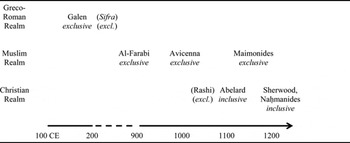
To summarize, in the Greco-Roman and Muslim realms, disjunction was understood at least primarily, if not solely, in its exclusive sense throughout the period under consideration here. By contrast, in the Christian realm, disjunction was understood at least primarily, if not solely, in its inclusive sense by the twelfth century of the Common Era. This is shown in Table 2, in which the authors discussed above are arranged from top to bottom, depending on whether they were active in the Greco-Roman, Muslim, or Christian realm, and from left to right, depending on when they were active. For each of these authors, it is indicated whether they used exclusive or inclusive disjunction. The Sifra and Rashi are included in parenthesis because there is no direct evidence whether they used exclusive or inclusive disjunction, although their approach to the problem at issue in this article suggests that they used exclusive disjunction.
Development of the Primary Sense of Disjunction from Exclusive to Inclusive in the Greco-Roman, Muslim, and Christian Realms

Maimonides died in 1204 CE, ninety years after Abelard began to write his Dialectica in Christian France in 1114 CE and completed it there by 1121 CE.Footnote 103 Maimonides spent his entire life in the Muslim realm. He was born in Cordoba in Al-Andalus, now central southern Spain, in 1135 CE, moved to Fes in the Maghreb as a young man, and lived the final three decades of his life in Fustat, near Cairo, Egypt. As a resident of the Muslim realm, it is unlikely that he ever had an opportunity to read, or otherwise learn relevant details about, Abelard's Dialectica. Even in the unlikely event that Maimonides had access to a copy of this work, he would not have been able to read it in the original Latin.Footnote 104 Thus, unless Maimonides had access to a translation of Abelard's work into Hebrew, Arabic, or Jewish Aramaic,Footnote 105 the existence of which at that time is unlikely, he must have relied solely on the works of Muslim logicians, chiefly Al-Farabi, and their exclusive reading of disjunction.
By contrast, Naḥmanides spent almost his entire life in the Christian realm. He was born in Girona in the Kingdom of Aragon, now north-eastern Spain, in 1194 CE and lived there and in other nearby Christian parts until he was forced to emigrate to Muslim-ruled Jerusalem in 1267 CE, three years before his death. He therefore may have had an opportunity to read, or otherwise learn relevant details about, Abelard's work, although we cannot know this for sure, as he did not leave us a treatise on logic. Although a Sephardic Jew, Naḥmanides was in direct contact with Christian philosophy, as is evident from his involuntary participation in the Disputation of Barcelona in 1263 CE with the formerly Jewish apostate Pablo Christiani about the respective merits of Judaism and Christianity. Despite a guarantee of freedom of speech from King James I of Aragon, this disputation led to allegations of heresy against Naḥmanides and his aforementioned forced emigration to Jerusalem. He may have written a Latin account of that fateful disputation for the bishop of his native Girona,Footnote 106 in which case he would have been able to read Abelard's Dialectica in the language in which it was written. More generally, as a result of disputations such as that of Barcelona, “the thirteenth century provides much more evidence of Jewish knowledge of … Latin, and direct Jewish contact with Christian texts, than can be seen previously.”Footnote 107 Perhaps even more suggestive is the fact that “[i]n addition to his Torah studies Ramban also interested himself in the secular knowledge of his times, by extensively studying philosophy and science,”Footnote 108 which, in the Christian realm in which he lived, would likely have required him to be able to read Latin.Footnote 109 It is therefore possible that Naḥmanides was able to read, and may have actually read, Abelard's Dialectica.
The question arises whether familiarity with the development of a primarily inclusive view of disjunction in the Christian realm—that is, borrowing—or unfamiliarity with the maintenance of a primarily exclusive view of disjunction in the Muslim realm—that is, invention—led Naḥmanides to adopt an inclusive view of disjunction. While no definite answer can be given to this question, Rashi's reliance on the ḳal ṿaḥomer logic of the Sifra, rather than on inclusive disjunction, is instructive. Rashi was born in 1040 CE in Troyes, Northern France, and was later active in Germany and thereafter again in France. He died in 1105 CE, before Abelard wrote his Dialectica and before Maimonides was born. Given where he lived, Rashi cannot have been more familiar with the works of Al-Farabi and other Muslim logicians than Naḥmanides. Therefore, if Naḥmanides adopted an inclusive view of disjunction because he was unfamiliar with the maintenance of a primarily exclusive view of disjunction in the Muslim realm, then Rashi should have done so for the same reason. Conversely, if the Sifra's reliance on ḳal ṿaḥomer logic settled the matter for Rashi, then it should also have done so for Naḥmanides. In the end, intellectual ingenuity cannot be excluded. However, given the timeframe explored above, it is at least possible that Naḥmanides thought the way he did in part because he lived at a certain time in the Christian realm, and was therefore subject to the influence of the Christian thought prevalent there at that time. Likewise, it is at least possible that Maimonides thought the way he did in part because he lived at a certain time in the Muslim realm, and was therefore subject to the influence of the Muslim thought then current there.Footnote 110
EXCLUSIVE AND INCLUSIVE DISJUNCTION IN MODERN AMERICAN LAW
Just as the adoption of an exclusive or an inclusive view of disjunction yielded different answers to questions of medieval Jewish law, so it continues to yield different answers to questions of modern American law. Three recent cases illustrate the point.
The first case, Kustom Signals, Inc. v. Applied Concepts, Inc., involved the alleged infringement of plaintiff's traffic radar patent.Footnote 111 Two independent claims in plaintiff's patent described a method and an apparatus, respectively, for searching Doppler return information “for the component that meets preselected magnitude or frequency criteria.”Footnote 112 A third claim described a similar apparatus including “means under operator control for selecting either a greatest magnitude or highest frequency search, whereby either strongest signal or fastest signal target identification is provided.”Footnote 113 Defendant's traffic radar device, by contrast, operated such that “both a strongest and a fastest analysis of the return signal are always performed, and are not subject to operator selection.”Footnote 114
The Federal Circuit's majority, led by Circuit Judge Newman, held that defendant's device did not literally infringe on plaintiff's patent, “for the alternative ‘or’ excludes devices that search both magnitude and frequency.”Footnote 115 The court's majority agreed with the district court, which “construed the term ‘or’ as used in [the] claim clauses … to mean ‘a choice between either one of two alternatives, but not both.’”Footnote 116 The majority saw “no basis whatsoever for believing that [plaintiff] intended its usage of ‘or’ somehow to embrace ‘and.’”Footnote 117
The Kustom Signals majority thus adopted an exclusive view of disjunction. In his dissent, Chief Judge Mayer urged instead that, “[i]n this case, ‘or’ should be construed inclusively to mean ‘one or another or both.’”Footnote 118 He noted that “the plain meaning of ‘or’ can be ‘either or both’” and observed that “[i]f a store owner says, ‘If it hails or snows today, we will close the store,’ then the owner will still close the store if it happens to hail and snow.”Footnote 119
The Kustom Signals majority could have supported its opinion by pointing out that in the third claim in plaintiff's patent, “or” was preceded by “either,” favoring an exclusive reading of “or” in that claim. Conversely, Chief Judge Mayer could have supported his dissent by pointing out that in the first two claims of plaintiff's patent, “or” was not preceded by “either,” favoring—through the contrast with the third claim—an inclusive reading of “or” in those two claims.Footnote 120 Maimonides would have sided with the Kustom Signals majority and its exclusive reading of “or,” but Naḥmanides would have sided with Chief Judge Mayer and his inclusive reading.
In another civil case, Southtrust Bank v. Copeland One, L.L.C., a lease gave the lessee “the exclusive right … to operate an ATM or any other type of banking facility on the Property.”Footnote 121 The Supreme Court of Alabama held that the lease was ambiguous between an exclusive and an inclusive reading of “or” and had to be construed against the lessee as its drafter, that is, exclusively.Footnote 122 Accordingly, the court's majority held that the lease gave the lessee the exclusive right to operate either an ATM or a branch bank on the property, but not both, and that once the lessee had elected to operate an ATM on the property, the lessor was free to bestow upon a third party the right to operate a branch bank there.Footnote 123 Justice Lyons, who had concurred in the original decision, subsequently dissented from the denial of an application for rehearing and interpreted “or” inclusively, stating that “[u]pon further consideration, … I would find that the lease unambiguously gives SouthTrust Bank the exclusive right to operate both an ATM and any other banking facility at that location.”Footnote 124 Justice Lyons observed that under the court's original opinion, the third party would not be allowed to have an ATM in its branch bank, an “anomalous result” that “underscore[d] the bizarre consequences of the original opinion's treatment of the … lease.”Footnote 125 A third opinion was voiced in a law review article discussing the case, which also deemed the lease to be unambiguous, but found that “the only reasonable interpretation” of “or” in the lease was as an exclusive disjunction, and that “[t]he court opted for the correct meaning, but for the wrong reasons.”Footnote 126 As before, Maimonides would have sided with the court's majority and the authors of the law review article and their exclusive reading of “or,” but Naḥmanides would have sided with Justice Lyons and his inclusive reading.
The choice between the exclusive and inclusive readings of “or” can also have drastic consequences in criminal cases, as illustrated by State v. Johnson.Footnote 127 Arizona's transferred intent statute provides in relevant part:
If intentionally causing a particular result is an element of an offense, and the actual result is not within the intention or contemplation of the person, that element is established if … the actual result differs from that intended or contemplated only in the respect that a different person or different property is injured or affected or that the injury or harm intended or contemplated would have been more serious or extensive than that caused … .Footnote 128
The Court of Appeals of Arizona interpreted this portion of the statute as follows:
In order for the first clause of § 13–203(B)(1) to apply, the actual and intended victims may differ, but the actual and intended harms must be the same. Conversely, for the second clause of (B)(1) to apply, the actual and intended victims must be the same, but the harm can differ. This conclusion stems from the use of the word “only” preceding the word “or” that joins the two clauses. This logical structure creates an exclusive disjunction, allowing transferred intent under (B)(1) if only one of the two components of the result (either the victim or the harm) differs, but not both.Footnote 129
However, the explanatory note to Model Penal Code § 2.03(2), on which Arizona's transferred intent statute is modeled and to which it is identical in all relevant respects, suggests a different interpretation of the word “or” as preceded by the word “only” here:
If the divergence [between the actual and the contemplated results] is only that a different person or property is affected, or that the contemplated harm would have been more serious, the difference is declared [in Model Code § 2.03(2)(a)] to be legally immaterial. If, however, there are other differences, the causality element is established only if [the requirements in Model Code § 2.03(2)(a) are met.]Footnote 130
This explanatory note suggests that the word “only” in Model Penal Code § 2.03(2)(a)—and in Arizona Revised Statute § 13–203(B)—serves only to exclude “other differences,” that is, differences other than that “a different person or different property is injured or affected” or that “the injury or harm designed or contemplated would have been more serious or more extensive than that caused,” but not also, as the Johnson court found, to exclude the possibility that both a different person or a different property is injured or affected and the injury or harm designed or contemplated would have been more serious or more extensive than that caused. Moreover, the Johnson Court was incorrect in claiming that the “logical structure” created in Arizona Revised Statute § 13–203(B)(1) by having “the word ‘only’ preced[e] the word ‘or’ that joins the two clauses” making up the remainder of the sentence necessarily “creates an exclusive disjunction, allowing transferred intent … if only one of the two components of the result (either the victim or the harm) differs, but not both.”Footnote 131 This would be true only if the words “only in the respect” were repeated after the word “or,”Footnote 132 but they are not. Absent such a repetition, the words “only in the respect” have scope over the remainder of the sentence as a whole and do not affect the interpretation of the word “or” that joins the two clauses making up that remainder as either inclusive or exclusive. Indeed, it would seem counterintuitive if intent could not be transferred where a perpetrator, for example, intends to kill one person but inflicts nonlethal injuries on another. Thus, an inclusive reading of “or” in Model Penal Code § 2.03(2)(a) and Arizona Revised Statute § 13–203(B)(1) is preferable over the exclusive reading chosen by the Johnson Court.
CONCLUSION
That medieval Greco-Roman, Muslim, and Christian philosophers exercised strong influences on Jewish thought is nothing new. To quote but one representative example, the editors of the Cambridge Companion to Medieval Jewish Philosophy state in the preface to that work:
Influenced first by Islamic theological speculation and by the great Greek philosophers and their Islamic successors, and then in the late medieval period by Christian Scholasticism, Jewish philosophers reflected on the nature of language about God, the scope and limits of human understanding, the eternity or createdness of the world, prophecy and divine providence, the possibility of human freedom, and the relationship between divine and human law.Footnote 133
This article has presented a case in which “the great Greek philosophers and their Islamic successors,” on the one hand, and “Christian Scholasticism,” on the other, exercised their influence on Jewish thought not directly, by influencing the substantive content of, for example, the reflections of Jewish sages “on the nature of language about God,” but in which they did so indirectly, by influencing the logical form of these reflections, which in turn governs their substantive content. This article has further shown that, although direct influences are easier to detect than indirect ones, when indirect influences can be detected, they can be as profound as direct ones. Finally, this article has shown that the issue of the logical form in question—the choice between exclusive and inclusive disjunction—is one that was not only relevant in medieval Jewish law, but remains equally relevant in modern American law.
ACKNOWLEDGEMENTS
I would like to thank Joshua Holo, Rabbi Gilbert Kollin, Karin Ludwig, Rabbi Robin Podolsky, Joseph Tepperman, the editors and editorial staff of the Journal of Law and Religion, and two anonymous reviewers for helpful comments on drafts of this article. All mistakes are my own.