Introduction
According to several theories of reading development, early readers first encode words by using letter-size units but start to utilize larger units as their reading skills develop (e.g., Ehri, Reference Ehri1995, Reference Ehri2005; Ehri & McCormick, Reference Ehri and McCormick1998, Frith, Reference Frith, Patterson, Marshall and Coltheart1985). This same idea is captured by the multiple-route model of orthographic processing (Grainger & Ziegler, Reference Grainger and Ziegler2011): beginning readers read words on a letter-by-letter basis but afterwards develop skills that enable them to use larger chunks (such as syllables and morphemes) that can be either phonologically or orthographically mediated. While syllables (e.g., en and ter in enter) are the phonological building blocks of words, they do not have semantic content. On the other hand, morphemes are the smallest units of language that carry meaning (e.g., houses has two morphemes, house, and s denoting plural). They can be characterized as having a more direct, orthographically mediated link to semantics. As reading skills develop, readers start to utilize orthographic information to a larger extent, while the use of phonological information takes a back seat (e.g., Grainger, Lété, Bertand, Dufau, & Ziegler, Reference Grainger, Lété, Bertand, Dufau and Ziegler2012; Tiffin-Richards & Schroeder, Reference Tiffin-Richards and Schroeder2015). This does not mean that readers only use one of these routes; the system is flexible and via simultaneous activation skilled readers can recognize any word by using any of the possible routes (Grainger et al., Reference Grainger, Lété, Bertand, Dufau and Ziegler2012).
It has been established that both syllables and morphemes are used by children in a relatively early phase of reading (e.g., Colé, Bouton, Leuwers, Casalis, & Sprenger-Charolles, Reference Colé, Bouton, Leuwers, Casalis and Sprenger-Charolles2012; Colé, Magnan, & Grainger, Reference Colé, Magnan and Grainger1999; Häikiö, Bertram, & Hyönä, Reference Häikiö, Bertram and Hyönä2011, Reference Häikiö, Bertram and Hyönä2016; Häikiö, Hyönä, & Bertram, Reference Häikiö, Hyönä and Bertram2015; Hasenäcker & Schroeder, Reference Hasenäcker and Schroeder2017; Lázaro, Acha, de la Rosa, García, & Sainz, Reference Lázaro, Acha, de la Rosa, García and Sainz2017; Maïonchi-Pino, Magnan, & Écalle, Reference Maïonchi-Pino, Magnan and Écalle2010; Quémart, Casalis, & Duncan, Reference Quémart, Casalis and Duncan2012). For instance, French first-grade children were facilitated by a previously presented target syllable when reading a word, even though this was restricted to high-frequency syllables (Colé et al., Reference Colé, Magnan and Grainger1999; Maïonchi-Pino et al., Reference Maïonchi-Pino, Magnan and Écalle2010). Similarly, Finnish first-graders reading sentences were disrupted to a larger extent when the syllable structure was violated by inserting a hyphen within a syllable than when the hyphen was between the syllables (Häikiö et al., Reference Häikiö, Hyönä and Bertram2015). These findings demonstrate that syllables are already utilized at least to some extent during the first grade. With regard to morphemes, Quémart et al. (Reference Quémart, Casalis and Duncan2012) demonstrated that French third-graders were disrupted by the presence of morphemes in reading pseudo-words for a lexical decision task. For Finnish, slow second-graders were facilitated by a hyphen between morphemes in compound words, but this was not true for more skilled and older readers (Häikiö et al., Reference Häikiö, Bertram and Hyönä2011). Furthermore, Spanish second-graders read words faster when the suffix was of high frequency (Lázaro et al., Reference Lázaro, Acha, de la Rosa, García and Sainz2017). Finally, French second-graders were not slowed down in word reading when there was a space either at the syllable or morpheme boundary, but they were disrupted when this space was at a non-boundary (Colé et al., Reference Colé, Bouton, Leuwers, Casalis and Sprenger-Charolles2012). These findings suggest that morphemes are already utilized in reading during the second grade, at least to some extent.
Even though the use of syllables and morphemes has been studied extensively, there are only a couple of studies that have directly compared them in reading. As mentioned above, Colé et al. (2011) did not find differences in word processing between the conditions separating letters in a word on the basis of syllables or morphemes, suggesting flexible processing of units during the second grade. Recently, Hasenäcker and Schroeder (Reference Hasenäcker and Schroeder2017) studied German second- and fourth-grade children who had to make a lexical decision on letter strings that contained a colon (:) either at the syllable or morpheme boundary. The second-graders were faster to respond when the colon was at the syllable boundary than when it was not. In the pseudo-word condition, their performance was not affected by a colon at the morpheme boundary. In contrast, the fourth-graders were slower to reject the pseudo-words when the colon was at the morpheme boundary. These findings suggest that younger German children primarily process words via syllables, whereas older German children can utilize morphemic decomposition. This was in contrast with the findings of Colé et al. (2011), who witnessed morpheme-level processing in the second grade. Hasenäcker and Schroeder (Reference Hasenäcker and Schroeder2017) argued that these differences might stem from cross-linguistic differences. They reasoned that the distinction between syllables and morphemes might be more pronounced in French than in German, thus explaining the divergent findings. At any rate, it is highly likely that there are cross-linguistic differences in the way different units are processed during early reading.
Finnish, the language of the present study, is a highly transparent language with very rich morphology. While the syllable structure is very straightforward, any noun can in principle have as many as 2,000 inflectional forms (Karlsson & Koskenniemi, Reference Karlsson and Koskenniemi1985). While some frequent words may be read using sight vocabulary, readers need to decompose the vast majority of words in a language like this. While Finnish children do utilize syllable-level information in reading, they are already disrupted to some extent by syllable-level hyphenation during the first grade (Häikiö et al., Reference Häikiö, Hyönä and Bertram2015, Reference Häikiö, Bertram and Hyönä2016). This happens despite Finnish children being exposed to syllable-level hyphenation during early reading instruction. With regard to morphemes, Häikiö et al. (Reference Häikiö, Bertram and Hyönä2011) demonstrated that slow second-graders were facilitated by morpheme-level hyphenation in compounds.
In the present study, early Finnish readers read sentences for comprehension while their eye-movements were registered. While Colé et al. (2011) and Hasenäcker and Schroeder (Reference Hasenäcker and Schroeder2017) assessed processing of derived words, in the present study we will look into inflected words. To our knowledge, this is the first time the relationship of syllables and inflectional morphemes in early reading has been assessed in sentence reading. To directly compare syllables with morphemes, there were bimorphemic target words for half of which the last syllable boundary coincided with the morpheme boundary and for the other half it did not. More precisely, in the essive case (marked with the suffix -na/-nä), the last syllable boundary is always also the morpheme boundary (e.g., ky-nä-nä, ‘as pen’). In contrast, for example, in the inessive case, the first letter of the morpheme suffix -ssa (‘in something’) is part of the previous syllable. For instance, in word kynässä, ‘in pen’, there are syllables ky, näs, and sä, but the morphemes are kynä, and ssä. This division was used in order to disentangle syllable-level and morpheme-level information; in addition to the non-hyphenated control condition (e.g., kynänä, ‘in pen’), we used either syllable-congruent (e.g., ky-nä-nä) or syllable-incongruent hyphenation (e.g., ky-nän-ä). When the syllable and morpheme boundaries did not coincide (e.g., ky-nä-ssä), the syllable-incongruent hyphenation was morpheme-congruent. If early readers prefer syllable-level information to morpheme-level information, they should be disrupted to a larger extent by syllable-incongruent but morpheme-congruent hyphenation. If, on the other hand, children already prefer morpheme-level information to syllable-level information, they should not be disrupted by syllable-incongruent but morpheme-congruent hyphenation.
Method
Participants
Thirty monolingual first-graders (15 boys, average age 7;10, range 7;4–8;4) and 30 monolingual second-graders (13 boys, average age 8;10, range 8;4–9;4) were recruited from a Finnish elementary school. They had received approximately 8 months or 1 year 8 months of formal reading instruction (first- and second-graders, respectively). All participants had normal or corrected-to-normal vision. Written permission from children's parents was acquired prior to the experiment. The participants received candy or stickers as a reward for participation.
Apparatus
Eye-movements were recorded monocularly with a table-mounted Eyelink 1000+ (SR Research, Canada) with 1000 Hz sampling rate. A chin-and-forehead rest was used to minimize head movements. The texts were presented on a 24-inch BenQ XL2420Z computer screen (refresh rate of 100 Hz, resolution 1920*1080).
Materials
Fifty-six words were selected from a pool of potential target words for which 21 staff members at the department of Psychology in the University of Turku had rated the age of acquisition (AoA) and familiarity of the nominative forms with a paper-and-pencil test. AoA had been rated on a 7-point scale (“At what age did you learn the word?”; 1 = 0–2 years, 2 = 3–4 years, 3 = 5–6 years, 4 = 7–8 years, 5 = 9–10 years, 6 = 11–12 years, 7 > 12 years). Average AoA ratings for each word were calculated on basis of the individual ratings. Only words with a maximum average of 4 were considered for inclusion in the study. Familiarity had been rated on a 5-point scale (“How often do you encounter or use the word?”; ranging from “very seldom” to “very often”). The selected words were early acquired bisyllabic or trisyllabic monomorphemic words (average word length 5.46 characters, range 4–7 characters; average AoA rating 2.45, range 1.33–3.83).
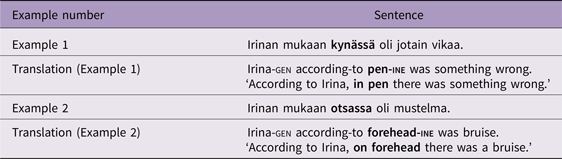
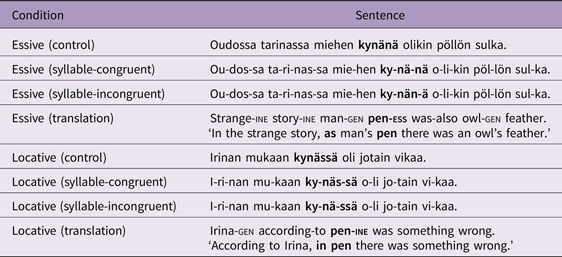
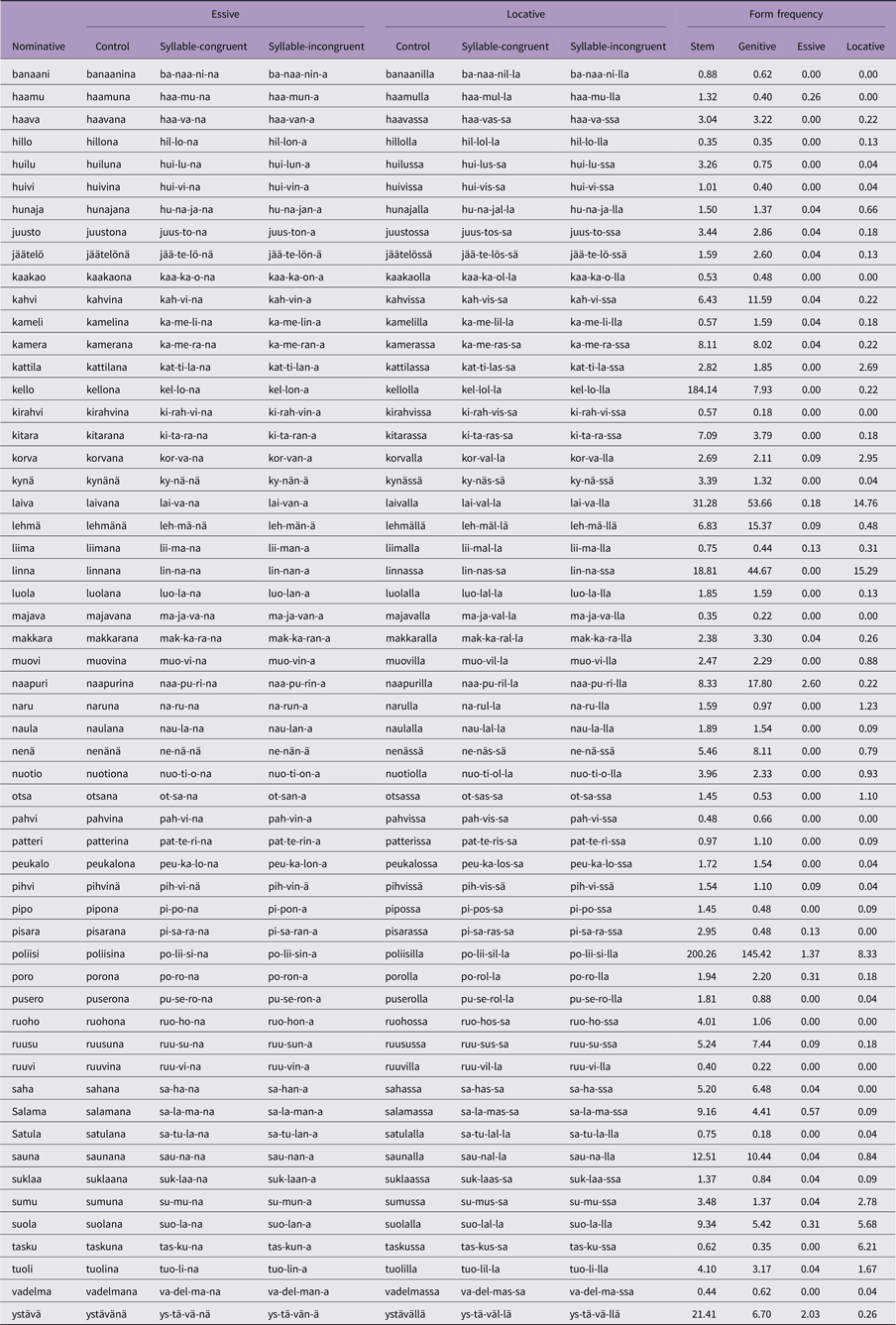
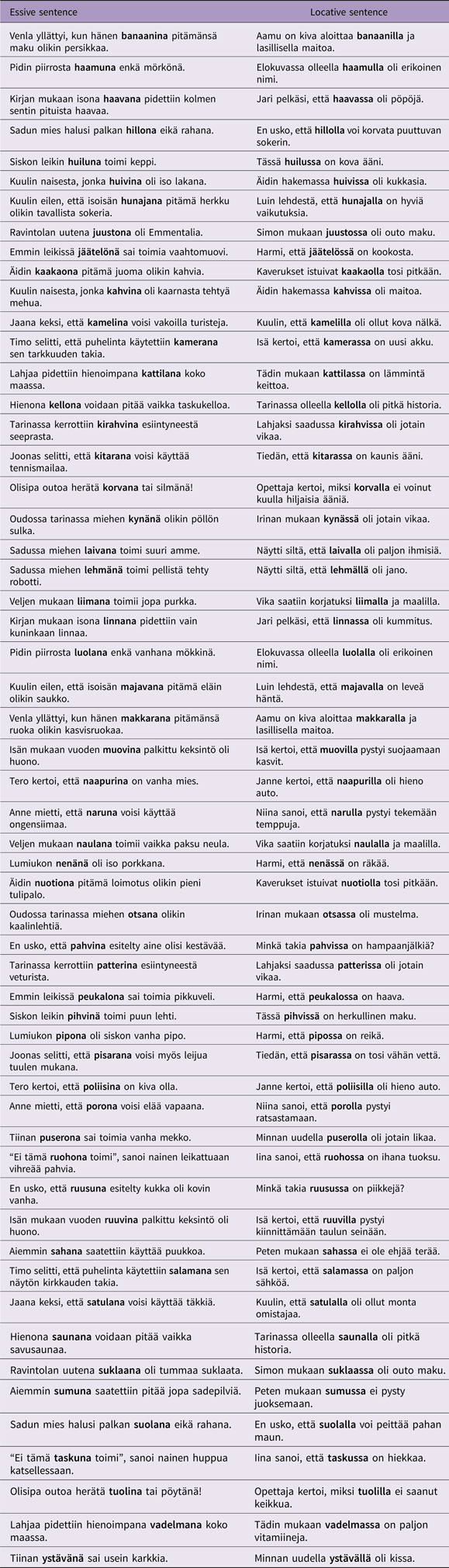
Since each participant would see each word only once (i.e., half of the experimental material), the words were divided into two groups with matched word length, AoA, and familiarity so that each word had a matching pair in the other group, in order to make sure that for each word seen in one condition there was a matched word for the other condition. The target words were embedded in sentences. Two sentences were created for each target word, one in which the target word was in essive case (-na/-nä, ‘as something’), and another in which the target word was either in inessive (-ssa/-ssä, ‘in something’) or adessive (-lla/-llä, ‘on something’ or ‘with something’) case (dubbed the locative case in the following). A list of target words in each condition alongside their form frequencies is presented in Table A1 in Appendix 1. The essive case was chosen as in Finnish it is the only case where the morpheme and syllable boundaries coincide consistently. In contrast, inessive and adessive were chosen as the morpheme and syllable boundaries never coincide in these cases. It needs to be noted that inessives are considerably more frequent than essives, not only in the newspaper corpus (in our database of 22.7 million tokens (Laine & Virtanen, Reference Laine and Virtanen1999), 5.1% of the words are in the inessive case, and 2.3% in the essive case), but also in previous Finnish child corpus analyses for both input and output (e.g., Kirjavainen & Lieven, Reference Kirjavainen, Lieven and Kidd2011). For this reason, we also used adessives, which are somewhat more frequent (3.4% in our corpus) than essives but the difference is not as pronounced as for inessives. When inessives and adessives were treated separately in the analyses, the pattern of the results was similar to the analyses presented here. Therefore, we have collapsed the two locative cases into one. For each word pair, the sentences were identical up to word N + 1 (see Table 1). Since the essives and locatives convey different meanings, sentence frames differed between the cases (see Table 2). The target word never appeared at the beginning or the end of the sentence. In total, there were 56 essive, 28 inessive, and 28 adessive sentences. Eight Turku University employees rated the naturalness of the sentences on a 7-point Likert scale. On average, the sentences were rated quite natural (average 5.85, range 3.38–6.88). The locative sentences (6.45) were rated as more natural than the essive sentences (5.27) (p < .001). This is related to locatives being more frequent than essives. A list of sentences used in the study is presented in Table A2 in Appendix 1.
Example of a Sentence Pair. The Target Word Is in Bold.

Example Sentences for One Target Word. The Target Word Is in Bold.
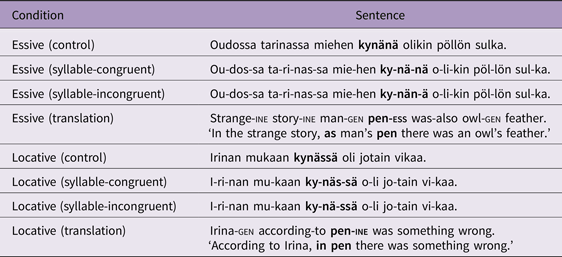
After the non-hyphenated control sentences, two hyphenated versions of the sentences were created, one with syllable-congruent hyphenation throughout the sentence, and another where the hyphenation was syllable-congruent throughout the sentence apart from the target word, in which there was one syllable-incongruent hyphen. In the essive case, the last hyphen was moved one character space further (e.g. ky-nä-nä → ky-nän-ä, ‘as a pen’) so that the first two or three syllables formed a proper word (a genitive form). In the locative case, the last hyphen was moved one character space earlier (e.g. ky-näs-sä → ky-nä-ssä, ‘in pen’) so that the first two or three syllables formed the stem of the word.
The sentences were distributed in three lists so that every third participant read a total of 20 control, 18 syllable-congruent, and 18 syllable-incongruent sentences, another third read 18 control, 20 syllable-congruent, and 18 syllable-incongruent sentences, and the rest read 18 control, 18 syllable-congruent, and 20 syllable-incongruent sentences. Every second participant saw the first word in the essive case, the second word in the locative case, and so on, and every other participant saw the opposite. Each participant saw each target word only once, either in the essive (28 occurrences) or locative (28 occurrences) case. The sentences were divided into two blocks. The presentation order was counterbalanced between the participants. In both blocks, there were also 10 filler sentences. The order of the sentences was randomized within blocks. Example sentences are presented in Table 2.
The sentences were presented in a proportional 36-point Calibri Light font. The hyphens were 18-point with the baseline shift of 4 pixels upwards. With a viewing distance of 60 cm one character subtended 0.11–0.61 degrees of visual angle. The sentences were all single-line sentences with a maximum of 67 characters per line, presented so that the upper-left corner of the text was approximately at the (480, 360) screen coordinate.
Procedure
Participants were instructed to read the sentences for comprehension at their own pace. They were further told that after varying intervals they would get a true/false statement (15 in total) about the sentence they had just read, for which they had to indicate whether it was true or false. Almost every participant responded to the statements with a minimum of 80% accuracy with the exception of two first-graders who were excluded from the analyses due to low reading skill. Additionally, the participants were told that some of the sentences would be hyphenated while the others would not, and that there might be some errors in the text, but that they should read as well as possible despite this. The eye-tracker was calibrated using a three-point calibration grid extending over the sentence area. Before each sentence, the participant fixated on a circle at the left side of the screen, after which the sentence appeared. The experiment proper was preceded by four practice sentences.
Dependent variables and predictors
The eye-fixation data was analyzed for the target words using three standard eye-movement variables as dependent variables; First Fixation Duration (FFD), Gaze Duration (i.e., summed duration of fixations on the target word before exiting it for the first time; GD), and Total Fixation Duration (i.e., summed duration of fixations on the target word; TFD).
The critical predictor variables were syllable boundary cue with three levels, ‘control’, ‘syllable-congruent hyphenation’, and ‘syllable-incongruent’ hyphenation, and case with two levels, ‘essive’, and ‘locative’. As for participant variables, we included grade.
Statistical considerations
Three first-graders were excluded from the analyses, two due to low reading skill, and one due to failed calibration due to eye glasses. Four first-graders did not complete the whole experiment but, since they reached the second block, their data were included in the analyses. Sentences for which there was track loss due either to technical problems or disturbance during the course of reading were excluded. This lead to the exclusion of 44 trials for the first grade and 20 trials for the second grade. In total, there were 3,075 trials included in the analyses (1,459 and 1,616 for the first and second grade, respectively).
The duration measures were log-transformed to normalize the data. Furthermore, values 2.5 SDs smaller or larger than the participant mean were excluded separately for each condition. This lead to the exclusion of 1.3%, 2.2%, and 0.7% of the data for FFD, GD, and TFD, respectively.
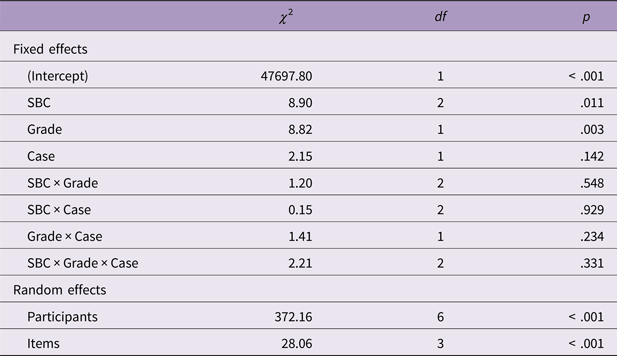
We used multiple regression mixed-effects modelling with participants and items as crossed random effects. Additionally, the predictor variables were entered into the random structure. As the models with maximal random structure failed to converge, we had to use less stringent random structure. The final random structures are reported in ‘Appendix 2’. We will report the results of the omnibus analysis using effects coding and Type III sum of squares. Furthermore, post-hoc contrasts were conducted for Syllable Boundary Cue and interactions when they were significant or close to significant. The mixed-effects analyses were conducted using the lme4 package (version lme4_1.1.14; Bates, Maechler, Bolker, & Walker, Reference Bates, Maechler, Bolker and Walker2015), and the contrasts were calculated using the glht() function of the multcomp package (version multcomp_1.4-7; Hothorn, Bretz, & Westfall, Reference Hothorn, Bretz and Westfall2008) for R statistical software (version 3.4.2; R Core Team, 2017). The models, including their full model syntax, are reported in ‘Appendix 2’. The 95% confidence intervals were computed using Wald estimation.
Results
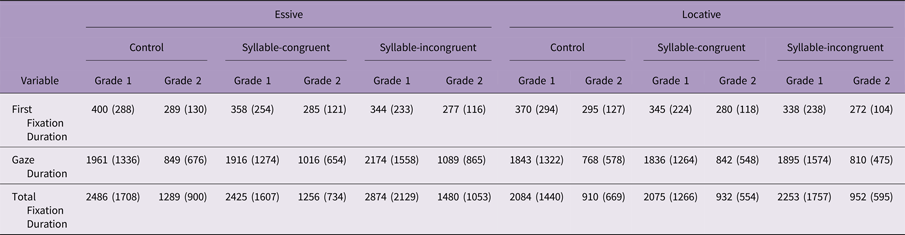
The non-transformed means and standard deviations for the dependent variables are presented in Table 3.
Non-transformed Means and Standard Deviations (in Parentheses) for the Dependent Variables in Milliseconds.

First Fixation Duration
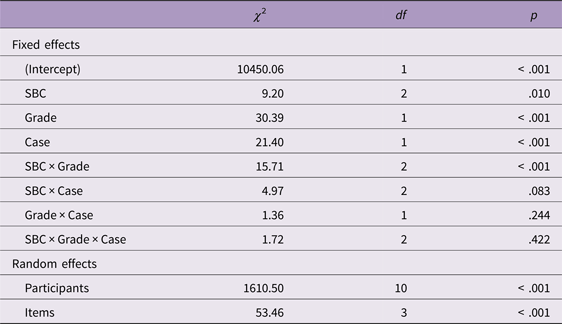
There were significant main effects of grade and syllable boundary cue (SBC). First-graders’ first fixations were longer than second-graders’ (B = .076, CI 95% [.026, .126]). Both the syllable-congruent and syllable-incongruent words elicited shorter first fixations than controls (z = 2.08, p = .037, and z = 2.91, p = .004, respectively). There were no interactions.
Gaze Duration
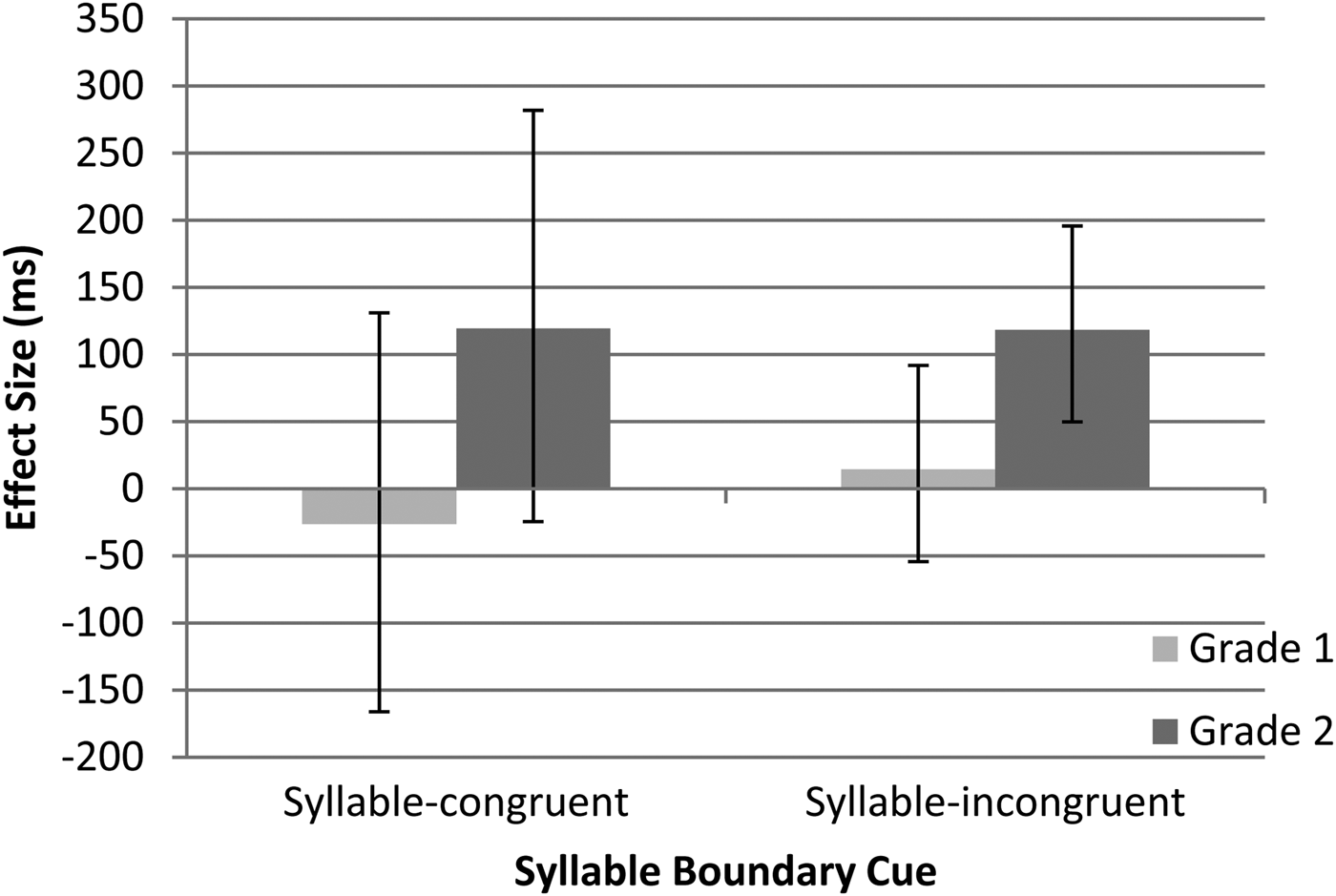
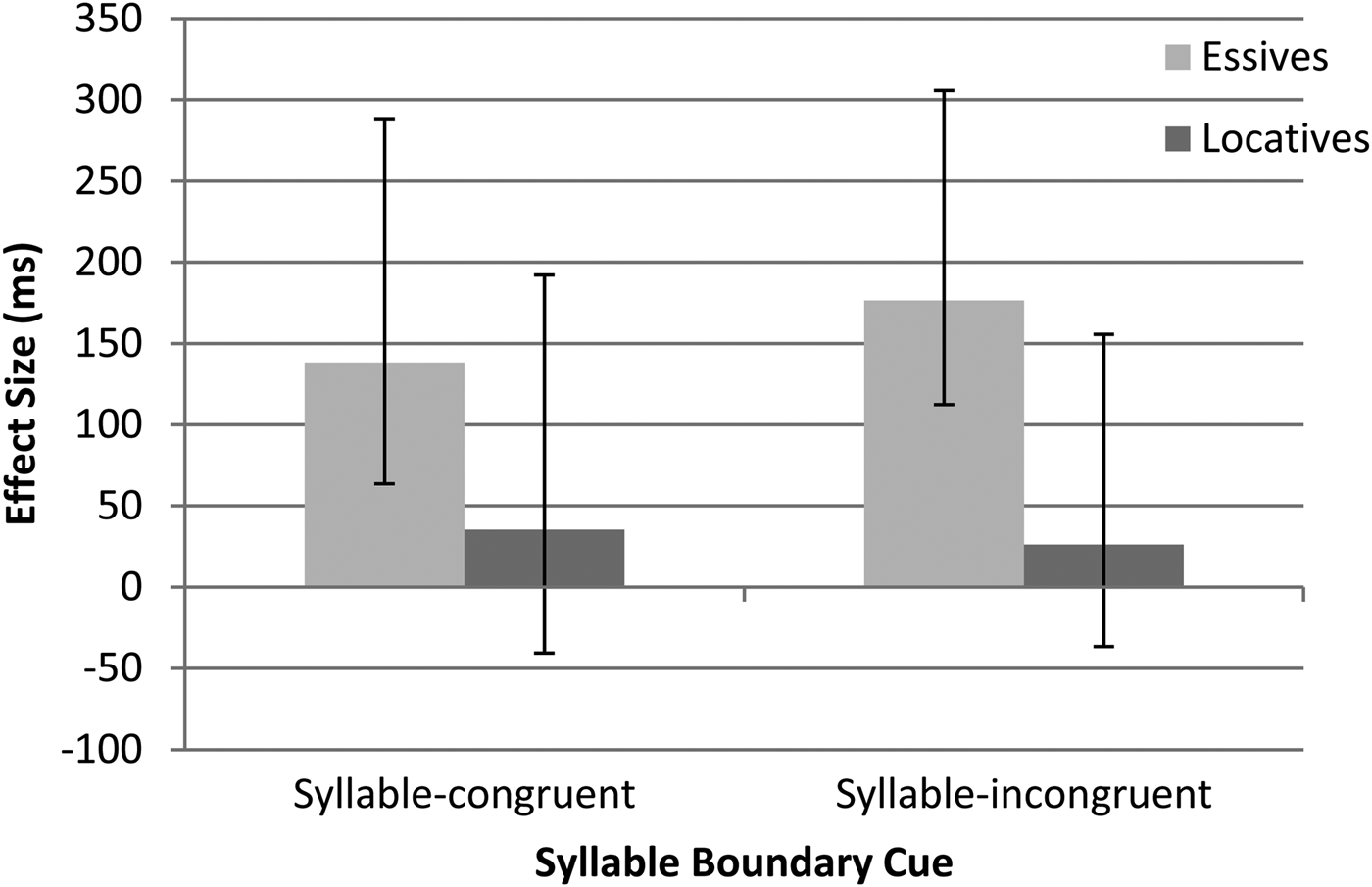
There were main effects of SBC, grade, and case. Both syllable-congruent and syllable-incongruent words were read slower than control words (z = –2.16, p = .031, and z = –2.85, p = .004, respectively). First-graders had longer GDs than second-graders (B = .372, [.239, .504]), and locatives were read faster than essives (B = .063, [.036, .089]). The main effect of SBC was qualified by a significant interaction between SBC and grade, and a marginal interaction between SBC and case. The nature of the interactions is depicted in Figures 1 and 2, in which the effect size of SBC is plotted (positive values denote slow-down in comparison to the control condition, negative values speed-up). With regard to the grade × SBC interaction, SBC did not affect first-graders’ reading (all |z| < 1). For second-graders, there was a slow-down caused by SBC; both the syllable-congruent and syllable-incongruent words elicited longer gaze durations than controls (z = –3.97, p < .001, and z = –4.61, p < .001, respectively). As seen in Figure 1, this effect was more reliable for words with syllable-incongruent hyphenation. With regard to case, essives were read slower in both the syllable-congruent and syllable-incongruent condition (z = –2.58, p = .010, and z = –3.56, p < .001, respectively), but this was not the case for locatives (all |z| < 1).
The effect size of Syllable Boundary Cue in relation to the control condition as a function of Grade on Gaze Duration (in ms). Positive values mean slow-down. The error bars denote 95% confidence intervals.

The effect size of Syllable Boundary Cue in relation to the Control condition as a function of Case on Gaze Duration (in ms). Positive values mean slow-down. The error bars denote 95% confidence intervals.

Total Fixation Duration
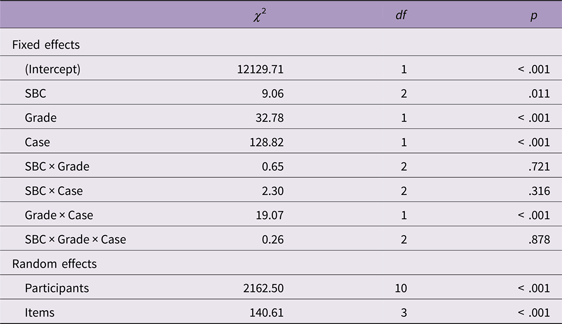
The main effects of SBC, grade, and case were significant. Syllable-incongruent hyphenation elicited longer TFDs than controls and syllable-congruent words (z = –2.91, p = .004, and z = –2.24, p = .025, respectively). First-graders had longer TFDs than second-graders (B = .371, [.244, .498]). Furthermore, locatives were read faster than essives (B = .138, [.114, .162]). Finally, there was a significant grade × case interaction. While locatives elicited shorter TFDs for both grades, the effect was more pronounced for the second-graders than for the first-graders (B = .524, [.437, .610], and B = .307, [.220, .394], respectively).
Discussion
In the present study, Finnish first- and second-graders read sentences with inflected target words. In the critical conditions, the target words were hyphenated so that the last hyphen was either syllable-congruent (e.g., ky-nä-nä) or syllable-incongruent (e.g., ky-nän-ä). The syllable-incongruent words were either morpheme-congruent (in the locative case, e.g., ky-nä-ssä, in which the first s of the morpheme suffix -ssä is part of the previous syllable) or morpheme-incongruent (in the essive case, e.g., ky-nän-ä, in which the n of the morpheme suffix -nä is also the first letter of the final syllable). It was shown that second-graders were slowed down by hyphenation to a larger extent, and that this effect was more reliable for the syllable-incongruent words. Overall, there was no slowdown in GD when the syllable-incongruent hyphen was morpheme-congruent (i.e., for locatives).
The lack of an effect in the syllable-incongruent but morpheme-congruent condition in GD suggests that early Finnish readers utilize morpheme-level information in word decoding. The lack of a three-way interaction suggests that this is already true for first-graders. When the hyphen was incongruent with both syllables and morphemes, there was a slowdown in TFD due to hyphenation disrupting processing of units larger than letters. These findings suggest that early Finnish readers are flexible in using both phonological syllable-level and orthographic morpheme-level units in word decoding. These findings are in line with those of Colé et al. (2011), who showed that French second-graders are flexible in using both syllables and morphemes in reading. However, our results seemingly go against those of Hasenäcker and Shcroeder (Reference Hasenäcker and Schroeder2017), who did not find morpheme-level effects for second-graders. The most likely reason for this discrepancy is that in the present study we used inflected words whereas Hasenäcker and Schroeder used derived words. It is likely that morphology plays a larger role in inflected than derived words, at least in Finnish. For instance, it has been demonstrated that, while adult readers routinely process the morphemes in inflected words, this is not always the case in derived words (e.g., Bertram, Laine, & Karvinen, Reference Bertram, Laine and Karvinen1999). Instead, it may be the case that the derived words are sometimes processed as wholes (e.g., kirjasto ‘library’), not via their parts (kirja + sto ‘book’+suffix for forming a collective noun). This is not true for the inflected words. Furthermore, even though inflections are also used in German, the inflectional morphology is richer in Finnish. For example, the suffixes used in the present study would be presented as prepositions in German (i.e., as separate words and not as morphemic suffixes). This more pronounced role of inflections may cause readers to extract morphological information at an earlier stage in Finnish than in German.
There was a difference between the cases in the syllable-congruent condition in GD. For the essives, there was a slow-down in relation to the control condition, but for the locatives there was no such effect. We think this stems from locatives being more frequent morphemes than essives. When a word has a more frequent suffix, the activation from the word parts makes the reading more fluent than with a less frequent suffix. Even when hyphenation disrupts word reading, simultaneous activation from a frequent morpheme may even out this effect. This finding further demonstrates the role of morphemes even during the first grade. This would also be in line with the finding that words with more frequent suffixes are read faster by Spanish second-graders (Lázaro et al., Reference Lázaro, Acha, de la Rosa, García and Sainz2017). As children have been exposed to words with locatives to a larger degree, one may also argue that they have developed sight vocabulary for some words in their locative forms. However, as our locative target words had an average surface frequency of 1.27 per million, it is not likely that our findings are largely affected by the heightened use of sight vocabulary.
Apart from the frequency differences, there are other possible confounds in the materials of the present study. For the locatives, the hyphen was moved towards the word beginning in the syllable-incongruent condition, whereas for the essives it was moved towards the word ending. For the essives, this formed a pseudo-word boundary at the syllable-incongruent boundary (i.e, the letter string prior to the syllable-incongruent hyphen could be perceived as a genitive). This was done in order to keep the conditions relatively comparable. To have a pure comparison, one should compare the same case in different conditions, but due to the nature of the language this is impossible. At any rate, this may have affected the word processing differently in the syllable-incongruent conditions as one could easily see the stem of the word in the locative case but a genitive form in the essive case. This may offer an alternative explanation for the slower performance in the syllable-incongruent essives. Readers may process the extra meaning for the letter string, which in turn slows down their reading. However, even this explanation suggests that early Finnish readers utilize morpheme-level information, as the letter string in question was a bimorphemic word. Furthermore, as essives and locatives required using different carrier sentences, this may have affected the target word processing. However, the sentence beginnings were kept as neutral as possible, and the target word location was very similar between the conditions (on average 3.52 and 3.43 for essives and locatives, respectively). Therefore, we do not think that these differences account for the differential processing of the cases with regard to SBC in GD.
Finally, hyphenation speeded up first fixations regardless of the congruency; early decoding was facilitated by small units being explicitly signaled. We think the lack of the congruency effect is due to the manipulation being located close to the word ending which is likely not attended to during initial word decoding for early readers.
All in all, word decoding is flexible even for Finnish first-graders; they can utilize both syllable-level and morpheme-level information. This fits well with the multiple-route model of orthographic processing (Grainger & Ziegler, Reference Grainger and Ziegler2011). However, more research is needed to find out under which circumstances these units become active.
Acknowledgements
We would like to thank Sascha Schroeder and an anonymous reviewer for their valuable comments on the earlier version of the manuscript. The second author was supported by a grant to Jukka Hyönä from Jane ja Aatos Erkon Säätiö (Jane and Aatos Erkko Foundation).
Appendix 1
Lists of materials.
Target Words in Each Condition and Frequencies of Each Word Form. For Essives, the Syllable-incongruent Condition Is Also Morpheme-incongruent. For Locatives, the Syllable-incongruent Condition is Morpheme-congruent.

Sentences Used in the Study. Target Words Are in Bold.

Appendix 2
Models for each measure.
First Fixation Duration: Results from the Model lmer(ffd~sbc*grade*case + (1 + sbc|participant) + (1 + grade|item),data)

Gaze Duration: Results from the Model lmer(gaze~sbc*grade*case + (1 + sbc + case|participant) + (1 + grade|item),data)

Total Fixation Duration: Results from the Model lmer(tfd~sbc*grade*case + (1 + sbc + case|participant) + (1 + grade|item),data)