I. INTRODUCTION
As a powerful tool for phase identification and quantitative phase analysis (QPA), X-ray powder diffraction has been extensively applied in both research and industry. The essential principle for QPA is that the diffraction intensities of a component phase are proportional to its abundance in the mixture. Nevertheless, different crystalline phases have various coherent scattering powers. Therefore, the diffraction intensities of the component phases in a mixture cannot be compared with each other directly and then related to the abundance of a component phase. Indeed, the diffraction intensities of each phase in the mixture have to be normalized by its coherent scattering power before it can be related to the abundance of the corresponding phase.
The structure factor is the amplitude of coherent scattering from the contents of one unit cell of a crystalline phase. The intensity of a certain reflection is proportional to the squared structure factor when experimental parameters, such as Lorentz-polarization factors, are taken into accounts. Then, the total coherent scattering power per unit cell of a crystal can be well represented by the sum of the squared structure factors over all possible reflections. The structure factor can be readily calculated when the atomic arrangement in the unit cell is known:
 $$F_h = \sum f_i( h ) \exp ( {i2\pi {\boldsymbol h}\cdot {\boldsymbol r}_{\boldsymbol i}} ) $$
where Fh is the structure factor, fi is the atomic scattering factor of the ith atom in the unit cell, h is the diffraction vector, and r is the positional vector of the ith atom.
Then, the total coherent scattering power per unit cell of a certain crystal,  $\sum\nolimits_h {{\vert {F_h} \vert }^2}$, can be determined (note that the multiplicity of reflection is already included in the value of
 $\sum\nolimits_h {{\vert {F_h} \vert }^2}$, as h includes all possible reflection indices, not just one per symmetrically equivalent group). If the crystal structure data is available for all the phases in the mixture, the abundance of each component phase can be deduced from the observed diffraction intensities normalized by the total coherent scattering power per unit cell of the corresponding phase.
The crystal structure data is not always available for each phase in the mixture to be quantitatively analyzed. Many methods have been developed for QPA, and some of them can be applied to analyze samples consisting of crystalline phases with unknown crystal structures, such as the internal standard method (Clark and Reynolds, Reference Clark and Reynolds1936; Alexander and Klug, Reference Alexander and Klug1948) and the spiking method (Copeland and Bragg, Reference Copeland and Bragg1958). With these methods, one does not need the crystal structure data of the component phases to deduce the fraction of each phase from the observed X-ray powder diffraction data. Nevertheless, additional samples, such as the pure phase of the target component and the investigated mixtures spiked with a known amount of the target phase or standard reference materials, have to be prepared, and each of them has to be measured with X-ray powder diffraction. Therefore, the process of QPA based on these methods is experimentally tedious and time-consuming. A concept of reference intensity ratio (RIR) has been developed by the Joint Committee on Powder Diffraction Standards since 1970 (Berry, Reference Berry1970; Gates-Rector and Blanton, Reference Gates-Rector and Blanton2019) for “rough quantitative X-ray diffraction analysis of mixtures.” When a crystalline phase is mixed with common reference material (usually corundum) with a weight ratio of 1:1, then the intensity ratio of the strongest reflection of each phase is defined as RIR. Based on the RIR, Chung (Reference Chung1974a, Reference Chung1974b) developed the “matrix flushing theory” and the “adiabatic principle,” which greatly simplify the process of QPA. If the RIR of each component phase in a mixture is known, then the abundance of a component phase can be derived directly from the X-ray powder diffraction data. Unfortunately, the RIR is not always available for phases to be quantitatively analyzed. It is especially true for new phases encountered in research and development activities. More importantly, the intensity ratio between the target phase and the reference material depends on the specimen preparation and experimental parameters of the X-ray diffraction data collection. Therefore, samples affected by preferred orientation are not suitable to be analyzed with the RIR method since RIRs listed in the ICDD PDFs are defined for randomly oriented samples. In addition, the RIR method utilizes only the intensity information of the strongest reflection, which is very sensitive to the specimen preparation and experimental parameters of data collection. In Reference Scarlett and Madsen2006, Scarlett and Madsen proposed a method to quantitatively analyze the mixture including partial or no known crystal structures (so-called PONKCS). However, this method is applicable only for cases where the pure phase of PONKCS is available, or at least, PONCKS exists as a dominant phase in the sample. Furthermore, the X-ray powder diffraction pattern of the mixture of PONCKS and reference material has to be measured to perform quantitative analysis. In recent years, Toraya (Reference Toraya2016, Reference Toraya2017, Reference Toraya2018, Reference Toraya2019) proposed a new method for QPA, which derives the abundance of the component phase from the diffraction intensities and the chemical composition of the target phase. This method enables the QPA for samples including phases with unknown crystal structures, while no additional auxiliary samples and diffraction datasets are necessary. In this method, the total coherent scattering power per unit cell of a component phase was estimated using the product of the unit cell volume and the sum of the squared electron numbers of each atom over the whole unit cell. Namely, the total coherent scattering power per unit cell was assessed by
 $$\sum\limits_h {{\vert {F_h} \vert }^2 = } CU\sum\limits_{i = 1}^N {n_i^2 } $$
where C is a proportional constant, U is the unit cell volume, ni is the electron number of the ith atom in the unit cell, and N is the total number of atoms in the unit cell.
Unfortunately, Eq. (2) was derived from an assumption that the peak height of the Patterson function at the origin can be approximated by the integrated convoluted electron density of the peak. This assumption has no solid theoretical foundation or logical proof. Moreover, to apply Eq. (2) in QPA, the proportional constant C has to be assumed to be common to, and independent of, the various component phases in the investigated mixture. Actually, there is no theoretical evidence for the assumption of “common C.”
Here, we present a new method to calculate the total coherent scattering power per unit cell of crystalline phases with unknown atomic arrangements in the unit cell. All information needed to implement the calculation is the unit cell parameters and the chemical contents of the unit cell, namely, the species and numbers of atoms in the unit cell. The approach to quantitatively analyze the abundance of crystalline phases with unknown atomic arrangements in the unit cells has been developed based on our new method for the calculation of the total coherent scattering power of crystals. The validity of both the method of calculating the total coherent scattering power per unit cell and the approach of QPA is verified.
II. THEORY
A. Calculation of the total coherent scattering power per unit cell of crystals using the unit cell parameters and the chemical contents of the unit cell
The structure factor, Fh, of a crystal with an electron density distribution of ρ(r) in its unit cell is the Fourier transform of ρ(r), namely,
 $$F_h = \int_U {\rho ( {\boldsymbol r} ) \exp ( {i2\pi {\boldsymbol h}\cdot {\boldsymbol r}} ) {\rm d}v } $$
where dv is a volume element of the unit cell at position r.
According to Parseval's theorem, the integral of the square of a function f(x) is equivalent to the integral of the square of the Fourier transform of f(x) (Pollard, Reference Pollard1926; Hughes, Reference Hughes1965). Applying Parseval's theorem to Eq. (3), then we have
 $$\displaystyle{1 \over U}\sum\limits_h {{\vert {F_h} \vert }^2} = \int_U {\rho ^2( {\boldsymbol r} ) {\rm d}v} $$
In a crystal, the electron density distribution of a constituent atom will be slightly different from that of a free atom of the same species because of the formation of chemical bonding. Nevertheless, the difference is so small that it can be detected only by very accurate X-ray diffraction measurements, and is negligible for routine X-ray diffraction measurements. Thus, for routine X-ray diffraction measurements, the electron density distribution in the unit cell of a crystal may be approximately taken as the sum of the electron density of a series of free atoms, each of which is of the same species and position as the corresponding constituent atoms in the unit cell of the crystal. Namely,
 $$\rho ( {\boldsymbol r} ) = \sum\limits_{i = 1}^N {\rho _i( {{\boldsymbol r}_{\boldsymbol i}} ) } $$
where ρ i(ri) is the electron density distribution of a free atom, which is of the same species and position as the ith constituent atom in the unit cell.
As the overlap of electron density between adjacent atoms is negligible, we have
 $$\int_U {\rho ^2( {\boldsymbol r} ) {\rm d}v = \int_U {\left[{\sum\limits_{i = 1}^N {\rho_i( {{\boldsymbol r}_{\boldsymbol i}} ) } } \right]} } ^2{\rm d}v = \int_U {\sum\limits_{i = 1}^N {\rho _i^2 ( {{\boldsymbol r}_{\boldsymbol i}} ) {\rm d}v = } } \sum\limits_{i = 1}^N {\int_U {\rho _i^2 ( {{\boldsymbol r}_{\boldsymbol i}} ) {\rm d}v} } $$
Let us consider a hypothetical crystal, which has the same unit cell as that of the crystal under study. There is only one atom in the unit cell of the hypothetical crystal, and the only atom is of the same species as the ith atom in the unit cell of the crystal under study and located at the origin of the unit cell of the hypothetical crystal. Then the structure factor of the hypothetical crystal is given by
 $$F_{i, {\boldsymbol {h}^{\prime}}} = \sum f_i( {{\boldsymbol {h}^{\prime}}} ) \exp ( {i2\pi {\boldsymbol {h}^{\prime}}\cdot {\boldsymbol {r}^{\prime}}} ) = f_i( {{\boldsymbol {h}^{\prime}}} ) \equiv f_{i, {h}^{\prime}}$$
or
 $$F_{i, {h}^{\prime}} = \int_U {\rho _i( {{\boldsymbol {r}^{\prime}}} ) \exp ( {i2\pi {\boldsymbol {h}^{\prime}}\cdot {\boldsymbol {r}^{\prime}}} ) {\rm d}v} $$
where  $F_{i, {\boldsymbol {h}^{\prime}}}$ is the structure factor of the hypothetical crystal, h′ and r′ are the diffraction vector and positional vector of the hypothetical crystal, respectively, f i(h′) is the atomic scattering factor of the constituent atom of the hypothetical crystal, and
 $\rho _i( {{\boldsymbol {r}^{\prime}}} )$ is the electron density distribution in the unit cell of the hypothetical crystal.
Applying the Parseval theorem to Eq. (8), then we have
 $$\displaystyle{1 \over U}\sum\limits_{{h}^{\prime}} {{\vert {F_{i, {h}^{\prime}}} \vert }^2 = \int_U {\rho _i^2 ( {{\boldsymbol {r}^{\prime}}} ) {\rm d}v} } $$
Combining Eqs (7) and (9), we have
 $$\int_U {\rho _i^2 ( {{\boldsymbol {r}^{\prime}}} ) {\rm d}v = \displaystyle{1 \over U}\sum\limits_{{h}^{\prime}} {\,f_{i, {h}^{\prime}}^2 } } $$
The only difference between  $\rho _i( {{\boldsymbol {r}^{\prime}}} )$ and
 $\rho _i( {{\boldsymbol {r}_i}} )$ is a positional translation. Then combining Eqs (4), (6), and (10), we have
 $$\sum\limits_h {{\vert {F_h} \vert }^2} = \sum\limits_{i = 1}^N {\sum\limits_{{h}^{\prime}} {\,f_{i, {h}^{\prime}}^2 } } $$
Using Eq. (11), we can calculate the total coherent scattering power per unit cell of a crystal without knowing the atomic arrangement in the unit cell. All we need to perform the calculation are the unit cell parameters and the chemical contents of the unit cell.
B. Application in the QPA
For X-ray powder diffraction in the Bragg–Brentano geometry, the intensity of reflection h of the jth component phase in a mixture consisting of J phases is given by
 $$I_{\,j, h} = \displaystyle{{e^4} \over {32\pi m^2c^4}}I_0\displaystyle{{\lambda ^3} \over R}G_{\,j, h}\displaystyle{v \over {2\mu }}\displaystyle{{v_j} \over {U_j^2 }}\vert {F_{\,j, h}} \vert ^2$$
where Ij,h is the intensity of reflection h of the jth component phase, e and m are the charge and mass of an electron, respectively, c is the speed of light, I 0 is the intensity of the incident X-ray beam illuminating the sample, λ is the wavelength of X-ray, R is the radius of the goniometer of the diffractometer, μ is the linear absorption coefficient of the sample, v is the volume of the sample irradiated by the X-ray, vj is the volume fraction of the jth phase, Gj,h is the Lorentz-polarization factor corresponding to the reflection h of the jth phase.
For X-ray powder diffraction in the Bragg–Brentano geometry, we have
 $$G_{\,j, h} = \displaystyle{{1 + {\rm co}{\rm s}^22\theta _M{\rm co}{\rm s}^22\theta } \over {{\rm si}{\rm n}^2\theta {\rm cos}\theta ( {1 + {\rm co}{\rm s}^22\theta_M} ) }}$$
where θM is the Bragg angle of the monochromator and θ is the Bragg angle of the powder diffraction. Gj,h is dependent on the diffraction angle, and then subsequently dependent indirectly on the reflection index h. Gj,h can be calculated for each reflection of the jth phase when its unit cell parameters are known.
If we define a proportionality factor K as
 $$K = \displaystyle{{e^4} \over {32\pi m^2c^4}}I_0\displaystyle{{\lambda ^3} \over R}\displaystyle{v \over {2\mu }}, \;$$
then K is constant for all phases in the sample, and Eq. (12) is transformed into
 $$I_{\,j, h} = K\displaystyle{{v_j} \over {U_j^2 }}G_{\,j, h}\vert {F_{\,j, h}} \vert ^2$$
Then the sum of the diffraction intensity of the jth phase is given by
 $$\sum\limits_h {I_{\,j, h}} = \sum\limits_h K \displaystyle{{v_j} \over {U_j^2 }}G_{\,j, h}\vert {F_{\,j, h}} \vert ^2$$
So that the volume fraction of the jth phase can be derived:
 $$v_j = \displaystyle{{U_j^2 \sum\nolimits_h {I_{\,j, h}/G_{\,j, h}} } \over {K\sum\nolimits_h {{\vert {F_{\,j, h}} \vert }^2} }}$$
According to Eq. (11), the volume fraction of the jth phase can also be calculated using the chemical contents of the unit cell instead of the structure factors:
 $$v_j = \displaystyle{{U_j^2 \sum\nolimits_h {I_{\,j, h}/G_{\,j, h}} } \over {K\sum\nolimits_{i = 1}^N {\sum\nolimits_{{h}^{\prime}} {\,f_{j, i, {h}^{\prime}}^2 } } }}$$
where  $f_{j, i, {h}^{\prime}}$ is the atomic scattering factor of the ith atom in the unit cell of the jth phase.
The volume fraction can be readily converted to the weight fraction by
 $$w_j = \displaystyle{{\rho _jv_j} \over {\sum\nolimits_{{\,j}^{\prime} = 1}^J {\rho _{{\,j}^{\prime}}v_{{\,j}^{\prime}}} }} = \displaystyle{{\displaystyle{{M_jZ_jv_j} \over {U_j}}} \over {\sum\nolimits_{{\,j}^{\prime} = 1}^J {\displaystyle{{M_{{\,j}^{\prime}}Z_{{\,j}^{\prime}}v_{{\,j}^{\prime}}} \over {U_{{\,j}^{\prime}}}}} }} = \displaystyle{{\displaystyle{{M_jZ_jU_j\sum\nolimits_h {( I_{\,j, h}/G_{\,j, h}) } } \over {\sum\nolimits_{i = 1}^N {\sum\nolimits_{{h}^{\prime}} {\,f_{\,j, i, {h}^{\prime}}^2 } } }}} \over {\sum\nolimits_{{\,j}^{\prime} = 1}^J {\displaystyle{{M_{{\,j}^{\prime}}Z_{{\,j}^{\prime}}U_{{\,j}^{\prime}}\sum\nolimits_h {( I_{{\,j}^{\prime}, h}/G_{{\,j}^{\prime}, h}) } } \over {\sum\nolimits_{{i}^{\prime} = 1}^{{N}^{\prime}} {\sum\nolimits_{{h}^{\prime}} {\,f_{{\,j}^{\prime}, {i}^{\prime}, {h}^{\prime}}^2 } } }}} }}$$
where wj is the weight fraction of the jth phase, ρ j, Mj, and Zj are the density, the chemical formula weight, and the number of chemical formula units in the unit cell of the jth component phase, respectively.
The weight fraction of each crystalline component in the mixture can be calculated using Eq. (18), while all information required to perform the calculation is the unit cell parameters and the chemical contents of the unit cell of each phase in addition to an X-ray powder diffraction pattern of the mixture. Neither pure phase of the component, reference materials, additional auxiliary samples, and diffraction datasets nor atomic arrangements in the unit cell, or RIR information is necessary. Of course, if atomic arrangements in the unit cell are known for some components,  $\sum\nolimits_h {{\vert {F_h} \vert }^2}$ in place of
 $\sum\nolimits_{i = 1}^N {\sum\nolimits_{{h}^{\prime}} {f_{i, {h}^{\prime}}^2 } }$ can be calculated and used in Eq. (18) for these phases.
III. VALIDATION AND DISCUSSION
A. Consistency between  $\sum\nolimits_{\boldsymbol h} {{\vert {{\boldsymbol F}_{\boldsymbol h}} \vert }^2}$ and $\sum\nolimits_{{\boldsymbol i} = 1}^{\boldsymbol N} {\sum\nolimits_{{\boldsymbol {h}^{\prime}}} {{\boldsymbol f}_{{\boldsymbol i}, {\boldsymbol {h}^{\prime}}}^2 } }$


Theoretically, Eq. (11) is valid only when the overlapped electron density of adjacent atoms is negligible and all possible reflections are taken into account. Actually, it is a reasonable approximation for a regular X-ray diffraction measurement that the overlapped electron density is negligible. Nevertheless, only reflections below a certain upper limit of the diffraction angle can be measured in a practical X-ray diffraction measurement. To apply Eq. (11) in analyzing the practical X-ray diffraction data, its validity has to be checked when only reflections in a limited diffraction angle range are available. Here we calculated both  $\sum\nolimits_h {{\vert {F_h} \vert }^2}$ and
 $\sum\nolimits_{i = 1}^N {\sum\nolimits_{{h}^{\prime}} {f_{i, {h}^{\prime}}^2 } }$ for several crystalline phases, namely Si, NaCl, α-Al2O3, Li2CO3, and Ag2Te (Hessite). The crystal structure data of these phases are obtained from the literature (Swanson and Fuyat, Reference Swanson and Fuyat1953; Parrish, Reference Parrish1960; Effenberger and Zemann, Reference Effenberger and Zemann1979; Van Der Lee and De Boer, Reference Van Der Lee and De Boer1993; Pillet et al., Reference Pillet, Souhassou, Lecomte, Schwarz, Blaha, Rérat, Lichanot and Roversi2001). The wavelength corresponding to CuKα radiation was assumed and the upper limit of the diffraction angle (2θ) was set to be 60, 80, 100, 120, and 140°. The calculation of
 $\sum\nolimits_h {{\vert {F_h} \vert }^2}$ and
 $\sum\nolimits_{i = 1}^N {\sum\nolimits_{{h}^{\prime}} {f_{i, {h}^{\prime}}^2 } }$ for Ag2Te and the corresponding results are presented in details as Supplementary Files to illustrate the implementation of our calculations. It is well known that atoms in a real crystal are vibrating about their equilibrium positions, and the atomic displacements reduce the atomic scattering factors in a way described as follows:
 $$f_i = f_{i, 0}{\rm exp}\left({-8\pi^2\left\langle { {u^2} \rangle } \right.{\rm si}{\rm n}^2\theta /\lambda^2} \right)$$
where f i,0 is the atomic scattering factor on which the effect of atomic displacement is not taken into account, and 〈u 2〉 is the mean-squared atomic displacement from the equilibrium position.
Then both  $\sum\nolimits_h {{\vert {F_h} \vert }^2}$ and
 $\sum\nolimits_{i = 1}^N {\sum\nolimits_{{h}^{\prime}} {f_{i, {h}^{\prime}}^2 } }$ are affected by the atomic displacements, and the consistency between them may also be influenced. We calculated
 $\sum\nolimits_h {{\vert {F_h} \vert }^2}$ and
 $\sum\nolimits_{i = 1}^N {\sum\nolimits_{{h}^{\prime}} {f_{i, {h}^{\prime}}^2 } }$ with the assumption 〈u 2〉 = 0 for all atoms, and the ratios of
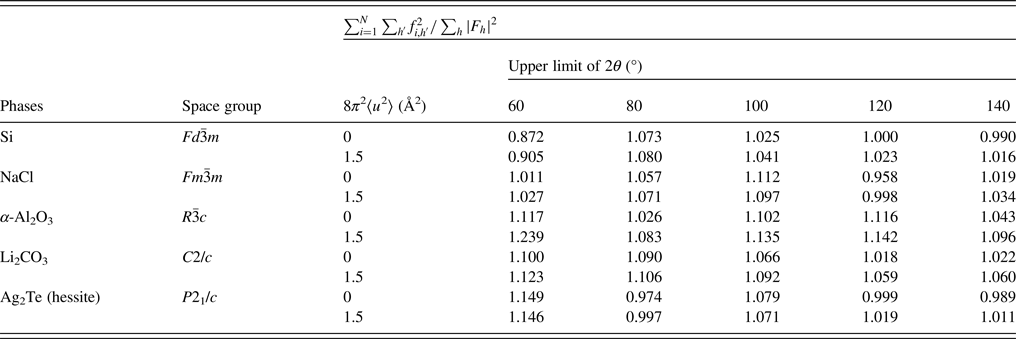
 $\sum\nolimits_{i = 1}^N {\sum\nolimits_{{h}^{\prime}} {f_{i, {h}^{\prime}}^2 } } /\sum\nolimits_h {{\vert {F_h} \vert }^2}$ are presented in Table I. A discrepancy in the range of 10%–15% was observed between
 $\sum\nolimits_h {{\vert {F_h} \vert }^2}$ and
 $\sum\nolimits_{i = 1}^N {\sum\nolimits_{{h}^{\prime}} {f_{i, {h}^{\prime}}^2 } }$ at the upper limit of scattering angle of 60° for all phases except for NaCl, for which the discrepancy is as low as about 1%. When the upper limit of 2θ increases to 80° or higher, generally, smaller inconsistencies between
 $\sum\nolimits_h {{\vert {F_h} \vert }^2}$ and
 $\sum\nolimits_{i = 1}^N {\sum\nolimits_{{h}^{\prime}} {f_{i, {h}^{\prime}}^2 } }$ are observed. The largest discrepancy, 11.6%, was observed for α-Al2O3 at the upper limit of 2θ of 120°, while in most cases the discrepancy is below 10%. As evidenced by the case study,
 $\sum\nolimits_{i = 1}^N {\sum\nolimits_{{h}^{\prime}} {f_{i, {h}^{\prime}}^2 } }$ is a reasonable approximation of
 $\sum\nolimits_h {{\vert {F_h} \vert }^2}$ when a sufficient number of reflections are taken into account. For a regular X-ray powder diffraction measurement using CuKα radiation, an upper limit of 2θ of 80° seems to be adequate for validating the approximation given in Eq. (11). We also noted that the ratios of
 $\sum\nolimits_{i = 1}^N {\sum\nolimits_{{h}^{\prime}} {f_{i, {h}^{\prime}}^2 } } /\sum\nolimits_h {{\vert {F_h} \vert }^2}$ fluctuate with the increase of the upper limit of 2θ until 140°, rather than converge to 1. This results from the fact that reflections of crystals are distributed in the observed 2θ range discretely and irregularly. It is also noteworthy that the ratios of
 $\sum\nolimits_{i = 1}^N {\sum\nolimits_{{h}^{\prime}} {f_{i, {h}^{\prime}}^2 } } /\sum\nolimits_h {{\vert {F_h} \vert }^2}$ observed for Li2CO3 and α-Al2O3 are always greater than 1, while the ratios observed for other phases fluctuate around 1. Compared with other phases, Li2CO3 and α-Al2O3 consist of atoms with a lower average atomic number. It is not clear yet that this is just an occasional phenomenon or there is regularity behind it.
 $\sum\nolimits_{i = 1}^N {\sum\nolimits_{{h}^{\prime}} {f_{i, {h}^{\prime}}^2 } } /\sum\nolimits_h {{\vert {F_h} \vert }^2}$ calculated for several crystalline phases with the assumption 8π 2〈u 2〉 = 0 and 1.5 Å2, respectively.

B. Effect of atomic displacement parameters on the consistency
We re-calculated  $\sum\nolimits_h {{\vert {F_h} \vert }^2}$ and
 $\sum\nolimits_{i = 1}^N {\sum\nolimits_{{h}^{\prime}} {f_{i, {h}^{\prime}}^2 } }$ reported in Section III.A with the assumption 8π 2〈u 2〉 = 1.5 Å2 for all atoms to illustrate the effect of atomic displacement on the consistency between them. The recalculated ratios of
 $\sum\nolimits_{i = 1}^N {\sum\nolimits_{{h}^{\prime}} {f_{i, {h}^{\prime}}^2 } } /\sum\nolimits_h {{\vert {F_h} \vert }^2}$ were also presented in Table I in comparison with the results obtained with the assumption 〈u 2〉 = 0 Å2. As shown in Table I, generally, the consistency between
 $\sum\nolimits_h {{\vert {F_h} \vert }^2}$ and
 $\sum\nolimits_{i = 1}^N {\sum\nolimits_{{h}^{\prime}} {f_{i, {h}^{\prime}}^2 } }$ did not improve when 8π 2〈u 2〉 = 1.5 Å2 was assumed for all atoms. Actually, in most cases, the ratios of
 $\sum\nolimits_{i = 1}^N {\sum\nolimits_{{h}^{\prime}} {f_{i, {h}^{\prime}}^2 } } /\sum\nolimits_h {{\vert {F_h} \vert }^2}$ increased in comparison with their counterparts calculated by assuming 〈u 2〉 = 0 Å2. Based on these limited preliminary results, it seems reasonable to assume 〈u 2〉 = 0 Å2 when one calculates
 $\sum\nolimits_{i = 1}^N {\sum\nolimits_{{h}^{\prime}} {f_{i, {h}^{\prime}}^2 } }$ as an approximation of
 $\sum\nolimits_h {{\vert {F_h} \vert }^2}$.
C. Quantitative phase analysis
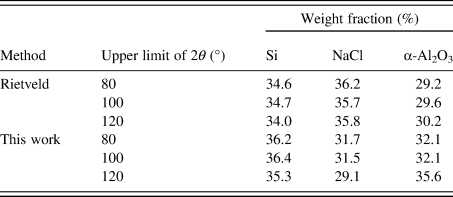
A mixture of Si, NaCl, and α-Al2O3 with the weight ratio of 1:1:1 was prepared, and the X-ray powder diffraction data of the mixture was collected using a Bruker D8 Advance diffractometer, which is operated in Bragg–Brentano geometry and equipped with CuKα irradiation. The powder pattern was shown in Figure 1. Equation (18) was applied to analyze the powder diffraction data and derive the weight fractions of the component phases. The integrated intensity of each reflection of each component phase, namely Ijh in Eq. (18), was retrieved from the powder pattern using pattern decomposition techniques proposed by Le Bail et al. (Reference Le Bail, Duroy and Fourquet1988). Although the experimental data was collected in the 2θ range of 20–125°, the upper limit of 2θ was set to 80, 100, and 120°, respectively, in the QPA to illustrate the effect of the upper limit of 2θ on the quality of QPA. The crystal structure data of Si and NaCl was used to calculate  $\sum\nolimits_h {{\vert {F_h} \vert }^2}$, while α-Al2O3 was treated as a phase with unknown atomic arrangements in the unit cell, and the chemical contents of its unit cell were used to calculate
 $\sum\nolimits_{i = 1}^N {\sum\nolimits_{{h}^{\prime}} {f_{i, {h}^{\prime}}^2 } }$. All possible reflections below the upper limit of 2θ were included in the calculation, and atomic displacements were not taken into account. The results of the QPA were presented in Table II. The phase abundance derived with the Fullprof program (Rodríguez-Carvajal, Reference Rodríguez-Carvajal1993), which implemented the whole profile fitting method proposed by Rietveld (Reference Rietveld1969), was also listed in Table II for comparison. The experimental powder pattern and the input, out files of the program Fullprof to perform pattern decomposition or Rietveld refinement were given as Supplementary Files. In this case study, the quality of QPA using both methods seems to be comparable, as indicated by the similar deviations of the derived weight fractions from the “true” value, 33.3%. Nevertheless, the weight fractions derived using our method fluctuate with the upper limit of 2θ more greatly than the values obtained with whole profile fitting techniques. This characteristic reflects the difference between these two methods in the fundamental: the method proposed in this study quantifies the weight fraction of the target phase in a mixture using the sum of integrated intensities in a certain range of diffraction angle, while the whole profile fitting technique measures the quantity of a component phase using the scale factor of the target phase's profile with the Hill and Howard (Reference Hill and Howard1987) algorithm. The scale factor of the target phase’ profile, theoretically, will not change with the range of 2θ, but the sum of the integrated intensities of the target phase will change greatly with the range of 2θ. In principle, when sufficient reflections are included in the calculation, the phase abundance derived with our method will converge to the “true” value. The example given here indicates that an X-ray powder diffraction pattern with an upper limit of 2θ = 80° (for CuKα irradiation) seems to be adequate for QPA. In comparison with the whole profile fitting techniques, the method proposed here has the advantage that QPA can be performed when only the unit cell parameters and the chemical contents of the unit cell are known, and one does not have to know the atomic arrangements in the unit cells of all component phases.
X-ray powder diffraction pattern of a mixture of Si, NaCl, and α-Al2O3 with the weight ratio of 1:1:1. The vertical axis is in sqrt scale to give greater clarity to small peaks. Vertical short bars from top to bottom line indicate the Bragg reflection positions of Si, NaCl,and α-Al2O3, respectively.

Results of QPA on a mixture of Si, NaCl, and α-Al2O3 with the weight ratio of 1:1:1.

SUPPLEMENTARY MATERIAL
The supplementary material for this article can be found at https://doi.org/10.1017/S0885715621000609.
ACKNOWLEDGEMENTS
The authors would like to thank Ms. WANG Qingqing of the Tianmu Lake Institute of Advanced Energy Storage Technologies for collecting the X-ray powder diffraction data. H.L. and M.H. are very grateful to Prof. LI Jia-Ju of the Institute of Geology and Geophysics, Chinese Academy of Science for his consistent support and encouragement.
FUNDING INFORMATION
This work was financially supported by the National Natural Science Foundation of China (Grant No. 11574060).