Introduction
With increased recognition and use of traditional environmental knowledge of northern peoples, and other indigenous groups, the literature on the subject has greatly increased since the 1990s. Controversial as it is, documenting this knowledge has been of interest to a number of different audiences including scholars, environmental managers, policy makers, educators, and the indigenous communities themselves. For environmental managers, for example, traditional environmental knowledge has been of importance in environmental assessment (McDonald and others Reference McDonald, Arragutainaq and Novalinga1997), wildlife (Kendrick and others Reference Kendrick, Lyver and Lutsel K'e Dene First Nation2005; Parlee and others Reference Parlee and Manseau2005a), forestry (Atleo Reference Atleo2004; Menzies Reference Menzies2006) and non-timber forest products (Turner Reference Turner2004), climate change research (Cruikshank Reference Cruikshank2001; Nichols and others Reference Nichols, Berkes, Jolly, Snow and the Community of Sachs Harbour2004), co-management (Stevenson Reference Stevenson2006), protected areas, integrated management, northern contaminants and other fields of study (Berkes and others Reference Berkes, Diduck, Fast, Huebert and Manseau2005).
In the area of policy, indigenous knowledge is important for cultural decolonisation (Simpson Reference Simpson and Taylor2005) and co-existence (McGregor Reference McGregor, Blaser, Feit and McRae2004), and Inuit qaujimajatuqangit (IQ) has been of interest to Nunavut policy makers (Wenzel Reference Wenzel2004). In the area of education, knowledge of the land has become a key area for educating the youth in culturally relevant ways (Takano Reference Takano2005). Furthermore, a number of traditional environmental knowledge documents have been prepared primarily with the political, cultural and educational needs of the community in mind (Freeman Reference Freeman1976; Bearskin and others Reference Bearskin, Lameboy, Matthew, Pepabano, Pisinaquan, Ratt, Rupert and Berkes1989; Gwich'in Elders 1997; Oozeva and others Reference Oozeva, Noongwook, Alowa and Krupnik2004). Many of these authors are aboriginal people themselves, and there is a growing presence of aboriginal scholars in the field (Battiste and Youngblood Henderson Reference Battiste and Youngblood Henderson (Sa'ke'j)2000; Andre and Fehr Reference Andre and Fehr2001; Atleo Reference Atleo2004; Bird Reference Bird2005; Simpson Reference Simpson and Taylor2005; McGeregor 2004; Menzies Reference Menzies2006).
Although it is known that there are a number of distinct audiences for traditional environmental knowledge, little work has been done in analysing how indigenous knowledge can be communicated to multiple audiences. Are there different kinds of traditional environmental knowledge of interest to northern communities, students, hunter and trapper organizations, scientists, policy makers and co-management bodies? What different media types or modes of communication can be used to communicate with these different audiences? The challenge is to find means to record effectively and to communicate traditional knowledge for multiple purposes. Traditional knowledge documents must be culturally appropriate and acceptable to local people, and also be usable in a variety of areas such as the management of resources, the documentation of local history, and the provision of cultural education. Given that there is now a substantial accumulation of these traditional knowledge documents, we can begin to discuss how best to communicate the traditional knowledge contained therein.
The objectives of this paper are to investigate how to approach the challenge of collecting and communicating different kinds of traditional environmental knowledge for a range of purposes; the media types (communication modes) that are available and have been used; and the appropriateness of these kinds of media for communicating traditional environmental knowledge to a diversity of audiences. Following a short background on definitions and concepts around traditional environmental knowledge, we review the kinds of knowledge that have been recorded, and the media types or modes of communication that have been used to make knowledge accessible to the multiple audiences within and outside northern communities.
Our emphasis is on the Canadian north and Alaska, but the analysis of the kinds of traditional knowledge is applicable internationally. Furthermore, the analysis of media types is not restricted to traditional knowledge but is perhaps equally relevant to educational communication in a number of areas. We assume that northern communities will continue to transmit their ways of knowing largely through learning-by-doing and oral tradition. None of the media types we discuss is a full replacement for lived experience in the transmission of knowledge within a society but merely a supplement to it.
Definitions and concepts
Traditional knowledge was described by Inuit delegates at a 1995 conference as:
practical common sense; teachings and experience passed through generations; knowing the country; being rooted in spiritual health; a way of life; an authority system of rules for resource use; respect; obligation to share; wisdom in using knowledge; using heart and head together (Emery Reference Emery1997: 3).
There is no single universally accepted definition of traditional knowledge. One of the more comprehensive definitions of the term was developed by the Traditional Knowledge Working Group of the Northwest Territories, as:
knowledge that derives from, or is rooted in the traditional way of life of Aboriginal people. Traditional knowledge is the accumulated knowledge and understanding of the human place in relation to the universe. This encompasses spiritual relationships, relationships with the natural environment and the use of natural resources, relationships between people; and, is reflected in language, social organization, values, institutions, and laws (Legat Reference Legat1991: 1).
Each of these definitions recognises traditional knowledge as generational knowledge composed of empirical observations, and with explanatory, practical, social and spiritual elements. It is rooted in the land (Simpson Reference Simpson and Taylor2005), encoded in indigenous languages (Battiste and Youngblood Henderson Reference Battiste and Youngblood Henderson (Sa'ke'j)2000), based on experience (Cruikshank Reference Cruikshank1998) and its use is guided by indigenous wisdom (Turner Reference Turner2005). Although rooted in the past, traditional knowledge is dynamic, adding to an accumulating body of knowledge, and evolving in such a way that lessons of the past remain relevant in the present. Such knowledge can take the form of stories, empirical observations, oral histories, songs, narratives, skills, or rules. We make a distinction between knowing, the process, versus knowledge, the thing known. This is the distinction, for example, between the traditional knowledge content of wildlife harvesting studies (‘just the facts’) versus the ways of perceiving, understanding and interpreting the environment (Preston Reference Preston2002; Ingold Reference Ingold2000; Turner Reference Turner2005).
Much of traditional knowledge is not about environmental matters but about other kinds of knowledge (for example child-rearing), but we limit this paper to environmental knowledge. Traditional ecological knowledge is about the relationship of living beings (including humans) with one another and with their environment (Berkes Reference Berkes2008). Traditional ecological knowledge and traditional environmental knowledge are often used as synonyms. However, for the purposes of this paper, we use traditional environmental knowledge (traditional knowledge for short) because it is the more appropriate term for discussing biophysical aspects of environment, as in climate change (Riedlinger and Berkes Reference Riedlinger and Berkes2001). Some authors prefer the term indigenous knowledge and others suggest local knowledge: we use the latter term in reference to recent knowledge, without the temporal depth of cumulative cultural transmission (Berkes Reference Berkes2008).
Aboriginal peoples themselves, in the Canadian north for example, often refer to their ‘knowledge of the land’ rather than to environmental knowledge (McGregor Reference McGregor, Blaser, Feit and McRae2004). Northern indigenous terms such as aschii (eastern Cree), aski (Anishnaabe), nde (Dogrib Dene) and nan or nan kak (Gwich'in Dene) are usually translated as land. Aschii has a nested meaning; it can refer to soil, hunting ground, community land and the world (Scott Reference Scott2006). Aschii is more than the physical landscape; it includes the living environment. Hence, these terms for land are more properly translated as ecosystem because they refer to plants, animals and humans as well as to the physical environment (Berkes and others Reference Berkes, Kislalioglu, Folke and Gadgil1998; Parlee and others Reference Parlee and Berkes2005b). It is interesting that, in the history of ecology, land was also often used as a synonym for ecosystem, as in the land ethic of Aldo Leopold (Reference Leopold1949).
While the definitions of traditional knowledge strive to recognise the understandings, values, beliefs, and worldviews that underlie aboriginal knowledge systems, in actual practice traditional knowledge has often been used in a simplistic way. Researchers and non-native resource managers have been criticised for ‘extracting’ empirical observations of natural phenomena, while failing to consider the cultural, moral, and spiritual context that underpins traditional knowledge systems (Nadasdy Reference Nadasdy1999; Simpson Reference Simpson and Taylor2005; Stevenson Reference Stevenson2006).
Northern aboriginal communities have responded to such over-simplification of their knowledge by re-articulating, re-defining, and thus re-claiming their ways of knowing. The term Inuit qaujimajatuqangit (IQ), for instance, was developed at a 1998 conference, and describes Inuit knowledge as encompassing ‘all aspects of traditional Inuit culture including values, world-view, language, social organization, knowledge, life skills, perceptions and expectations’ (Anon. 1998: 1 as cited in Wenzel Reference Wenzel2004). This definition highlights the broad, multi-faceted nature of Inuit knowledge and re-roots the knowledge system in its socio-cultural context. However, as Wenzel (Reference Wenzel2004) points out, the term IQ should not be equated with traditional ecological or environmental knowledge, although such knowledge is certainly a part of IQ.
The point is that traditional knowledge is not a simple compilation of disparate observations that might lead to resource management prescriptions or raw materials for biotechnology research. Rather, it is a body of knowledge and practice that guides decisions related to human-environment interactions, as well as to human-human interactions, as in the case of IQ. Traditional knowledge may be characterised as a knowledge-practice-belief complex, a system that requires several levels of analysis, including knowledge embedded in social institutions providing norms and rules, and a worldview that shapes perception and provides meaning (Berkes Reference Berkes2008). Several other authors dealing with northern indigenous peoples have also argued for the necessity of dealing with different components or levels of indigenous knowledge, including values and cosmology (Usher Reference Usher2000). These multiple kinds of knowledge need to be taken into account in approaching the challenge of collecting and communicating different kinds of knowledge for a diversity of purposes.
Kinds of traditional environmental knowledge documented
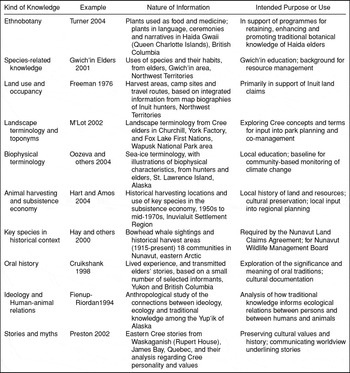
Given that the environmental knowledge of northern aboriginal peoples is an inter-related complex of multiple kinds of knowledge, one can ask the following questions. What different kinds of knowledge have been communicated in publications from northern communities? And to whom have these various kinds of knowledge been of use? Table 1 begins to explore these questions by presenting examples of ten categories of indigenous knowledge that have been recorded and communicated. The categories presented are not intended as rigid groupings, but rather as a framework to structure the current discussion. Each is addressed in turn.
Kinds of traditional environmental knowledge documented.

Ethnoscience, and in particular ethnobotany, is one of the parent disciplines of traditional environmental knowledge (Berkes Reference Berkes2008). There is a rich literature on indigenous plant identification and their uses (Marles and others Reference Marles, Clavelle, Monteleone, Tays and Burns2000; Turner Reference Turner2004). In recent years, botanical guides have come to incorporate indigenous names and uses, as in the Nunavik (northern Quebec) book by Blondeau and others (Reference Blondeau, Roy, Cuevrier and Avatay Cultural Institute2004). Regional ethnobotanical books are currently being produced by indigenous scholars (Andre and Fehr Reference Andre and Fehr2001). Some of these studies explore the interrelationships of plants, animals, and humans (Turner Reference Turner2004) and extend into ethnoecology (Feit Reference Feit and Cox1992; Main-Johnson Reference Main-Johnson2000).
Projects focusing on traditional knowledge of animal species include those on single species (Nakashima Reference Nakashima1991; Keith Reference Keith2005) and those covering a range of species (Hart and Amos Reference Hart and Amos2004; Gwich'in Elders 2001). In the realm of practice, Gwich'in Elders (2001) outline procedures of harvesting, preparing and using animals. They share beliefs and stories relevant to each species, for example, the belief that porcupines have the power to grant wishes. Stories help to frame natural history knowledge: together, the various types of knowledge convey the important practical and cosmological relationships that exist between humans and animal species.
Land use and occupancy studies have been carried out in northern communities since the 1960s. Many of these studies use systematic interviews and map biographies to record visually current and past land-based activities including travel routes, campsites, hunting, fishing, gathering, and ceremonial sites (Tobias Reference Tobias2000). The original Freeman (Reference Freeman1976) study, and the subsequent Nunavut atlas (Riewe Reference Riewe1992) proved to be key source documents in negotiating the Inuit Land Claims Agreement and the creation of Nunavut Territory. Similarly, in other communities, such atlases have been used to demonstrate continued land use, to support land claims and self-determination (Auld and Kershaw Reference Auld and Kershaw2005). Importantly, land use maps also document indigenous worldviews by illustrating that the land is actively used and occupied, with no dividing line between the human (cultural) and the non-human (natural) components.
Beyond documenting traditional activities, there have been a number of efforts to record and communicate toponyms and terminology related to indigenous landscape categories (Main-Johnson Reference Main-Johnson2000; M'Lot Reference M'Lot2002). Inuit Heritage Trust Incorporated (IHTI 2002) has developed maps that record traditional indigenous names for places and features on the land, thereby legitimising local names and terms. The names themselves often reflect a detailed knowledge of the land, for example, by recording historical and cultural events, past and present (IHTI 2002). Taken as a whole, these local terms capture history, activities on the land and biophysical features (M'Lot Reference M'Lot2002), presenting a northern worldview of landscapes as social-ecological memory-scapes (Nuttall Reference Nuttall1992).
Some books have concentrated on specific kinds of biophysical terminology. With illustrations, terms and descriptions for over 100 kinds of sea-ice, Oozeva and others (Reference Oozeva, Noongwook, Alowa and Krupnik2004) demonstrate the depth and detail of knowledge of the Yup'ik. Recognising that young people learn from books, Yup'ik elders emphasise the need to transmit knowledge that will enable youth to travel safely on the ice, and offer this publication as one more avenue by which such knowledge may be acquired (Oozeva and others Reference Oozeva, Noongwook, Alowa and Krupnik2004). Beyond words and terms, this piece also illustrates the skills of observation necessary to read the ice, thereby providing tools to carry out life skills.
Animal harvesting and the subsistence economy have been documented, for example, by the Nunavut wildlife harvest study (NWMB 2004), which records the quantities and species of animals harvested by Nunavut communities. The study is a tool to help the Nunavut Wildlife Management Board in understanding and managing fluctuations in wildlife abundance (NWMB 2004). Because animals are primarily harvested for local consumption, harvest data also serves to take the pulse of the traditional subsistence economy, and illustrates the strong role that subsistence hunting still plays in northern communities.
The study by Hay and others (Reference Hay, Aglukark, Igutsaq, Ikkidluak and Mike2000) aims to access knowledge surrounding the historical context of a key northern species: the bowhead whale. It records whaling history from an Inuit perspective, helps conserve culture, and preserves knowledge, skills and practices related to the bowhead hunt, an activity that now takes place too infrequently for knowledge to be fully transmitted through demonstration and practice. The study communicates the practical and social importance of bowheads for the Inuit and presents an aboriginal perspective on the impacts that European and southern activities in the north had on traditional ways of life. It is important that the bowhead knowledge study has also provided the nucleus for discussions around re-opening a limited bowhead harvest in Nunavut (Hay and others Reference Hay, Aglukark, Igutsaq, Ikkidluak and Mike2000).
Oral histories offer another approach to sharing knowledge about the past (Cruikshank Reference Cruikshank1998). Oral histories communicate traditional knowledge as lived experience, or knowledge acquired, developed, and used over the course of individual lives. Within these stories are descriptions of practices, travel routes, kinship relations, traditional lifestyles, and beliefs as experienced in everyday life. The narratives present the world in the speaker's own words, exactly as it is understood and expressed. In the case of the Igloolik oral history project, narratives have been used to make life stories of elders accessible to future generations. They record historical events in the voices of the people who experienced them (Cruikshank Reference Cruikshank1998) and provide resources to researchers and students learning about particular aspects of traditional life (Kublu and others Reference Kublu, Laugrand, Oosten, Nakasuk, Paniaq, Ootoova and Angmaalik1999; Hart and Amos Reference Hart and Amos2004).
Human-animal relationships among northern indigenous groups are dealt with in a number of academic studies (Preston Reference Preston2002; Tanner Reference Tanner1979; Fienup-Riordan Reference Fienup-Riordan1994), and in reports authored or co-authored by indigenous experts themselves to address practical matters such as youth education (Bearskin and others Reference Bearskin, Lameboy, Matthew, Pepabano, Pisinaquan, Ratt, Rupert and Berkes1989) and environmental change (Thorpe and others Reference Thorpe, Hakongak, Eyegetok and the Kitikmeot Elders2001). Like oral histories, human-animal relations provide a window on indigenous worldviews, providing an understanding of how animals and humans interact and depend on each other. These beliefs are often represented in stories, and manifested in rules and practices to be followed during harvest, preparation, and consumption of wildlife (Tanner Reference Tanner1979; Bearskin and others Reference Bearskin, Lameboy, Matthew, Pepabano, Pisinaquan, Ratt, Rupert and Berkes1989). Values inherent in human-animal relationships, such as reciprocity and respect, are reflected in how humans relate and should behave towards their fellow humans (Fienup-Riordan Reference Fienup-Riordan1994; Wenzel Reference Wenzel2004; Bird Reference Bird2005).
Finally, traditional legends and stories have been documented and recorded across the north (Preston Reference Preston2002; Bird Reference Bird2005; Ticasuk 1987). Many are undertaken primarily to conserve cultural continuity. The goal seems not simply to prevent the stories from being lost, but to keep alive the process of communicating, learning, and understanding through stories. Cruikshank (Reference Cruikshank1998) describes stories as cultural tools that communicate values, attitudes, and beliefs to establish meaning and significance in everyday life, a kind of cultural scaffolding for understanding the world. Stories may be told and re-told differently each time, the emphasis changing with the message that a storyteller chooses to convey to the audience (Cruikshank Reference Cruikshank1998). The recording of stories inevitably freezes traditional texts, but readers may still interact with them, taking lessons relevant to their lives (Cruikshank Reference Cruikshank1998; Bird Reference Bird2005).
The above examination of indigenous knowledge publications reveals an impressive range of different kinds of knowledge that have been documented for use within, and outside of, northern communities. Motivations for developing these publications appear to be varied, including desires to enhance political voice; educate local youth; promote safety on the land; preserve indigenous culture; record history from indigenous perspectives; educate southern policy makers; communicate with scientists; and create resources for co-management institutions. Given the range of motivations, traditional knowledge pieces have become tools for cross-cultural communication and educational material for a number of groups, indigenous youth, policy makers, academics, scientists, community members, and other northern groups. It is not uncommon for a single output to be distributed to several audiences, with multiple uses in mind.
The kinds of knowledge summarised in Table 1 suggest that indigenous knowledge studies have tended to emphasise the empirical aspects of traditional knowledge, as in wildlife harvesting studies and land use mapping. Fewer studies have paid direct attention to knowledge as process, including indigenous values, social relations, and spiritual and cosmological aspects of northern knowledge systems (McGregor Reference McGregor, Blaser, Feit and McRae2004; Simpson Reference Simpson and Taylor2005). Hence the current literature seems to over-represent tangible traditional knowledge (knowledge as the thing known), as opposed to ways of knowing (knowledge as process). Nevertheless, aspects of cultural values and worldview are often encoded in the language, observations, and stories that are being communicated, offering insights into indigenous ways of knowing. Tangible aspects of traditional knowledge often contain elements that combine realms of practice and belief, establish meaning (Preston Reference Preston2002), and develop relationships, common sense and skills (Ingold Reference Ingold2000).
Media types and strategies for communication
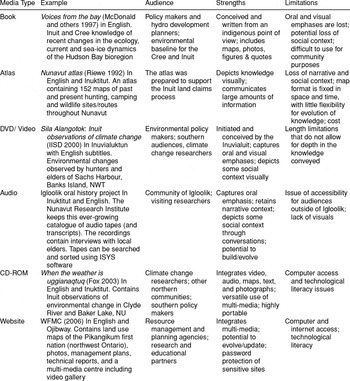
There is a wide range of motivations for documenting indigenous knowledge, and a multiplicity of audiences for traditional knowledge outputs. However, documenting knowledge in a way that captures detailed empirical and ideological elements, and at the same time respects its constantly evolving nature, is no simple task. Nor is the process of selecting a mode of communication that is appropriate for matching the specific kinds of knowledge to be shared with their intended audiences. In recent years, communities, government agencies, and researchers in the north have begun to employ multiple media formats and communication strategies to approach these challenges. A range of options has emerged for communicating such knowledge through audio, visual and written formats. The six most common media types are presented in Table 2. We comment on the challenges associated with documenting indigenous knowledge before turning to these six modes of communication, with particular attention to their suitability for communicating various kinds of traditional knowledge to potential northern and southern audiences.
Types of media available for communicating traditional environmental knowledge.

The knowledge systems of northern people are based on oral tradition, and are taught through stories and the guided development of practical skills. Hence, the most appropriate method for communicating indigenous knowledge would be direct interaction with knowledge holders, through workshops, hearings, meetings, and on-the-land excursions. Many of the publications in Table 2, in fact, capture indigenous knowledge this way. However, the written formats of books and papers face the challenge of capturing not only the oral, but also the visual, tactile, and experiential aspects of knowledge. The dynamic nature of knowledge presents difficulties, as any permanent record (by definition) ‘freezes’ the information that it communicates. Moreover, as seen in reference to traditional stories, the social context of an exchange is critical in influencing what knowledge is shared and how it is communicated (Cruikshank Reference Cruikshank1998). For an audience to understand fully the meaning of an indigenous knowledge publication, it should also have a sense of the social context of the communication.
It is equally important to conserve the narrative context of indigenous knowledge. If individual observations or sentences are abstracted from their narrative context, or the context of the conversation in which they were voiced, they run the risk of being misunderstood, misconstrued, or excessively simplified (Nadasdy Reference Nadasdy1999). Furthermore, if indigenous knowledge must be translated, publishers must take care to conserve the exact meaning of what was shared, as well as the nuanced knowledge embedded in words and terms of the local dialect. Finally, the audiences of indigenous knowledge publication also warrant consideration. Their interests, literacy levels, technological access, and technological literacy will all factor into decisions about which media types will be effective for communication.
Turning to the six categories in Table 2, print media (mainly books) have been one of the most common ways in which to communicate traditional knowledge. Books may incorporate quotes, written summaries, descriptions, diagrams, and photographs (McDonald and others Reference McDonald, Arragutainaq and Novalinga1997; Gwich'in Elders 2001; Thorpe and others Reference Thorpe, Hakongak, Eyegetok and the Kitikmeot Elders2001; Keith Reference Keith2005). Although widely used, books are limited in that they can only communicate what can be described in words or captured in images. It is a challenge for written media to convey skills of observation or practice, gestures and expressions, or to illustrate accurately the social context of an exchange. A number of publications have intentionally incorporated social context by outlining the environments in which knowledge was shared (Cruikshank Reference Cruikshank1998; Bird Reference Bird2005). Books appropriate for southern audiences and policy makers may be less effective in communities where literacy levels are low. Two approaches to making written material more accessible in the north are the distribution of posters for display in community schools, libraries and meeting rooms, and plain-language versions of books. Plain language documents such as Schuegraf (Reference Schuegraf2005) tend to be shorter and less theoretical than academic publications. Technical terms are generally explained or removed and layouts include larger fonts, and more visual material than standard books.
In comparison to books, atlases pose relatively little concern with respect to literacy, as maps may be understood by both northerners and southerners, although not necessarily in the same way. Maps and atlases have been used to communicate land-based knowledge of travel routes, wildlife habitats, harvest sites, toponomy and place names, and map biographies (Tobias Reference Tobias2000). They have not only been useful in land claims negotiations, but also have the potential to spur and support further research. For instance, the Nunavut atlas (Riewe Reference Riewe1992) extended the results of the Freeman (Reference Freeman1976) project, to support land selection for the 1993 Nunavut Land Claims Agreement. The continued work by Inuit Heritage Trust Incorporated (IHTI 2002) is documenting Inuit place names to support ongoing research in the new territory. The primary drawback of published maps is that they are fixed in time, and cannot allow for changes in activities, routes, or migration patterns. Maps are also limited in that they can only hold knowledge that is tied to places on the land as translated into points, lines, areas or symbols. They do not display narratives about the significance of places, or stories associated with the land. A few publications have addressed this limitation by combining pages of text and maps in a single document (Auld and Kershaw Reference Auld and Kershaw2005) or by cross-linking points and lines on maps to transcripts of the interviews in which the information was gathered.
Film-based media such as videos, DVDs, and television programmes are appropriate for northern communities. They have also been used to communicate to southern public and policy makers as well as to southern communities (IISD 2000; Manseau and others Reference Manseau, Parlee, Bill, Kendrick, Rainbow Bridge Communications (producers), Berkes, Huebert, Fast, Manseau and Diduck2005; EFU 2008). Video-based media are perhaps the most effective means for communicating the social context of knowledge shared: a viewer sees the environment, the audience, and the interaction between a speaker and the audience. The viewer recognises the narrative not as a pronouncement of observations but as a social exchange between knowledgeable individuals. Videos are also able to capture facial expressions, gestures, voice, demonstrations, and ambient sound, putting them far ahead of written text in communicating traditional skills and portraying the emphases and values that speakers place on their words. Even the knowledge contained in local dialects can be maintained with subtitles added for outside audiences or prepared in multiple languages with DVD technology (IISD 2000). The primary limitation of film is the length, though rich in quality, only a limited amount of knowledge can be shared in a 60 or 90 minute film.
Audio recordings offer another means to capture the nuances of a speaker's words and tone. Radio technology has long been used in the north, allowing for communication by broadcast, as well as through archived sound recordings. The Igloolik oral history project, a partnership of the Nunavut Research Institute and the Igloolik Inullariit Society, has recorded, filed and catalogued over 1,000 hours of interviews. Because recordings are kept intact, all of the knowledge shared retains its narrative context. Where there is back and forth between audience and speaker, the recordings provide clues as to the social context of the discussion. One drawback to this approach is the challenge of transcribing and translating tapes that are recorded in local dialects, and the risks associated with inadvertently altering meanings or losing the nuances of local terms. The Igloolik project also faces issues of access; because the tapes are stored in Igloolik, the library is primarily a local resource, available only to those outsiders who are able to fly to the community. However, a major strength of this project is that it is a ‘living library’. While each voice is recorded permanently, the collection as a whole is ever growing and can thereby reflect changing attitudes and incorporate different perspectives. Therefore, it is able to reflect the dynamic nature of indigenous knowledge in a way that is difficult to do in books or video.
Computer-based media such as CDs have emerged as versatile tools for communicating indigenous knowledge through a combination of audio, video, text, photographs, and maps. CDs like When the weather is uggianaqtuq (Fox Reference Fox2003) can link between written quotes, oral stories, videos, and key map points, thereby capitalising on the strengths of these various media as they apply to the knowledge being shared. Because this is a computer-based approach, however, computer access and literacy among northern audiences do pose some concern. That said, both the number of computers and the number of young people with strong computer skills is on the rise in the north. However, older generations may need assistance in accessing CD publications. A still emerging avenue of communication, CDs are becoming an effective approach to communicating with researchers and policy makers. They are also becoming a key resource in northern schools in which teachers seek to integrate modern computer skills with culturally relevant learning.
Internet websites have the potential to combine multiple media in much the same way as CDs. Environmental management agencies have used the internet to provide information about their activities, share indigenous and scientific knowledge, make educational links, and to post relevant documents such as management plans, reports and meeting minutes (WFMC 2008; FJMC 2008; Taiga Net 2008). Password protection can be used to control access to any sensitive information contained on a website, or to limit users to those in the desired audience. In addition to the issues of computer access and technological literacy discussed above, websites also depend on access to reliable internet connections. High-speed access in the north is on the increase and the lack of it will probably cease to be a barrier in a few years. Websites are superior to CDs in that they can be updated on a regular basis with new information, publications and video clips. The internet offers another mode of communication able to reflect the dynamic and evolving knowledge of northern peoples.
Of the media options presented in Table 2, none emerges as a clear best choice for communicating indigenous knowledge. The oral knowledge of northern people, the lived experience of generations of hunters, care givers, and elders, cannot be completely captured by any one media type. Nevertheless books, videos, atlases, audio recordings, CDs, and websites all offer avenues through which northern people may begin to influence policy and decision-making, to build cross-cultural understanding, and to strengthen their own cultures. Consideration of how best to communicate must account for the interests, literacy levels, technological access and technological literacy of the audiences that are to benefit from these publications, and the kind of knowledge shared. A traditional song, for example, will be more appropriately recorded on tape, than as a page of written lyrics. Similarly, knowledge of travel routes and the stories associated with them may best be shared through maps that are linked to audio or written transcripts.
In any case, communication is not limited to a single media type. For example, the Gwich'in environmental knowledge project (Gwich'in Elders 2001) developed several books as well as a more detailed database of local knowledge. The Nunavut wildlife harvest study (NWMB 2004) combined a report of text and tables with a CD showing maps of harvesting activities. The Arctic borderlands ecological knowledge co-op offers a web site (Taiga Net 2008) as well as printed reports, posters, maps, and an annual gathering (Eamer Reference Eamer, Reid, Berkes, Wilbanks and Capistrano2006). In fact many aboriginal groups are now looking at creative uses of multiple digital media for cultural, political, and linguistic self-representation (Moore and Hennessy Reference Moore and Hennessy2006). While it is certainly more costly to develop two products rather than one, the use of multiple forms of media helps to ensure that the communication reaches multiple target audiences. A notable fact about these three projects is that the selection of the media type, and the control of the medium, is by the representatives of the knowledge holders themselves.
In addition, there are options beyond those discussed here. Next to learning-by-doing, story telling is probably the single most important traditional way of conveying indigenous teachings. Accordingly, live theatre and other performing arts that can capture the essence of story telling and ceremonies should be effective ways of communicating traditional knowledge. Of course, many indigenous groups, including those of the Pacific region and the Inuit circumpolar region, do have traditions of theatre-like practices. Given the rapid pace of change in communication technology, it is almost certain that additional options will be available in the near future.
Discussion and conclusions
As with many aspects of life in the north, traditional knowledge outputs are very much an experiment-in-progress at the junction between traditional and contemporary ways. They represent one tool through which communities are addressing the challenge of applying and communicating indigenous ways of knowing in a rapidly changing world. The motivations for applying traditional knowledge, the audiences with whom it is shared, and the media of communication, all reflect aspects of both old and new.
Our understanding of the diversity and range of traditional environmental knowledge and its audience has expanded over the years. When the first indigenous knowledge outputs were produced in the 1970s, only a few target audiences were identified, such as negotiators and policy makers in native land claim processes. It was not clear to whom, and for what uses, the recorded knowledge would be useful. Since that time a number of key purposes have emerged, including political voice and the education of local youth. Traditional knowledge outputs have taken on their own social lives and in some cases have been put to uses other than those for which they were originally intended. Accompanying this trend, there has been an increasingly greater presence of indigenous researchers building capacity in the north, developing ownership, and ensuring that knowledge is organised and presented in a culturally appropriate manner.
Incentives for northern communities to develop such outputs come from a desire to strengthen cultural norms and practices, as well as to apply traditional ways of knowing to new challenges. In the case of land claim negotiations, for example, land use atlases allowed indigenous knowledge to come to bear on political arenas where it had previously not been considered. These early atlases proved the extent of northerners' knowledge and use of the land, and made that knowledge available for decisions about new political boundaries. Beyond documenting information for outside uses, northerners are increasingly finding motivation to record indigenous knowledge for local purposes. The rapid social change that has taken place over the last century has, in many cases, ruptured local practices, and the social relations and the language necessary for oral traditions to thrive. This has created a need to record knowledge for reasons of cultural preservation and continuity.
The audiences for whom such products are developed represent a broad mix of both traditional and new actors. Although foreigners (whalers, explorers) have been present in the north for generations, audiences of policy makers, researchers, and a southern public located thousands of kilometres away, are all novel. In some ways, writing and recording traditional knowledge is a means of framing it to be accessible to these outside audiences, all of which are accustomed to written tradition and book learning. However, indigenous knowledge publications are also being used to support northern groups that are taking on the new challenge of caring for the land through hunters and trappers organisations and co-management bodies. The education of youth, often a local priority, is now being supplemented by book, video, and computer based learning.
In northern indigenous communities, each generation rediscovers its cultural knowledge and must combine what is remembered from the past, with what is experienced in the present. It is the change in social-ecological context between generations that drives the evolution of traditional knowledge (Ingold Reference Ingold2000). In the twenty-first century, northerners document and apply their knowledge in a context of global environmental change and rapidly changing political, economic, social, and cultural conditions (Berkes and others Reference Berkes, Diduck, Fast, Huebert and Manseau2005). They face the challenge, perhaps more than ever, of integrating the wisdom of past generations with the reality of the present.
Along with the expansion of our understanding of the diversity and range of traditional environmental knowledge and its audience, there has been an expansion of the diversity and range of media types to communicate this knowledge. For example, in the mid-1980s when the material for the book by Bearskin and others (Reference Bearskin, Lameboy, Matthew, Pepabano, Pisinaquan, Ratt, Rupert and Berkes1989) was being developed, there were few media options available. Since that time, there has been an explosion of options. Traditional knowledge is no longer limited to the realm of books, reports and academic papers. These new media options allow us to mix and match to find the best fit between kinds of knowledge, the intended audience, and the media type used.
Each of the media formats highlighted in this article represents a merger of time-tested traditional knowledge, with non-traditional media formats. Clearly no single medium is complete in capturing all aspects of indigenous knowledge, but many of these approaches are still relatively new and continue to be developed and refined. In fact, the political significance of documents like the Inuit land use and occupancy study (Freeman Reference Freeman1976) and the increasing number of indigenous knowledge publications in circulation suggest a continued need for resource materials. The ultimate value of such products, in terms of communication, education, cultural preservation, political voice, and community benefits, is likely to become clearer over time.
Media options and communication strategies available are evolving rapidly and will probably continue to do so, bringing even more options in the near future. This has implications for the variety of uses of traditional knowledge, including youth education. A major implication for researchers in the north is the increasing feasibility of reaching northern audiences, using multiple ways of communicating findings and allowing for multiple uses of research results. Knowledge exchange is not one way; it is reflexive, iterative, and adaptive. The two-row wampum provides a model of co-existence of indigenous and western knowledge, and the nature of exchange between them, two distinct streams that are meant to interact and assist one another as need be (McGregor Reference McGregor, Blaser, Feit and McRae2004).
Of course, the overall success of communication will depend on more than just the knowledge content and the choice of media formats. Regardless of the audiences for whom they are produced, the value of traditional knowledge outputs will be influenced by their complete life cycles. From conception through development, verification, distribution and use, the key issues have been the ownership of the documented knowledge, capacity building in communities, cooperation, and the distribution of benefits. It is important to consider who is involved in researching and designing indigenous knowledge products, as well as what secondary outputs and additional benefits are extended to northern communities. Finally, while traditional knowledge outputs provide useful resources for a variety of uses, we recognise that all formats have various limitations and cannot communicate all aspects of complex and evolving ways of knowing. It is therefore important that these resources be used by, or with, individuals who understand the context of social institutions, values, and ideologies that frame such knowledge. It is not sufficient to base management decisions on traditional knowledge publications without consulting local knowledge holders, or to use them to teach young people without coordinating visits from local elders.
Acknowledgements
We would like to thank Bonny's project partners in Pond Inlet, Nunavut, and Berkes' project partners in Wemindji, James Bay, Quebec, for helping to remind us of the importance of the communicating indigenous knowledge. We thank Micheline Manseau and Anne Kendrick for their media expertise and help with the work in Baffin, Katja Neves-Graca for emphasising the significance of knowledge as a Batesonian process, and Henrik Moller and two anonymous referees for comments on the first draft of this paper. The project was supported by fellowships from the Social Sciences and Humanities Research Council (SSHRC) and University of Manitoba Faculty of Graduate Studies, and a grant from the Northern Scientific Training Program (NSTP) to Bonny; and SSHRC and Canada Research Chairs (http://www.chairs.gc.ca) programme support to Berkes.