Introduction
Community-based ecotourism (CBET), a form of community-based natural resource management, is based on the concept that economic benefits can be generated from ecotourism activities that are beneficial to local people (Kiss Reference Kiss2004, Hernandez Cruz et al. Reference Hernandez Cruz, Baltazar, Gomez and Estrada Lugo2005, Men Reference Men2006). Because ecotourism requires natural resources that are attractive to tourists, CBET motivates local people to conserve those resources. Therefore, CBET is expected to be a popular tool for natural resource conservation, especially in tropical countries. Many reports have illustrated the successes of CBET in such conservation. However, Kiss (Reference Kiss2004) notes that most reports are anecdotal and subjective, lack quantitative data and analysis and appear in non-peer-reviewed sources.
There are various approaches to evaluating the effectiveness of natural resource conservation initiatives. One is the use of remote sensing data to evaluate land-use and/or forest cover changes before and after conservation actions, or inside and outside conservation areas (e.g., Brandt et al. Reference Brandt, Kuemmerle, Li, Ren, Zhu and Radeloff2012, Nagendra et al. Reference Nagendra, Lucas, Honrado, Jongman, Tarantino, Adamo and Mairota2013, Lund et al. Reference Lund, Burgess, Chamshama, Dons, Isango and Kajembe2015). Using local people’s perceptions of changes in natural resource conditions is another approach to evaluating the success or failure of resource conservation efforts (Ostrom & Nagendra Reference Ostrom and Nagendra2006, Nagendra Reference Nagendra2007, Scullion et al. Reference Scullion, Thomas, Vogt, Perez-Maqueo and Logsdon2011, Bennett Reference Bennett2016). Each method has advantages and disadvantages. For instance, satellite data can capture large areas of deforestation, whereas local people’s perceptions may be able to determine forest changes only in specific areas in their villages or communities (Souza et al. Reference Souza, Roberts and Cochrane2005, Griscom et al. Reference Griscom, Ganz, Virgilio, Price, Hayward and Cortez2009, Margono et al. Reference Margono, Turubanova, Zhuravleva, Potapov, Tyukavina and Baccini2012). Several studies have adopted mixed-method approaches with combined remote sensing and interviews to evaluate the effectiveness of conservation strategies (e.g., Scullion et al. Reference Scullion, Thomas, Vogt, Perez-Maqueo and Logsdon2011, Lund et al. Reference Lund, Burgess, Chamshama, Dons, Isango and Kajembe2015). Because interview data are used mostly to evaluate local people’s perceptions of the social and economic impacts of conservation actions, it is not well known whether remote sensing data and analysis of those perceptions will yield similar results when evaluating the ecological impacts of such actions. Whether local people’s perceptions concur with the results of biological surveys has been thoroughly studied in marine conservation programmes (e.g., Daw et al. Reference Daw, Robinson and Graham2011, Leleu et al. Reference Leleu, Alban, Pelletier, Charbonnel, Letourneur and Boudouresque2012). However, little is known about whether different methods yield similar results when evaluating changes in forest resources.
Cambodia has a population of 15 million people, 20% of whom lived below the poverty line (US$1.25 daily income) in 2011 (Ministry of Planning 2013). From environmental and natural resource perspectives, weak governance has allowed tremendous overexploitation of Cambodia’s forests over the last decade (Davis et al. Reference Davis, Yu, Rulli, Pichdara and D’Odorico2015). More than 70% of the population live in rural areas and are dependent on agriculture, fishing and forest products for their livelihoods. Thus, the declining forest resources could negatively impact those who are dependent on them. CBET has been used increasingly to involve local people in natural resource conservation, especially forest conservation, and to reduce poverty. Currently, there are 56 ecotourism sites in Cambodia (Rann Reference Rann2013).
The Chambok CBET programme is well known as a flagship model of CBET in Cambodia. It has won several awards, including a socially responsible tourism award in 2013 (Men Reference Men2006, Va et al. Reference Va, Om and Touch2013). To help conserve forest resources, Mlup Baitong, a local environmental non-governmental organization, established the Chambok CBET programme in 2002, which opened to visitors in 2003. This programme is believed to be able to engage local people in protecting forests and to help improve local livelihoods (Men Reference Men2006). However, there is a lack of studies evaluating change in forest cover in the Chambok CBET areas.
In the present study, we compare two approaches to addressing this gap. First, we compare forest cover changes from satellite imagery in CBET and non-CBET areas using a covariate matching method (Andam et al. Reference Andam, Ferraro, Pfaff, Sanchez-Azofeifa and Robalino2008, Davis et al. Reference Davis, Yu, Rulli, Pichdara and D’Odorico2015). Second, we analyse local people’s perceptions of forest resource changes (Twongyirwe et al. Reference Twongyirwe, Bithell, Richards and Rees2017) to evaluate the effectiveness of the Chambok CBET programme.
Methods
Study Area
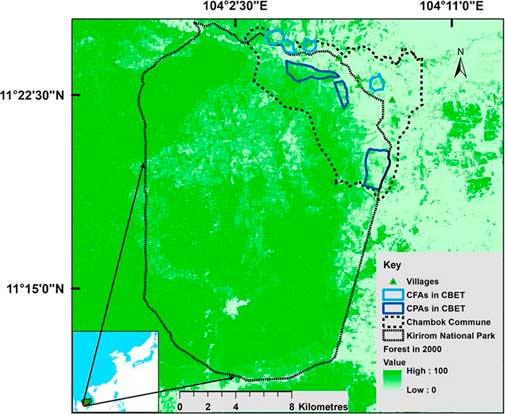
The Chambok CBET site is in the Chambok Commune, Phnom Sruoch District, Kampong Speu Province of southwestern Cambodia (Fig. 1). The Commune officially consists of four villages and had a total population of 761 households with 3670 people in 2008 (National Institute of Statistics of Cambodia 2008). Half of the communal area is in Kirirom National Park (KNP) (Fig. 1). According to data provided by the Chambok CBET committee in 2011, ecotourism attracted 10 000 tourists to the site in 2010, resulting in a profit of US$10 000 for the committee and other stakeholders. The number of tourists increased to 11 200 in 2011 (9000 Cambodians and 2200 foreigners). The revenue was used mainly for committee staff wages, and 20% of the income was deposited in the community’s savings account for spending on community infrastructure development, forest conservation and aid to the poorest households in the commune.
Locations of Chambok community-based ecotourism (CBET) conservation zones, four villages in the Chambok Commune and Kirirom National Park in Cambodia. Green-scale values indicate canopy cover rates from 0% to 100%, as obtained from Hansen et al. (Reference Hansen, Potapov, Moore, Hancher, Turubanova and Tyukavina2013). CFA = community forestry area; CPA = community protected area.

The total area of forest conservation zones at the Chambok CBET site is 10.42 km2, consisting of three community forestry areas (CFAs) outside KNP and three community protected areas (CPAs) inside KNP (Fig. 1). The conservation zones all have small mountains and hills with elevations between 60 and 640 m above sea level.
The CFAs and CPAs are state public properties and were established in 2001 and 2002, respectively. The Forestry Administration under the Ministry of Agriculture, Forestry and Fisheries gives the community power to manage the CFAs for sustainable natural consumption and the reduction of poverty and illegal logging activities. The Ministry of the Environment of Cambodia provides CPAs to the community with the objectives of addressing deforestation, traditional uses of forest resources and livelihood improvement.
The CFAs, CPAs and the Chambok CBET programme have their own committees and members, who come from their respective villages. The Chambok CBET committee manages ecotourism activities, which provide alternative income sources for forest dependents and build local awareness of the importance of natural forest resources to the community. It has attempted to conserve the forests in the CFAs, CPAs and other areas in the commune by providing financial assistance or equipment to the CFA and CPA committees, especially for forest patrol activities.
Forest Cover Changes Using Published Global Data
We evaluated forest cover changes using the high-resolution global maps of Hansen et al. (Reference Hansen, Potapov, Moore, Hancher, Turubanova and Tyukavina2013), where each 30-m × 30-m pixel is expressed in terms of tree canopy cover from 0% to 100%, as obtained from satellite imagery. The initial forest cover in 2000 was defined as the total forest pixel count. We defined forest as a pixel with at least 30% tree canopy cover, as in Davis et al. (Reference Davis, Yu, Rulli, Pichdara and D’Odorico2015), who used the same data. Forest loss was defined as a stand-replacement disturbance or complete removal of the tree cover canopy at the Landsat pixel scale. Forest gain was defined as the inverse of loss or the establishment of a tree canopy from a non-forested state (Hansen et al. Reference Hansen, Potapov, Moore, Hancher, Turubanova and Tyukavina2013). The year of forest loss was available annually from 2001 to 2012, while forest gain was not reported on an annual basis, but as an occurrence over 12 years. We defined ‘deforestation’ as pixels that we classified as forest in 2000 and as forest loss from 2001 to 2012. Conversely, we defined ‘forest recovery’ as pixels that we classified as non-forest in 2000 and as forest gain from 2001 to 2012. We calculated gross deforestation and gross forest recovery as separate analyses. However, both forest loss and forest gain occurred in some pixels. For such pixels, we assigned ‘forest recovery’ if we classified them as forest in 2000 because forest gain should be followed by forest loss. In contrast, we assigned ‘deforestation’ to pixels that we classified as non-forest in 2000.
Initially, for the Chambok Commune, we simply compared forest cover change inside the Chambok CBET conservation zones (hereafter referred to as ‘inside the CBET zones’) with forest cover change outside those zones (hereafter referred to as ‘outside the CBET zones’) from 2000 to 2012. We calculated the percentage of deforestation inside and outside the CBET zones from 2001 to 2012. Similarly, we calculated the percentage of forest recovery inside and outside the CBET zones from 2001 to 2012. We used the boundaries of the Chambok CBET conservation zones provided by the Mlup Baitong organization.
Covariate Matching between Forests Inside and Outside CBET Zones within the Chambok Commune Area
Because the location of the Chambok CBET programme was not chosen randomly, pre-existing characteristics (e.g., distance to the nearest road) differed between zones that are inside and outside the Chambok CBET. These pre-existing characteristics may influence the likelihood of deforestation (Andam et al. Reference Andam, Ferraro, Pfaff, Sanchez-Azofeifa and Robalino2008, Joppa & Pfaff Reference Joppa and Pfaff2009, Reference Joppa and Pfaff2011, Blackman Reference Blackman2013). Therefore, simply comparing forest cover change inside and outside the Chambok CBET conservation zones may yield biased results. Thus, we used covariate matching to minimize the bias caused by such pre-existing characteristics. The aim of this covariate matching is to balance the distribution of covariates inside and outside the CBET zones by sampling areas outside those zones that are very similar to those inside the zones in terms of the pre-existing characteristics that affect deforestation. Matching enables us to construct a counterfactual for the treated units – that is, an estimate of what outcomes would have been for these units absent conservation (Miranda et al. Reference Miranda, Corral, Blackman, Asner and Lima2016). Using covariate matching, we calculated the average treatment effect on the treated (ATT), which is the difference in average outcomes on areas inside the CBET zones and on the matched sample of areas outside (Blackman et al. Reference Blackman, Pfaff and Robalino2015).
To calculate the ATT of deforestation, we randomly selected 20% of all pixels that we classified as forest in 2000, both inside and outside the CBET zones. We calculated the ATT of forest recovery by randomly selecting 20% of all pixels that we classified as non-forest in 2000, both inside and outside the CBET zones. There was both forest loss and gain in some areas. However, such areas amounted to only 0.05% of the Chambok Commune area, and we excluded these areas for the covariate matching to simplify the analysis. For the ATT of deforestation, we used 1257 and 7830 pixels inside and outside the CBET, respectively, while for the ATT of forest recovery, there were 1038 and 8210 pixels inside and outside the CBET, respectively.
Covariate information included distances to the nearest road, to the nearest river, to the nearest railway, to the main town and to a village, as well as slope and elevation and whether an area was inside or outside the KNP (Table S1, available online). We chose these specific covariates because such land characteristics, which are related to accessibility or land productivity, often differ between conservation and control sites and also affect deforestation (e.g., Andam et al. Reference Andam, Ferraro, Pfaff, Sanchez-Azofeifa and Robalino2008, Joppa & Pfaff Reference Joppa and Pfaff2011). Our choice of covariates also depended on data availability.
We then used covariate matching with the nearest neighbour based on the Mahalanobis distance. We used exact matching to determine whether an area was inside or outside the KNP. We used the ‘Matching’ package of R version 3.3.3 to conduct the covariate matching (Sekhon Reference Sekhon2015, R Core Team 2017). We checked the robustness of the ATT estimates to unobserved bias using Rosenbaum’s bounds, which indicate the required level of unobserved heterogeneity needed to make a statistically significant ATT non-significant (Blackman et al. Reference Blackman, Pfaff and Robalino2015, Miranda et al. Reference Miranda, Corral, Blackman, Asner and Lima2016). We set the significance level of the test to 0.05. We used the R package ‘rbounds’ to calculate Rosenbaum’s bounds (Sekhon Reference Sekhon2007, Keele Reference Keele2014).
We also measured the spill-over around the CBET areas using the matching method, following the methodology of Andam et al. (Reference Andam, Ferraro, Pfaff, Sanchez-Azofeifa and Robalino2008). We defined the treatment group as outside the CBET but within 1 km of the CBET boundary. We defined the control group as outside the CBET but greater than 1 km away from the CBET. Previous studies (e.g., Andam et al. Reference Andam, Ferraro, Pfaff, Sanchez-Azofeifa and Robalino2008, Davis et al. Reference Davis, Yu, Rulli, Pichdara and D’Odorico2015) used 2 km as the buffer distance instead of our 1 km. This is because our study area was small, and outside the CBET but within 2 km of the boundary made up 85.6% of the area outside the CBET.
Local People’s Perceptions of Forest Resource Changes
In 2011, we used a household survey questionnaire to interview 174 systematically selected households (23% of the 761 households in the commune). We interviewed every second household along main roads and sub-roads in four villages to understand local people’s perceptions of forest resource changes and availability. We defined ‘forest resources’ as timber and non-timber forest products that local community members collect for their livelihoods, such as timber, firewood, bamboo, mushrooms, poles and rattan. The respondents chose among five categories (increased greatly, increased, no change, decreased and decreased greatly) that matched their perceptions of forest resource changes after the establishment of the Chambok CBET programme in each of the CFAs and CPAs (i.e., the CBET conservation zones). Then, they answered ‘Yes’ or ‘No’ to the question ‘Do you think that the local community can protect their own forest resources in the CBET conservation zones?’ They also answered the question ‘What kinds of forest products and other intangible forest ecosystem services do you obtain from the CBET conservation zones?’ In addition, we asked all respondents the amount of time (days) spent collecting each forest product that they obtained over three periods (1998–2003, 2003–2008 and 2008–2011).
We conducted two focus group discussions (each consisting of a group of eight local community members comprising both men and women) to address the topic of forest cover and resource change and the drivers of deforestation during the periods before and after establishment of the Chambok CBET programme in the commune. We also conducted six key informant interviews with the commune chief, village chiefs, Chambok CBET leader, local guides and CFA and CPA committees in order to understand issues of current forest changes, conservation, traditional forest resource consumption and their respective challenges.
Results
Forest Cover Change from 2000 to 2012
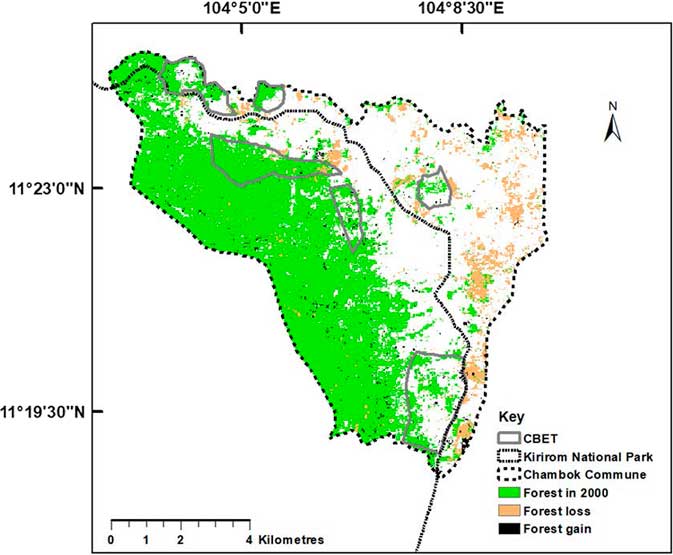
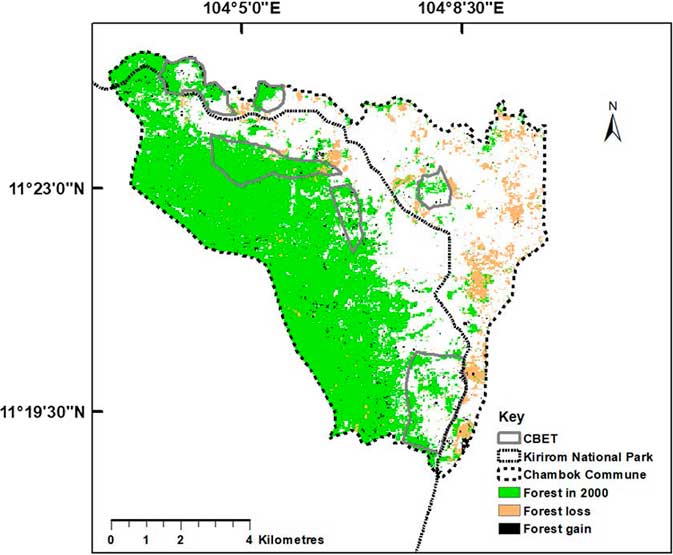
Inside the CBET zones, deforestation and forest recovery from 2000 to 2012 were 0.12 and 0.04 km2, respectively (Fig. 2; Table 1), equivalent to 2.19% and 0.72% of the areas classified as forests within the CBET zones in 2000. Deforestation and forest recovery rates outside the CBET zones were 6.31% and 0.85%, respectively. In total, areas inside and outside the CBET zones experienced net forest cover decreases of 0.08 km2 (0.12 km2 of forest loss minus 0.04 km2 of forest gain = 0.08 km2) and 1.92 km2 (2.23 km2 of forest loss minus 0.30 km2 of forest gain = 1.92 km2), respectively (Table 1).
Forest cover change from 2000 to 2012 in the Chambok Commune, based on Hansen et al. (Reference Hansen, Potapov, Moore, Hancher, Turubanova and Tyukavina2013), to estimate rates of forest cover in 2000. CBET = community-based ecotourism.
Deforestation and forest recovery between 2000 and 2012. CBET = community-based ecotourism

Covariate Matching between Forests Inside and Outside CBET Zones within the Chambok Commune Area
Before the covariate matching of deforestation, areas inside the CBET zones had a significantly lower deforestation rate than those outside the zones (Table S2). Distances to the road, river and village inside the zones were significantly less than those outside the zones. The area covered within KNP was smaller inside the CBET zones than outside them. We also found that areas inside the CBET zones had steeper slopes and lower elevations than those outside the zones. Before the matching of forest recovery, it did not differ significantly between areas inside the CBET zones and those outside the zones (Table S3). Distances to the road, river, main town, railway and village inside the CBET zones were significantly greater than those outside the zones. The likelihood of an area being within KNP was higher inside the CBET zones than outside them.
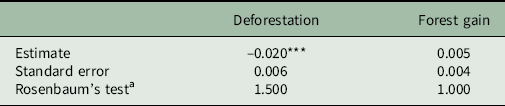
The difference in mean values, the mean empirical quantile–quantile plot and the mean difference in cumulative distributions tended towards zero after the matching, although some variables had significant differences in mean values (Tables S4 and S5). Therefore, the matching improved the covariate balance. The covariate matching results showed that forest inside the CBET zones had a 2.0% lower deforestation rate than that outside the zones from 2000 to 2012 (Table 2). The covariate matching results also showed that areas inside the CBET zones had 0.5% greater forest recovery than those outside the zones, but this is not statistically significant at the 0.1 level.
Average treatment effect on treated for deforestation and forest recovery

*** p < 0.01.
a Rosenbaum’s upper bound.
Using Rosenbaum’s bounds to check for hidden bias showed that our matching results for deforestation and forest recovery were robust up to factors of 1.50 and 1.00, respectively (Table 2). This indicates that our results would remain significant at the 5% level even if the covariate of unobserved bias caused the odds ratios of deforestation to differ between areas inside and outside the CBET zones by factors as large as 1.50 or 1.00.
For spill-over (Table S6), the covariate balance was improved by matching (Tables S7 and S8); the ATT of near CBET and outside CBET was zero. The covariate matching result also showed that the near-CBET area had significantly less forest recovery by 0.5%. The Rosenbaum’s bounds sensitivity test revealed that the results of spill-over are robust up to factors of 1.00 and 1.26 for deforestation and forest gain, respectively (Table S6); the spill-over results are not robust to unobserved hidden bias, and we should interpret those results with caution.
Local People’s Perceptions of Forest Resource Change
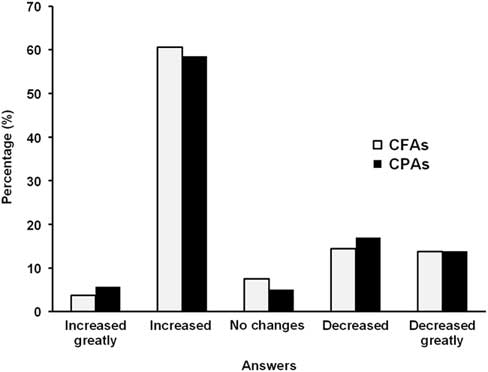
For both the CFAs and CPAs, 64% of the respondents said that forest resources ‘increased greatly’ or ‘increased’, whereas 36% stated that they ‘decreased’, ‘decreased greatly’ or did not change (Fig. 3).
Local people’s perceptions of changes in forest resources after the establishment of the following Chambok community-based ecotourism (CBET) conservation zones: three community forestry areas (CFAs) in CBET conservation zones; and three community protected areas (CPAs) in CBET conservation zones.

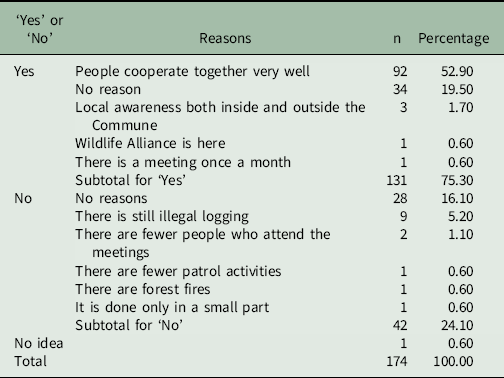
A total of 75% of the respondents said that the local community could protect the conservation areas at the Chambok CBET site and only 25% said that it could not (Table 3). Most respondents with the positive attitude said that people cooperated very well to protect the conservation areas. Most who answered negatively had no opinion regarding their reasoning, and only 5% said that illegal logging persisted.
Answers to the question ‘Do you think that the local community can protect their own forest resources in the community-based ecotourism conservation zones?’

The respondents focused more on forest products than on other services, which reveals that community members may ignore or have little awareness of intangible services (Table S9). Forest products that the community has often consumed in their daily lives include firewood (26.09%), bamboo (23.91%) and mushrooms (14.49%) (Table S9). The other services were water (6.28%), ecotourism (2.42%), fish (0.72%) and culture-related knowledge (0.48%) (Table S9). Only a limited number of local community respondents acknowledged ecotourism (2.42% of the total) (Table S9). The time spent collecting five forest products during 1998–2003, 2003–2008 and 2008–2011 and the time for collecting firewood and poles tended to increase over time, although there were no statistically significant differences (p >0.05) among the three periods for the other products (Table S10).
The focus group discussion and key informant interviews indicated that, before 1990, forests were still dense; however, because of a population increase, there had been increasing firewood collection, charcoal-making and illegal logging activities from 1990 to 2000. Both community members and outsiders took part in these three activities, because these, in addition to hunting wild animals, were the main livelihood strategies in the area. Respondents reported that there were many charcoal-making kilns in the area and, as a result, forests declined rapidly, especially in the 1990s. However, after establishment of the Chambok CBET programme, it was felt that forest cover had increased because of elimination of the kilns and efforts to reduce illegal logging.
Before the establishment of the Chambok CBET programme, the most important driver was illegal logging for timber, firewood and charcoal-making. Participants said that most illegal loggers were from outside the commune. The second most important driver was forest clearance for agricultural land, because as families grew, there was a greater demand for cultivated land to provide food for children. After clearing land, cut trees were used to make firewood and charcoal. The third driver was poverty. Most poor people in the commune made charcoal and fuelwood to sell, which were the most important jobs enabling their survival. After the establishment of the Chambok CBET programme, the participants said that the most important driver had remained illegal logging, even though the intensity of that logging had been greatly reduced. The second most important driver had been forest fires, which occurred almost yearly. The participants reported that they had attempted to reduce forest fires by patrolling and raising awareness, but these activities had not been adequate because of a lack of financial and technical resources.
Discussion
The global maps of forest cover change showed that the Chambok CBET conservation zones had a net decrease of forest cover from 2000 to 2012 (Table 1) and that the conservation efforts of the Chambok CBET programme were unable to halt deforestation. However, with the covariate matching to control for differences in pre-existing characteristics between conservation zones inside and outside the Chambok CBET, the Chambok CBET programme evidently reduced deforestation by 2.0%. Such effectiveness of community-based management in terms of forest cover changes is consistent with the systematic review by Min-Venditti et al. (Reference Min-Venditti, Moore and Fleischman2017). However, the Rosenbaum’s upper bound for deforestation (1.5; Table 2) is relatively small compared to those obtained in other studies that focused on forest change using similar methods (e.g., Blackman et al. Reference Blackman, Pfaff and Robalino2015, Rasolofoson et al. Reference Rasolofoson, Ferraro, Jenkins and Jones2015, Miranda et al. Reference Miranda, Corral, Blackman, Asner and Lima2016). This robustness test suggests that the single approach using remote sensing does not convincingly show that the CBET programme reduced deforestation, since a relatively weak confounder might be able to influence the forest cover change estimates. On the other hand, the interviews and group discussions indicated the local people also perceived that the Chambok CBET programme was effective; more than half of the respondents believed that forest resources had increased at the Chambok CBET site (Fig. 3). We conclude from these two approaches that the Chambok CBET programmes effectively conserved the forests.
Twongyirwe et al. (Reference Twongyirwe, Bithell, Richards and Rees2017) suggest remarkable agreement between remote sensing results and local knowledge of forest changes in western Uganda. However, we also found that remote sensing data and local people’s perceptions produced somewhat different estimates of forest changes. The remote sensing data showed a net decrease of forest cover in the CBET zones, whereas more local people perceived that forest resources had increased, even though the time they spent collecting firewood and poles had increased over time. One reason for this discrepancy might be differences in the observations and their spatial scales, and these two methods for evaluating conservation effectiveness vary in their strengths and weaknesses. Remote sensing can easily capture canopy cover over all areas of interest, but it is difficult to obtain information regarding forest quality, such as forest degradation (Souza et al. Reference Souza, Roberts and Cochrane2005, Griscom et al. Reference Griscom, Ganz, Virgilio, Price, Hayward and Cortez2009, Margono et al. Reference Margono, Turubanova, Zhuravleva, Potapov, Tyukavina and Baccini2012) and the availability of forest and non-forest products. In contrast, it is not easy for local people to grasp the forest condition across large areas, but their observations and experiences within smaller areas can provide more detailed information regarding natural resource conditions (Yasué et al. Reference Yasué, Kaufman and Vincent2010). There was both deforestation and forest recovery in the conservation zones from 2000 to 2012 (Table 1). Therefore, the respondents with positive perceptions may have been more influenced by smaller areas exhibiting forest recovery. In addition, more positive perceptions may be the result of wishful thinking and/or external influences (Yasue et al. 2010, Bennett Reference Bennett2016). Indeed, 75% of the respondents in our study agreed with statement that ‘the local community can protect the conservation area’ (Table 3). Finally, external support from ministries and non-governmental organizations may also lead to more positive thinking.
In our study, the remote sensing approach shows the weak evidence that the Chambok CBET programme was effective at reducing deforestation, but local people’s perceptions confirm this effectiveness. Bennett (Reference Bennett2016) stated that local people’s perceptions can affect local support for conservation and determine whether individuals will take actions that facilitate or undermine conservation initiatives and outcomes. In the present study, more respondents expressed positive opinions regarding forest resource conservation, and such positive perceptions are expected to improve the effectiveness of further conservation actions by increasing local participation (Allendorf et al. Reference Allendorf, Aung and Songer2012).
Conclusion
Based on forest cover change maps, the Chambok CBET was effective at reducing deforestation, although the outcome was not completely robust to unobserved heterogeneity, and the effectiveness of the Chambok CBET programme coincided with local people’s perceptions on the programme regarding the conservation of forests. Mixed-method approaches, such as those combining remote sensing and assessments of local people’s perceptions, are essential for evaluating conservation efforts and taking subsequent actions to further improve community-based conservation efforts.
Supplementary Material
For supplementary material accompanying this paper, visit multimediafluids.uam.elogim.com/core/journals/environmental-conservation
Acknowledgements
We thank the Ministry of Education, Culture, Sports, Science and Technology (MEXT) and the Japan International Cooperation Centre (JICE) for providing a scholarship for Lonn Pichdara, and the staff of the Forestry Administration and Ministry of Agriculture, Forestry and Fisheries of Cambodia based in the provinces and Phnom Penh, as well as the Mlup Baitong staff in Phnom Penh. The local authorities, Chambok CBET members and leader of the Chambok Commune are thanked for cooperating with and supporting this study. We are grateful to Scott Lloyd and Steven Hunter from Edanz Group (www.edanzediting.com/ac) for editing a draft of this manuscript.
Financial Support
This work was supported by a grant from JST-RISTEX for Future Earth.
Conflict of Interest
None.
Ethical Standards
None.