Introduction
Intensive family intervention projects became a flagship mechanism within New Labour's anti-social behaviour and social policy programmes and the number of these projects has increased substantively in recent years. The government established a national network of fifty-three Family Intervention Projects in England during 2006–7 as part of the Respect Action Plan (Respect Task Force, 2010) and the Youth Task Force Action Plan established fifty-two Challenge and Support Projects and twenty Intensive Intervention Projects (Department for Children, Schools and Families, 2008). In June 2010, a further eighty-eight projects were established (Department for Children, Schools and Families, 2010). In 2007, three ‘Breaking the Cycle’ Family Support Projects were established in Scotland to complement two existing projects, including the Dundee Families Project, which strongly influenced the contemporary model of, and political support for, these projects (see Dillane et al., Reference Dillane, Hill, Bannister and Scott2001; Scott, Reference Scott and Flint2006; Pawson et al., Reference Pawson, Davidson, Sosenko, Flint, Nixon, Casey and Sanderson2009). The Welsh Assembly Government has piloted early intervention projects addressing drug misuse and parenting (see Wright et al., Reference Wright, Gray, Watts, McAteer, Hazel, Liddle and Haines2010).
The current UK coalition government is retaining the early intervention and multi-agency/sector models and focus on parenting skills that characterised intensive family intervention projects during the New Labour governments and has emphasised the importance of the provision, and take up, of support to address the underlying causes of anti-social behaviour, including intensive family interventions (HM Government, 2010; Ministry of Justice, 2010; Home Office, 2011). The government has created a single Early Intervention Grant from April 2011, which will collate previous funding streams and, through community budgets and the new Public Health Grant, is attempting to provide more local autonomy and pool funding to address the lives of families with multiple problems (HM Government, 2010).
Intensive family intervention projects are premised on a ‘triple-track’ approach of early intervention, ‘non-negotiable’ support and enforcement action if support is not taken up or progress is not made (Respect Action Plan, 2006). The projects are based upon a key worker adopting an ‘assertive and persistent’ approach, securing the engagement of families and co-coordinating multi-agency support packages. The projects may be delivered through twenty-four-hour support in a residential unit or support in dispersed (temporary) accommodation, but most frequently they involve outreach to families in their own homes. The projects have different foci, including anti-social behaviour, child poverty, youth crime, housing and women offenders and are delivered by state and voluntary sector organisations.
There is now a substantial evaluative literature on intensive family intervention projects (Dillane et al., Reference Dillane, Hill, Bannister and Scott2001; Jones et al., Reference Jones, Pleace, Quilgars and Sanderson2006a, Reference Jones, Pleace, Quilgars and Flint2006b; Nixon et al., Reference Nixon, Parr, Hunter, Myers, Sanderson and Whittle2006, Reference Nixon, Parr, Hunter, Myers, Sanderson and Whittle2008; White et al., Reference White, Warrener, Reeves and La Valle2008; Pawson et al., Reference Pawson, Davidson, Sosenko, Flint, Nixon, Casey and Sanderson2009; Dixon et al., Reference Dixon, Schneider, Lloyd, Reeves, White, Tomaszewski, Green and Ireland2010; Local Government Leadership and Westminster Council, 2010; Renshaw and Wellings, Reference Renshaw and Wellings2010; Wright et al., Reference Wright, Gray, Watts, McAteer, Hazel, Liddle and Haines2010; Flint et al., Reference Flint, Batty, Parr, Platts-Fowler, Nixon and Sanderson2011a, Reference Flint, Batty, Parr, Casey and Nixon2011b). These evaluations have included quantitative and qualitative methodologies and economic cost–benefit analysis. This research evidence suggests that these projects achieve significant and positive outcomes and deliver considerable public cost savings. However, both intensive family intervention projects and evaluations of them have been subjected to critique (Garrett, Reference Garrett2007; Gregg, Reference Gregg2010) on the basis that the research techniques deployed and the presentation of results has been flawed or limited and have overly estimated the positive and progressive outcomes associated with the projects.
Although intensive family intervention projects are strongly supported in policy and equally vehemently opposed by their critics, the basis of these debates is often weak. Policy narratives describe, but fail to define, notions of ‘gripping’ and ‘challenging’ families (Respect Task Force, 2006; Department for Children, Schools and Families, 2010). Meanwhile critics have been reliant on reinterpreting or critiquing existing evaluations and, indeed, have resorted to asking ‘what did the project staff actually do for these children?’ (Gregg, Reference Gregg2010: 13; see also Garrett, Reference Garrett2007). Previous evaluations have assessed a range of quantitative, qualitative and fiscal outcomes and provided data about the circumstances and needs of families, the functions of project workers and the nature of interventions. The complexity of rhetoric and practices within these projects has also been the subject of studies (Parr, Reference Parr2008; Parr and Nixon; Reference Parr, Nixon, Barnes and Prior2009; Nixon et al., Reference Nixon, Pawson and Sosenko2010).
This article is based on the authors’ involvement in evaluations of three intensive family intervention project programmes in England and Scotland (Pawson et al., Reference Pawson, Davidson, Sosenko, Flint, Nixon, Casey and Sanderson2009; Flint et al., Reference Flint, Batty, Parr, Platts-Fowler, Nixon and Sanderson2011a, Reference Flint, Batty, Parr, Casey and Nixon2011b). It aims to offer a framework for interpreting evidence and to enhance the basis of debate about the rationales, mechanisms and efficacy of intensive family intervention projects through examining the contexts within which outreach models of these projects are delivered, offering a systematic categorisation of project workers’ roles and the forms of support provided, and presenting a typology of outcomes. The article argues that enhanced understandings of project functions and more sophisticated analyses of outcomes are essential if the processes and impacts of these projects are to be more robustly conceptualised.
Contexts
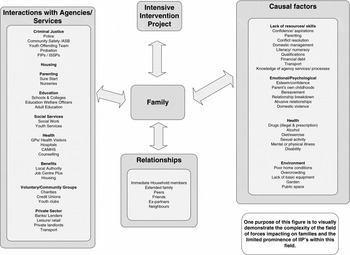
Figure 1 maps the field of forces within which a relationship between a family and an intensive intervention project occurs. There is a tendency in evaluations to consider programmes as ‘unified entities’ through which recipients are processed (Blamey and MacKenzie, Reference Blamey and MacKenzie2007). Project interventions are conceptualised as operating in a form of sealed vacuum, in which social influences are expunged or ‘controlled’ as variables (see Blamey and MacKenzie, Reference Blamey and MacKenzie2007; Flint, Reference Flint2012). The individuals subject to the intervention are regarded, for example in policy narratives, as autonomous individuals, rather than as being formed in and through relationships (Morris and Featherstone, Reference Morris and Featherstone2010). But these projects, like all forms of social policy, are interventions in, and an attempt to exert control within, the social world (Kerr, Reference Kerr1999). There is a consequent need to recognise the importance of sociability and the situated nature of action, context and setting (Frauley, Reference Frauley2007; Valentine, Reference Valentine2007; Aldridge et al., Reference Aldridge, Shute, Ralphs and Medina2009). Socially constructed space is a neglected dimension in understanding family projects (see Murray and Barnes, Reference Murray and Barnes2010), despite the recognition of the centrality of norms and values in local communities and of social bonds and how these configure expectations, and influence motivations and opportunities to change behaviour and to sustain these changes (Maruna, Reference Maruna2004; Nixon et al., Reference Nixon, Parr, Hunter, Myers, Sanderson and Whittle2008; Morris and Featherstone, Reference Morris and Featherstone2010; Flint, Reference Flint2012). The sense of identity arising from these relationships (or their absence for socially isolated households) is also argued to be key to the psychological and motivational factors leading to behavioural change (Blamey and MacKenzie, 2010). It needs to remembered that, although outreach models of projects may be, to some extent, plugged into these social worlds through the primary mechanism of domestic visits to family homes (Flint, Reference Flint2012), despite the terminology of ‘intensive intervention’, workers will spend a maximum of a few hours a week with family members (see Dillane et al., Reference Dillane, Hill, Bannister and Scott2001; Nixon et al., Reference Nixon, Parr, Hunter, Myers, Sanderson and Whittle2006 and Garrett, Reference Garrett2007, for a discussion of the very different socio-spatial dynamics within residential unit models of intensive family intervention projects).
Fields of forces impacting on families

The previous evaluations of intensive family intervention projects have identified the complexity, multiplicity and fluidity of the vulnerabilities and issues experienced by the families and the causal factors underpinning problematic conduct. These factors combine with the relationships influencing individuals to form the individual-level characteristics and factors which have been identified as the most significant element in determining the outcomes of a therapeutic intervention (Assay and Lambert, Reference Assay, Lambert, Hubble, Duncan and Miller1999; Renshaw and Wellings, Reference Renshaw and Wellings2010). Figure 1 classifies four types of causal factor, each comprising multiple elements coexisting with any of the other factor categories.
A lack of resources and skills has been highlighted in government discourse, particularly in relation to parenting strategies (Respect Task Force, 2006; HM Government, 2010), but there are numerous other aspects, including conflict resolution and domestic management (social, emotional and practical) competencies. Family members may not have the basic literacy and numeracy skills required to navigate some key interactions. The families may be in substantial financial debt and poverty and may not have access to required transport resources. The families may also lack a basic knowledge of available services, or of how to access and interact with service providers, or not have the confidence to be assertive with these providers if necessary. A recent study found that 28 per cent of low income family households with children in early years were not accessing any of the available support services that they were entitled to (Aperia Limited, 2010).
A focus on a skills deficit is appealing to policy narratives, in part because it tends to individualise problems, locate the responsibility within individuals and offers a visible path to resolution, through retraining or the inculcation of such skills. In other words, there is a focus on investing in individuals, similar to wider rationales within social policy, particularly related to the labour market and economic citizenship. However, emotional and psychological factors are also of primary significance, including the impacts of relationship breakdown, abusive relationships and, in some cases, domestic violence. Bereavement is a neglected issue in policy and academic accounts of these projects, despite its prominence within the families subject to intensive interventions, as is parents’ own often very troubled and traumatic childhoods. All of these generate low levels of self-esteem and confidence. This group of factors raises problems for governance conceptualisations and challenges for intensive family intervention projects. Domestic violence, bereavement and troubled childhoods make the culpability of family members for problematic behaviour more ambiguous. They also undermine the notion of these projects as a form of ‘early intervention’, given that they are actually addressing multi-generational issues. They also challenge the capacities of projects to respond to these emotional and psychological vulnerabilities that cannot be readily or adequately addressed through a human investment and skills deficit model (see Gregg, Reference Gregg2010).
Similarly, the health of families, including mental or physical illness, disability, substance addiction and misuse, risky sexual activity and poor diets and lack of exercise are primary causal factors of vulnerability or problematic behaviour and again challenge the capacities of projects to address these issues. The final category of causal factors is the physical domestic environment. Although poor home conditions and unkempt gardens are often viewed as visible manifestations of a lack of due care and responsibility, they are often causal factors in the vulnerabilities of some families. Overcrowded or poor-quality or inappropriate accommodation and the lack of basic domestic items, such as furniture, carpets, kitchen equipment or washing appliances, impact upon mental and physical wellbeing, but may also generate a context where it is practically impossible for a family to cope or progress. The outreach element of intensive family intervention projects results in families’ homes being a key arena for engagement and assessment (see Flint, Reference Flint2012), and addressing the domestic environment has become a primary element of project work, particularly through the use of personalised budgets and spot purchasing.
In addition to the relationships and causal factors influencing families and their interactions with intensive family intervention projects, families are embedded in a web of relationships and interactions (even if these may be disengaged, dormant or hostile) with a wide range of private, public and community and voluntary sector agencies and services (see Figure 1). A recent study by Aperia Limited (2010) identified the scale and complexity of agency interaction, with at least twenty-five services, provided by nine public sector organisations, being delivered to low income families. The study suggested that families often felt intimidated and bewildered by this kaleidoscope of agency provision, each of which generates a relationship that has to be managed by the families. This spectrum of services also generates significant challenges for intensive family intervention projects, often tasked with co-coordinating support packages.
Figure 1 maps out conceptually the interactions and influences upon families and the context of their encounters with intensive family intervention projects. The complexity of these interactions in the model is apparent (and is not exhaustive, for example, the role of the media in forming norms and standards, see Skeggs and Wood, Reference Skeggs and Wood2008). The figure indicates the limited prominence of intensive family intervention projects within the field of forces impacting upon families and how projects need to respond to, work with, or compete with these other influences in a multiplicity of sites and processes of interaction.
Mechanisms
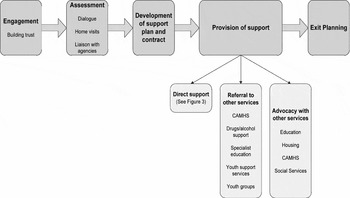
Intensive family intervention projects are premised on the relationship and dynamics between a family and a key worker or workers. The importance of relationships and empathy for productive engagement is well established (Mayer and Timm, Reference Mayer and Timm1970; Forrester et al., Reference Forrester, Kershaw, Moss and Hughes2008; Gerdes, Reference Gerdes2011). Previous evaluations have similarly identified the centrality of project workers to the outcomes of family intervention projects and that the relationship between the project workers and families has been a primary factor in the achievement of positive change (Nixon et al., Reference Nixon, Parr, Hunter, Myers, Sanderson and Whittle2006; White et al., Reference White, Warrener, Reeves and La Valle2008; Pawson et al., Reference Pawson, Davidson, Sosenko, Flint, Nixon, Casey and Sanderson2009). Although these evaluations have identified and discussed the key attributes and practices of project workers, Figure 2 attempts to provide a more systematic and sequential classification of their key roles.
Project Worker Roles

Once a referral of a family to a project has been accepted, the first role of the project worker is to attempt to secure the engagement of the family with the support being offered. When the complexities of influences and histories of previous interactions with agencies described in Figure 1 is considered, the challenges that project workers may face in securing rapport and trust and participation in project interventions is apparent. It should also be noted that levels of initial engagement may vary considerably between family members, and that facilitating engagement is a fluctuating process present throughout the period of an intervention.
The second role of assessment has been rather neglected to date in the literature, but is of major significance to the conceptualisation of family problems and consequent support needs and the extent to which family lives are ‘opened up’ for examination and intervention (Foucault, Reference Foucault1978; Starkey, Reference Starkey2002). Initial assessments are made through multi-agency panels and Common Assessment Frameworks, and project workers utilise an initial period following referral to clarify and classify the issues facing a family and link these to the development of a support plan. Assessment may also be defined by reviews of family progress or evaluation of their conduct, and is therefore a continual mechanism.
However, the intensity of the relationship that is often established between workers and families expands the spatial and temporal scope of assessment, such that workers observe, through domestic visits, the dynamics within the private space of households (see Flint, Reference Flint2012), and undertake a form of excavation in which issues from parents’ own childhoods become evident. This suggests considerable power for project workers to perceive family needs beyond the relative superficiality of official assessment mechanisms. However, such a process, which may last for the duration of an intervention, may result in a shift of emphasis in interventions and an increase in the support being requested from other agencies. This may not always be welcomed, particularly as the disparity with initial referral rationales and assessed needs increases.
Assessment functions are linked to the development of support plans and, in some projects, the use of a contract with family members. This emphasis within policy narratives on the contractual basis of the relationship between project workers and the subject of interventions, and its efficacy, reflects the quasi-legal and economic-rationality premises that underpin governmental understandings, for example through the advocating of formal sanctions (see Flint, Reference Flint2011). The most prominent role of project workers, and the function covered in most depth in the existing literature is the provision of support, which we have classified in a typology of direct support, referral to other services and advocacy (see Figure 3 and the discussion below). Each of these are usually progressed simultaneously and, as will be shown, comprise a diverse range of potential actions requiring discrete forms of skills and knowledge. The final role of project workers is exit planning. This is essential given the emphasis on the sustainability of positive outcomes, but is often the least developed element of projects (Dillane et al., Reference Dillane, Hill, Bannister and Scott2001; Nixon et al., Reference Nixon, Parr, Hunter, Myers, Sanderson and Whittle2006; Pawson et al., Reference Pawson, Davidson, Sosenko, Flint, Nixon, Casey and Sanderson2009). Exit planning is also strongly influenced by the status and power of projects within the network of agency relationships illustrated in Figure 1, given that it is usually a process of transferring responsibility and resource expenditure from the projects to other organisations.
Typology of Support
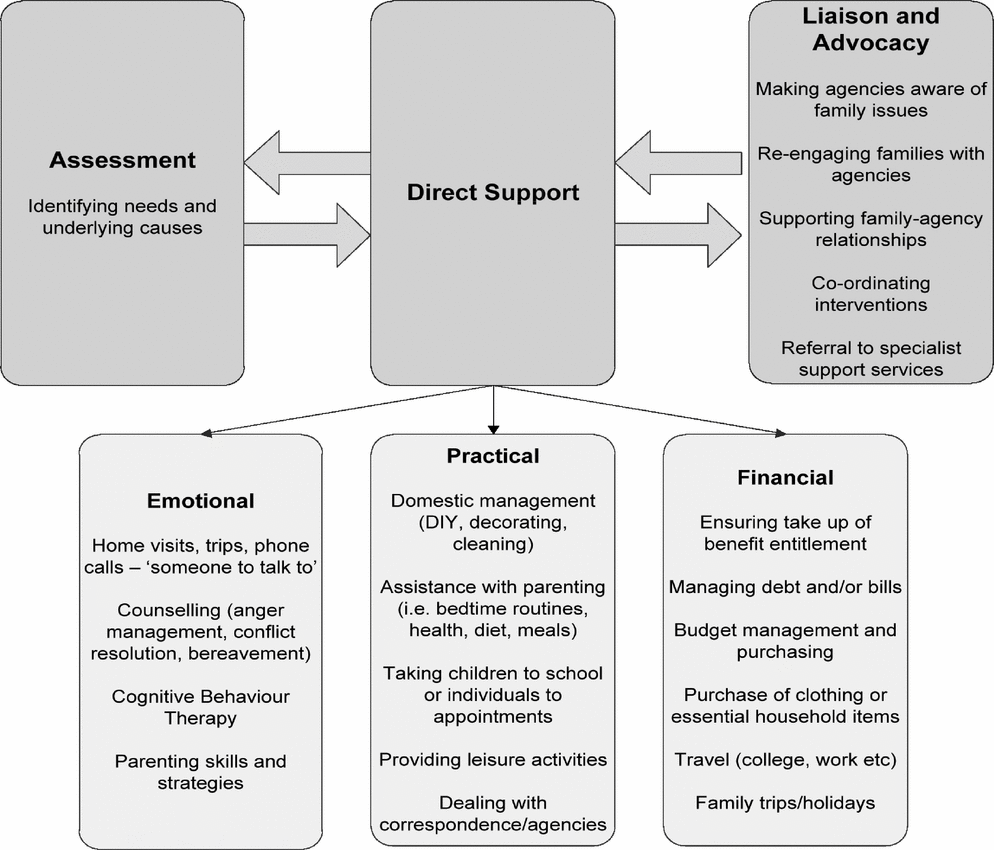
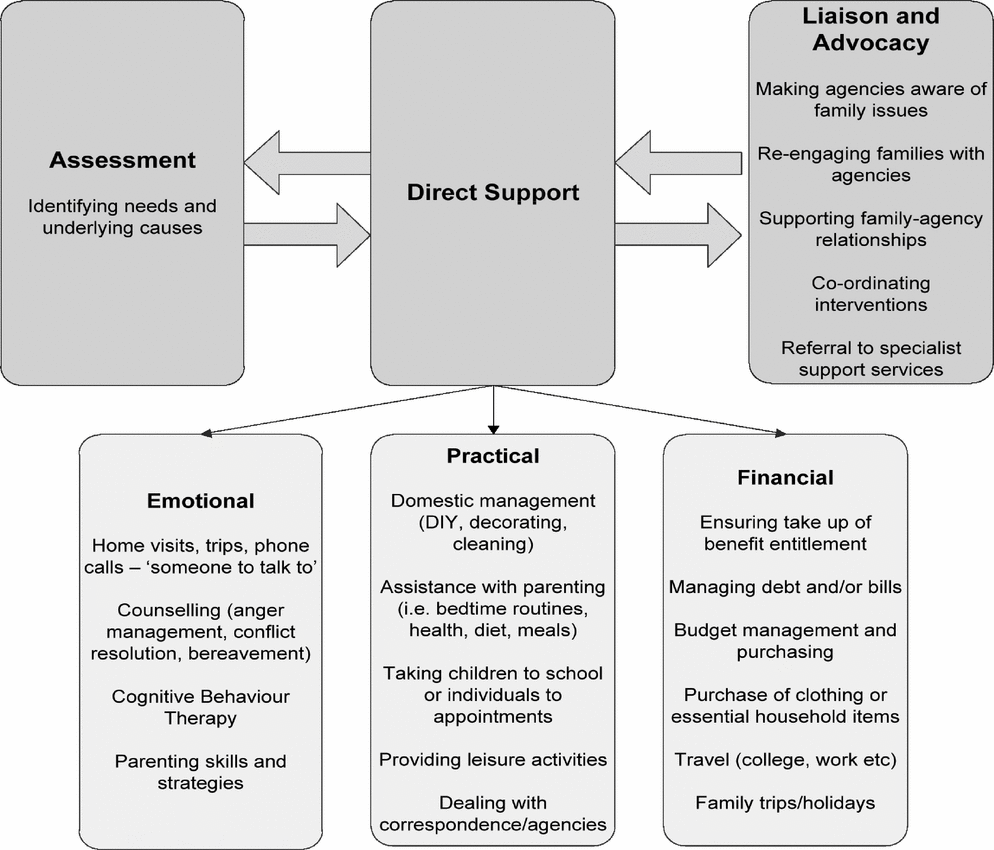
Figure 3 presents a typology of forms of support provided to families by project workers. The first of these is assessment, which we characterise as a form of support, given its capacity to identify, in greater depth, nuance and accuracy, the support needs of families. Second, the direct form of support comprises three categories of action. Emotional support includes listening to family members and engaging in meaningful dialogue with them (Parr, Reference Parr2008). Evaluations have indicated that this seemingly mundane function has been very significant for families’ sense of support and response, particularly to crisis (Nixon et al., Reference Nixon, Parr, Hunter, Myers, Sanderson and Whittle2008; Pawson et al., Reference Pawson, Davidson, Sosenko, Flint, Nixon, Casey and Sanderson2009). Importantly, this emotional support and empathy may take different forms to that of traditional social work (Reynolds and Scott, Reference Reynolds and Scott2000; Zadoroznyi, Reference Zadoroznyi2009; Flint et al., Reference Flint, Batty, Parr, Platts-Fowler, Nixon and Sanderson2011a), a difference often identified and articulated by families themselves. Emotional support extends to workers delivering more specialist or formal counselling or Cognitive Behavioural Therapy sessions or parenting courses.
The second and third element of this direct support – practical and financial – have not been widely acknowledged in both policy narratives or critiques of these projects, which have respectively focused upon the challenging families and agency coordination, or surveillance and coercive, aspects of workers’ roles (although the importance of these forms of support has long been recognised, see Mayer and Timm, Reference Mayer and Timm1970). Project workers provide a range of domestic management and parenting support and become involved in the daily lives of families (see Parr, Reference Parr2008), for example assisting in children getting to school on time, shopping, food preparation and dealing with correspondence. Project workers may also contribute to the management of household finances and consumption practices through ensuring benefits entitlements are claimed, addressing debt or paying bills and supporting the appropriate purchasing of essential goods. Many project workers also utilise devolved personalised budgets and semi-autonomous spot purchasing powers to provide clothing, furniture, kitchen equipment, travel costs and leisure activities. These personalised budgets have become a significant element of project workers’ roles and the dynamics of their relationships with families (see Duffy, Reference Duffy2010; Flint et al., Reference Flint, Batty, Parr, Platts-Fowler, Nixon and Sanderson2011a, Reference Flint, Batty, Parr, Casey and Nixon2011b).
The third form of support is referral, liaison and advocacy actions with other agencies. Project workers refer family members to local support services, to complement or enhance their own direct support work or to access specialist provision beyond their own competencies. They also act as brokers in re-establishing communication between families and agencies and as facilitators in managing and maintaining these relationships and dialogues. Project workers may also seek to coordinate the provision of multi-agency support packages to families and to assume a lead worker function, although this practice is far from universal across projects. The final element of this form of support is advocacy, in which project workers make agencies aware of the (often previously hidden) needs of families and request and sometimes challenge agencies’ responses or offers of support. This may include arguing for referrals to specialist services to be accepted, for risk factors or special educational needs to be formally recognised, or for agencies (most notably housing and education) to ‘bend’ their mainstream services or policies to accommodate the specific needs and behaviour of families. This element requires the project worker to have both knowledge of existing services and the capacity to access or influence them, and therefore a further set of skills and knowledge. This element of support is affected by local politics of risk, resource allocation and responsibilities and may generate tension between intensive family intervention projects and other services, in which the relative status of the project, and the project workers, within the agency regimes presented in Figure 1 is a key determining factor.
These typologies of project worker roles and forms of support are aimed at providing a conceptual basis for understanding how these projects actually function, illustrating the diversity of actions, tasks and responsibilities that workers have, the complexity and tensions within these roles and the myriad skills and knowledge required. These typologies do not assume or imply the efficacy or otherwise of these interventions, but rather aim to offer a more comprehensive and robust framework for assessing the outcomes of these projects, as discussed in the following section.
Outcomes
Policy narratives, previous evaluations and critiques of intensive family intervention projects have all made claims for their outcomes (or lack of outcomes) and interpreted the data and evidence from a spectrum of perspectives. These range from claims that projects ‘work, change and make communities safer’ (Brown, Reference Brown2009) to arguments that projects comprehensively fail to address anti-social behaviour and mental health issues (Gregg, Reference Gregg2010). There have been four main sources of data produced: economic cost–benefit analysis of inputs, outputs and the imputed savings from outcomes; quantitative analysis of measurable ‘hard’ outcomes (such as reductions in anti-social behaviour or improved school attendance); quantitative analysis of ‘softer’ subjective elements, for example proportions of families feeling their situation or health had improved; and qualitative data, drawing upon the perspectives of families, project workers and agency officers to identify a diverse set of outcomes. However, although detailed data have been generated, they have not been systematically classified or disaggregated and there has been limited attention given to the sequencing of outcomes (see Renshaw and Wellings, Reference Renshaw and Wellings2010) or the psychological and motivational responses leading to behaviour changes (see Blamey and MacKenzie, Reference Blamey and MacKenzie2007).
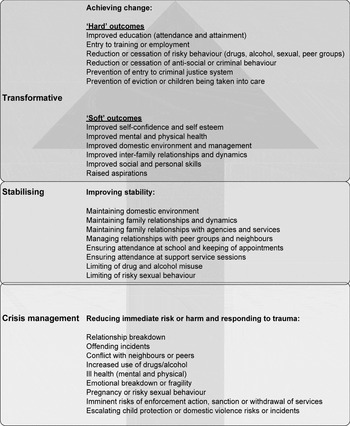
Figure 4 presents a typology of intensive family intervention project outcomes, through which projects’ influence on families and efficacy as a mechanism of social policy may be understood and assessed. These are limited to positive outcomes. There may, of course, be no change in a family as a result of an intervention and interventions could exacerbate problems for families, although there is no research evidence of this (see Garrett, Reference Garrett2007; Gregg, Reference Gregg2010, for a commentary of possible negative impacts). Outcomes may also differ between family members, including between children and adults.
Typology of Outcomes

We have identified three broad categories of outcomes. Crisis management reduces immediate risk or harm and is responsive to escalating problems or trauma. This is often the focus of project work in the immediate period following referral, but it is important to note that crisis and trauma may arise during any (or multiple) period(s) of an intervention. Crisis management outcomes have not been subject to detailed study in previous evaluations of intensive family intervention projects because they do not represent progress or change as these are traditionally defined and, to the extent that they prevent enforcement action or children being accommodated by local authorities, these are usually conceptualised as an outcome of an entire project intervention (see the discussion transformative change below) rather than specific interventions at particular periods in families’ circumstances.
The second set of outcomes relate to stabilising a family or improving stability within the family unit. This sequentially follows stages of crisis management, creating a context and a space (emotional, social and physical) which enables families to begin to address underlying causal factors, to access or engage more beneficially with a range of services, to undertake the learning and practice of new strategies and to focus beyond immediate daily management of severe challenges or problems. These outcomes also represent a protection and reinforcement of progress being made, and they are, in almost all cases, a prerequisite for transformative changes.
The third set of outcomes are transformative in that they achieve change that is determinable from an original ‘baseline’ position at the point of referral and that will significantly reconfigure the position and circumstances of families or individual family members. These are the change outcomes that are envisaged in policy narratives and that are most regularly examined in evaluations and economic assessments. This set of outcomes may be further classified into ‘hard’ outcomes that are susceptible to quantification, verification and economic valuation; and soft outcomes, that are equally transformative (and, indeed, frequently provide the basis for ‘hard’ outcomes and are central to the longer-term sustainability of post-intervention outcomes) but which are less subject to measurement and assessment.
The ‘hard’ transformative outcomes comprise only a small proportion of the potential outcomes of an intensive family intervention project. Although ‘achieving change’ is the focus of such interventions and, ultimately, what these projects are assessed against, less visible and ‘early stage’ outcomes of crisis management and improving stability have a major impact on both families and services. Therefore such interventions may deliver very significant results short of transformative change for a family, a point often missed in cost–benefit paradigms and some critiques of these projects (Gregg, Reference Gregg2010). There is also a sequential dimension to these outcomes, in that crisis management and stabilising a family are likely to be prerequisites of achieving more transformative change, but cases are seldom characterised by a linear or consistent form of progression (Flint et al., Reference Flint, Batty, Parr, Platts-Fowler, Nixon and Sanderson2011a). Although the foci of evaluations is often formalised interventions linked to transformative change, a significant amount of intervention resources are deployed in addressing more immediate needs and through more nebulous mechanisms. The range of potential specific outcomes presented in Figure 4 reaffirms the complexity and scale of the challenges facing families and project interventions in achieving transformative change. This indicates the need for realism in what these projects, despite being defined as ‘intensive’, may be expected to deliver.
Conclusions
This article has sought to develop a conceptualisation of the contexts, mechanisms and outcomes of outreach models of intensive family intervention projects and, in doing so, to enhance the basis of controversies about the impacts, cost–benefit, politics and social justice implications of these initiatives. Its purpose is not to directly assess the efficacy or ‘added value’ of these projects in these domains or to argue whether changes could be delivered through other mechanisms. However, we would conclude with four points. Firstly, we have omitted the application of formal sanctions and ‘challenging families’ as additional discrete roles for project workers, on the basis that decisions about enforcement action and their subsequent deployment are not taken directly by project workers, and that the informal challenging of families and attempts to ensure that they comply with any enforcement action are included in the mechanisms of support outlined in the article (see Flint, Reference Flint2011 for a further discussion). Secondly, it is essential that the full range of potential outcomes from intensive family intervention projects is recognised, particularly in increasingly econometric assessments limited to measurable quantitative and ‘transformative’ indicators of efficacy.
Thirdly, the range of support mechanisms provided by the projects raises the obvious question of how such support could alternatively be delivered in the absence of these projects or the funding to deliver them. Finally, we have attempted to reveal the challenges, complexities and diverse skills required by project workers, which are often simplified (and undervalued) in limited notions of ‘challenging’ families and ‘assertive’ approaches. In particular, project workers often facilitate a comprehensive, nuanced and accurate assessment of families’ actual complex problems, needs and dynamics that is not generated through any other technique of intervention. However, these workers often have a liminal identity (Zadoroznyi, Reference Zadoroznyi2009), reflected in their relatively low status and power within local regimes of governance; especially, but not exclusively, where projects are delivered by third sector organisations, as the new government is actively promoting (Ministry of Justice, 2010).
Intensive family intervention projects, or models of delivery based upon them, are likely to remain as the coalition government's ‘rehabilitation revolution’ continues the New Labour administrations’ focus upon early intervention, whole-family approaches and parenting (HM Government, 2010; Ministry of Justice, 2010; Home Office, 2011). A more robust conceptualisation and understanding of these projects, amongst advocates and critics alike, is required, given the importance of decisions about their continuation and resourcing for the families − amongst the most vulnerable in our society – being supported by them.
Acknowledgements
We are very grateful for the insightful comments of three anonymous referees on an earlier version of this article. We also wish to thank our research colleagues and all the practitioners and families involved in the studies upon which this article is partly based.