




No CrossRef data available.
Article contents
The contribution of implicit and explicit memory to the effects of errorless learning: A comparison between young and older adults
Published online by Cambridge University Press: 11 April 2005
Abstract
There is evidence that the prevention of errors during learning might be helpful in improving an impaired memory performance, both in amnesia as well as in normal age-related memory decline. Although errorless learning is a promising technique for use in rehabilitation practice, the underlying mechanisms are unclear. That is, it has been suggested that the beneficial effects of errorless learning operate through implicit memory, whereas others implicate that it is explicit memory that is responsible for the enhanced memory performance after errorless learning. The current study examined the contribution of implicit and explicit memory function to the memory performance after errorless and errorful learning using the process-dissociation procedure. A group of young adults (N = 40) was compared to a matched group of older individuals (N = 40) on a spatial memory task (i.e., learning the locations of everyday objects in a room). The results clearly show age-related decline in explicit spatial memory, while implicit spatial memory was unaffected. Furthermore, the young group benefited from errorless learning compared to errorful learning, while the older group did not show a difference between the two learning conditions. Also, it was found that the effects of errorful learning were related to explicit memory function, and not implicit processing, corroborating and extending recent findings. (JINS, 2005, 11, 144–151.)
Keywords
Information
- Type
- Research Article
- Information
- Journal of the International Neuropsychological Society , Volume 11 , Issue 2 , March 2005 , pp. 144 - 151
- Copyright
- © 2005 The International Neuropsychological Society
INTRODUCTION
Age-related memory decline has been demonstrated on a variety of memory tasks, such as word-list learning (Titov & Knight, 1997), face-name associations (Kessels & De Haan, 2003a), and spatial memory (Light & Zelinski, 1983). Since the latter is especially important in daily-life functioning, such as finding your way about in the environment or remembering where your keys or glasses are stored (Kessels et al., 2002), impairments in spatial memory can have profound effects on the quality of life of older people. Although a decline in spatial memory has been consistently found in healthy older people, it seems most profound in explicit spatial memory, i.e., the conscious recollection of spatial information, whereas implicit forms of spatial memory (unconscious knowledge and skills) are presumed to be relatively spared (cf. Schacter & Tulving, 1994).
The role of implicit and explicit processing in spatial memory has been studied in detail by Caldwell and Masson (2001), comparing young and older adults. Participants had to study the locations of everyday objects in five rooms presented on a computer screen. In the retrieval phase of the study, the process dissociation procedure by Jacoby et al. (1993) was applied, in which two different response instructions were given, i.e. an include and an exclude condition. In the include condition, participants were instructed to relocate the objects at their previously occupied (i.e., target) locations. In case the target location could not be explicitly remembered, the participant had to relocate the object at the first location that came to mind. It is assumed that both explicit memory (knowing) and implicit memory (guessing) produces the target response. In the exclude condition, participants were instructed to first recall the target location of the object, but subsequently had to relocate the object at a different (new) location than the previously occupied target location. Again, if the target location could not be remembered, the object had to be relocated at the first location that came to mind. Using this instruction, implicit memory generates the target response, while explicit memory generates an opposite and incorrect (new) response.
The contribution of explicit and implicit memory can be estimated using two mathematical equations, in which C equals the probability that explicit (conscious) memory produces the correct response and U equals the probability that implicit (unconscious) memory generates the correct response. The probability that the target response is produced in the include condition is I = C + (1 − C)U, whereas this probability equals E = (1 − C)U for the exclude condition. Thus, the explicit and implicit components can be easily computed: C = I − E and U = E/(1 − C) (Caldwell & Masson, 2001; Jacoby et al., 1993). Interestingly, Caldwell and Masson's (2001) study showed that the estimate of explicit memory for object location was smaller in older people compared to the young group, with the implicit component being equal in both groups. This again supports the notion that explicit memory processing deteriorated as a result of normal ageing, while implicit memory remains unaffected.
The distinction between implicit and explicit memory is particularly important in relation to the efficacy of memory training principles that can be applied in age-related memory decline. One promising principle is the so-called errorless learning (EL) technique (Kessels & De Haan, 2003b). This technique originates from behavioral studies in pigeons, in which learning without errors resulting in a better memory performance compared to trial-and-error learning (Terrace, 1963). Baddeley and Wilson (1994) have introduced this paradigm as a possible tool in patients suffering from severe memory problems. According to these authors, the errors that occur during trial-and-error or errorful learning are consolidated through implicit memory processes. In subjects with normal memory functions, these errors are corrected by explicit memory, resulting in an accurate memory trace. In patients with amnesia or older people with memory problems, however, explicit memory is impaired while implicit memory is still intact. Thus, errors made during learning are not corrected in these subjects, resulting in the consolidation of an incorrect memory trace. Preventing the occurrence of errors during learning might therefore be effective in the enhancement of the memory performance in that only the accurate responses is implicitly consolidated. Indeed, patients with amnesia have been found to benefit from errorless learning (EL) compared to errorful learning (EF) to a greater extent than healthy subjects (Wilson et al., 1994), supporting the notion that EL operates through implicit learning. In contrast, others (Hunkin et al., 1998) have suggested that it is not implicit memory that is responsible for the beneficial effects of EL, but that these effects are the result of what they call residual explicit memory function. They studied patients with severe memory problems, focusing on priming effects of word stems that were learned either in an EL or an EF condition. If the beneficial effect of EL has its origin in implicit memory, a positive correlation should be found between recall and priming of the EL words. Furthermore, priming effects should be higher for correctly remembered words than for words that were nor remembered. However, Hunkin et al. (1998) did not find this relation between priming as an index of implicit memory and EL recall.
In light of the controversy in the literature regarding the underlying mechanisms of EL, the goal of the present study was to further assess the contribution of implicit and explicit memory in EL and EF in young and older adults, using the process-dissociation procedure described by Jacoby (1998). Both Baddeley and Wilson (1994) and Hunkin et al. (1998) predict an overall decrease of explicit memory (C) in the older group, whereas implicit memory (U) should be equal in both groups. Alternative predictions, however, can be distilled with respect to the effects of EL. According to Baddeley and Wilson's (1994) view, in which implicit memory is responsible for the beneficial effects of EL, specifically the older group will benefit from EL compared to EF. Hence, the probability that implicit memory has generated the correct response (U) will be higher in the EL condition than in the EF condition in the older group. The young adults will display no difference across the conditions with respect to U. Alternatively, according to Hunkin and colleagues (1998), partially intact explicit memory is responsible for the gain in the EL condition; since explicit memory function is unaffected in the young adults compared to the older group, the young group will benefit to a greater extent from EL than the older subjects. Also, the probability that explicit memory has generated the response (C) will be higher in EL compared to EF (see Table 1 for a schematic overview). The current study will apply the spatial memory paradigm developed by Caldwell and Masson (2001) and extend it by including both an EL and an EF condition in order to establish in detail the amount of explicit and implicit processing underlying these learning conditions.
Expected results with respect to the strength of the implicit and explicit memory estimates after errorless learning (EL) compared to errorful learning (EF) in both age groups, based on the implicit and explicit memory hypothesis.

METHODS
Research Participants
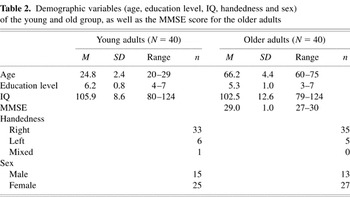
Table 2 shows the demographic characteristics of the two groups that were included in the analyses. Forty young adults (15 males; ages 20–29; M age = 24.8, SD = 2.4) and 44 older people (14 males; ages 60–75; M age = 66.2, SD = 4.4) were selected from a subject pool of the research institute and participated in the current study. All participants received payment of €7.00 for their participation and informed consent was obtained. A semi-structured interview was conducted in all participants in order to exclude people with a neurologic or psychiatric history, severe medication use or recent anesthesia (in the prior 2 years). Additionally, the Mini-Mental State Examination (MMSE) was performed in the older group to detect possible cognitive deterioration (Folstein et al., 1975). A cut-off score of 27 was used as an exclusion criteria, resulting in the exclusion of four participants in the older group (1 male) from all further analyses. Education level was computed using a 7-point scoring system (1 being the lowest: less than primary school, and 7 being the highest: university degree). Since education level in older people is often an underestimation of their actual intelligence, the Dutch version of the National Adult Reading Task (Schmand et al., 1991) was used as an index of the participant's actual IQ. Education level was indeed higher in the young group (Mann-Whitney U = 393.0, Z = 4.1, p < .0005), but there were no statistical differences between the two groups with respect to gender distribution (Mann-Whitney U = 760.0, Z = 0.5), actual IQ [t(77) = 1.4] and handedness (Mann-Whitney U = 735.0, Z = 0.7). All participants had normal or corrected-to-normal vision.
Demographic variables (age, education level, IQ, handedness and sex) of the young and old group, as well as the MMSE score for the older adults

Materials
A Pentium PC was used to run the task, with a 15 inch LCD touch-sensitive monitor to measure the responses. The Rooms Task was adapted from a paradigm described by Caldwell and Masson (2001) and consisted of colored photographs of five rooms (living room, bedroom, study room, bathroom and kitchen) and colored photographs of 50 everyday objects (10 for every room). The locations of the objects in the rooms were determined in a pilot study, in which participants were instructed to locate each object at its most appropriate position. Subsequently, the locations used in the memory task were always the locations which were not the least and not the most frequently chosen as “most appropriate.” Size of the photographs was 20 × 25 cm, with the object (size 5 × 5 cm) placed at the bottom of the screen (see Figure 1 for a sample stimulus display). The object's possible locations were indicated by white squares within the photograph. After clicking the correct location, the object appeared at that location at a size of 2 × 2 cm.

Example of a stimulus display in the errorless learning condition (actual size 20 × 25 cm).
Procedure
A between-subjects design was used in order to minimize possible proactive or retroactive interference effects of the two learning conditions. Half of the subjects within each age group performed the EL condition, the other half the EF condition. Each group was matched on sex and education level. Both conditions consisted of a learning phase and a test phase, each consisting of 50 trials (five rooms with 10 objects each).
Learning phase
In the learning phase, a trial consisted of a picture of a room, with a photo of one of the objects shown at the bottom of the computer screen. Participants were instructed that they had to remember the location of the objects in the rooms, which had to be remembered at a later moment. In agreement with Caldwell and Masson (2001), participants had to say the name of the object out loud in each trial. Naming errors, which occurred only occasionally, were corrected by the experimenter. Given the visuospatial nature of this memory task, naming errors were not analyzed further. The order of the trials was randomized.
In the EL condition, subjects were further instructed to locate the object at its correct position in the room, which was indicated by a white square. The object could be moved by clicking it and subsequently clicking the indicated location. The object was then shown at that location for 3 s, after which the screen was emptied and a button appeared with which the next trial could be started. In the EF condition, subjects were also instructed to locate the object at its correct location, but here there were three possible locations in the room, indicated by white squares. The subjects then had to find out which one was the correct location, by clicking the object and clicking a location. The object subsequently moved to that location; if the location was correct, the object was shown at the location for 3 s, otherwise, the object moved back to the bottom of the screen and the subject had to try again, until the correct location was found. Next, the screen was emptied and a button appeared to start the next trial.
Test phase
After a 15-min delay, in which the participants performed other cognitive tasks for a separate study, the test phase was introduced. A test trial consisted of the picture of a room with an object at the bottom of the computed screen. Three possible locations of the object were indicated by white squares (the target location and two incorrect locations). Each trial was assigned randomly to either the include-instruction condition or the exclude-instruction condition in such a way that every participant performed 25 trials in the include condition and 25 trials in the exclude-instruction condition. The order of the trials was randomized and different from the order of the trials in the learning phase. In each trial, the instruction (either include or exclude) was shown at the bottom of the screen and read out loud by the experimenter.
In the Include condition, the participant was instructed to relocate the object at the target location; this instruction activates explicit memory processes (Jacoby, 1998). In case the participants could not remember the correct locations, they were instructed to relocate the object at the first location that came to mind; this instruction activates implicit memory processes. Hence, in the include condition, both implicit and explicit memory produce the target answer, i.e. the location the object occupied previously. In the exclude condition, the subjects first had to recall the target location. Subsequently, they had to relocate the object at a different location than the target location; this instruction hence activates explicit memory processes. In case the target location could not be recalled, the participant was prompted to relocate the object to the first location that came to mind; this instruction activated implicit memory processes, in that the location that the object occupied in the learning phase is expected to be stored implicitly, and the expected response would thus be the target location. This response would be opposite to the response generated by explicit memory that would result in relocation at a different location than the target one.
RESULTS
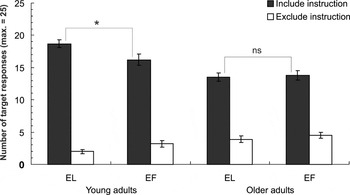
Figure 2 shows the performance for both age groups in the two learning conditions on the Rooms Task. In both in include and the exclude condition, the number of objects relocated at their target locations was computer (i.e., an old response). Two-way analyses of variance (ANOVA) were performed, in which α was set at .05.

Mean (+ SEM) number of objects relocated at target (or old) locations (maximum is 25) of the young and older group after errorless (EL) and errorful (EF) learning for the include-instruction (I) and exclude-instruction (E) relocation trials. In addition to the difference between EL and EF in the young group (*p < .05), a significant overall effect of age was found (p < .001).
ANOVA with the number of target answers in the Include condition (I) as dependent variable and Age Group and Learning Condition as independent variables showed a main effect of age group [F(1,76) = 28.8, p < .001], indicating an overall better performance in the young group compared to the older participants. No main effect of learning condition was found [F(1,76) = 2.49], but there was a significant Age Group × Learning Condition interaction [F(1,76) = 4.0, p < .05). Subsequent analysis showed that the young age group performed better in the EL condition than the EF condition [F(1,38) = 6.0, p < .05], whereas the older participants' performance did not differ between the two learning conditions [F(1,38) = .1]. ANOVA with the number of correct answers in the exclude condition (E), indicating the number of implicitly generated responses resulting in relocation at the old location, as dependant variable and age group and learning condition as independent variables again showed a main effect for age group [F(1,76) = 11.5, p < .001], indicating the older age group more frequently relocated the objects at an old location in the exclude condition. There was a trend for a main effect of learning condition [F(1,76) = 3.6, p < .06], indicating an overall slightly higher error rate in the EF condition compared to the EL condition. The Age Group × Learning Condition interaction was not significant [F(1,76) = .4].
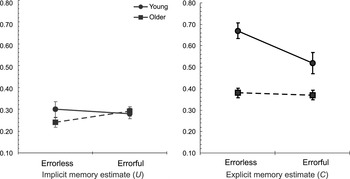
Figure 3 shows the estimates of C (conscious or explicit processing) and U (unconscious or implicit processing) for the two learning conditions and the two groups. Of the total group of 80 participants, 9 made no errors in the exclude condition (8 young adults and 1 older person). However, a perfect performance on the exclude trials results in the underestimation of the implicit-memory component (Jacoby et al., 1993). In agreement with the suggestion of these authors, perfect Exclude scores were therefore not included in the calculation of U. ANOVA was performed with the probability that explicit memory has generated the response (C) as dependent variable and age group and learning condition as independent variables. The results showed a main effect of age group [F(1,76) = 27.9, p < .001], in which the estimate of C was higher in the young group compared to the old group. Also, a main effect of learning condition was found [F(1,76) = 3.9, p < .05], in which the estimate of C was higher in the EL than in the EF condition. A trend was found for an interaction between Age Group × Learning Condition [F(1,76) = 2.9, p < .09]. Subsequent analyses showed that the estimate of C did not differ between the two learning conditions in the older group, whereas C was higher in the EL than in the EF in the young group [F(1,38) = 6.5, p < .05]. ANOVA with the probability that the response was generated by implicit memory (U) as dependent variable and age group and learning condition as independent variables did not reveal a main effect for age group [F(1,67) = 1.3] or learning condition [F(1,67) = .4]. Furthermore, there was no significant interaction between Age Group × Learning Condition [F(1,67) = 2.0].

Mean (+ SEM) estimates of implicit (U) and explicit (C) recall after the errorless and errorful learning conditions in the young and older age group.
DISCUSSION
The current study examined the role of explicit and implicit memory in errorless and errorful learning of object locations, both in young and older adults. The contributions of explicit and implicit memory were estimated using the process-dissociation procedure (Jacoby, 1998). Two alternative explanations with respect to the underlying cognitive processes of errorless learning were investigated. According to Baddeley and Wilson (1994), implicit memory is responsible for the consolidation of erroneous responses in EF. EL helps implicit memory to overcome this failure in that only the correct response is strengthened. Hence, especially the older group should benefit from EL, with an expected higher contribution of implicit memory in the EL than in the EF condition. In contrast, according to Hunkin et al. (1998), (partially) intact explicit memory is responsible for the beneficial effects of EL. Therefore, it could be expected that the young group should benefit to a greater extent from EL than the older participants. Furthermore, the contribution of explicit memory should be higher in the EL condition than in the EF condition for both age groups (see also Table 1).
The results clearly show an overall worse memory performance in the older adults compared to the young group, in agreement with previous studies on age-related deterioration of episodic memory in general (Haaland, Price, & Larue, 2003) and allocentric spatial memory in particular (Desrocher & Smith, 1998). In addition, we replicated the results of Caldwell and Masson (2001). Young adults overall performed better than older adults in the Include condition and make less target responses in the exclude condition. As expected, the contribution of explicit memory is smaller in older adults compared to the young group, and the estimate of implicit memory does not differ between the groups. This is in agreement with the notion that implicit memory function is relatively spared in ageing, while explicit memory function deteriorates. With respect to the effects of the learning conditions, it was found that the young groups displayed a better overall performance in the EL condition compared to the EF condition in the include condition. Furthermore, the proportion of explicit memory processes in the young group is higher in the EL than in the EF condition. However, the older group did not benefit from EL compared to EF, and the proportion of explicit memory processes did not differ between the two learning conditions.
These differential effects of EL in both age groups are in favor of Hunkin et al.'s (1998) notion that EL works through residual explicit memory function, in that the older group did not benefit from EL, despite having normal implicit memory function. Furthermore, a recent study by Tailby and Haslam (2003) in patients with mild, moderate and severe memory impairments did not find evidence for a specific role of implicit memory in EL as well. It should be noted, however, that the term residual explicit memory is not well defined, in that it is unclear whether it refers to a robust, age-independent capacity of explicit memory or whether explicit memory can be regarded as a continuum which declines eventually. Additionally, the finding that the older group does not benefit from EL does not support previous results showing that impaired individuals benefit to a greater extent from errorless learning procedures than unimpaired participants (Baddeley & Wilson, 1994; Evans et al., 2000; O'Carroll et al., 1999).The present results are in agreement with recent findings on the effects of EL in young and older adults using face–name associations, also showing that especially the young adults benefited from EL, whereas the older group did so to a lesser extent, contrary to the expectations (Kessels & De Haan, 2003a). However, if explicit memory is aided by errorless learning, it remains unclear why the older participants did not improve on explicit spatial recall after errorless learning in the current study. Obviously, although aging resembles somewhat the pattern of cognitive decline in amnesic patients, it is possible that there are qualitative differences between age-related memory decline and clinical memory dysfunction that could explain these contrastive findings. Moreover, it is possible that the beneficial effects of EL do not fully extend to the spatial domain. For example, it might be that explicit memory for spatial information has declined as a results of aging to such an extent that EL does not result in an improved performance anymore. However, the overall performance of the older group was above chance, thus excluding possible confounding results due to a floor effect. Nevertheless, it could be that the amount of error introduced during learning was too small, since it was possible to guess the target location in the first attempt. Conversely, as this is the first study on EL using spatial information, further research is needed to examine this hypothesis in more detail.
Finally, it should be mentioned that the process-dissociation procedure itself has been criticized over the years (see, e.g., Dodson & Johnson, 1996). Basically, three assumptions underlie the process-dissociation procedure (Jacoby, 1998): (1) explicit and implicit memory are independent memory functions; (2) explicit and implicit memory work in a consistent manner in both retrieval conditions; (3) the response produced by explicit memory dominated the one produced by implicit memory. Especially the assumption that explicit and implicit memory contribute independently to the eventual performance has often been challenged (Curran & Hintzman, 1995, 1997). This, however, has been recognized by Jacoby et al. (1997), who in turn state that there is ample evidence that implicit and explicit memory function in an independent manner in most situations, a finding which is generally supported by empirical manipulations (Parkin et al., 1990). Furthermore, Anooshian and Seibert (1996) have validated the process-dissociation procedure in studying the underlying mechanisms of various forms of spatial memory.
In sum, the current study clearly showed an age-related memory decline in explicit spatial memory, whereas implicit spatial processing seems unaffected. Additionally, the young group benefited from EL compared to EF of spatial information, whereas the older group did not. Evidence obtained with the process-dissociation procedure reveals that it is explicit memory that is related to the beneficial effects of EL, and not implicit memory. While generally EL is a promising technique in cognitive rehabilitation, both in research as in clinical practice (Kessels & De Haan, 2003b; Grandmaison & Simard, 2003), the efficacy of this technique in the learning of spatial information in specific is unclear. Since learning spatial information is of vital importance in everyday function (i.e., successful navigation in new environments and remembering the locations of stored items), both in healthy participants and in memory-impaired individuals, more research is needed to unravel the underlying mechanisms of impairment and the effects of intervention principles.
ACKNOWLEDGMENTS
The authors would like to thank Debbie Hobbel for her assistance in this study. Dr. Kessels was supported by a VENI Grant (#451-02-037) by the Netherlands Organization for Scientific Research (NWO). Dr. Postma was supported by an NWO-PIONIER grant (#440-20-000). The results of this study were presented at the third joint meeting of the Australian Society for the Study of Brain Impairment (ASSBI) and the International Neuropsychological Society (INS), Brisbane, Australia, July 2004.
References
REFERENCES
Anooshian, L.J. &
Seibert, P.S.
(1996).
Diversity within spatial cognition: Memory processes underlying
place recognition.
Applied Cognitive Psychology,
10,
281–299.3.0.CO;2-8>CrossRefGoogle Scholar
Baddeley, A. &
Wilson, B.A.
(1994).
When implicit learning fails: Amnesia and the problem of error
elimination.
Neuropsychologia,
32,
53–68.CrossRefGoogle Scholar
Caldwell, J.I. &
Masson, M.E.J.
(2001).
Conscious and unconscious influences of memory for object
location.
Memory and Cognition,
29,
285–295.CrossRefGoogle Scholar
Curran, T. &
Hintzman, D.L.
(1995).
Violations of the independence assumption in process
dissociation.
Journal of Experimental Psychology: Learning, Memory, and
Cognition,
21,
531–547.Google Scholar
Curran, T. &
Hintzman, D.L.
(1997).
Consequences and causes of correlations in process
dissociations.
Journal of Experimental Psychology, Learning, Memory, and
Cognition,
23,
496–504.CrossRefGoogle Scholar
Desrocher, M. &
Smith, M.L.
(1998).
Relative preservation of egocentric but not allocentric spatial
memory in aging.
Brain and Cognition,
37,
91–93.Google Scholar
Dodson, C.S. &
Johnson, M.K.
(1996).
Some problems with the process-dissociation approach to
memory.
Journal of Experimental Psychology: General,
125,
181–194.CrossRefGoogle Scholar
Evans, J.J.,
Wilson, B.A.,
Schuri, U.,
Andrade, J.,
Baddeley, A.,
Bruna, O.,
Canavan, T.,
Della-Sala, S.,
Green, R.,
Laaksonen, R.,
Lorenzi, L., &
Taussik, I.
(2000).
A comparison of “errorless” and
“trial-and-error” learning methods for teaching individuals
with acquired memory deficits.
Neuropsychological Rehabilitation,
10,
67–101.CrossRefGoogle Scholar
Folstein, M.F.,
Folstein, S.E., &
McHugh, P.R.
(1975).
“Mini-mental state”: A practical method for grading the
cognitive state of patients for the clinician.
Journal of Psychiatric Research,
12,
189–198.CrossRefGoogle Scholar
Grandmaison, E. &
Simard, M.
(2003).
A critical review of memory stimulation programs in Alzheimer's
disease.
Journal of Neuropsychiatry and Clinical Neuroscience,
15,
130–144.CrossRefGoogle Scholar
Haaland, K.Y.,
Price, L., &
Larue, A.
(2003).
What does the WMS–III tell us about memory changes with normal
aging?
Journal of the International Neuropsychological Society,
9,
89–96Google Scholar
Hunkin, N.M.,
Squires, E.J.,
Parkin, A.J., &
Tidy, J.A.
(1998).
Are the benefits of errorless learning dependent on implicit
memory?
Neuropsychologia,
36,
25–36.Google Scholar
Jacoby, L.L.,
Toth, J.P., &
Yonelinas, A.P.
(1993).
Separating conscious and unconscious influences of memory: Measuring
recollection.
Journal of Experimental Psychology: General,
122,
139–154.CrossRefGoogle Scholar
Jacoby, L.L.,
Begg, I.M., &
Toth, J.P.
(1997).
In defense of functional independence: Violations of assumptions
underlying the process-dissociation procedure?
Journal of Experimental Psychology: Learning, Memory, and
Cognition,
23,
484–495.Google Scholar
Jacoby, L.L.
(1998).
Invariance in automatic influences of memory: Toward a user's
guide for the process-dissociation procedure.
Journal of Experimental Psychology: Learning, Memory and
Cognition,
24,
3–26.CrossRefGoogle Scholar
Kessels, R.P.C.,
Kappelle, L.J.,
De Haan, E.H.F., &
Postma, A.
(2002).
Lateralization of spatial-memory processes: Evidence on spatial
span, maze learning, and memory for object locations.
Neuropsychologia,
40,
1465–1473.CrossRefGoogle Scholar
Kessels, R.P.C. &
De Haan, E.H.F.
(2003a).
Mnemonic strategies in older people: A comparison of errorless and
errorful learning.
Age and Aging,
32,
529–533.Google Scholar
Kessels, R.P.C. &
De Haan, E.H.F.
(2003b).
Implicit learning in memory rehabilitation: A meta-analysis on
errorless learning and vanishing cues methods.
Journal of Clinical and Experimental Neuropsychology,
25,
805–814.Google Scholar
Light, L.L. &
Zelinski, E.M.
(1983).
Memory of spatial information in young and old adults.
Developmental Psychology,
19,
901–906.CrossRefGoogle Scholar
O'Carroll, R.E.,
Russell, H.H.,
Lawrie, S.M., &
Johnstone, E.C.
(1999).
Errorless learning and the cognitive rehabilitation of
memory-impaired schizophrenic patients.
Psychological Medicine,
29,
105–112.CrossRefGoogle Scholar
Parkin, A.J.,
Reid, T.K., &
Russo, R.
(1990).
On the differential nature of implicit and explicit memory.
Memory and Cognition,
18,
507–514.CrossRefGoogle Scholar
Schacter, D.L. &
Tulving, E.
(1994).
What are the memory systems of 1994? In
D.L. Schacter (Ed.),
Memory distortions (pp.
1–38).
Cambridge, MA:
Harvard University Press.
Schmand, B.,
Bakker, D.,
Saan, R., &
Louman, J.
(1991).
De Nederlandse Leestest voor Volwassenen: Een maat voor het
premorbide intelligentieniveau [The Dutch Adult Reading Test: A
measure of premorbid intelligence].
Tijdschrift voor Gerontologie en Geriatrie,
22,
15–19.Google Scholar
Tailby, R. &
Haslam, C.
(2003).
An investigation of errorless learning in memory-impaired patients:
Improving the technique and clarifying theory.
Neuropsychologia,
41,
1230–1240.CrossRefGoogle Scholar
Terrace, H.S.
(1963).
Discrimination learning with and without
“errors.”
Journal of Experimental Analysis of Behavior,
6,
1–27.CrossRefGoogle Scholar
Titov, N. &
Knight, R.G.
(1997).
Adult age differences in controlled and automatic memory
processing.
Psychology and Aging,
12,
565–573.CrossRefGoogle Scholar
Wilson, B.A.,
Baddeley, A.,
Evans, J., &
Shiel, A.
(1994).
Errorless learning in the rehabilitation of memory impaired
people.
Neuropsychological Rehabilitation,
4,
307–326.CrossRefGoogle Scholar

Expected results with respect to the strength of the implicit and explicit memory estimates after errorless learning (EL) compared to errorful learning (EF) in both age groups, based on the implicit and explicit memory hypothesis.
Demographic variables (age, education level, IQ, handedness and sex) of the young and old group, as well as the MMSE score for the older adults

Example of a stimulus display in the errorless learning condition (actual size 20 × 25 cm).
Mean (+ SEM) number of objects relocated at target (or old) locations (maximum is 25) of the young and older group after errorless (EL) and errorful (EF) learning for the include-instruction (I) and exclude-instruction (E) relocation trials. In addition to the difference between EL and EF in the young group (*p < .05), a significant overall effect of age was found (p < .001).
Mean (+ SEM) estimates of implicit (U) and explicit (C) recall after the errorless and errorful learning conditions in the young and older age group.
 You have
Access
- 34
- Cited by