Young children are expert word-learners, with an average word-learning rate of 360 words a year at age 2;6 (Rowe, Raudenbush, & Goldin-Meadow, Reference Rowe, Raudenbush and Goldin-Meadow2012). The emergentist coalition model of word-learning (ECM; Hollich, Hirsh-Pasek, & Golinkoff, Reference Hollich, Hirsh-Pasek and Golinkoff2000) describes how babies and toddlers draw on a variety of available cues, including perceptual, linguistic, and social-pragmatic information, to acquire new words. Children's use of these cues shifts over time (Maguire, Hirsh-Pasek, & Golinkoff, Reference Maguire, Hirsh-Pasek, Golinkoff, Hirsh-Pasek and Golinkoff2006), with babies (10–12 months) drawing on associative, rather than social cues (Hollich et al., Reference Hollich, Hirsh-Pasek and Golinkoff2000), toddlers (19–24 months) gradually shifting to a word-learning process that recruits social cues, and older children (two and above) becoming adept at drawing on a wide variety of cues (Hirsh-Pasek, Golinkoff, Hennon, & Maguire, Reference Hirsh-Pasek, Golinkoff, Hennon, Maguire, Hall and Waxman2004; Hollich et al., Reference Hollich, Hirsh-Pasek and Golinkoff2000).
As children enter school, they face an additional word-learning challenge: not only must they continue to refine their emerging knowledge of the words used in everyday spoken language, they must also build their knowledge of academic vocabulary if they are to become successful readers. The ECM has mainly been used as a model for early word-learning ‘in the wild’, but also provides a useful theoretical lens for the word-learning that occurs in an instructional context. The ECM is a dynamic model that recognizes word-learning as involving multiple inputs that are differentially weighted at different points in children's development, and even in different settings (e.g., the classroom vs. the home, or playtime vs. book-reading time). Laboratory-based experimental studies trace the developmental shifts that occur as babies and toddlers access different kinds of information about words over time (e.g., Maguire et al., Reference Maguire, Hirsh-Pasek, Golinkoff, Hirsh-Pasek and Golinkoff2006), but little research has explored the cues preschoolers draw on to learn new words, particularly in instructional settings where words are abstract, and interactions are rarely limited to an adult–child dyad. Ideally, children are presented with a rich variety of cues when learning sophisticated vocabulary in the classroom, including perceptual supports such as pictures in a book or gestures, linguistic cues such as definitions of a word, and social cues such as adults highlighting word meanings or responding contingently. We investigate here which of the multiple perceptual, linguistic, and social cues to word-meaning are especially salient to children in an instructional context.
Particularly important to consider is the classroom activity within which children learn words, as research has shown that opportunities for language learning vary across different activity settings (Cabell, DeCoster, LoCasale-Crouch, Hamre, & Pianta, Reference Cabell, DeCoster, LoCasale-Crouch, Hamre and Pianta2013; Gest, Holland-Coviello, Welsh, Eicher-Catt, & Gill, Reference Gest, Holland-Coviello, Welsh, Eicher-Catt and Gill2006). A study which compared teachers’ language during book-reading, free play, and mealtime found that there was significantly more sophisticated vocabulary and conceptually rich talk in book-reading than in the other contexts, while free play involved the most pretend talk (Gest et al., Reference Gest, Holland-Coviello, Welsh, Eicher-Catt and Gill2006). Science activities in preschool, which often include the use of informational text, have also been found to be linguistically richer than other contexts, involving higher-quality feedback and more language modeling from teachers (Cabell et al., Reference Cabell, DeCoster, LoCasale-Crouch, Hamre and Pianta2013). However, the studies that examine language variation across settings are observational and investigate teachers’ naturalistic language practices. It is unclear whether this variation across settings still exists when adults explicitly teach new words. In the present study, we examine two adult-scaffolded settings: shared book-reading and guided play.
Settings for word-learning: shared book-reading and guided play
Shared book-reading is a well-established setting for intentionally teaching children new words (Marulis & Neuman, Reference Marulis and Neuman2010; Mol, Bus, & de Jong, Reference Mol, Bus and de Jong2009), with the National Early Literacy Panel's meta-analysis reporting that book-reading interventions had an average effect size of d = 0.73 on oral language (NELP, 2008). However, a recent systematic review of book-reading's impact on vocabulary points out the wide variability in shared book-reading methods and the critical need to pinpoint the specific components that support word-learning, such as defining words, using props, and asking questions (Wasik, Hindman, & Snell, Reference Wasik, Hindman and Snell2016).
Like shared book-reading, pretend play is a common preschool activity. Play has been hypothesized to support language development, with some research showing benefits such as the use of more advanced linguistic forms by children during pretend play (Bruner, Reference Bruner1983). Overall, though, research evidence is somewhat equivocal as to the extent to which free play, or play in which adults are not involved, supports oral language development (Lillard et al., Reference Lillard, Lerner, Hopkins, Dore, Smith and Palmquist2013). Play scaffolded by adults has been shown to support language skills in longitudinal research: preschoolers whose teachers extended talk on topics, used cognitively challenging talk, and allowed children to talk more during play, had higher scores on kindergarten language assessments (Dickinson, Reference Dickinson, Dickinson and Tabors2001). A newer line of research has explored the learning possibilities of guided play, a method in which adults play with children while scaffolding them towards specific learning aims such as learning new words (Hirsh-Pasek & Golinkoff, Reference Hirsh-Pasek, Golinkoff, Zigler, Gilliam and Barnet2011). The small number of guided play vocabulary interventions have shown significant increases in vocabulary knowledge (Dickinson et al., Reference Dickinson, Collins, Nesbitt, Toub, Hassinger-Das, Hadley and Golinkoff2019a; Han, Moore, Vukelich, & Buell, Reference Han, Moore, Vukelich and Buell2010; Toub et al., Reference Toub, Hassinger-Das, Nesbitt, Ilgaz, Weisberg, Hirsh-Pasek and Dickinson2018), but have not identified the ‘active ingredients’ for word-learning.
Perceptual and linguistic cues in shared book-reading and guided play
Book-reading and guided play offer a number of perceptual and linguistic cues that support word-learning. During a book-reading session, the book text itself is a rich source of both linguistic and perceptual supports. The vocabulary is more sophisticated than the words children encounter in everyday oral language (Stanovich, Reference Stanovich1986), and new words are embedded within syntactic frames that allow children to bootstrap meaning information, inferring the new word's form class from the surrounding context (Fisher, Gertner, Scott, & Yuan, Reference Fisher, Gertner, Scott and Yuan2010). Hearing the new words in a meaningful context and paired with illustrations may help children to extract semantic information about the word, even in the absence of explicit definitions (Medina, Snedeker, Trueswell, & Gleitman, Reference Medina, Snedeker, Trueswell and Gleitman2011).
Additional linguistic supports are available through the extra-textual talk supplied by the adult reader. Adult-scaffolded interactions are especially important for children with less-developed language, with explicit instruction helping to ameliorate the Matthew effect, in which children with more language knowledge gain more from book-reading (Hindman, Erhart, & Wasik, Reference Hindman, Erhart and Wasik2012). Providing word definitions during readings has been shown to add 10% in gains above the effect of repeated readings of books alone (Biemiller & Boote, Reference Biemiller and Boote2006).
Guided play can also provide a wealth of perceptual and linguistic cues for word-learning. Supplying toys that relate to target words sets the stage for conversation and play that includes those terms (Weisberg, Hirsh-Pasek, Golinkoff, & McCandliss, Reference Weisberg, Hirsh-Pasek, Golinkoff and McCandliss2014). Research drawing on theories of embodied cognition (e.g., Barsalou, Reference Barsalou1999) views play as an avenue to help children more effectively map words’ meaning by pairing action with language (e.g., Glenberg, Gutierrez, Levin, Japuntich, & Kaschak, Reference Glenberg, Gutierrez, Levin, Japuntich and Kaschak2004). Guided play also involves adult talk that is intended to support children's word-learning, such as giving meaning information about new words at opportune moments (Toub et al., Reference Toub, Hassinger-Das, Nesbitt, Ilgaz, Weisberg, Hirsh-Pasek and Dickinson2018).
Interaction types during shared book-reading and guided play
As described by the ECM and other theories of language development, another important cue for word-learning are the social cues found within children's interactions with more skilled language partners. The linguistic and perceptual cues described above are instantiated within these adult–child interactions, the different forms of which significantly influence children's vocabulary development (Hoff, Reference Hoff2006). Here, we focus on three main kinds of interactions – (1) instructional, (2) responsive, and (3) active processing – that have been shown to support vocabulary knowledge, but which differ in their relative emphases on child participation and engagement. In examining these kinds of talk, we shift from investigating specific perceptual and linguistic cues, which could be present in any of these interaction types, to the interaction patterns between adults and children: in other words, not just the content of what is communicated, but the social form in which it is communicated.
Instructional talk
Instructional talk is initiated by an adult with the primary intention of giving information about target words. In book-reading, the term ‘instructional talk’ encompasses explicit instructional strategies such as providing definitions for words, giving examples of usage, and supplying conceptual information, and has been shown to be a predictor of language growth in preschoolers (McCartney, Reference McCartney1984). Instructional talk is beneficial in that it provides explicit information about word meaning, but children may not necessarily be fully interested or engaged in this talk. Instructional talk can have a negative effect on children's language growth (Dickinson, Reference Dickinson, Dickinson and Tabors2001; Gámez & Lesaux, Reference Gámez and Lesaux2012) if not appropriately tailored to children's language level, if it precludes opportunities for children to use language themselves, or if it detracts from children's understanding of the story. Instructional talk is rarer in studies that use guided play methods, as the goal is to embed learning activities within child-directed play (Toub et al., Reference Toub, Hassinger-Das, Nesbitt, Ilgaz, Weisberg, Hirsh-Pasek and Dickinson2018). However, instructional talk can occur during guided play when the adult directs children's play or moves out of the play world to teach new information.
Responsive talk
Responsive talk involves interactions in which a child signals an interest or need and the adult responds in a way that recognizes and/or extends the child's offering (Landry et al., Reference Landry, Smith, Swank, Zucker, Crawford and Solari2012). The use of responsive language strategies is predicated on the theory that language develops from a foundation of joint attention and engagement, where both language partners are attending to the same topic or object (Tamis-LeMonda & Bornstein, Reference Tamis-LeMonda, Bornstein, Kail and Reese2002). Preschool teachers’ use of responsive interaction strategies, such as following children's lead in conversations, is associated with vocabulary growth in preschoolers (Cabell, Justice, McGinty, DeCoster, & Forston, Reference Cabell, Justice, McGinty, DeCoster and Forston2015). A responsive preschool language environment appears to continue to influence children's language trajectories over time, with preschool teachers’ responsiveness predicting receptive vocabulary through kindergarten (Peisner-Feinberg et al., Reference Peisner-Feinberg, Burchinal, Clifford, Culkin, Howes, Kagan and Yazejian2003).
During book-reading, specific responsive strategies may include restating children's utterances to use standard syntax or extending children's conversational offerings (Barnes, Dickinson, & Grifenhagen, Reference Barnes, Dickinson and Grifenhagen2017). Responsive talk can be a source of rich information about words during book-reading: children hear their own use of target vocabulary words echoed by adults, but used with an expanded meaning and different syntactic structure. Responsive interactions are particularly powerful for word-learning because they are initiated by children, who are therefore actively thinking about words and receptive to adult input. Extensive research has examined responsive interactions during book-reading with parent–child dyads (e.g., Sonnenschein & Munsterman, Reference Sonnenschein and Munsterman2002), but some evidence suggests that child-initiated interactions are relatively less common during shared book-readings in preschool (Hindman, Connor, Jewkes, & Morrison, Reference Hindman, Connor, Jewkes and Morrison2008). However, teachers’ use of responsive comments during book-reading have been positively associated with children's growth in receptive vocabulary (Barnes et al., Reference Barnes, Dickinson and Grifenhagen2017).
Responsive talk is a cornerstone of guided play, in keeping with the nature of play as a primarily child-led activity (Christie, Reference Christie and Christie1991). During adult-scaffolded play, responsive talk typically involves the use of strategies such as extensions and expansions of children's utterances, following the child's lead, or play prompts/demonstrations (e.g., “Why don't you play with the doll?”) (Cabell et al., Reference Cabell, Justice, McGinty, DeCoster and Forston2015; Girolametto & Weitzman, Reference Girolametto and Weitzman2002). Teachers modeling the use of target words during guided play has also been associated with word-learning (Newman, Reference Newman2019). A guiding principle of responsive talk during play is that it should respond to children's cues by encouraging them to practice and refine their emerging word knowledge. For example, an adult might ask as a child silently plays with clay and a toy rake, “OK farmer, what are you going to plant in that soil?”, thereby adding language to a non-verbal action and giving children an additional syntactic frame for a new word.
Active processing talk
‘Active processing’ is a term used by McKeown and Beck (Reference McKeown and Beck2014) to refer to learners’ hands-on experiences analyzing the semantic meaning and connotations of words. During active processing interactions, adults prompt learners to interact with and analyze word meanings. In other words, children are asked to ‘do things’ with words (Nagy & Scott, Reference Nagy, Scott, Kamil, Mosenthal, Pearson and Barr2000), such as generate examples and non-examples of use (McKeown & Beck, Reference McKeown and Beck2014). These interactions have been shown to increase vocabulary depth in kindergartners when used after book-reading (McKeown & Beck, Reference McKeown and Beck2014) and were associated with significant gains in word knowledge in a meta-analysis of vocabulary instruction (Stahl & Fairbanks, Reference Stahl and Fairbanks1986). Active processing interactions can also be embedded within guided play methods: in one vocabulary intervention that used guided play, teachers asked questions designed to help children refine their knowledge of words and use them in new contexts (Toub et al., Reference Toub, Hassinger-Das, Nesbitt, Ilgaz, Weisberg, Hirsh-Pasek and Dickinson2018).
Word-learning affordances for pairing shared book-reading and guided play
Pairing book-reading and play shows promise for fostering word-learning, as combining these activity settings builds in repeated encounters with words, rich semantic information, and opportunities to interact with words. Shared book-reading sessions can serve as a foundation for later play, as children gain a fast-mapped understanding of new words and a shared narrative from the book to draw on as play fodder. Guided play can further deepen semantic representations as new words are indexed to play props (e.g., using a small chair toy to learn the word throne) or illustrated through play characters’ actions. Play also serves as an opportunity for children to interact with and integrate different contexts of use (McKeown & Beck, Reference McKeown and Beck2014).
These activity settings also highlight different, complementary emphases on the types of adult–child interactions shown to be supportive of language learning. Book-reading is the most common activity setting for instructional talk in preschool classrooms (Gest et al., Reference Gest, Holland-Coviello, Welsh, Eicher-Catt and Gill2006), and provides an ideal context for supplying information about words over multiple readings. Once children have gained initial representations of new words, active processing interactions can be used to probe nuances of meaning during post-book-reading discussions (Coyne, McCoach, Loftus, Zipoli, & Kapp, Reference Coyne, McCoach, Loftus, Zipoli and Kapp2009; McKeown & Beck, Reference McKeown and Beck2014). Guided play complements the more teacher-led nature of book-reading, as responsive interactions occur more often during play than in other early childhood activity settings, including book-reading (Girolametto & Weitzman, Reference Girolametto and Weitzman2002).
Present study
This study analyzes video-recordings from a vocabulary intervention conducted with small groups of preschool children, using shared book-reading and guided play. The purpose of this vocabulary intervention was to support children's depth of vocabulary knowledge by teaching words in conceptually linked categories during shared book-reading and guided play. The intervention was found to have substantial and significant effects on children's depth of word knowledge (d = 1.18, for children's learning of taught words vs. control words) (Hadley, Dickinson, Hirsh-Pasek, & Golinkoff, Reference Hadley, Dickinson, Hirsh-Pasek and Golinkoff2019). The present study examines the perceptual and linguistic cues, and adult–child interaction types, from this intervention to better understand how fine-grained aspects of adult language practices influence children's word-learning during book-reading and play.
Two research questions are addressed:
1. Which perceptual and linguistic cues during book-reading and play are significant predictors of growth in word knowledge?
2. Are instructional, responsive, and active processing interactions during book-reading and play significant predictors of growth in word knowledge?
Methods
Research participants
Data come from 30 children enrolled in three preschool classrooms from a state-funded program for low-income families in a southeastern US city. The sample included only children who did not have an Individualized Education Plan and who understood enough English to be able to follow directions, as reported by their teacher. The average age for the children at pretest was 4;11 (SD = 3.1 months). The sample was approximately 43% male, and, based on teacher report, 76.7% percent of the sample children were African-American, 6.7% Hispanic, 10% Caucasian, and 6.6% were designated bi-racial or of another ethnicity. Within each classroom, children were randomly assigned to a mixed-gender playgroup of three children, and children remained in the same playgroup for the duration of the intervention. The first author, an experienced classroom teacher and trained educational researcher, delivered the intervention to children.
Materials: book and word selection
Two commercially available information texts were chosen: Planting a Rainbow by Lois Ehlert and Vegetables in the Garden by Pascale de Bourgoing and Gallimard Jeunesse. These books contained information about the plant-growing process and descriptions of different types of vegetables or flowers. Half of the ten playgroups were randomly assigned to start with the flower book while the other half were assigned to start with the vegetable book.
Eight target words were selected for each book, and five target words were taught during both books (21 words total). Words were chosen to support conceptual knowledge of plants and the plant-growing process. For each book, we taught one word for a type of plant (vegetable or flower), five words for specific kinds of vegetables/flowers (e.g., daffodil), and two words that built knowledge about vegetables or flowers (e.g., vines). Additionally, we selected five words to teach during both books to build overall knowledge about plants (e.g., seed, root). All words except two (raw and sprouting) were concrete nouns. See ‘Appendix A’ for a list of target words.
Procedures
The intervention was conducted over a two-month period. The intervention was organized under the general theme of ‘growing things’, and included one book on vegetables and another on flowers. Activities based on each book lasted for four days. Mixed-gender playgroups of three children left their classroom to participate in intervention activities in a quiet space. During each of two weeks, children participated in four consecutive days of back-to-back book-reading and play sessions, for a total of eight days of intervention activities. All target words were taught first during book-reading, then further supported during guided play. The book-reading lasted approximately 10 minutes, and then children engaged in 10 minutes of book-related, adult-guided play. All children were individually pre-tested and post-tested by members of the research team for knowledge of vocabulary words within one week prior to and following the intervention, respectively.
Book-reading
Before each of the four readings of the book, the properties of each kind of plant (vegetables and flowers) were discussed. Then children were shown pictures of various plants and other ‘growing things’, including target words, and asked to decide whether the picture was, or was not, a vegetable or flower, and explain their answer.
All target words were taught during book-reading During the book-reading, each target word was explained when it occurred in the text. The explanation consisted of the following:
• Pointing at a corresponding book illustration and showing a card with a photograph of the word to support conceptual knowledge and display the word's perceptual features (e.g., “These are radishes. Here's another picture of some radishes growing in the ground.”)
• Definitional information delivered in concise, child-friendly language, including categorical (e.g., “radishes are vegetables,”) and other conceptual information (e.g., “Radishes are the root of the plant, so they grow underground.”)
During the first and second readings, children were asked to repeat the word to reinforce its phonological representation (e.g., “Can you say radish?”). In the third and fourth readings, children were given a definition and asked to supply the word (e.g., “What is the vegetable that grows underground, and is red on the outside and white on the inside?”). Extra-textual talk (definitional information, reminders to elicit children's repetition of words, and questions about words) was listed on prompt cards used during reading by the adult to ensure that children in different playgroups received similar information about words. This ‘soft scripting’ (Neuman, Danielson, & Samudra, Reference Neuman, Danielson and Samudra2019) was intended to preserve the fidelity of the intervention while also allowing the adult to naturally respond to children's questions and comments about word meanings during book-reading.
Guided play
A ten-minute play session immediately followed each book-reading. There was a collection of toys for each book with props related to target vocabulary. For the vegetables book, this included a farmhouse, farmer figurines, toy vegetables, seeds, and cooking implements. For the flower book, the same farmhouse, farmer figurines, and seeds were used, as well as toy plant beds, clay used to represent dirt, and gardening implements.
During the first two days of play, the first author used an adult-directed method of play in which each child was each given two to three props, and children were instructed to enact key concepts from the book. For example, after the vegetable book, children were each given farmer figurines and instructed to act out planting seeds in the soil, watering the plants, and harvesting and cooking the vegetables. This play also involved some sort of threat or conflict to foster a sense of playfulness and fun: animals coming to eat the plants or a tornado ruining the crop. Target vocabulary words were used in each ‘scene’, along with brief child-friendly definitions (e.g., “a leek is a vegetable”). This adult-directed play was intended to serve as a model for children's play, demonstrating ways to use the props and incorporate concepts from the book into their play.
During the second two days of play, a more child-led method of play was used in which the children initiated the play and the adult followed their lead, building on their play ideas and encouraging the other children to join in. The adult also took on one of the character roles (farmer, chef) during this play, and focused on incorporating target words whenever possible, as well as capitalizing on opportunities for developing conceptual knowledge as they arose.
Throughout all four days of play, several language support strategies were used. These strategies included (1) encouraging children to use the target words, (2) expanding children's utterances, and (3) asking open-ended questions to help develop conceptual understanding. Pre-written questions were listed on prompt cards and a checklist was used to ensure that all target words were used during play. See ‘Appendix B’ for selections from transcripts of play sessions that illustrate these strategies.
Measures and variables of interest
Coding for target word use
We developed a coding scheme to identify and describe the perceptual, linguistic, and social-pragmatic cues (Hollich et al., Reference Hollich, Hirsh-Pasek and Golinkoff2000) used during the intervention. We coded all adult uses of target words during book-reading, including the pre-book-reading discussion, and play. Children's use of target words was not coded because children were not always visible or audible on video-recordings. Speech that specifically related to target words was coded, rather than all talk, as the focus of the present study was on the factors supporting learning of the target words. This approach provided fine-grained data on adult talk, with an average of six codes per minute recorded for each session.
All book-reading and play sessions were video-recorded, and half of all videos were selected for coding – two videos from each book for each playgroup, or a total of four videos for each playgroup. The instructional methods used on days 1 and 2, and days 3 and 4, respectively, were essentially the same, with the same prompt cards provided for days 1 and 2, and a second set of prompt cards for days 3 and 4. Therefore, we selected videos from days 2 (more instructional) and 3 (more responsive and interactive) as most representative of the range of instruction used in the intervention. In three instances, a video from day 1 or 4 was substituted because the day 2 or 3 video was missing or incomplete. The average video length was 21.06 minutes (median 21.75 minutes) and ranged from 12 to 33 minutes. An education master's student was trained to criterion (90% agreement) on the coding scheme and coded all of the selected videos. To establish inter-rater reliability, 20% of the videos were double-coded by the first author and the percent agreement between the two coders’ ratings was calculated. Overall inter-rater reliability was high (95.7%). The percent agreement between the two coders for specific categories is given below.
Coders recorded each use of a target word by the adult. The coder then filled out the following fields for each use of the target word: the setting (book-reading or play), perceptual and linguistic cues, and adult–child interaction types. These codes are described in more detail below.
Number of exposures
Because book-reading and play sessions were designed to be responsive to children's interests and questions, the procedures did not strictly control for the number of times each word was used. The coding of videos counted each use of the target word by the adult to track, and statistically control, for the number of times children heard target words and control for variations in the amount of talk used across groups. Inter-rater agreement was high for this category (90%).
Perceptual and linguistic cues
Coders used six non-exclusive codes to describe the kinds of perceptual and linguistic cues used to teach word meanings during book-reading and play. If a target word was simply used by the adult, without the addition of any perceptual or linguistic support, none of the following codes were used. These codes were as follows: (1) definition – definitional information is given about the word, including synonyms and perceptual or conceptual information; (2) part of book text – word is read aloud as part of the book; (3) book picture – adult points to a picture in the book to illustrate word meaning; (4) picture card – adult holds up or points at the picture card for the word; (5) gesture – adult performs a gesture that illustrates word's meaning, or ‘acts out’ the word, in conjunction with verbal use of the word; and (6) prop – target word is indexed to a toy/prop to illustrate the word's meaning. Because codes (3)–(6) were not significant individually and provided similar types of support, a composite ‘perceptual cues’ variable was created by adding codes (3)–(6) together. Inter-rater agreement was high for this category (96.6%).
Interaction types
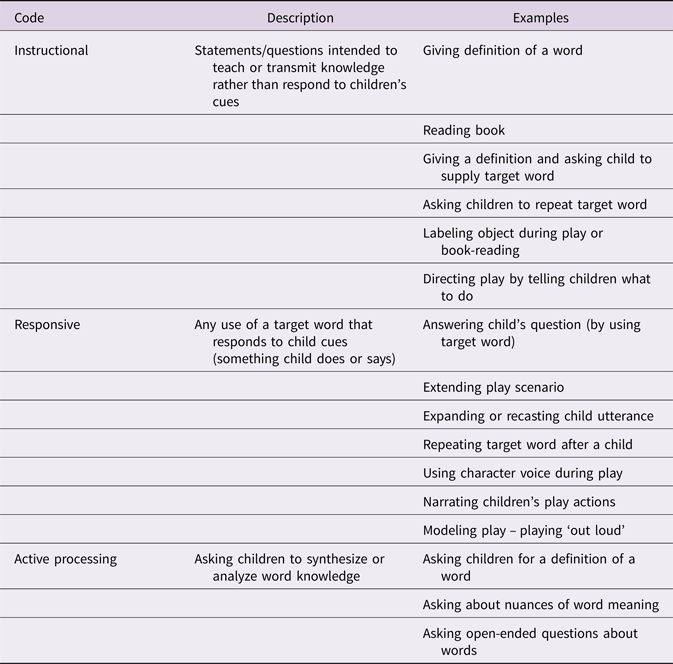
The coder selected one of three mutually exclusive options for the type of adult–child interaction in which a target word was used: instructional, responsive, and active processing. Instructional interactions were those intended to teach or transmit information, rather than respond to children's cues, while using a target word. Types of instructional interactions included giving a word's definition, labeling a picture with the target word, reading the book text, or directing children's play while using a target word (e.g., “Why don't you plant some seeds?”). Responsive interactions were those that responded to something a child did or said, while using a target word. Types of responsive interactions included answering a child's question, expanding or recasting children's utterances, giving a definition in response to a child's comment or question, modeling play, or building on a child's play idea. Active processing interactions were those that asked children to synthesize or analyze word meaning. Types of active processing interactions included asking children about nuances of word meaning (e.g., “How is sprouting different from growing?”) or asking open-ended questions that probed category membership (e.g., “How do you know that an artichoke is a vegetable and not a fruit?”). More examples of these codes are given in ‘Appendix C’. Inter-rater agreement was high for this category (95.6%).
Peabody Picture Vocabulary Test, Version IV
To assess the general vocabulary breadth and language abilities of the sample as compared to their age-group peers, we administered the Peabody Picture Vocabulary Test (PPVT-IV; Dunn & Dunn, Reference Dunn and Dunn2007) before the intervention began. For this sample, the mean standard score was slightly lower than the normative mean of 100 (M = 97.0) and the standard deviation was slightly higher than the normative standard deviation of 15 (SD = 16.05). The PPVT-IV was also used as a covariate in analyses to control for children's general vocabulary knowledge.
Vocabulary breadth measure
To measure children's receptive understanding of target words, an experimenter-designed measure was modeled after the PPVT-IV and administered at pre-test and post-test. This measure captures vocabulary breadth in that it taps relatively shallow knowledge of target words, and was included so that even minimal knowledge of target words (i.e., knowledge that children are not yet able to verbalize) could be captured. Similar multiple-choice tests have been widely used to assess target word comprehension (e.g., Blewitt, Rump, Shealy, & Cook, Reference Blewitt, Rump, Shealy and Cook2009). The examiner stated a word and asked the child to select the referent from three illustrations, including a correct referent, a foil from the same taxonomy (e.g., a marigold for the target word tulip) and a foil from the overall theme of ‘growing things’ (e.g., a fern for the target word hyacinth). Pictures of the target words were selected that were different from those used during the intervention, and four practice items depicting familiar objects were used at the beginning of the test to be certain that children understood the task. The test included 18 out of 21 target words. Three words were omitted from the test and assessed only on the NWDT-M measure (see below for a description of this measure) due to limited imageability (e.g., raw), or because they were high-frequency words (e.g., vegetables, flowers) that children likely had at least minimal knowledge of, and were therefore best measured on the NWDT-M, which allows for measurement of incremental increases in knowledge. There were two versions of the test (version A and B) with the items in different orders; the order in which these versions were given to children was counterbalanced.
Vocabulary depth measure: New Word Definition Test—Modified (NWDT-M)
To measure children's depth of knowledge of target words, an experimenter-designed measure was developed and administered at pre-test and post-test. This measure was adapted from Blewitt et al.’s (Reference Blewitt, Rump, Shealy and Cook2009) New Word Definition Test, which we renamed as the New Word Definition Test—Modified (NWDT-M) to reflect our adaptations, namely, additional categories for gestures and contextual information. This informal definition task allowed for coding of the number of information units children offered for each word, rather than their ability to give adult-like word definitions.
Children were asked to define words verbally or by using gestures. Children were tested on a representative subset of target words (15 out of 21 words; see ‘Appendix A’) due to time constraints and the cognitive demands on children. For each word, children were asked, “What is (a) ___?” and a follow-up question, “Can you show me or tell me anything else about ___?” If a student did not respond to a question, the tester moved on to the next word. All student responses were transcribed by testers. Two forms of the test (A and B) listed words in different orders, and the order in which these forms were administered was counterbalanced.
A coding scheme was developed (adapted from Blewitt et al., Reference Blewitt, Rump, Shealy and Cook2009) to categorize and score student responses for the number of information units given. Coding was conducted by a research assistant, and 20% of all forms were randomly selected and checked for reliability against a master coder after every four forms were completed. Overall percentage agreement averaged 97.6%, with a mean Cohen's kappa value of .97.
Coding scheme
We used eight information unit categories to score student responses for semantic content and contextual information: category information, perceptual qualities, functional information, part/whole, synonyms, gestures, meaningful context, and basic context. Each information unit was worth 1 point, except for basic context, which was worth 0.5 point. The first four categories were used for concrete nouns only. Perceptual qualities included properties such as how something looks, smells, tastes, feels, or sounds. Functional information included any process, purpose, or use for concrete nouns, and answers the question, “What do you do with it?” Part/whole described a distinct part of a target word or the whole that the target word was a part of. The remaining categories were used for all word types. Synonyms included any word or short phrase that was equivalent to the word being explained, and provided decontextualized meaning information. Gestures included gestures or actions that showed knowledge of the word's meaning (e.g., curling up in a ball and then gradually standing up to represent sprouting).
We also coded for two types of use in context. Meaningful context included responses that showed knowledge of the target word in a typical, meaningful context, along with semantic information. For example, one student said, “Seeds grow. They grow into a red tree.” In this example, “grow” would be scored for function, and “into a red tree” would be scored for meaningful context, because the student used an example to illustrate what seeds might grow into, along with semantic information. Basic context, worth only 0.5 point, was a simple association between a target word and a typical context, without any use of semantic information. For example, several children said, “monkey”, for vines, a response that does not include semantic information but still contains an association with a typical context. Incorrect or irrelevant responses received a score of 0. See ‘Appendix D’ for examples of student responses and scoring.
Data analysis
We first estimated the variance components associated with the unconditional models, examining the magnitude of the intra-class correlation coefficients (ICCs). The unconditional models for both the vocabulary breadth and vocabulary depth measures revealed clustering effects, with ICCs of 0.400 and 0.366, respectively. To account for the nested nature of our data, we used multilevel regression models for all analyses. Analyses examine children's residualized gains (post-test vocabulary knowledge controlling for pre-test vocabulary knowledge) in vocabulary knowledge. Unless otherwise noted below, all post-hoc pairwise comparisons were conducted using Fisher's Least Significant Difference (LSD) test.
Results
Correlations between pre-post target word knowledge, interaction types, and perceptual and linguistic cues
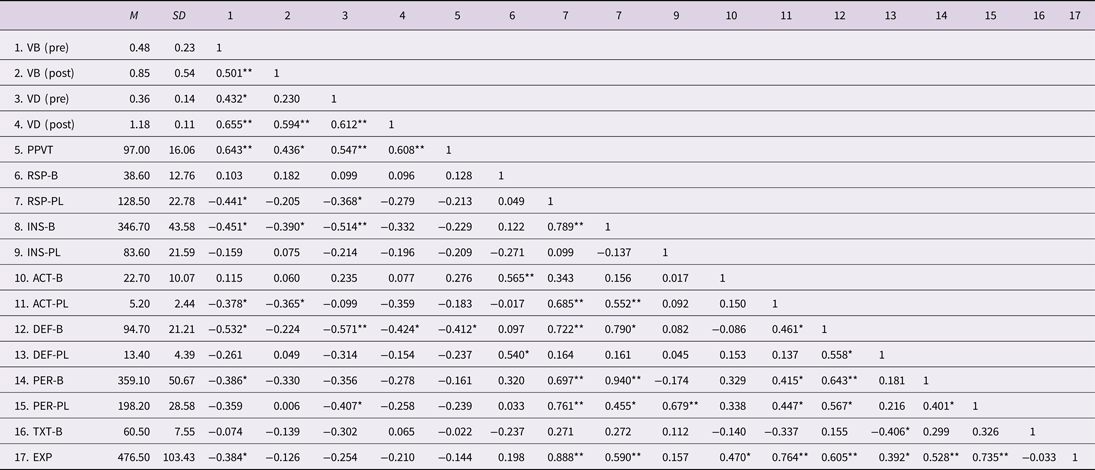
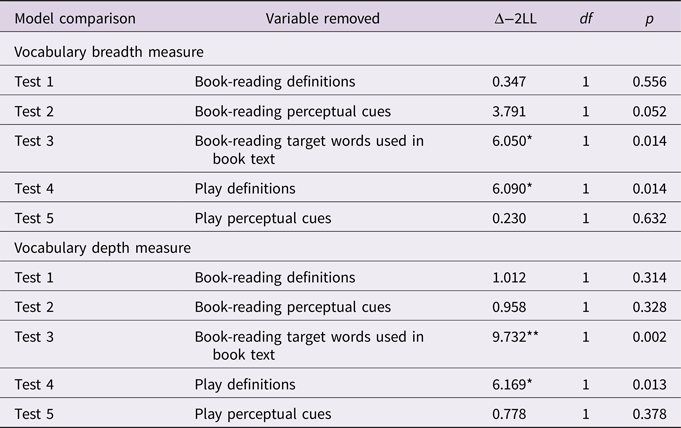
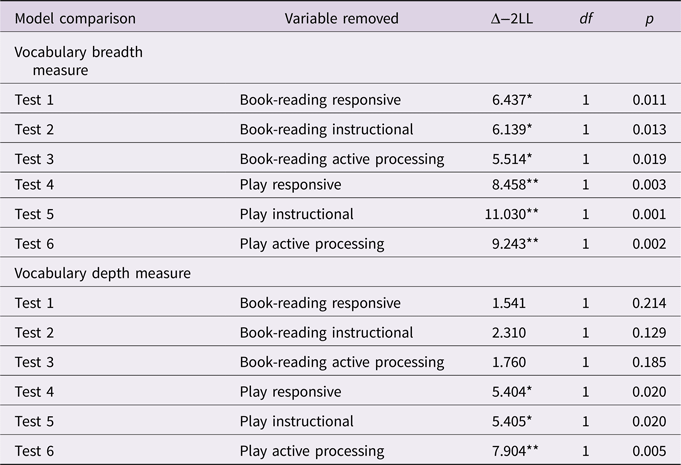
Table 1 provides the means and correlation matrices for vocabulary measures, interaction types, and perceptual and linguistic cues. The pre-test scores on both the vocabulary breadth and depth measures were negatively associated with many of the cue types, suggesting that children who knew more about words at pre-test received less information about words. Post-test scores showed similar, although weaker, negative relationships with the number of cues provided. Because of the high correlations between some of those variables, we first tested the assumption of collinearity. These results indicated that, although variables used in the same models were correlated, they did not reach multicollinearity, with variance inflation factors (VIFs) within acceptable ranges (i.e., less than 5) (O'Brien, Reference O'Brien2007). Additionally, we conducted supplementary analyses to ensure that our findings were not subject to the effects of collinearity. We ran a series of model comparisons using likelihood ratio tests (LRTs), comparing the full model to a model with one key predictor at a time removed. The pattern of results was consistent with the findings reported in Tables 2 and 3 (see ‘Appendix E’ for full results of supplementary analyses).
Correlation matrices for outcome measures, interaction types, and perceptual/linguistic cues

Notes. VB = vocabulary breadth score for target words; VD = vocabulary depth scores for target words; PPVT = Peabody Picture Vocabulary Test; RSP-B = responsive interactions – book; RSP-PL = responsive interactions – play; INS-B = instructional interactions – book; INS-PL = instructional interactions – play; ACT-B = active processing interaction – book; ACT-PL = active processing – play; DEF-B = total number of target words defined during book-reading; DEF-PL = number of target words defined during play; PER-B = total number of perceptual cues for target words during book-reading; PER-PL = total number of perceptual cues for target words during play; TXT-B = total number of target words read from book text; EXP = total number of exposures for target words. Breadth measure values indicate the proportion of items that were answered correctly. Depth measure values indicate the average number of information units children provided for each word. Values for variables 6–17 represent the average number of interactions or perceptual/linguistic cues for playgroups, summed across four book-reading/play sessions; ** p < .01, *p < .05.
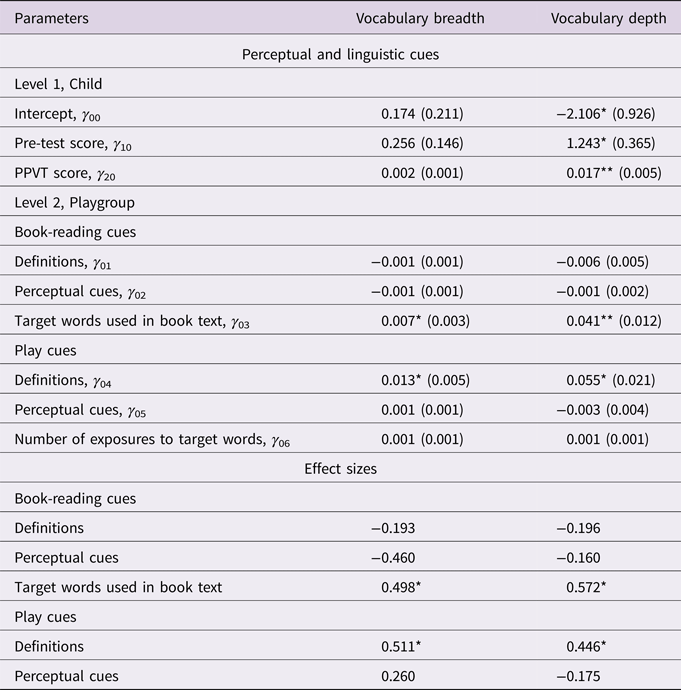
Parameter estimates (standard errors) for perceptual and linguistic cues (top panel) and effect sizes (bottom panel)

Notes. Standard errors adjusted for interdependency of children nested within playgroups. Effect sizes were calculated by multiplying the predictor's coefficient by its standard deviation, then dividing by the standard deviation of the outcome variable. The resulting effect size is equivalent to Cohen's d; ** p < .01, * p < .05.
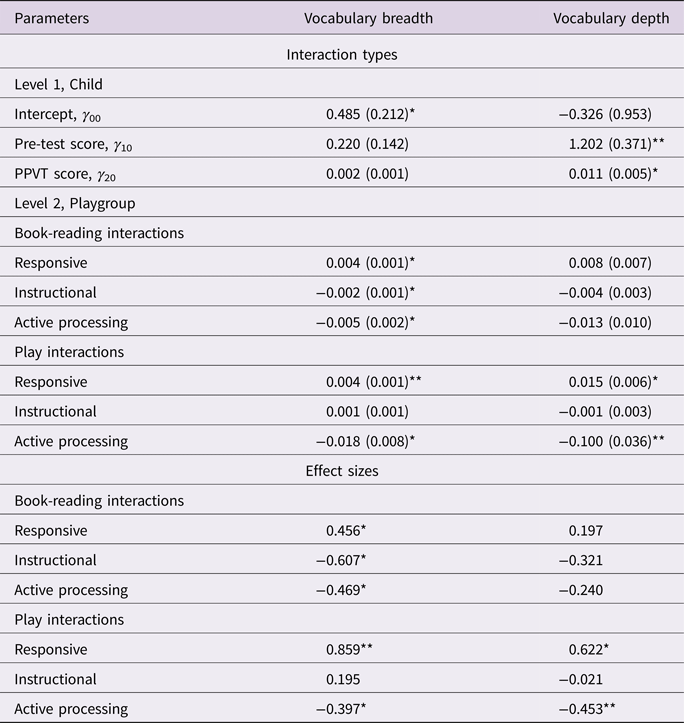
Parameter estimates (standard errors) for interaction types (top panel) and effect sizes (bottom panel)

Notes. Standard errors adjusted for interdependency of children nested within playgroups; effect sizes were calculated by multiplying the predictor's coefficient by its standard deviation, then dividing by the standard deviation of the outcome variable; the resulting effect size is equivalent to Cohen's d; ** p < .01, * p < .05.
Associations between perceptual and linguistic cues and growth in vocabulary knowledge
Research question 1 investigates the relationship between five types of cues for target words (definitions during book-reading and play, perceptual cues during book-reading and play, and use of target words in the book text) and the vocabulary outcome variables. We tested the association between the five playgroup-level predictors (γ 01–γ 05) for word cues and the two vocabulary outcome measures, accounting for the nesting of childrenij in playgroupsj. A covariate (γ 06) was included to control for the number of target word uses. Children's knowledge of words at pre-test (γ 10) and PPVT scores (γ 20) were also included as covariates.
 $$\eqalign{ {\rm Posttes}{\rm t}_{{\rm ij}} &= {\rm \gamma} _{00} + \lpar {{\rm \gamma}_{10}{^\ast}{\rm Pretes}{\rm t}_{{\rm ij}}} \rpar + \lpar {{\rm \gamma}_{20}{^\ast}{\rm PPV}{\rm T}_{{\rm ij}}} \rpar + \lpar {{\rm \gamma}_{01}{^\ast}{\rm DefBoo}{\rm k}_{\rm j}} \rpar \cr &+ \lpar {{\rm \gamma}_{02}{^\ast}{\rm PerceptualBoo}{\rm k}_{\rm j}} \rpar + \lpar {{\rm \gamma}_{03}{^\ast}{\rm BookTex}{\rm t}_{\rm j}} \rpar + \lpar {{\rm \gamma}_{04}{^\ast}{\rm DefPla}{\rm y}_{\rm j}} \rpar \cr &+ \lpar {{\rm \gamma}_{05}{^\ast}{\rm PerceptualPla}{\rm y}_{\rm j}} \rpar + \lpar {{\rm \gamma}_{06}{^\ast}{\rm Exposur}{\rm e}_{\rm j}} \rpar + {\rm U}_{0{\rm j}} + {\rm e}_{{\rm ij}}} $$
Table 2 shows the results from this analysis. All variables were entered into the model simultaneously, and the coefficients can therefore be interpreted as the unique effect of a given perceptual or linguistic cue, holding all others equal.
We estimated effect sizes for all linear relationships by multiplying the coefficient of the predictor by its standard deviation, then dividing by the standard deviation of the dependent variable (this approach is also used in Burchinal, Vandergrift, Pianta, & Mashburn, Reference Burchinal, Vandergrift, Pianta and Mashburn2010; Leyva et al., Reference Leyva, Weiland, Barata, Yoshikawa, Snow, Treviño and Rolla2015). This effect size indicates the change in the outcome variable in standard deviation units when the predictor increases by a standard deviation, and is equivalent to Cohen's d.
Analysis indicated that the number of target word definitions in the guided play setting was significantly and positively associated with growth in vocabulary breadth (d = 0.511) and depth (d = 0.446), controlling for the other perceptual and linguistic cues and total number of target words used, as was hearing target words used in the book text (d = 0.498 for breadth, d = 0.572 for depth).
Associations between interaction types and growth in vocabulary knowledge
Research question 2 examines the associations between types of interactions (responsive, instructional, and active processing, in both book-reading and play settings) and vocabulary learning. We tested the association between the six playgroup-level predictors (γ 01–γ 06) for interaction types and the two vocabulary outcome measures, accounting for the nesting of childrenij in playgroupsj. The model used was similar to Equation (1), but the playgroup-level predictors of perceptual/linguistic cues were replaced with interaction type predictors, and the covariate controlling for number of exposures was removed.
Table 3 shows the results from this analysis. The number of responsive interactions during play showed a positive and statistically significant association with growth in vocabulary breadth (d = 0.859) and depth (d = 0.622), while the active processing interactions during play were negatively and significantly associated with both vocabulary breadth (d = –0.397) and depth (d = –0.453). There were significant associations between interaction type and vocabulary growth during book-reading on the breadth measure only, with responsive interactions positively predicting growth (d = 0.456) and active processing (d = –0.469), and instructional (d = –0.607) interactions negatively predicting growth.
Discussion
The present paper examines preschoolers’ word-learning in an instructional setting within the contexts of book-reading and play. Our data come from a successful vocabulary intervention in which children showed substantial growth in vocabulary knowledge. Drawing on Hollich et al.’s (2000) emergentist coalition model (ECM), which recognizes word-learning as a dynamic, flexible process in which children recruit different word-learning cues at different developmental stages, we investigated the specific perceptual, linguistic, and social-pragmatic cues that supported preschoolers’ vocabulary growth, controlling for general vocabulary knowledge and knowledge of target words at pretest. The present study builds on the ECM by finding that, not only do children recruit different word-learning cues at different developmental stages, but they also do so in different word-learning settings. Moreover, our findings suggest that preschool-aged children's (4;11 in this sample) word-learning is supported through child-initiated, rather than adult-initiated, interactions about words. We discuss the specific findings in more detail below.
Perceptual and linguistic cues and growth in vocabulary knowledge
We first examined perceptual and linguistic cues, or the visual and verbal supports the adult provided for word meaning. Perceptual cues were not significantly associated with word-learning in either setting. During book-reading, only hearing target words used in the book text was significantly related to growth (d = 0.498 for breadth, d = 0.572 for depth) when the other perceptual and linguistic cues were controlled for. This finding points to the importance of the book text itself as a fertile source of meaning for words. The books used here were informational texts that contained rich conceptual information and also made explicit connections between related concepts. Comparisons of narrative and informational text suggest that informational text may better support students’ conceptual learning (Cervetti, Bravo, Hiebert, Pearson, & Jaynes, Reference Cervetti, Bravo, Hiebert, Pearson and Jaynes2009). Children may also have used the text to infer syntactic information about words, ‘bootstrapping’ meaning information from the words’ position in sentences (e.g., Fisher et al., Reference Fisher, Gertner, Scott and Yuan2010). The finding here also aligns with evidence from another recent vocabulary intervention in which teachers read books containing new words. There were no differences in learning between a condition where teachers explicitly defined the new words during book-reading sessions, and one in which they simply used new words to talk about the story (Dickinson et al., Reference Dickinson, Nesbitt, Collins, Hadley, Newman, Rivera and Hirsh-Pasek2019b). When taken together, these results indicate that children are able to extract some information about word meaning simply from hearing words used repeatedly in a rich context.
During guided play, hearing definitions was significantly related to growth (d = for 0.519 for vocabulary breadth, d = 0.487 for vocabulary depth). It is important to note that definitions during play were not necessarily used in instructional interactions, and were often introduced in responsive interactions (e.g., Child: “What's that?” Adult: “That's soil; soil is dirt.”). Definitions were also used sparingly during play (M = 13.4 times) as compared to book-reading (M = 94.7 times), perhaps because they were used only when pertinent to the play topic. Play definitions tended to be more brief and incorporate a single piece of semantic information (e.g., “Leeks are vegetables.”) when compared to book-reading definitions, which often included multiple features (e.g., “Leeks grow underground and we eat the stem.”). It is possible that the brief, contingent bits of meaning information provided during play were more easily absorbed by children when compared to the longer, more instructional definitions used during book-reading. The association between definitions in play and growth in word knowledge suggests that children can learn information about word meanings during play; however, given the relatively sparse use of this strategy, it may not generalize to all word types.
The findings above should be interpreted in light of the negative correlations between pre-test scores and the perceptual and linguistic cues variables (see Table 1), suggesting that the adult may have provided less explicit information about word meaning when it was perceived that children already knew something about words.
Adult–child interactions and growth in vocabulary knowledge
Guided play
Among the various interactions types, responsive interactions during play were the strongest predictor of growth in breadth (d = 0.859) and depth (d = 0.622) of vocabulary knowledge. These findings indicate the importance of joint engagement in vocabulary learning, as the coding of responsive interactions captured moments in which a child offered a comment, question, or non-verbal overture (such as silently offering a toy), and the adult answered, expanded children's utterances with additional meaning information or a definition, or extended the play idea while using a target word. This suggests that information about word-meaning is most helpful when instantiated in the context of adult–child interactions that provide contingent, thoughtful scaffolding of children's emergent word knowledge.
An alternate explanation for the responsive interactions finding is that children who were learning more about words also offered more on-topic overtures, creating opportunities for the provision of contingent responses that included target words. This is consistent with transactional models of development in which adults’ interactions with children are significantly influenced by the child's own competencies (Sameroff & Mackenzie, Reference Sameroff and Mackenzie2003). This finding implies that children who are already learning more about words may be more engaged and more likely to initiate cycles of interaction that lead to deeper word-learning, with children who are learning less making fewer overtures.
Active processing interactions during play were negatively related to growth in word knowledge. While active processing interactions have been productively employed with kindergarten students (Coyne et al., Reference Coyne, McCoach, Loftus, Zipoli and Kapp2009; McKeown & Beck, Reference McKeown and Beck2014), the questions used here may have simply been too challenging for preschoolers. For example, questions such as, “Is a daffodil a flower, or a vegetable? How do you know?” often got no responses from children. It is possible that children's developing word knowledge was too fragile to accommodate these probing questions. Children may have also been unfamiliar with these types of questions, as analytic talk is relatively uncommon in preschool classrooms (Dickinson & Porche, Reference Dickinson and Porche2011). Furthermore, play may have not been an appropriate setting for active processing questions, as other studies have used this strategy in post-book-reading discussions rather than playful settings (Coyne et al., Reference Coyne, McCoach, Loftus, Zipoli and Kapp2009; McKeown & Beck, Reference McKeown and Beck2014). Active processing questions, however, do model a strategy for analyzing word meaning that is helpful in developing children's word-learning abilities, and further practice with these types of questions over a longer time period may be beneficial.
Shared book-reading
Instructional talk during book-reading was a significant negative predictor of growth in word-learning (d = –0.396 on breadth measure). These results are surprising as instructional talk is a primary vehicle for explicit information about word meaning, a factor which has been shown to support children's word-learning (Biemiller & Boote, Reference Biemiller and Boote2006). However, such explicit information may be most helpful when shared responsively: preschool teachers’ analytic talk about books strongly predicted children's vocabulary when these conversations were responsive and dialogic (Dickinson & Smith, Reference Dickinson and Smith1994). The amount of instructional talk during book-reading in this study (on average, 346 instances over four sessions) may also have crowded out opportunities for child participation. In a longitudinal study, children who were in classrooms with lower ratios of teacher–child talk in preschool had higher literacy skills in kindergarten (Dickinson & Porche, Reference Dickinson and Porche2011), indicating that creating sufficient space for child talk is important in supporting literacy. An alternate explanation for the finding here is that children who were learning more about words may have supplied more information themselves, driving down the amount of adult instructional talk. In later readings of the book, children were asked to participate by “filling in the blanks” with target words and definitions as the adult read.
Limitations
This study involves several limitations. First, the sample size is small, and the intervention was implemented by a researcher in small groups of three children. Given the findings here that word-learning varies across settings, it is particularly important to highlight the affordances of the small group book-reading and play featured here, and to emphasize that such findings likely do not generalize to the more typical preschool whole-class shared book-reading or free-play activities. In particular, there were greater word-learning opportunities in the small-group settings because they allowed for the kinds of responsive interactions about new words that are rare in preschool classrooms (Cabell et al., Reference Cabell, DeCoster, LoCasale-Crouch, Hamre and Pianta2013). Using a researcher, rather than a teacher, as the interventionist likely also influenced our results and limited generalizability, as previous meta-analyses have found larger gains in word-learning for researcher-implemented interventions (Marulis & Neuman, Reference Marulis and Neuman2010). Finally, the analyses are correlational, not causal, in nature.
Conclusions and implications
Differential opportunities for word-learning across settings
The findings here lend support to the theory that children recruit different word-learning cues in different settings. Previous research has found similar variations in language richness across settings, with teachers using the strongest language support strategies during science activities (Cabell, Reference Cabell, DeCoster, LoCasale-Crouch, Hamre and Pianta2013) and shared book-reading (Fuccillo, Reference Fuccillo2011) when compared to other settings such as literacy, math, and circle time. The present study was able to leverage the language-rich potential of both the shared book-reading setting and science content, while also using the guided play setting to further develop conceptual knowledge.
Another recent study examined variation in Head Start teachers’ use of academic language across settings, including book-reading, small group instruction, and group content instruction (Dickinson, Hofer, Barnes, & Grifenhagen, Reference Dickinson, Hofer, Barnes and Grifenhagen2014). Each setting had a different cluster of language affordances, with book-reading showing high lexical diversity, complex syntax, and more talk about vocabulary than other settings, while group content instruction included a high rate of sophisticated vocabulary use, complex syntax, and talk about science-related content. The present study confirms and builds on these findings, with different clusters of structural and content-focused features appearing in shared book-reading and guided play. Shared book-reading, as in the Dickinson et al. (Reference Dickinson, Hofer, Barnes and Grifenhagen2014) study, included rich language as provided by the book text, and was a site of impactful responsive interactions, although fewer responsive interactions were used during book-reading (M = 38.6) than in guided play (M = 128.5). Guided play featured definitions, which could also be considered talk about word meanings and content, and responsive interactions. These findings indicate the promise of both shared book-reading and guided play as settings in which language can be supported across multiple dimensions.
Interactive word-learning
The present study also suggests an account of word-learning at the preschool age that is highly social and interactive, with adult and child language closely linked to one another. In particular, the findings indicate that children's learning is best supported by responsive, child-led interactions about words. This represents a kind of middle ground between highly didactic instructional methods in which the adult supplies most of the word meaning information and children listen, and settings in which children play or explore freely without adult support. Instead, the responsive interactions here can be characterized as adult-scaffolded: children initiated interactions, but the adult kept play and book-reading ‘on topic’ by building on child overtures. Children are thus positioned to become “apprentice[s] to a master language user” (Hollich et al., Reference Hollich, Hirsh-Pasek and Golinkoff2000, p. 27).
The relationship between responsive adult talk and growth in word-learning implies a kind of feedback loop, or, as Justice and colleagues have termed it, bi-directional dynamics (Justice, McGinty, Zucker, Cabell, & Piasta, Reference Justice, McGinty, Zucker, Cabell and Piasta2013) between adult and child. Responsive interactions may support the child's use of the new word, which again gives the adult an opening to further support word-learning. Of course, these word-learning cycles depend on the child initiating the interaction. This may mean that adults should be particularly mindful of supporting children with emergent language skills to initiate interactions, perhaps by modeling play or recognizing and building on non-verbal overtures (Kaiser, Hancock, & Nietfeld, Reference Kaiser, Hancock and Nietfeld2000). Adults can also cultivate word consciousness, or children's awareness of and attention to words (Neugebauer et al., Reference Neugebauer, Gámez, Coyne, McCoach, Cólon and Ware2017), as well as the ability to think and ask about words’ meanings (Graves & Watts-Taffe, Reference Graves and Watts-Taffe2008). Teaching a child to ask about an unknown word's meaning provides the opportunity for an adult to provide a thoughtful, contingent response that, according to the findings in this study, is a powerful vehicle for word-learning.
Acknowledgments
The authors would like to gratefully acknowledge Kathy Hirsh-Pasek, Amanda Goodwin, and Deborah Wells Rowe for reading and commenting on previous versions of this manuscript. We also appreciate the help and participation of the 30 preschool children and their teachers who participated in this study.
Appendix A
Words taught in intervention

Appendix B
Selected transcripts from play sessions

Appendix C
Interaction type codes and examples
Appendix D
Examples of student responses and codes assigned

Appendix E
Results of model comparisons with likelihood ratio tests
Likelihood Ratio Test (LRT) results for perceptual and linguistic cues on vocabulary breadth measure (top panel) and vocabulary depth measure (bottom panel)

Likelihood Ratio Test (LRT) results for interaction types on vocabulary breadth measure (top panel) and vocabulary depth measure (bottom panel)