

1. Introduction
A recent trend has been to seek explanations for movement constraints not in the syntactic configuration, but in processing complexity (Kluender Reference Kluender1991, Reference Kluender, Goodluck and Rochemont1992; Kluender and Kutas Reference Kluender and Kutas1993a,Reference Kluender and Kutasb; Hawkins Reference Hawkins1994; Kluender Reference Kluender, Culicover and McNally1998; Hawkins Reference Hawkins2004; Arnon et al. Reference Arnon, Hofmeister, Jaeger, Sag and Snider2005; Hofmeister et al. Reference Hofmeister, Jaeger, Sag, Arnon, Snider, Featherston and Sternefeld2007; Sag et al. Reference Sag, Hofmeister and Snider2007; Hofmeister and Sag Reference Hofmeister and Sag2010; Hofmeister et al. Reference Hofmeister, Jaeger, Arnon, Sag and Snider2013a, Reference Hofmeister, Casasanto, Sag, Sprouse and Hornstein2013b; Gieselman et al. Reference Gieselman, Kluender, Caponigro, Fainleib, LaCara and Park2013).Footnote 1 In this squib, we focus on a particular set of constraints that have been subsumed in the literature under the notion of freezing. The idea of freezing in syntactic theory is that the reordering of syntactic material may under certain circumstances render parts of a structure closed to extraction.Footnote 2 This idea was first explored by Ross (Reference Ross1967), who noted the unacceptability of extraction from an extraposed PP (1d) and from an extraposed relative clause (2d).
- (1)
a. You read a book [about Abraham Lincoln] yesterday.
b. You read a book tj yesterday [about Abraham Lincoln]j.
c. Whoi did you read a book about ti yesterday?
d. * Whoi did you read [a book tj ] yesterday [about ti]j.
- (2)
a. You read a book that explains linguistics yesterday.
b. You read a book tj yesterday [that explains linguistics]j.
c. * Whati did you read a book [that explains ti] yesterday?
d. * Whati did you read a book tj yesterday [that explains ti]j?
While (2c) is ruled out by Ross's Complex NP Constraint, this constraint does not apply to the extraposed relative clause. Thus, there must be another constraint to rule out (2d). And while (1c) is acceptable, (1d) is of reduced acceptability. Thus, Ross proposed the Frozen Structure Constraint.Footnote 3
(3) The Frozen Structure Constraint (FSC) (Ross Reference Ross1967: 295)
If a clause has been extraposed from a noun phrase whose head noun is lexical, this noun phrase may not be moved, nor may any element of the clause be moved out of that clause.
A somewhat different, but related proposal is due to Wexler and Culicover (Reference Wexler and Culicover1980), who proposed the Raising Principle (4) and the Freezing Principle (5), based on considerations of language learnability.
(4) Raising Principle (Wexler and Culicover Reference Wexler and Culicover1980: 143)
If a node A is raised, then no node that A dominates may be used to fit a transformation.
(5) Freezing Principle (Wexler and Culicover Reference Wexler and Culicover1980: 119)
a. If the immediate structure of a node in a phrase-marker is nonbase, that node is frozen.
b. If a node A of a phrase-marker is frozen, no node dominated by A may be analyzed by a transformation.
The Raising Principle can be interpreted as blocking subextraction from an extraposed PP, as in (1d).Footnote 4 The Freezing Principle blocks extraction from an NP shifted to the end of VP – that is, Heavy NP Shift (HNPS) – as illustrated in (6).
- (6)
a. You put a picture of Abraham Lincoln on the table. [no extraction, no HNPS]
b. You put tj on the table [a picture of Abraham Lincoln]j. [no extraction, HNPS]
c. Whoi did you put [a picture of ti] on the table? [extraction, no HNPS]
d. * Whoi did you put tj on the table [a picture of ti]j? [extraction, HNPS]
Regarding freezing itself, Winkler et al. (Reference Winkler, Radó, Gutscher, Featherston and Versley2016) show that the unacceptability of a supposedly frozen was-für split construction in German (Müller Reference Müller2010), can be ameliorated by manipulation of contrastive focus in the key examples. The conclusion is that the freezing phenomenon does not reflect violation of a grammatical constraint, but the proper interpretation of focus in context.Footnote 5
Focusing specifically on extraction from an extraposed PP, Hofmeister et al. (Reference Hofmeister, Culicover and Winkler2015) demonstrate that acceptability judgments of sentences such as (1d) can be explained entirely in terms of acceptability judgments of extraction and extraposition. In an experiment testing the judgments of native speakers, they found that the difference between the judgments of extraposition (1b) and the baseline (1a), and the difference between the judgments of extraction (1c) and the baseline (1a), added up to just the difference between the judgments of extraction from extraposition (1d) and the baseline (1a). That is, there is no component of the unacceptability of extraction from extraposition that must be attributed to freezing per se.
These results raise the question of whether it is possible to find experimental evidence that a grammatical principle of freezing is or is not responsible for the unacceptability judgments reported in other cases. In this paper we present evidence that suggests that the reduced acceptability of extraction from a shifted heavy NP, as in (6d), is the sum of the unacceptability of HNPS and extraction. These results completely mirror those reported by Hofmeister et al. (Reference Hofmeister, Culicover and Winkler2015) for extraction from extraposed PPs.
2. Acceptability judgments: Extraction and HNPS
The two approaches to freezing make different predictions that can be tested experimentally. Under a processing approach to freezing, we would predict that extraction from HNPS should reflect the individual processing cost of the shift operation and the extraction operation.Footnote 6 If freezing is due to a grammatical principle, we would predict an additional violation cost for sentences that contain extraction from shifted NPs beyond the cost of processing the individual dependencies. To test such complex hypotheses, it is crucial to rely on experimental data, since these hypotheses predict different data patterns. Such data cannot be obtained from individual introspective judgments (Scontras and Gibson Reference Scontras and Gibson2011, Gibson et al. Reference Gibson, Piantadosi and Fedorenko2011). In the next section, we lay out an experimental design based on a factorial approach to movement constraints (Sprouse Reference Sprouse2007; Sprouse et al. Reference Sprouse, Wagers and Phillips2012).
2.1 Materials
We conducted two experiments to test the acceptability of HNPS and extraction from HNPS across various constructions. The first study compared shifted orders to base orders without extraction and was used to establish the baselines to which extraction data was compared. This design allows us to determine how much HNPS and extraction independently affect judgments, and whether combining the two lowers judgments beyond what is expected on the basis of each independent factor. More precisely, a grammatical account of freezing would predict that the extraction data should reveal interactions with the baseline data. If, by contrast, freezing is merely the additive effect of the shift operation and the extraction operation, only main effects should be observed. Moreover, by varying the intervening material we were able to test whether there are other factors that play a role in acceptability.
In our materials, the intervening phrases consisted of adverbial PPs (7a-b), adverbs (7c-d), and PP arguments of the verb (7e-f). The conditions for the baseline experiment and the extraction experiment are shown in (7) and (8), respectively:
(7) Baseline conditions:
a. The professor praised a detailed review of the new book in his article. (PP-adv base)
b. The professor praised in his article a detailed review of the new book. (PP-adv shift)
c. The professor praised a detailed review of the new book passionately. (adverb base)
d. The professor praised passionately a detailed review of the new book. (adverb shift)
e. The professor gave a detailed review of the new book to his colleague. (PP-arg base)
f. The professor gave to his colleague a detailed review of the new book. (PP-arg shift)
(8) Extraction conditions:
a. What did the professor praise a detailed review of in his article? (PP-adv base)
b. What did the professor praise in his article a detailed review of? (PP-adv shift)
c. What did the professor praise a detailed review of passionately? (adverb base)
d. What did the professor praise passionately a detailed review of? (adverb shift)
e. What did the professor give a detailed review of to his colleague? (PP-arg base)
f. What did the professor give to his colleague a detailed review of? (PP-arg shift)
Participants read 40 experimental items in each of the two experiments.Footnote 7 The items were distributed on eight different lists according to the Latin square design. The experimental materials were presented along with 60 unrelated distracters in an individually randomized order. Each experimental session was introduced by a practice session to familiarize participants with the task.
2.2 Participants and procedure
Acceptability judgments were collected via Amazon.com's Mechanical Turk marketplace, which is an effective and reliable means to collect judgment data of large participant numbers (Gibson et al. Reference Gibson, Piantadosi and Fedorenko2011, Sprouse Reference Sprouse2011). Each of the experiments was completed on Mechanical Turk by 96 individuals. At the beginning of the experiment, participants identified their age, sex, handedness and language background. To remove any incentive to lie about language background, participants were not excluded from the experiment on the basis of language history. The results from three participants in the baseline experiment and one participant in the extraction experiment who did not indicate English was their first language were eliminated prior to analysis, leaving 93 participants for the baseline experiment [44 female, 49 male; mean age: 32,5; right-handed: 85, left-handed: 8] and 95 for the extraction experiment [44 female, 51 male; mean age: 36; right-handed: 88, left-handed: 7]. Participants received $2.50 for their participation. The estimated duration of an experimental session was 15 minutes. Participants were instructed to judge the subsequent sentences in terms of naturalness on a seven-point scale, one being extremely unnatural and seven being extremely natural. The distractors contained 15 standardized sentences representing five degrees of acceptability. On the basis of the judgments given for the standardized fillers, we were able to determine whether or not participants did the study properly. No participants had to be excluded from the analysis on the basis of the judgments participants gave for the standardized fillers.
2.3 Results
The overall 3 × 2 × 2 experimental design has three factors: the within-participant factors construction (three levels: PP adverbial, PP argument, and adverb); structure (two levels: shift vs. base); and extraction as a between-participants factor (subexperiments baseline and extraction). We first report on the overall analyses for the complete design with the between-participant factor extraction (baseline vs. extraction) crossed with the within-participant factors structure (base vs. shift) times construction (PP adverbial, PP arguments, adverbs). For the three-level factor construction, we specified two orthogonal contrasts with PP adverbial as a reference condition. PP adverbials are compared against adverbs, as they have the same function. PP adverbials are compared against PP arguments, as they have the same phrasal category and the same length on the basis of word count. α errors are indicated by superscripts as follows: ***(if p < .001); **(if p < .01); *(if p < .05); +(if p < .10); ns (if p ≥ .10).
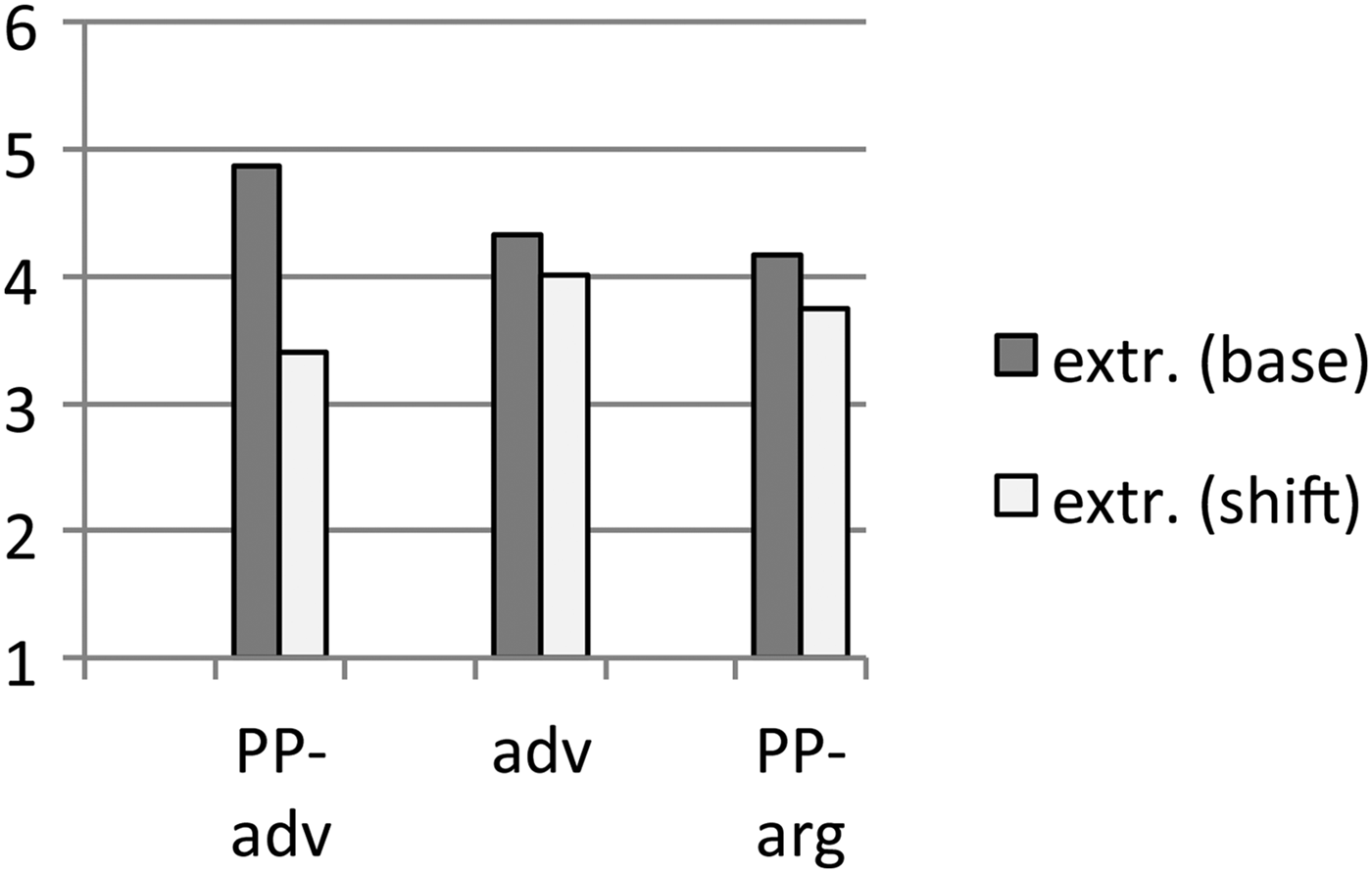
The overall analyses reveal a main effect of structure [F1(1,186) = 187.80***, η2 = .50; F2(1,39) = 144.25***, η2 = .79], which does not interact with extraction [both F < 1], showing that HNPS lowers acceptability alike for all three constructions (see Figures 1 and 2). There is also a main effect of construction [F1(2,372) = 11.23***, η2 = .06; F2(2,78) = 3.04+, η2 = .07] which does strongly interact with extraction [F1(2,372) = 42.97***, η2 = .19; F2(2,78) = 31.39***, η2 = .45] indicating that costs of extraction in terms of acceptability differ for the three constructions. The contrasts reveal that the extraction costs for the reference condition PP adverbial (difference in the means of base minus shift: 0.97) are higher than for adverbs (0.55) [F1(1,186) = 26.26***, η2 = .12; F2(1,39) = 28.66***, η2 = .42] but lower than for PP arguments (1.32) [F1(1,186) = 19.75***, η2 = .10; F2(1,39) = 9.42**, η2 = .20]. As regards the main effect of construction, it turns out that on average adverbs are rated less acceptable than PP adverbials [F1(1,186) = 17.89***, η2 = .09; F2(1,39) = 5.23*, η2 = .12], with the latter being as acceptable as PP arguments [both F < 1]. Finally, structure interacts with construction [F1(2,372) = 80.62***, η2 = .30; F2(2,78) = 46.15***, η2 = .54]. The three-way interaction of all factors does not reach significance [F1(2,372) = 2.36+, η2 = .01; F2(2,78) = 2.22ns, η2 = .05].
Mean ratings for non-extractions

Mean reatings for extractions

Due to the interactions of construction with extraction and with structure, we present separate analyses for the three constructions; not surprisingly, the main effect of structure is obtained for all three constructions [PP adverbials: F1(1,186) = 290.90***, η2 = .61; F2(1,39) = 151.33***, η2 = .80; adverbs: F1(1,186) = 35.85***, η2 = .16; F2(1,39) = 25.97***, η2 = .40; PP arguments: F1(1,186) = 42.85***, η2 = .19; F2(1,39) = 39.72***, η2 = .51]. Moreover, all three constructions exhibit a main effect of extraction, showing that extraction actually causes costs for all three constructions [PP adverbials: F1(1,186) = 65.82***, η2 = .26; F2(1,39) = 113.51***, η2 = .74; adverbs: F1(1,186) = 21.70***, η2 = .10; F2(1,39) = 45.17***, η2 = .54; PP arguments: F1(1,186) = 112.67***, η2 = .38; F2(1,39) = 188,15***, η2 = .83].
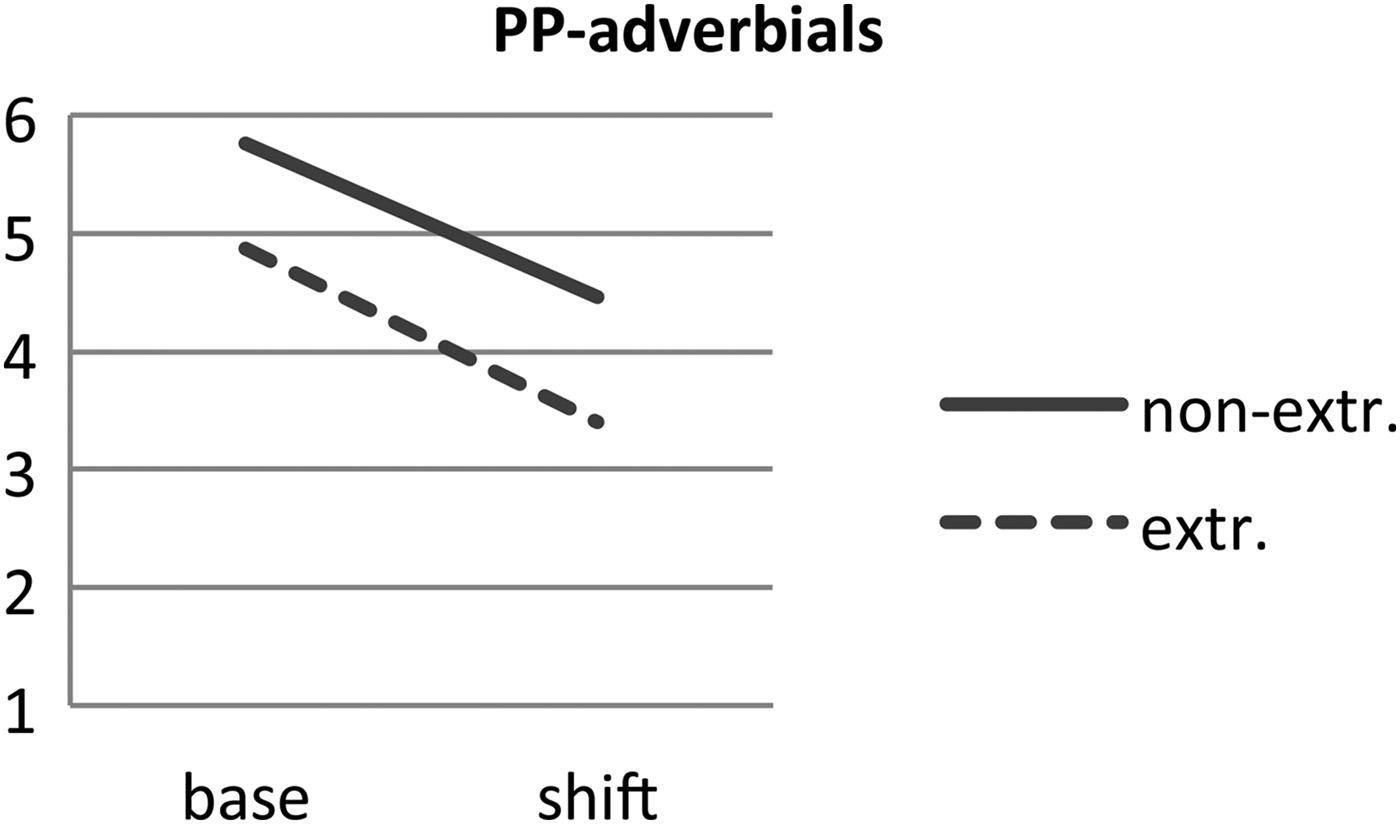
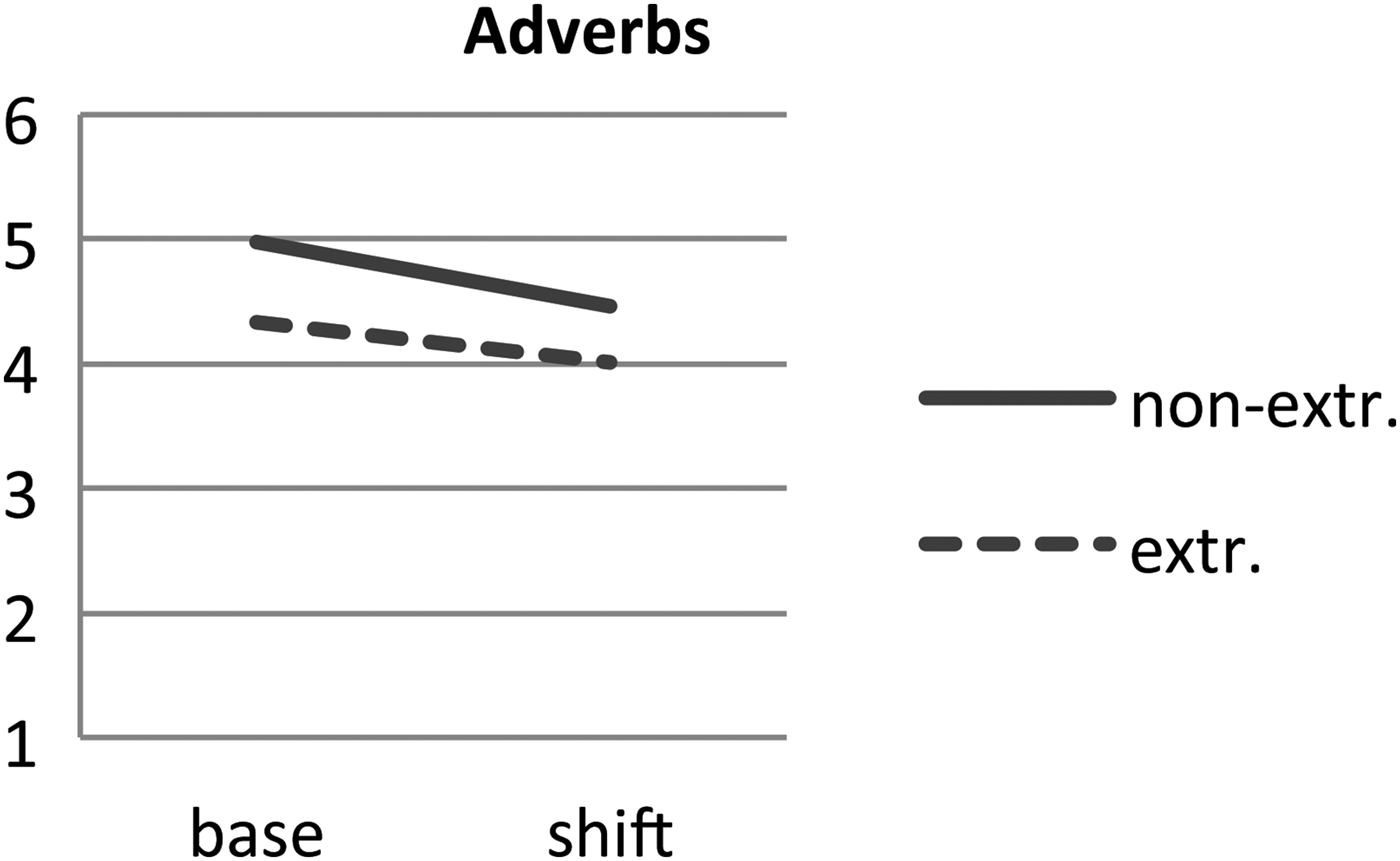
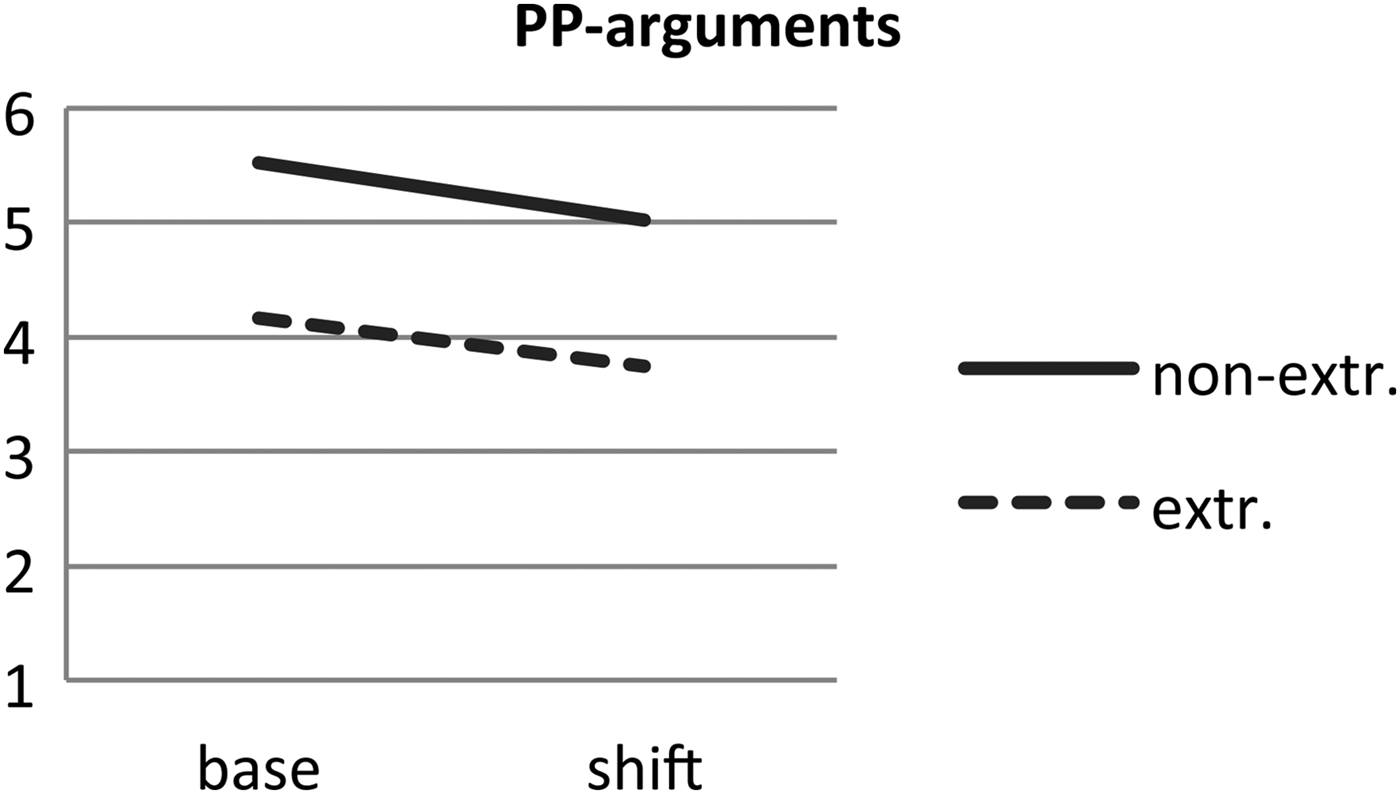
We finally ask whether the two factors interact. The prediction is that if there is an extra penalty for extraction out of HNPS, this extra penalty should show up in a significant interaction of structure with extraction. Crucially, the interactions missed significance throughout, that is, in the case of adverbial PPs (cf. Figure 3), adverbs (cf. Figure 4) and argument PPs (cf. Figure 5). [PP adverbials: F1(1,186) = 1.08ns, η2 < .01; F2(1,39) = 1.62ns, η2 = .04; adverbs: F1(1,186) = 1.97ns, η2 = .01; F2(1,39) = 1.94ns, η2 = .05; PP arguments: both F < 1]. Note that the eta square values reported here show that our data had enough statistical power to reveal potential interactions predicted by the grammatical theory of freezing and, in fact, the data easily revealed main effects for the factors shift and extraction. We therefore assume that the absence of these interactions is real and not a matter of statistical power.
Mean ratings for PP-adverbials

Mean ratings for Adverbs

Mean ratings for PP-arguments

2.4 Discussion
The two experimental studies show that the acceptability of HNPS varies depending on the intervening material over which the heavy NP is shifted. The other three constructions reveal a penalty for HNPS. The experiments also reveal that adverbial PPs and argument PPs behave differently. The penalty for HNPS is much greater in the case of adverbial PPs than with argument PPs. Overall, the studies show that HNPS and extraction independently lower the ratings. However, the two factors do not interact in three of the tested constructions, which suggests that in these cases there is no extra cost for extraction out of HNPS. The cost for HNPS and extraction is purely additive in these cases.
3. General discussion
Above we noted that there is empirical evidence against a grammatical account of freezing in the case of two of the main exemplars of the freezing effect, extraction from extraposition and the German was-für split construction. Now we have similar evidence in a third main exemplar of freezing, extraction from HNPS.
Thus, the current results bolster the prima facie case against a grammatical account of freezing. The more plausible explanation, it seems, is that the judgments are due to the complexity of processing the chains. There is of course prior evidence that chain processing is costly; see for example Gibson (Reference Gibson1998, Reference Gibson, Marantz, Miyashita and O'Neil2000), among others.
While there is no interaction between HNPS and extraction, HNPS itself appears to be sensitive to what the NP has been shifted over. In two of the four conditions, namely HNPS over adverbs and PP arguments, the effect is much smaller than it is in the case of HNPS over PP adverbials. We do not have an explanation of why HNPS over different material produces different levels of acceptability, quite independently of extraction. But the case of PP adverbials versus PP arguments is even less clear. Since our concern here is whether there is an interaction between HNPS and extraction, we set this question aside.
Beyond the cases that we have reviewed here, there are additional candidates for freezing that deserve further scrutiny. For example, extractions from subjects are candidates for freezing effects, on the assumption that subjects are in a position derived through movement. Sprouse et al. (Reference Sprouse, Wagers and Phillips2012) and Sprouse et al. (Reference Sprouse, Caponigro, Greco and Cecchetto2016) found evidence of superadditivity in extractions from subjects, but Rizzi (Reference Rizzi, Cheng and Corver2006, Reference Rizzi2007), Chaves (Reference Chaves2013), and Polinsky et al. (Reference Polinsky, Gallo, Graff, Kravtchenko, Morgan, Sturgeon and Sprouse2013), among others, offer arguments that subjects are not in fact frozen (see also Gallego (Reference Gallego2009) for an alternative interpretation of some of Rizzi's data). Culicover and Nowak (Reference Culicover and Nowak2002) suggested that extraction from topics, while complex, is not ungrammatical.
There are, finally, broader methodological questions to consider regarding the extent to which it is valid to draw conclusions about grammatical and extra-grammatical sources for acceptability judgments. We take the position, elaborated at length in Hofmeister et al. (Reference Hofmeister, Culicover and Winkler2015), that additive effects such as those observed here cannot decisively prove the nonexistence of a grammatical principle, but simply provide evidence against it, and raise questions about whether it is the best explanation of the phenomena. In fact, the interactions may be very complex but produce the appearance of simple additivity by mixing additivity, superadditivity and subtraction. We believe that the best way to actually resolve this question is to develop a precise model of what is going on in the processing of these sentences, something that no one, to our knowledge, has successfully accomplished.
Given the present state of affairs, we apply Occam's Razor, and hypothesize that freezing effects are not a matter of a grammatical principle, but of processing complexity.