Cyberbullying is defined as intentional aggression that is (repeatedly) carried out on the internet or while using electronic devices against a person who cannot defend himself or herself (Kowalski, Limber, & Agatston Reference Kowalski, Limber and Agatston2008; Smith et al., Reference Smith, Mahdavi, Carvalho, Fisher, Russell and Tippett2008). There is sufficient evidence that this form of peer aggression is associated with numerous negative outcomes that deteriorate healthy psychosocial development. For instance, cyberbullying is associated with depressive symptoms and suicidal thoughts (Hinduja & Patchin, Reference Hinduja and Patchin2010; Perren, Dooley, Shaw, & Cross, Reference Perren, Dooley, Shaw and Cross2010). Furthermore, a longitudinal study showed that cyber-victimisation predicted an increase in depressive symptoms over time (Machmutow, Perren, Sticca, & Alsaker, Reference Machmutow, Perren, Sticca and Alsaker2012).
Prior research has identified several effective coping strategies, such as social support seeking, which is defined as the support accessible to an individual through social ties to other individuals or the larger community, and is available to the individual in a crisis (Lin, Dean, & Ensel, Reference Lin, Dean and Ensel1981). However, there is evidence that despite its assumed effectiveness, adolescent victims do not always use it (Juvonen & Gross, Reference Juvonen and Gross2008). Therefore, the present study aims at understanding which factors might influence the selection of social support seeking from victims’ significant others. Before presenting the theoretical framework of this study, it should be emphasised that asking for social support is a qualitatively different phenomenon than receiving social support, and it does not ensure the quality of provided social support.
Coping and Coping Strategies in Cyberbullying
The theoretical background behind coping is that individuals react to a stressful situation to eliminate its negative effects. The Transactional Model of Stress and Coping provides a theoretical framework for understanding how people respond to stressful experiences (Lazarus & Folkman, Reference Lazarus and Folkman1984). This model represents a framework for evaluating the processes of handling stressful events, which includes two levels of appraisal. Primary appraisal stems from individuals’ evaluations of the meaning they assign to specific situations, and it is influenced by many factors. According to Park and Folkman (Reference Park and Folkman1997), individuals evaluate the extent to which their values, commitments, and goals are violated by a stressful experience. Secondary appraisal refers to the evaluation of various coping strategies and their potential outcomes (Lazarus & Folkman, Reference Lazarus and Folkman1984). In this phase, a person evaluates what can be done in a troublesome situation. Thus, appraisal processes are influenced by individuals’ global meaning systems, which refer to basic assumptions, beliefs, and expectations about the world, and appraisal of the resources they have at their disposal (Terry, Reference Terry1994). Furthermore, these processes indicate that individuals reappraise the situation repeatedly, which may encompass using various coping strategies (Park & Folkman, Reference Park and Folkman1997).
Recent meta-analyses of coping strategies revealed that victims of cyberbullying apply a wide range of strategies (i.e., technological solutions ranging from blocking unwanted contact to deleting threatening messages, confronting a bully and mainly using retaliation, doing nothing or ignoring the situation, and seeking either emotional or instrumental support; McGuckin et al., Reference McGuckin, Perren, Corcoran, Cowie, Dehue, Ševčíková, Völlink, Smith and Steffgen2013). A recently published study on the use and effectiveness of coping strategies has shown that 91% of victims who asked for support evaluated this strategy as emotionally helpful (Machackova, Cerna, Sevcikova, Dedkova, & Daneback, Reference Machackova, Cerna, Sevcikova, Dedkova and Daneback2013). In addition, 56% of victims reported that social support seeking helped stop the cyberbullying. The study did not examine the person (i.e., a peer or an adult) sought for social support. However, other studies provide evidence that social support seeking is a helpful strategy irrespective of the people whom victims confide in (Livingstone, Haddon, Görzig, & Ólafsson, Reference Livingstone, Haddon, Görzig and Ólafsson2011; Smith et al., Reference Smith, Mahdavi, Carvalho, Fisher, Russell and Tippett2008).
To understand the effectiveness of coping strategies it is relevant to consider the nature of cyberbullying. Its conceptualisation derives from the definition of traditional or school bullying, which is understood as a form of peer aggression characteristic of intentionality, repetitiveness, and power imbalance (see Smith et al., Reference Smith, Mahdavi, Carvalho, Fisher, Russell and Tippett2008). Although cyberbullying may be perpetrated by an unknown and anonymous aggressor, many studies provide evidence that there is an overlap between cyberbullying and school bullying (Kowalski, Giumetti, Schroeder, & Lattanner, Reference Kowalski, Giumetti, Schroeder and Lattanner2014; Raskauskas & Stoltz, Reference Raskauskas and Stoltz2007). A recent meta-analysis found that young cyberbullies are also inclined to bully others offline or to be victimised online as well. The findings for victimisation were unclear, such that not all individuals who were victims of school bullying reported being cyberbullied (Kowalski et al., Reference Kowalski, Giumetti, Schroeder and Lattanner2014). The authors concluded that perpetrating cyberbullying may be understood as an extension of school bullying, while offline victimisation might not always predict online victimisation. However, their argument does not disprove the proposal that cyber-victimisation might be another form of school bullying. Recent research shows that most victims were cyberbullied by someone whom they knew from their school (Juvonen & Gross, Reference Juvonen and Gross2008; Slonje & Smith, Reference Slonje and Smith2008). Furthermore, according to Hinduja and Patchin (Reference Hinduja and Patchin2013), cyberbullying might be preferred to school bullying since students are less likely to expect sanctions by their school or parents. This brief overview of studies indicates that cyberbullying may sometimes be an extension of school bullying.
The range of effective coping strategies that cyber-victims might utilise seems to be limited in that coping with cyberbullying on their own is less likely to be associated with success, since some strategies are passive or may exacerbate aggression (Frydenberg & Lodge, Reference Frydenberg and Lodge2007). On the contrary, sharing an experience with cyberbullying and social support seeking seems to belong to the most relevant and effective strategies that may end antisocial behaviour, such as cyberbullying (see McGuckin et al., Reference McGuckin, Perren, Corcoran, Cowie, Dehue, Ševčíková, Völlink, Smith and Steffgen2013; Machackova et al., Reference Machackova, Cerna, Sevcikova, Dedkova and Daneback2013). In addition, the definition of cyberbullying, including the power imbalance between aggressor and victim, implies that without help, a victim cannot easily handle this form of peer aggression.
Despite the fact that there is agreement among scholars and young internet users that help-seeking behaviour is important for tackling cyberbullying (Dooley, Gradinger, Strohmeier, Cross, & Spiel, Reference Dooley, Gradinger, Strohmeier, Cross and Spiel2010; Slonje, Smith, & Frisén, Reference Slonje, Smith and Frisén2013), recent meta-analyses show that cyber-victims are reluctant to talk with adults about their experience (McGuckin et al., Reference McGuckin, Perren, Corcoran, Cowie, Dehue, Ševčíková, Völlink, Smith and Steffgen2013; Slonje et al., Reference Slonje, Smith and Frisén2013). If they do confide, peers are most likely to be contacted (Livingstone et al., Reference Livingstone, Haddon, Görzig and Ólafsson2011; Slonje & Smith, Reference Slonje and Smith2008).
Factors Related to Social Support Seeking Among Victims of Cyberbullying
Social support seeking is one coping strategy that individuals may utilise if they experience bullying either online or offline when they cannot easily defend themselves. However, their responses depend on appraisal processes (Park & Folkman, Reference Park and Folkman1997). In primary appraisal, victims of cyberbullying evaluate the meaning of online attacks. The outcome of primary appraisal can be the extent of perceived harm caused by the attacks. By acknowledging the existence of harm, victims move on to secondary appraisal. In this phase, they assess the resources that they have at their disposal. In this study, we are interested in the role of attachment to parents and peer relationships in the extent of perceived harm and social support seeking. The reasons are twofold. First, cyberbullying seems to be a form of peer aggression that is associated with peer rejection (Wright & Li, Reference Wright and Li2013). Second, attachment is a theoretical concept based on the assumption that human functioning derives from relationships with attachment figures who provide emotional support and physical protection (Bowlby, Reference Bowlby1969). Attachment theory is relevant because it conceptualises patterns of relating to others as general internal working models that might be part of individuals’ global meaning systems (Bowlby, Reference Bowlby1988; Bretherton & Munholland, Reference Bretherton, Munholland, Cassidy and Shaver2008). In relation to coping strategies, internal working models are significant from the point of view that they imply a representational system, which allows individuals to visualise interactions with others based on their previous experiences (Bowlby, Reference Bowlby1969). Bretherton (Reference Bretherton and Thompson1990) emphasises the meaning gathered from children's attachment interactions, since it shapes their developing self and, according to Cassidy, Kirsh, Scolton, and Parke (Reference Cassidy, Kirsh, Scolton and Parke1996), quality relationships with peers do as well. These assumptions indicate that internal working models might play a salient role in primary and secondary appraisals when facing cyber-victimisation and the outcomes of which are the extent of perceived harm and social support seeking.
The Present Study
In the present study, we were concerned with the quality of attachment to parents and peer relationships and their association with the extent of perceived harm and social support seeking.
In secondary appraisal, individuals consider the sources they have at their disposal when they decide whether to seek or not to seek social support among significant others when facing a stressful situation. Adolescents with insecure attachment are characterised by the lack of experience with parents providing support and giving comfort. In cyber-victimisation, this might prevent some cyber-victims from social support seeking. Therefore, we hypothesised that cyber-victims with peer rejection and poor parental attachment would use this coping strategy less.
Supposing that the intensity of harm, as an outcome of primary appraisal, may trigger social support seeking, the aim of the study was to study the association between perceived harm and social support seeking, as well as the effects of harm on associations between attachment styles and social support seeking.
There may be a variety of factors that influence cyber-victims’ decisions to seek social support. In our study, we included experiences with offline victimisation and online aggression. The inclusion of offline victimisation is important, as Ševčíková, Šmahel, and Otavová (Reference Ševčíková, Šmahel and Otavová2012) showed that peer aggression taking both the forms of cyberbullying and school bullying should be understood as bullying with elements of totality, that is, the situation in which a victim cannot feel safe anywhere, which puts a strain on them. In line with these findings, we hypothesised that offline victimisation would be positively associated with social support seeking. Furthermore, there is sufficient evidence that online aggression is linked to cyber-victimisation (for a review, see Kowalski et al., Reference Kowalski, Giumetti, Schroeder and Lattanner2014). Some scholars suggest that online aggression is a maladaptive response to strain, which may have various origins and provide victims with temporary relief (McGuckin et al., Reference McGuckin, Perren, Corcoran, Cowie, Dehue, Ševčíková, Völlink, Smith and Steffgen2013; Wright & Li, Reference Wright and Li2013). Thus, online aggression was also examined as a control variable, which might inhibit the social support seeking coping strategy among cyber-victims. Finally, in the analysis we controlled for gender, as girls might be more open to seeking social support than boys (see Hunter, Boyle, & Warden, Reference Hunter, Boyle and Warden2004).
Methods
Procedure
The present study was a part of a research project that aimed to examine adolescents’ responses to and experiences with cyberbullying. Incidents of cyberbullying in young Czech internet users vary depending on samples and conceptualisations of cyberbullying (Dědková & Šmahel, Reference Dědková, Šmahel and Černá2013). A comparable survey of EU Kids Online II showed that 8% of Czech children aged 9–16 were bullied on the internet while the European average of cyberbullying was 6% (Livingstone et al., Reference Livingstone, Haddon, Görzig and Ólafsson2011). This present study is based on a subsample of 451 cyber-victims (M age = 15.26; SD = 1.84; 68% girls). This subsample was extracted from data collected in winter 2011–2012 from 2,092 Czech children aged 12 through 18 (M = 15.1; SD = 1.86; 55% females). The sample came from 34 primary and secondary schools located in the South Moravian region of the Czech Republic. The schools were randomly selected from the official registry of all schools in the South Moravian region, which included schools of different sizes, different types of locations (village, small town, region's main city), and both governmental state and private schools. As for ethics, informed consent was obtained from the headmaster of every selected school. The anonymity and confidentiality of respondents was ensured by the administration of an anonymous online questionnaire. Respondents’ participation was voluntary and no one refused to participate. Neither personal, nor school identification data, was collected. The questionnaire was filled out in school computer labs in the presence of a trained administrator who could answer questions and offer technical advice if needed.
Measures
Cyber-victimisation
Following the definition of cyberbullying (Juvonen & Gross, Reference Juvonen and Gross2008; Smith et al., Reference Smith, Mahdavi, Carvalho, Fisher, Russell and Tippett2008), the respondents were provided with a description of cyberbullying as misusing the internet or mobile phone to purposefully harm or harass another person. The description was illustrated with examples of various forms of cyberbullying, such as sending offensive and vulgar emails, text messages or IM messages, and impersonating someone online. The respondents were asked a yes–no question about whether they had ever experienced anything similar. The repetition was not taken into account because one humiliating content can be spread across a vast audience or reused in another situation such as in school (Heirman & Walrave, Reference Heirman and Walrave2008; Ševčíková et al., Reference Ševčíková, Šmahel and Otavová2012). Those who answered yes were labelled cyber-victims (N = 451, 22% from the whole sample).
Online aggression
Following the description of cyber-victimisation, respondents were asked whether or not they had engaged in these behaviours as perpetrators (coded as yes = 1 and no = 0). From the cyber-victims, 22% (N = 101) reported that they had perpetrated these behaviours.
Offline victimisation
Following Olweus’ (Reference Olweus1996) definition of school bullying, the respondents were provided with a description of school bullying, which emphasised repetition and intentionality. They were also provided with examples of various forms of school bullying. The respondents were asked to indicate whether (yes = 1) or not (no = 0) they had ever experienced school bullying. From the group of cyber-victims, 56% (N = 250) answered that they had also been victims of school bullying.
Parental attachment
We used the parental attachment subscale of Armsden's and Greenberg's (Reference Armsden and Greenberg1987) Attachment Scale. The Czech version was validated on Czech adolescents (Širůček & Lacinová, Reference Širůček, Lacinová, Ježek and Lacinová2008). The scale consists of 23 items and three subscales measuring trust towards parents (e.g., ‘My parents respect my feelings’; α = .89), communication with parents (e.g., ‘My parents encourage me to talk about my problems’; α = .90) and alienation from parents (e.g., ‘My parents have their own problems, so I don't bother them with mine’; α = .77). A 5-point Likert scale was used ranging from never ( = 1) to always ( = 5). The scale was computed as a mean of all items, with alienation items reversed scored (M = 3.55, SD = .84; α = .95).
Peer rejection
The quality of peer relationship was assessed using the Experienced Peer Relationships Scale, which Širůček and Širůčková (Reference Širůček, Širůčková, Ježek and Lacinová2008) developed from Armsden's and Greenberg's (Reference Armsden and Greenberg1987) Attachment Scale and validated on Czech adolescents. There were eight items (e.g., ‘They reject me’, ‘They laugh at me’), with 5-point answers ranging from never ( = 1) to always ( = 5). Final scores for this variable were computed by averaging the scores for all items (M = 1.86; SD = 0.73). The scale's internal consistency was good (α = .88).
Social support seeking
We asked victimised children to indicate whether they reacted to cyberbullying by utilising the coping strategy of social support seeking (i.e., ‘I told someone about it’). The type of person with whom they talked (e.g., parents or peers) was not specified. Possible answers were yes ( = 1) or no ( = 0). Seventy-three per cent of cyber-victims reported that they utilise this coping strategy (N = 305).
Perceived harm
To measure the harm experienced as a result of cyberbullying, respondents were asked about the extent to which they were upset about experiencing cyberbullying on a 4-point scale (not at all = 1, a little bit = 2, moderately = 3, very much = 4; M = 2.62; SD = 0.88).
Plan for Data Analysis
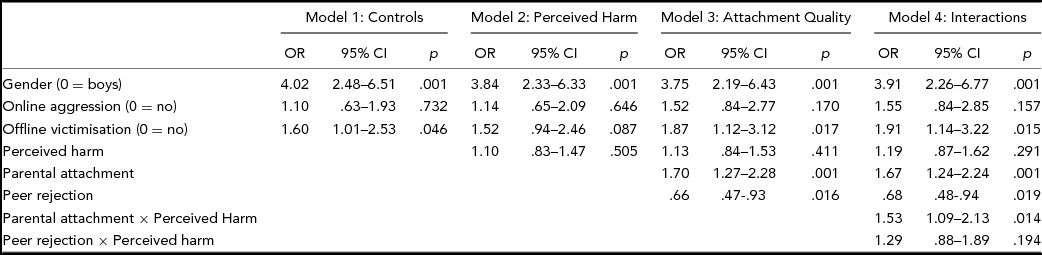
To test our hypotheses and the effects of interactions between cyber-victims’ quality of attachment to parents and peers and perceived harm on social support seeking, we conducted a multiple logistic regression analysis. All continuous predictors (i.e., parental attachment, peer rejection, perceived harm) were centred to protect against multicollinearity (Aiken & West, Reference Aiken and West1991). In the first model, we included the control variables of gender, online aggression, and offline victimisation. In the second model, perceived harm was included. The third model included the quality of attachment to parents and peers. The final model included two, two-way interactions between parental attachment and perceived harm, and peer rejection and perceived harm. All analyses were conducted in SPSS 21.
Results
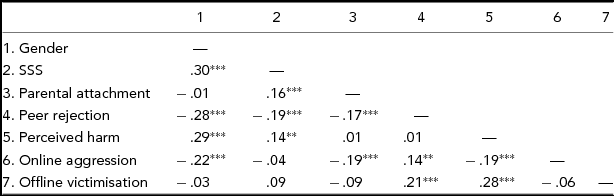
Table 1 presents the correlations among the studied constructs. Pairwise deletion was used for missing data in the correlational analyses. Phi correlations were performed for the relationship between two binary variables, whereas point-biserial correlations were conducted for the association between one binary variable and one continuous variable. Pearson correlations were performed for the relationship between two continuous variables. Findings revealed that boys were less likely to seek social support and had lower perceived harm from cyberbullying than girls. However, boys were more likely to be rejected by peers and to engage in online aggression when compared to girls. Cyber-victims’ usage of the social support strategy was related positively to parental attachment and perceived harm, whereas it was associated negatively with peer rejection. Their parental attachment was correlated negatively with peer rejection and online aggression. Peer rejection was associated positively with online aggression and with offline victimisation. Cyber-victims’ perceived harm was related positively to offline victimisation and negatively to online aggression.
Correlations Among All Variables in the Study
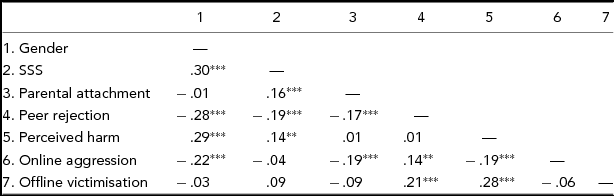
Note: Gender: Boys = 0 and Girls = 1; SSS = Social Support Seeking.
** p < .01. *** p < .001.
The results from the multiple logistic regression analysis are included in Table 2. Missing data was handled using listwise deletion. Models 1, 2, and 4 were significant, and thus model 4 was used to interpret the results. Girls who were cyber-victims were 4 times more likely to seek social support when compared to boys (OR = 3.91, p < .001). Findings also indicated that cyber-victims who had good parental attachment (OR = 1.67, p < .001) were more likely to seek social support, and those who experienced offline victimisation (OR = 1.91, p < .05) were 2 times more likely to seek social support. On the other hand, cyber-victims who experienced peer rejection were 32% less likely to seek social support (OR = .68, p < .05).
Results of Logistic Regression Predicting SSS from Perceived Harm, and Attachment Quality (N = 414)

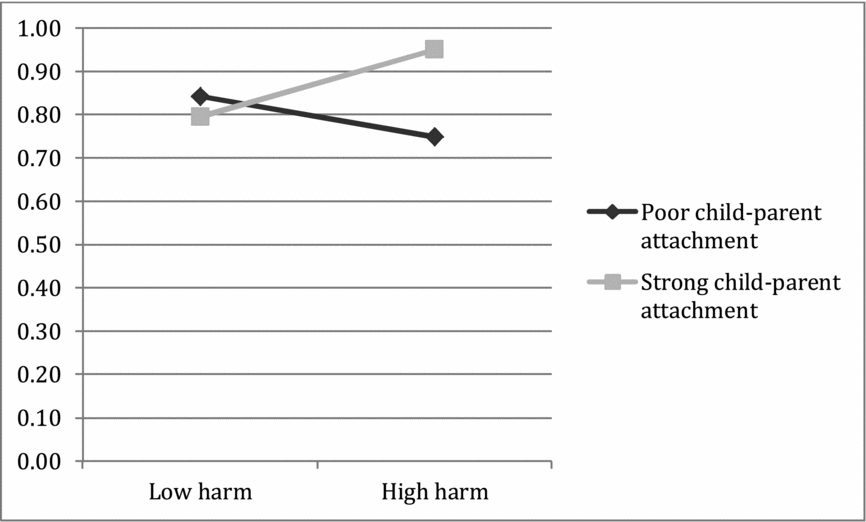
Only the two-way interaction between parental attachment and perceived harm was significant; cyber-victims with poor parental attachment and higher perceptions of harm had a lower probability of social support seeking (see Figure 1).
Interaction effect of parental attachment and harm predicting probability of social support seeking.
Discussion
This study showed that peer rejection decreased the likelihood of social support seeking, while cyber-victims’ positive attachment to parents increased its likelihood. In other words, cyber-victims who had poor relationships either with peers or parents were less likely to ask others for help. However, factors such as being a girl and being victimised offline were positively linked to social support seeking. Furthermore, this study showed that the likelihood of social support seeking was especially low among those cyber-victims who reported poor parental attachment and simultaneously an increased extent of harm.
In accordance with our expectations, cyber-victims with poor relationships with their parents and peers refrained from seeking social support among significant others. As suggested in the introduction, the explanation could be that poor relationships represent a lack of social sources, which prevent victims from considering social support seeking when selecting from possible coping strategies (Terry, Reference Terry1994). In contrast to these victims, cyber-victims with positive parental attachment were more likely to report social support seeking. These findings can be interpreted as their internal working models allowing them to visualise mainly positive interactions with their parents (Bowlby, Reference Bowlby1969), which made them more open to confide in others about cyber-victimisation.
Furthermore, this study showed that, after controlling for gender, the intensity of perceived harm had no effect on social support seeking, but it moderated the link with parental attachment. Even though victims with poor parental attachment experienced intense harm, this did not lead them to reconsider seeking social support as a coping strategy. Following the theory of attachment (Bowlby, Reference Bowlby1988; Bretherton & Munholland, Reference Bretherton, Munholland, Cassidy and Shaver2008), the harm caused by this form of peer aggression may activate victims’ internal working model, which stems from their prior experience with their parents, and then intensifies their feeling that there is nobody whom they may turn to for support.
It is worth mentioning that perceived harm did not interact with the association between peer rejection and social support seeking. This discrepancy in the findings on the role of perceived harm in social support seeking may be relevant for future research on persons whom cyber-victims talk to about cyberbullying. This study did not differentiate among individuals they sought for social support. However, prior research suggests that individuals are reluctant to talk with adults about their experiences (McGuckin et al., Reference McGuckin, Perren, Corcoran, Cowie, Dehue, Ševčíková, Völlink, Smith and Steffgen2013; Slonje et al., Reference Slonje, Smith and Frisén2013). If they confide in others, they are more likely to do so with peers (Livingstone et al., Reference Livingstone, Haddon, Görzig and Ólafsson2011; Slonje & Smith, Reference Slonje and Smith2008). To understand processes regarding attachment styles, the intensity of harm, and social support seeking, future research may focus on whether the internal working model represented by quality parent-child attachment makes cyber-victims who experience intense harm less open to seeking social support or whether this effect applies only to seeking social support from parents and not peers. This may add another perspective for studying why parents and other adults are not contacted when youths cope with cyberbullying.
The present study also showed that gender and offline victimisation had an effect on social support seeking. As for gender, the results indicated that girls were more likely to seek social support than boys, which is in line with prior research on school bullying (see Hunter et al., Reference Hunter, Boyle and Warden2004). Concerning offline victimisation, this experience seems to mobilise victims to take action and seek social support. It is possible that, due to their prior experiences with school bullying as targets, they might more quickly respond to cyber-victimisation than cyber-victims who were not victimised offline.
The present study is not without limitations. First, cross-sectional data were used. Although the relationships found in this study have theoretical justification, research with longitudinal designs is needed to verify the findings that we obtained. Second, a single item was used to assess social support seeking without taking into consideration the difference between emotional and instrumental support. However, these types of social support are closely interconnected, especially when it comes to friends and family members (Semmer et al., Reference Semmer, Elfering, Jacobshagen, Perrot, Beehr and Boos2008). Also, the differentiation between these two types of support is complicated by the fact that asking for emotional support may implicitly express victims’ needs for instrumental support as well. Third, we did not differentiate between the people victims sought for social support. Victims might have approached other people, such as teachers, whose relationships with the victims were not taken into consideration in this study. However, confiding in teachers about cyber-victimisation was among the least frequently used response to cyberbullying in one study (Livingstone et al., Reference Livingstone, Haddon, Görzig and Ólafsson2011). Further, respondents were given a detailed description of cyberbullying, and cyber-victims were identified based on the dichotomous question that did not capture the frequency and timeframe for cyber-victimisation. This limitation of the measure could result in an increased rate of cyber-victimisation, when compared to a prior prevalence survey conducted by Livingstone et al. (Reference Livingstone, Haddon, Görzig and Ólafsson2011). Finally, the intensity of perceived harm was measured by a single item.
Despite these limitations, this study expands our knowledge about the reasons for not seeking social support, in that victims reporting peer rejection and parental attachment were less likely to seek social support. This finding should be taken into consideration when developing intervention programs for reducing cyberbullying, which mostly emphasise the importance of reporting cyber-victimisation to adult authorities (Välimäki et al., Reference Välimäki, Almeida, Cross, Moore, Berne, Deboutte and Sygkollitou2013). It is apparent that without further intervention, measures providing students with a piece of advice, such as the importance of reporting cyberbullying, may not meet with positive outcomes. Prevention and intervention programs should address the quality of parent-child attachment in order to change cyber-victims’ patterns of selecting coping strategies. The study also provides evidence that cyber-victimisation in combination with offline victimisation makes victims more willing to seek social support.
Acknowledgments
The authors acknowledge the support of the VITOVIN project (CZ.1.07/2.3.00/20.0184), which is co-financed by the European Social Fund and and the Faculty of Social Studies, Masaryk University.