Figures of speech, tropes, images, metaphors: I take these as materials of prime historical interest, for they are vehicles of self-knowledge, of the concepts upon which people act. They are also, especially in the public domain, forces in their own right, often coloring perceptions in a certain way even against all evidence.
Alan Trachtenberg, The Incorporation of America: Culture and Society in the Gilded Age (1982), 8In May 1863, Henry Adams wrote to his brother, Charles Francis Adams Jr., that he was spending most of his spare time reading the works of Alexis de Tocqueville, and he told Charles that he considered the Frenchman's works to be “the Gospel of my private religion.”Footnote 1 On the face of it, this letter would seem to constitute evidence that leading American intellectuals were reading Tocqueville in 1863.
James T. Kloppenberg, however, has employed it as evidence that no one was reading Tocqueville at that time.
The scholarship on Tocqueville's standing in American culture exhibits a long-standing dissociation (illustrated by Kloppenberg's interpretation) between the evident and abundant historical record, on the one hand, and the dogmatic statements issued either in defiance of that record or as erroneous inferences drawn from it, on the other. The contention of this essay is that a clear, distinct, and universally held conventional narrative about Tocqueville's reputation has blinded historians and driven scholarly accounts, and that this fanciful tale persists in the face of an immense body of widely available evidence to the contrary.
In an influential essay entitled “Life Everlasting” that has been twice reprinted, most recently in a new Norton critical edition of Tocqueville's Democracy in America, Kloppenberg claimed that Tocqueville suffered a “disappearance … from the outbreak of the Civil War until the outbreak of World War II.” To support this incorrect assertion, he pointed to two irrelevant facts: first, the relative absence of Tocqueville's ideas in the books of Charles Beard and Frederick Jackson Turner; and second, Adams's declaration that Tocqueville's works were like gospels to him. “It is nearly always true,” Kloppenberg claimed about the latter statement, “that wherever Henry Adams stood, at any stage of his life, scarcely anyone else could be found.”Footnote 2 Because Henry Adams was a preeminently contrarian thinker, one can confidently assert that whatever he was reading was, by virtue of that fact, forgotten everywhere else.
Kloppenberg's contention that Adams's study of the works of Tocqueville during the Civil War constitutes evidence that Tocqueville disappeared during the Civil War can serve as an ideal example of how not to write history. In addition to being a wholly ad hominem assertion – it is based not on empirical evidence but rather on the presumed personality characteristics of Adams himself – it ignores the context of both the biographical and the historical events in Adams's life at that time, and it distorts the plain meaning of the text of Adams's letter.
In 1863, the twenty-five-year-old Adams was serving as secretary to his father, Charles Francis Adams, whom President Lincoln had appointed to the Court of St. James while the great struggle for the survival of democratic nationhood raged at home; he was writing to his beloved brother, a captain in the First Massachusetts Cavalry moving up the Shenandoah Valley toward Gettysburg.Footnote 3 However opposed to the then-current American cultural trends we might judge the author of The Education of Henry Adams to have been, it is a mere rhetorical gesture to assert that the young secretary in London was identical in this respect to the great contrarian pessimist who wrote The Education four decades later. Adams was certainly not, “at any stage of his life,” always the same, unchanging boulder in the stream of American culture.
Kloppenberg's contention not only is invalidated by its ad hominem quality and by the facts of Adams's biography, but it is also contradicted by an abundance of disconfirming evidence on the issue from American sources. The year 1862, for example, was the single most critical year, in terms of number, quality, and importance to scholars, of Tocqueville publication during the entire nineteenth century, except for 1838 when the first American edition of the Democracy appeared.Footnote 4 That same year, one contributor to the Christian Examiner wrote, “As an historian and a political philosopher [Tocqueville's] preeminence is undeniable,” while the New York Times compared Tocqueville to Cicero and Montesquieu as the paramount political philosophers of the ancient, the early modern, and the contemporary ages.Footnote 5
Further, the real message of Henry's letter is that he was reading Tocqueville's works along with those of John Stuart Mill: “I pass my intervals from official work, in studying De Tocqueville and John Stuart Mill, the two high priests of our faith.”Footnote 6 Must we conclude that Mill disappeared during the 1860s, because of Henry Adams's countercyclical reading habits? In truth, there could be few more conventional courses of reading at that time than a combination of Mill and Tocqueville.
The Adams quotation was the only gesture toward evidentiary discourse that Kloppenberg employed to make the case for Tocqueville's alleged disappearance between the Civil War and 1900.Footnote 7 In “Life Everlasting,” Kloppenberg went on to assert, “Toward the turn of the twentieth century [Democracy in America] fell out of fashion, and out of print.”Footnote 8 Here he was, like many scholars, echoing (and citing) a sheer fabrication that had appeared in a 1976 essay by Robert Nisbet, in which Nisbet wrote, “just after the turn of the century the book went out of print, and it is no injustice to add, out of mind.”Footnote 9 In later years scholars continued to reiterate this fantastic tale. The Democracy was “out of print” by the early twentieth century, Michael Kammen wrote. It “had fallen out of print,” said Wilfred McClay.Footnote 10 And that was because, as Kloppenberg put it in another essay, in “the closing years of the nineteenth century … Tocqueville vanished.”Footnote 11 Vanished! He was “out of mind,” “out of fashion, and out of print”; he had suffered a “disappearance.”
But the notion that Tocqueville was out of print in 1900 is totally inaccurate and profoundly misleading. Here is a simple fact: editions or reprints of Democracy in America were published in the United States in 1898, 1899, again in 1899, 1900, 1904, again in 1904, 1905, 1908, 1912, and again in 1912. These were excellent editions, most of them quite affordable; they were beautifully printed; and they contained introductions by distinguished, widely known public figures.Footnote 12 Moreover, other Tocqueville publications appeared during these years besides the Democracy, such as the Tocqueville–Jared Sparks correspondence, a translation of Tocqueville's Souvenirs, and even a school edition of Tocqueville's American travel journals for use by French-language students.Footnote 13 Nevertheless, in defiance of the clear and copiously documented historical record, this false notion that the Democracy was out of print around 1900, and the disappearance of Tocqueville that it supposedly indicated, has become widely accepted by leading scholars.
In 2007, the historian Scott Sandage actually performed a word-search on the digital archive of the New York Times and found twenty mentions of the Democracy between 1920 and 1935.Footnote 14 Sandage's effort must stand as a classic case of technological naïveté, of seeking a certain kind of evidence because one's tools render it convenient and close at hand. This is what, in some degree, has happened to the methods and content of intellectual history concerning this subject. Intellectual history must, like all branches of history, employ methods that have some connection with the material. “Criteria of significance should not be methodological, but substantive in nature,” David Hackett Fischer has reminded us, but not recently enough. “They should always be grounded in the nature of the problem itself and not in the tools of problem solving.” Furthermore, as Allan Megill briskly noted in regard to a similar question of reception: “In the absence of comparisons to other authors, a count of citations to an author's work is largely meaningless.”Footnote 15 One must trust that if Sandage had conducted a word search of De L'esprit des Lois and found fifteen references, he would not have concluded that Tocqueville was 33 percent more influential than Montesquieu during the 1920s. But such are the obfuscations and embarrassments that emerge when previously established conclusions drive the search for evidence. Without a doubt, the Democracy word count was made in order to illustrate a preexisting conclusion, not to gather data to employ in reaching one.
In a 2006 essay, Cheryl Welch asserted without evidence that, by 1900, Americans considered Tocqueville's work “of dubious relevance to their increasingly industrial immigrant nation.” In her 2001 study, De Tocqueville, Welch made the same point, and cited one contemporary reference to support it: she claimed that in his 1898 Democracy edition, Daniel C. Gilman had “admitted that westward expansion, urbanization, industrialization, immigration,” and other changes had rendered the Democracy “less relevant.” In a review of The Cambridge Companion to Tocqueville in The Tocqueville Review, Serge Audier declared that in 1900 Americans “strongly doubted the relevance of his picture of the society and economy of the United States.” The Tocqueville scholars continually echo one another in this fashion until certain ideas, including wholly inaccurate ones, emerge as incontestable.Footnote 16
In fact, Gilman did not “admit” any such thing in his excellent introduction – what indeed was there to admit? – but rather showed that in spite of the social transformations that had taken place since the 1840s Tocqueville had retained his ability to speak to present-day readers. Indeed the argument of the Gilman introduction is that Tocqueville's relevance was ongoing, uninterrupted, and more or less immune to such social changes as the escalating development of cities and industry:
Notwithstanding the changes which have occurred in the material and social circumstances of the United States during the last sixty years, the consequent elimination of certain factors in the civilization of this country, and the introduction of new and unforeseen problems, – notwithstanding all this, the student of modern popular government must revert to Tocqueville.Footnote 17
Far from identifying social changes as sources of Tocqueville's neglect, Gilman considered them to be beside the point in regard to the issue and referred to the continuing relevance of Tocqueville to prove the point.
Like Kloppenberg, Welch is an outstanding scholar; indeed she is the author of the most profound, and Kloppenberg of the most original, article on Tocqueville published in the previous decade.Footnote 18 But in both cases, their customary analytic penetration simply deserts them when they address the question of Tocqueville's turn-of-the-twentieth-century reputation. A glimpse at Welch's approach to the subject in her study De Tocqueville is of value because of its representative nature: it is characteristic of the literature in its glancing blows at the evidence, its circularity, its belletristic quality, and especially its reliance on synecdoche. Welch's reference to Gilman's introduction came not directly from that text but rather through the medium of a relatively obscure essay written by James T. Schleifer. Schleifer's piece, however, is a very thin reed on which to rest sweeping statements about industrialization, immigration, urbanization, and the alleged neglect of Tocqueville supposedly consequent on those giant, impersonal forces. Schleifer's essay appeared in a 1989 catalog of an exhibition of Tocqueville items at the Library of Congress. It is a three-page account of the introductions to six American Democracy editions of the nineteenth and twentieth centuries.Footnote 19 From this one source Welch took some phrases about Gilman's introduction to support the contention that those great social forces were “the primary cause of Tocqueville's decline in the United States,” and, later, that Americans found Tocqueville “of dubious relevance to their increasingly industrial immigrant nation.”Footnote 20 Welch thereby subjected Gilman's argument to a complete reversal, reinterpreting Gilman's introduction, which directly contradicts the current conventional wisdom, in such a way as to make it nestle comfortably into the preestablished structure of the conventional narrative. It is an approach to the evidence that precisely parallels Kloppenberg's procedure of using Henry Adams's reading of Tocqueville to support the claim that Tocqueville had disappeared.
Kloppenberg put forward a closely related but even more fantastic claim, namely that the social changes of the Progressive Era caused the French prophet to vanish entirely. In “the closing years of the nineteenth century,” Kloppenberg wrote, “Tocqueville vanished, replaced on both sides of the Atlantic by analysts who focused less on [the presumably more Tocquevillean subject of] the relations between politics, society, and culture than on [the supposedly un-Tocquevillean themes of] the dynamics of class struggle in France and class, race, and ethnicity in the United States.”Footnote 21 The extremely high level of abstraction and generalization in these undocumented statements cries out for some evidentiary backing, but Kloppenberg identified none of these turn-of-the-century analysts, cited no contemporary works, and instead simply posited Tocqueville's complete disappearance as historical fact without producing a particle of evidence.
Quite neglected in this thesis that attention to matters of race, ethnicity, and class during the Progressive Era necessarily led to Tocqueville's vanishing is any consideration of the obvious fact that scholarship on those issues in our own conflict-ridden age is far more central and abundant than it was a hundred years ago, and yet Tocqueville's reputation is, by Kloppenberg's own account, approaching its zenith. “In American social science, Tocqueville is ubiquitous.” “Tocqueville is hot.” “We are witnessing the apotheosis of Tocqueville.”Footnote 22 Studies of class, race, and ethnicity led to Tocqueville's oblivion and disappearance a hundred years ago, but in the present day they seem to be having the opposite effect.
These arguments about Tocqueville's disappearance proceed by a method of algorithmic synecdoche: they are synecdoches for further synecdoches. Two historians – Beard and Turner – are said to represent the entire progressive historiographical tradition; the progressive historians in turn symbolize the Progressive Era; and the Progressive Era is shorthand for immigration, urbanization, and industrialization. Finally, this string of invalid inferences culminates with these social forces, urbanization and so forth, playing a causal role in the complete disappearance of Tocqueville during the era in question.
Kloppenberg did not allude to the progressive historians, or to Henry Adams, directly; rather, he took his references from a 1968 article by Lynn L. Marshall and Seymour Drescher. It is perhaps symptomatic of the nature and quality of the evidence and argument on this issue that Marshall and Drescher did not refer to Adams's correspondence directly either, but rather took the quotation from a well-known 1940 book by Ralph Henry Gabriel.Footnote 23
Kloppenberg, then, following Marshall and Drescher, referred to an “almost complete lack of interest in Tocqueville among the most prominent progressive historians,” Beard and Turner, as “confirmation” of his claim that Tocqueville disappeared.Footnote 24 Yet Marshall and Drescher's important article is richer and more diverse in evidence, and contains more qualifications and reservations, than Kloppenberg's very selective summary indicates. Indeed they provided a wealth of examples in their text and footnotes of discussions of Tocqueville in those historians' works.Footnote 25 In any case, their argument was not that the historians ignored Tocqueville altogether, but that they were unmoved by his philosophy of history. Moreover, all students of the progressive historians know that at their forefront ran a troika of historians, not a pair. The troika comprised Beard, Turner, and Vernon L. Parrington. Perhaps Parrington was left out of the disappearance discourse because Parrington did several times, and with approbation, refer to Tocqueville in his three-volume Main Currents in American Thought (1927–30). Taken together, the work of the progressive historians simply fails to provide a compelling case for Tocqueville's disappearance after the closing years of the nineteenth century.
In establishing his own explanation for Tocqueville's disappearance, Kloppenberg had to confront the influential claim of Robert Nisbet that, after 1870, Tocqueville's celebratory volumes on the United States – as Nisbet simplistically interpreted them – were “lost in the vast chorus” of praise for American institutions that came from the pens of Americans themselves.Footnote 26 Nisbet's statement was a classic ipse dixit – a statement made from a position of authority without any evidence. Kloppenberg chose simply to counteract Nisbet's ipse dixit with one of his own: “It was instead the prevalence of conflict that submerged Tocqueville's Democracy.” Americans “interpreted Democracy in America as stressing an underlying national consensus on basic values,” and consequently the social conflicts of the late nineteenth century “caused Americans to doubt the wisdom of Tocqueville's analysis.”Footnote 27 Kloppenberg's statement was a mirror image of Nisbet's. It was every bit as devoid of evidentiary support as the argument it sought to supplant, but it did have a supposed political advantage – that of stressing social “conflict” over the right-wing Nisbet's emphasis on happy “consensus.” It may have been a counterhegemonic ipse dixit, but it was an ipse dixit nonetheless, and as such did not substitute for evidence. I am not aware of any late nineteenth-century writers who say anything similar to what Kloppenberg ascribes to them, namely that this is an age of conflict, and the Democracy celebrates a consensus on our basic values, so I am in consequence in doubt as to its wisdom. Nor did Olivier Zunz's meticulous examination of late nineteenth-century Tocqueville commentary turn up any examples of such discourse.Footnote 28
A further stage in this logic of substitution and synecdoche posits the progressive historians as stand-ins for the Progressive Era. “This was a period that was marked by dramatic and violent disagreements,” Kloppenberg wrote. And the progressive historians showed “an almost complete lack of interest in Tocqueville,” thereby “confirm[ing]” Kloppenberg's explanation of Tocqueville's putative absence during the Progressive Era.Footnote 29 But historians, progressive or not, make poor stand-ins for an entire historical epoch, as all current historians must surely feel. In fact, however, Tocqueville did receive attention from genuinely progressive quarters in the early twentieth century. The best example comes from a man who was practically a laboratory specimen of the progressive reformer, the trust opponent, consumer advocate, and social worker John Graham Brooks, who wrote with enthusiasm, although with a critical bite, about Tocqueville in his popular 1908 study As Others See Us, most of which had appeared as a series of articles in the Chautauquan in 1907 and 1908. Brooks was not merely a progressive who wrote about the French prophet, but one who wrote about him as being a progressive reformer. Brooks carefully explained Tocqueville's relevance to such issues as conservation, the trusts, business consolidation, and other problems the progressives confronted, including the race problem.Footnote 30
The Progressive Era disappearance of Tocqueville turns out to be a fairy tale unmoored from valid evidence or clear argument.
Central to the discourse about Tocqueville's sudden disappearance is a stable cluster of metaphors. These metaphors have actually constituted much of the Tocqueville scholarship, rather than having been selected as vehicles to express conclusions that investigators reached after they established testable hypotheses and subjected those hypotheses to verification by empirical evidence. My simple, uncontroversial contention is that metaphors are not just means of expression, they are forms of thought. Like Alan Trachtenberg, I argue that they “are also, especially in the public domain, forces in their own right, often coloring perceptions in a certain way even against all evidence.”Footnote 31
And with respect to Tocqueville scholarship, there has beyond doubt developed what can accurately be called a myth, one that colors perceptions even against all evidence. This myth recounts not only how Tocqueville had vanished or disappeared and was sunk in oblivion, but also how he later returned to provide guidance and wisdom on questions that we are asking now, and therefore has achieved a kind of apotheosis. The structure of that myth is exactly the same as the great Greek and Roman stories of Orpheus, Persephone, Aeneas, and many others. These characters disappear, undertake a harrowing journey to the Underworld, suffer, and return with special knowledge derived from those very journeys and their suffering, for the purpose of giving us guidance in our troubled era.
Here I must underscore a vital distinction between merely resembling a story and constituting one. My argument is not simply that the common understanding of Tocqueville's reputation bears a resemblance, demonstrates parallels, or is analogous to certain familiar old mythical tales – although such parallels abound – but rather that the writers on the subject have constructed, through their perhaps half-conscious selection of plots and tropes, a fully realized narrative universe in which this story line – one about Tocqueville's sudden oblivion, heartening return, and generous guidance – is the received, time-honored understanding about the issue. This narrative is truly hegemonic: it does not have to account for itself. Its converse is “unthinkable.” Events within that universe are explained by reference to it, while the data “outside” the narrative are ignored, marginalized, or at the limit, actually taken up in support of it. An example of the former error occurs in Isaac Kramnick's introduction to the Norton critical edition: “With the exception of Henry Adams, who saw the Frenchman's writings as the ‘gospel of my private religion,’ few paid much attention to him,” Kramnick amazingly wrote, with no evidence or further comment.Footnote 32 And we have already seen one instance of the latter tactic: Kloppenberg's deployment of Adams's statement not to illustrate an exception to a trend, but to serve as proof of it.
With few exceptions, then, the scholarly narrative on this question consists not of metaphoric formulations chosen to vividly express research findings, but rather of the metaphors themselves presented as statements about reality. What is most striking about the discourse surrounding Tocqueville's supposed abrupt disappearance from American intellectual life (aside from the lack of evidence or coherent argument to support it) is the tiresome uniformity of the metaphors employed to discuss the phenomenon. By far the most common, deceptively totalizing, and indeed the ruling, almost universally deployed, figure is that of oblivion.
“Tocqueville's book … seemed to fall into oblivion,” wrote Joseph Epstein in 2006. “Slipped into oblivion,” claimed Eric Keslassy. “Submerged,” Kloppenberg wrote. “To finally fall into oblivion,” was Aurelian Craiutu's version of events.Footnote 33
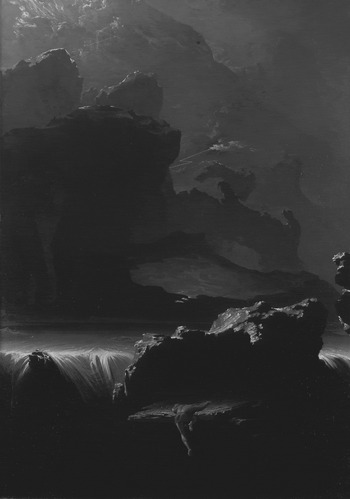
This metaphor – this giving a thing the name of another thing, in Aristotle's definition – consists in bestowing the name of a place upon a state of being. In this instance, the state of being is that of forgetfulness or being forgotten, and the place is a river flowing in the Underworld, one of three rivers that according to Greek beliefs dead souls must cross. That is why oblivion is always associated with water – the waters of oblivion (see Figure 1).
John Martin (1789–1854), Sadak in Search of the Waters of Oblivion (1812), Saint Louis Art Museum, Friends Fund. Poor Sadak was sent by the evil Sultan to bring home a vessel containing the waters of oblivion. Sadak outwitted the Sultan, however, and himself became the ruler.

The Tocqueville commentators who proclaim Tocqueville's fall into oblivion almost invariably do so by means of watery metaphors: Tocqueville sank into oblivion, slipped into oblivion; in Kloppenberg's words, the Democracy was “submerged.” The rising interest in Tocqueville in the postwar years is also presented in a watery way, as a series of waves that lap upon the banks of the river as Tocqueville recrosses it and returns to the human world – a “wave crested twice,” a “wave,” “overlapping waves,” and the like. “[T]here has been a steady stream of American scholarly material on Tocqueville, punctuated by waves of more general interest,” Welch declared.Footnote 34
Oblivion is located in the Underworld. As Nisbet expressed it in his immensely influential article, “Tocqueville disappeared among the shades”; or in Craiutu's reiteration, Tocqueville suffered “a surprisingly long posthumous saison en enfer.” Tocqueville's period of absence meant that during the 1930s George Wilson Pierson had to “quietly unearth” Tocqueville's voyage and furnish meaning to the resulting book.Footnote 35
To descend to the Underworld, and then to return with hard-won wisdom, gifts, lore, and guidance is a foundational story in Western art, music, and literature. Heroes have guides for the Underworld – the Sibyl for Aeneas, Persephone for Orpheus, Virgil for Dante; and they serve in their turn as guides for their own cultures – Aeneas for his Trojans, Virgil for Augustan Rome, Dante for us.
The Tocqueville narrative most closely parallels the story of Orpheus, who, after his adored Eurydice had been bitten by a serpent, died, and passed into the Underworld, resolved to follow her there, and to bring her back. Central to the Orpheus tale is the familiar prohibition of looking back, the necessity of keeping one's eyes ahead on the path and on the future. As Eurydice followed him on the trail upward, out of the world of shadows and toward the light, Orpheus at the last instant lost his confidence and turned to see if Eurydice was following him – and thereby lost her for the second time.
Orpheus is the archetype of liminality. His about-face occurred precisely at the threshold between the Underworld and our own earth. After reemerging into the world of men, it was said, he forswore contact with women, and according to Ovid he took to making love to boys instead.Footnote 36 But by virtue of his very loss, the bisexual Orpheus brought to humans something inestimable: not only music itself with its power to speak directly to the souls of men and women, but all the other arts as well.
Tocqueville is the modern liminal figure; lost in the Underworld for decades, he returned to guide us in the age of twentieth-century despotism, according to the mythographers. His liminality is twofold. First, he stands at (and even a little above) the boundary of the United States and Europe, providing by virtue of his aristocratic, European personality and culture a unique and indispensable perspective on the democratic United States; and just as important a stern, critical, and loving guidance for France and Europe derived from his American quest. Second, as Tocqueville commentators have consistently, and again in defiance of the evidence, depicted him, Tocqueville is a thinker who provides direction to thinkers of both the left and the right. Although Michael Kammen decisively refuted this claim with abundant quantitative evidence in 1998,Footnote 37 it continues to be a commonplace assertion that supposedly illustrates the breadth and strategic placement of Tocqueville's wisdom.
The second, nearly universal metaphor that pervades the commentary is that of Tocqueville as a thinker endowed with an unlimited inventory of personalities – personalities that he obligingly alters for the convenience of his commentators. It was Nisbet who introduced this theme in his unsubstantiated and blatantly ideological 1976 essay “Many Tocquevilles.” There he presented not one but four imaginary Tocquevilles, namely “the prophet of totalitarianism,” “the anatomist of affluence,” the critic of cultural degradation under democracy, and the analyst of equality. That Nisbet produced no evidence for his assertions bothered subsequent scholars not one whit. They embraced his contentions uncritically. Nisbet's essay became canonical – it has just been reprinted in the aforementioned Norton critical edition, always a canonizing gesture – and it established the convention of writing about Tocqueville's works not in terms of themes that he addressed but rather in terms of the supposedly changing personalities of Tocqueville himself.Footnote 38 In their excellent new book about Tocqueville's post-1840 American writings Aurelian Craiutu and Jeremy Jennings write of the many “facets of Tocqueville's persona: the philosopher, the moralist, the writer, the politician and the defender of French colonization of Algeria.” “The truth is there are many Tocquevilles,” Craiutu wrote in 2005. In an introduction to a 2000 Democracy edition Joseph Epstein similarly wrote of the many Tocquevilles, “the Tocqueville who …” wrote about this or that subject; and Welch in another recent essay scanned the horizon of twenty-first-century political theory and reported back that she found, mirabile dictu, a passel of new Tocquevilles out there. There are “several new ‘Tocquevilles’ that are beginning to make an appearance in the twenty-first century,” she wrote, not omitting the obligatory scare quotes around Tocquevilles. Serge Audier entitled his review of the Companion “Towards ‘New Tocquevilles’?” The concerns, subjects, themes found in Tocqueville's writings are thereby reinscribed as personalities.Footnote 39
The archetype of the shape-shifting seer and guide is Proteus, the Old Man of the Sea. It was Menelaus who, advised and fortified by the sea goddess Eidothea in Book IV of the Odyssey, wrestled with Proteus and forced him to divulge the future course of Menelaus' voyage. “And he,/if only you ambush him somehow and pin him down,/will tell you the way to go, the stages of your voyage,/how you can cross the swarming sea and reach home at last,” Eidothea assures Menelaus. But you will need to “muster your heart and strength and hold him fast,/wildly as he writhes and fights you to escape.” He will “twist and turn/into every beast that moves across the earth,/transforming himself into water, superhuman fire,/but you hold on for dear life, hug him all the harder!” When Menelaus and his companions pounced on Proteus, “First he shifted into a great bearded lion/and then a serpent – / a panther – / a ramping wild boar – / a torrent of water – / a tree with soaring branchtops – / but we held on for dear life, braving it out.”Footnote 40 And an exhausted Proteus relented, spoke out, and revealed to Menelaus the course of his future journey.
But the ultimate symbol of death, resurrection, guidance, and apotheosis toward which this discourse has been reaching and which it has now attained, is that of Tocqueville as a Christ figure. For like Orpheus, Persephone, Aeneas, and Dante, Christ also descended into hell. But he returned, he really came back – he appeared, showed himself to Mary Magdalene, to the apostles on the road to Emmaus – and he gave guidance to them, told them to go out into the world and spread that guidance.
In a 2006 article, Kloppenberg, who in “Life Everlasting” attempted to explain what he called “Tocqueville's eternal life in America,” pushed the logic of the metaphor to its predestined conclusion by writing of Tocqueville's having been “resurrected” and claiming that the twenty-first century had seen “an apotheosis of Tocqueville.” But the sociologist James R. Abbott, after a comprehensive review of the literature of his field, has reached the opposite conclusion: far from being ubiquitous, Tocqueville has all but disappeared. “Today … one is hard pressed to find Tocqueville's presence anywhere in professional sociology,” he found. “Searches of sociology journals reveal just how negligible Tocqueville's influence is. Introductory textbooks mirror this fact, rarely mentioning Tocqueville's contributions to the discipline.” Welch discovered an absence of a different sort when she examined the literature by political theorists: not complete neglect but rather a tendency of making “a nod to Tocqueville,” who is consequently “much more often cited than read.” Ironically, Tocqueville really has, at least in one social science discipline, sunk into oblivion – but at precisely the time that the conventional wisdom asserts his omnipresence.Footnote 41
Having proclaimed “Tocqueville's eternal life,” then, Kloppenberg went on to announce also the Frenchman's resurrection and apotheosis. In his exact terms, Tocqueville vanished, but has experienced resurrection, life everlasting, and apotheosis. No matter how much nudging, winking, and irony this metaphoric cluster is intended to convey, the main point to be emphasized about it is not its novelty, but its absolute conformity to the metaphoric structure of the conventional wisdom as it has developed in the past thirty years; it is but a pushing to extremes of the myth of Tocqueville's oblivion, heroic return, and prophetic guidance. As we have seen, scholars have responded to disconfirming data on this issue by ignoring it altogether, or by (so to say) Ptolemaically adding epicycles to the received explanation, or by covering over fissures in the story with the glue of an ipse dixit.
Fictitious notions about Tocqueville's role in American intellectual history need to be set right not only in the interest of an accurate historical record, but also because such false ideas lead to distorted interpretations of Tocqueville's works. If Tocqueville was thought to have vacated the American landscape during the Gilded Age and Progressive Era, that was because his works were somehow not “relevant” to such emblematic social problems of that epoch as immigration and urbanization. Kloppenberg's binary opposition between Tocqueville-themed writers who focussed on society, politics, and culture in contrast to those concerned with race, ethnicity, and class well represents this distorted view. The binary is spurious on its face, as are the two triads that are said to constitute it. Countless scholars and commentators do and did write about race, class, and politics; culture, society, and ethnicity; and every other permutation of those six reifications. Scholars, in short, would do well to recall Gilman's 1898 argument that the importance of Tocqueville's thought is not, in any determinative way, dependent on currently prevailing social and economic conditions.
The narrative of Tocqueville's journey from oblivion to apotheosis is a myth. The function of myth is to conceal history. Tocqueville scholars have been adding accretions to the myth, rather than unveiling the history. It is time for our understanding of Tocqueville's actual role in American intellectual history to be raised to a level that is comparable with other aspects of the literature on Tocqueville's life and work. A good way to begin would be to acknowledge the fact that, when the works of a writer who has been dead for half a century are published in new editions and reprints fourteen times in as many years, that writer cannot be said to have vanished.