Introduction
High-molecular-weight glutenin subunits (HMW-GS) in common wheat significantly influence bread-making quality. HMW-GS are encoded by Glu-A1, Glu-B1 and Glu-D1 on the long arms of the 1A, 1B and 1D chromosomes in bread wheat, with each locus consisting of two tightly linked genes, encoded x- and y-type HMW-GS, according to their molecular weight (Shewry et al., Reference Shewry, Gilbert, Savage, Tatham, Wan, Belton, Wellner, D'Ovidio, Békés and Halford2003). The primary structure of HMW-GS consists of a signal peptide, a conserved N- and C-terminal region, and a variable central repetitive domain (Shewry et al., Reference Shewry, Gilbert, Savage, Tatham, Wan, Belton, Wellner, D'Ovidio, Békés and Halford2003). Differences among the various types of HMW-GS are mainly the result of repeat motif variants in the central repetitive domains (Tatham et al., Reference Tatham, Drake and Shewry1990). The cysteine residues in HMW-GS form disulphide bonds, the numbers and locations of which are usually conserved in HMW-GS. These residues play important roles in dough quality (Gao et al., Reference Gao, Zhang, Newberry, Chalmers and Mather2013; Du et al., Reference Du, Ma, Min, Zhang and Jia2018). Typically, there are four cysteine residues in x-type HMW-GS and seven in y-type HMW-GS. It is generally accepted that HMW-GS with extra cysteine residues form superior gluten macropolymers, resulting in good bread-making quality (Tamás et al., Reference Tamás, Gras, Solomon, Morell, Appels and Békés2002). For example, in common wheat, an extra cysteine residue present in the repetitive domain of the 1Dx5 subunit is considered to be superior-quality HMW-GS.
As important genetic resources, wheat-related species, such as Aegilops, Agropyrum, Thinopyrum and Eremopyrum, exhibit extensive variations of HMW-GS that may contribute to the improvement of dough quality. Aegilops comosa is an important gene resource among wheat-related species having a potential value for wheat-quality improvement (Weegels et al., Reference Weegels, Hamer and Schofield1996). In this study, we identified two novel unusual HMW-GS genes from an Ae. comosa (MM, 2n = 2X = 14) and isolated their complete encoding sequences. Their molecular structures, heterologous expression and contribution to dough quality were also investigated in this work.
Experiment
Glutens in Ae. comosa (accession number PI 551026), durum wheat Langdon and wheat cultivar Chinese spring were extracted, followed by protein separation in a 10% SDS-PAGE (Wan et al., Reference Wan, Wang, Shewry and Halford2002). Cloning of the coding sequences of HMW-GS, Escherichia coli expression and a mixing test in vitro were performed according to the procedures described in our previous report (Hou et al., Reference Hou, Feng, Yu, Du and Ren2017).
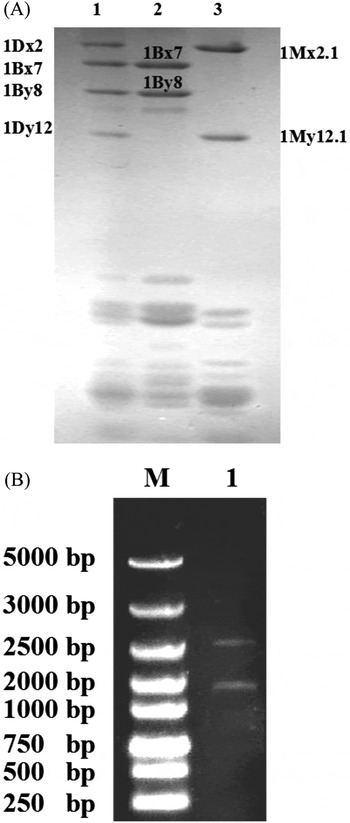
Ae. comosa PI 551026 contains two HMW-GS fragments. The mobility of the x-subunit was similar to that of 1Dx2, and that of the y-subunit was similar to 1Dy12 (Fig. 1(a)). These HMW-GS fragments were designated 1Mx2.1 and 1My12.1, respectively. Coding genes of 1Mx2.1 and 1My12.1 were amplified and two PCR fragments were obtained (Fig. 1(b)). The lengths of the open-reading frames were 2466 and 1866 bp for 1Mx2.1 and 1My12.1, respectively. The sequences of 1Mx2.1 and 1My12.1 have been deposited into GenBank (accession numbers MH794606 and MH794607).
(a) SDS-PAGE of HMW-GS in Ae. Comosa. Lane 1: HMW-GS in Chinese Spring; lane 2: HMW-GS in Langdon; lane 3: HMW-GS in Ae. comosa. (b) PCR amplification of HMW-GS genes in Ae. comosa. M: DNA ladder; lane 1: PCR products.

Alignments of the deduced amino acid sequences indicated that all of these HMW-GS contain four district domains: a signal peptide, an N-terminal domain, a repetitive domain and a C-terminal domain. Interestingly, the variations of cysteine residues in the HMW-GS examined in this study were quite different from those of the published HMW-GS. In 1Mx2.1, an extra cysteine residue was present in the repetitive sequence near the C-terminal domain (online Supplementary Fig. S1A) due to a GGT→TGT mutation at position 1981. In 1My12.1, the conservative cysteine residue in the C-terminal domain was missing (online Supplementary Fig. S1B).
To confirm the authenticity of the 1Mx2.1 gene, the expressed protein was identified using SDS-PAGE. As shown in online Supplementary Fig. S2, expressed 1Mx2.1 in E. coli was identified, whose electrophoretic mobility was similar to that of the native subunit from the seed (online Supplementary Fig. S2).
The mean values of the mixograph parameters with three replicates are listed in Table 1. HMW-GS 1Dx5 was included as a positive control. When either 1Mx2.1 or 1Dx5 was incorporated into the base flour, it caused a significant increase in MPT, T × W and MPW, as well as a decrease in RPS values (P < 0.05). Compared with 1Dx5, 1Mx2.1 exhibited higher MPT and MPW when 100 mg HMW-GS was incorporated (Table 1).
Mixograph parameters of 1Mx2.1, 1My12.1 and 1Dx5 incorporated into base flour

MPT, middle peak time; MPH, middle peak height; MTW, width at 8 min; RPS, right of peak slope; MPW, middle peak width. Within columns, values followed by the same letter are not significantly different at P = 0.05.
Discussion
The structure and function of HMW-GS in relation to dough strength have both been defined in the past studies (Ma et al., Reference Ma, Appels, Bekes, Larroque, Morell and Gale2005). The amount of allelic variations in HMW-GS among wheat and its related species provides a large number of genetic sources for wheat-quality improvement. In this work, two novel HMW-GS genes from Ae. comosa were cloned and characterized, and the results indicate that the 1Mx2.1 allele may serve as a new gene for wheat-quality improvement.
Studies of common wheat have indicated that differences in the number of cysteine residues are associated with variations in wheat-processing quality. Subunit 1Dx5 has an extra cysteine residue located at the repetitive domain near the N-terminal domain and is associated with superior processing quality (Gianibelli et al., Reference Gianibelli, Larroque, MacRitchie and Wrigley2001). Similarly, an extra cysteine residue occurs in the repetitive domain of the mutant 1Ax1, which also shows positive effects on dough properties (Li et al., Reference Li, Wang, Ma, Zeng, Chang, Chen, Li, Yang, Wang and He2017). In contrast, 1Bx14 and 1Bx20, which have fewer cysteine residues, have been shown to have negative effects on dough strength (Shewry et al., Reference Shewry, Gilbert, Savage, Tatham, Wan, Belton, Wellner, D'Ovidio, Békés and Halford2003). In this study, the subunit 1Mx2.1 has an extra cysteine residue in the repetitive domain and might be a potential candidate gene for improving wheat quality (online Supplementary Fig. S1). For a single subunit, an in vitro mixing test provides useful information for assessing the contribution to dough quality (Du and Zhang, Reference Du and Zhang2017; Hou et al., Reference Hou, Feng, Yu, Du and Ren2017). The in vitro test in this investigation provided important evidence that 1Mx2.1 could be used as a candidate gene to improve wheat quality (Table 1). Although the attribute of extra cysteine residues is a rare variation in common wheat, this variation is frequently found in wheat-related species (Gao et al., Reference Gao, Zhang, Newberry, Chalmers and Mather2013; Ma et al., Reference Ma, Yang, Li, Ge, Guo, Subburaj, Zeller, Hsam and Yan2013; Hou et al., Reference Hou, Feng, Yu, Du and Ren2017). One practical question that remains to be answered is how to use these genes in wheat-breeding programmes. For further utilization of the 1Mx2.1 gene in wheat breeding, a transgenic wheat expressing the 1Mx2.1 subunit needs to be developed, from which the mechanism of this subunit's effects on dough quality may be revealed.
Acknowledgements
This work was financed by the National Natural Science Foundation of China (31860375, 31660390), Natural Science Foundation of Guizou Province (2019-1236), Innovation and Entrepreneurship Training Program for Undergraduate (201710663026), Foundation for Breeding Programs (2017YFD0100900), Achievements Transformation Programs of Agriculture in Guizhou Province (Qiankehe Achievement 2016-4022). We thank LetPub (http:www.letpub.com) for its linguistic assistance during the preparation of this manuscript.
Supplementary material
The supplementary material for this article can be found at https://doi.org/10.1017/S1479262119000091