Introduction
Over the last decade, important advances in determining prognosis and novel treatment approaches came into the management of oropharynx cancer (OPC). This is largely because of the identification of human papilloma virus (HPV)-related tumours,Reference Chaturvedi, Engels and Pfeiffer 1 the survival improvement with the association of chemotherapy to radiotherapy (RT) for advanced disease,Reference Pignon, Bourhis, Domenge and Designé 2 , Reference Pignon, le Maitre and Bourhis 3 and the availability of intensity-modulated radiotherapy (IMRT) to reduce the incidence of xerostomia and the morbidity of radiation.Reference Vergeer, Doornaert, Rietveld, Leemans, Slotman and Langendijk 4 – Reference McBride, Parambi, Jang, Goldsmith, Busse and Chan 8 Moreover, recent retrospective series have highlighted a potential role of IMRT in improving survival and locoregional control (LRC), in OPC, as compared with conventional radiation with, however, conflicting results.Reference McBride, Parambi, Jang, Goldsmith, Busse and Chan 8 – Reference Hodge, Bentzen and Wong 13 This may reflect the case series’ heterogeneity, with different chemotherapy associations and radiation schedules, which may create selection bias. The only evidence of survival benefit with the use of IMRT versus conventional radiation comes from single-institutional retrospective studies in the setting of concurrent chemoradiotherapy for OPC,Reference McBride, Parambi, Jang, Goldsmith, Busse and Chan 8 , Reference Clavel, Nguyen and Fortin 9 , Reference Rothschild, Studer and Seifert 12 , Reference Hodge, Bentzen and Wong 13 although these results need additional confirmation. To date, the clinical impact of IMRT on survival outcomes remains challenging, and new schedules of IMRT administration need to be explored, even in the setting of different chemotherapy association strategies. Currently, the non-surgical approaches for locally advanced OPC consist of radiation with concurrent chemotherapy (CCRT) or induction chemotherapy (IC) followed by radiation with or without concurrent chemotherapy (induction chemoradiotherapy(ICRT)).Reference Pfister, Ang and Brockstein 14 In the absence of high-level evidence supporting CCRT versus ICRT, our treatment approach for stage III/IV OPC has endorsed ICRT, with a protocol containing three cycles of IC followed by definitive radiation. Since 2005, we have implemented IMRT for use in OPC, adopting a simultaneousintegratedboost schedule (SIB-IMRT) to enhance the intensity of locoregional treatment after IC. The purpose of this study was to assess the efficacy of SIB-IMRT compared with conventional radiation in patients treated from 2002 to 2012.
Methods
Study cohort
We retrospectively reviewed the records of all patients with squamous cell cancer of the oropharynx treated with primary radiotherapy (RT) from 2002 to 2012. Tumours were reclassiied according to the American Joint Committee on Cancer TNM classification 7th edition.Reference Edge, Byrd, Compton, Fritz, Greene and Trotti 15 This was a treatment-given analysis; we identified a relatively homogeneous group of 84 consecutive patients with stage III and IV OPC who underwent induction IC followed by radical RT. Patients were evaluated by a multidisciplinary board at diagnosis, and treatment policies were based on offering definitive ICRT to patients with stage III/IV OPC who were not suitable for conservative surgery. Staging procedures consisted of physical examination, panendoscopy and contrast-enhanced head and neck CT scan. positron emission tomography/computed tomography (PET/CT) scan was performed for staging in 40 cases (47%). Pretreatment variables considered for this analysis included: age, sex, smoke, stage, performance status (PS), lowest neck level involved, presence of extraoropharyngeal extension, tumour grading and HPV status. Tumour specimens from 39/84 patients (46%) were available for HPV assessment. HPV status was evaluated by immunohistochemical analysis for tumour p16 expression. Tumour cells with strong and diffuse p16 expression were categorised as positive. The treatment protocol consisted of three cycles of IC followed by systematic RT. Most patients (81 of 84) received the planned 3 cycles of IC before radiation. Of the 84 patients (52%), 44 received TPF (docetaxlel 75 mg/m2, cisplatin 100 mg/m2, 5 FU 1,000 mg/m2), and 40 patients (48%) received PF. Response at the completion of IC was determined on physical examination. Imaging studies were used at the discretion of physicians, when physical examination was unable to determine response. The median interval between the end of IC and the start of RT was 38 days (range, 3–6 weeks). Before 2005, all patients were treated using a CT-based three-dimensional radiation technique (3D-RT) with conventional fractionation (2 Gy/fraction/day, 5 days/week). 3D-RT was delivered with a ‘shrinking field technique’ with daily fractions of 2 Gy and dosages of 60 and 50 Gy for the high-risk and low-risk nodal regions, respectively, plus a final boost to the gross primary and nodal disease. The median dose to the gross disease in the 3D-RT cohort (36 patients) was 70 Gy (range, 60–74·4 Gy).
Since 2005, we implemented an SIB-IMRT technique for OPC using a moderate hypofractionation and delivering 7,095 cGy in 33 fractions, at 2·15 Gy each, to the gross primary and nodal tumour (PTV 1), 6,270 cGy at 1·90 Gy/fraction to the high-risk nodal region (PTV 2) and 5,610 cGy at 1·70 Gy per fraction to the low-risk nodal region (PTV 3). The median dose to the gross disease in the SIB-IMRT cohort (48 patients) was 70 Gy (range, 60–76 Gy). All patients were treated for bilateral necks.
Toxicity associated with radiation was scored according to the Common Terminology Criteria for Adverse Events v3·0 (CTCAE). 16 Weight loss, need for hospitalisation and need for a feeding tube during treatment were also recorded. Final response was assessed by clinical examination 4–6 weeks after RT was ended. PET-CT and/or CT scan were performed for evaluation of final response whenever required by physicians. A complete response (CR) was defined as the absence of tumour. A partial response (PR) was defined as a decrease of 50% in the 2 greatest perpendicular dimensions of a lesion, either on primary tumour and neck disease. A response less than a PR was defined as no response; this includes both stable disease and progressive disease. The policy for neck dissection was based on the nodal response to RT and clinical N stage at presentation, when patients had N3 disease, or less than CR in the neck after RT, they were planned for a neck dissection.
Statistical analysis
The study endpoints included overall survival (OS) and LRC. Time of diagnosis was used as time zero. OS was calculated until the date of death for any cause. LRC was defined as locoregional progression-free survival, which was calculated from diagnosis until locoregional treatment failure, second primary diagnosis or death. If relapse, or death, did not occur before the cut-off date, data were censored at the time of the last valid assessment before the cut-off date.
Patients planned for neck dissection within 6 months of initiation of RT were not deemed as to have developed a regional recurrence. Patients were monitored at 2-month intervals for the first 2 years, at 4 months for the 3rd year, and at every 6 months thereafter and so on until death. Toxic effects related to radiation were assessed during and on completion of RT, and at subsequent follow-up visits. All suspensions in RT administration owing to toxicity were recorded. Patients were divided into two groups according to radiation modality, and the comparison of clinical variables was made using Wilcoxon two-sample test. OS and LRC were computed by using the Kaplan–Meier method, and log-rank test was used to test the differences in the probability of events between SIB-IMRT and 3D-RT subgroups. Different clinical characteristics were tested in univariate and multivariate analyses using Cox proportional hazard model (hazard ratios—HR) and corresponding 95% confidence interval (CIs) for OS and LRC. Radiation technique was included in all univariate and multivariate models. In all cases, statistical significant was claimed for p ≤ 0·05.
Results
Treatment response and toxicity
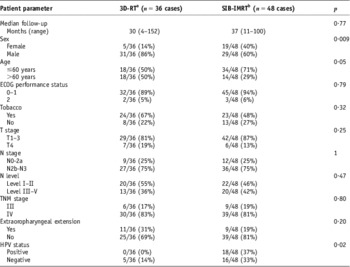
Median follow-up for the matched cohorts were similar (30 months for 3D-RT versus 37 months for SIB-IMRT), and baseline characteristics were generally balanced between the two groups, with the exception of gender, age and HPV (Table 1). It is noteworthy that the lower prevalence of HPV-positive tumours in the 3D-RT cohort was consistent with the determination of HPV status since 2009; indeed, only 5 of 36 cases managed with 3D-RT had HPV determination.
Patients’ characteristics by radiation modality

Notes: a 3D radiation technique with conventional fractionation.
b Simultaneous boost intensity-modulated radiotherapy.
Abbreviation:HPV, human papilloma virus.
Table 2 summarises treatment data according to radiation modality; 3D-RT patients were less likely to have PET-CT for staging and to receive IC with TPF with respect to SIB-IMRT subgroup.
Treatment parameters and follow-up by radiation modality

Notes: a 3D radiation technique with conventional fractionation.
b Simultaneous boost intensity-modulated radiotherapy.
Abbreviations: PET, positron emission tomography; IC, induction chemotherapy.
The overall CR rate after completion of ICRT was 67%. Of the patients, 27 (32%) were planned for neck dissection after radiation. The most common grades 2–3 toxicity attributed to IC was neutropenia (grades 2 and 3 in 25 and 21% of patients, respectively). One patient experienced grade 4 sensory and motor neuropathy during IC. Of the total number of patients, 51 (61%) developed grade 3 or 4 mucositis and skin reactions during RT, 9 patients (11%) had a feeding tube during RT and 4 patients (5%) did not complete the planned RT course. No significant difference was detected concerning acute toxicity, use of feeding tube and treatment compliance between the two modalities of radiation. Concerning late effects, the most frequent CTCAE grade ≥ 3 toxicities were fibrosis (a total of five cases, 6%; three cases in the 3D-RT group and two cases in the SIB-IMRT group) and dysphagia (three cases, 4%; all cases were registered in the 3D-RT group). The overall incidence of CTCAE grade ≥ 3 late toxicity was reduced in the IMRT group with respect to 3D-RT (p = 0·0002).
Survival outcomes
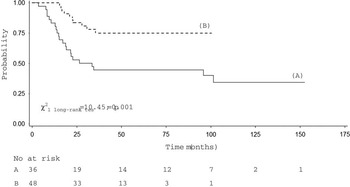
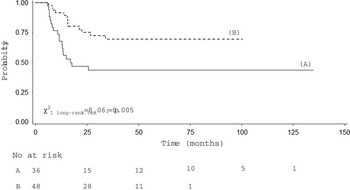
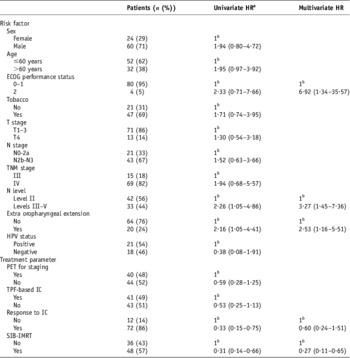
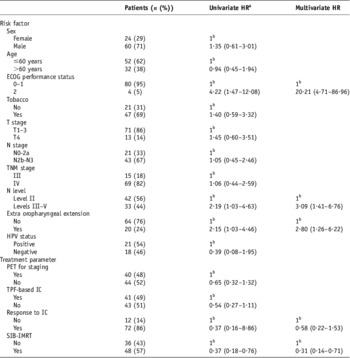
At a median follow-up of 32 months (range, 4–152 months), the 3-year OS and LRC for the entire series were 61 and 59%, respectively. At 3 years, the SIB-IMRT group had an improved OS (78 versus 50%, p = 0·001) and LRC (70 versus 40%, p = 0·005) compared with the 3D-RT group (Figures 1 and 2). Univariate analysis identified extraoropharyngeal extension (HR 2·16, 95% CI 1·05–4·41, p = 0·037), involvement of lower neck levels (HR 2·26, 95% CI 1·05–4·86, p = 0·036), response to IC (HR 0·27, 95% CI 0·08–0·88, p = 0·030) and the use of SIB-IMRT (HR 0·31, 95% CI 0·14–0·66, p = 0·002), as significant predictors of OS. Age >60 years resulted borderline for worse OS (HR 1·95, 95% CI 0·97–3·92, p = 0·059).
Overall survival of 84 advanced oropharynx cancer patients by radiation modality (A = 3D-RT; B = SIB-IMRT).

Locoregional control of 84 advanced oropharynx cancer patients by radiation modality (A = 3D-RT; B = SIB-IMRT).

ECOG PS >1, extraoropharyngeal extension, involvement of lower neck levels, response to IC and use of SIB-IMRT resulted the significant predictors for LRC (HR 4·22, 95% CI 1·47–12·08, p = 0·02; HR 2·80, 95% CI 1·26–6·22, p = 0·01; HR 3·09, 95% CI 1·41–6·76, p = 0·005; HR 0·37, 95% CI 0·16–8·86, p = 0·02; HR 0·31, 95% CI 0·14–0·71, p = 0·006, respectively).
Multivariate analyses were performed examining five factors (PS, extraoropharyngeal extension, involvement of lower neck levels, response to IC and use of SIB-IMRT) for OS and LRC. PS, extraoropharyngeal extension, involvement of lower neck levels and use of SIB-IMRT resulted independent significant predictors for OS (HR 6·92, 95% CI 1·35–35·57, p = 0·02; HR 2·53, 95% CI 1·16–5·51, p = 0·019; HR 3·27, 95% CI 1·45–7·36, p = 0·004; HR 0·27, 95% CI 0·11–0·65, p = 0·004, respectively) and LRC (HR 20·21, 95% CI 4·71–86·69, p = 0·0001; HR 2·80, 95% CI 1·26–6·22, p = 0·01; HR 3·09, 95% CI 1·41–6·76, p = 0·005; HR 0·31, 95% CI 0·14–0·71, p = 0·006, respectively). Response to IC was not an independent predictor for OS or LRC (HR 0·60, 95% CI 0·24–1·51, p = 0·28; HR 0·58, 95% CI 0·22–1·53, p = 0·27, respectively). Findings from univariate and multivariate analyses for OS and LRC of all 84 patients are shown in Tables 3 and 4.
Distribution of patients and overall survival, hazard ratios (HR) and corresponding 95% confidence intervals according to selected risk factors

Notes: a Estimated through Cox proportional hazard model, adjusted for age.
b Reference category.
Abbreviations: HPV, human papilloma virus; PET, positron emission tomography; IC, induction chemotherapy; SIB-IMRT, simultaneous integrated boost-intensity modulated radiotherapy.
Distribution of patients and locoregional control, hazard ratios (HR) and corresponding 95% confidence intervals according to selected risk factors

Notes: a Estimated through Cox proportional hazard model, adjusted for age.
b Reference category
Abbreviations: HPV, human papilloma virus; PET, positron emission tomography; IC, induction chemotherapy; SIB-IMRT, simultaneous integrated boost-intensity modulated radiotherapy.
Discussion
In this series, we have confirmed several known prognostic factors for patients with OPC, including response to IC and adoption of IMRT technique; the latter is thought to correlate with favourable impact in terms of tumour control as reported in other retrospective series.Reference McBride, Parambi, Jang, Goldsmith, Busse and Chan 8 , Reference Clavel, Nguyen and Fortin 9 , Reference Rothschild, Studer and Seifert 12 , Reference Hodge, Bentzen and Wong 13 Our study further identified the extraoropharyngeal extension of the primary tumour and the presence of metastasis in lower neck levels, and as novel prognostic factors for OS as well as LRC.
Our study confirms the role of IMRT in improving tumour control in OPC, and in particular the advantage of concomitant boost as compared with standard fractionation.Reference Orlandi, Palazzi, Pignoli, Fallai, Giostra and Olmi 17 This may be explained by the higher biological effective dose to the gross tumour obtained with the moderate hypofractionation in the SIB-IMRT schedule (7,095 Gy with daily fractions of 2·15 Gy). Unlike previous studies, we focused on a homogeneous cohort of patients in terms of disease and treatment strategy, to provide the best possible comparison between 3D-RT and IMRT. Indeed, previously published experiences had the criticism of important clinical selection biasReference Rothschild, Studer and Seifert 12 , Reference Hodge, Bentzen and Wong 13 or inconsistencies in the durations of median follow-up.Reference McBride, Parambi, Jang, Goldsmith, Busse and Chan 8 The difference observed in previous studies, regarding the median follow-up between the two regimens, mirrors the fact that the patients were not treated in the same periods, introducing bias concerning the potential changes in clinical practice over the years, as pointed up by Clavel et al.Reference Clavel, Nguyen and Fortin 9 in a recent observational analysis. It is noteworthy that, in our own cohort, the duration of median follow-up was similar between the IMRT and the 3D-RT groups; this is owing to the fact that 3D-RT is still currently used for OPC in our institution.
A unique aspect of the present work is the benefit in tumour control of SIB-IMRT in the setting of ICRT. In fact, the existing data on this topic have been focused on the setting of CCRT.Reference McBride, Parambi, Jang, Goldsmith, Busse and Chan 8 , Reference Clavel, Nguyen and Fortin 9 Our results for the entire series in terms of OS and LRC (3-year OS and LRC were 61 and 59%, respectively) were comparable to data from the 94-01 French Head and Neck Oncology and Radiotherapy Group (GORTEC) randomized trial of stage III or IV oropharynx carcinoma using concomitant radiochemotherapy.Reference Posner, Lorch and Goloubeva 18
In the context of IC, efforts have been made to improve the outcome in this subset of patients maximising locoregional treatment with altered fractionation RT,Reference Kader, Mydin and Wilson 19 adron therapyReference van de Water, Bijl, Schilstra, Pijls-Johannesma and Langendijk 20 , Reference van de Water, Lomax, Bijl, Schilstra, Hug and Langendijk 21 or combination of RT plus cetuximab,Reference Keil, Selzer and Berghold 22 but data are controversial. Preliminary results from two randomised trials reported comparable survivals between aggressive approaches with IC plus CCRT versus upfront CCRT,Reference Cohen, Karrison and Kocherginsky 23 , Reference Haddad, Rabinowits and Tishler 24 reflecting an uncertain role for the intensification of locoregional treatment with CCRT or cetuximab after IC. Therefore, more aggressive locoregional treatment with CCRT after IC may produce less absolute benefit in OS owing to reduction in treatment compliance, as demonstrated by treatment dropouts in the IC plus CCRT arm.Reference Cohen, Karrison and Kocherginsky 23 Our results, in terms of compliance to SIB-IMRT, were fairly good, with only 5% of the patients requiring discontinuation of radiation. In relation to that, TPF-based IC followed by SIB-IMRT should be considered an effective and well-tolerated treatment strategy to be placed along with CCRT for advanced OPC.
Our study has several limitations, the main one being its retrospective nature, the lack of uniformity regarding the use of PET-CT (only 4/40 patients managed with 3D-RT had PET-scan evaluation), and the lack of data regarding HPV-status for 45/84 patients. The significant difference in the use PET-CT between the two matched cohorts may have caused, at least partially, a selection bias, producing a suboptimal treatment practice to present standards in some 3D-RT patients. This factor limits the findings of the present study, although PET-CT, in our analysis, did not emerge as a significant predictor of OS and LRC. In conclusion, IC plus SIB-IMRT appeared to be an effective treatment approach for locally advanced OPC, with a good compliance. SIB-IMRT represents a highly attractive tool to enhance the therapeutic index of radiation in comparison with conventional techniques. These results need to be confirmed in future prospective trials, and further insights concerning the role of SIB-IMRT in the context of the HPV-related tumours are needed.
Acknowledgement
The authors wish to thank Mrs Luigina Mei for editorial assistance.
Conflict of interests
None.