During the last 25 years, surgical treatment has been offered for patients born with hypoplastic left heart syndrome, either by means of primary cardiac transplantation,1, 2 or following the Norwood sequence of procedures that culminates in construction of the Fontan circulation.
The operative mortality for the Norwood approach has now decreased to acceptable values in many centres.3–5 The associated cardiac and non-cardiac problems persisting after the operations, however, have achieved less attention, and some of the published reports suffer from selectivity in the patients studied.
We have previously reported on the cardiac and non-cardiac medical state of all surviving Norwegian children with hypoplastic left heart syndrome 1½–5 years after completion of the Norwood-Fontan surgical programme.6 Our present aim is to provide a comprehensive description of the state of these patients after a longer period of follow-up.
Material and methods
In Norway, the Rikshospitalet University Hospital has country-wide responsibility for patients born with hypoplasia of the left heart, which gives us access to complete medical information for the whole cohort of patients born with this condition from 1987. For medico-political reasons, all Norwegian children born during the period from 1987 through 1998 with hypoplastic left heart syndrome, and whose parents chose surgical treatment, underwent surgery at a surgical centre in the United States of America.
In this period, 87 children were born with this syndrome. Of the 54 children whose parents opted for surgical treatment, three died before any surgical procedure could be undertaken, 26 died in direct relation to the surgical procedures, and four patients died later.
The initial operation in the newborn period was a Norwood procedure with construction of a systemic-to-pulmonary arterial shunt. Later, one patient underwent complete construction of the Fontan circulation in one step, while all the others had a bidirectional Glenn operation before the completion of the Fontan circulation by construction of a lateral tunnel.
After completion of the Fontan circulation, seven surgical procedures were performed in five of the 25 surviving children. These were closure of the connection of the hepatic veins to the pulmonary atrium in two, resection of a restrictive interatrial septum in two, closure of fenestration in the atrial tunnel in two, and repair of an aneurysm from the right ventricle in one. Transcatheter interventions were performed in five patients, namely closure of fenestration in two, closure of a hepatic vein draining to the left atrium in two, and stenting of the pulmonary arteries in one. In 2 patients, it was necessary to implant a permanent pacemaker. There were no major complication in any of these procedures undertaken subsequent to completion of the Fontan circulation, and none of the patients has required cardiac transplantation.
Of the surviving patients, 21 were candidates for this study. Their families were invited to participate in a comprehensive examination, and 15 families accepted (Fig. 1). The age of the children at the time of examination was from 5 to 12 years.

Figure 1. Overview over the complete cohort of children born with hypoplastic left heart syndrome in Norway in the period from 1987 until 1998.
A detailed history and clinical examination was undertaken for each patient, measuring blood pressure and saturations of oxygen, and recording the electrocardiographic, echo-Doppler, chest X-Ray, and 24-hour electrocardiographic monitoring findings.
In 11 of the 15 patients, it was possible to test them on a treadmill using the Oslo protocol.7 Maximal aerobic capacity expressed as millilitres of oxygen per kilogram bodyweight raised to the exponent 0.67 per minute was used as a more reliable indicator for aerobic capacity in children than millilitres per kilogram per minute.8
We also tested gross motor function, including scores for tone, power, balance, coordination, deep tendon reflexes, and fine motor function, including scores for involuntary movements and figure drawing. Data from the interview was used to evaluate vision and hearing, while we used the fourth edition of the Stanford-Binet Intelligence Scale9 to assess cognitive function. In addition to a composite score, this test gives four sub-scores, namely verbal reasoning, abstract reasoning, quantitative reasoning, and short-term memory. Visual attention and discrimination was tested using the neuropsychological test battery for children.10
One parent of each child, 11 mothers and four fathers, took part in a semistructured interview, which covered employment and education of the parents, family economy and housing conditions, social network and support, and their experiences with the system of health care. In addition, the interview covered marital discord, and the existing and previous physical and mental health of family members. The parents completed the child behavioural checklist11 to provide scores for the overall behaviour and emotional problems of their child. The Hopkins symptom checklist for parental mental health,12 measuring anxiety and depression, was also completed.
Results
Of the 15 children, 5 had a height less than the 2.5th centile, while no child had a weight less than the 2.5th centile related to height. Three of the children were microcephalic. One had lip pits consistent with van der Woude syndrome, and slight dysmorphic traits were seen in one other child.
The cardiac findings were in general favourable. One patient had required implantation of a pacemaker, whilst all the others had sinus rhythm, in a few with relative bradycardia. Moderate regurgitation of the tricuspid and neo-aortic valve was relatively common, but was deemed to be of limited haemodynamic significance. Protein-losing enteropathy was diagnosed in two patients.
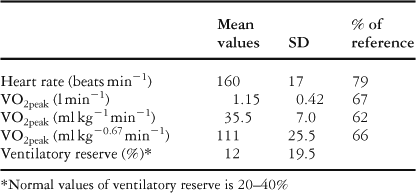
On the treadmill test, 8 of the 11 patients tested had a reduced exercise capacity compared to the healthy norm (Table 1). In 3 patients, the values for maximal uptake of oxygen were normal to near-normal, at least 80 to 85% of reference values. The ventilatory reserve was reduced. There was, however, no correlation between high exercise capacity and normal ventilatory reserve (r equal to −0.49). The four patients not tested either refused, were mentally unable to perform the test, or did not achieve peak values.
Table 1. The table shows mean values, and standard deviations (SD), of crucial exercise data compared to reference values in patients with hypoplastic left heart syndrome.

None of the examined children had cerebral palsy, but one child had marked gross and fine motor problems. One further child had marked fine motor problems. In 6 children, gross motor function was slightly affected, and in 6 fine motor function was slightly impaired. The majority of the children had achieved independent walking by 18 months. In 4 children, we found evidence of slight dysarthria, while four had a problem with strabismus, and two were reported to have reduced hearing. Seizures had occurred in one child from eight years of age, albeit fairly well controlled on medication with valproate and lamotrigine. Enuresis was present in four children aged between 4½ and 9½ years.
The group as a whole exhibited significant neuropsychological deviation. The mean composite intelligence quotient for the cohort was 87, with a range from 52 to 111. The composite score for 10 of the children was in the normal range, that is 100 plus or minus 1 standard deviation, within the range from 84 to 116. Scores were below the normal range in 5, with two of these meeting the diagnostic criterions for mental retardation. In 3 children, composite scores were between one and two standard deviation below the average for the age. Of the 10 children in the normal range, the difference between own highest and lowest scores on the subscales was larger than expected, with 4 of these having a difference of two standard deviations or more.
In the visual attention sub-test of the neuropsychological test battery for children, 9 of the children scored within or above normal range, taking this to be one standard deviation from the norm, while six scored below this normal range.
When the parents rated the children's present physical health on a scale from 0, representing as ill as can be imagined, to 10, representing optimal health, the median was 8.5, with a range from 3 to 10, and their quality of life was rated at a median of 9.5, with a range from 8 to 10. Comments made by the parents relative to the scores included reduced physical strength and endurance, noted by 9, problems being outside on cold days, noted by 2, and that the child gets easily blue, noted by a further 2. Protein losing enteropathy was the reason for the health score being graded at 3. All other scores were graded at 7.5 or higher. There were hardly any comments concerning conditions unrelated to hypoplastic left heart syndrome.
Of the 9 school-aged children, 6 received special assistance, amounting to from 4 to 13 lessons a week. Social support was also a significant requirement for five of them. Attention deficit hyperactivity disorder had been diagnosed in 4, and for one of them, this diagnosis had been established and medication had been introduced. In the pre-school group of six children, two received extra teaching and social support in kindergarten. Of the remaining four, three had been referred to the child psychiatry service for assessment, but only one positive diagnosis, of encopresis, was made.
On the child behavioural checklist, one parent scored above the normal range, indicating more problems, for overall behaviour, while three parents scored above the normal range for emotional problems. When the parents evaluated their own mental health on the Hopkins symptoms checklist, the median score was 1.34, with a range from 1 to 2.5. For this test, a score above 1.75 is considered to imply a clinical disorder. Of the mothers, 4 had a permanent partner who was not the father of their affected child, with 2 of these reporting that the illness of the child had contributed to divorce. In all, 11 of the mothers had given birth to younger siblings.
Negative reactions to the attitudes of doctors and nurses during the first dramatic days after the birth of their affected child were reported by 5 parents. They felt that the information and prognosis they initially received were unbalanced, and that the medical staff had been unsupportive. All the interviewed parents except one reported that having a child with hypoplastic left heart syndrome gave them many positive experiences.
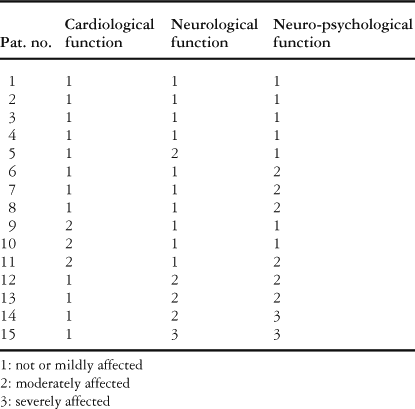
We have summarised the findings in the 15 examined children in Table 2.
Table 2. Disability scores.

From the medical records of the six children whose families refused to participate in this study, we know that two are free from significant cardiac and non-cardiac problems. The one who had an operation for an aneurysm in the right ventricular outflow tract now has a significantly dilated ascending neo-aorta, with moderate valvar regurgitation. A pacemaker has been implanted in one additional child, two have epilepsy, and one of these has significant mental retardation and spastic diplegia.
The cause of death in the four children whose death was unrelated to the operations was protein-losing enteropathy in two, and uncontrollable effusions in the serous cavities in the other two.
Discussion
Many of our patients were operated when the Norwood procedure was relatively new. Consequently, our results may not be predictive for patients undergoing surgery in the current era. The operations, nonetheless, were performed in a highly specialized centre, with considerable experience with this type of operation.
For the whole cohort, the total operative mortality for our children born with hypoplastic left heart syndrome, and undergoing surgical correction, was significant at 61%. For the survivors, the cardiac and haemodynamic state and function were generally good. In 2 of the total of 21 candidates for our study, nonetheless, it had proved necessary to implant a permanent pacemaker, while protein-losing enteropathy was a significant problem, and has continued to be so in a more recent cohort not included in this study.
As might be expected, the patients with hypoplastic left heart syndrome, even with a “perfect” Fontan circulation, had reduced peak uptake of oxygen, and lower peak heart rate, when compared to a healthy population. It is of interest that three patients had normal to near normal peak uptake of oxygen, with values between 75 and 85% of the norm. The reason for this is unknown, albeit that increased levels of physical activity may be a contributing factor. The ventilatory reserve gives an indication of lung capacity at peak exercise. Normal individuals have a reserve of 20 to 40%, but our patients showed a reduced reserve, indicating a problem in the lungs that is not well investigated.
Few of the examined children had major neurological abnormalities. This is consistent with the findings in our previous study, and in contrast to an earlier report.13 Minor problems, nonetheless, were seen in several children. It is important that proper attention is given to these problems, which, though deemed minor, may be of great consequence to the individual child. Professional help should be provided early when needed.
The majority of children in this group had intelligence scores within the normal range, but the results of neuropsychological testing give a clear indication that children with hypoplastic left heart syndrome have more problems in one or more cognitive areas than their healthy peers. This has also been reported in other studies.14–16
The overall indication from the neuropsychological findings in our study is that the main area of cognitive dysfunction occurs in the realms of attention, short term memory, and working memory, with one-third of our cohort being below the normal range for neuropsychological function, and two children meeting the diagnostic criterions for mental retardation. The results for three of the remaining 13 children indicate that they will encounter educational problems warranting specialised professional attention.
Deviation was also noted in the 10 children in the normal neuropsychological range. Of these, 4 had a larger than expected discrepancy in their own performance. Although minor, this may cause learning difficulties, dependent upon general cognitive level, and/or environmental factors. The children with less obvious cognitive dysfunction are at risk of not receiving appropriate help and support. Minor cognitive dysfunction may not be regarded as a significant problem. If it is not recognized, and no methodological, pedagogical and other adjustments are made, it may have a negative effect on the quality of life these children.
In our study of 1996,6 the low problem score reported by the parents was assessed by the child psychiatrist as an expression of lack of realism on the part of the parent concerning the physical and mental health of their child. Some of the six families who refused to take part in the present study gave this as their reason for refusal.
In our present study, the parental assessment of the mental health of their child was more in accordance with the professional assessment of the child compared to the previous study,6 and there was a remarkable shift concerning the dominating kind of problem reported. The parent group from 19966 reported a high fraction of externalizing problems, such as aggressive and rule-breaking behaviour, while now internalising problems, such as anxiousness, depression, and somatic complaints, were recognized to a greater extent both in absolute and relative figures.
Higher problem scores given by the parents, and their stronger recognition of the emotional aspects in the situation of their child, may indicate that established procedures and social support had reduced stress within the families. The same conclusion may be drawn from the fact that the time-span from the birth of the child with hypoplastic left heart syndrome to the next child in the family was significantly shorter for the children born in 1996 and later, with a mean of 2 years and 8 months, than for the older group, where the mean was 4 years and 6 months.
We conclude that, although the surgical treatment of hypoplastic left heart syndrome has made immense progress, the operative mortality reported from most centres is still significant, and in the patients who survive there is significant morbidity. Cardiac problems, however, were not the most important ones in our patients. We should keep in mind, nonetheless, that the prognosis remains uncertain over the long term for those with the Fontan circulation, particularly because the morphologically right ventricle has to serve as the systemic ventricle. The relatively high proportion of our patients with protein-losing enteropathy is also a cause for concern. It is also important to follow closely any patients shown to have significant neurological and neuropsychologigal problems, since many are likely to need a range of specialized support over the longer term. It is our hope that the findings of this, and similar, studies will contribute to hightening the awareness of these issues.