Introduction
Agroecosystems encompass intertwined scenarios of warfare between crop plants and their pests, between the pests and their natural enemies, and amongst the natural enemies sharing the pest as prey. Amidst this complex scenery, the enemies differ by size, identity, and superiority (e.g., Polis et al. Reference Polis, Myers and Holt1989; Rosenheim et al. Reference Rosenheim, Kaya, Ehler, Marois and Jaffee1995; Henry et al. Reference Henry, Bannerman, Gillespie and Roitberg2010). Their interactions with each other are, therefore, expected to vary; as does their impact per se on the food they share (Rosenheim et al. Reference Rosenheim, Wilhoit and Armer1993; Vance-Chalcraft et al. Reference Vance-Chalcraft, Rosenheim, Vonesh, Osenberg and Sih2007).
Green peach aphid under predation
The green peach aphid (Myzus persicae (Sulzer); Hemiptera: Aphididae) is a generalist phloem feeder that brings severe damage to a vast range of cash crops (Van Emden and Harrington Reference Van Emden and Harrington2007), whilst being liable to the attack of an array of aphidophagous organisms (Van Emden et al. Reference Van Emden, Eastop, Hughes and Way1969). In practice, lacewing, for example, Chrysoperla carnea (Stephens) (Neuroptera: Chrysopidae), parasitoid wasps, for example, Aphidius colemani (Viereck) (Hymenoptera: Braconidae), and coccinellids, for example, Adalia bipunctata (Linnaeus) (Coleoptera: Coccinellidae) are influential regulating agents of Aphididae (Şengonca and Frings Reference Şengonca and Frings1985; Van Emden and Harrington Reference Van Emden and Harrington2007).
Both coccinellids and chrysopids are agile predators and will compete to consume aphids. In general, size matters in predatory guilds as larger predators can have stronger impacts on smaller predators (Şengonca and Frings Reference Şengonca and Frings1985; Woodward and Hildrew Reference Woodward and Hildrew2002; Yvon-Durocher et al. Reference Yvon-Durocher, Reiss, Blanchard, Ebenman, Perkins and Reuman2011). But, when the smaller in size is more aggressive and within limited space, it can subdue the larger predatory competitor (Nedvěd et al. Reference Nedvěd, Fois, Ungerová and Kalushkov2013; see also Lucas et al. Reference Lucas, Coderre and Brodeur1997). The competitive advantage of a predator at the expense of another is thought to be context-dependent and may also impact the suppression of prey population (Şengonca and Frings Reference Şengonca and Frings1985; Yvon-Durocher et al. Reference Yvon-Durocher, Reiss, Blanchard, Ebenman, Perkins and Reuman2011; Nedvěd et al. Reference Nedvěd, Fois, Ungerová and Kalushkov2013) and thus affect other trophic levels in the system (Woodward et al. Reference Woodward, Ebenman, Emmerson, Montoya, Olesen, Valido and Warren2005; Rusch et al. Reference Rusch, Birkhofer, Bommarco, Smith and Ekbom2015).
When a key predator preys on other members of the same predatory guild, whilst they all together compete for the same common extraguild prey (e.g., aphids), it is then a special case of intraguild interaction termed as intraguild predation (Polis et al. Reference Polis, Myers and Holt1989). The subdued (weaker) predator that is consumed by the more dominant predator is termed thereby intraguild prey (Polis et al. Reference Polis, Myers and Holt1989).
Parasitoid in action
The interactions get more complex when a parasitoid is a part of the natural enemy guild. Aphidius wasps are manipulative enemies of aphids (Khudr et al. Reference Khudr, Oldekop, Shuker and Preziosi2013), which start their attack with parasitism and end it with consumption of the host (Jervis et al. Reference Jervis, Copland, Harvey and Jervis2005). The solitary female A. colmani begins the process by subduing its aphid host for oviposition, turning the host into a puparium for its juvenile, where the latter gradually consumes the host from inside leaving it, at the end of the process, as an exoskeleton (mummy) ready for the adult wasp to eclose and complete the life cycle (Benelli et al. Reference Benelli, Messing, Wright, Giunti, Kavallieratos and Canale2014). It is well demonstrated that the parasitised aphids tend to mummify away from their healthy mother population in order to reduce any possible subsequent parasitoid attacks on the clone (McAllister and Roitberg Reference McAllister and Roitberg1987; Khudr et al. Reference Khudr, Oldekop, Shuker and Preziosi2013); such altruism may expose them to other predators (McAllister and Roitberg Reference McAllister and Roitberg1987). As such, the parasitoid may become the intraguild prey in intraguild predation scenarios, when other predatory guild members consume the puparia (aphids being parasitoidised) and thus, in effect, killing the parasitoid progeny (McAllister and Roitberg Reference McAllister and Roitberg1987; Brodeur and Rosenheim Reference Brodeur and Rosenheim2000; Traugott et al. Reference Traugott, Bell, Raso, Sint and Symondson2011). This can overall be beneficial for the parthenogenetic aphid colony (clone) as altruistic behaviours provide the predators with diseased individuals. This may concomitantly minimise consecutive attacks by the parasitoid (McAllister and Roitberg Reference McAllister and Roitberg1987). Thus, in the presence of other predatory guild members, the parasitoid will vary its manipulative strategies (Jervis et al. Reference Jervis, Copland, Harvey and Jervis2005) to increase its fitness. This can be achieved by changing its virulence (parasitisation rate) or altering host behaviour (Khudr et al. Reference Khudr, Oldekop, Shuker and Preziosi2013), so that aphids of the population under attack may show less altruism (McAllister and Roitberg Reference McAllister and Roitberg1987; Khudr et al. Reference Khudr, Oldekop, Shuker and Preziosi2013).
Super-predation by a novel top predator
Another spin of complexity may influence aphids when a foreign enemy interposes in an already conjoined yet opposed predatory guild interaction. The spider impact on aphids can be explained by an indirect direct effect through consuming efficient natural enemies of aphids, or through intimidation (non-lethal effects) (Hlivko and Rypstra Reference Hlivko and Rypstra2003; Nyffeler and Birkhofer Reference Nyffeler and Birkhofer2017). The impact can also be explained by a direct effect through consuming aphids (alatae and apterae), as well. There is an increasing interest in the applicability of spiders in pest control, including aphids (Nyffeler Reference Nyffeler1982; Sunderland et al. Reference Sunderland, Fraser and Dixon1986, Reference Sunderland, Crook, Stacey and Fuller1987; Nyffeler and Birkhofer Reference Nyffeler and Birkhofer2017). Synanthropic spiders, such as Parasteatoda tepidariorum (Koch) (Araneae: Theridiidae), live in association with humans and are opportunistic in their diet (Hajer and Hrubá Reference Hajer and Hrubá2006; World Spider Catalog 2016). A variant of this polyphagous spider, referred to in Europe as the greenhouse spider (Hajer and Hrubá Reference Hajer and Hrubá2006), is not commonly encountered by aphids apart from within infested greenhouses. Moreover, aphids are fairly sedentary in nature and usually, albeit being edible, do not make the main part of the diet for generalist spiders if more preferable provision is available. However, in the greenhouse setting, P. tepidariorum can inhabit the plants that also host aphids. Given that both P. tepidariorum and aphids usually retreat to the dark, residing below leaves, entrapment of aphids by the sticky irregular webs of this spider is more likely to happen accidentally (Breene et al. Reference Breene, Dean, Nyffeler and Edwards1993), or as a result of marked foraging activity by P. tepidariorum, which is known to change the sites of its web in search for more food (Fiedler Reference Fiedler2000).
Being an entomophagous spider, P. tepidariorum can target a spectrum of prey spanning not only aphids (common prey), but also the predators and parasitoids of the aphid (possible intraguild prey). This makes the spider a top predator, and the process of consuming the intraguild prey can, therefore, be referred to as super predation (Nyffeler and Sunderland Reference Nyffeler and Sunderland2003; Van Emden and Harrington Reference Van Emden and Harrington2007). Note, here, that the spider cannot only consume parasitised aphids, but also, different from the other predators, it can entrap both adult wasps and the predators. However, the suppression of the aphid population may vary in respect to the nature of the intraguild interactions, where spiders are present. In other words, the influence of spiders is quite contextual and the direction of their effect will differ between disruption of, and acting in synergy with, other aphid natural enemies (Yasuda and Kimura Reference Yasuda and Kimura2001; Dinter Reference Dinter2002; Wente Reference Wente2014).
The exploitation–interference continuum and the matter of symmetry
One can envision a continuum to take place between the following forms of interaction amongst the natural enemies comprising an aphidophagous guild (Ferguson and Stiling Reference Ferguson and Stiling1996; Holt and Polis Reference Holt and Polis1997; Le Bourlot et al. Reference Le Bourlot, Tully and Claessen2014): 1) exploitation, which takes place when the interaction between natural enemies is modulated by dwindling and exhausted prey population; and 2) interference, which unlike exploitation, is marked by direct conflict between the enemies. It is noteworthy that the presence of parasitised prey individuals, before they complete mummification, adds another layer of complexity to the interactions in parasitoid–predator assemblages. This is because the parasitised aphids create a situation termed as pseudo-interference, where the intraguild competitors of a parasitoid indirectly consume the developing parasitoid juveniles by devouring the aphids that host them (Krause and Ruxton Reference Krause and Ruxton2002). The parasitoid, therefore, is more vulnerable to intraguild predation in its asymmetrical relationships with the other aphid enemies, which can consume both healthy and parasitised aphids (parasitoid puparia) (Brodeur and Rosenheim Reference Brodeur and Rosenheim2000; Traugott et al. Reference Traugott, Bell, Raso, Sint and Symondson2011).
At any rate, the symmetry of the interplay amongst predatory guild members (Lucas et al. Reference Lucas, Coderre and Brodeur1998; Hénaut et al. Reference Hénaut, Machkour-M’rabet and Lachaud2013) is likely to be context-dependent with additive or non-additive effects on the prey (Sih et al. Reference Sih, Englund and Wooster1998, Crumrine and Crowley Reference Crumrine and Crowley2003; Griffen and Byers Reference Griffen and Byers2006), especially when considerable reciprocal influence takes place amongst the enemies (Lucas et al. Reference Lucas, Coderre and Brodeur1998; Brahma et al. Reference Brahma, Sharma, Kundu, Saha, Saha and Aditya2015). In this regard, the risk of consumption of the shared prey will be subject to the type and intensity of intraguild competition as well as collective consumption (Polis and Holt Reference Polis and Holt1992; Vance-Chalcraft and Soluk Reference Vance-Chalcraft and Soluk2005; Griffen and Byers Reference Griffen and Byers2006). This may result in a decrease or increase in the fitness of shared prey subject to the varying collective action of the natural enemies in operation (Cardinale et al. Reference Cardinale, Harvey, Gross and Ives2003; Lucas Reference Lucas2005; Griffen and Byers Reference Griffen and Byers2006). In turn, the dynamics of constant change and prey defence induction brought about by the influence of natural enemies and their species composition will influence the ontogeny and behavioural phenotype of the aphid prey that is known for phenotypic plasticity and polyphenism (i.e., extreme phenotypic plasticity) (Whitman and Agrawal Reference Whitman, Agrawal, Whitman and Ananthakrishnan2009). In response to environmental stressors, aphids may produce discrete dispersive winged morphs (alates) to take flight and recolonise in safer contexts (Purandare et al. Reference Purandare, Tenhumberg and Brisson2014).
On the whole, the interactions amongst the enemies of the prey are central to shaping the composition and dynamics of aphidophagous guilds (Lucas Reference Lucas2005). However, the regulatory effects of the competitive guild interplay are not fully comprehended thus far (Symondson et al. Reference Symondson, Sunderland and Greenstone2002). For example, the simultaneous integration of varied bionts of different hierarchal influence (i.e., parasitoids, predators, intraguild prey, shared prey, and top predators) into model agroecosystems is yet to be further investigated in terms of the functional as well as the contextual roles of enemy identity/species. There is an increasing need to examine which enemy assortments (species composition) boost and which hamper the functional grouping of natural enemies in terms of suppressing their shared prey. Also, across intraguild scenarios, knowledge is still limited on the effects of the functionality of grouping of multiple enemies on the ecology of shared parthenogenetic sap-feeding prey that is a plant parasite of a vast array of crop plants.
The integration of synanthropic top predators, for example, spiders, (Samu and Szinetár Reference Samu and Szinetár2002; Maloney et al. Reference Maloney, Drummond and Alford2003), which can simultaneously feed on less dominant natural enemy guild members and the shared prey (Rosenheim et al. Reference Rosenheim, Kaya, Ehler, Marois and Jaffee1995; Hodge Reference Hodge1999; Nyffeler and Sunderland Reference Nyffeler and Sunderland2003) should receive more attention. In this regard, it has been demonstrated that matching species of insect natural enemies with context-dependent top predators, such as spiders, is actually not that straightforward because specific assortments can be beneficial, whilst other enemy combinations can be disruptive to other efficient biocontrol agents and thus may be deemed disadvantageous (e.g., Dinter Reference Dinter2002; Henry et al. Reference Henry, Bannerman, Gillespie and Roitberg2010). Particularly, the impact of introducing novel synanthropic spiders in model agroecosystems on the aforementioned matters of functionality and identity is hitherto understudied.
These concerns are of paramount importance from ecological as well as agricultural perspectives. This is because effective or disruptive grouping of natural enemies can wield influence beyond the intraguild scene of action to impact other trophic levels and eventually ecosystem services (Cardinale et al. Reference Cardinale, Harvey, Gross and Ives2003; Lang Reference Lang2003).
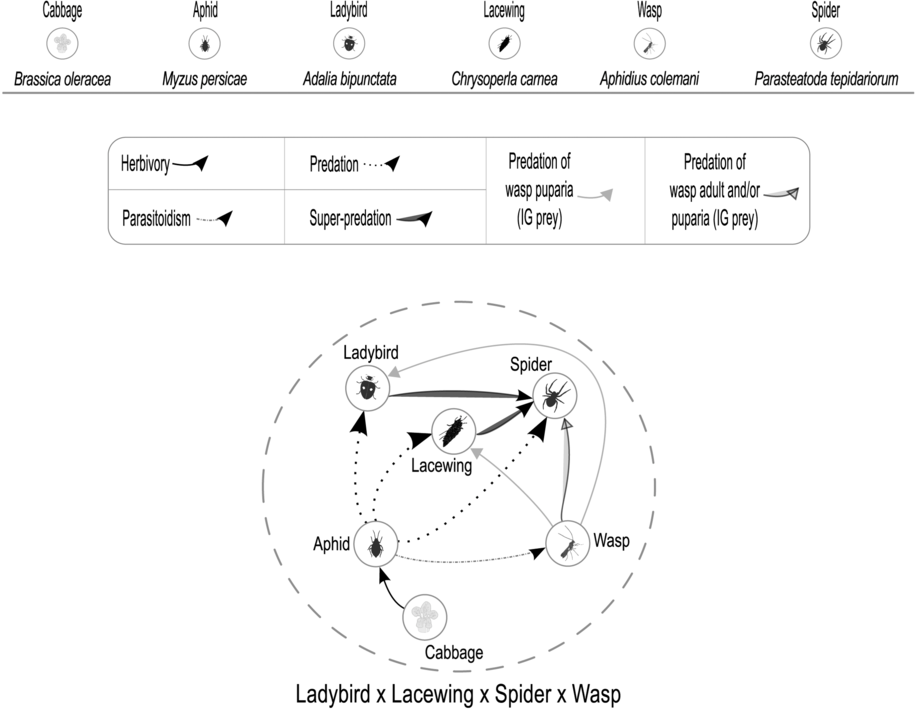
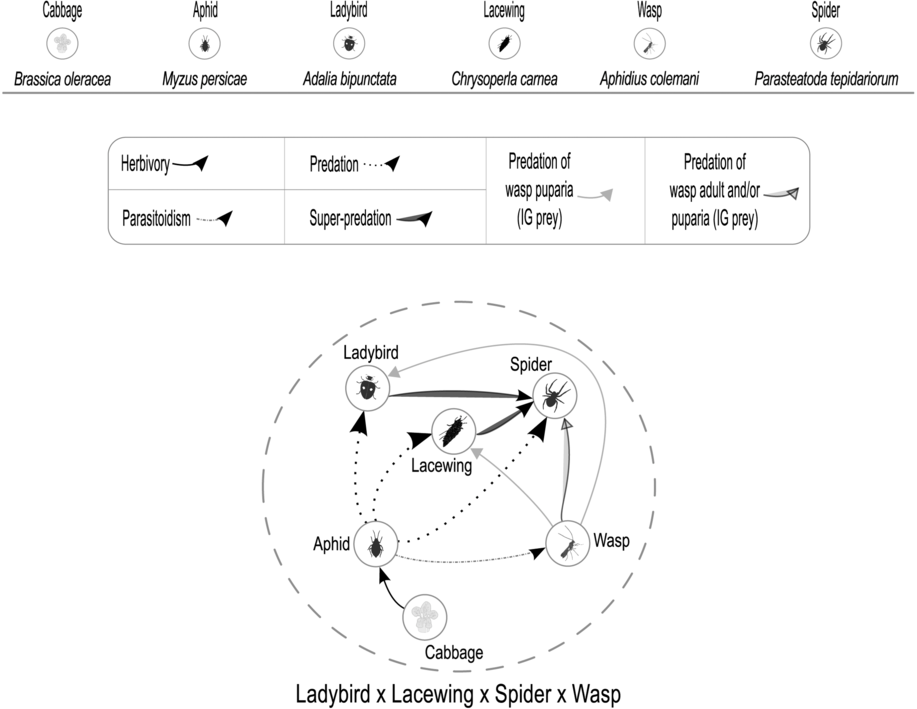
In this experimental glasshouse study, we investigated the performance of green peach aphid M. persicae under the respective influences of single, double, triple, or quadruple pressures inflicted by four species comprising the natural enemy combination. The natural enemy treatment comprised all possible combinations of parasitoid A. colemani and three predators: A. bipunctata, C. carnea, and P. tepidariorum that comparatively functioned as a top predator; Fig. 1 provides a conceptual food web illustration. We raise the following questions:
1. Do green peach aphid abundance, polyphenism (production of alates) and behaviour (within-enclosure spatial distribution) respectively, differ across all possible combinations of the natural enemies of different identities?
2. How does the presence of predators and a parasitoid wasp influence green peach aphid abundance with and without intraguild interactions?
3. Does the intraguild interaction with the top predator comparatively alter the impacts of other natural enemies on green peach aphid performance?
Schematic representation of the natural enemy combinations and their food webs. One individual of each four distinct species of natural enemies was used to comprise a guild, where green peach aphid was the shared prey, whilst Parasteatoda tepidariorum, being the top predator, was able to simultaneously prey on the green peach aphid and all other guild members. There were 16 food webs corresponding to each level of the 16 different natural enemy combinations, with “green peach aphid alone” having the simplest basic food web and (Adalia bipunctata x Chrysoperla carnea x Parasteatoda tepidariorum x Aphidius colemani) being the most complex one. Distinct arrow patterns were used to refer to the ecological processes pertaining to the food web. The adult A. colemani can only be targeted by P. tepidariorum (shady arrow; predation of adult and puparia), whilst A. colemani juveniles inside parasitised aphids are vulnerable to all predators when they target the parasitised aphid individuals (light grey arrow). IG prey, intraguild prey.
Materials and methods
Green peach aphid and host plant
Clonal descendants from one mother of green peach aphid were raised for three months on kale (Brassica oleracea var. sabellica Linnaeus; Brassicaceae) at the glasshouse facility of Freie Universität Berlin, Germany, (photoperiod 16:8 light:dark hours], 22–24 °C, approximately 75% relative humidity). The initial sample of green peach aphid was provided by the Julius Kühn-Institut, Berlin, Germany. For the treatments, we used savoy cabbage (Brassica oleracea var. sabauda Linnaeus) (cultivar Vertus 2) as a host plant. Three seeds per pot were sown in 22-cm plastic pots filled with steam-sterilised soil.
A light plastic scaffold was attached to each pot to keep a fine-meshed enclosure upright (40 cm length, 25 cm circular diameter). Twenty nymphs of M. persicae (fourth instars) were placed onto each plant four weeks following germination, using a wet damp brush. This resulted in a total of 60 green peach aphid congeners per enclosure prior to the introduction of the natural enemy/ies. The congeners were all genetically identical due to parthenogenesis under the conditions of the experiment. As described below, there were 16 different treatment combinations with five repeats each. In total, there were 4800 clonal nymphs that were separated into the “contextual compartments” of the experiment.
Members of the aphidophagous guild (natural enemy combinations)
Adalia bipunctata adults, C. carnea second instars, and parasitoid A. colemani were obtained from a commercial biocontrol supplier (Sautter and Stepper GmbH, Ammerbuch, Germany). Upon delivery, A. colemani puparia (mummified green peach aphids, each including a pupa of A. colemani) were placed in petri dishes until the emergence of the adult A. colemani, then freshly eclosed females were randomly selected, isolated in petri dishes, and fed on 10% sucrose solution soaked into small cotton masses, prior to their individual use in natural enemy combinations. No starvation of the natural enemies was allowed prior to the experiment.
Parasteatoda tepidariorum is a widely distributed synanthropic spider native to South America and usually found in greenhouses in Europe (Hajer and Hrubá Reference Hajer and Hrubá2006; McGregor et al. Reference McGregor, Hilbrant, Pechmann, Schwager, Prpic and Damen2008; World Spider Catalog 2016). A P. tepidariorum female was first captured on fishtail palm (Caryota Linnaeus; Araliaceae) at the glasshouse facility mentioned above. A healthy P. tepidariorum population was subsequently reared for approximately six months in the glasshouse on culture of 100 propagated young shoots of common ivy (Hedera helix Linnaeus; Arecaceae) and supplied with Dipterans and green peach aphids (M. persicae conspecific, obtained from Bayer CropScience, Monheim, Germany, different from the genotype used in the experiment) as food source. We used mature approximately one-month-old female P. tepidariorum.
Experimental design and analysis structure
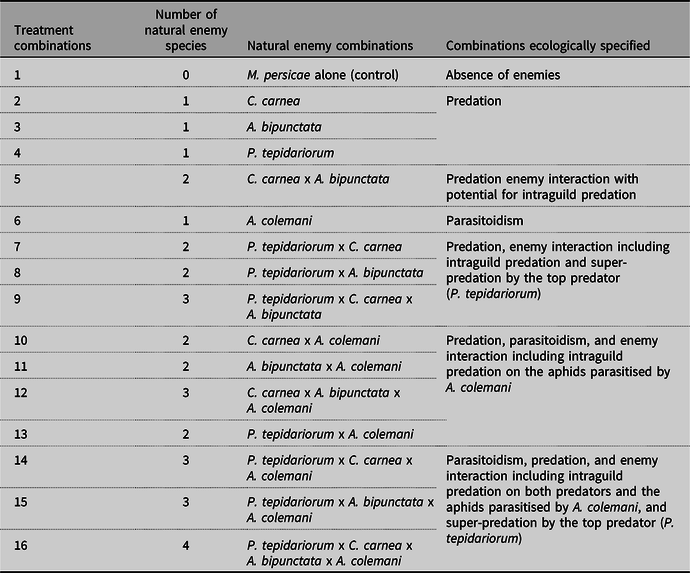
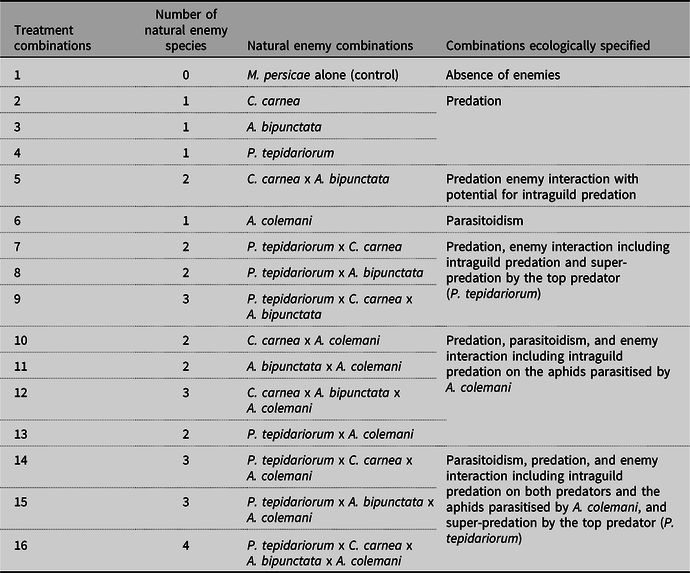
All possible combinations of natural enemies pertaining to four species (identities) were tested including unary, binary, ternary, and quaternary groupings. This resulted in 16 different treatment lines with five replicates each, making a total number of 80 units, (Table 1) and (Fig. 1) for supportive diagrammatic illustrations of the food web concept and natural enemy combinations. Concordant with each natural enemy combination, one individual of each matching natural enemy species was carefully transferred into each related enclosure, already infested with 60 green peach aphids (fourth instars), and placed onto the soil amongst the cabbage plants using a fine brush and a plastic spatula. Twelve days following the introduction of the natural enemies into the enclosures, we recorded green peach aphid numbers including alates (winged dispersive morphs) and mummies (number of parasitoidised green peach aphids). We also observed green peach aphid spatial distribution on a fine-scale within enclosures (off-plants or on-plant: leaf upper side/leaf down side/stem).
Natural enemy combination. The natural enemy combinations consisted of 16 different treatments starting with green peach aphid, Myzus persicae, alone (enemy-free) and ending with four enemies (i.e., species/identities) present together. The last column, for elucidation purpose only, illuminates the ecological processes brought about by the interplay amongst the natural enemies of the green peach aphid, in line with their functional grouping. Parasteatoda tepidariorum acted as a top predator with the ability to simultaneously prey on the green peach aphid (shared prey) and all other aphidophagous guild members (Chrysoperla carnea, Adalia bipunctata, and Aphidius colemani), hence the term super-predation. Enemy and intraguild interaction is the general umbrella under which intraguild predation or super predation may occur.
We watered the plants as necessary by pouring water into individual pot trays. The data analysis was done via R environment version R version 3.3.1 (R Development Core Team 2016; RStudio Team 2017). No voucher specimens or aphids or their natural enemies were retained from this study.
Green peach aphid abundance
We tested the response variable (aphid abundance (total green peach aphid numbers per enclosure, collected at the end of the experiment)) from different perspectives in order to obtain a comprehensive understanding of the response variable across contexts:
Model 1: treatment effect (i.e., the effect of natural enemy combinations)
We tested the impact of the composition of the natural enemy combination on green peach aphid abundance, using a generalised linear model with a quasipoisson family due to over-dispersion and high skewness, “multcomp” R package (Hothorn et al. Reference Hothorn, Bretz and Westfall2008). We opted for this quasi-likelihood approach because it is highly recommended as a remedy for overdispersed count data, which is typical in insect ecology (Ver Hoef and Boveng Reference Ver Hoef and Boveng2007; Zeileis et al. Reference Zeileis, Kleiber and Jackman2008). Further, the quasi-likelihood approach not only helps to better relate the aphids to their environmental conditions (Ver Hoef and Boveng Reference Ver Hoef and Boveng2007) without the need for data transformation (O’Hara and Kotze Reference O’Hara and Kotze2010), but also aids in drawing accurate conclusions about the significance of model predictors (Crawley Reference Crawley2007).
The explanatory variable was the natural enemy combination denoting the 16-level treatments that comprised factoriality (Table 1, Fig. 1) for a food web and design details. This was followed by a post hoc Tukey’s honestly significant difference test elucidating pairwise comparisons of the levels comprising the treatment effect.
As complementary background information for the relevant natural enemy combinations, we also show A. colemani virulence (i.e., mean parasitoidisation rate measured as the percentage of parasitoidised aphids (mummies) in relation to the entire aphid population per enclosure).
Model 2: natural enemy pressure
The explanatory variable was the number of species of natural enemies present (from zero (green peach aphid alone) to four (natural enemy species all together)). This was investigated using a generalised linear model with a quasipoisson family, “multcomp” R package.
Model 3: natural enemy presence and interaction
Furthermore, we applied another generalised linear model to investigate green peach aphid abundance under the following effects: 1) presence of the enemy of green peach aphid (no, yes), and 2) natural enemy identity (i.e., species) with and without interaction with other natural enemies of the green peach aphid; this comprises the following variables:
Parasteatoda tepidariorum: P. tepidariorum alone (unary), P. tepidariorum absent, and P. tepidariorum was present with one or more other natural enemy identities (species).
Chrysoperla carnea: C. carnea alone (unary), C. carnea absent, and C. carnea was present with one or more other natural enemy identities (species).
Adalia bipunctata: A. bipunctata alone (unary), A. bipunctata absent, and A. bipunctata was present with one or more other natural enemy identities (species).
Aphidius colemani: A. colemani alone (unary), A. colemani absent, and A. colemani was present with one or more other natural enemy identities (species).
Green peach aphid polyphenism
Per cent of green peach aphid winged morphs (alates), as a trait of extreme phenotypic plasticity (polyphenism) in response to fear of predation induced by predation or parasitoidisation threats, was also calculated per enclosure and tested using two models:
Model 1: treatment effect (i.e., the effect of natural enemy combinations): the model was built as described above (relevant to green peach aphid abundance) (Table 1, Fig. 1) for design details.
Model 2: natural enemy pressure: the model is built as described above (relevant to the analysis of green peach aphid abundance). Average alata production was also proportionally displayed to complete the picture of green peach aphid performance.
Green peach aphid behaviour
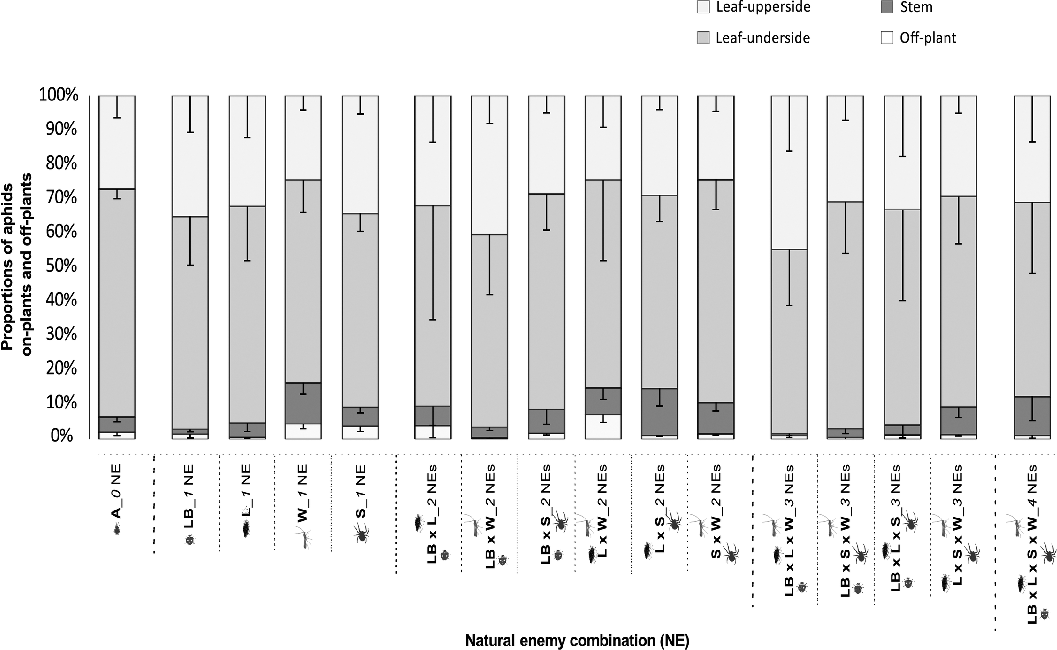
Within-enclosure green peach aphid spatial distribution (described above), elucidating green peach aphid behaviour, was analysed using conditional likelihood multinomial models, “nnet” R package (Venables and Ripley Reference Venables and Ripley2002) and “car” R package (Fox and Weisberg Reference Fox and Weisberg2011).
Model 1: treatment effect (i.e., the effect of the natural enemy combinations): the explanatory variable was the natural enemy combination denoting the 16-level treatments that comprised factoriality (Table 1, Fig. 1).
Model 2: natural enemy pressure: the explanatory variable was the continuous factorial number of identities of the enemies of green peach aphids present (from zero (green peach aphid alone) to four (natural enemy species all together)).
The data are available via Figshare repository: https://figshare.com/s/30fa6572c142bf22775c.
Results
Green peach aphid abundance
Natural enemy combination effect
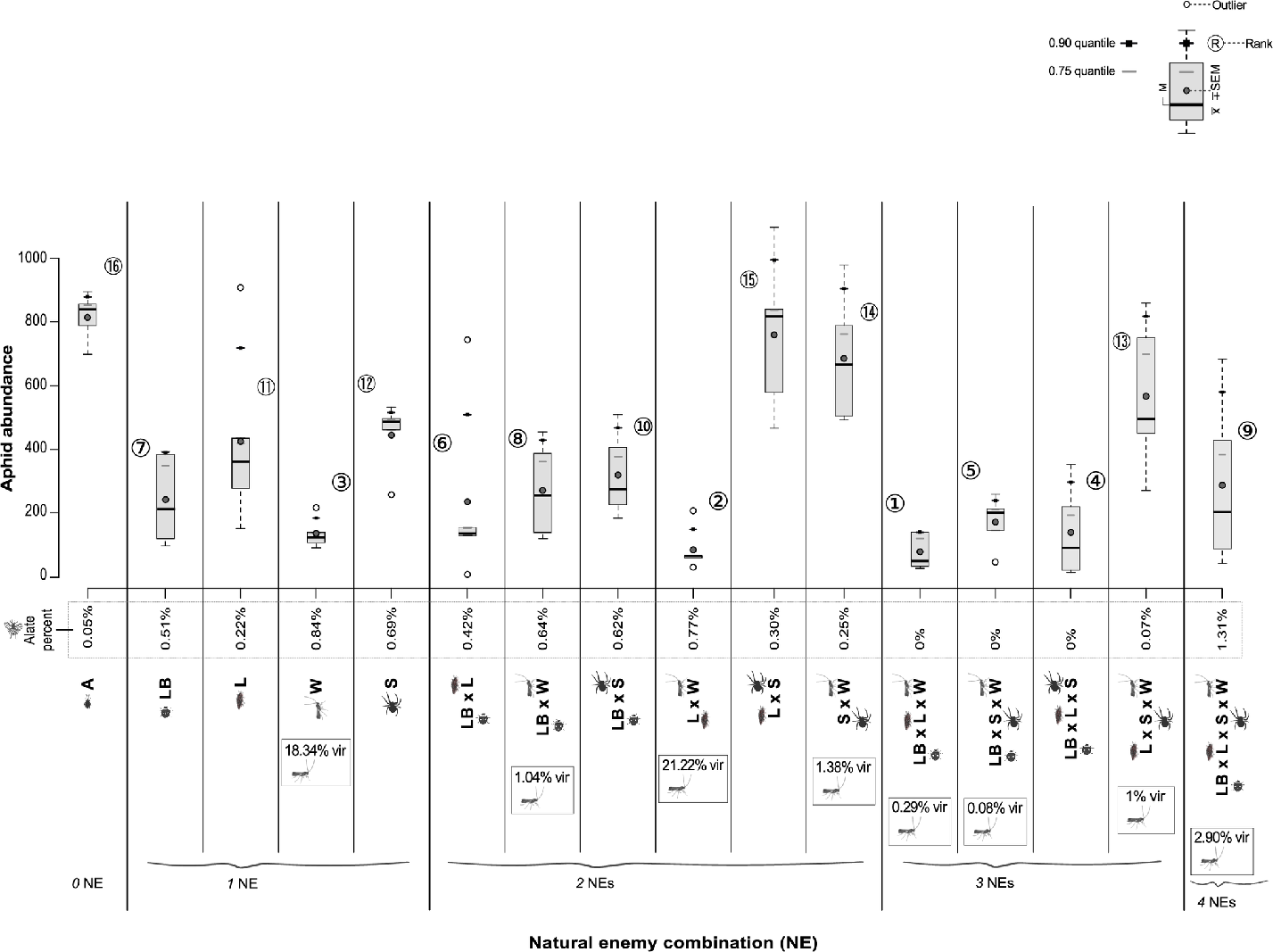
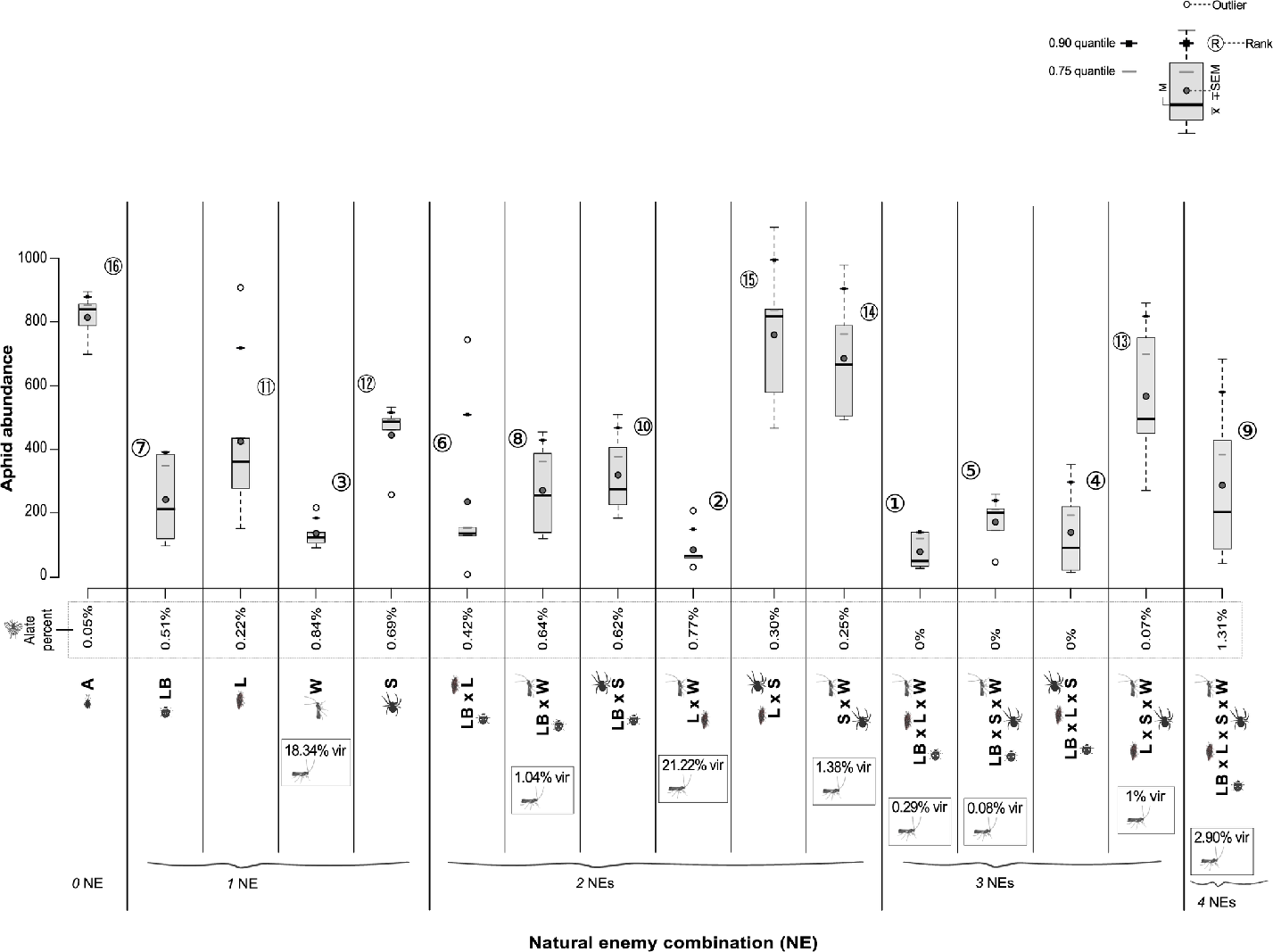
Green peach aphid abundance was strongly and negatively influenced by the natural enemy combination (F (15,64) = 7.92, P < 0.0001); see (Fig. 2) for a display of the differential effect, Supplementary Fig. S1 for enriched version with more annotated statistical details, Supplementary Table S1 for detailed model results, Supplementary Table S2 for post hoc Tukey’s honestly significant difference test elucidating multiple pairwise comparisons, and Supplementary Table S3 for further data exploration.
Green peach aphid abundance measured, as average total raw numbers, is presented as box plots. The illustration is supported with circled numbers, indicating ranks®, which comparatively show the differential suppressive magnitude of the effect of the natural enemy combinations. The percentages in the rectangle below the x-axis refer to the respective proportions of winged morphs (alates). A = Green peach aphid alone, L = Chrysoperla carnea, LB = Adalia bipunctata, W = Aphidius colemani, S = Parasteatoda tepidariorum.
Natural enemy numbers (pressure effect)
The number of natural enemies of the green peach aphid also had a significant as well as a negative influence on green peach aphid abundance (F (4,75) = 4.14, P = 0.004), but this effect differed by natural enemy combination, (Fig. 2) displays of the differential effect; see also Supplementary Table S1 for detailed model results and Supplementary Table S3 for a proportionate display of green peach aphid abundance under the different levels of the natural enemy combination and natural enemy pressure.
Natural enemy presence and interaction
The presence of the enemies of the green peach aphid had a strong negative influence on green peach aphid abundance (F (1,78) = 17.10, P < 0.0001). With and without natural enemy interaction: Aphidius colemani negatively affected green peach aphid abundance and the effect was significant (F (2,76) = 3.28, P = 0.043), so did the P. tepidariorum (F (2,74) = 7.60, P = 0.001) and A. bipunctata (F (2,70) = 11.30, P < 0.0001). However, the effect of C. carnea, performing alone or in interaction with other enemies of the green peach aphid, was only marginally significant (F (2,72) = 2.87, P = 0.063); see Supplementary Table S1 for detailed model results.
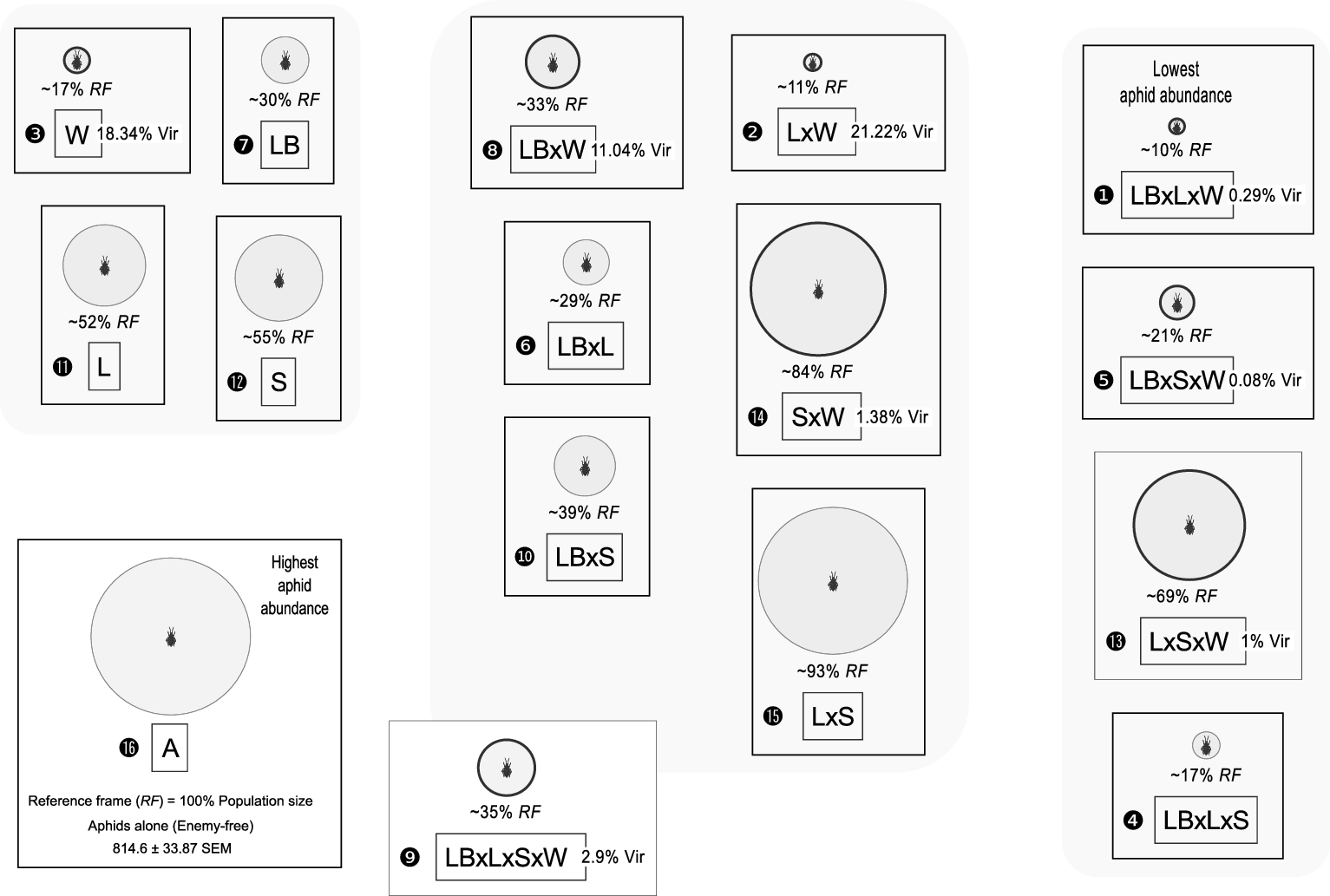
The most suppressive combination was (A. bipunctata x C. carnea x A. colemani); whereas the combination (P. tepidariorum x C. carnea) was the least suppressive of green peach aphid population. Compared to green peach aphid alone (enemy-free) treatment, all combinations of enemies of green peach aphid, with and without interaction, varyingly inflicted suppressive effects on green peach aphid numbers (Figs. 2–3) for a proportionate illustration of green peach aphid abundance under the different natural enemy combinations (−/+ A. colemani).
Proportionate green peach aphid abundance under different natural enemy combinations and differential Aphidius colemani virulence. The abundance of green peach aphid alone under the enemy-free conditions was used a reference frame (RF = 100% green peach aphid abundance); all the other values of green peach aphid abundance are shown as comparative proportions of the reference frame. The 16 green peach aphid abundances were also ordered and annotated as negative circled numbers, with number  assigned to the highest green peach aphid abundance and
 assigned to the lowest abundance under the collective suppressive action of the ternary natural enemy combination (Adalia bipunctata x Chrysoperla carnea x Aphidius colemani)). Under parasitoid presence, green peach aphid population circles are shown with a thickened border and accompanied by the virulence of Aphidius colemani (parasitoidisation rate) as a percentage (% Vir). A = green peach aphid alone, L = Chrysoperla carnea, LB = Adalia bipunctata, W = Aphidius colemani, S = Parasteatoda tepidariorum. SEM, standard error of the mean.

In the absence of interaction with other natural enemies, C. carnea and P. tepidariorum were less effective in controlling green peach aphid numbers than A. bipunctata. In general, natural enemy combinations with more than one enemy more negatively affected green peach aphid population than the unary enemy treatments with few exceptions: in three out of seven cases, A. bipunctata was more effective than when it was in combination with other enemies, and more effective in six out of 11 cases versus any natural enemy combination with two or more enemies; in two out of seven cases, C. carnea was more effective than when it was in combination with other enemies, and more effective in three out of 11 cases versus any natural enemy combination with two or more enemies; in three out of seven cases, P. tepidariorum was more effective than when it was in combination with other enemies and more effective in three out of 11 cases versus any natural enemy combination with two or more enemies. Note that the combinations (C. carnea x A. colemani) and (A. bipunctata x C. carnea x A. colemani) were the only treatments to be more effective than A. colemani acting alone. Further, notably the combinations (P. tepidariorum x C. carnea x A. bipunctata) and A. colemani alone had an equal magnitude in suppressing green peach aphid population (Figs. 2–3). See also Supplementary Table S3 for further assimilation of the possible conflicts and synergies underlying respective green peach aphid responses and the differential effect of which on green peach aphid population sizes.
Adalia bipunctata, after A. colemani, was the most effective species in suppressing green peach aphid numbers under unary natural enemy combinations. But, the pairing up of those two enemies distinctly resulted in slightly more green peach aphid numbers than the case where A. colemani or A. bipunctata were present alone. However, the combination (A. bipunctata x C. carnea) led to similar outcome to the scenario where A. bipunctata performed alone (Fig. 2). It is striking nevertheless that Aphidius colemani virulence rose dramatically from as little as 1.04% (A. colemani paired up with A. bipunctata) to 21.22% (A. colemani paired up with C. carnea) (Fig. 3).
Adalia bipunctata was more effective alone than when paired up with P. tepidariorum. This pattern changed considerably in the assembly (P. tepidariorum x A. bipunctata x A. colemani) with remarkable decline in parasitoid virulence (0.08%), indicating an overall stronger suppression of the green peach aphid population than the effect of the A. bipunctata or P. tepidariorum (but not A. colemani when acting alone). By comparison, the combination (P. tepidariorum x C. carnea x A. colemani), with parasitoid virulence (1%), was less effective than each of the single enemies when they were alone (Figs. 2–3). However, A. colemani had its second best virulence reading of 2.90% associated with the combination (P. tepidariorum x A. bipunctata x C. carnea x A. colemani), which led to pronounced reduction in green peach aphid numbers, close in magnitude to the effect of A. bipunctata performing alone (Figs. 2–3). Nevertheless, green peach aphid abundance varied remarkably, dependent on the natural enemies with which C. carnea was paired/grouped up. Green peach aphid abundance peaked in response to the natural enemy combinations (P. tepidariorum x C. carnea) and (P. tepidariorum x C. carnea x A. colemani). On the other end of the spectrum, green peach aphid numbers hit the bottom of the chart under the combination (C. carnea x A. bipunctata x A. colemani) (Figs. 2–3, Supplementary Table S3).
Parasteatoda tepidariorum alone, of the category of one enemy only, resulted in the best green peach aphid performance. Moreover, apart from the scenario (P. tepidariorum x A. bipunctata), combining the P. tepidariorum with other natural enemies imparted boost to green peach aphid numbers. For example, green peach aphid population thrived under the dual influence of P. tepidariorum and A. colemani (1.38% mummies). Furthermore, grouping C. carnea, A. colemani, and P. tepidariorum (top predator in this scenario) impeded green peach aphid population, but considerably was weaker in effect compared to the case where A. bipunctata was used in lieu of C. carnea (A. bipunctata x A. colemani x P. tepidariorum); note that in this scenario parasitoid virulence was null (Fig. 3, Supplementary Table S3).
Interestingly, for a couple of replicates, we observed a P. tepidariorum attack on A. bipunctata that was followed by paralysis of A. bipunctata and wrap in silk procedure. Moreover, upon data collection, two C. carnea individuals were consumed by P. tepidariorum. Here, the green peach aphid abundance pattern changed distinctly when A. bipunctata accompanied C. carnea in the presence of P. tepidariorum. For those natural enemy combinations, where P. tepidariorum functioned as a top predator; with ability to trap A. colemani and A. bipunctata (and/or C. carnea), and consuming healthy and parasitised aphids, the ups and downs in green peach aphid numbers were clearly observed across the corresponding treatments (Fig. 2). It is pertinent to point out, however, that A. bipunctata and C. carnea did not prey upon each other during the experiment.
Green peach aphid polyphenism
Production of alates was significantly affected by natural enemy combinations (F (15,64) = 2.59, P = 0.004) and natural enemy numbers (pressure) (F (4,75) = 6.67, P = 0.0001); see Supplementary Table S4 for further model details. The production of alates was exceedingly low and it varied greatly, spanning 0% in smaller green peach aphid populations under the combination (A. bipunctata x C. carnea x A. colemani), very small proportions relevant to larger populations, for example, 0.05% alates under green peach aphid alone, and larger proportions of smaller populations, for example, 0.84% alates under A. colemani and 0.77% alates under (C. carnea x A. colemani). The highest percentage of alates (1.31%) was recorded where the four natural enemies were all grouped together resulting in a modest green peach aphid population size but relatively heightened alata production (Fig. 2).
Green peach aphid behaviour
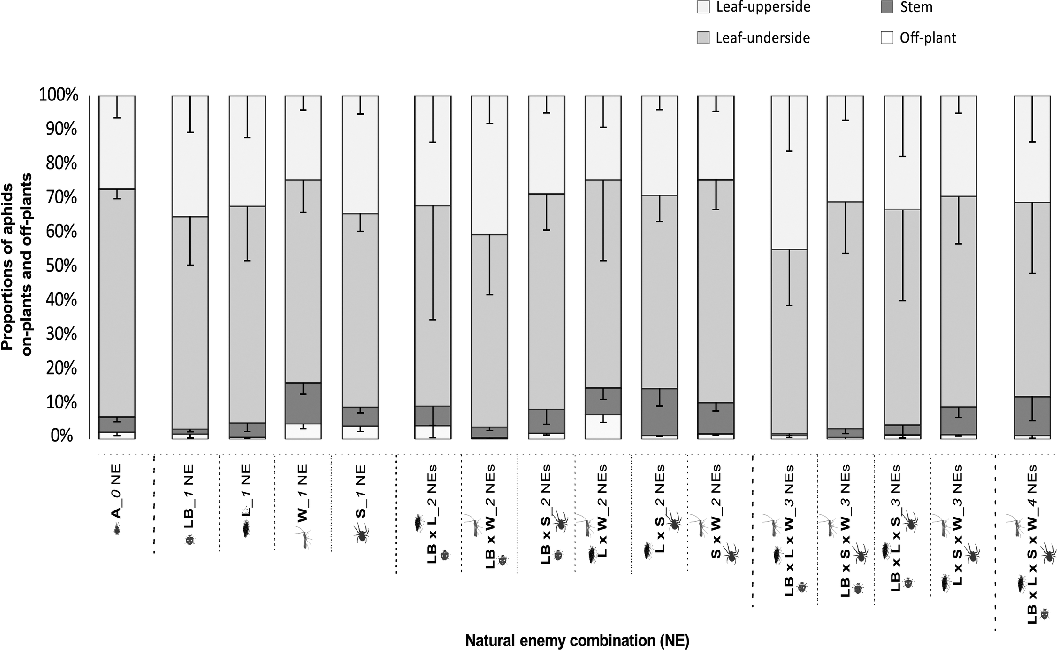
Green peach aphid within-enclosure distribution (denoting green peach aphid behaviour) varied considerably across the different combinations of natural enemies (LRχ2 = 984.02, df = 45, P < 0.0001) and natural enemy numbers (pressure) (LRχ2 = 78.809, df = 3, P < 0.0001). The majority of the aphids resided on plant (mainly below leaves) (Fig. 4). However, green peach aphid proportions above leaves notably rose under the influence of the combinations (A. bipunctata x C. carnea x A. colemani) and (A. bipunctata x A. colemani) (Fig. 4). The highest per cent of green peach aphids on stems was found where P. tepidariorum and C. carnea were present together, which was a combination resulting in relatively large green peach aphid numbers (Fig. 4). By contrast, the smallest on-stem proportion was under the influence of the combination (A. bipunctata x C. carnea x A. colemani). Moreover, when C. carnea and A. colemani were present together, the highest per cent of green peach aphids off-plant was recorded (Fig. 4). Note that this was observed in one of the most suppressed populations of green peach aphid with a relatively sizeable proportion of alates (0.77%) and the highest recorded proportion of mummies (21.22%) (Fig. 3). Noticeable numbers of green peach aphids were found off-plants under the influence of the combinations: (A. colemani, A. bipunctata x C. carnea), and P. tepidariorum, respectively. By contrast, the vast majority of green peach aphids aggregated on plant under the influence of other natural enemy combinations, for example, (P. tepidariorum x A. colemani x A. bipunctata) (Fig. 4).
Green peach aphid fine-scale distribution. Green peach aphid preference of aggregation (± standard error of the mean) on plants and off plants, as a proxy for behaviour, is proportionally displayed in grades of grey. A = green peach aphid alone, L = Chrysoperla carnea, LB = Adalia bipunctata, W = Aphidius colemani, S = Parasteatoda tepidariorum.
Discussion
In this work, we demonstrated prey performance to differ contingent upon the numbers of natural enemies along with natural enemy combinations and interactions that encompassed parasitoidism, predation, intraguild predation, and super-predation. The different competitive scenarios of interactions within the natural enemy assemblage shaped the abundance and influenced the phenotypic plasticity and the behaviour of the focal genotype of the shared green peach aphid prey. Moreover, green peach aphid dynamics and the outcome of natural enemy interactions remarkably differed when P. tepidariorum, as a top predator, was present.
The role of Parasteatoda tepidariorum is dynamically transformative
Parasteatoda tepidariorum employed in our study usually sits and awaits the prey at bay; a hallmark of its ambush technique. However, noticeably P. tepidariorum would show mobility in the culture and the experiment of the present work by relocating its irregular tangle cobwebs to shady areas below plant leaves to increase chances of prey capture by its distinct sticky snares (Benjamin and Zschokke Reference Benjamin and Zschokke2003). This plasticity in behaviour helped P. tepidariorum capture green peach aphids (fairly sedentary prey) where they usually hide and aggregate (personal observation). This idiosyncrasy is one of the characteristics that distinguish P. tepidariorum from other web spiders (Fiedler Reference Fiedler2000). Further, after several months of upbringing on mixed aphid-Dipteran diet, P. tepidariorum became more habituated to target more sedentary prey such as green peach aphids, perhaps through learning (Hénaut et al. Reference Hénaut, Machkour-M’rabet and Lachaud2013). The webs of P. tepidariorum differed in size and complexity and often were reduced (personal observation in the present work); a plastic trait shown by P. tepidariorum in response to environmental stimulation (Benjamin and Zschokke Reference Benjamin and Zschokke2003; Zevenbergen et al. Reference Zevenbergen, Schneider and Blackledge2008). This species is usually sensitive to the slightest vibrational cues in its cobwebs that trigger P. tepidariorum to confront trespassers by wrap attack, using the gum-footed sticky web lines (Uetz et al. Reference Uetz, Boyle, Hieber and Wilcox2002; Benjamin and Zschokke Reference Benjamin and Zschokke2003; Hajer and Hrubá Reference Hajer and Hrubá2006). It is notable that not only did P. tepidariorum trap green peach aphid alates but in our work was also observed to have cocooned apterous green peach aphids that got trapped (especially gravid females) for consumption afterwards.
Parasteatoda tepidariorum made an agile and superior member of the aphidophagous guild in our work and varied its hunting tactics between lying in wait and a degree of within-enclosure forage (Hajer and Hrubá Reference Hajer and Hrubá2006; Uma and Weiss Reference Uma and Weiss2012). Moreover, in the dearth of studies on palatability preference by this polyphagous spider, we can only infer from the empirical data that A. colemani, given its fragile wings and small body size, might have been an easier catch for the traps of P. tepidariorum, hence the considerable increase in green peach aphid numbers under the combination (P. tepidariorum x A. colemani); a similar outcome could be also seen for the C. carnea larva (agile but weaker competitor) versus P. tepidariorum, contrary to A. bipunctata adults that were both agile and a bigger adversary of P. tepidariorum. Again, P. tepidariorum did not always kill A. bipunctata or C. carnea because there were plenty of green peach aphids in the proximity of its traps on leaf downsides. However, when P. tepidariorum eliminated the competitors, the antagonistic reaction could have been mainly defensive as being driven by tactile stimulation of its web when the predatory competitors attempted to “steal” (Nyffeler and Benz Reference Nyffeler and Benz1982) an easy catch (the aphid shared prey adhering to the web (Breene et al. Reference Breene, Dean, Nyffeler and Edwards1993) or cocooned).
Our findings support the assessment of non-linearity of intraguild interactions (Ferguson and Stiling Reference Ferguson and Stiling1996; Crumrine and Crowley Reference Crumrine and Crowley2003; Griffen and Byers Reference Griffen and Byers2006). Suppression of the green peach aphid population in the current work varied distinctly depending on the presence of enemies and their combinations with and without interaction with the top predator. This contributes credence to the notion that the exclusion of other inter-players by the top predator would lead to variable selective pressures on the pest, which in turn may result in relative decrease or increase in prey population size. This is expected to be dependent on the combination of species of the aphidophagous guild and the functionality of their combinations (Polis et al. Reference Polis, Myers and Holt1989; Losey and Denno Reference Losey and Denno1998; Lucas et al. Reference Lucas, Coderre and Brodeur1998; Brahma et al. Reference Brahma, Sharma, Kundu, Saha, Saha and Aditya2015). It is worthy to note, however, that the negative impact of P. tepidariorum on the green peach aphid population in our study can also be partly attributed to what is referred to as incidental mortality (Breene et al. Reference Breene, Dean, Nyffeler and Edwards1993) where aphids accidentally remain stuck to the web whilst they move on their host plants where P. tepidariorum retreats, as well. More importantly, P. tepidariorum suppressive effect might have also stemmed from a fear of predation by green peach aphids (Hlivko and Rypstra Reference Hlivko and Rypstra2003; Nyffeler and Birkhofer Reference Nyffeler and Birkhofer2017).
Green peach aphid decision-making dilemma
In the face of maximising consumption risk, the production of alates was evidently contextual and considerably low in general; this varied across the natural enemy combinations. The highest percentage of winged morphs (of the low-density population) under the combined influence of all the natural enemies can be attributed to green peach aphid sensitivity to the sharp drop in local abundance. In other words, green peach aphid mothers of the all-female parthenogenetic population would invest more in the production of the dispersive daughters as a phenotypic plastic survival strategy against escalated predation risk due to the joint consumption by the natural enemies (Müller et al. Reference Müller, Williams and Hardie2001; Purandare et al. Reference Purandare, Tenhumberg and Brisson2014). Nevertheless, we do not rule out a regulatory indirect influence of an associated non-consumptive predation risk on green peach aphid performance associated with the presence of the enemies of green peach aphids (Lima Reference Lima1998; Davenport and Chalcraft Reference Davenport and Chalcraft2013). The patterns of population suppression in our work are greatly of consumptive nature, but also arguably can be partly non-consumptive. This is attributable to elevated stress by the enemies foraging the enclosure as they simultaneously spread their cues in the proximity of green peach aphid aggregates. Non-consumptive effects in insect systems have been shown to have far-reaching effects on both insects (Buchanan et al. Reference Buchanan, Hermann, Lund and Szendrei2017) and the ecosystem embedding the insects and their enemies (Buchanan et al. Reference Buchanan, Hermann, Lund and Szendrei2017; Hermann and Landis Reference Hermann and Landis2017; Khudr et al. Reference Khudr, Buzhdygan, Petermann and Wurst2017).
Here, the perception of imminent danger would induce green peach aphid morph production in order to flee the risk-laden venues (Irwin et al. Reference Irwin, Kampmeier, Weisser, van Emden and Harrington2007). Conversely, high proportions of alates did not always coincide with strong predation pressure and/or risk (e.g., under the three-enemy combination (A. bipunctata x P. tepidariorum x A. colemani)). This can be attributed to green peach aphid perception of environmental risk cues relative to the synergy of the impact of the natural enemies, consequent complex maternal decision-making, and preconditioning of neonates to abandon their host plants (McAllister et al. Reference McAllister, Roitberg and Weldon1990). In the above-mentioned three-enemy treatment, markedly fewer green peach aphids were found off-plants and no alates were produced, indicating a green peach aphid on-plant aggregation and an on-plant concealment strategy instead of dropping off or flying away.
Integrated pest management by both conventional and novel means has been gaining momentum (Greer Reference Greer2000; Young Reference Young2017). For instance, the findings on treatment of aphid environment with predator-associated cues (Khudr et al. Reference Khudr, Buzhdygan, Petermann and Wurst2017) and inclusion of P. tepidariorum in aphid control (Nyffeler Reference Nyffeler1982; Sunderland et al. Reference Sunderland, Fraser and Dixon1986, Reference Sunderland, Crook, Stacey and Fuller1987; Nyffeler and Birkhofer Reference Nyffeler and Birkhofer2017) seem to bear particular promise as novel ways of aphid management. Moreover, alteration or disruption of the feeding behaviour of phloem-feeding insects, as elicited by the presence of their natural enemies and enemy-associated non-consumptive effects, maybe utilisable in limiting the spread of plant disease (Tholt et al. Reference Tholt, Kis, Medzihradszky, Szita, Tóth, Havelda and Samu2018). At any rate, our understanding of non-consumptive effects in arthropod systems is still developing (Buchanan et al. Reference Buchanan, Hermann, Lund and Szendrei2017). Moreover, the knowledge on non-lethal effects, associated with polyphagous predators, such as spiders, on agro-ecosystems of aphid predator plant systems is still rudimentary (Nyffeler and Birkhofer Reference Nyffeler and Birkhofer2017).
The aggregation on plant and the escape decision
Under differential enemy pressures, higher proportions of the green peach aphid aggregated on specific parts of the plant subject; this can be explained by aphid propensity to draw together relatively more as a defensive strategy against escalated fear of predation (Turchin and Kareiva Reference Turchin and Kareiva1989; Vulinec Reference Vulinec, Evans and Schmidt1990). Aggregating more together on a limited space enhances social aphid–aphid communication, which in turn could trigger plastic-defensive behaviours faster in parthenogenetic sap-feeding insects (Villagra et al. Reference Villagra, Ramírez and Niemeyer2002; Muratori et al. Reference Muratori, Rouyar and Hance2014). This, to a degree, might provide the shared prey with more security against attacks carried out by multiple enemies in certain contexts (Turchin and Kareiva Reference Turchin and Kareiva1989; Vulinec Reference Vulinec, Evans and Schmidt1990; Villagra et al. Reference Villagra, Ramírez and Niemeyer2002).
The observed patterns of spatial distribution within the enclosure support the conditional notion of cost-sensitive decision-making in aphids; verifying the dropping-off plant as altruistic adaptive defence manifested by parasitised aphids (McAllister and Roitberg Reference McAllister and Roitberg1987; McAllister et al. Reference McAllister, Roitberg and Weldon1990; Muratori et al. Reference Muratori, Rouyar and Hance2014). Our findings demonstrate that the congeners of the green peach aphid appeared to be more risk-taking by walking off-plant (a proxy for escape behaviour) under two respective unary cases: P. tepidariorum and A. colemani. In the former, P. tepidariorum is not as active and agile as C. carnea and A. bipunctata on the soil surface, and thus dropping off plants was relatively less risky for the aphids versus P. tepidariorum. Whereas, in the latter, an increased parasitoid virulence played an important role in the induction of altruism and escape propensities in green peach aphid as shown in the findings documented in this work.
Concomitantly, the alteration of green peach aphid distribution as a property of antipredator behaviour, however, can be a double-edged strategy at the expense of aphids. Here, we emphasise that we observed a dwindling population under the combination (C. carnea x A. colemani), with heightened parasitoid virulence (21.22%). Whereas, for the benefit of the green peach aphid, numbers dramatically increased under the combination (P. tepidariorum x A. colemani x C. carnea) with 1% parasitoid virulence. Arguably, given that A. colemani is a “solitary” koinobiont parasitoid in need of a continuous supply of healthy aphids for oviposition, the interaction of the parasitoid with the predators may have followed a gradient between exploitative and interferential competition (Jervis et al. Reference Jervis, Copland, Harvey and Jervis2005; Le Bourlot et al. Reference Le Bourlot, Tully and Claessen2014).
Parasitoid puparia behind the scenes
We can deduce that one important driving factor to underlie the varied outcomes of the natural enemy combinations, in this study, was the presence of parasitised green peach aphids on the course of mummification. Subject to the collective influence of parasitoids and other present natural enemies, aphids under active parasitoid attack may show altruism by exposing themselves once parasitised as a “free provision” for other predators, (McAllister and Roitberg Reference McAllister and Roitberg1987; McAllister et al. Reference McAllister, Roitberg and Weldon1990). This, when it occurred, would make those compromised aphids easier prey to capture – leading to possible varying impacts of natural enemies, which may have resulted in additive or disruptive aphid regulation accordingly (Nilsson et al. Reference Nilsson, Hertonsson, Stenberg, Bodersen, Olsson and Stenroth2006; Fodrie et al. Reference Fodrie, Kenworthy and Powers2008; Snyder and Ives Reference Snyder, Ives, Wajnberg, Bernstein and Van Alphen2008).
At any rate, the parasitoid will strive to manipulate aphid adaptive altruism (McAllister and Roitberg Reference McAllister and Roitberg1987; McAllister et al. Reference McAllister, Roitberg and Weldon1990) through changing the frequency of A. colemani virulence (in terms of parasitoidisation rate) such that aphids expose themselves less to predators due to less parasitoid virulence (Brodeur and Rosenheim Reference Brodeur and Rosenheim2000). Nevertheless, the “free provision” concept of altruism as a plastic inducible defence (Harvell Reference Harvell1990; Villagra et al. Reference Villagra, Ramírez and Niemeyer2002; Nelson and Rosenheim Reference Nelson and Rosenheim2006) might not always be universally useful, since certain aphid predators, such as coccinellids, may discern between parasitised and healthy aphid individuals (Omkar 2016), but they usually have no preference for healthy over parasitised prey type (Bilu and Coll Reference Bilu and Coll2009). However, consuming more parasitised aphids can negatively influence the performance of the coccinellids and hence this could lead to less aphid suppression (Bilu and Coll Reference Bilu and Coll2009), as seen in our work for the natural enemy combinations (A. bipunctata) versus (A. bipunctata x A. colemani).
Competitive advantage in the light of dominance and enemy identity
Despite being unlike in size, chrysopids and coccinellids can negatively influence or kill each other (Şengonca and Frings Reference Şengonca and Frings1985; Szentkirályi Reference Szentkirályi, McEwen, New and Whittington2001; Nedvěd et al. Reference Nedvěd, Fois, Ungerová and Kalushkov2013). Predator size/aggressiveness differences would not be necessarily detrimental for spiders because their venom gives it the edge over larger and/or agile antagonists (Uma and Weiss Reference Uma and Weiss2012; Pennisi Reference Pennisi2017), which in turn gives this species dominance in the aphid predatory guild. Thus, the asymmetrical interactions within the natural enemy combination may foster unequal competitive advantages amongst its members sharing aphid as prey (Rosenheim and Wilhoit Reference Rosenheim and Wilhoit1993; Brodeur and Rosenheim Reference Brodeur and Rosenheim2000; Lapchin and Guillemaud Reference Lapchin and Guillemaud2005). In this regard, for example, Rosenheim et al. (Reference Rosenheim, Wilhoit and Armer1993) came to the conclusion that a chrysopid might become, under certain circumstances, an intraguild prey itself that may result in an increase in aphid abundance due to competitive exclusion (see also Dinter Reference Dinter2002).
Intraguild interactions are complexity-prone
Firstly, different modes of search and hunt for prey and the intensity of the associated negative or positive competitive interactions amongst the enemies of prey are thought to be influenced by the interacting identities of species and time of their interaction (Nilsson et al. Reference Nilsson, Hertonsson, Stenberg, Bodersen, Olsson and Stenroth2006). Here, it is advocated that generalised plastic anti-predator-defensive measures are more likely to occur on the side of the prey (Urban Reference Urban2008). The predator hunting mode may affect the phenotypic plasticity of prey, as a response to a fear of predation, and prey survival (Irwin et al. Reference Irwin, Kampmeier, Weisser, van Emden and Harrington2007; Miller et al. Reference Miller, Ament and Schmitz2013). By contrast, in the presence of dominant predators, it is argued that a fixed plastic response to predatory guild members may be, however, avertible (Hieber et al. Reference Hieber, Wilcox, Boyle and Uetz2002).
Secondly, stress-triggered aphid responses such as changes in reproductive success, distribution, and phenotypic plasticity can affect the regulatory efficiency of natural enemies and hence prey fitness (Miller et al. Reference Miller, Ament and Schmitz2013; Omkar 2016); this is proposed to vary by context (Villagra et al. Reference Villagra, Ramírez and Niemeyer2002; Brahma et al. Reference Brahma, Sharma, Kundu, Saha, Saha and Aditya2015). As such, aphid congeners themselves might not always be the most disadvantaged party in the game of aphidophagy as the interactions amongst guild members are prone to abatement (Hieber et al. Reference Hieber, Wilcox, Boyle and Uetz2002) as part of a diffuse co-evolutionary arms race where each inter-player strains to cap the adversary (Dawkins and Krebs Reference Dawkins and Krebs1979; Hieber et al. Reference Hieber, Wilcox, Boyle and Uetz2002; Lapchin and Guillemaud Reference Lapchin and Guillemaud2005).
Thirdly, Belgrad and Griffen (Reference Belgrad and Griffen2016) emphasised that the interplay between varied contextual prey behaviour and hunting mode of predators might have extended effects on ecosystem functioning through modulating predator–prey dynamics. Given the spatiotemporal complexity of intraguild interactions in agroecosystems (Szentkirályi Reference Szentkirályi, McEwen, New and Whittington2001; Kowles Reference Kowles2015), a compromised efficiency of a fundamental natural enemy of a pest (prey), having exponential population growth rates (as for aphids), by other intraguild enemies can lead to infestation outbreaks. This can have negative impacts on ecosystem diversity and ecosystem supporting functions (e.g., Snyder and Wise Reference Snyder and Wise2001; Cardinale et al. Reference Cardinale, Harvey, Gross and Ives2003). As such, guarded functional grouping of natural enemies can provide sustainable and environmentally friendly pest regulation solutions, an approach that has been attracting growing attention (Dent Reference Dent2000; see also Maloney et al. Reference Maloney, Drummond and Alford2003).
From a perspective of prey: risk enhancement or risk reduction
Notwithstanding the evidence that predators might discriminate against the poor quality hosts (Omkar 2016), whether it is competition (Janssen et al. Reference Janssen, Pallini, Venzon and Sabelis1998; Sih et al. Reference Sih, Englund and Wooster1998; Le Bourlot, et al. Reference Le Bourlot, Tully and Claessen2014), or, more intensively, intraguild predation (Rosenheim and Wilhoit Reference Rosenheim and Wilhoit1993; Szentkirályi Reference Szentkirályi, McEwen, New and Whittington2001; Traugott et al. Reference Traugott, Bell, Raso, Sint and Symondson2011), the outcome of intraguild interactions from the perspective of the shared prey can be as follows:
I) Risk reduction: The risk for the shared prey getting consumed decreases due to less than additive effects or conflict amongst the enemies of prey (Ferguson and Stiling Reference Ferguson and Stiling1996; Vance-Chalcraft and Soluk Reference Vance-Chalcraft and Soluk2005; Griffen and Byers Reference Griffen and Byers2006). In our case, it appears that P. tepidariorum distinctively, directly or indirectly, disrupted the respective impact of A. colemani and C. carnea on the green peach aphid population (less than it did with A. bipunctata). Or II) Risk enhancement: The risk for the shared prey getting preyed upon increases in the presence of an assemblage of its natural enemies, with plausibly fewer antagonistic interactions, or a degree of conflict avoidance (see Bell et al. Reference Bell, Rader, Peck and Sih2009), leading to heightened collective aphidophagy (Losey and Denno Reference Losey and Denno1998; Sih et al. Reference Sih, Englund and Wooster1998; Sokol-Hessner and Schmitz Reference Sokol-Hessner and Schmitz2002; Cardinale et al. Reference Cardinale, Harvey, Gross and Ives2003). Notable examples are the ternary natural enemy combinations of this work.
Conclusions
In this work, we highlight the effects of assembling two common green peach aphid predators, a parasitoid, and a novel top entomophagous predator in shaping the fitness and behaviour of their shared prey in question. The shared prey (green peach aphid as a phloem-feeding pest) developed distinct responses to encounters with different combinations of its enemies. The risk of being consumed was comparatively reduced or enhanced contingent upon the outcome of the varied level of aphidophagy encompassing collective additive and non-additive intraguild interactions. Our results also imply that the decisions made by green peach aphids to spread through space in search for on-plant micro-feeding sites would be sensitive to the contexts where green peach aphids reside. Green peach aphid decision-making would also depend on the cost borne for making choices of aggregation under atypical ecological challenge, specially through the inclusion of a novel top predator.
Our findings bear implications through the integration of different natural enemies of the green peach aphid with an unconventional predator (P. tepidariorum) to control crop pests in above-ground multi-trophic systems. We recommend a careful use of novel top predators, such as synanthropic spiders, due to their contextual synergistic or disruptive intraguild nature/functionality. It appears P. tepidariorum can very well disrupt potent parasitoids by entrapment and thus their binary combinations seemed to be inefficient in suppressing green peach aphid numbers, but this should be examined further in larger common garden experiments. We advocate harnessing the use of ternary and quaternary species assemblages in future studies to examine prey performance subject to the interplay amongst predation, parasitoidism, and super-predation in the field.
Acknowledgements
We sincerely thank Dr. Inga Mewis (Julius Kühn-Institut, Berlin, Germany) for supplying us with an initial sample of the M. persicae clone used in the study, and Dr. Sascha Eilmus (Bayer CropScience AG, Monheim, Germany) for providing the sample genotype that was used to feed P. tepidariorum stock culture. We would like to express our gratitude to Dr. Theo Blick for his expert help concerning the identification of P. tepidariorum. We are also thankful to Mr. Sven Kleier for his help in the identification of the ornamental fishtail palm. Our thanks also go to Mr. Harry Potter, Ms. Hayley Craig, and anonymous reviewers for their remarks on the article readability. M.S.K. is grateful to Dr. Reinmar Hager for his kind support. This work was funded by the Freie Universität Berlin in support of M.S.K. O.Y.B. received funding from the DRS Point Fellowship, Freie Universität, Berlin.
Supplementary material
To view supplementary material for this article, please visit https://doi.org/10.4039/tce.2020.7.