Introduction
Host choice has a definitive impact on the reproductive success of insect parasitoids because immatures are usually unable to shift to other individual host and are thus forced to develop in discrete units selected by their mother. Solitary parasitoids are defined as species in which only one individual per host can complete the development regardless (up to a certain limit) the number of eggs deposited by the same or another female. In these species, the parasitized status of the host is expected to have an impact on the development (Bai and Mackauer, Reference Bai and Mackauer1992; Harvey et al., Reference Harvey, Harvey and Thompson1993; Tunca and Kilinçer, Reference Tunca and Kilinçer2009; Devescovi et al., Reference Devescovi, Bachmann, Nussenbaum, Viscarret, Cladera and Segura2017). Consequently, the ability to discriminate between parasitized and non-parasitized hosts should be highly favoured by natural selection in order to avoid superparasitism, i.e., the occurrence of more than one oviposition in the same host (Salt, Reference Salt and Salt1961). At least, approximately 200 hymenopteran species can discriminate against parasitized hosts (van Lenteren, Reference van Lenteren and van Lenteren1981; Mackauer, Reference Mackauer, Mackauer, Ehler and Roland1990; van Alphen and Visser, Reference van Alphen and Visser1990; Brodeur and Boivin, Reference Brodeur and Boivin2004). It has also been shown that females of some species are able to discriminate between self- and con-specific superparasitism (van Dijken et al., Reference van Dijken, van Stratum and van Alphen1992; Visser, Reference Visser1993) and even assess the number of eggs already present in a host (Bakker et al., Reference Bakker, Peulet and Visser1990).
Superparasitism can be considered disadvantageous because females would invest time and eggs in low quality hosts. However, this behaviour could be adaptive in ecological scenarios in which the probability of success is higher than zero, such as under the uncertainty of finding non-parasitized hosts or any host at all (Bakker et al., Reference Bakker, van Alphen, van Batenburg, van der Hoeven, Nell, van Strien-van Liempt and Turlings1985; Hubbard et al., Reference Hubbard, Marris, Reynolds and Rowe1987; Roitberg et al., Reference Roitberg, Sircom, Roitberg, van Alphen and Mangel1993; Weisser and Houston, Reference Weisser and Houston1993), or if the supernumerary egg has any chance of defeating older competitors (van Dijken and Waage, Reference van Dijken and Waage1987; Bai and Mackauer, Reference Bai and Mackauer1990; van Alphen and Visser, Reference van Alphen and Visser1990; Chau and Maeto, Reference Chau and Maeto2008). Nevertheless, it is more likely to complete development in non-parasitized hosts, thus a preference for this type of host should be expected (van Alphen and Visser, Reference van Alphen and Visser1990). Depending on the species and provided that the female is able to discriminate, it has been shown that the decision to parasitize is modulated by external factors, such as the presence of conspecifics, and internal factors, such as prior experience or egg load (Weisser and Houston, Reference Weisser and Houston1993; Ardeh et al., Reference Ardeh, de Jong and van Lenteren2005; Bernstein and Jervis, Reference Bernstein, Jervis, Wajnberg, Bernstein and van Alphen2008; Hoffmeister and Wajnberg, Reference Hoffmeister, Wajnberg, Wajnberg, Bernstein and van Alphen2008).
Host discrimination has been traditionally addressed through direct and indirect methods (Fellowes et al., Reference Fellowes, van Alphen, Jervis and Jervis2005). The direct method usually constitutes the best experimental approach in order to determine this ability (van Lenteren, Reference van Lenteren and van Lenteren1981). These studies use behavioural evidence such as the ratio between the rejection rate of parasitized and non-parasitized hosts, the time spent in patches with either type of host, the size of the egg clutch, and sex allocation (van Alphen et al., Reference van Alphen, van Dijken and Waage1987; Fellowes et al., Reference Fellowes, van Alphen, Jervis and Jervis2005). In the indirect method (Salt, Reference Salt and Salt1961), female parasitoids are provided with a group of hosts on which they can freely forage for a fixed amount of time after which the distribution of the number of eggs laid per host is compared with an expected, theoretical distribution (usually the Poisson distribution) (Rogers, Reference Rogers1975; Meelis, Reference Meelis1982; Hemerik et al., Reference Hemerik, van der Hoeven and van Alphen2002). A significant deviation of the null model indicates a non-random egg distribution, with two possible patterns: uniform or aggregated (Yamada and Ikawa, Reference Yamada and Ikawa2005; Rusina, Reference Rusina2011). The former suggests that females avoid superparasitism (although some larvae can be superparasitized), whereas the latter indicates that superparasitism is preferred. Both cases suggest that superparasitism must be recognized by the foraging female.
The endoparasitoid Diachasmimorpha longicaudata (Ashmead) (Hymenoptera: Braconidae) is a solitary, koinobiont species, native to Southeast Asia (Wharton and Gilstrap, Reference Wharton and Gilstrap1983). This generalist parasitoid is widely used as a biological control agent against Tephritidae fruit fly pests and is usually reared on different host species (Ovruski et al., Reference Ovruski, Colin, Soria, Oroño and Schliserman2003). Females attack late second to third instar larvae (L3) of species from several genera (Wharton and Gilstrap, Reference Wharton and Gilstrap1983; Wharton, Reference Wharton, Robinson and Hooper1989). D. longicaudata has been successfully applied as a control agent of Ceratitis capitata (Wiedemann) (Diptera: Tephritidae) and several species of the genus Anastrepha (Schiner) (Diptera: Tephritidae) in many regions of the American continent (Cancino et al., Reference Cancino, Villalobos, De La Torre, Leppla, Bloem and Luck2002; Jordão-Paranhos et al., Reference Jordão-Paranhos, Walder and Papadopoulos2003; Ovruski et al., Reference Ovruski, Colin, Soria, Oroño and Schliserman2003; Montoya and Cancino, Reference Montoya and Cancino2004; Viscarret et al., Reference Viscarret, La Rossa, Segura, Ovruski and Cladera2006). In previous studies, we did not find negative effects in D. longicaudata adults emerging from C. capitata hosts at intermediate levels of superparasitism (up to five eggs per host) (Devescovi et al., Reference Devescovi, Bachmann, Nussenbaum, Viscarret, Cladera and Segura2017). However, higher superparasitism levels lead to the death of all individuals, including the host larva (Devescovi et al., Reference Devescovi, Bachmann, Nussenbaum, Viscarret, Cladera and Segura2017). Considering the high fecundity of this sinovigenic parasitoid (Viscarret et al., Reference Viscarret, La Rossa, Segura, Ovruski and Cladera2006; González et al., Reference González, Montoya, Perez-Lachaud, Cancino and Liedo2007; Meirelles et al., Reference Meirelles, Redaelli and Ourique2013; Segura et al., Reference Segura, Nussenbaum, Viscarret, Devescovi, Bachmann, Corley, Ovruski and Cladera2016), these results allow questioning the advantages of host discrimination under laboratory conditions.
Superparasitism and host discrimination have been studied in D. longicaudata, first through indirect methods using Anastrepha suspensa (Loew) (Diptera: Tephritidae) as host (Lawrence et al., Reference Lawrence, Greany, Nation and Baranowski1978), and later through direct methods using Anastrepha ludens (Loew) (Montoya et al., Reference Montoya, Benrey, Barrera, Zenil, Ruiz and Liedo2003; González et al., Reference González, Montoya, Pérez-Lachaud, Cancino and Liedo2010). Although these studies contributed to the understanding of host discrimination in D. longicaudata, the fact that different host species were used and different methods were carried out, clear-cut conclusions are difficult to draw. In the current study, we evaluated host discrimination ability in virgin females of D. longicaudata through both direct and indirect methods in order to allow a more comprehensive interpretation of this topic. By using colonies of the parasitoid reared on C. capitata and Anastrepha fraterculus (Wiedemann) (Diptera: Tephritidae) we also investigated the differences that could arise in this behaviour depending on the host species.
Materials and methods
Insects
C. capitata, A. fraterculus and D. longicaudata were obtained from the experimental rearing kept at the IGEAF (INTA, Buenos Aires, Argentina). Rearing of insects followed standard protocols (Ovruski et al., Reference Ovruski, Colin, Soria, Oroño and Schliserman2003; Viscarret et al., Reference Viscarret, La Rossa, Segura, Ovruski and Cladera2006; Vera et al., Reference Vera, Abraham, Oviedo and Willink2007). C. capitata derived from a colony originally established in 1994 in Mendoza province with wild pupae from infested peaches. Larvae were reared using an artificial diet based on boiled carrot, cornmeal, sugar, yeast, and preservatives (Terán, Reference Terán1977), whereas adult flies were provided with water and a mixture of sugar and brewer's yeast. A. fraterculus rearing was originally established at the Estación Experimental Agroindustrial Obispo Colombres (Tucumán, Argentina). This colony was initiated in 1997 with pupae from infested guavas collected in Tafí Viejo (Tucumán) (Jaldo et al., Reference Jaldo, Gramajo and Willink2001). Rearing followed standard procedures using an artificial diet based on yeast, wheat germ, sugar, agar, and preservatives for larvae (Salles, Reference Salles1995), and a mixture of sugar, hydrolysed corn, and hydrolysed yeast for adults (Jaldo et al., Reference Jaldo, Willink and Liedo2007). The colony of D. longicaudata was initiated with individuals from Planta Piloto de Procesos Industriales Microbiológicos (PROIMI, Tucumán, Argentina) in 2001 (Ovruski et al., Reference Ovruski, Colin, Soria, Oroño and Schliserman2003), and reared first on C. capitata larvae (for nearly 150 generations) and later also on A. fraterculus (for nearly 30 generations) at IGEAF. Adult parasitoids were kept in cages (40 × 40 × 40 cm3) and provided with water and honey. Rearing conditions were 25 ± 1°C, 60 ± 10% RH, and a 14:10 (light:dark) photoperiod.
We used 5–10 days-old (days post emergence) virgin females in all the experiments. Virgin females were used in order to avoid introducing a confounding factor (i.e., insemination status) by evaluating a possible mixture of successfully and unsuccessfully inseminated females, which might behave differentially in terms of host discrimination if male and female eggs have a different value for the female. This decision was made as we were unable to ascertain the insemination status of the tested females even if copulation was observed.
Because inexperienced females that have not accessed hosts might have high egg loads and a low discrimination rate (van Alphen and Visser, Reference van Alphen and Visser1990; Rosenheim and Rosen, Reference Rosenheim and Rosen1991; Minkenberg et al., Reference Minkenberg, Tatar and Rosenheim1992; Carbone and Rivera, Reference Carbone and Rivera2003), we offered them host larvae 24 h before the experiment to allow oviposition and stimulate the foraging behaviour.
Host discrimination by direct methods
Discrimination ability was assessed on single females by means of direct observation of their behaviour within an experimental arena in which 24-h parasitized and non-parasitized L3 larvae of the same batch (PL24 and NL, respectively) were simultaneously offered. This arena consisted of a plate for cell culture (13 cm × 9 cm) with 24 wells (1 cm in diameter, 0.5 cm deep) (Corning, NY, USA). Each of the 24 wells were filled with semi-solid, cold agar (1 g/100 ml water) in order to provide a humid substrate to the larvae during the observations. Parasitized larvae were obtained 24 h before the observations following Devescovi et al. (Reference Devescovi, Bachmann, Nussenbaum, Viscarret, Cladera and Segura2017). To this end, L3 larvae were taken with soft tweezers and placed on the lid (voile mesh) of a flask containing five female parasitoids until one of them pierced one larva with the ovipositor. The larva was first paralysed and considered to be parasitized if the process until ovipositor extraction lasted at least 30 s. PL24 carried only one parasitoid egg and were kept in larval diet until the test. On the following day, four PL24 and four NL were carefully transferred to the peripheral wells (already filled with agar) using entomological forceps, leaving one empty well in between. Then, the plate was covered with voile mesh to conceal the larvae. An acrylic cage with two small holes for ventilation was placed on top of the plate in order to avoid the parasitoid from escaping. This design was adapted from van Alphen and Jervis (Reference van Alphen, Jervis, Jervis and Kidd1996), which was also used by Montoya et al. (Reference Montoya, Benrey, Barrera, Zenil, Ruiz and Liedo2003) to test D. longicaudata on A. ludens. This was performed for both colonies of D. longicaudata, using the respective host species (C. capitata or A. fraterculus).
During the test, one female was gently released in the centre of the arena. The observation period started when the female showed typical foraging behaviours (folding of the wings over the thorax, tapping on the substrate with the antennae during short and paused walks). The observation period lasted for 30 min or until the parasitoid left the arena. The following variables were recorded: (1) latency to the first oviposition (i.e., time since foraging behaviour onset until first oviposition); (2) first oviposition choice (PL24 or NL); (3) duration of the first oviposition; (4) total number of ovipositions in each type of larva (confirmed by dissections after the observation period); (5) number and type of larvae that were visited for the first time and were rejected for oviposition (brief oviposition insertions); and (6) time spent foraging over each well.
As the results using C. capitata did not support host discrimination in a first instance (see ‘Results’ section) and based on other host–parasitoid systems (Mackauer, Reference Mackauer, Mackauer, Ehler and Roland1990; Danyk and Mackauer, Reference Danyk and Mackauer1993), a second set of individuals were tested using 48 h-parasitized larvae (PL48), only for C. capitata.
A total of 49 and 33 females reared on C. capitata were tested using larvae parasitized 24 h (PL24) and 48 h (PL48) before the experiments, respectively. Thirty-six parasitoids reared on A. fraterculus were tested using PL24. Behavioural tests were carried out in a room with 600 lux and 25°C.
Statistical analyses
The latency to the first oviposition was compared among parasitized larvae (PL) and NL by means of a Student's t test. In the cases in which PL48 (C. capitata) and PL24 (A. fraterculus) were offered, data were transformed to the logarithm and square root, respectively, in order to meet statistical assumptions. The frequency of first ovipositions in one or the other larval type was assessed by means of a G-test of goodness of fit. First oviposition duration was compared between PL and NL in each experiment by means of Student's t tests, applying the logarithm and square root in the cases of PL24 (C. capitata) and PL24 (A. fraterculus), respectively. In the case of the experiment PL48 (C. capitata) and as no adequate transformation could be applied, this variable was analysed by means of an unequal variances t-test (Welch's t-test) (McDonald, Reference McDonald and McDonald2014). The total number of ovipositions per female in each type of host was analysed by paired t-tests in each experiment. The number of rejected larvae was compared between PL and NL by means of using a chi-squared test of homogeneity or with Fisher's exact test, depending on the number of the expected frequencies. Assumptions and fulfilments of these tests were checked. Finally, the rejection frequencies were compared by pairs between the different experiments (C. capitata-24 h vs. C. capitata-48 h, A. fraterculus-24 h vs. C. capitata-24 h, and A. fraterculus-24 h vs. C. capitata-48 h) by means of chi-squared tests of homogeneity. Statistical analyses were performed with Statistica 10 (StatSoft, Inc., 1984–2011).
We also used the superparasitism index (Sirot et al., Reference Sirot, Ploye and Bernstein1997) [SPI = (number of ovipositions in PL/time spent in PL wells)/(number of ovipositions in NL/time spent in NL wells)] to quantify host discrimination. SPI = 1 indicates random oviposition, SPI < 1 indicates rejection of PL, and SPI > 1 indicates preference for PL. This index reflects the acceptance or rejection of PL and NL and considers that an effective oviposition depends on both the ability of the larva to escape and the ability of the parasitoid to find it and its motivation to accept it (Sirot et al., Reference Sirot, Ploye and Bernstein1997). As its mathematical construction requires that the female had visited and deposited at least one egg in both larval types, 15 females for the experiment C. capitata-24 h, 16 for the experiment C. capitata-48 h, and 16 for the experiment A. fraterculus-24 h were respectively included in the analysis of this index.
Host discrimination by indirect methods
An indirect method for assessing discrimination ability was used to compare and complement the results from the previous methodology. In order to study the egg distributions, a group of non-parasitized L3 larvae was offered to a single parasitoid in a Plexiglas cage (65 × 16 × 16 cm3) that contained a central compartment (15 × 15 × 15 cm3) with a focal oviposition unit. These units consisted of a Petri dish (10 cm in diameter, 1 cm in height) with 20–30 L3 larvae in agar (1 g/100 ml water) tightly wrapped in a voile mesh. The central compartment had one hole on each lateral side leading to smaller oviposition unit with five non-parasitized larvae. The lateral units gave female the possibility to leave the focal patch, so she was not forced to incur in superparasitism as the patch was getting depleted of non-parasitized larvae (van Lenteren et al., Reference van Lenteren, Bakker and van Alphen1978). A single female was placed in the centre of the focal oviposition unit and left to forage freely. These experiments were performed under 600 lux and 25°C (same conditions as those used for the direct method). After 4 h, the larvae were removed and conditioned with vermiculite until pupation. Forty-eight hours later, pupae were dissected under stereomicroscope (60×) (Olympus, Japan). The number of parasitoid larvae per host was recorded for each exposed fruit fly larvae (i.e., determination of the level of superparasitism, LSP). This was performed with 50 females reared on C. capitata and with 43 females reared on A. fraterculus using their respective host species.
Statistical analyses
Data obtained from the different colonies (D. longicaudata reared and tested on C. capitata and A. fraterculus) were analysed separately. A descriptive analysis was performed showing the minimum and maximum number of eggs laid among all replicates, the mean total number of deposited eggs and the mean LSP (total number of deposited eggs/number of larvae). Also, for each tested female a frequency distribution of the number of hosts with different LSPs was obtained and the observed distributions were compared with a Poisson (random) distribution by means of chi-squared test using the module ‘Distribution fitting’ of software Statistica 10. Three outcomes are possible: superparasitism with random distribution, superparasitism with non-random distribution (either uniform or aggregated), and a distribution of eggs incurring in no superparasitism. A non-random, uniform pattern is defined after significant differences between expected and observed distributions are found and when a higher number of host larvae with LSP 1 and a lower number of larvae with LSP 0 and LSP > 1 is observed. Similarly, a non-random, aggregated pattern is defined after significant differences between expected and observed distributions are detected and when a higher number of host larvae with LSP 0 and LSP > 1 and a lower number of larvae with LSP 1 is observed. After analyses, each female was assigned to one of these categories.
To estimate the foraging strategy of a female as the patch was being depleted (van Alphen and Nell, Reference van Alphen and Nell1982) and to seek for a state-dependent association, the total number of eggs laid by each female was compared among the three categories (uniform, random and no-superparasitism distributions, see ‘Results’ section) by means of a one-way analysis of variance, followed by a Tukey test. This analysis was performed for each colony of D. longicaudata. Assumptions of the statistical analyses were tested and met.
Results
Host discrimination by direct methods
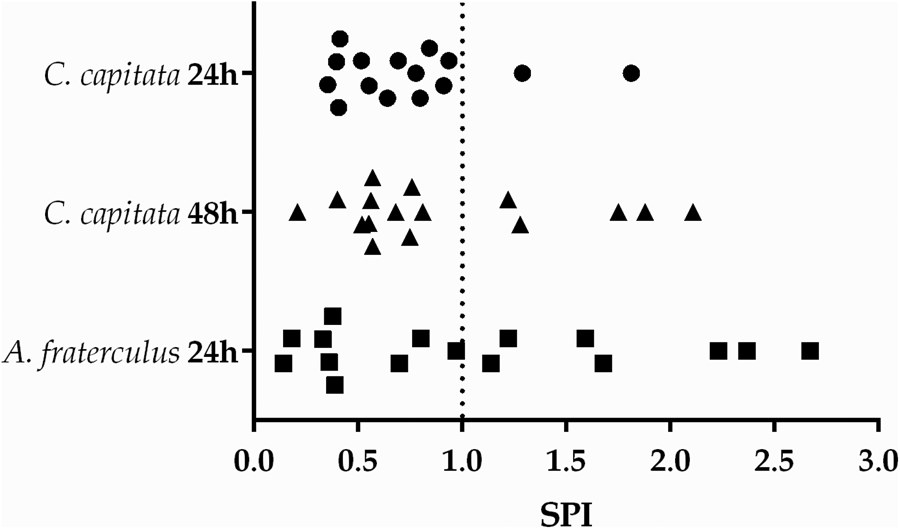
In the experiment offering C. capitata PL24 and NL, females laid 1.84 ± 0.14 eggs (mean ± SE, n = 49) during 30 min of observation. The latency to the first oviposition, the oviposition duration, the mean number of ovipositions, the frequency of the first oviposition choice, and the percentage of rejection were not significantly different between PL24 and NL (table 1). The SPI calculated for 15 females ranged from 0.35 to 1.81, with SPI < 1 in 86.66% of the females (fig. 1). Twenty-two females laid eggs only in LP24 and 12 only in NL, so it was not possible to calculate the index in these cases.
Range of SPI values calculated for individual females of D. longicaudata reared on C. capitata or A. fraterculus using host larvae parasitized 24 or 48 h before the test, offered together with non-parasitized hosts. The dotted line marks SPI = 1, which represents a random oviposition.

Assessment of host discrimination by means of direct methods using larvae of C. capitata

This table shows the statistical results for the different analysed variables for the experiment using 24-h parasitized larvae (PL24) and non-parasitized larvae (NL). Mean ± SE and the number of replicates (n) are shown.
In the experiment offering C. capitata PL48 and NL females deposited 2.09 ± 0.21 eggs (mean ± SE, n = 33) in 30 min. There were no significant differences in the latency to the first oviposition, the mean number of ovipositions, and in the frequency of the first oviposition choice between LP48 and NL (table 2). The oviposition duration was longer and the percentage of rejection was higher for PL48 than for NL (table 2). The SPI calculated for 16 females ranged from 0.21 to 2.11, with SPI < 1 in 68.75% of the females (fig. 1). Eight females laid eggs only in PL48 and nine only in NL, and thus it was not possible to calculate the index in these cases.
Assessment of host discrimination by means of direct methods using larvae of C. capitata

This table shows the statistical results for the different analysed variables for the experiment using 48-h parasitized larvae (PL48) and non-parasitized larvae (NL). Mean ± SE and the number of replicates (n) are shown.
*Denotes significant differences (α = 0.05).
In the experiment offering A. fraterculus PL24 and NL, females deposited 2.25 ± 0.20 eggs (mean ± SE, n = 34) in 30 min. The latency to the first oviposition, oviposition duration, the mean number of ovipositions, and the frequency of the first oviposition choice were not statistically different among the larval types (table 3). A higher rejection rate was observed for PL24 over NL (table 3). The SPI calculated for 16 females ranged from 0.14 to 2.67, with SPI < 1 in 60% of the females (fig. 1). Nine females laid eggs only in PL24 and 11 only in NL, so they were not used to estimate the index.
Assessment of host discrimination by means of direct methods using larvae of A. fraterculus

This table shows the statistical results for the different analysed variables for the experiment using 24-h parasitized larvae (PL24) and non-parasitized larvae (NL). Mean ± SE and the number of replicates (n) are shown.
*Denotes significant differences (α = 0.05).
Finally, the rejection of parasitized larvae was compared among tests using parasitoids reared on C. capitata and A. fraterculus. The comparison between experiments using C. capitata PL24 and PL48 showed a similar rejection over parasitized larvae (χ2 = 2.10, d.f. = 1, n = 88, P = 0.148). Conversely, A. fraterculus PL24 were more frequently rejected than C. capitata PL24 (χ2 = 4.29, d.f. = 1, n = 96, P = 0.038) but equally to C. capitata PL48 (χ2 = 0.26, d.f. = 1, n = 78, P = 0.611).
Host discrimination by indirect methods
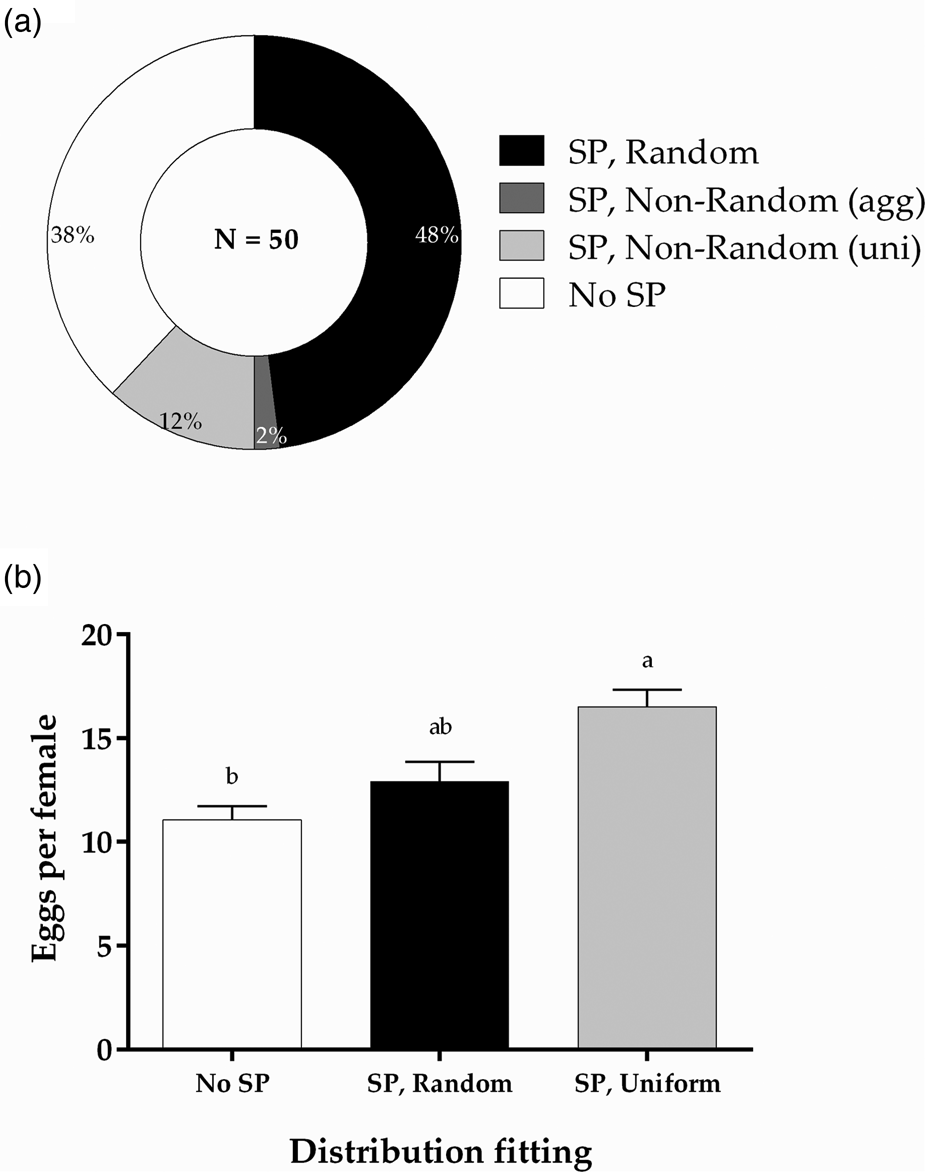
In the 4-h trials, the females reared and tested on C. capitata deposited a minimum of 5 and a maximum of 24 eggs, a mean (±SE) of 12.76 ± 0.59 eggs in 22.4 ± 0.56 larvae, with a mean (±SE) LSP of 0.58 ± 0.03 ranging from LSP 0 to LSP 3 except for one case with up to LSP 5. The analyses of individual egg distributions showed that 62% (31 females) incur in superparasitism, from which 77.4% (24 females) showed a random pattern and 22.6% (7 females) showed a non-random pattern (six females: uniform pattern; one female: aggregated pattern). The rest (38% = 19 females) did not incur in superparasitism (larvae with LSP 0 and 1), parasitizing approximately half of the offered larvae (fig. 2a). Females of the three groups (random, uniform, and no-superparasitism distributions) laid significantly different number of eggs [F (2, 46) = 4.82, P = 0.013, fig. 2b]. The females that did not superparasitize laid a significantly lower number of eggs compared to those with uniform egg distributions (P = 0.01). Females with random distributions laid an intermediate and non-significant number of eggs compared to the other groups (P > 0.05).
Results of indirect methods using females of D. longicaudata reared and tested on C. capitata. (a) Percentage of behavioural responses assigned according to the egg distribution analyses and (b) egg distribution types as a function of the mean number of deposited eggs. SP, Random: random egg distributions, with some superparasitized larvae; SP, Non-Random (agg): aggregated egg distributions, with some superparasitized larvae; SP, Non-Random (uni)/SP, Uniform: uniform egg distributions, with some superparasitized larvae; No SP: egg distributions with no superparasitism. Different letters above columns denote significant differences (α = 0.05). Error bars denote SE.

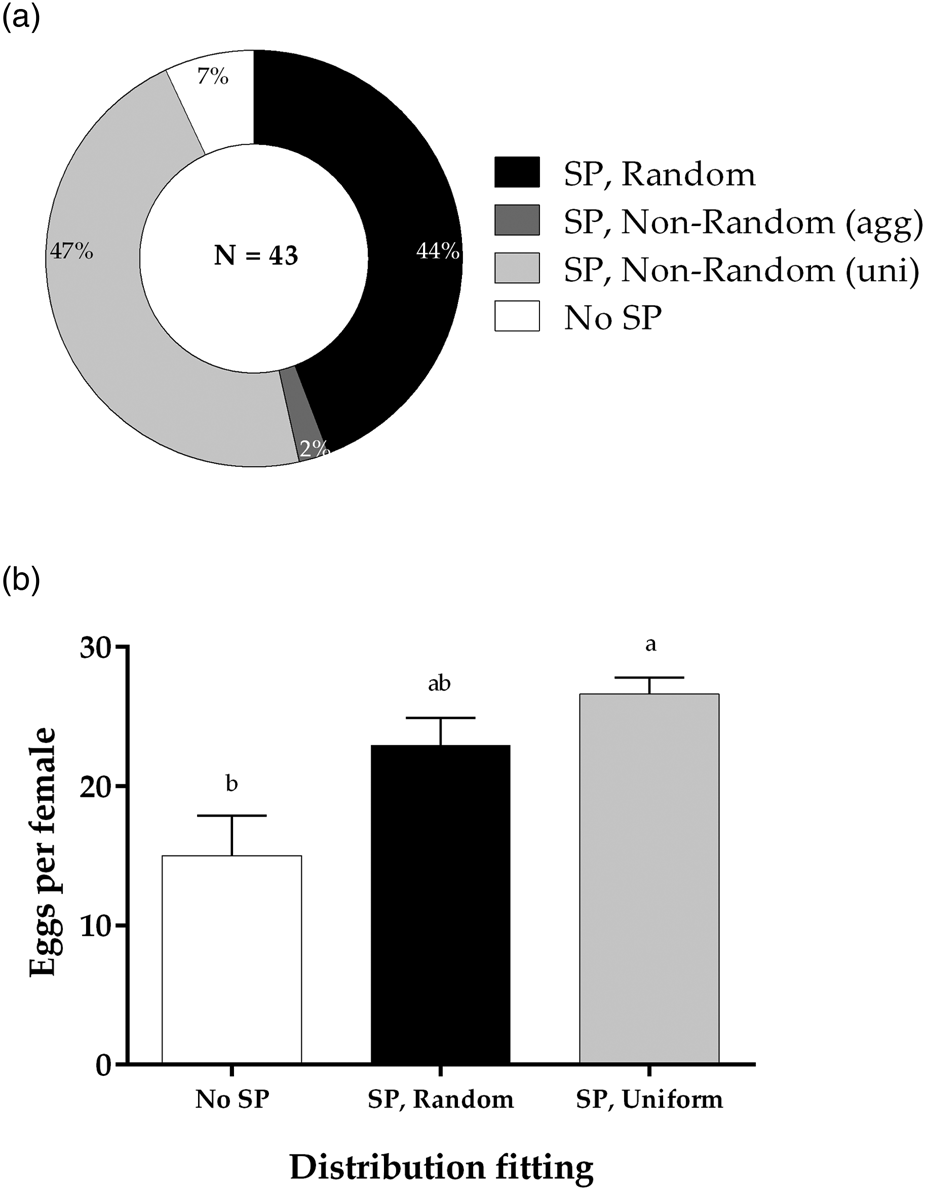
Females reared and tested on A. fraterculus deposited a minimum of 7 and a maximum of 37 eggs, a mean (±SE) of 24.16 ± 1.12 eggs in 28.95 ± 0.24 larvae, with a mean (±SE) LSP of 0.83 ± 0.04 ranging from LSP 0 to LSP 3, except for two cases with up to LSP 4. As for the colony reared on C. capitata, three different patterns of egg distributions were observed: 93% (40 females) incur in superparasitism, from which 47.5% (19 females) produced a random pattern and 52.5% (21 females) a non-random pattern (20 females: uniform pattern; 1 female: aggregated pattern). The remaining 7% (three females) did not incur in superparasitism (larvae with LSP 0 and 1) (fig. 3a). The number of eggs laid by the females of the different groups showed a similar trend as in the other colony [F (2, 39) = 4.14, P = 0.023, fig. 3b]: the females that did not superparasitize laid a similar number of eggs compared to those that laid their eggs randomly (P = 0.169), but fewer eggs than those with a uniform pattern (P = 0.027). Also, those females with uniform egg distributions laid a similar number of eggs than females with a random pattern (P = 0.239).
Results of indirect methods using females of D. longicaudata reared and tested on A. fraterculus. (a) Percentage of behavioural responses assigned according to the egg distribution analyses and (b) egg distribution types as a function of the mean number of deposited eggs. SP, Random: random egg distributions, with some superparasitized larvae; SP, Non-Random (agg): aggregated egg distributions, with some superparasitized larvae; SP, Non-Random (uni)/SP, Uniform: uniform egg distributions, with some superparasitized larvae; No SP: egg distributions with no superparasitism. Different letters above columns denote significant differences (α = 0.05). Error bars denote SE.

Discussion
Host discrimination was assessed for D. longicaudata through two independent methods and for two colonies reared on different species. Direct observations of female behaviour towards C. capitata larvae suggested that, in spite of having recorded a similar number of ovipositions in parasitized and non-parasitized hosts, the effective rejection needed 48 h after a previous parasitization by a conspecific. A higher oviposition duration for the parasitized larvae was also addressed in this case, which suggests an assessment of the larval quality by the female. Conversely, parasitoids reared on A. fraterculus were able to reject parasitized larvae sooner, showing also a similar number of ovipositions between host types. All other tested parameters, regardless of the colony and time after parasitization, gave no evidence about discrimination ability. These results are slightly different from those of Montoya et al. (Reference Montoya, Benrey, Barrera, Zenil, Ruiz and Liedo2003) who found a lower number of ovipositions in parasitized larvae when offered simultaneously with non-parasitized larvae, although the use of A. ludens larvae as hosts and mated female parasitoids might account for such differences. The general occurrence of superparasitism matched with previous studies (Altafini et al., Reference Altafini, Redaelli and Jahnke2013; Meirelles et al., Reference Meirelles, Redaelli and Ourique2013), showing no evidences of perfect discrimination, even under diverse experimental conditions.
It is proposed that the discrimination ability of a female should increase over time if the mechanism for recognition is mediated through the detection of physiological changes that may need some time to spread through the host larvae (van Alphen and Nell, Reference van Alphen and Nell1982; Mackauer, Reference Mackauer, Mackauer, Ehler and Roland1990; Danyk and Mackauer, Reference Danyk and Mackauer1993). Given the variability these insects surely face in a natural habitat, it may be possible that host discrimination is enhanced if the first parasitoid instar has already hatched; as described for the parasitoid Ephedrus californicus (Baker) (Hymenoptera: Aphidiidae) (Chow and Mackauer, Reference Chow and Mackauer1986). This mechanism may explain our results on the test using 48-h parasitized C. capitata larvae. In this experiment, the significant rejection of superparasitism found when using 24-h parasitized A. fraterculus larvae may be explained if there were intrinsic differences in the host species, such as different immunological or defensive responses, that will allow the parasitoid to recognize the parasitization status earlier that in C. capitata. For instance, there are evidences of egg encapsulation in A. fraterculus (Conte and Lanzavecchia, pers. comm.) but in the case of C. capitata this seems very infrequent, though encapsulation do occur but at a later stage (L1) (Suárez et al., Reference Suárez, Buonocore Biancheri, Sánchez, Cancino, Murúa, Bilbao, Molina, Laria and Ovruski2020).
Alternatively and according to what was reported for other species [e.g., Leptopilina heterotoma (Thomson) (Hymenoptera: Eucolidade) (Visser et al., Reference Visser, van Alphen and Nell1992)], Montoya et al. (Reference Montoya, Benrey, Barrera, Zenil, Ruiz and Liedo2003) proposed that females of D. longicaudata attacking A. ludens could mark the host with a chemical signal [an oviposition-deterrent pheromone, ODP (Anderson, Reference Anderson1988)] that would be readily detected by another female (or even herself). Visser et al. (Reference Visser, van Alphen and Nell1992) hypothesized that the mark laid by the first female should persist until no harm can be made to her egg by a second one. In solitary parasitoids, first instars possess strong mandibles which are presumably used against competitors and thus superparasitism should be especially avoided within this period. In D. longicaudata this period lasts ca. 48 h under laboratory conditions and first instars do eliminate competitors by combat (Devescovi et al., Reference Devescovi, Bachmann, Nussenbaum, Viscarret, Cladera and Segura2017). However, there are no evidences about the ability to determine such period by females nor about an ODP. Besides, if females were able to recognize such signal, they would have rejected parasitized larva of C. capitata right after they were first parasitized, so we should have detected rejection 24 h after the initial parasitization.
SPI (Sirot et al., Reference Sirot, Ploye and Bernstein1997) suggested different behavioural responses towards superparasitism: from complete avoidance to preference for parasitized larvae. Nevertheless, the index seems to exaggerate the discrimination ability compared to direct behavioural observations, given the large number of cases classified as superparasitism avoidance (SPI < 1) in each experiment (especially for C. capitata-24 h). The calculation of the index is based on the foraging time on the patch with a given type of larva and it may have occurred that some females were not necessarily assessing host quality. Oviposition insertion did not occur every time a female approached a larva. If parasitization status is mostly assessed during ovipositor insertion, as reported for L. heterotoma (Ruschioni et al., Reference Ruschioni, van Loon, Smid and van Lenteren2015), host discrimination ability evaluated through SPI would be overestimated. Yet, if we also consider the females that were not included for the calculation of SPI, this index now equals the results from direct observations. For instance, when using 24-h parasitized C. capitata larvae, only two cases were assigned as preference for superparasitism according to SPI, but also 22 females oviposited only in parasitized larvae. There were also 25 females that avoided superparasitism: 13 suggested by the SPI and 12 that only parasitized healthy larvae. Taking this together, almost no differences were observed in the number of females avoiding or preferring superparasitism. A similar situation occurred in the other experiments (C. capitata-48 h and A. fraterculus-24 h), in agreement with a significant rejection rate of parasitized larvae. The index has been previously and reliably utilized as dependent variable to test a state-dependent model that predicted the tendency to superparasitize of sexual and asexual Venturia canescens (Gravenhorst) (Hymenoptera: Ichneumonidae) females (Amat et al., Reference Amat, Desouhant and Bernstein2009) and under different time and egg-limited circumstances (Sirot et al., Reference Sirot, Ploye and Bernstein1997). Altogether and with some limitations, we still consider that this index provides an alternative estimation of the discrimination ability.
Egg distributions by single virgin females analysed by indirect methods also suggested a repertoire of different strategies. Both colonies showed an overall similar pattern with almost half of the females avoiding superparasitism and half with random ovipositions. The main difference was that, in the case of C. capitata, the majority of those females avoiding superparasitism avoided it completely. When A. fraterculus was used as host, most of the females of this group incur in superparasitism but with a uniform pattern. Within each colony, the females incurring in no superparasitism laid the lowest number of eggs, followed by those with random distributions and finally by females with uniform distributions. Overall, parasitoids emerging from A. fraterculus were more fecund than those emerging from C. capitata (Meirelles et al., Reference Meirelles, Redaelli and Ourique2013), and this may explain the shifting from distributions with no superparasitism to distributions with superparasitism with a uniform pattern. The females (one in each colony) showing an aggregated distribution laid an intermediate number of eggs. In a similar experiment, van Alphen and Nell (Reference van Alphen and Nell1982) observed some cases of random distributions of eggs in groups of females of the larval endoparasitoid Asobara tabida (Nees) (Hymenoptera: Braconidae), confined for 20 h in a patch with hosts. Because it was already known that this species was able to discriminate between host types, they concluded that the results were a combination of a first non-random distribution followed by several random distributions. Even considering the differences in the exposure times, our results do not comply with this interpretation because those females with the highest number of ovipositions should have shown a random distribution. Instead, we consider that host discrimination in D. longicaudata might be genetically variable among individuals as observed in other species for different behaviours (Wajnberg, Reference Wajnberg, Consoli, Parra and Zucchi2009), largely affected by different factors such as state dependence (Mangel, Reference Mangel1987; Sirot and Bernstein, Reference Sirot and Bernstein1996; Sirot et al., Reference Sirot, Ploye and Bernstein1997) or environmental changes (Visser, Reference Visser1993; Reference Visser1995).
The two methods used in this study showed evidence of host discrimination in D. longicaudata with a continuous degree of variability, suggesting that genetic factors might be important. It would be interesting to evaluate the genetic basis of superparasitism avoidance and determine if a process of directional selection could be implemented in order to improve the discrimination ability. It is important to notice that we used virgin females, which only produce male eggs for being an haplo-diplod organism. If the cost of producing a male egg is lower than that of producing a female egg, then virgin females could be less selective than mated ones. Under this scenario, our experimental design could have underestimated the discrimination ability of D. longicaudata. However, we did not find a clear relationship between mating status and discrimination ability in the literature. For instance, no effect of the mating status was found on the discrimination ability in Eupelmus vuilleti (Crawford) (Hymenoptera: Eupelmidae) (Darrouzet et al., Reference Darrouzet, Bignon and Chevrier2007) and on the superparasitism level in E. californicus (Baker) (Hymenoptera: Aphidiidae), Praon pequodorum (Viereck) (Hymenoptera: Aphidiidae), and Lysiphlebus testaceipes (Cresson) (Hymenoptera: Braconidae) (Michaud, Reference Michaud1994) and even higher levels of superparasitism were found in mated females (compared to virgin females) of Tiphodytes gerriphagus (Marchal) (Hymenoptera: Scelionidae) (Sousa and Spence, Reference Sousa and Spence2000), and of Aphidius smithi (Sharma & Subba Rao) (Hymenoptera: Braconidae) and Monoctonus paulensis (Ashmead) (Hymenoptera: Braconidae) (Michaud, Reference Michaud1994). Furthermore, Darrouzet et al. (Reference Darrouzet, Bignon and Chevrier2007) proposed that virgin females should be able to discriminate quite efficiently in order to avoid being eliminated, as in many solitary parasitoid species female larvae are better competitors than male larvae. These aspects might induce differences in the oviposition behaviour of mated and virgin females which could be addressed in future studies.
Interestingly, we found evidence of differences between colonies, suggesting that the host species could affect discrimination decisions, probably due to differences in fecundity and egg availability. Parasitoids produced with biological control purposes should be highly efficient in the search and discrimination of host quality, thus avoiding superparasitism and minimizing the time and energy associated with the searching behaviour (Mackauer, Reference Mackauer, Mackauer, Ehler and Roland1990; Godfray, Reference Godfray1994). Despite the mild impact of low levels of superparasitism on the quality of the natural enemies being produced (Devescovi et al., Reference Devescovi, Bachmann, Nussenbaum, Viscarret, Cladera and Segura2017), this phenomenon will always imply a loss of eggs that could potentially generate new individuals in non-parasitized hosts. Getting to know these behavioural aspects is of high relevance for the implementation of biological control of fruit flies, both for a higher efficiency in the mass rearing and for the parasitoid's performance under field conditions.
Acknowledgements
We thank Mr Fabián H. Milla and Mr Germán Crippa from IGEAF, INTA for their collaboration in the rearing of the insects.