Enzootic bovine leucosis is a contagious disease of cattle caused by the retrovirus, bovine leukaemia virus (BLV). Most infected cows do not display clinical signs of disease; approximately 30% of BLV carriers will eventually develop a persistent lymphocytosis while fewer than 5% eventually develop malignant lymphosarcoma (Schwartz & Levy, Reference Schwartz and Levy1994). Many European countries have eradicated BLV, while the prevalence among adult dairy cows in other locations range from 23 to 46% (Sargeant et al. Reference Sargeant, Kelton, Martin and Mann1997; Trono et al. Reference Trono, Perez-Filgueira, Duffy, Borca and Carrillo2001; Ott et al. Reference Ott, Johnson and Wells2003; VanLeeuwen et al. Reference VanLeeuwen, Forsythe, Tiwari and Chartier2005).
Control of BLV at the national level has involved programmes that emphasize various combinations of three approaches: management intervention with an on-going monitoring programme, test and segregate, and test and slaughter (Nuotio et al. Reference Nuotio, Rusanen, Sihvonen and Neuvonen2003; Rodríguez et al. Reference Rodríguez, Florins, Gillet, de Brogniez, Sánchez-Alcaraz, Boxus, Boulanger, Gutiérrez, Trono, Alvarez, Vagnoni and Willems2011). Management interventions can only be effective if the management determinants are well identified, are causal in nature, account for a sizable attributable risk, and if the necessary management interventions are both easy and inexpensive. Sprecher et al. (Reference Sprecher, Pelzer and Lessard1991) evaluated a programme of single-use needles and obstetrical sleeves, disinfection of tattoo equipment, electrical burn dehorning, and feeding of milk replacer and heat-treated colostrum. The prevalence of BLV-infected heifers in a dairy herd decreased from 44 to 17% in two years without culling or segregating of infected animals. However, this study design did not include non-intervention control herds or prioritize the management variables in terms of relative significance. Other studies have identified individual management practices that may be associated with increased risk of BLV transmission (Roberts et al. Reference Roberts, Lucas, Wibberley and Chasey1982; DiGiacomo et al. Reference DiGiacomo, Darlington and Evermann1985; Lassauzet et al. Reference Lassauzet, Thurmond, Johnson, Stevens and Picanso1990), but as with the aforementioned study (Sprecher et al. Reference Sprecher, Pelzer and Lessard1991), the relative impact of each of these management variables is unknown. Reports have also suggested that the importance of haematogenous transmission is variable and may depend on the frequency and nature of exposure, or prevalence of infection within the herd (Roberts et al. Reference Roberts, Lucas, Wibberley and Chasey1982; Thurmond et al. Reference Thurmond, Portier, Puhr and Burridge1983; Weber et al. Reference Weber, Meiske, Haggard, Sorensen, Domagala and Flaum1988; Hopkins et al. Reference Hopkins, DiGiacomo, Evermann, Christensen, Deitelhoff and Mickelsen1991; Gutiérrez et al. Reference Gutiérrez, Alvarez, Politzki, Lomónaco, Dus Santos, Rondelli, Fondevila and Trono2011).
The objective of this study was to determine and quantify the major management determinants of BLV prevalence in Michigan dairy cattle, and to discuss the extent to which they should be incorporated into herd management practices on dairy farms. The initial analysis measured the impact of each management variable as the sole predictor of herd BLV prevalence, including factors hypothesized to be causes of BLV and factors hypothesized to be effects of BLV. Our subsequent analysis was a step-down multivariable general linear model focused on hypothesized causes of intra-herd transmission.
Material and Methods
Selection of study herds and cows
Dairy herds in Michigan that routinely participated in Dairy Herd Improvement Association (DHIA) testing and averaged ⩾120 cows on test for the previous 12 months were stratified into equal-sized cohorts of 119 small-sized herds (120–174 cows), 119 medium-sized herds (175–295 cows) and 119 large herds (296–6738 cows). Within each of these strata, herds were assigned a random number which determined the order in which they were contacted and invited to participate in our study. We sought approximately 40 herds from each cohort, but exclusions because of the inability to schedule herd visits or lack of data within herd DHIA records resulted in a total of 113 participating herds. Most herds (n = 105) had all Holstein cows, two herds were Brown Swiss, four herds were Jerseys, and two herds comprised a mixture of breeds.
Within each herd, we identified 10 cows each from the first, second, third, and ⩾fourth lactations that were the most recently calved, based on the current DHIA test. On the next month for each herd between June and August 2010, DHIA technicians collected milk samples from the selected cows for submission to the DHIA laboratory for ELISA testing of BLV antibodies.
BLV milk ELISA and prevalence
Milk samples were immediately preserved with 0·2 mg/ml bronopol and 7·8 μg/ml natamycin (D&F Control Systems, Inc., Dublin CA, USA). Samples were first analysed for milk components (e.g. fat, protein, somatic cells) after transportation to a DHIA laboratory (Universal Laboratory Services, East Lansing MI, USA) and subsequently analysed for antibodies to BLV (AntelBioSystems Inc., East Lansing MI) as previously described (Erskine et al. Reference Erskine, Bartlett, Byrem, Render, Febvay and Houseman2012a). All transportation and storage of samples was at ambient temperature. All analyses for antibodies to BLV were conducted within 5 d of the original collection date. Antibodies to BLV were detected using an ultrapure virus lysate in a commercially available antibody capture ELISA (IDEXX Laboratories, Westbrook ME, USA) routinely used for bulk milk analysis. Prior to analysis, individual DHIA milk samples were diluted 1:30 in sample diluent to reduce the effect of carry-over contamination (<%) that occurs during the DHIA sampling process.
A BLV herd profile (BHP) was calculated for each herd as the arithmetic mean of the lactation-specific prevalence rates for the first, second, third and ⩾ fourth lactations (Erskine et al. Reference Erskine, Bartlett, Byrem, Render, Febvay and Houseman2012b). Thus, the BHP is independent of age differences among herds which may result from poor cow longevity in herds with high levels of BLV infection (Erskine et al. Reference Erskine, Bartlett, Byrem, Render, Febvay and Houseman2012a). The correlation between the BHP and actual herd prevalence (as measured by testing all lactating cows within a herd) was determined to be 0·99 and the mean (±sem), median, and range were 32·8 (±2·1), 30·0, and 0–80·6, respectively (Erskine et al. Reference Erskine, Bartlett, Byrem, Render, Febvay and Houseman2012b).
Risk factor analysis of herd BLV prevalence
A 118-question management interview was administered to the cooperating herd managers or owners during the summer of 2010. The questions targeted previously identified risk factors for BLV. In the initial analysis, each management variable was analysed as a sole predictor of BHP using a standard one-way ANOVA for categorical variables and simple linear regression for continuous variables. All 113 herds were included in this analysis. Management variables were analysed regardless of whether they were hypothesized to be causes or effects of BLV infection. The residuals for each analysis were evaluated for normal distribution by the Shapiro–Wilk W test.
Multivariable model
The multivariable modelling focused on those risk factors that were hypothesized to be important determinants of intra-herd BLV transmission among herd mates. The risk factors for intra-herd transmission are likely to be very different from the risk factors regarding entry of the virus from outside the herd. Therefore, variables such as the purchase of bulls or cows were not included in our intra-herd risk factor multivariable model. The 15 herds with no BLV-positive cattle were excluded from the multivariate analysis, because inclusion of these herds would represent ‘statistical noise’; herds without BLV can use management procedures that are deemed to increase the risk of BLV exposure without any risk of BLV within herd transmission. Since a previous study (Erskine et al. Reference Erskine, Bartlett, Byrem, Render, Febvay and Houseman2012a) showed a significant association between BLV and cow longevity and milk production, variables that were hypothesized to be effects or symptoms of BLV infection were not evaluated in this multivariable model. For example, recognition of lymphosarcoma on the farm and testing cows for BLV were excluded from the multivariable analysis because these variables were thought to primarily be effects of BLV or attempts to control BLV rather than potential causes of BLV infection.
Some variables were excluded from consideration in the multivariable analysis because they were highly correlated with other included variables. For example, the use of artificial or natural breeding in cows and heifers contained largely redundant information on the herd's breeding practices, so bull breeding of heifers (H_BULL) was selected for the final model because it was more predictive. The number of milking groups in the herd was not included because it was largely reflective of the herd size. Also excluded from this phase of the analysis were those variables with >10% missing values or variables for which less than ten herds used a differing management procedure, i.e. maldistribution of data.
With the exceptions noted above, management variables that were predictors in the initial analysis at P ⩽ 0·1 were considered for inclusion in a step-down multivariable model. Variable selection for the multivariable model was based on type III sum of squares significance levels. The final model was reduced to where all variables contributed at P ⩽ 0·05. Four biologically meaningful two-way interactions were evaluated for inclusion, and quadratic terms of continuous variables were also tested. The overall validity of the final model was verified with an analysis of the normality of residuals with Shapiro–Wilk W test. All eligible variables identified in the initial single variable model were re-checked with the final model to confirm a non-significant contribution (P > 0·05).
Results
Determinants of estimated herd prevalence
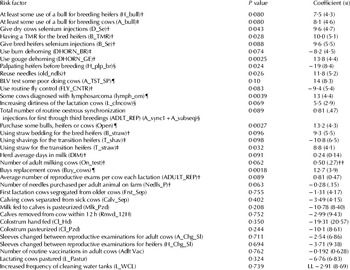
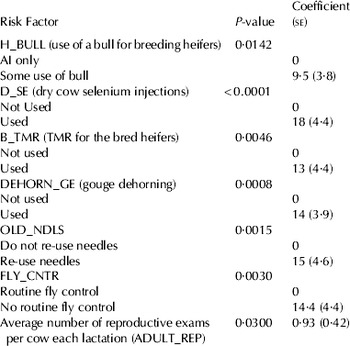
Risk factors found to be associated with BHP at P ⩽ 0·1 on one-way ANOVA or simple linear regression (for continuous-level variables) are shown in Table 1. Variables that were selected for the full multivariable model are indicated in the footnote of Table 1. The final reduced multivariable model is shown in Table 2. The Shapiro–Wilk W of the residuals was 0·98, indicating that the residuals were normally distributed, suggesting that the major assumption for general linear models was not violated. The R-squared was 0·43.
One-way ANOVA or regression analysis of estimated herd BLV milk ELISA prevalence (BLV Herd Profile)

† Variables included in the initial step-down multivariable modelling
‡ Considered redundant information with another variable that was included
§ Excluded because of maldistribution of values
¶ Excluded as a probable effect of BLV rather than a probable cause
†† On_test – Coefficient is for each 100 cows in the herd
The W normal for the residuals from each of the above models averaged 0·95 and was always greater than 0·93
Multivariable models of estimated herd BLV prevalence (BLV herd profile)

No 2-way interactions or quadratic terms were significant at P < 0 0·1
Residuals were distributed normally (Shapiro–Wilk W = 0·98)
R-square = 0·43; BHP mean = 38
Discussion
In countries such as the USA, which do not participate in a national BLV eradication programme, control of the disease focuses on preventing transmission through haematogenous routes, and not test and culling programmes such as those practised in Europe. Previous reports have identified such practices as gouge dehorning, injections with shared hypodermic needles, and tattoo pliers to be risks in the transmission of BLV (Roberts et al. Reference Roberts, Lucas, Wibberley and Chasey1982; DiGiacomo et al. Reference DiGiacomo, Darlington and Evermann1985; Lassauzet et al. Reference Lassauzet, Thurmond, Johnson, Stevens and Picanso1990; Kobayashi et al. Reference Kobayashi, Tsutsui, Yamamoto, Hayama, Kameyama, Konishi and Murakami2010). Our study largely agreed with these earlier reports, as farms that reported reuse of needles and the practice of gouge dehorning had a significantly greater risk of BLV infection. Nonetheless, the role of haematogenous determinants in transmission is variable and may depend on the frequency of their use (Roberts et al. Reference Roberts, Lucas, Wibberley and Chasey1982; Thurmond et al. Reference Thurmond, Portier, Puhr and Burridge1983; Weber et al. Reference Weber, Meiske, Haggard, Sorensen, Domagala and Flaum1988; Hopkins et al. Reference Hopkins, DiGiacomo, Evermann, Christensen, Deitelhoff and Mickelsen1991). We attempted to account for total exposure for some of the management variables in our survey and analysis. For example, in addition to the dichotomous response regarding reuse of needles, standard injection protocols were recorded for each herd, accounting for the sum of routine vaccinations, oestrous synchronizations, supplemental vitamins, etc. The preliminary single regression model (Table 1) identified that herds that administered supplemental selenium injections, and those that had higher numbers of oestrous synchronization injections had higher risk of BLV infection. However, in the final multivariate model (Table 2) only the use of selenium injections remained. This finding may have been a surrogate measure of total injection use, e.g. herds that practised more intensive vaccination programmes also were more likely to use selenium injections. Nonetheless, given the sophistication of reproductive and vaccination programmes that are currently employed on many dairy operations, we believe that the number of injections administered to dairy cattle on our study farms exceeds that which was typical in previous reports that investigated the role of needle use and the spread of BLV within a herd. However, acceptance of single use needles as part of a routine protocol, although a likely benefit for the control of BLV, may conflict with labour efficiency, ironically in herds with greater injection demands in their protocols.
Our study found that natural service breeding of heifers and cows was associated with an increase in BLV prevalence. This is consistent with previous reports that have associated bull breeding or insemination with BLV-contaminated semen with greater risk of infection (Lucas et al. Reference Lucas, Dawson, Chasey, Wibberley, Roberts and Saunders1980; Roberts et al. Reference Roberts, Lucas, Wibberley and Chasey1982). As with haematogenous routes, risk of transmission from semen may depend on total exposure, i.e. the number of breedings from an infected bull. One report found that semen collected from BLV seropositive bulls was negative for the presence of the virus (Choi et al. Reference Choi, Monke and Stott1986). However, previous reports suggested that changes in immune function, lost milk production and longevity from BLV may progress with duration of infection (Pollari et al. Reference Pollari, Wangsuphachart, DiGiacomo and Evermann1992; Da et al. Reference Da, Shanks, Stewart and Lewin1993; Erskine et al. Reference Erskine, Corl, Gandy and Sordillo2011). Thus, younger bulls that are BLV- infected may have lower viral shedding in semen.
It is possible that natural breeding may also facilitate BLV transmission via vaginal trauma. This may explain why bull breeding was more significantly associated with risk of infection for heifers than cows in our model. This is consistent with research that suggests that rectal trauma associated with palpation is associated with greater risk of BLV (Hopkins et al. Reference Hopkins, DiGiacomo, Evermann, Christensen, Deitelhoff and Mickelsen1991). Whether from trauma or semen exposure, our study suggests that eliminating natural service, especially for heifers, may reduce transmission of BLV within a herd.
Several of the variables regarding housing approached statistical significance in the single regression model, and feeding of total mixed rations to breeding age heifers remained in our final model as being associated with increased risk of BLV infection. We suspect that feeding of total mixed rations is not an actual risk of BLV infection, but rather a surrogate indicator for other management practices, most likely related to grouping. Higher risks of infection have been associated with loose housing or grouping of animals and possible transmission through nasal secretions at shared feeding bunks (Thurmond et al. Reference Thurmond, Portier, Puhr and Burridge1983; Lucas et al. Reference Lucas, Roberts and Banks1993; Sargeant et al. Reference Sargeant, Kelton, Martin and Mann1997; Kobayashi et al. Reference Kobayashi, Tsutsui, Yamamoto, Hayama, Kameyama, Konishi and Murakami2010). Similarly, use of straw for bedding was associated with higher BLV prevalence, and may relate to management of other environmental factors such as sanitation and fly control.
A Virginia dairy herd was able to reduce the prevalence of BLV from 44 to 17% over two years by instituting single use needles and obstetrical sleeves, disinfection of tattoo equipment, electrical burn dehorning, and feeding of milk replacer and heat treated colostrum (Sprecher et al. Reference Sprecher, Pelzer and Lessard1991). Despite the lack of non-intervention controls or the determination of the relative significance of the management practices, our results agreed with this study, as we determined that several herd management variables remained in our final model, with a robust coefficient of variation (R 2 = 0·43). Paradoxically, a BLV herd control programme in an Argentinean dairy that (1) used single needles for vaccination, bleeding and application of medications, (2) used single sleeves for rectal palpation, (3) disinfected instruments used for tattooing, ear-tagging and other practices involving blood, and (4) bred heifers by artificial insemination only was unable to reduce the prevalence of BLV over a 3-year period (Gutiérrez et al. Reference Gutiérrez, Alvarez, Politzki, Lomónaco, Dus Santos, Rondelli, Fondevila and Trono2011). This suggests that other, unaccounted for management factors, that were not included in our or previous studies may play a role in the transmission of control of BLV in some herds. It is interesting to note that in the Argentinean study the prevalence of BLV infection in the herd was 85% which was higher than any herd in our study (Gutiérrez et al. Reference Gutiérrez, Alvarez, Politzki, Lomónaco, Dus Santos, Rondelli, Fondevila and Trono2011). This may indicate that in herds with extremely high prevalence of BLV standard control practices alone may be inadequate to control transmission. Additionally, no mention of fly control or the extent of infestation was made in the Argentinean study; our study found fly control to be significantly associated with BLV transmission, which agrees with earlier reports that link blood-sucking flies to risk of infection (Hasselschwert et al. Reference Hasselschwert, French, Hribar, Luther, Leprince, Van der Maaten, Whetstone and Foil1993; Kobayashi et al. Reference Kobayashi, Tsutsui, Yamamoto, Hayama, Kameyama, Konishi and Murakami2010).
As with other diseases, effective control of BLV relies on the ability to change management behaviours, other economic priorities on the farm, and facilities. The control of BLV is complex, and the benefits and pitfalls of strategies such as test and culling or segregation, or use of management practices have been reviewed (Rodríguez et al. Reference Rodríguez, Florins, Gillet, de Brogniez, Sánchez-Alcaraz, Boxus, Boulanger, Gutiérrez, Trono, Alvarez, Vagnoni and Willems2011). Selective segregation according to the peripheral-blood proviral load has been suggested as an alternative to classical control measures (Gutiérrez et al. Reference Gutiérrez, Alvarez, Politzki, Lomónaco, Dus Santos, Rondelli, Fondevila and Trono2011). Differences in genetics and virulence of viral strains between herds, duration of infection for individual cows, and the elapsed time between when herd management practices were first instituted and the summer of 2010 (survey collection) may also have contributed variability to our data.
In spite of widespread prevalence of BLV in our study population, 15 of the 113 herds (13·3%) had no BLV-positive results, and 36·3% (41/113) of the herds had no positive first-lactation animals. This suggests that herds can maintain a BLV-negative status and that herd eradication should be possible. At the national level, experience in Europe clearly demonstrates that BLV can not only be eradicated from individual herds, but it can be eradicated from entire countries (European Commission, 2003). Finland's experience took 30 years to achieve eradication, although the prevalence probably never exceeded 5% (Nuotio et al. Reference Nuotio, Rusanen, Sihvonen and Neuvonen2003). Other countries, such as Lithuania, are very close to achieving eradication (Acaite et al. Reference Acaite, Tamosiunas, Lukauskas, Milius and Pieskus2007).
Eradication of BLV in countries that lack cohesive programmes is difficult. ‘Test and slaughter’ programmes would be prohibitively expensive when starting from such a high prevalence as is currently found in the USA, especially if management changes could not first reduce the prevalence (Rodríguez et al. Reference Rodríguez, Florins, Gillet, de Brogniez, Sánchez-Alcaraz, Boxus, Boulanger, Gutiérrez, Trono, Alvarez, Vagnoni and Willems2011). The current study identified management risk factors that, if causal relationships could be established, have the potential to further reduce BLV prevalence. Unless a vaccine can be developed that enables distinction of serologic response from natural infection, management changes and/or segregation may be the only method to reduce the prevalence in some herds to a sufficiently low level at which a test and slaughter programme might be economically feasible.
The authors gratefully acknowledge funding of this project by the Elwood Kirkpatrick Dairy Science Research Endowment, IDEXX Laboratories, and technical support by Antel BioSystems Inc.