Non-technical Summary
An unusual worm, previously interpreted as the earliest leech, is described from 437 year old marine strata of Wisconsin. Lacking preserved internal organs, it is ~16 cm long, 8.2 mm wide, with 250 annulations and a circular structure at one end, which the authors interpret as the broken end of a molt. It is therefore referred to the Cycloneuralia, a group of worms that shed their skin.
Introduction
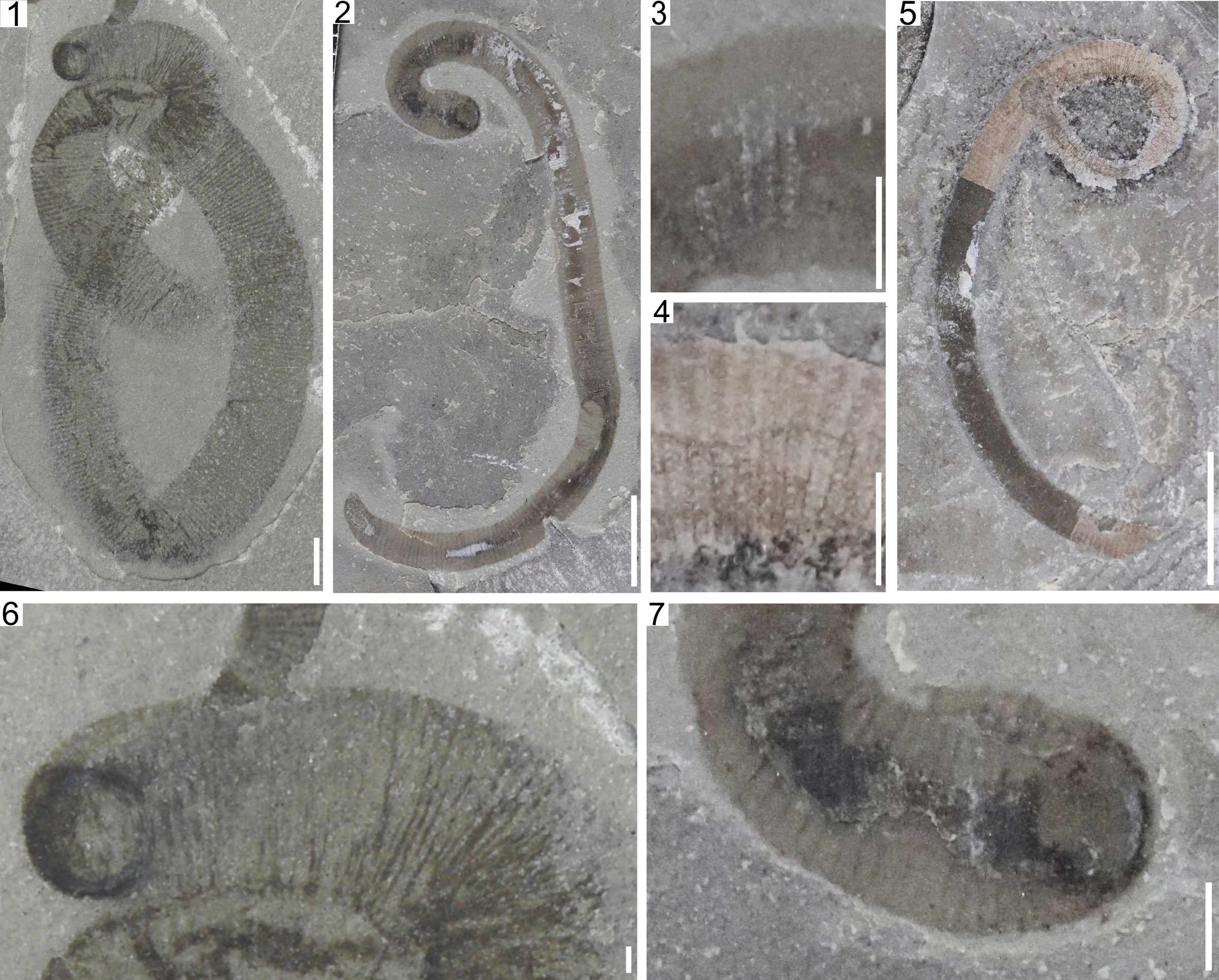
Exceptionally preserved fossils from the early Silurian (Llandovery, Telychian, ~437 Ma) Brandon Bridge Formation (Mikulic et al., Reference Mikulic, Briggs and Kluessendorf1985a, Reference Mikulic, Briggs and Kluessendorfb) include a large worm (Fig. 1.1), with what was said to resemble a disk or suction cup, suggesting to Mikulic et al. that it could be a leech. However, a number of recent studies have been skeptical that this specimen is a leech, and alternative hypotheses have been suggested (Westberg, Reference Westberg2019; Shcherbakov et al., Reference Shcherbakov, Timm, Tzetlin, Vinn and Zhuravlev2020; Gass and Braddy, in press). Here, we describe this unusual worm, discuss its potential affinities, and refer it to the Cycloneuralia incertae sedis.
(1, 6) Cycloneuralia incertae sedis, UWGM 2422: (1) image courtesy of UWGM; (6) magnification of break. (2–5, 7) Palaeoscolecida incertae sedis, early Silurian (late Llandovery; Telychian) Brandon Bridge Formation, Waukesha Lime and Stone Company quarry, Wisconsin, USA, 43.04°N, 88.21°W: (2, 3, 7) UWGM 2724: (2) complete; (3) magnification of plates; (7) magnification of break; (4, 5) UWGM 2087: (4) magnification of plates; (5) complete. Scale bars = 5 mm (1, 2, 5), 1 mm (3, 4, 6, 7).
Geological setting
The Waukesha Biota (Brandon Bridge Formation Lagerstätte) is a diverse assemblage of early Silurian (Telychian, 437 Ma) shallow marine fossils. They were discovered in the early 1980s by paleontologists Donald Mikulic and Joanne Kluessendorf, and private collectors Gerald Gunderson and Ronald Meyer (Gass and Braddy, in press). Most fossils were found at a quarry operated by the Waukesha Lime and Stone Company (43.04°N, 88.21°W). Others came from a quarry in Franklin, Milwaukee County, operated by Franklin Aggregate Inc., 32 km to the south (42.91°N, 87.99°W). The Franklin Biota is similar to that from Waukesha, but lacks trilobites (Wendruff et al., Reference Wendruff, Babcock, Mikulic and Kluessendorf2020a). The conodont fauna indicates that the strata containing the Waukesha Biota are within the Pterospathodus eopennatus Conodont Superzone, corresponding to a mid-Telychian age (Kleffner et al., Reference Kleffner, Norby, Kluessendorf and Mikulic2018; 437 Ma). The Waukesha Biota is similar to the Eramosa Lagerstätte, from the Silurian of Ontario (von Bitter et al., Reference von Bitter, Purnell, Tetreault and Stott2007).
The exceptional preservation of the Waukesha Biota, mainly in a 12 cm thick, thinly rhythmically bedded, light-green to pinkish-gray plattenkalk (dolomitic mudstone), deposited in an anoxic, possibly brackish, interreef, tidally-influenced environment, was mediated by microbial entombment (Wendruff et al., Reference Wendruff, Babcock, Mikulic and Kluessendorf2020a). Typical biomineralized animals are rare, but soft-bodied organisms, including worms, a conodont animal, and a possible lobopodian, rarely preserved in the fossil record, are present.
Soft tissues, including limbs, eyes, gut tracts, and internal organs, are preserved in some of the arthropods, lobopodians, annelids, and conodonts. Soft-bodied animals are strongly compressed and typically preserved in francolite or as organic stains (Kluessendorf, Reference Kluessendorf1994) in diagenetic phosphate, kerogen, and minor pyrite. The worms are typically preserved as flattened compressions composed of a dark film. Originally phosphatic organisms, e.g., conulariids and orbiculoids, are generally well preserved without secondary mineral overgrowth, whereas organisms composed of calcium carbonate are generally decalcified and ‘ghosted’ (Wendruff et al., Reference Wendruff, Babcock, Mikulic and Kluessendorf2020a).
Other organisms in the biota include biofilms and microbial mats (Wendruff et al., Reference Wendruff, Babcock, Mikulic and Kluessendorf2020a), the noncalcified dasycladalean alga Heterocladus waukeshaensis LoDuca, Kluessendorf, and Mikulic, Reference LoDuca, Kluessendorf and Mikulic2003, and Thallograptus Öpik, Reference Öpik1928 identified as an alga or graptolite (Wendruff et al., Reference Wendruff, Babcock, Mikulic and Kluessendorf2020a, fig. 8E). Rare vauxiid or anthaspidellid sponges (Gass and Braddy, in press); a favositid tabulate coral (Wendruff et al., Reference Wendruff, Babcock, Mikulic and Kluessendorf2020a, fig. 6G); common conulariids (Miller et al., Reference Miller, Jacquet, Anderson and Schiffbauer2022); Sphenothallus Hall, Reference Hall1847 that could be related to conulariids (Wendruff et al., Reference Wendruff, Babcock, Mikulic and Kluessendorf2020a, fig. 6B, C); orthid, orbiculoid, and rhynchonellid brachiopods; an orthocone nautiloid; and a crinoid (Wendruff et al., Reference Wendruff, Babcock, Mikulic and Kluessendorf2020a, fig. 6H) indicate an inter-reef or open-shelf offshore setting. Dendroid graptolites are common, whereas pelagic graptolites are rare. The conodont Panderodus unicostatus (Branson and Mehl, Reference Branson and Mehl1933) (see Murdock and Smith, Reference Murdock and Smith2021, fig. 2) preserves a feeding apparatus within soft tissues. Well-preserved fossils with a notochord, V-shaped myomeres, and caudal fins from Franklin Quarry (Wendruff et al., Reference Wendruff, Babcock, Mikulic and Kluessendorf2020a, fig. 8F, G) could represent a headless conodont.
Worms include a spiny polychaete, an aphroditid polychaete, scolecodonts (polychaete jaws) (Mikulic et al., Reference Mikulic, Briggs and Kluessendorf1985b), and, in addition to the worm described in this paper, three possible palaeoscolecid taxa: one is up to 46 mm long and 2.4 mm wide with two adjacent transverse rows of ~15 small circular, uniformly sized plates on its trunk annulations (Fig. 1.2, UWGM 2724; Fig. 1.4, 1.5, UWGM 2087). They are sometimes preserved tightly coiled, which could indicate death in an anoxic environment (Kluessendorf, Reference Kluessendorf1990). A second palaeoscolecid is up to ~41 mm long, 3.5 mm wide, with ~120 annulations and transverse rows of ~14 rectilinear plates, combining to form longitudinal striations along the body (Wendruff et al., Reference Wendruff, Babcock, Mikulic and Kluessendorf2020a, fig. 7E; UWGM 4121, 2578). The third, represented by at least three specimens (Westberg, Reference Westberg2019, figs. 6, 7), has fine annulations, tiny horn-like plates arranged in a hexagonal pattern, and raspberry-shaped plates.
An undescribed short-legged lobopodian also occurs (Mikulic et al., Reference Mikulic, Briggs and Kluessendorf1985b, pl. 1, figs. 13, 14). Arthropods dominate—mainly abundant and diverse trilobites (an undescribed dalmanitid and at least 12 other species; Wendruff et al., Reference Wendruff, Babcock, Mikulic and Kluessendorf2020a; Gass et al., Reference Gass, Edgecombe, Ramsköld, Mikulic and Watkins1992; Gass and Braddy, in press), crustaceans (including three species of the phyllocarid Ceriatocaris Jones, Feldmann, and Schweitzer, Reference Jones, Feldmann and Schweitzer2015, leperditicopid ostracodes, and the thylacocephalan Thylacares brandonensis Haug et al., Reference Haug, Briggs, Mikulic, Kluessendorf and Haug2014), a chelicerate (synziphosurine; Moore et al., Reference Moore, Briggs, Braddy, Anderson, Mikulic and Kluessendorf2005), and various enigmatic arthropods. These include Parioscorpio venator Wendruff et al., Reference Wendruff, Babcock, Wirkner, Kluessendorf and Mikulic2020b, originally considered the oldest scorpion, but probably a cheloniellid-like arthropod with a pair of large raptorial appendages (Braddy and Dunlop, Reference Braddy and Dunlop2021; Braddy et al., Reference Braddy, Gass and Gass2022, but see Anderson et al., Reference Anderson, Schiffbauer, Jacquet, Lamsdell, Kluessendorf and Mikulic2021, and Van Roy et al., Reference Van Roy, Rak, Budil and Fatka2022).
An uncommon, unnamed arthropod known as the ‘butterfly animal’ (Mikulic et al., Reference Mikulic, Briggs and Kluessendorf1985a, fig. 17, Reference Mikulic, Briggs and Kluessendorf1985b, fig. 2e; Gass and Braddy, in press, fig. 6g) also occurs. A vermiform arthropod, Acheronauta stimulapis Pulsipher et al., Reference Pulsipher, Anderson, Wright, Kluessendorf, Mikulic and Schiffbauer2022, is a basal mandibulate that could be related to thylacocephalans.
Materials and methods
Repository and institutional abbreviation
A Canon 6D camera with an EF 24-105 mm macro lens was used to photograph the specimens in Figure 1.1 and 1.7, and a Canon EOS Rebel T7i camera with a 60 mm macro lens was used to photograph the remaining specimens shown in this work. SEM imaging was not possible due to the delicate nature of the fossils. They are deposited in the University of Wisconsin Geology Museum (UWGM).
Systematic paleontology
Clade Cycloneuralia Nielsen, Reference Nielsen1995
Remarks
UWGM 2422 was originally interpreted as a leech (Mikulic et al., Reference Mikulic, Briggs and Kluessendorf1985a, Reference Mikulic, Briggs and Kluessendorfb). Leeches (subclass Hirudinea) are aquatic or terrestrial, parasitic or predatory, soft-bodied vermiform segmented clitellate annelids, with a nonsegmented prostomium (cephalized first body segment), an anterior (oral) sucker, a muscular body, and a posterior (anal) sucker to attach to hosts. Putative leech fossils are known from the Eocene Monte Bolca Lagerstätte of Italy (Alessandrello, Reference Alessandrello1990), the Jurassic Solnhofen Lagerstätte of Germany (two taxa; Kozur, Reference Kozur1970), a middle Permian Lagerstätte in South Africa (Prevec et al., Reference Prevec, Nel, Day, Muir and Matiwane2022, fig. 5l), and the Upper Pennsylvanian (305 Ma) Kinney Brick Quarry Lagerstätte of New Mexico, USA (Lerner et al., Reference Lerner, Hannibal and Lucas2004). Assuming that previous reports are reliable, if this worm from the Waukesha Biota is a leech, it would extend their temporal range by 132 Ma. However, none of those fossils is convincingly a leech (Sawyer, Reference Sawyer1986; de Carle, Reference de Carle2022).
Trace fossils (ichnotaxa) include woven cocoons (Bertling et al., Reference Bertling, Braddy, Bromley, Demathieu and Mikulás2006), but secreted cocoons, like those produced by clitellates, are curiously not treated as trace fossils (Genise et al., Reference Genise, Bertling, Braddy, Bromley, Mikulás, Nielsen, Rindsberg, Schlirf and Uchman2004). Leeches have both male and female genital pores, reproducing by eggs deposited in cocoons, secreted by a clitellum. The act of secretion of a cocoon results from the life activities of an animal, so the distinction between woven and secreted cocoons seems unnecessary; the latter are similar to nests. Putative leech cocoons, ovoid fossils 1–10 mm long with a felt-like wall fabric, are quite common throughout the Mesozoic and Cenozoic (see Manum et al., Reference Manum, Rose and Sawyer1991; Bomfleur et al., Reference Bomfleur, Kerp, Taylor, Moestrup and Taylor2012 for reviews), suggesting that leeches could have been abundant in post-Paleozoic limnic and soil ecosystems.
According to one of the most well-regarded leech experts, a fossil leech should possess a posterior sucker, segments with secondary annulation (i.e., the three primary annulations per somite are further subdivided, although, as a side note, this is not the case for many leeches and possibly three or more annuli per somite might be a better proposition), no parapodia or lobopodia, and setae should be absent or restricted to the head (Sawyer, Reference Sawyer1986). UWGM 2422 lacks evidence of secondary annulation and, although it has a circular structure at one end that was interpreted as a sucker, it is instead interpreted here as a breakage (i.e., taphonomic). The disk-bearing half is slightly narrower than the other half, behind a fold (bottom of Fig. 1.1), probably due to sediment infill of a circular cross section being flattened into a flaccid molt (further distinguishing the animal from a leech, which does not molt). A circle with circumference πd has a flattened width of π / 2 (if d = 1), i.e., 1.57 times wider; UWGM 2422 is 1.52 times wider. Leeches tend to have fairly tapered bodies, with narrowed anterior ends, and are constricted where the body meets the posterior sucker. Both anterior and posterior suckers consist of thickened soft tissue. In contrast, the circular structure of UWGM 2422 exhibits no appreciable thickening, the body does not narrow anteriorly, and it is not constricted near the circular structure (Fig. 1.6). We therefore do not interpret this fossil as a leech.
Westberg (Reference Westberg2019) suggested that UWGM 2422 is a palaeoscolecid but did not provide a rationale. The class Palaeoscolecida Conway Morris and Robison, Reference Conway Morris and Robison1986 is an extinct stem group of priapulids (Conway Morris, Reference Conway Morris1997; Harvey et al., Reference Harvey, Dong and Donoghue2010) or cycloneuralians (i.e., Nematoda + Nematomorpha + Kinorhyncha + Loricifera + Priapulida; Wills et al., Reference Wills, Gerber, Ruta and Hughes2012). They have an eversible tooth-bearing pharynx (anterior introvert with scalids), with six-fold symmetry (not five-fold as in priapulids; Yang et al., Reference Yang, Smith, Zhang and Yang2020), a long (up to several decimetres), slender, multiannulated body (up to several hundred simple annuli, sometimes bifurcated) covered in circumferential rings of organophosphatic plates (Harvey et al., Reference Harvey, Dong and Donoghue2010). Some taxa have spines or nipples at their posterior end. They are common in small shelly fossil (SSF) assemblages from the early Cambrian (Series 2, Stage 3). Palaeoscolecid body fossils are also known from various Burgess Shale-type Lagerstätten, sometimes in abundance (one quarter of all fossils in the Chengjiang Biota are palaeoscolecids; Zhao et al., Reference Zhao, Caron, Bottjer, Hu, Yin and Zhu2014). They occur in the Cambrian of Canada, USA, Greenland, Russia, China, and Australia (e.g., García-Bellido et al., Reference García-Bellido, Paterson and Edgecombe2013; Smith, Reference Smith2015), the Ordovician of Britain, Bohemia, Peru, USA, and China (e.g., Muir et al., Reference Muir, Tin-Wai, Xiang-Feng, Zhang and Lin2014; Wang et al., Reference Wang, Muir, Botting, Feng, Servais and Li2014), and Morocco (Gutiérrez-Marco and García-Bellido, Reference Gutiérrez-Marco and García-Bellido2015; Martin et al., Reference Martin, Lerosey-Aubril and Vannier2016; García-Bellido and Gutiérrez-Marco, Reference García-Bellido and Gutiérrez-Marco2022), and the Silurian of Britain (Whittard, Reference Whittard1953).
Another vermiform specimen (UWGM 2724) from the Waukesha Biota also bears a circular structure at one end (Fig. 1.2, 1.7). It is not as distinct as that of UWGM 2422 and also differs in its much smaller size and longitudinally longer annulations (in relation to body width) with transversely arranged phosphatic plates (Fig. 1.3). Except for the circular structure at one end, this specimen is indistinguishable from many of the other palaeoscolecids from this biota.
Shcherbakov et al. (Reference Shcherbakov, Timm, Tzetlin, Vinn and Zhuravlev2020) suggested that UWGM 2422 should be placed within the priapulid family Ancaligonidae, based on its ‘rigid’ cuticle (i.e., was molted), large size, and lack of a well-expressed introvert. Priapulids are Cambrian to Holocene, marine, infaunal, vermiform, predatory ecdysozoans possessing an extensible spiny introvert (eversible) proboscis, typically with five spines circling the mouth and rows of longitudinally arranged plates.
Some evidence suggests that this worm is an ecdysozoan. Internal organs, frequently preserved in other vermiform taxa of the Waukesha Biota, are lacking in this individual, which suggests that it is a molt. The ‘circular structure’ would therefore be interpreted as a slightly contracted broken end of the molt.
We therefore interpret UWGM 2422 as a vermiform ecdysozoan (i.e., cycloneuralian). Specimen UWGM 2422 (Fig. 1.1) does not preserve the organophosphatic plates present in typical palaeoscolecids. Cycloneuralia is a clade of ecdysozoans that includes the Scalidophora (kinorhynchans, loriciferans, and priapulids) and the Nematoida (nematodes and nematomorphs), united by a nervous system with a circumpharyngeal brain, something difficult to detect in fossils.
Gass and Braddy (in press) referred to UWGM 2422 as a “worm of uncertain affinities” after excluding it from leeches. They further stated that the circular structure resembles breakage. Our present analysis suggests that this individual is most likely a molt that broke at one end during ecdysis, thus producing the circular structure at the region of breakage. The fact that a gut tract is lacking and the body appears to be folded (bottom of Fig. 1.1) suggests that it is a molted cuticle, which would exclude an annelid affinity and constrain it to a vermiform ecdysozoan. It could be a decapitated priapulid, but until additional material comes to light that confirms or refutes this hypothesis, we prefer to keep this specimen in open nomenclature.
An alternate interpretation is that the circular structure is a large, circular mouth, considering its shape and placement. However, given the evidence outlined above, we find it more likely that it is a point of breakage that occurred during ecdysis.
Cycloneuralia incertae sedis
Figure 1.1
- Reference Mikulic, Briggs and Kluessendorf1985a
?Leech, Mikulic et al., fig. 19.
- Reference Mikulic, Briggs and Kluessendorf1985b
?Leech, Mikulic et al., p. 716, fig. 2f.
- Reference Briggs1991
?Earliest leech, Briggs, p. 137, fig. 10.
- Reference Wendruff, Babcock, Mikulic and Kluessendorf2020a
Putative leech, Wendruff, p. 8, fig. 7a.
- In press
Worm of uncertain affinities, Gass and Braddy, fig. 2a.
Occurrence
Telychian; late Llandovery (437 Ma), Brandon Bridge Formation. Waukesha Lime and Stone Company quarry, Waukesha County, Wisconsin, USA (43.04°N, 88.21°W).
Description
UWGM 2422 has a fairly uniform width and a high aspect ratio (average 24.6). It is 160 mm long and 5.4 (anterior) to 8.2 mm wide, with ~250 annulations (Fig. 1.1). The slightly broader half might be due to dorsoventral flattening (see above). It bears a large circular structure at one end, almost the entire width of the body; this is interpreted as breakage. It is impossible to determine whether the circular structure was located at the anterior (oral) or posterior end. There is no evidence of teeth (‘introvert scalids’), plates, or any other ornamentation on the cuticle.
Remarks
UWGM 2422 is preserved as flattened compression in a dark film on a finely laminated dolostone. Shcherbakov et al. (Reference Shcherbakov, Timm, Tzetlin, Vinn and Zhuravlev2020, p. 220) suggested that it has some features in common with Ruedemannella obesa (Ruedemann, Reference Ruedemann1925) (see Howell, Reference Howell1959), from the Bertie Waterlime of Buffalo, New York, e.g., “dense prominent transverse ribbing along a relatively long (over 120 mm) plump body and a sharply rounded terminal opening resembling a rear sucker of a leech.” However, Ruedemann (Reference Ruedemann1925) stated that R. obesa lacks a sucker and the posterior of the type is not preserved. The holotype of R. obesa is 118 mm long, 14 mm wide, with ~118 annulations with two longitudinal series of plates and jaws 2.5 mm long. The paratype is 45 mm long, 11 mm wide, with ~62 annulations. It is interpreted as a plump annelid and its aspect ratio (4.10) is much lower than that of the unusual worm from the Waukesha Biota. We therefore do not interpret the Waukesha worm as related to R. obesa.
Our principal finding is that this Waukesha worm is not a leech. Knowing this prevents researchers from mistakenly using this fossil as a calibration point for molecular-clock analysis of leech phylogenetics.
Acknowledgments
We thank M. Westberg for useful discussions. The material is figured with permission of the University of Wisconsin Geology Museum. We thank C. Eaton for making the material available for study. We also thank J. Botting and an anonymous referee for their reviews.
Declaration of competing interests
The authors declare none.