Children in foster care have typically experienced early adversity, including chronic neglect as well as other forms of maltreatment. Exposure to such stressors is associated with behavioral, autonomic and/or immunological manifestations of pathology at later age (Ellis, Essex, & Boyce, Reference Ellis, Essex and Boyce2005). These associations may in part be due to the effects of early adversity on neural affect regulation systems. However, the move to a foster home and the exposure to a more positive and stable caregiving environment may be protective. Dozier and her colleagues have shown that infants placed in foster care were able to develop organized attachment relationships when placed with nurturing foster caregivers (Dozier, Stovall, Albus, & Bates, Reference Dozier, Stovall, Albus and Bates2001; Stovall & Dozier, Reference Stovall and Dozier2000). When placed with nonnurturing foster caregivers, children were at greater risk for developing disorganized attachment (Dozier et al., Reference Dozier, Stovall, Albus and Bates2001). Oosterman and Schuengel (Reference Oosterman and Schuengel2008) found associations between attachment security (as observed with the Attachment Q-Sort; Waters & Deane, Reference Waters and Deane1985) and foster parent sensitivity. However, this association was only found once clinical symptoms of disordered attachment were taken into account, suggesting that pathogenic early experiences may continue to play a role. This study will examine whether the quality of relationships with foster caregivers are associated with adaptive regulation of stress in the context of challenges, which may be an indirect indicator of the extent to which the relationship with the foster caregiver may have an protective influence on the development of foster children. In addition, indicators of early adversity were examined in relation to attachment and stress regulation.
Physiological Stress Systems and Adversity
Different psychobiological models on early development have proposed associations between regulation of stress and social interactive experiences (Hofer, Reference Hofer2006; Porges, Reference Porges2004). An important model, that explicates the relations between functioning of the autonomic nervous system (ANS) and social interactions, is proposed by Porges (Reference Porges2004). Porges' model of social engagement incorporates physiological mechanisms that are involved in the development of normal and atypical social behavior. This model is derived from polyvagal theory (Porges, Reference Porges1995), which posits three phylogenetic stages in neural development of the ANS. The first stage is the unmeyelinated (vegetative) vagal system, which primarily functions to protect metabolic resources. This stage is associated behaviorally with immobilization, such as freezing under acute threat (Porges, Reference Porges2004). The second stage involves the sympathetic nervous system, which can increase metabolic output and inhibit the vegetative vagal system to promote behavioral mobilization (e.g., fight or flight responses). The sympathetic nervous system can, in turn, be inhibited by the myelinated vagal system, or parasympathetic nervous system, which is the third and evolutionarily most recent adaptation of the ANS. The myelinated vagal system is a flexible, rapidly responding system that regulates cardiac output. Cardiac output can be reduced to promote calm states, which is adaptive when environmental demands are low. However, in the face of environmental challenges, the myelinated vagal system will increase cardiac output, thereby facilitating engagement with the environment (Porges, Reference Porges2004). The organization of the ANS is assumed to be hierarchical, indicating that response strategies associated with the newest structures are activated first. When the response strategy is not adaptive given the environmental situation, responses associated with the next newest structure will be activated (Porges, Reference Porges1995). In this context, Porges (Reference Porges2004) emphasized the importance of processing of information from the environment: conceptualized as neuroception. Neuroception refers to the involvement of neural structures in distinguishing among situations that are safe or dangerous. This implicates that when danger is perceived, social engagement strategies associated with the myelinated vagal system withdraw to give way to response strategies related to the sympathetic nervous system.
Porges' model emphasizes the function of the vagal system in promoting calming and social behavior by inhibiting the lower order (defense) systems. Beauchaine (Reference Beauchaine2001; Beauchaine, Gatzke-Kopp, & Mead, Reference Beauchaine, Gatzke-Kopp and Mead2007) proposed an integrated model of both sympathetic and parasympathetic functioning in relation to the development of adaptive and maladaptive behavior. Consistent with Porges' theory and empirical findings concerning vagal reactivity during infancy, childhood, and adolescence (for a review, see Beauchaine, Reference Beauchaine2001), the vagal system appeared to be the underlying structure of emotion regulation. Consequently, deficient vagal tone as well as excessive vagal reactivity appear to reflect dysregulation of emotional processes. Beauchaine et al. (Reference Beauchaine, Gatzke-Kopp and Mead2007) argued that when the vagal system is compromised, response strategies shift from vagally mediated responses to sympathetic nervous system mediated fight/flight responses, that activate strong approach or avoidance emotions. The hierarchical organization of the ANS in combination with the valence of fight/flight-related emotions may explain the relation between aberrant vagal functioning and the development and maintenance of a broad range of psychological problems (Beauchaine, Reference Beauchaine2001).
Although according to the models of Porges and Beauchaine early adversity may have broad effects on ANS regulation, studies on foster children have focused particularly on the hypothalamic–pituitary–adrenal (HPA) axis (Gunnar, Fisher, & The Early Experience, Stress, and Prevention Network, Reference Gunnar and Fisher2006). Research on preschool age foster children (Dozier et al., Reference Dozier, Manni, Gordon, Peloso, Gunnar and Stovall-McClough2006; Fisher, Gunnar, Chamberlain, & Reid, Reference Fisher, Gunnar, Chamberlain and Reid2000; Gunnar et al., Reference Gunnar and Fisher2006) as well as a study on postinstitutionalized infants and toddlers (Bruce, Kroupina, Parker, & Gunnar, Reference Bruce, Kroupina, Parker and Gunnar2000), found disruptions to the daily cycle of HPA axis activity, characterized by atypically low early morning cortisol levels in at least 35% of these children (Gunnar et al., Reference Gunnar and Fisher2006). These effects on neuroendocrine regulation have also been found in nonfoster children who have been maltreated (Cicchetti & Rogosch, Reference Cicchetti and Rogosch2001a, Reference Cicchetti and Rogosch2001b).
Studies focusing on effects of adversity on ANS reactivity included exclusively methods that have been used to assess activation of the sympathetic branch of the ANS, including heart rate (HR), blood pressure, and preejection period (PEP). However, it should be noted that the latter measure is the most precise indicator of sympathetic activity because HR and blood pressure are also partly influenced by the parasympathetic branch of the ANS (Cacioppo, Uchino, & Berntson, Reference Cacioppo, Uchino and Berntson1994). The study of Heim et al. (Reference Heim, Newport, Heit, Graham, Wilcox and Bonsall2000) found increased HR responses to stress in adults with a history of childhood abuse. Further, children in environments characterized by high levels of family stress were found to show increased PEP reactivity on laboratory challenges (Ellis et al., Reference Ellis, Essex and Boyce2005).
Physiological Stress Systems and Attachment
ANS functioning has also been studied in relation to quality of attachment, although most studies included only HR measurements, except for two studies (Hill-Soderlund et al., Reference Hill-Soderlund, Mills-Koonce, Propper, Calkins, Granger and Moore2008; Stevenson-Hinde & Marshall, Reference Stevenson-Hinde and Marshall1999) that included measures of respiratory sinus arrhythmia (RSA). RSA refers to rhythmic fluctuations in heart period associated with respiration (De Geus & Van Doornen, Reference De Geus, Van Doornen, Fahrenberg and Myrtek1996), and is an index of parasympathetic or vagal activity. Early findings on HR showed increased reactivity on separation from the caregiver in a series of case studies of avoidant-attached infants (Sroufe & Waters, Reference Sroufe and Waters1977). Spangler and Grossman (Reference Spangler and Grossman1993) found highest HR increases in infants with disorganized attachment relationships. Moreover, Willemsen-Swinkels, Bakermans-Kranenburg, Buitelaar, Van IJzendoorn, and Van Engeland (Reference Willemsen-Swinkels, Bakermans-Kranenburg, Buitelaar, Van IJzendoorn and Van Engeland2000) found HR increases on leave-taking and HR decreases on reunion with the caregiver for disorganized children. In contrast, Zelenko et al. (Reference Zelenko, Kraemer, Huffman, Gschwendt, Pageler and Steiner2005) found no significant differences between the attachment groups. With respect to RSA, Stevenson-Hinde and Marshall (Reference Stevenson-Hinde and Marshall1999) found no associations between attachment quality and RSA reactivity, although findings on HR in this study revealed a significant interaction between attachment and temperamental inhibition, indicating that HR on reunion with the caregiver did not decrease in high inhibited, insecurely attached children. A recent study on attachment and RSA reactivity showed differences between secure and insecure–avoidant infants, indicating more RSA reactivity (vagal withdrawal) in avoidant infants during the Strange Situation (Hill-Soderlund et al., Reference Hill-Soderlund, Mills-Koonce, Propper, Calkins, Granger and Moore2008). Taken together, findings in the general population do not suggest a clear pattern of associations between differences in quality of attachment and ANS reactivity. However, these studies have mainly focused on HR, which has a multidetermined nature and may therefore only be a general indicator of arousal (Fox & Hane, Reference Fox, Hane, Shaver and Cassidy2008). Some studies also included measures of the parasympathetic nervous system, but none of the studies on attachment and ANS reactivity included both measures of parasympathetic and sympathetic nervous system reactivity. Furthermore, because of the potential contrast between foster children's history of adversity and their experiences with foster parents, concurrent associations with ANS reactivity may be stronger for attachment to foster parents than for attachment to parents in the general population.
The present study focused on the relation between ANS reactivity and quality of attachment in foster children by using indicators of sympathetic and parasympathetic nervous system activity. Based on the link between early adversity, such as neglect and abuse, and physiological regulation, we first examined the relation between these experiences and ANS reactivity as well as attachment to decide whether subsequent analyses of ANS reactivity and attachment should include an index of early adversity. Beauchaine et al. (Reference Beauchaine, Gatzke-Kopp and Mead2007) argued that the biobehavioral systems underlying emotion regulation and social behavior, including the vagal system, are responsive to environmental influences, at least in young children. This may suggest that possible effects of early caregiving experiences of adversity on ANS regulation may be buffered by quality of subsequent caregiving, indicated, for example, by secure relationships with foster parents. We further explored whether specific components of early adverse experience (e.g., physical abuse, sexual abuse, neglect) might affect ANS functioning.
The relation between attachment and ANS reactivity was examined using a separation–reunion paradigm based on the Strange Situation (Ainsworth, Blehar, Waters, & Wall, Reference Ainsworth, Blehar, Waters and Wall1978; Cassidy & Marvin, Reference Cassidy and Marvin1992). Based on the relations among vagal system functioning, emotion regulation, and (mal)adaptive behavior, we hypothesized that children with insecure attachment, and in particular children with disordered attachment relationships (which is the term used to indicate both disorganized–controlling and insecure–other classifications), would show less vagal regulation than children with secure attachment relationships. Adaptive vagal regulation was defined in terms of RSA reactivity, indicating RSA decreases on separation followed by RSA increases on reunion. We further expected that children with disordered attachment would show stronger vagal withdrawal during the Strange Situation, which may be evidenced by a decrease in RSA from the start until the end of the procedure. Furthermore, we tested differences in reactivity of the sympathetic nervous system in relation to attachment, because sympathetic nervous system-mediated responses are expected when the vagal system is not functioning optimally. These responses are assumed to be associated with psychopathology and we therefore expect to find effects for children with disordered attachment relationships. Sympathetic reactivity was measured by PEP, which is an index of cardiac contractility. Changes in PEP during stress reflect β-adrenergic effects of the heart (Sherwood, Allen, Obrist & Langer, Reference Sherwood, Allen, Obrist and Langer1986; Sherwood et al., Reference Sherwood, Allen, Fahrenbert, Kelsey, Lovallo and Van Doornen1990). Stronger sympathetic activity, as reflected by a shortened PEP, was expected on separation and from the beginning of the Strange Situation to the end in children with disordered (and possibly also insecure) attachment than in children with secure attachment relationships.
Method
Participants
The sample included 60 foster children (39 girls) and their primary foster parent (54 mothers). Foster children ranged in age from 26 to 88 months (M = 56.88, SD = 16.52). The mean age of placement in the foster family was 12.25 months (SD = 16.59, range = 0–69 months). Almost all the foster children (97%) experienced one or more previous placements (M = 2.31, SD = 1.10), ranging from 0 to 6. Foster children had lived with their current foster families for 3–76 months (M = 35.33, SD = 18.52). The sample was selected for long term (3 months or more), nonkinship placements.
Procedure
Caregivers and children visited the university laboratory for a separation–reunion procedure based on the Strange Situation (Ainsworth et al., Reference Ainsworth, Blehar, Waters and Wall1978; Cassidy & Marvin, Reference Cassidy and Marvin1992). Physiological reactivity was measured during this procedure. Children wore six electrodes on the skin, which were connected to a small lightweight device (VU University—Ambulatory Monitoring System 46 [VU-AMS]; see physiological measures). The children were given a jacket to wear that had a pocket to carry the device. A similar procedure was conducted in a previous study on preschool children from a normative sample (Oosterman & Schuengel, 2007). Like the foster children, most children in this sample were very cooperative with the electrodes and settled quickly. We therefore decided not to introduce a formal period of desensitization, although Episode 2 of the Strange Situation procedure (caregiver and child are together in the room) is included to let parent and child acclimatize. In addition to the physiological measurements, the separation–reunion procedure was used to assess the quality of attachment of foster children.
Measures
Strange Situation
The original Strange Situation procedure (Ainsworth et al., Reference Ainsworth, Blehar, Waters and Wall1978) was designed to observe secure base behavior in 12- to 18-month-olds. However, several classification systems for coding attachment quality beyond infancy have been developed (Cassidy & Marvin, Reference Cassidy and Marvin1992; Crittenden, Reference Crittenden1992; Main & Cassidy, Reference Main and Cassidy1988). Although postinfancy attachment measures are less extensively validated than the original Ainsworth Strange Situation classification system, several studies have demonstrated divergent, convergent, and construct validity (for a review, see Moss, Bureau, Cyr, Mongeau, & St-Laurent, Reference Moss, Bureau, Cyr, Mongeau and St-Laurent2004). Moreover, attachment appeared moderately stable from infancy through the preschool years (Moss, Cyr, Bureau, Tarabulsy, & Dubois-Comtois, Reference Moss, Cyr, Bureau, Tarabulsy and Dubois-Comtois2005). Because most of the children in our sample fit into the age group 3 to 5, we used the Cassidy and Marvin system (1992), and not the Main and Cassidy (Reference Main and Cassidy1988) classification system, which is primarily validated for 6- or 7-year-old children. It should be noted, however, that the two systems are conceptually similar and include the same five category coding scheme (Moss, Rousseau, Parent, & Saintonge, Reference Moss, Rousseau, Parent and Saintonge1998). Differences in the distribution of attachment classifications in relation to age were tested in the current sample but were not significant, F (3, 57) = 1.04, p = .38.
Some adaptations were made with regard to the lab procedure. The original Strange Situation includes short separations from the caregiver that may less suitable for older children because short separations are assumed to be more routine for children in the preschool age range. Moreover, the original procedure does not yield parallel separation and reunion episodes for parent and stranger. We therefore extended the original procedure based on guidelines for coding preschool attachment (Cassidy & Marvin, Reference Cassidy and Marvin1992), which resulted in a 24-min procedure during which children experienced two separations and reunions with both the parent and a stranger (see Table 1 for an overview of the different episodes). We consulted Robert Marvin, an expert in observational coding of preschool attachment, about the proposed adaptations of the procedure. The second author was trained in attachment organization in preschool children by Robert Marvin and William Whelan at the Child Parent Attachment Clinic, University of Virginia. After reaching a reliability level of 80%, she coded the foster child's attachment classification using the videotaped adapted Strange Situation Procedure. Of the 60 children, 54% was classified secure with her foster parent (B), 21% insecure avoidant (A), 10% insecure ambivalent (C), 8% insecure controlling–disorganized (D-controlling) and 7% insecure–other (I-O). In analyses this variable was dichotomized in two ways (Cassidy & Marvin, Reference Cassidy and Marvin1992): secure (B)–insecure (A, C, D-Controlling, I-O); and ordered (A, B, C)–disordered (D-Controlling, I-O).
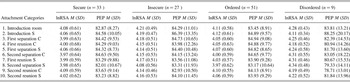
Mean (standard deviation) lnRSA and PEP scores by episodes of the Strange Situation and attachment

Note: lnRSA, natural logarithm of respiratory sinus arrhythmia; PEP, preejection period.
Psychophysiological measures
The VU-AMS was used to record electrocardiogram (ECG), basal thorax impedance (Z 0), changes in impedance (dZ) and the first derivative of pulsatile changes in transthoracic impedance (dZ/dt) continuously. To yield the impedance cardiogram (ICG), dZ/dt is sampled at 250 Hz (De Geus & Van Doornen, Reference De Geus, Van Doornen, Fahrenberg and Myrtek1996). The VU-AMS software programs (2006) were used to extract the physiological parameters.
The software program for ICG derived and displayed an average ICG waveform of 128 samples (512 ms). The following three points were scored and marked on the average dZ/dt waveform: (a) B-point or upstroke, (b) dZ/dt (min), and (c) X-point or insicura. From these points, the PEP was obtained, which is defined as the time between the onset of ventricular depolarization (Q-wave onset) and the onset of left ventricular ejection of blood in the aorta (B-point; Sherwood et al., Reference Sherwood, Allen, Fahrenbert, Kelsey, Lovallo and Van Doornen1990; Willemsen, De Geus, Klaver, Van Doornen & Carroll, Reference Willemsen, De Geus, Klaver, Van Doornen and Carroll1996). Because of the limited reliability of B-point detection, because of ambiguity in the location of the B-point, each dZ/dt waveform was checked and corrected when automated scoring revealed B-points that were morphologically inconsistent (Riese et al., Reference Riese, Groot, Van Den Berg, Kupper, Magnee and Rohaan2003). Fewer than 5% of the waveforms were discarded. Interrater reliability of three raters was determined on 2,377 ICG signals of 15 subjects, and ranged from .88 to .94 (intraclass correlation coefficient = .90).
The software program for continuous measurement of ECG R-wave to R-wave intervals and thoracic impedance was used to correct the respiration signal. The respiration signal was obtained from filtered (0.1–0.4 Hz) thoracic impedance signal. The beginning and end of inspiration and expiration were detected by an automatic scoring algorithm. RSA was derived by the peak–trough method (Grossman, Van Beek & Wientjes, Reference Grossman, Van Beek and Wientjes1990), which combined the respiratory time series and the interbeat intervals (IBI) to calculate the shortest IBI during HR acceleration in the inspiration phase, and the longest IBI during deceleration in the expiration phase (De Geus, Willemsen, Klaver, & Van Doormen, Reference De Geus, Willemsen, Klaver and Van Doornen1995). RSA was defined as the difference between the longest and the shortest IBI. Scoring of the respiration signal and the IBI was done automatically.
Early adversity composite
Information about preplacement experiences was obtained by questionnaires completed by child welfare case workers. In 56.5% of the cases, children had experienced neglect, 11.7% had experienced physical abuse, 5% had experienced sexual abuse, and 30% of the children witnessed domestic violence. Further, in 40% of the cases, biological parents had psychiatric problems, 61.7% were addicted to drugs or alcohol, and 25% of the children of drug-addicted parents were born addicted to drugs themselves. For the present analyses, these early risk factors (maximum number of seven) were summed and used as an indicator of early risk. The average number of risk factors was 2.43 (SD = 1.37). Because information about preplacement experiences was not available for two children, analyses on early adversity are based on sample size of 58.
Data analyses
Preliminary analyses (Pearson correlations and analyses of variance) were conducted to examine the relation between experiences of early adversity as well as other possible confounding variables (e.g., age child, time in placement, previous placements) and the primary study variables, attachment and ANS reactivity, to determine whether these variables should be included as covariates in subsequent analyses. The aggregated risk variable was used in analyses, although analyses focused on ANS reactivity also explored specific components of adversity. With regard to ANS reactivity, both mean PEP and RSA episode scores and reactivity scores were included. Reactivity includes sympathetic activity, as indexed by PEP decreases and parasympathetic withdrawal, as indexed by RSA decreases. Reactivity scores were therefore calculated for each child on separation and reunion with the foster caregiver as the difference in PEP and RSA between two succeeding episodes. Positive values for change reflect PEP or RSA increase. Finally, the mean episode-to-episode PEP and RSA increases were used as a robust measure of reactivity across the Strange Situation and is also examined in relation to early adversity.
To examine the association between attachment and ANS reactivity, repeated measures analyses of variance (ANOVAs) were conducted to compare PEP and RSA reactivity between subjects (attachment) and within subjects (across episodes). In addition to the preliminary analyses in which several confounding variables (including age of the child) were tested, age (median split) was included as a factor in repeated measures ANOVA to test for possible moderation effects. The attachment variable was attachment quality in terms of secure/insecure and ordered/disordered (based on the Strange Situation procedure). Planned contrasts were used to examine whether PEP and RSA changed from the start until the end of the procedure, and more specifically, on separation and reunion with the foster caregiver. Because RSA was skewed at all the episodes of the procedure, its natural logarithm (lnRSA) was used in the analyses.
Results
Preliminary analyses
In preliminary analyses we examined whether early adversity, age, age at out of home placement, and time in placement were associated with attachment classifications and with ANS mean episode scores and reactivity scores. Early adversity was not associated significantly with quality of attachment (point-biserial correlation; r = −.11, ns for secure/insecure and r = −.07, ns for ordered/disordered). Moreover, none of the correlations between the summary risk measure and PEP and lnRSA mean episode and reactivity scores were significant (p > .29 for PEP and p > .14 for lnRSA), except for the correlation between the summary risk measure and PEP reactivity on the first separation (r = .31, p < .05), indicating lower sympathetic activity (higher levels of PEP) for children with higher scores on the risk index. Exploratory analyses including specific components of risk revealed a significant association between increased sympathetic reactivity (lower levels of PEP) across the Strange Situation and a background of neglect (point-biserial correlation; r = −.26, p = .05). With regard to lnRSA, sexual abuse was positively related to lnRSA reactivity (lower levels of lnRSA) on the first separation (point-biserial correlation; r = −.32, p < .05) and negatively related to lnRSA reactivity on reunion (point-biserial correlation; r = .36, p < .01), indicating that children with a background of sexual abuse showed increased parasympathetic reactivity (lower levels of lnRSA) on separation and decreased parasympathetic reactivity (higher levels of lnRSA) on reunion compared to children without a background of sexual abuse.
There were no effects of age, time in placement and age at out of home placement on attachment (p >.20). Associations between age of the foster child and mean PEP as well as PEP and lnRSA reactivity scores were not significant (p > .34 for PEP and p > .21 for lnRSA). However, associations between age and lnRSA mean episode scores were all significant (correlations ranged from r = .27, p < .05 to r = .41, p < .001). Mean lnRSA scores were also significantly related to time in placement (correlations ranged from r = .23, p = .08 to r = .41, p < .01). Mean PEP and PEP reactivity scores were not significantly related to time in placement (ps > .08). Age at out of home placement was not associated with mean PEP and lnRSA scores (p > .20 for PEP and p > .35 for lnRSA) nor to PEP and lnRSA reactivity scores (p > .11 for PEP and p > .22 for lnRSA). Because only some associations with ANS reactivity but none with attachment (all ps > .10) were found, adversity as well as other possible confounding variables were not included as covariates in analyses on attachment and ANS reactivity. A correlation table including the specific statistics of the reported associations is available on request.
ANS reactivity in relation to quality of attachment
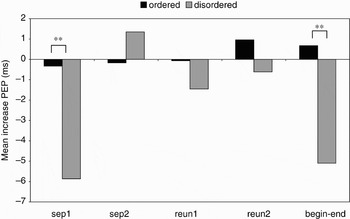
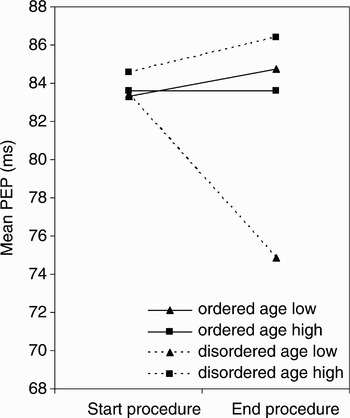
The means (standard deviation) of lnRSA and PEP by episodes of the Strange Situation and attachment category are presented in Table 1. Differences between children with ordered and disordered attachment were significant for both changes in PEP, Wilk's Λ = .81, F (5, 54) = 2.61, p < .05, η2 = .20, and changes in lnRSA, Wilk's Λ = .73, F (5, 54) = 4.11, p < .01, η2 = .28. Planned contrasts revealed significant differences between the attachment groups on PEP reactivity from the start to the end of the Strange Situation, F (1, 58) = 8.61, p < .01, indicating PEP decreases for children with disordered attachment compared to children with ordered attachment relationships. Changes in PEP reactivity on separation and reunion were not significantly different for children with ordered and disordered attachment after controlling for multivariate outliers. These findings on PEP reactivity are summarized in Figure 1. When age of the foster child was included as a factor (ordered attachment: M age = 57.16 months, SD age = 16.35, disordered attachment: M age = 53.68, SD age = 17.90), there was an attachment classification (ordered versus disordered) by age interaction, Wilk's Λ = .81, F (5, 52) = 2.46, p < .05, η2 = .19. As can be seen in Figure 2, planned contrast revealed that only relatively young children with disordered attachment relationships showed PEP decreases from the start until the end of the Strange Situation, F (1, 56) = 9.19, p < .01. A significant interaction effect on the first separation failed to reach significance after controlling for extreme within-group outliers (values outside the multiplied by 3 interquartile range).
Mean PEP increases of children with ordered and disordered attachment from the beginning to the end of the procedure and on separation and reunion with the foster parent. **p < .01.

Interaction between age and attachment (ordered vs. disordered) in relation to PEP reactivity from the start until the end of the procedure.

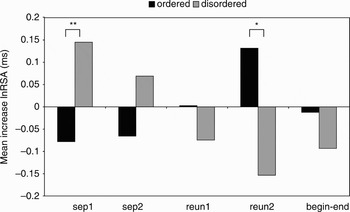
With regard to lnRSA reactivity, both separation and reunion effects were found. Children with ordered attachment showed lnRSA decreases on the first separation from the foster caregiver, whereas children with disordered attachment showed lnRSA increases, F (1, 58) = 7.81, p < .01. Effects on reunion indicated that children with ordered attachment showed lnRSA increases on the second reunion with the foster caregiver, whereas children with disordered attachment showed lnRSA decreases, F (1, 58) = 5.94, p < .05. These results are summarized in Figure 3. Analyses on lnRSA including age as a factor revealed no significant interaction effects between age and attachment classification (p > .50). Differences between secure and insecure children across the episodes of the Strange Situation failed to reach significance for changes in PEP, Wilk's Λ = .92, F (5, 54) = .90, p = .49, η2 = .08, as well as lnRSA, Wilk's Λ = .92, F (5, 54) = .98, p = .44, η2 = .08.
Mean lnRSA increases of children with ordered and disordered attachment from the beginning to the end of the procedure and on separation and reunion with the foster parent. *p < .05. **p < .01.

Discussion
The quality of attachment relationships with foster parents was associated with foster children's patterns of ANS reactivity on separation and reunion with the foster caregiver. Children with disordered attachment relationships showed less vagal regulation, indicated by RSA, than children with ordered attachment relationships. Moreover, younger children with disordered attachment relationships showed more sympathetic activity, as indicated by PEP, than older children with disordered attachment relationships, as well as children with ordered attachment relationships with foster caregivers. This may indicate that ordered attachment relationships with current foster caregivers are associated with better regulation of emotions in the context of stress and environmental challenges.
Vagal regulation refers to the role of the myelinated vagus in promoting calm states when environmental demands are low. On the other hand, withdrawal of vagal influence allows for engagement when there are environmental challenges (Porges, Reference Porges2004). In the context of our procedure, vagal regulation was defined in terms of RSA decreases on separation and RSA increases on reunion. Findings showed more vagal regulation among children with ordered attachment compared to children with disordered attachment. Children with disordered attachment showed the opposite responses, that is, RSA increased on separation and RSA decreased on reunion. The findings on RSA reactivity were not consistent with the study of Stevenson-Hinde and Marshall (Reference Stevenson-Hinde and Marshall1999), who found no main effects of attachment on RSA responses on reunion. However, their results on HR, indicating less HR decreases in insecurely attached and high inhibited children, also suggested less involvement of the vagal system during reunion in children with insecure attachment relationships. Similar findings were reported by Hill-Soderlund et al. (Reference Hill-Soderlund, Mills-Koonce, Propper, Calkins, Granger and Moore2008) with respect to insecure–avoidant infants, who showed during the whole Strange Situation procedure more vagal withdrawal (RSA reactivity) than secure infants. Our study revealed no significant differences between secure and insecure children on vagal regulation. It is important to note that most of the children in previous studies were younger than the children included in the current study. It has been suggested that the influence of caregivers on children's emotion regulating and reactivity may change across early childhood, as children's capacities for self-regulation increases (e.g., Calkins & Hill, Reference Calkins, Hill and Gross2007). These capacities may help children, even children in insecure attachment relationships, to deal with the stress of separation from their caregiver. However, children with disordered attachment relationships may fail to have certain capacities, because of their continually activated fear system during the strange situation, leading to inhibition of the vagal system to facilitate response strategies associated with the sympathetic nervous system (Porges, Reference Porges2004).
In general, our findings concerning less vagal regulation for children with disordered attachment were strengthened by the findings on PEP reactivity. The increases in PEP reactivity across the procedure in relatively young children with disordered attachment relationships may indicate that the sympathetic nervous system, relative to the parasympathetic nervous system is more reactive in these children than in children with ordered attachment relationships. Several earlier studies have examined the link between disordered attachment and increased stress reactivity by measuring HPA axis activity. Increases in HPA axis activity, as indicated by cortisol levels, and increases in sympathetic activity are expected under perceived threat (Gunnar et al., Reference Gunnar and Fisher2006). Studies have shown that insecurely attached infants (Spangler & Grossman, Reference Spangler and Grossman1993) and disorganized infants in particular (Hertsgaard, Gunnar, Erickson, and Nachmias, Reference Hertsgaard, Gunnar, Erickson and Nachmias1995; Spangler & Grossman, Reference Spangler and Grossman1993) exhibited higher cortisol concentrations after the Strange Situation. However, Spangler and Schieche (Reference Spangler and Schieche1998) found that only the ambivalent infants showed increased cortisol levels during the Strange Situation, whereas other studies showed an interaction between attachment and temperament, indicating cortisol elevations for insecurely attached and fearful children (Gunnar, Brodersen, Nachmias, Buss, & Rigatuso, Reference Gunnar, Broderson, Nachmias, Buss and Rigatuso1996; Nachmias, Gunnar, Mangelsdorf, Parritz, & Buss, Reference Nachmias, Gunnar, Mangelsdorf, Parritz and Buss1996). It should also be noted that several studies among young children failed to find increased cortisol reactivity under conditions of threat (Dozier, Peloso, Lewis, Laurenceau & Levine, Reference Dozier, Peloso, Lewis, Laurenceau and Levine2008; Gunnar & Donzella, Reference Gunnar and Donzella2002; Gunnar & Quevedo, Reference Gunnar and Quevedo2007). In addition to the HPA axis' involvement in the stress system, the ANS is involved as well, shown by activity in the sympathetic nervous system such as indicated by PEP. Measures of PEP have the advantage over cortisol measures that they can reveal immediate reactions of the sympathetic nervous system to changes in the environment. However, it should be noted that the effects in this study concerned PEP reactivity across the whole Strange Situation, whereas effects of the specific separation and reunion episodes were not significant. The lack of significant PEP findings on the specific episodes might be due to the relatively low resolution for impedance cardiography (250 Hz) of the device used in our study. The power to detect PEP differences might be enhanced through the use of higher resolution impedance cardiography. Nevertheless, our findings strengthen further the evidence for a link between disorganized or disordered attachment and activation of defensive systems involved in fight or flight responses (Main & Solomon, Reference Main, Solomon, Greenberg, Cicchetti and Cummings1990).
Because of the supposed link between sympathetic nervous system-mediated responses and psychopathology, we were surprised by the interaction effect, which suggested that heightened sympathetic reactivity was more characteristic for the younger foster children than for the older foster children. Several explanations are possible. One explanation might be that child age is associated with longer time in relatively stable and safe placement. In fact, a moderate association existed (r = .36, p < .01) between age and time in placement. This would imply that heightened sympathetic reactivity might be reduced by having an ordered attachment relationship, irrespective of time in placement, or by stable out-of-home placement, irrespective of attachment quality. This hypothesis can only be tested using longitudinal measurement of attachment. A different explanation might indicate a pattern of underarousal in children with disordered attachment, based on existing literature about altered ANS reactivity in older children with psychopathology. In 6- to 7-year-old children, externalizing behavior problems were found associated with an overall pattern of ANS underarousal, indicated by low sympathetic and parasympathetic reactivity (Boyce et al., Reference Boyce, Quas, Alkon, Smider, Essex and Kupfer2001). Caution is needed, however, in interpreting the age differences in ANS reactivity of children with disordered attachment in terms of underarousal, because no differences were found on vagal system regulation. Moreover, although our sample may be high risk, only a small number of children were classified with disordered attachment relationships.
Based on Porges' model, decreased vagal regulation and increased reactivity of the sympathetic nervous system in children with disordered attachment indicated a reduction of the influence of the myelinated vagus. This may partly also be the case in children with a background of neglect, who showed more PEP reactivity during the procedure than children without such a background. This was not found for children with other sources of adversity, such as abuse. These findings are consistent with the study of Bruce, Fisher, Pears and LeVine (Reference Bruce, Fisher, Pears and LeVine2009; see also Gunnar et al., Reference Gunnar and Fisher2006), who showed that especially children with a background of neglect and not physical or sexual abuse per se had the lowest morning cortisol levels. Moreover, children in the current study who experienced sexual abuse showed adaptive patterns of vagal regulation, which may suggest that even when children are placed in better caregiving environments, effects of neglectful care are more detrimental and perhaps also persistent than other types of early adversity. However, future research is needed to explore these relations more extensively, even more because the group of children with a background of sexual abuse in the current study was small.
Reduced influence of the vagal system is assumed to reflect dysregulation of emotional processes that may lead to the development and maintenance of psychopathology (Beauchaine, Reference Beauchaine2001). Findings of this study suggest a compensatory rather than a moderating influence of quality of caregiving on the link between early adversity and physiology. However, future studies should include measures of parenting sensitivity instead of the proxy variable attachment quality, which may be a better estimator of the environment quality of children in foster care.
Finally, our findings may fit within an attachment theoretical framework. The link between disordered attachment and increased stress reactivity may indicate that separations from the caregiver and possibly also reunions are more alarming for children with disordered attachment than for children with ordered attachment relations. This may be explained by the observation that children in disorganized attachment relationships experience their caregivers as frightening (Main & Hesse, Reference Main, Hesse, Greenberg, Cicchetti and Cummings1990; Schuengel, Bakermans-Kranenburg, & Van IJzendoorn, Reference Schuengel, Bakermans-Kranenburg and Van IJzendoorn1999). As a result, children are confronted with an unresolvable paradox, that is, seeking comfort from caregivers perceived as frightening, which may only increase the child's fear instead of providing security. This paradox is assumed to lead behaviorally to a collapse in strategies, resulting in disorganized or disoriented behavior in infants (Main & Hesse, Reference Main, Hesse, Greenberg, Cicchetti and Cummings1990). Attachment disorganization in infancy has been found to give way to disorganized–controlling and insecure–other attachment patterns in preschool age children (Van IJzendoorn, Schuengel, & Bakermans-Kranenburg, Reference Van IJzendoorn, Schuengel and Bakermans-Kranenburg1999). Heightened stress reactivity may be associated with heightened propensity of fight or flight responses instead of proximity seeking. Research on children who were raised from birth by the same caregivers showed that disorganized behavior in infants result from frightening or frightened caregiving (Schuengel et al., Reference Schuengel, Bakermans-Kranenburg and Van IJzendoorn1999). In the context of children in foster care, it remains unclear whether these stress responses result from foster caregiving or from children's previous experiences with other caregivers. Because this study did not examine attachment relationships of foster children with their biological parents or other previous caregivers, the possibility cannot be ruled out that the quality of these previous relationships has influenced the quality of the foster parent–child relationship. Another limitation of this study involves the cross-sectional nature of the data. Stovall and Dozier (Reference Stovall and Dozier2000) have shown that the study of attachment over time can greatly enhance our knowledge on the process of developing secure attachment behavior with a new caregiver. Future studies might include measures of ANS reactivity to reveal the possible influence of the new attachment relationship with the foster caregiver on children's emotion regulation. This study suggest that children's ability to regulate emotions in the context of environmental stress and challenges may set children on more adaptive developmental pathways.