Over 800 000 people die by suicide annually (World Health Organization, 2014) and suicide is now the second leading cause of death in adolescents and young adults in America (Hoyert and Xu, Reference Hoyert and Xu2012). Although suicide risk assessment and prevention have been researched extensively, recent meta-analyses (May and Klonsky, Reference May and Klonsky2016; Franklin et al., Reference Franklin, Ribeiro, Fox, Bentley, Kleiman, Huang, Musacchio, Jaroszewski, Chang and Nock2017) have demonstrated that decades of research have only minimally improved the ability to predict and prevent suicide in specific individuals. A key difficulty is that research has primarily focused on risk factors that predict suicidal ideation, which are generally poor predictors of suicidal behavior (May and Klonsky, Reference May and Klonsky2016). Recent theoretical models have attempted to address this concern by focusing on different factors that lead to suicidal ideation and that contribute to the capacity to make a lethal or potentially lethal suicide attempt.
Drawing from several theoretical models, such as the Interpersonal Theory of Suicide (ITS; Van Orden et al., Reference Van Orden, Witte, Cukrowicz, Braithwaite, Selby and Joiner2010), the Three Step Theory (3ST; Klonsky and May, Reference Klonsky and May2015), and the Integrated Motivational-Volitional Model (IMV; O'Connor et al., Reference O'Connor, Cleare, Eschle, Wetherall, Kirtley, O'Connor and Pirkis2016), capacity for suicidal behavior can be viewed as a combination of dispositional (e.g. genetically derived pain tolerance or reactivity) and acquired (e.g. learned fearlessness of pain and death and familiarity with the use of lethal means) components. One way in which capacity for suicidal behavior can be strengthened is through increased pain tolerance, which can occur through exposure to painful events including accidental injuries and non-suicidal self-injury (NSSI; Hooley et al., Reference Hooley, Ho, Slater and Lockshin2010; Franklin et al., Reference Franklin, Hessel and Prinstein2011). A variety of factors contribute to these components of capacity and are in need of additional research regarding how they specifically lead to risk for suicidal behavior.
Deficits in interoception, defined as the ability to effectively and accurately perceive the physiological condition of one's body (Craig, Reference Craig2002), may be a factor that contributes to capacity for suicidal behavior. Interoception is posited to encompass numerous domains, including awareness and trusting of bodily states, emotional awareness and reactions, attentional and self-regulatory responses, and listening to and noticing one's body sensations (Mehling et al., Reference Mehling, Price, Daubenmier, Acree, Bartmess and Stewart2012). The mental health benefits of interoceptive awareness are clear: converging evidence suggests that interoceptive awareness is central to emotional experience and shapes affective functioning (Blascovich and Mendes, Reference Blascovich, Mendes, Fiske, Gilbert and Lindzey2010; MacCormack and Lindquist, Reference MacCormack and Lindquist2017), is linked to greater mindfulness (Carruthers, Reference Carruthers2008; Hölzel et al., Reference Hölzel, Lazar, Gard, Schuman-Olivier, Vago and Ott2011; Mehling et al., Reference Mehling, Price, Daubenmier, Acree, Bartmess and Stewart2012), and promotes stronger emotion regulation (Füstös et al., Reference Füstös, Gramann, Herbert and Pollatos2013) and empathy (Fukushima et al., Reference Fukushima, Terasawa and Umeda2011; Ernst et al., Reference Ernst, Northoff, Böker, Seifritz and Grimm2013).
However, interoceptive deficits (ID) have been identified in various forms of psychopathology, including those with disordered eating (Sim and Zeman, Reference Sim and Zeman2004; Peat and Muehlenkamp, Reference Peat and Muehlenkamp2011) and those who engage NSSI (Favaro and Santonastaso, Reference Favaro and Santonastaso1998; Smith et al., Reference Smith, Forrest and Velkoff2018). Those with both disordered eating and who engage in NSSI exhibit the greatest levels of ID (Ross et al., Reference Ross, Heath and Toste2009; Claes et al., Reference Claes, Jiménez-Murcia, Agüera, Castro, Sánchez, Menchón and Fernández-Aranda2012; Muehlenkamp et al., Reference Muehlenkamp, Peat, Claes and Smits2012; Noma et al., Reference Noma, ‘ichi, Ono, Miyagi and Murai2015). Furthermore, ID significantly predicted suicide attempts, both cross-sectionally and longitudinally, in women with bulimia nervosa (Franko et al., Reference Franko, Keel, Dorer, Blais, Delinsky, Eddy, Charat, Renn and Herzog2004; Forcano et al., Reference Forcano, Fernández-Aranda, Álvarez-Moya, Bulik, Granero, Gratacòs, Jiménez-Murcia, Krug, Mercader, Riesco, Saus, Santamaría and Estivill2009). A key limitation to much of the existing literature on this topic is the frequent use of samples of women with eating disorders, limiting the potential generalizability of these results (Franko et al., Reference Franko, Keel, Dorer, Blais, Delinsky, Eddy, Charat, Renn and Herzog2004; Forcano et al., Reference Forcano, Fernández-Aranda, Álvarez-Moya, Bulik, Granero, Gratacòs, Jiménez-Murcia, Krug, Mercader, Riesco, Saus, Santamaría and Estivill2009; Dodd et al., Reference Dodd, Smith, Forrest, Witte, Bodell, Bartlett, Siegfried and Goodwin2018; Smith et al., Reference Smith, Forrest and Velkoff2018). Importantly, ID have been repeatedly linked to both suicidal ideation (Rogers et al., Reference Rogers, Hagan and Joiner2018) and suicide attempts (Forrest et al., Reference Forrest, Smith, White and Joiner2015; Dodd et al., Reference Dodd, Smith, Forrest, Witte, Bodell, Bartlett, Siegfried and Goodwin2018; Rogers et al., Reference Rogers, Hagan and Joiner2018). The lack of interoceptive awareness related to these ID could contribute to a reduction in the barriers to NSSI, such as an awareness of one's bodily sensations (Rogers et al., Reference Rogers, Hagan and Joiner2018). Properly formed, this awareness may curtail or prevent self-inflicted injuries through an increased initial pain threshold (Pollatos et al., Reference Pollatos, Füstös and Critchley2012; Weiss et al., Reference Weiss, Sack, Henningsen and Pollatos2014). Indirectly, this contribution to NSSI engagement may contribute to changes in pain tolerance through engagement in NSSI as supported by Dodd et al. (Reference Dodd, Smith, Forrest, Witte, Bodell, Bartlett, Siegfried and Goodwin2018).
NSSI has been repeatedly found to be a robust predictor of suicidal behavior in a variety of samples (Muehlenkamp and Gutierrez, Reference Muehlenkamp and Gutierrez2007; Guan et al., Reference Guan, Fox and Prinstein2012; Klonsky et al., Reference Klonsky, May and Glenn2013). Specifically, NSSI versatility (i.e. the number of different methods an individual has utilized to engage in NSSI) has been found to be a stronger longitudinal predictor of risk than frequency of NSSI (Turner et al., Reference Turner, Layden, Butler and Chapman2013). Additionally, a meta-analysis revealed that after suicidal ideation, NSSI versatility had the strongest association with suicide attempts out of 20 relevant variables (Victor and Klonsky, Reference Victor and Klonsky2014). Bringing this all together, one recent study found that ID were related to suicide attempts indirectly through NSSI and then through self-reported pain tolerance (Dodd et al., Reference Dodd, Smith, Forrest, Witte, Bodell, Bartlett, Siegfried and Goodwin2018); although this study consisted exclusively of women with eating disorders.
In the current study, we tested three hypotheses across seven independent samples. First, we predicted that, consistent with past research, self-reported ID would be directly and independently associated with suicidal ideation beyond the effects of gender, age, NSSI versatility, and depression. Second, we predicted that self-reported ID would play an indirect role in suicidal actions, through direct effects on NSSI versatility. Finally, we sought to replicate and extend the recent findings of Dodd et al. (Reference Dodd, Smith, Forrest, Witte, Bodell, Bartlett, Siegfried and Goodwin2018), hypothesizing that the full indirect pathway from ID to suicide attempts would progress through NSSI versatility and then pain tolerance. This specific pathway was predicted due to the likelihood that pain tolerance may increase due to repeated exposure to painful events (i.e. NSSI) and support for this model from relevant theories of suicide (Van Orden et al., Reference Van Orden, Witte, Cukrowicz, Braithwaite, Selby and Joiner2010; Klonsky and May, Reference Klonsky and May2015; O'Connor et al., Reference O'Connor, Cleare, Eschle, Wetherall, Kirtley, O'Connor and Pirkis2016) and in previous research (Dodd et al., Reference Dodd, Smith, Forrest, Witte, Bodell, Bartlett, Siegfried and Goodwin2018). Notably, the current study expanded on previous findings by assessing pain tolerance behaviorally rather than relying on self-report. Furthermore, this study adds to the current literature by testing these hypotheses in multiple independent samples, not limited to women with eating disorders.
Method
Participants and procedures
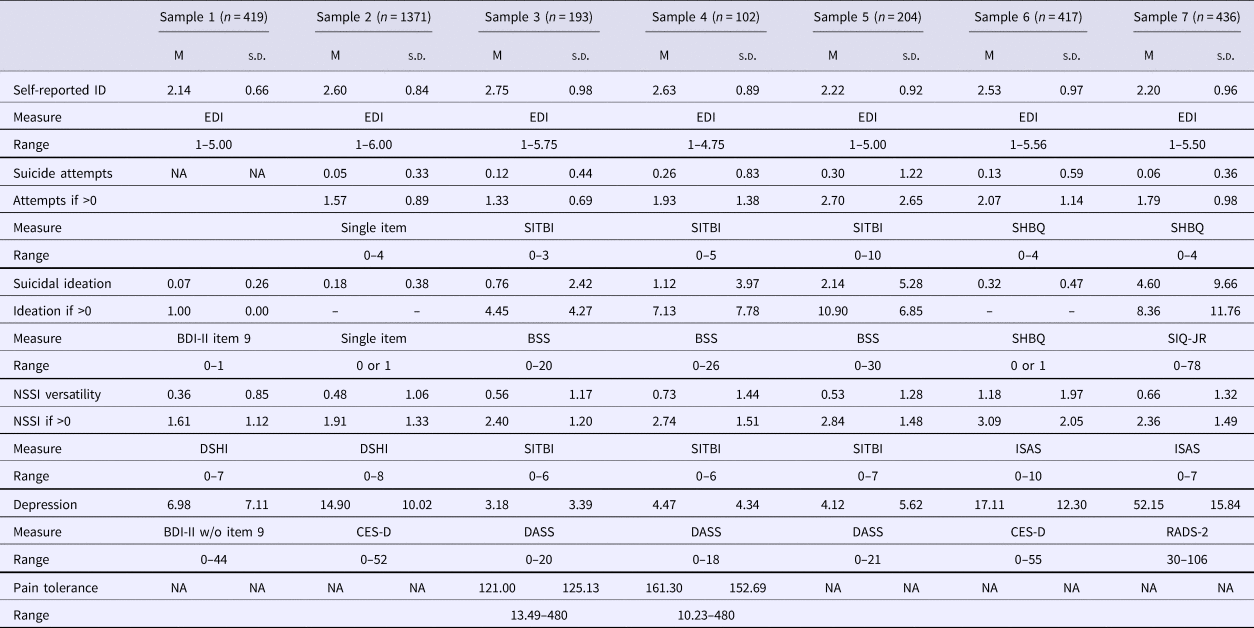
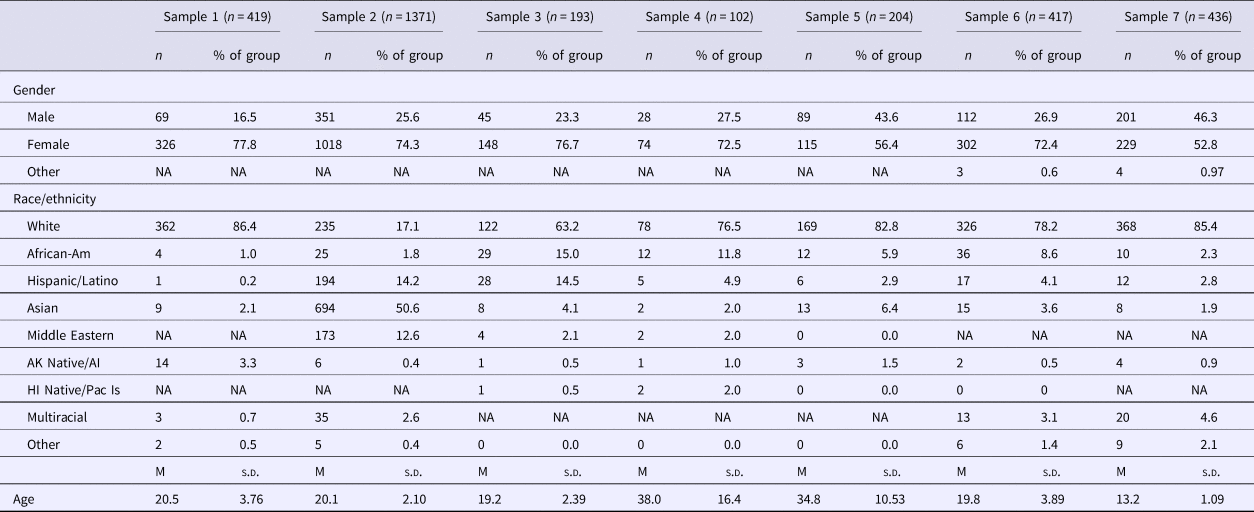
This study analyzed data from seven independent samples to conceptually replicate findings across samples. These samples were selected for secondary data analysis based on their inclusion of relevant measures; however, it is worth noting that none of these studies were originally designed to specifically test the hypotheses from this study. As described in the Measures section and summarized in Table 1, some variables were assessed using different measures and some variables (i.e. pain tolerance and suicide attempts) were not available in every sample. Each sample is briefly described below with demographic information summarized in Table 2. All studies were approved by the appropriate Institutional Review Boards prior to data collection.
Descriptive data

For full information on each measure used, including the full title of the measure, please see the Method section.
M, mean; s.d., standard deviation; ID, interoceptive deficits; NA, measure not available in this study; Suicide attempts, number of previous suicide attempts; Attempts/Ideation/NSSI if >0 includes the mean and standard deviation when limiting the sample only to those with a score >0; ‘Single item’ indicates that the construct was assessed using a single item that is not part of a larger scale (full text of these items is available in the Method section); NSSI versatility, number of self-injury methods endorsed; Range, actual reported range of scores.
Demographics

African-Am, African-American/Black; Ak Native/AI, Alaska Native/American Indian; HI Native/Pac Is, Hawaiian Native/Pacific Islander; M, mean; s.d., standard deviation; NA, response option not available in this study. In Sample 1, 5.7% of participants did not report gender or race. In Sample 2, 0.1% did not report gender, and 0.3% did not report race. In Sample 5, 0.5% did not report race.
Sample 1
Sample 1 includes 419 undergraduate students from a large Midwestern public university. Participants were recruited from all psychology department courses and invited to complete self-report questionnaires in a research laboratory in small groups as part of a larger study. Approximately 7.2% of data were missing at random in this sample, this reduced the n used to test the first hypothesis to 313 for this sample. Participants were compensated with course credit and local mental health resources were provided to all participants. Of these students, 7.2% reported suicidal ideation and 19.8% reported engaging in NSSI. Suicide attempt data were not available in this dataset, so this sample is not included in analyses testing our second and third hypotheses.
Sample 2
Sample 2 includes 1371 undergraduate students from a large Southwestern public university. Of note, this sample was primarily made up of Asian-American students (50.6%). Approximately 1.6% of data were missing in this sample. Participants answered questionnaires online as part of a larger study and were compensated with course credit. Of these students, 17.7% reported suicidal ideation and 24.9% reported engaging in NSSI. Among participants who reported a previous suicide attempt (n = 46), the mean number of attempts was 1.57 (s.d. = 0.89). Local and national mental health resource information was provided to all participants.
Sample 3
Sample 3 includes 193 undergraduate students from a large public university in the Southeastern USA. Participants completed questionnaires and a pressure pain assessment individually in a university laboratory for course credit. There were no missing data in this sample. Of these students, 17.1% reported suicidal ideation and 23.3% reported engaging in NSSI. Among participants who reported a previous suicide attempt (n = 18), the mean number of attempts was 1.33 (s.d. = 0.69). Local and national mental health resource information was provided to all participants.
Sample 4
Sample 4 includes 102 community members (exclusive of undergraduate students) from a mid-sized city in the Southeastern USA. Research procedures for this sample were identical to those of Sample 3, except that participants were compensated with a small gift card and a raffle entry for a tablet. There were no missing data in this sample. Of these community members, 15.7% reported suicidal ideation and 26.5% reported engaging in NSSI. Among participants who reported a previous suicide attempt (n = 14), the mean number of attempts was 1.93 (s.d. = 1.38).
Sample 5
Sample 5 includes 204 American participants from 40 of the 50 states recruited through Amazon's Mechanical Turk (MTurk) service. Many recent studies have utilized this recruitment system, and it has provided high-quality data (Buhrmester et al., Reference Buhrmester, Kwang and Gosling2011; Mason and Suri, Reference Mason and Suri2012). Participants completed this study online and were provided with a small financial incentive. Approximately 0.4% of data were missing in this sample. Of these adults, 19.6% reported suicidal ideation and 18.2% reported engaging in NSSI. Among participants who reported a previous suicide attempt (n = 23), the mean number of attempts was 2.70 (s.d. = 2.65). National mental health resource information was provided to all participants.
Sample 6
Sample 6 includes 417 university students enrolled in undergraduate psychology courses at a Southern public university. Participants were recruited from all psychology department courses and invited to come into the research laboratory to complete a packet of self-report questionnaires in small groups as part of a larger study. Participants received course credit for participation. Mental health services referral information and resources were provided to participants. Approximately 5.0% of data were missing in this sample. Of these students, 31.5% reported suicidal ideation and 38.0% reported engaging in NSSI. Among individuals who reported a suicide attempt (n = 28), the mean number of attempts was 2.07 (s.d. = 1.14)
Sample 7
Sample 7 includes 436 adolescents from public middle and high schools in the south-central region of the USA. Participants were recruited from seventh and ninth grades and completed self-report questionnaires at school as part of a larger study after parental consent was obtained. Adolescents received $10 for their participation. Participants who endorsed critical items on measures of suicide ideation and attempts were referred to school counselors for further assessment. Approximately 5.0% of data were missing in this sample. Of these adolescents, 55.0% reported suicidal ideation and 27.8% reported engaging in NSSI. Among adolescents who reported a suicide attempt (n = 14), the mean number of attempts was 1.79 (s.d. = 0.98).
Measures
Demographics
Data on gender (males coded as 1, females coded as 0), age, and racial/ethnic identity were collected through demographic questionnaires.
Interoceptive deficits
Self-reported ID were assessed through the nine-item Interoceptive Awareness subscale of the Eating Disorders Inventory-3 (EDI; Garner, Reference Garner2004). The research scoring procedures, in which participants provide responses on a six-point scale, were utilized in all samples to allow for a wider variety of responses compared with the truncated clinical scoring procedures. Samples 2–5 included an older version of the EDI (Garner et al., Reference Garner, Olmstead and Polivy1983). This version includes identical items to the EDI-3, with the exception of one missing item. Due to the discrepancy in item numbers, mean Interoceptive Awareness subscale scores were calculated (instead of a summed score) in each sample and used in analyses (possible range: 1–6). Cronbach's α values were good to excellent in all samples (α = 0.84–0.92).
Suicide attempts
Sample 1 did not assess suicide attempt history. Sample 2 utilized a single item question with the same wording as the item used in samples 6 and 7 from the Self-Harm Behaviors Questionnaire (SHBQ) to assess suicide attempt history. Lifetime number of suicide attempts were assessed using the Self-Injurious Thoughts & Behaviors Interview-Short Self Report Form (SITBI; Nock et al., Reference Nock, Holmberg, Photos and Michel2007) in Samples 3–5. The SITBI asks, ‘How many suicide attempts have you made in your lifetime?’ Samples 6–7 used the suicide attempt frequency item from the SHBQ (Gutierrez et al., Reference Gutierrez, Osman, Barrios and Kopper2001), which asks, ‘How many times have you attempted suicide?’ and has response options of ‘0’, ‘once’, ‘twice’, ‘three times’, and ‘four or more times’. The upper response was coded as four attempts in this study.
Suicidal ideation
Sample 1 utilized item 9 of the Beck Depression Inventory Second Edition (BDI-II; described below; Beck et al., Reference Beck, Steer and Brown1996) to assess suicidal ideation (possible range: 0–3). Sample 2 assessed suicidal ideation through a single item with a yes or no response option, coded 0 (no) or 1 (yes), ‘Have you ever seriously considered suicide?’ Samples 3–5 assessed suicidal ideation with the Beck Scale for Suicidal Ideation (BSS; Beck et al., Reference Beck, Steer and Ranieri1988). Nineteen items from this 21-item measure were included. Two items assessing suicidal behavior were excluded. Cronbach's α values were good to excellent in all three samples: α Sample 3 = 0.88; α Sample 4 = 0.88; α Sample 5 = 0.96 and the possible range of scores is 0–38. Sample 6 utilized the suicidal ideation item from the SHBQ (Gutierrez et al., Reference Gutierrez, Osman, Barrios and Kopper2001) which asks ‘Have you ever talked or thought about wanting to die? Killing yourself?’ A yes response to either question is coded as positive for suicidal ideation (i.e. ‘1’). Sample 7 utilized the Suicide Ideation Questionnaire-JR (SIQ-JR; Reynolds, Reference Reynolds1988) as a continuous measure of ideation. The SIQ-JR consists of 15 items that ask about thoughts related to suicide, death, dying, and making plans and preparations, rated on a 0–6 Likert scale ranging from ‘I never have this thought’ to ‘I have this thought every day’. The internal consistency of the SIQ-JR was high: α = 0.93 and the possible range of scores is 0–90.
Non-suicidal self-injury
NSSI was assessed using a measure of NSSI versatility, a count of the number of different methods an individual has used throughout their lifetime to engage in NSSI. This metric has been strongly linked to suicidal behavior in a number of studies (e.g. Muehlenkamp and Gutierrez, Reference Muehlenkamp and Gutierrez2007; Turner et al., Reference Turner, Layden, Butler and Chapman2013). Samples 1 and 2 obtained these data from the Deliberate Self-Harm Inventory (DSHI; Gratz, Reference Gratz2001), which assesses NSSI history (possible range: 0–15). Samples 3–5 utilized the SITBI (Nock et al., Reference Nock, Holmberg, Photos and Michel2007) to determine this information (possible range: 0–7). Samples 6–7 utilized responses from the Inventory of Statements About Self-Injury (ISAS; Klonsky and Glenn, Reference Klonsky and Glenn2009; possible range: 0–13). All NSSI methods endorsed were summed to create a total number of NSSI methods. Most of the methods described in these three measures are present in at least two of the three measures. All three measures include the most common forms of NSSI (e.g. cutting, burning, hitting). Some of the SITBI methods are combined (e.g. cutting and carving one's skin is a single option). The DSHI also includes a few rarely or never endorsed methods such as dripping acid onto one's skin. Each of these widely used assessment measures assess the same phenomenon of NSSI versatility, but break it into more or fewer specific categories.
Depression
In Sample 1, depression was measured using the BDI-II (Beck et al., Reference Beck, Steer and Brown1996) total score, excluding item 9, as item 9 was utilized as a dependent variable assessing suicidal ideation. The BDI-II is a well-validated, 21-item measure of depression symptom severity with a possible range of scores in this study of 0–60, and had a strong Cronbach's α value in this study (α = 0.90). In Sample 1, 77.1% scored in the minimal range (0–13), 7.4% in the mild range (14–19), 4.5% in the moderate range (20–28), and 1.7% in the severe (29–63) range.
Samples 2 and 6 used the Center for Epidemiological Studies Depression scale (CES-D; Radloff, Reference Radloff1977). The CES-D is a widely used, well-validated 20-item measure of depressive symptom severity, which demonstrated a strong Cronbach α value in these samples (α = 0.90, 0.93, respectively). It has a possible score range of 0–60 with scores at or above 16 indicating those at risk for clinical depression (Lewinsohn et al., Reference Lewinsohn, Seeley, Roberts and Allen1997). In Sample 2, 37.9% of participants scored in the at-risk range, and in Sample 6, 40.0% were at risk.
Samples 3–5 used the depression subscale of the Depression Anxiety Stress Scale (DASS; Henry and Crawford, Reference Henry and Crawford2005), a 21-item measure of depression, anxiety, and stress. This subscale has a possible range of scores from 0 to 21, and demonstrated good-to-excellent Cronbach's α values in all three samples (α Sample 3 = 0.85; α Sample 4 = 0.89; α Sample 5 = 0.96). Severity ranges are based on the doubled score for the 21-item version of the DASS used in these samples. In Sample 3, 75.1% scored in the ‘normal’ range (0–9), 9.3% in the mild range (10–13), 9.3% in the moderate range (14–20), 5.7% in the severe range (21–27), and 0.5% in the extremely severe range (28–42). In Sample 4, 61.8% scored in the ‘normal’ range, 12.7% in the mild range, 14.7% as moderate, 4.9% severe, and 5.9% as extremely severe. In Sample 5, 69.1% scored in the ‘normal’ range, 6.4% as mild, 10.3% moderate, 4.4% severe, and 9.8% as extremely severe.
Sample 7 assessed depression with the Reynolds Adolescent Depression Scale – Second Edition (RADS-2; Reynolds, Reference Reynolds2002). The RADS-2 is a widely used 30-item measure of depressive symptoms that has been validated for use with adolescents, with excellent reliability in the current sample (α = 0.94), and a possible range of 30–120, with scores at or above 76 representing those at risk for clinical depression. In Sample 6, 9.4% of adolescents scored above the cut-off.
Pain tolerance
Pain tolerance was assessed with a pressure algometer that applies pressure to the back of a participant's middle finger. This algometer's 755 g mass at a blunted tip was applied to the non-dominant middle finger between the central knuckles. Given the design of this tool (i.e. a uniform amount of pressure is constantly applied), tolerance was measured as the amount of time that passed until the participant reached their maximum pain tolerance and lifted the weight off of their finger, with a maximum time of 8 min. The algometer used in these studies was built to match the specifications of algometers that have been previously used in psychological research (Hooley and St. Germain, Reference Hooley, St Germain and Nock2014). These data were only available from Samples 3 and 4.
Data analytic strategy
Linear multiple regression analyses were conducted to test the first hypothesis assessing the relationship between self-reported ID and suicidal ideation using SPSS version 24. Analyses for Samples 2 and 6 utilized logistic regression analyses as the suicidal ideation variable was a dichotomous question. In all models, suicidal ideation was entered as the dependent variable with self-reported ID, NSSI versatility, depression scores, gender, and age included as independent variables. NSSI versatility, gender, age, and depression scores, which were assessed in all samples, were entered as covariates to control for possible differences in suicidal ideation based on gender and age (as these variables differed notably between some samples) and for known differences in suicidal ideation among those with and without depressive symptoms and a history of NSSI engagement (May and Klonsky, Reference May and Klonsky2016). Carlson and Wu (Reference Carlson and Wu2012) recommend including only covariates that have significant associations with predictor variables. NSSI versatility and depression scores were correlated with self-reported ID in all samples, and gender and age were each correlated with self-reported ID in four out of the seven samples. Given our primary goal of evaluating the role of self-reported ID in suicidal ideation and providing clearly comparable analyses across these seven samples, all four covariates were included in each test of this hypothesis. Missing data in each sample were handled with listwise deletion. The model effect size for each sample is reported as well.
To test the second hypothesis assessing the possible indirect role of self-reported ID in suicidal actions through NSSI, NSSI versatility was entered as a mediator between self-reported ID and suicide attempts using zero inflated negative binomial (ZINB) analyses in MPlus Version 6.11. Finally, to test the third hypothesis that the indirect effect of self-reported ID operates through NSSI versatility and then through pain tolerance on suicide attempts, we conducted a ZINB indirect effects model in MPlus version 6.11. We utilized maximum likelihood estimation with robust standard errors when testing both the second and third hypotheses.
Results
Data summarizing means and standard deviations of data from all samples are included in Table 1. Correlations between these variables are presented for each sample in online Supplementary Tables S1–S4Footnote †Footnote 1.
The first hypothesis predicted that self-reported ID would be directly associated with suicidal ideation beyond the effects of gender, age, NSSI versatility, and depression. Sample 1, composed of Midwestern public university students supported this hypothesis, finding that only self-reported ID and depression scores significantly accounted for variation in suicidal ideation [F (5,308) = 22.99, p < 0.001; R 2 = 0.27Footnote 2; see Table 3]. Sample 7 was the only other sample that supported this hypothesis [F (5,342) = 76.86, p < 0.001; R 2 = 0.52; see Table 3]. In Sample 7, an adolescent sample, depression, and NSSI versatility were significant indicators of ideation, and self-reported ID accounted for unique variance in ideation above and beyond the covariates.
Regression analyses predicting suicidal ideation

*p < 0.05; **p < 0.01; ***p ⩽0.001.
ID, interoceptive deficits; NSSI, non-suicidal self-injury versatility; Gender, male coded as 1, female as 0; β, standardized β; s.e., standard error; OR, odds ratio.
In Sample 2 (Southwestern university students), Sample 3 (Southeastern university students), and Sample 5 (MTurk workers), only depression and NSSI versatility accounted for significant variance in suicidal ideation. Sample 2 produced a full model accounting for approximately 20% of variation in suicidal ideation [Nagelkerke Pseudo R 2 = 0.20; χ2(5) = 164.56, p < 0.001]. The full model from Sample 3 accounted for only 10% of suicidal ideation variance [R 2 = 0.10; F (5,187) = 4.05, p = 0.002] but Sample 5 accounted for nearly 58% of suicidal ideation variance [R 2 = 0.58; F (5,192) = 51.97, p < 0.001]. The model for Sample 4 (Southeastern community residents) accounted for 40% of the variation in suicidal ideation, but this effect was driven by depression scores and gender; neither NSSI versatility nor self-reported ID were significant indicators of suicidal ideation in this sample [R 2 = 0.40; F (5,96) = 12.65, p < 0.001]. In Study 6, gender, depression, and NSSI versatility accounted for significant variance in ideation [χ2(5) = 98.85, p < 0.001; Nagelkerke Pseudo R 2 = 0.37; see Table 3].
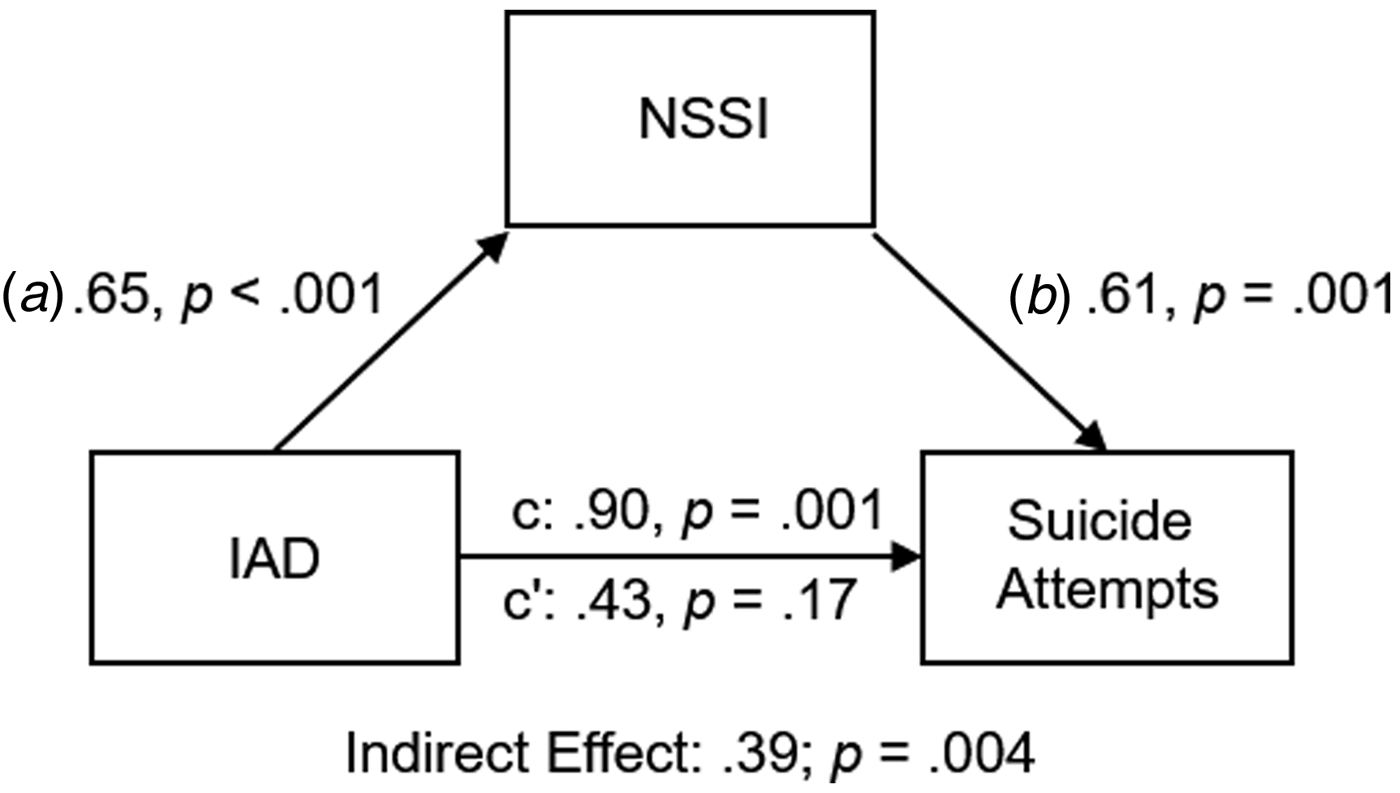
The second hypothesis states that self-reported ID play an indirect role in suicidal actions (i.e. number of suicide attempts) through NSSI versatility. Table 4 includes data from each step of the indirect effects analyses for each of the six samples used to test this hypothesis (Sample 1 was excluded because it did not include an evaluation of suicide attempt history). Figure 1 illustrates the results from Sample 5 as an example of the visual representation of these analyses. Results from most samples found statistically significant indirect effects of self-reported ID on suicide attempts through NSSI, supporting our hypothesis with the exceptions of Sample 4, the Southeastern community sample, and Sample 7, the adolescent sample.
Visual representation of the indirect effects analyses. Data are reported from Sample 5.

Indirect effects of self-reported interoceptive deficits on suicide attempts through NSSI versatility

NSSI, non-suicidal self-injury versatility; SA, suicide attempt; B, unstandardized β; IRR, incidence rate ratios.
The final hypothesis states that in addition to self-reported ID exerting an effect on suicide attempts through an effect on NSSI, NSSI additionally affects suicide attempts indirectly through elevated pain tolerance. Only Samples 3 and 4 included an assessment of pain tolerance, so this hypothesis was only tested in those two samples. First, in Sample 3, self-reported ID were significantly associated with NSSI versatility (β = 0.21, p = 0.003, IRR = 1.23). However, self-reported ID and NSSI were each unrelated to pain tolerance (β = 0.07 and 0.10, p = 0.43 and 0.22, IRR = 1.07 and 1.11, respectively), and self-reported ID (β = 0.15, p = 0.646, IRR = 1.16), NSSI versatility (β = 0.74, p = 0.507, IRR = 2.10), and pain tolerance (β = 0.53, p = 0.486, IRR = 1.70) were unrelated to the presence of a lifetime suicide attempt after taking into account excess zeros using the ZINB analysis. The indirect effect of self-reported ID on pain tolerance through NSSI versatility (B = 2.56, s.e. = 2.36, p = 0.28, IRR = 12.94) and of NSSI versatility on suicide attempts through pain tolerance (B = 0.03, s.e. = 0.04, p = 0.46, IRR = 1.03) were non-significant. Similarly, in Sample 4, self-reported ID were positively related to NSSI versatility (β = 0.31, p = 0.004, IRR = 1.36), and self-reported ID (β = −0.05, p = 0.60, IRR = 0.95) and NSSI (β = 0.05, p = 0.63, IRR = 1.05) were each unrelated to pain tolerance. Furthermore, self-reported ID (β = −0.11, p = 0.948, IRR = 0.90), NSSI versatility (β = 1.01, p = 0.935, IRR = 2.75), and pain tolerance (β = −0.19, p = 0.935, IRR = 0.83) were not related to the presence of a lifetime suicide attempt after taking into account excess zeros using the ZINB analysis. As in Sample 3, the indirect effect of self-reported ID on pain tolerance through NSSI versatility (B = 2.58, s.e. = 5.52, p = 0.64, IRR = 13.20), and of NSSI versatility on suicide attempts through pain tolerance (B = 0.01, s.e. = 0.02, p = 0.69, IRR = 1.01), were non-significant.
In summary, results from adult samples generally found that self-reported ID are not directly associated with suicidal ideation, but that they are indirectly connected to suicide attempts through NSSI versatility. Conversely, in our one adolescent sample, self-reported ID were associated with suicidal ideation beyond the effect of multiple covariates but were not indirectly associated with a history of suicide attempts. Finally, the indirect path from self-reported ID to suicide attempts does not appear to flow through NSSI and then through pain tolerance in the two adult samples we tested, contrary to previous, similar evaluations of this pathway.
Discussion
This study sought to understand the role of self-reported ID on suicidal ideation and behavior in a variety of samples, distinct from the severely eating disordered samples in which the relationship between ID and suicide ideation and behavior is often studied. We tested three hypotheses, first that self-reported ID would be directly and independently associated with suicidal ideation beyond the effects of gender, age, NSSI versatility, and depression. Second, we predicted that self-reported ID would play an indirect role in suicidal actions, through direct effects on NSSI versatility. Finally, we tested an alternative indirect pathway from self-reported ID to suicide attempts through NSSI versatility and then through behaviorally assessed pain tolerance.
Overall, Hypothesis 1, which predicted a direct association between self-reported ID and suicidal ideation, received mixed results. Only data from Samples 1 and 7 supported this hypothesis when including gender, age, NSSI versatility, and depression as covariates. Additionally, the strength of the effect of self-reported ID on suicidal ideation was the weakest of all statistically significant variables in both samples. Sample 1 utilized a single-item measure of suicidal ideation that had limited variability (i.e. item 9 from the BDI-II), which may have accounted for the divergent results from the other adults samples. However, this single item has previously been used to assess suicidal ideation (Anestis et al., Reference Anestis, Bagge, Tull and Joiner2011; Venta et al., Reference Venta, Mellick, Schatte and Sharp2014), and Sample 2 also used a single-item measure of ideation but did not provide support for this hypothesis. Sample 7 was a sample of adolescents, so the divergent findings of this sample may indicate that self-reported ID have a different relationship with suicidal ideation in adolescents compared with adults. Based on the five study samples that did not support this hypothesis, which include over 2200 unique individuals, self-reported ID do not appear to be directly associated with suicidal ideation beyond the effects of gender, age, depressive symptoms, and NSSI versatility for adults. The significant finding from Sample 7 may indicate that there is a direct association in adolescents, but replication and additional research are needed to confirm this finding, and to compare possible age-related differences in the relationship between self-reported ID and suicidal ideation between adolescents and adults.
Four of five tested adult samples (three geographically diverse undergraduate samples and one diverse community sample) supported the second hypothesis, which predicted an indirect effect between self-reported ID and suicide attempts through NSSI versatility. While the adolescent sample (i.e. Sample 7) did not show a significant indirect effect, it should be noted that the indirect effect of self-reported ID on suicide attempts through NSSI versatility approached significance in this adolescent sample (p = 0.09). A more clinically based sample of adolescents may result in a significant indirect relationship between these variables. This topic merits more attention in future research endeavors.
The hypothesis that these indirect effects would act on suicidal behavior through behaviorally assessed pain tolerance, consistent with Dodd et al.’s (Reference Dodd, Smith, Forrest, Witte, Bodell, Bartlett, Siegfried and Goodwin2018) finding of an indirect effect through self-reported pain tolerance, was not supported in either the Southeastern undergraduate or the community-based sample, which was the one adult sample to not find a significant indirect effect in the second hypothesis. The use of a behavioral measure of pain tolerance (i.e. blunt pressure pain tolerance) in these two samples did not support an indirect role of pain tolerance on suicide attempts. This indicates that although self-reported ID appear to act on suicide attempts through NSSI versatility, that link does not appear to be due to increased levels of pain tolerance. Self-reported ID may be another component of the breadth of ways in which individuals are predisposed to have an elevated capacity for suicidal behavior. Phenomena including having an outsider's perspective of one's own body and having low body regard, which have been shown to moderate risk for NSSI (Muehlenkamp et al., Reference Muehlenkamp, Swanson and Brausch2005, Reference Muehlenkamp, Bagge, Tull and Gratz2013), may also influence this relationship.
Our findings that self-reported ID were not associated directly with pain tolerance also diverges from previous research, which support a link between ID and pain tolerance (Pollatos et al., Reference Pollatos, Füstös and Critchley2012; Weiss et al., Reference Weiss, Sack, Henningsen and Pollatos2014). These differences may be due to differences in the assessment of ID (i.e. this study used a self-report measure that primarily assesses awareness of emotional experiences, rather than an assessment of accuracy of heartbeat detection) and the use of samples of relatively healthy undergraduates and adults rather than a study of somatoform patients and healthy controls.
Overall, results from six adult samples largely (with the exception of one undergraduate sample) found that self-reported ID are not directly associated with suicidal ideation, but that they are indirectly connected to suicide attempts through NSSI versatility, with the exception of one community-based sample. These findings that self-reported ID appear to be specifically associated with suicidal behavior and not suicidal ideation in adults indicates that self-reported ID may be one of few identified indicators of risk for suicidal behavior. Future studies should seek to determine how self-reported ID best fits into theoretical conceptualizations of capacity for suicide (e.g. as an acquired and/or dispositional factor). Although self-reported ID appear to primarily increase risk through greater NSSI versatility, it does not appear that this occurs due to increases in pain tolerance. One way in which this may occur could be through an effect on diminished body regard and a feeling of disconnection from one's body which then reduces psychological barriers against harming oneself, making NSSI more likely. These possibilities all require testing in future studies.
Assessments of ID may be able to provide a non-face valid way of assessing suicide risk (within the context of a broader suicide risk assessment) to which individuals who want to conceal suicidal thoughts or behaviors may be willing to respond. Additional research is needed to explore potential mechanisms connecting ID to suicidal behavior and the potential utility of using ID assessments as a non-face valid measure of increased suicide risk.
Although these results will need replication, especially within broad clinical samples, preliminary clinical implications can be proposed. Consistent with other studies (Nock et al., Reference Nock, Joiner, Gordon, Lloyd-Richardson and Prinstein2006; Muehlenkamp and Gutierrez, Reference Muehlenkamp and Gutierrez2007), NSSI versatility was correlated with suicidal behavior in all our samples. Clients with a significant or ongoing NSSI history should be regularly assessed for suicide risk with a thorough suicide risk evaluation (see Chu et al., Reference Chu, Klein, Buchman-Schmitt, Hom, Hagan and Joiner2015). Furthermore, among these clients, an assessment of their awareness of and the accuracy of their interoceptive experiences may be useful. For those with ID, training to be more aware and mindful of their bodily signals, such as is used in treatments for anxiety (Barlow et al., Reference Barlow, Allen and Choate2016; Blakey and Abramowitz, Reference Blakey and Abramowitz2018) and in Dialectical Behavior Therapy (Linehan, Reference Linehan1993), may be clinically useful for reducing suicide risk.
This study's primary strength is that it includes seven independent and diverse samples from different regions of the USA, providing improved generalizability of the results to the population at large. This is also one of a few studies examining the role of self-reported ID on suicide to include samples that are not exclusively limited to women with eating disorders. As these studies were each implemented independently as parts of other research endeavors, different measures were used to assess the variables of interest. The consistency of the findings across different measures shows that these findings may reflect true effects.
Although this study used a wide sample of over 3000 individuals, it is limited in that none of the included samples were from a clinical population; further research in clinical samples is needed. This study was also limited by the self-report (with the exception of behaviorally assessed pain tolerance), cross-sectional design used in all samples. This prevents our ability to determine temporal precedence and causality of the variables assessed in this study. Additionally, these studies were designed to test other hypotheses and were not originally designed to test the hypotheses included in this article. Future studies would benefit from including behavioral measures of interoceptive abilities such as a heartbeat detection test. Furthermore, changes in ID (and any related change in pain tolerance) over time, especially during the transition from adolescence to adulthood should be investigated. Additionally, although gender was included as a covariate, these analyses were not conducted independently for men and women. Future studies would benefit from explicitly testing these relationships to determine if they function differently in men and women.
Finally, our study was limited in that each sample utilized a self-report measure of ID that was designed for use in relation to disordered eating (i.e. the Eating Disorder Inventory) and which only assesses one facet of interoceptive abilities (i.e. awareness of emotional experiences; Khalsa et al., Reference Khalsa, Adolphs, Cameron, Critchley, Davenport, Feinstein, Feusner, Garfinkel, Lane, Mehling, Meuret, Nemeroff, Oppenheimer, Petzschner, Pollatos, Rhudy, Schramm, Simmons, Stein, Stephan, Van den Bergh, Van Diest, von Leupoldt and Paulus2018). However, as noted by previous research, interoceptive awareness is multidimensional (Mehling et al., Reference Mehling, Price, Daubenmier, Acree, Bartmess and Stewart2012) and perceived interoceptive awareness does not always correspond to actual interoceptive awareness (Garfinkel et al., Reference Garfinkel, Seth, Barrett, Suzuki and Critchley2015). Facets of interoceptive awareness likely relate to suicide risk differentially, as demonstrated by Rogers et al. (Reference Rogers, Hagan and Joiner2018), who found that suicide attempters, but not suicide ideators, had a greater tendency to ignore or distract themselves from bodily sensations, less self-regulation using body sensations, and less trust of their body sensations compared with those without a history of suicidal ideation or attempts. These facets may similarly relate more strongly to NSSI and pain tolerance than the type of interoceptive awareness assessed by the Interoceptive Awareness subscale of the EDI, which primarily contains items pertaining to interoceptive emotional awareness. Thus, future work should integrate multidimensional assessments [e.g. heartbeat perception tests and the Multidimensional Assessment of Interoceptive Awareness (Mehling et al., Reference Mehling, Price, Daubenmier, Acree, Bartmess and Stewart2012), a self-report measure that assesses a variety of interoceptive components] to further elucidate the nature of the associations between ID, NSSI, pain tolerance, and suicidal behavior across the range of interoceptive facets including attentional biases, distortions of physiological sensitivity, cognitive biases, and insight impairments. As interoception is currently understood to be a multi-faceted, complex way in which the nervous system processes internal stimuli, with numerous potential overlapping elements with how emotion and pain are processed (Khalsa et al., Reference Khalsa, Adolphs, Cameron, Critchley, Davenport, Feinstein, Feusner, Garfinkel, Lane, Mehling, Meuret, Nemeroff, Oppenheimer, Petzschner, Pollatos, Rhudy, Schramm, Simmons, Stein, Stephan, Van den Bergh, Van Diest, von Leupoldt and Paulus2018), many aspects of interoception remain to be assessed in the context of suicide risk. Specific interoceptive symptoms have been implicated in numerous psychiatric disorders including panic disorder, somatic symptoms disorders, eating disorders, post-traumatic stress disorder, and autism spectrum disorders. While some specific symptoms overlap between disorders (e.g. failure to anticipate changes to interoceptive states in mood and anxiety disorders), other situations may involve a unique constellation of interoceptive symptoms specific to the individual and disorder (see Khalsa et al., Reference Khalsa, Adolphs, Cameron, Critchley, Davenport, Feinstein, Feusner, Garfinkel, Lane, Mehling, Meuret, Nemeroff, Oppenheimer, Petzschner, Pollatos, Rhudy, Schramm, Simmons, Stein, Stephan, Van den Bergh, Van Diest, von Leupoldt and Paulus2018 for a brief review). Research remains to be conducted on the specific interoceptive symptoms that define the relationship between ID and suicide based on an expanded conceptualization of interoception that includes multifaceted assessments that go beyond self-reported ID and a focus on awareness of emotional experiences.
Conclusion
This study, incorporating seven independent samples, largely found that among adults, self-reported ID are not uniquely associated with suicidal ideation beyond other relevant factors, but are associated with suicide attempt history indirectly through NSSI versatility and not through behaviorally assessed physical pain tolerance. Furthermore, self-reported ID are associated with suicidal ideation in adolescents. Awareness of and treatments addressing ID in the context of NSSI and suicide risk may be beneficial, even outside of the eating disordered patient populations in which ID have typically been studied.
Author ORCIDs
Christopher R. Hagan 0000-0001-5603-7433
Financial support
Support from NIGMS Grant #8P20GM103436-14 was used in the collection of data for Sample 7.
Supplementary material
The supplementary material for this article can be found at https://doi.org/10.1017/S0033291718003872.