

Background
The Post Anaesthetic Care Unit (PACU) is a dynamic, acute clinical area where patient numbers and acuity may fluctuate rapidly due to any number of variables, which are often difficult to control, for example delayed discharge and change in theatre lists. Staff to patient allocation requires constant juggling to ensure that numbers and skill mix are appropriate to ensure the safety of all patients throughout their stay. Staffing the PACU remains an intractable problem for managers as they seek to overcome obstacles which may prevent the constant onward flow of patients back to wards. Often staff numbers and skills are inadequate to safely maintain numbers – staff may be asked to work overtime and this may have an impact on staff morale as stress, fatigue and sickness kick in, thus causing even more staffing issues. Sheward et al [Reference Sheward2005] demonstrated a significant relationship between nurse–patient ratios and emotional exhaustion.
On the basis of UK practice, there is a serious shortfall of literature on staffing the PACU, together with evidence from audit on staffing management in the PACU. In November 2009, British Anaesthetic and Recovery Nurses Association (BARNA) held a round table event in London with members and non-members to discuss these issues. A second seminar was held in Manchester in March 2010. A summary of the ideas arising from these sessions was published in an article in this journal [Smedley, Reference Smedley2010]. As a result of these seminars, it was decided to conduct a national audit on staffing to more fully understand the problems facing PACU units all over the country in this regard.
Audit design
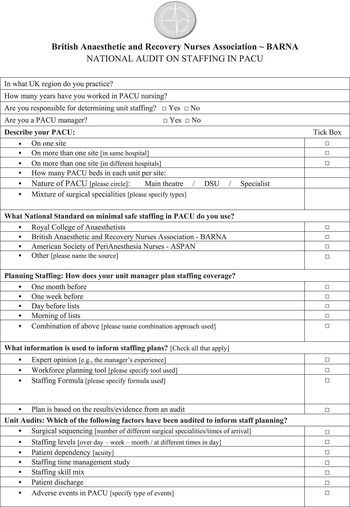
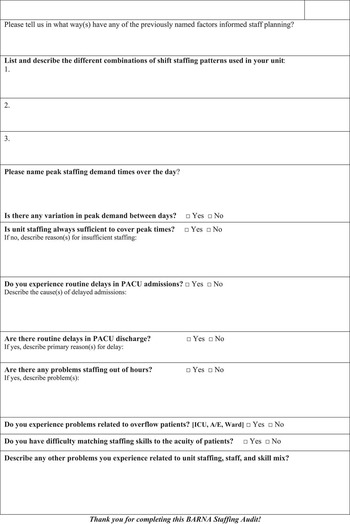
The audit was broad based and incorporated details on demographics, staffing standards, strategies for staffing, shift patterns and routine problems encountered in everyday practice (See copy of Audit in Appendix 1). A total of 150 audit sheets were distributed and returned over 2010–2011. One hundred audits were returned.
The results are given here below. Implications for practice are considered alongside ideas for both raising the profile on staffing and for developing tools and strategies to assist PACU managers with staffing problems. Evidence both from literature and from the Delayed Discharge [Bishop and Llewellyn, Reference Bishop and Llewellyn2012] printed alongside this article in the journal are used throughout to elucidate points made, where relevant reference is also made to points raised during the two BARNA Talks seminars.
Audit responses
Demographic questions
Of the responses received, these were spread fairly evenly throughout the United Kingdom and the Republic of Ireland. Similarly, the range of experience within PACU nursing was evenly spread with over 42% of respondents having worked for <10 years, 32% for 10–20 years and 26% for over 20 years. Of the respondents, 45% were responsible for determining unit staffing and 55% were not, while 37% were PACU managers and 63% were not. Although interest from Unit managers would be expected with regard to a staffing audit, the high return of audits from non-managers who did not set staffing would imply that the staffing issue is one that impacts on all PACU practitioners.
PACU facilities
Forty-eight percent of respondents reported working on one site only and 44% reported working on more than one site in the same hospital. A small percentage of 6% reported working on more than one site in different hospitals and 2% were working in freestanding PACU units. The diversity of PACU sites may lead to day-to-day problems with staff utilisation (both in numbers and skill mix) if staff are needed to transfer from one site to another to help out with lunch relief and so on.
The number of beds cited in each PACU unit varied from 2 to 22 beds with fairly even distribution between three categories as below:
• 2–6 beds per site
• 7–12 beds per site
• 15–22 beds per site.
Although no direct correlation between unit size and problems cited in the audit could be made, it did at least confirm a good spread of size of individual PACUs in this information. Certainly it is true that while a large unit contains many diverse staffing pressures and complexities – a small two-bedded unit can also face its own staffing shortfalls and problems. Of these sites, the majority of PACUs were situated in main theatres (59%), with 22% specialist units and 19% day surgery PACUs. Most surgical specialities were noted in the audits returned and many working in main theatre listed a wide variety of surgical interventions performed.
Overall, it was felt that the respondents represented a good cross section of the PACU sites, size, speciality and variety in surgeries performed within this clinical speciality. Each one of these factors affected staff planning and skill mix and validated the audit while providing some interesting information.
Planning staffing
Use of staffing standard
The majority of respondents (47%) used the PACU staffing levels advised by the Royal College of Anaesthetists [2009] while 29% used BARNA Staffing Standards [2005]. Eighteen percent did not use any Standard against which to set Staffing, 5% used the AfPP Standard [2008] and the remaining 1% used the American Society of Peri-Anesthesia Nurses’ (ASPAN) Standard [2010].
The 2009–2010 round table events (BARNA Talks) recorded that minimal safe staffing standards are essential as a start point to audit variables that affect staffing. Negotiation with senior management for more staff in the PACU can be done far more effectively with a respected minimal staffing standard paired with local audit results to frame discussion.
The audit results implied that PACU practitioners are aware of a diversity of minimal safe staffing standards set to inform practice and against which audit may be used to measure performance. The disparity in the use of different standards, however, suggests that not one staffing standard is used routinely in practice. Does this mean that PACU units are working differently from each other in practice? If so, how does this impact on the care given? How great is the need for universal use of a well known and respected national minimal safe staffing standard, which PACU managers would automatically use? Respect for the authority of any standard must rest with the reputation of the institution setting that standard. The Royal College of Anaesthetists (RCOA) is a highly respected body and it is perhaps not surprising that their standard is well known and trusted with consequent high score on use. This corroborated the viewpoint expressed at BARNA Talks that the RCOA staffing standard was the most authoritative and was widely used [Smedley, Reference Smedley2010].
The results of this audit, together with information from BARNA Talks, will be put towards reformulating the BARNA standard on minimal staffing levels using the BARNA website (barna.co.uk) as the most readily available portal for busy practitioners to access. Staffing the PACU is an ongoing problem area for managers and the drive must be towards a universally accepted minimal safe staffing standard, which yields significant authority in planning or changing PACU staffing provision.
Rota planning
The majority of respondents (61%) planned staffing one month in advance with 26% planning rotas a week ahead. Thirteen percent reported planning or changing staffing one day before or on the morning of the list. In addition, 33% reported using a variety of the above. This would seem to imply that even the best laid plans can go awry. Forward planning even a week before does not always reflect a changing situation on any one morning as theatre lists may be cancelled or delayed, staff call in sick or the unexpected occurs. These data would appear to corroborate the view of the participants in BARNA Talks who stated that managers used expert opinion to plan staff ratios a month ahead, but that changes were routinely made the day before or on the day in question.
Tools used to inform rota planning
Seventy nine respondents cited that the PACU manager's expert opinion was the main tool in developing staffing plans. Workforce planning tool was used by 10 and staffing formula by 14. Six cited audit and 10 did not fill in this section at all. Numbers are given here as respondents ticked more than one box in this category. It was interesting to note that the manager's expert opinion was still by far the most validated tool to inform staffing.
The PACU manager combines intricate knowledge of the flow patterns through the unit, anaesthetic/surgeons performance, set against her nurse's skills. Not one formula could ever match this specialist knowledge. Although there have been a number of workforce tools available in nursing, they usually are appropriate to more static patient populations such as wards and intensive care unit (ICU). Smedley [Reference Smedley2010] writes both of the complexity of some formulae and tools developed in planning staffing for clinical areas. Waters and Andalo [Reference Waters and Andalo2003] see the necessity for staffing solutions that need to be practical, accessible and seen to make a positive difference. It may be useful to make available workforce planning formulae that may be appropriate to inform PACU staff planning. Although research into this area is in its infancy, there is no doubt that in future years, as PACU is recognised as a distinct acute clinical speciality with its own unique problems, more appropriate tools may be developed. The days where the manager's expert opinion were enough are numbered as Hurst [Reference Hurst2003] writes: ‘I think the days are now over where nurses can use professional judgement as a solitary tool. But it still has a life if it is used in tandem with another workforce planning method’.
Use of audit to inform staff planning
Six of the hundred respondents said that they used audit to inform staff planning. All varieties of audit were fairly evenly distributed. Again numbers are given as respondents ticked more than one box:
• 27: surgical sequencing
• 47: staffing levels
• 31: patient dependency
• 9: staffing time management
• 40: staffing skill mix
• 23: patient discharge
• 5: adverse events
• 23: no response.
It was encouraging that so many respondents indicated he/she had been involved in auditing any one of the above variables that affect staffing and skill mix. In order to plan staffing as accurately as possible, audit is the only proven method to accrue evidence that there is a problem or weakness in current staffing strategy that needs to be rectified. Often more than one audit is needed to make the point. Dexter et al [Reference Dexter2005] advised routine audit on discharge, surgical scheduling and match of staff numbers to patients. Furthermore, he advised that staffing audit should be carried out over a specified period such as 3 months, and indeed be ongoing and routine using built-in IT systems to facilitate this. He noted a marked improvement of performance by increasing the period of audit. It is interesting that so few have audited ‘adverse events’. This may be due to the fact that adverse events are not anticipated and routine audit built into any system would not accommodate them. However, a retrospective audit of any adverse event could cast light on significant detail around staffing or skill mix and should be considered.
Of the audits carried out, some respondents reported that audit had helped illuminate on the following problem areas:
• Identified staffing level and skill mix required at peak times
• Diagnosed bottleneck caused by delayed discharge
• Analysed whether patient preoperative status could be audited to predict patient acuity
• Provided insight into training and need for mentors being available to instruct.
Audit is so important a tool in analysing staffing problems and accruing evidence to inform and change staffing ratios that it would be useful for BARNA to make available on its website standard audits around known variables that cause staffing problems. It must be noted that audit informs staffing solutions, the solutions themselves are formulated in the majority of cases by expert opinion while the use of workforce formulae suitable for PACU remains in its infancy.
Shift patterns
A perplexing variety of shift patterns were cited by the survey respondents with the majority being a mixture of long and short days.
• Long days
• Short days
• Half days
• Two or three shifts in a day
• Staggered shifts
• Night shift
• On-call arrangements.
The many varieties of shift patterns reflect the need to stagger PACU staff to match the expected periods of high activity and to ensure that PACU is safely staffed during any 24-hour period.
Where the PACU is not large enough to employ dedicated PACU night staff, on-call systems are in place. However, for the majority of units – the need to have specialist PACU staff from early morning to late at night is evident. Staffing out of hours was signified to be a real problem: only 14% of respondents run an on-call list, but this could still cause problems if theatres are overrunning or staff call in sick. Of those who do not run an on-call list and do not have designated PACU or anaesthetic nurses on site – safety in practice must be queried. On-call arrangements need to be investigated more thoroughly with the possible further audit on this area and development of a position statement.
Peak staffing times
Peak staffing times across hospitals were quite varied, with 40% indicating that lunchtimes are busy because morning sessions overrun. Sixty percent of respondents indicated that the early evening is also a demanding time for staff as afternoon lists overrun, and in some hospitals evening lists are just beginning. Seventy-four percent indicated that these peak times vary across the days of the week, which may depend on the variety of surgical specialities operating. Eighty-one percent declared that staffing was not always sufficient to cover peak times while 19% said it was. This would seem to signify that despite the many varied shift patterns used to stagger staff during the day in order to ensure that peak times are covered, the strategy was not always succeeding. It reflects the extreme difficulty of covering all the variables that interplay to affect staffing and the difficulty in getting one fit. Respondents cited a number of reasons for these low staffing levels to include:
• Insufficient staff (staff training, sickness, maternity leave, jobs not filled)
• Flow problems (delayed discharge, patient's arriving together)
• Patients added to list – overrunning
• Step-down patients (from ICU, High Dependency Unit (HDU) and Accident and Emergency (A/E)
• Official breaks
• One unit did not report problems, as staff members were ‘very flexible’.
These are familiar comments to anyone experienced in PACU nursing. All variables cited above could be included in a general or more focussed audit, and such audits are essential if hard evidence is to guide staffing levels designed to avoid obvious shortfalls.
Routine delays in PACU admission
There was a fairly even distribution here with 58% saying they did experience delays and 42% saying they did not. Comments included the following:
• Surgeons starting lists late
• No beds for surgical patients
• Lists delayed due to equipment problems
• Patient preparation delayed in ward/wards not collecting patient/communication problems with ward/PACU nurse has to deliver patients to the ward, thus leaving unit understaffed for 20 minutes and unable to accept admissions
• Pre-booking theatre spaces – no flexibility in giving this space to another patient
• No space in PACU – as patients are unable to return to the ward due to unavailability of beds or nurses being too busy
• Beds blocked by ICU patients.
A good percentage of the reasons given for delayed admission are in fact caused by delayed discharge from PACU due to insufficient beds and other factors (see next section on discharge). Where the delay in admission is caused by pre-PACU reasons such as surgical scheduling then it is in some sense, a simpler matter to audit the order of surgical patients into PACU to see where bulges in admission occur. This direct assessment could reasonably cast light on the problem. Dexter et al [Reference Dexter2005] emphasised the point that the order of surgical patients can optimise bed space and staff use in PACU.
How can the PACU manager influence surgical scheduling where surgeons are protective of his/her surgical time and accustomed to personal routines? It would be interesting to interview PACU managers to see how they use ‘soft’ bargaining power vis a vis their perioperative colleagues. Although we seek rationale and formulae in today's health management, the reality on the shop floor is often complicated by clash of personalities and unexpected events, which have to be accommodated. A qualitative audit to probe manager's skills and solutions within this area would be rewarding.
Routine delays in patient discharge
Ninety-five percent of audit participants cited routine delays in discharge while 5% stated they had none a decisive result indicating the high level of problems in routine discharge from PACU.
Problems listed were as follows:
• Insufficient ward staff to collect patients and lack of PACU staff to escort patients back
• Failure of ward staff to collect on time
• Anaesthetic review delays – delay as awaiting blood results
• Insufficient surgical beds to receive patient – poor bed management communication by non-clinical bed manager
• Patient admitted through Theatre Admission Unit (i.e. with no ward bed)
• Ward dependency – meal and drug rounds
• No trained ward staff – not available at meal breaks
• Unplanned admissions while awaiting space in HDU.
The onus is very much here on the ward's inability to cope with theatre cases either due to lack of bed or ward staff available to care for these patients. The relationship of PACU and the wards has always required some work on communication and audit across both ward and PACU to determine the cause of delay and to set up rectifying steps.
This decisive result falls in line with the audit results of Bishop and Llewellyn [Reference Bishop and Llewellyn2012] where the number of delays in discharge increased over a 3-month winter period. When patients cannot be discharged, patients cannot be admitted to PACU. The flow is interrupted and this may lead to cancellation of operations and overrun of theatre. In this study, much of the delay in discharge was due to the unavailability of beds on the wards. In this audit, solutions were found by improved communication between the bed management team and PACU with innovations to expediting the discharge process from the wards. Use of an IT system with ‘live bed board’ showing an up-to-date bed status was also introduced into the Trust and all measures have diminished the delayed discharge problem.
Future audit around discharge: the many variables connected with discharge shown above may be audited to find the common problem(s) causing the hold up. Discharge criteria from the unit may be a factor that can be resolved by designing a new policy on discharge.
Problems staffing out of hours
Roughly 37% of respondents reported problems in staffing out of hours, but a higher proportion (41%) said not. This may be because the respondents were working in the day surgery unit.
The problems cited were as follows:
• PACU staff not on call, so scrub staff recover emergency cases
• Poor availability of bank or agency PACU staff who will take this on
• Staff who are not on call forced to stay if more than one cite overruns
• Overrunning theatre lists and staff sickness impact on established on-call system
• Having to staff two separate areas and provide staff for private lists during weekends and on some evenings – all of which have an impact
• A staff member calling in sick late – which does not leave enough time to get another member of staff in place.
From these brief comments, a picture emerges of the complexity of ensuring that staffing is maintained at safe levels out of hours. The literature around staffing PACU out of hours is sparse and audit information not available. A brief scan of the internet uncovered a discussion in the United States around out-of-hours provision (http://allnurses.com/pacu-nursing/back-up-pacu-307503.html), which demonstrated the difficulty in maintaining ASPAN minimal safe staffing standard of ‘2 RNs in the room while a patient is in 1st phase recovery’ [ASPAN 2010]. Certainly here in the United Kingdom, an audit of out-of-hours staffing provision in PACU is long overdue and is something this Association should examine.
Problems related to overflow patients (ICU, A&E, HDU)
Approximately 69% of respondents stated they had problems with overflow patients while 31% did not. The reasons given were:
• Emergencies taking up ICU and HDU beds – this means that booked ICU surgical patients have to come to the PACU
• If HDU is short of staff, PACU nurses have to help out
• Lack of ward beds impacts back on ICU discharge – new patients come to the PACU
• Delayed admissions to ICU and HDU due to bed shortages.
The fact that two-thirds of respondents reported problems with ICU/HDU patients taking up PACU beds was significant and corroborated the audit undertaken by Llewellyn and Bishop [Reference Bishop and Llewellyn2012]; they found that over a 3-month monitoring period a significant increase in ICU overflow admissions to the PACU was possibly due to ‘winter pressures’. This impacted on the free flow of admissions flowing through PACU.
The issues affecting caring for ICU/HDU patient in PACU are shared by many PACU units both at home and internationally, Kiekkas et al [Reference Kiekkas2005] noted a worldwide trend to admit ICU patients to PACU when demand increases. There are serious questions that need to be asked regarding the suitability of PACU for nursing safely the ICU/HDU and A&E patient. Lack of privacy together with restricted visiting rights are referred to in Bishop and Llewellyn's [Reference Bishop and Llewellyn2012] article. The authors also discuss staffing relating not only to numbers but staff trained to ICU standards. As care of an ICU/HDU patient usually requires one to one nursing, so must the impact of caring for these patients on PACU staffing levels and the needs of the PACU patient must be considered.
The admission and care of ICU/HDU/A&E patients to the PACU requires further auditing nationally as a stand-alone issue. There are many variables within this area that require audit – and the development of position statements to support the PACU manager, who is often pressed to accept these patients needs to be considered urgently. If the PACUs are inevitably forced to accept higher acuity patients, this will have a huge impact on training. How best to prepare the PACU nurses to look after the ICU patients if no ICU nurse is available and there is insufficient medical cover? In today's straightened economic circumstances, it is BARNA's goal to ensure that appropriate material is available to instruct and guide the PACU nurses in the care of the ventilated patients with complex needs.
Skill mix and patient acuity
Thirty three per cent of respondents declared that they did have difficulty matching staffing skills to patient acuity while 68% reported not. The following comments were made around this issue:
• Not enough staff to safely cover hours, sohaving to work long and extra hours to cover the department
• Short-staffed most of the time, difficult to recruit experienced staff who can cover all specialities
• Try to have good skill mix but sometimes stretched due to sickness and absence – now looking at training recovery support workers to help trained staff. Patient care seems to be taking a back seat – ‘all that matters is money and over spend’
• Skill mix sometimes difficult at night due to patients staying overnight (A&E, ICU and medical patients)
• Could not work without a great team who are flexible and open to rearranging shifts and working bank.
While more respondents reported no difficulty in matching up skills to acuity, the accompanying comments would seem to suggest difficulties in this respect. Long hours, sickness and absence are quoted as having an impact and matched the response at the BARNA Talks meeting, asserting that staff skill mix was not always satisfactory. Some evidence from literature exists about the importance of matching skill mix to patient acuity. Iacono [Reference Iacono2006] states that PACU staffing needs should not be based solely on daily numbers of anticipated patients but on workload intensity, acuity, nursing experience and competence. Matching staffing skills to patient numbers and acuity is a far more complex challenge than appropriating a certain number of PACU staff to a given number of patients. Assessing patient dependency on an ongoing basis should inform staff scheduling in the PACU and while the study by O'Brien and Benger [Reference O'Brien and Benger2007] provides a useful model developed in A&E, there needs to be more research within the PACU environment around this problem. Failure to develop the clinical skills of PACU nurses is as important as failing to staff the unit with appropriate numbers. Both may have dangerous consequences in this dynamic area because each may lead to staff stress, fatigue, sickness and poor morale and motivation at work.
There is now increasing interest in and literature on staff morale in nursing. In an ever decreasing pool of experienced nurses it is important to ensure that nurses are well supported in critical areas such as PACU. General nursing studies such as Sheward et al [Reference Sheward2005] have shown a significant relationship between nurse: patient ratios and emotional exhaustion; however, there has yet been no extensive audit or research into exhaustion in PACU staff. Overworked staff with poor morale will mean that staff are generally less willing to be flexible in plugging the inevitable gaps in PACU staffing. Nurses may well not be so keen to advance their skills sets, take on mentoring work that is essential to keep staff updated or increase their knowledge and skills required to take on the more acute patient. This would be a rich area for investigation by BARNA. Participants at BARNA Talks felt secure and content in their work, while acknowledging that the PACU environment can at times be stressful [Smedley, Reference Smedley2010].
Overall summary
It appears from this small audit that there are many ongoing problems that exist in relation to staffing in the PACU. The audit was very general, and the number of returns was only 100, but nevertheless the audit results seem to corroborate many of the ideas expressed in the BARNA Talks seminars and to reflect evidence found in the literature. There would be a great deal of value in re-auditing this general staffing survey while using more focussed questions together with virtual technology software to facilitate both distribution and analysis of results. Establishing evidence to inform staffing at a national level will continue to be a part of BARNA's mission. While the sample size limitations of this audit are acknowledged, it has prompted discussion within BARNA that the Association has an opportunity to develop information packages to assist managers to plan staffing. Staffing the PACU will have to become more streamlined in the future as resources become increasingly stretched in this economic climate. As described by Jenkins [Reference Jenkins2007], hospital design in the future will no doubt have built-in systems for continuous monitoring of flow and analysis of every part of the patient journey. In this review, Jenkins describes the use of a whole team of staffing experts, including a process engineer, two decision support analysts, the PACU charge nurse, the nursing manager and ad hoc department nurses using LEAN principles to optimise the use of staff against patient flow. It clearly takes a legion of experts in this field to successfully analyse the staffing problem and to find solutions. Most units at this time have developed some level of sophistication to plan staffing and must use the best available and affordable resources in the future. Suggestions for future progress in this area of practice include:
• Development of a revised minimal safe staffing standard, which reflects the current problems in staffing PACU units in the United Kingdom.
• Evidence on staffing from audit (national and local audit news) together with evidence from literature.
• Audit design together with a list of variables that frequently need auditing will inform managers to look at their unit performance afresh.
• The development of learning packages would help in understanding the problem with some key facts or clear fun diagrams to inform aspects of problem.
• Recording of interviews with experienced PACU managers on how to use ‘soft’ bargaining power vis a vis colleagues (e.g. surgical sequencing) to improve staffing.
• Position statements on staffing reinforce all of the above and can be used to give authority to unit managers when bargaining for more staff.
• A summary of appropriate workforce tools/formulae to inform staffing appropriate to PACU could be made available.
• A review of the latest methods of constant auditing of flow in PACU – use of built-in IT systems and data collection together with the application of LEAN principles.
It remains to thank everyone who participated in this audit and returned valuable information on staffing in your units. Thank you!
About the author
Pat Smedley is currently BARNA President and is developing a BARNA Education committee to work on producing teaching materials for PACU practice. She is a freelance writer and lecturer in PACU practice and Co-Chair of the Education Committee for the forthcoming ICPAN (International Conference for Peri-Anaesthesia Nursing) in Dublin 2013. Pat Smedley can be contacted at: patsmedley@googlemail.com
Appendix 1 BARNA: National Audit on Staffing in PACU