1. Introduction
Let  $A$ be a commutative unital ring. Then
 $A$ is called
 $K_n$-regular if the canonical map
 $K_n(A)\to K_n(A[X_1,\ldots ,X_m])$ is an isomorphism for all positive integers
 $m$. By [Reference Vorst and van der KallenVor79, Corollary 2.1] a
 $K_{n+1}$-regular ring is also
 $K_n$-regular. It is well known that a regular noetherian ring is
 $K_{n}$-regular for all
 $n$. In [Reference Vorst and van der KallenVor79] Vorst conjectured the following partial converse.
Conjecture (Vorst) Let  $k$ be a field, and let
 $A$ be essentially of finite type over
 $k$. If
 $A$ is
 $K_{\dim (A)+1}$-regular, then
 $A$ is regular.
The case  $\dim (A)=0$ is easy and the case
 $\dim (A)=1$ was shown by Vorst in [Reference Vorst and van der KallenVor79, Theorem 3.6]. For fields
 $k$ of characteristic
 $0$, Cortiñas, Haesemeyer, and Weibel proved the conjecture in [Reference Cortiñas, Haesemeyer and WeibelCHW08, Theorem 0.1]. Geisser and Hesselholt in [Reference Geisser and HesselholtGH12] proved the conjecture for
 $A$ of finite type over a perfect field
 $k$ of positive characteristic assuming resolution of singularities.
In order to formulate our results, we introduce the  $p$-dimension of an
 $\mathbb {F}_p$-algebra
 $A$. This number is defined as
 \[ \operatorname{\mathit{p}-dim}(A) = \sup \{ \operatorname{\mathit{p}-dim}(k(\mathfrak{p})) + \operatorname{ht}(\mathfrak{p}) \, | \, \mathfrak{p} \subset A \text{ prime ideal}\} \]
where  $\operatorname {\mathit {p}-dim}(k(\mathfrak {p}))$ is the
 $p$-rank of the residue field
 $k(\mathfrak {p})$; see § 2 for details. In general,
 $\operatorname {\mathit {p}-dim}(A)\geq \dim (A)$ and equality holds, for instance, if
 $A$ is of finite type over a perfect field.
Theorem A. Let  $A$ be an excellent noetherian
 $\mathbb {F}_p$-algebra such that
 $[k(x):k(x)^{p}]<\infty$ for all points
 $x\in \operatorname {Spec}(A)$. If
 $A$ is
 $K_{\operatorname {\mathit {p}-dim}(A)+1}$-regular, then
 $A$ is regular.
In particular, this implies the result of Geisser and Hesselholt mentioned above without assuming resolution of singularities. The theorem indicates that the condition that  $A$ be essentially of finite type over a field is not necessary for the conjecture to hold. In fact, using the result of Cortiñas, Haesemeyer, and Weibel, we show the following generalization in characteristic
 $0$.
Theorem B. Let  $A$ be an excellent noetherian ring of characteristic
 $0$. If
 $A$ is
 $K_{\dim (A)+1}$-regular, then
 $A$ is regular.
We also prove the following result for curves in mixed characteristic. This seems to be the first result of that form in mixed characteristic.
Theorem C. Let  $A$ be an excellent noetherian ring with
 $\dim (A)\leq 1$ such that
 $A/\mathfrak {m}$ is perfect of characteristic
 $p> 2$ for every maximal ideal
 $\mathfrak {m} \subset A$. If
 $A$ is
 $K_{2}$-regular, then
 $A$ is regular.
These results motivate the following question, already asked similarly by Vorst in [Reference Vorst and van der KallenVor79].
Question D. Let  $A$ be an excellent noetherian ring which is
 $K_{\dim (A)+1}$-regular. Is
 $A$ necessarily regular?
The proof of Theorem C is based on the logarithmic derivative with values in (absolute) de Rham–Witt forms and calculations of Hesselholt and Madsen [Reference Hesselholt and MadsenHM04]. The proof of Theorem A essentially follows the strategy of Geisser and Hesselholt. We replace resolution of singularities by an argument involving the Zariski–Riemann space of  $\operatorname {Spec}(A)$. This forces us to study
 $K$-theory of valuation rings. In fact, we use the following vanishing result for the
 $K$-theory of valuation rings.
Theorem E. Let  $V$ be a valuation ring of characteristic
 $p$ with field of fractions
 $F$. Then
 $K_{i}(V; {{\mathbb {Z}}}/p) = 0$ for
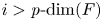 $i > \operatorname {\mathit {p}-dim}(F)$.
Using a recent result of Clausen, Mathew, and Morrow [Reference Clausen, Mathew and MorrowCMM21], this follows from an analogous vanishing of topological cyclic homology (see Proposition 3.10). The main new ingredient is a Cartier isomorphism for valuation rings, a proof of which was outlined in a letter of Gabber to the first author [Reference GabberGab18]. We give a detailed account of his argument in the appendix.
This existence of a Cartier isomorphism is also used in a recent paper of Kelly and Morrow [Reference Kelly and MorrowKM21], where they independently prove the finer result  $K_i(V;{{\mathbb {Z}}}/p^{r}) \cong W_r\Omega ^{i}_{V,\log }$ by similar methods.
Notation
All rings in this text are assumed to be commutative and unital. For a presheaf of spectra  $E$ and an integer
 $p$ we write
 $E/p$ for the cofiber of the
 $p$-multiplication on
 $E$ and set
 $E_i(X;{{\mathbb {Z}}}/p)=\pi _i(E/p(X))$.
2. Preliminaries on the p-dimension
Let  $p$ be a prime number. In this section we introduce the notion of
 $p$-dimension for
 $\mathbb {F}_{p}$-algebras. Let
 $R$ be an
 $\mathbb {F}_{p}$-algebra, and let
 $A$ be an
 $R$-algebra. By
 $R[A^{p}] \subset A$ we denote the
 $R$-subalgebra of
 $A$ generated by the
 $p$th powers of the elements in
 $A$. Recall the following definition from [Reference GrothendieckEGA,
 $0_{\text {IV}}$(21.1.9)].
Definition 2.1 A family  $(x_{i})_{i\in I}$ of elements of
 $A$ is called a
 $p$-basis of
 $A$ over
 $R$ if the family of monomials
 \begin{equation} \prod_{i} x_{i}^{n_{i}} \quad (0 \leq n_{i} < p, n_{i} = 0 \text{ for all but finitely many } i \in I) \end{equation}
forms a basis of  $A$ as an
 $R[A^{p}]$-module. It is called
 $p$-independent over
 $R$ if the family (1) is linearly independent over
 $R[A^{p}]$. The monomials (1) are called the
 $p$-monomials of the family
 $(x_{i})_{i\in I}$. A
 $p$-basis for
 $A$ over
 $\mathbb {F}_{p}$ is called an absolute
 $p$-basis or simply a
 $p$-basis for
 $A$.
We record the following simple observation.
Lemma 2.2 Assume that the family  $(x_{i})_{i\in I}$ forms a
 $p$-basis of
 $A$ over
 $R$. If
 $S \subset A$ is a multiplicative set, then
 $({x_{i}}/{1})_{i\in I}$ forms a
 $p$-basis of the localization
 $S^{-1}A$ over
 $R$.
Proof. To see that the family of  $p$-monomials associated with
 $({x_{i}}/{1})_{i \in I}$ generates
 $S^{-1}A$ as an
 $R[(S^{-1}A)^{p}]$-module, note that we can write any element of
 $S^{-1}A$ in the form
 ${a}/{s^{p}}$ with
 $a\in A$ and
 $s\in S$. It is also easy to see that the family
 $({x_{i}}/{1})_{i \in I}$ is
 $p$-independent over
 $R$.
If the family  $(x_{i})_{i\in I}$ is a
 $p$-basis of
 $A$ over
 $R$, then it is also a differential basis, that is, the family
 $(dx_{i})_{i\in I}$ is a basis of the
 $A$-module of Kähler differentials
 $\Omega _{A/R}$; see [Reference GrothendieckEGA,
 $0_{\text {IV}}$ Corollary 21.2.5]. The converse holds if
 $R \to A$ is a field extension [Reference Matsumura and ReidMat86, Theorem 26.5]. In particular, if
 $k' \subset k$ is any extension of fields of characteristic
 $p$, then
 $k$ admits a
 $p$-basis over
 $k'$ and any two
 $p$-bases have the same cardinality. This cardinality is called the
 $p$-rank of
 $k$ over
 $k'$. The
 $p$-rank of
 $k$ over
 $\mathbb {F}_{p}$ is simply called the
 $p$-rank of k and denoted by
 $\operatorname {\mathit {p}-dim}(k)$. So
 $\operatorname {\mathit {p}-dim}(k) = \dim _{k} \Omega _{k}$, where
 $\Omega _{(-)}= \Omega _{(-)/\mathbb {F}_{p}}$ denotes the module of absolute Kähler differentials.
Lemma 2.3 Assume that  $k \subset k'$ is a finitely generated field extension in characteristic
 $p$. Then
 \[ \operatorname{\mathit{p}-dim}(k') = \operatorname{\mathit{p}-dim}(k) + \operatorname{trdeg}_{k} k'. \]
In particular,  $\operatorname {\mathit {p}-dim}(k) = \operatorname {\mathit {p}-dim}(k')$ if the extension is finite.
Proof. This follows from the exact sequence
 \[ 0 \to \Gamma_{k'/k/\mathbb{F}_{p}} \to \Omega_{k} \otimes_{k} k' \to \Omega_{k'} \to \Omega_{k'/k} \to 0, \]
where the imperfection module  $\Gamma _{k'/k/\mathbb {F}_{p}}$ is defined as the kernel of the map in the middle, together with the Cartier equality [Reference Matsumura and ReidMat86, Theorem 26.10]
 \[ \dim_{k'} \Omega_{k'/k} - \dim_{k'} \Gamma_{k'/k/\mathbb{F}_{p}} = \operatorname{trdeg}_{k'} k, \]
which holds since the field extension  $k \subset k'$ is finitely generated.
Definition 2.4 For an  $\mathbb {F}_p$-scheme
 $X$ the
 $p$-dimension is defined as
 \[ \operatorname{\mathit{p}-dim}(X) = \sup \{ \operatorname{\mathit{p}-dim}(k(x)) + \dim(\mathcal{O}_{X,x}) \, | \, x \in X \} \]
where  $k(x)$ is the residue field of
 $X$ at
 $x$. For an
 $\mathbb {F}_{p}$-algebra
 $A$ we set
 $\operatorname {\mathit {p}-dim}(A) = \operatorname {\mathit {p}-dim}(\operatorname {Spec}(A))$.
Note that  $\dim ( \mathcal {O}_{\operatorname {Spec}(A), \mathfrak {p}} ) = \operatorname {ht}(\mathfrak {p})$ and
 \[ \operatorname{\mathit{p}-dim}(A) = \sup \{ \operatorname{\mathit{p}-dim}(A/\mathfrak{p}') \, | \, \mathfrak{p}' \subset A \text{ minimal prime ideal} \}. \]
In the following lemmas we collect some elementary properties of the  $p$-dimension.
Lemma 2.5 If the noetherian  $\mathbb {F}_{p}$-algebra
 $A$ is reduced and has an absolute
 $p$-basis of cardinality
 $r$, then
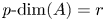 $\operatorname {\mathit {p}-dim}(A) = r$.
Proof. By Lemma 2.2 it is enough to show that
 \[ \operatorname{\mathit{p}-dim}(k) + \dim(A) = r \]
provided  $A$ is local with residue field
 $k$. Since
 $A$ is reduced, the Frobenius map
 $a \mapsto a^{p}$ is injective. According to [Reference GrothendieckEGA,
 $0_{\text {IV}}$ Theorem 21.2.7], the
 $\mathbb {F}_{p}$-algebra
 $A$ is then formally smooth and hence regular by [Reference GrothendieckEGA,
 $0_{\text {IV}}$ Theorem 22.5.8]. Let
 $\mathfrak {m}$ denote the maximal ideal of
 $A$. The claim now follows from the fundamental exact sequence [Reference Matsumura and ReidMat86, Theorem 25.2]
 \[ 0 \to \mathfrak{m}/\mathfrak{m}^{2} \to \Omega_{A} \otimes_{A} k \to \Omega_{k} \to 0 \]
using  $\dim _{k} \mathfrak {m}/\mathfrak {m}^{2} = \dim (A)$ by the regularity of
 $A$ and
 $\dim _{k}(\Omega _{A} \otimes _{A} k) = r$ by the remarks preceding Lemma 2.3.
Lemma 2.6 Let  $A\subset B$ be a finite extension of integral
 $\mathbb {F}_p$-algebras. Then
 $\operatorname {\mathit {p}-dim}(A)=\operatorname {\mathit {p}-dim}(B)$.
Proof. For a prime ideal  $\mathfrak {q}\subset B$ and
 $\mathfrak {p}=\mathfrak {q}\cap A\subset A$, we have the equality
 $\operatorname {\mathit {p}-dim}(k(\mathfrak {q}))=\operatorname {\mathit {p}-dim}(k(\mathfrak {p}))$ by Lemma 2.3 as the residue field extension
 $k(\mathfrak {p})\subset k(\mathfrak {q})$ is finite. Moreover,
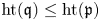 $\operatorname {ht}(\mathfrak {q})\leq \operatorname {ht}(\mathfrak {p})$, since
 $A \subset B$ is integral, and hence
 $\operatorname {\mathit {p}-dim}(B)\leq \operatorname {\mathit {p}-dim}(A)$. On the other hand, for every prime ideal
 $\mathfrak {p}\subset A$ there exists a prime ideal
 $\mathfrak {q}\subset B$ with
 $\mathfrak {p}=\mathfrak {q}\cap A$ and
 $\operatorname {ht}(\mathfrak {q})\geq \operatorname {ht}(\mathfrak {p})$ by the going-up theorem [Reference Matsumura and ReidMat86, Theorem 9.4]. Therefore
 $\operatorname {\mathit {p}-dim}(B)\geq \operatorname {\mathit {p}-dim}(A)$. This shows the claim.
Lemma 2.7 Let  $A$ be either an
 $\mathbb {F}_p$-algebra of finite type over a field
 $k$ or a complete local noetherian
 $\mathbb {F}_{p}$-algebra with residue field
 $k$. Then
 \[ \operatorname{\mathit{p}-dim}(A) = \operatorname{\mathit{p}-dim}(k) + \dim(A) \]
where  $\dim$ denotes the Krull dimension.
Proof. We may assume that  $\operatorname {\mathit {p}-dim}(k) < \infty$, since otherwise both sides of the equation are
 $\infty$. By the remark after Definition 2.4, we may assume that
 $A$ is integral. Write
 $d$ for the Krull dimension of
 $A$. If
 $A$ is of finite type over a field
 $k$, Noether normalization [Reference MatsumuraMat80, (14.G)] yields a finite injective map
 $k[x_{1}, \ldots , x_{d}] \to A$. If
 $A$ is complete,
 $A$ contains a coefficient field [Reference Matsumura and ReidMat86, Theorem 28.3], and a choice of a system of parameters yields a finite injective map
 $k[[x_{1}, \ldots , x_{d}]] \to A$. By Lemma 2.6 it now suffices to show that
 \[ \operatorname{\mathit{p}-dim}(k[x_{1}, \ldots, x_{d}] ) = \operatorname{\mathit{p}-dim}(k[[x_{1}, \ldots, x_{d}]]) = \operatorname{\mathit{p}-dim}(k) + d. \]
But in view of Lemma 2.5 this follows from the fact that if  $b_{1}, \ldots , b_{r}$ form a
 $p$-basis of
 $k$, then
 $b_{1}, \ldots , b_{r}, x_{1}, \ldots , x_{d}$ form a
 $p$-basis of
 $k[x_{1}, \ldots , x_{d}]$ and of
 $k[[x_{1}, \ldots , x_{d}]]$; see [Reference Gabber and OrgogozoGO08, Lemma 2.1.5].
Lemma 2.8 Let  $A \subset B$ be an extension of finite type of integral noetherian
 $\mathbb {F}_{p}$-algebras. Then
 $\operatorname {\mathit {p}-dim}(B) \leq \operatorname {\mathit {p}-dim}(A) + \operatorname {trdeg}_{\operatorname {Frac}(A)} \operatorname {Frac}(B)$.
Proof. Let  $\mathfrak {q} \subset B$ be a prime ideal, and let
 $\mathfrak {p} = \mathfrak {q} \cap A \subset A$. The dimension inequality [Reference Matsumura and ReidMat86, Theorem 15.5] gives
 \[ \operatorname{ht}(\mathfrak{q}) + \operatorname{trdeg}_{k(\mathfrak{p})} k(\mathfrak{q}) \leq \operatorname{ht}(\mathfrak{p}) + \operatorname{trdeg}_{\operatorname{Frac}(A)} \operatorname{Frac}(B). \]
Since the field extension  $k(\mathfrak {p}) \subset k(\mathfrak {q})$ is finitely generated, Lemma 2.3 implies that
 \[ \operatorname{\mathit{p}-dim}(k(\mathfrak{q})) = \operatorname{\mathit{p}-dim}(k(\mathfrak{p})) + \operatorname{trdeg}_{k(\mathfrak{p})} k(\mathfrak{q}). \]
Taken together, these facts imply the claim.
3. Derived differential forms and valuation rings
Let  $A$ be an
 $\mathbb {F}_{p}$-algebra. Since the differential of the (absolute) de Rham complex
 $\Omega ^{*}_{A}$ is Frobenius linear, the subgroups of cycles
 $Z\Omega ^{i}_{A} \subset \Omega ^{i}_{A}$ and boundaries
 $B\Omega ^{i}_{A} \subset \Omega ^{i}_{A}$, and the cohomology groups
 $H^{i}(\Omega ^{*}_{A})$ are canonically
 $A$-modules via the Frobenius
 $a \mapsto a^{p}$. There is a unique
 $A$-linear multiplicative map
 \[ \gamma_{A} \colon \Omega^{i}_{A} \to H^{i}(\Omega^{*}_{A}) \]
characterized by  $\gamma _{A}(1) = 1$ and
 $\gamma _{A}({{d}x}) = x^{p-1}\,{{d}x}$; see [Reference KatzKat70, Proof of Theorem 7.2]. The map
 $\gamma _{A}$ is usually denoted by
 $C^{-1}$ and is called the inverse Cartier operator. The classical theorem of Cartier [Reference KatzKat70, Theorem 7.2] says that
 $\gamma _{A}$ is an isomorphism provided that
 $A$ is smooth over a perfect field. If
 $\gamma _{A}$ is an isomorphism, the inverse induces a map
 $C\colon Z\Omega ^{i}_{A} \to \Omega ^{i}_{A}$ called the Cartier operator. In the appendix (Corollary A.4(iii)) we explain a proof of the following result due to Gabber [Reference GabberGab18].
Theorem 3.1 Let  $V$ be a valuation ring of characteristic
 $p$. Then the inverse Cartier operator
 $\gamma _{V}$ is an isomorphism.
In the following, we need some non-abelian derived functors; see [Reference LurieLur09, § 5.5.8] and [Reference LurieLur18, Chapter 25] for a general treatment. We denote by  $\mathrm {Poly}_{\mathbb {F}_{p}}$ the category of polynomial
 $\mathbb {F}_{p}$-algebras in finitely many variables, and by
 $\mathrm {SCR}_{\mathbb {F}_{p}}$ the
 $\infty$-category obtained from the category of simplicial commutative
 $\mathbb {F}_{p}$-algebras by inverting the quasi-isomorphisms. Then
 $\mathrm {Poly}_{\mathbb {F}_{p}}$ is a full subcategory of
 $\mathrm {SCR}_{\mathbb {F}_{p}}$. Moreover, if
 $D$ is any
 $\infty$-category that admits sifted colimits, then any functor
 $F\colon \mathrm {Poly}_{\mathbb {F}_{p}} \to D$ admits an essentially unique extension
 $LF\colon \mathrm {SCR}_{\mathbb {F}_{p}} \to D$ which preserves sifted colimits. The functor
 $LF$ is called the derived functor of
 $F$.
If  $F$ is a functor
 $\mathrm {SCR}_{\mathbb {F}_{p}} \to D$, we still denote by
 $LF$ the derived functor of the restriction of
 $F$ to
 $\mathrm {Poly}_{\mathbb {F}_{p}}$. There is a natural transformation
 $LF \to F$. If the functor
 $F$ commutes with filtered colimits, then
 $LF(A) \simeq \textrm {colim}_{\Delta ^{\mathrm {op}}} F(P)$ where
 $P \xrightarrow {\sim } A$ is a simplicial resolution by free
 $\mathbb {F}_{p}$-algebras.
Example 3.2 For  $F = \Omega _{(-)}$, viewed as functor on
 $\mathrm {Poly}_{\mathbb {F}_{p}}$ with values in the derived
 $\infty$-category
 $D(\mathbb {F}_{p})$ of
 $H\mathbb {F}_{p}$-modules, we obtain the functor
 $L\Omega _{(-)}\colon \mathrm {SCR}_{\mathbb {F}_{p}} \to D(\mathbb {F}_{p})$. For any
 $\mathbb {F}_{p}$-algebra
 $A$,
 $L\Omega _{A}$ is equivalent to the underlying
 $H\mathbb {F}_{p}$-module of the cotangent complex
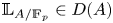 $\mathbb {L}_{A/\mathbb {F}_{p}} \in D(A)$; see [Reference LurieLur18, § 25.3].
Moreover,  $L\Omega ^{i}_{A}$ is equivalent to the underlying
 $H\mathbb {F}_{p}$-module of the derived exterior power
 $L{\bigwedge} ^{i}_{A}\mathbb {L}_{A/\mathbb {F}_{p}}$; see [Reference LurieLur18, § 25.2]. This follows directly from the constructions and the fact that for a polynomial
 $\mathbb {F}_{p}$-algebra
 $P$ the
 $P$-module
 $\Omega _{P}$ is free.
The following result is essentially due to Gabber and Ramero.
Theorem 3.3 Let  $V$ be a valuation ring of characteristic
 $p$, and let
 $i \geq 0$. Then the following assertions hold.
(i)
 $L\Omega ^{i}_{V} \simeq \Omega ^{i}_{V}[0]$.
(ii) The
$V$-module $\Omega ^{i}_{V}$ is torsion-free or, equivalently, $\Omega ^{i}_{V}$ flat.
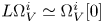


Proof. For  $i=0$, both claims are clear; for
 $i=1$, assertion (i) follows from [Reference Gabber and RameroGR03, Theorem 6.5.12] and (ii) is [Reference Gabber and RameroGR03, Corollary 6.5.21]. An alternative argument due to Gabber is explained in the appendix; see Corollary A.4. Now let
 $i \geq 2$. Since
 $\mathbb {L}_{V} \simeq \Omega _{V}[0]$ and
 $\Omega _{V}$ is torsion-free and hence flat, it follows that
 \[ L\Omega^{i}_{V} \simeq L{\bigwedge}^{i}_{V}\mathbb{L}_{V} \simeq {\bigwedge}^{i}_{V}\Omega_{V} = \Omega^{i}_{V}[0]; \]
see [Reference LurieLur18, Proposition 25.2.3.4]. It remains to prove (ii) for  $i \geq 2$. As
 $\Omega _{V}$ is torsion-free, it is isomorphic to a filtered colimit of finitely generated torsion-free modules, which are free by [Reference BourbakiBou89, VI.3.6 Lemma 1]. Since exterior powers of free modules are free, and since taking exterior powers commutes with filtered colimits,
 $\Omega ^{i}_{V}$ is a filtered colimit of free modules and hence flat.
We want to prove the analog of Theorem 3.3 for the de Rham–Witt groups. For this we need some preparations.
Lemma 3.4 Let  $V$ be a valuation ring of characteristic
 $p$. Then
 $LB\Omega ^{i}_{V} \simeq B\Omega ^{i}_{V}[0]$ and
 $LZ\Omega ^{i}_{V} \simeq Z\Omega ^{i}_{V}[0]$.
Proof. By the Cartier isomorphism, recalled at the beginning of this section, we have the following short exact sequence of functors on  $\mathrm {Poly}_{\mathbb {F}_{p}}$:
 \[ 0 \to B\Omega^{i} \to Z\Omega^{i} \xrightarrow{C} \Omega^{i} \to 0. \]
Taking derived functors and evaluating at  $V$, we obtain the following cofiber sequence.

As by Theorem 3.1 the inverse Cartier operator  $\gamma _{V}$ is also an isomorphism for the valuation ring
 $V$, we also have the following cofiber sequence.

As the inverse Cartier operator is natural, the following diagram, in which the vertical maps are the canonical ones, commutes.

The right vertical map in this diagram is an equivalence by Theorem 3.3. So we see that if we prove the assertion about  $B\Omega ^{i}$, then also the assertion about
 $Z\Omega ^{i}$ follows. We now argue by induction on
 $i$. As
 $B\Omega ^{0} = 0$, the assertion is clearly true in the case
 $i = 0$. As above, the exact sequence of functors
 \[ 0 \to Z\Omega^{i} \to \Omega^{i} \xrightarrow{d} B\Omega^{i+1} \to 0 \]
similarly gives rise to the following diagram of cofiber sequences.

By induction, the left vertical map is an equivalence, hence so is the right vertical map.
We next recall the definition of the higher boundaries and cycles in the de Rham complex from [Reference IllusieIll79, I.2.2]. Let  $A$ be an
 $\mathbb {F}_{p}$-algebra for which the inverse Cartier operator
 $\gamma _{A}\colon \Omega ^{i}_{A} \to H^{i}(\Omega ^{*}_{A})$ is an isomorphism, for example a polynomial algebra or a valuation ring. One defines the chain of subgroups
 \[ \begin{array}{cc}0 = B_{0}\Omega^{i}_{A} \subset B_{1}\Omega^{i}_{A} \subset \cdots \subset B_{n}\Omega^{i}_{A} \subset \cdots \subset Z_{n}\Omega^{i}_{A} \subset \cdots \subset Z_{1}\Omega^{i}_{A} \subset Z_{0}\Omega^{i}_{A} = \Omega^{i}_{A}\end{array} \]
inductively by setting 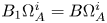 $B_{1}\Omega ^{i}_{A} = B\Omega ^{i}_{A}$,
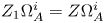 $Z_{1}\Omega ^{i}_{A} = Z\Omega ^{i}_{A}$ and requiring that
 $\gamma$ induces isomorphisms
 \begin{equation} B_{n}\Omega^{i}_{A} \xrightarrow{\simeq} B_{n+1}\Omega^{i}_{A}/B\Omega^{i}_{A} \quad \text{and} \quad Z_{n}\Omega^{i}_{A} \xrightarrow{\simeq} Z_{n+1}\Omega^{i}_{A}/B\Omega^{i}_{A}. \end{equation}
Since the  $B_{n}\Omega ^{i}$ and
 $Z_{n}\Omega ^{i}$ define functors on
 $\mathrm {Poly}_{\mathbb {F}_{p}}$, we get derived functors
 $LB_{n}\Omega ^{i}$ and
 $LZ_{n}\Omega ^{i}$ defined on
 $\mathrm {SCR}_{\mathbb {F}_{p}}$. In particular, we may evaluate them on any
 $\mathbb {F}_{p}$-algebra.
Lemma 3.5 Let  $V$ be a valuation ring of characteristic
 $p$. Then
 $LB_{n}\Omega ^{i}_{V} \simeq B_{n}\Omega ^{i}_{V}[0]$ and
 $LZ_{n}\Omega ^{i}_{V} \simeq Z_{n}\Omega ^{i}_{V}[0]$.
Proof. We argue by induction on  $n$. The case
 $n=1$ is dealt with in Lemma 3.4. By definition, we have the following exact sequence of functors on
 $\mathrm {Poly}_{\mathbb {F}_{p}}$:
 \[ 0 \to B\Omega^{i} \to B_{n+1}\Omega^{i} \xrightarrow{C} B_{n}\Omega^{i} \to 0. \]
Taking derived functors and evaluating at  $V$ gives the inductive step, similarly to the proof of Lemma 3.4. The proof for
 $Z_{n}\Omega ^{i}$ is the same.
Next we recall that to any  $\mathbb {F}_{p}$-algebra
 $A$ one functorially associates its de Rham–Witt pro-complex
 $\{W_{n}\Omega ^{*}_{A}\}_{n}$; see [Reference IllusieIll79], [Reference Hesselholt and MadsenHM04, Theorem A]. The structure maps of the pro-system are denoted by
 $R$ and are called restriction maps. It follows directly from [Reference IllusieIll79, Theorem I.1.3] that the restriction maps are surjective. We view
 $W_{n}\Omega ^{i}$ as a functor on
 $\mathbb {F}_{p}$-algebras with values in
 $D({{\mathbb {Z}}})$. So we have its derived functor available.
Proposition 3.6 Let  $V$ be a valuation ring of characteristic
 $p$ with field of fractions
 $F$, and let
 $n\geq 1$ and
 $i \geq 0$. Then the following assertions hold.
(i)
$LW_{n}\Omega ^{i}_{V} \simeq W_{n}\Omega ^{i}_{V}[0]$.(ii) The natural map
$W_{n}\Omega ^{i}_{V} \to W_{n}\Omega ^{i}_{F}$ is injective.


Proof. (i) As a first step, we treat the case  $i=0$. Note that
 $W_{n}\Omega ^{0}$ is the ring
 $W_{n}$ of Witt vectors of length
 $n$. We claim that in fact
 $LW_{n}(A) \simeq W_{n}(A)[0]$ for any
 $\mathbb {F}_{p}$-algebra
 $A$. This is clear for
 $n=1$. For
 $n >1$ the claim follows by induction using the short exact sequence
 \[ 0 \to A \xrightarrow{V^{n}} W_{n+1}(A) \to W_{n}(A) \to 0 \]
which is natural in  $A$.
We next prove that  $\pi _{0}LW_{n}\Omega ^{i}_{A} = W_{n}\Omega ^{i}_{A}$ for any
 $\mathbb {F}_{p}$-algebra
 $A$. Let
 $P \xrightarrow {\sim } A$ be a simplicial resolution of
 $A$ by free
 $\mathbb {F}_{p}$-algebras. We have to show that the sequence
 \[ W_{n}\Omega^{i}_{P_{1}} \xrightarrow{\partial_{0} - \partial_{1}} W_{n}\Omega^{i}_{P_{0}} \to W_{n}\Omega^{i}_{A} \to 0 \]
is exact. According to [Reference Geisser and HesselholtGH06b, Lemma 2.4], the right-hand map is surjective and its kernel is generated by elements of the form  $x\cdot \omega$ and
 ${{d}x}\cdot \omega$ with
 $x \in \ker (W_{n}(P_{0}) \to W_{n}(A))$ and
 $\omega \in W_{n}\Omega ^{i}_{P_{0}}$ or
 $\omega \in W_{n}\Omega ^{i-1}_{P_{0}}$, respectively. By the first step of the proof we know that
 $W_{n}(P) \xrightarrow {\sim } W_{n}(A)$ is a simplicial resolution. In particular, for
 $x$ as above there exists an element
 $y \in W_{n}(P_{1})$ such that
 $\partial _{0}(y) = x$,
 $\partial _{1}(y) = 0$. If
 $s$ denotes the degeneracy map
 $W_{n}(P_{0}) \to W_{n}(P_{1})$, then
 $y\cdot s(\omega )$ (respectively,
 ${{d}y}\cdot s(\omega )$) is a preimage of
 $x\cdot \omega$ (respectively,
 ${{d}x}\cdot \omega$) under
 $\partial _{0} - \partial _{1}$, thus showing the desired exactness.
It remains to prove that  $LW_{n}\Omega ^{i}_{V}$ is concentrated in degree 0 for
 $i \geq 1$ and
 $n \geq 1$. We argue by induction on
 $n$. Since
 $W_{1}\Omega ^{i} \cong \Omega ^{i}$ (see [Reference IllusieIll79, Theorem I.1.3]), the case
 $n=1$ follows from Theorem 3.3(i). Assume our assertion is proven for some
 $n\geq 1$. Recall from [Reference IllusieIll79, I.3.1] the canonical filtration on
 $W\Omega ^{i}_{A} = \lim _{n} W_{n}\Omega ^{i}_{A}$ given by
 \[ \operatorname{Fil}^{n}W\Omega^{i}_{A} = \ker ( W\Omega^{i}_{A} \xrightarrow{\text{can.}} W_{n}\Omega^{i}_{A} ) \]
for any smooth  $\mathbb {F}_{p}$-algebra
 $A$. Its associated graded pieces sit in a short exact sequence
 \begin{equation} 0 \to \operatorname{gr}^{n}W\Omega^{i}_{A} \to W_{n+1}\Omega^{i}_{A} \xrightarrow{R} W_{n}\Omega^{i}_{A} \to 0. \end{equation}
Viewed as a short exact sequence of functors in the smooth  $\mathbb {F}_{p}$-algebra
 $A$, the latter gives rise to a cofiber sequence of derived functors
 \begin{equation} L\operatorname{gr}^{n}W\Omega^{i} \to LW_{n+1}\Omega^{i} \to LW_{n}\Omega^{i}. \end{equation}
By induction, it now suffices to show that  $L\operatorname {gr}^{n}W\Omega ^{i}_{V}$ is concentrated in degree 0. By a fundamental result of Illusie [Reference IllusieIll79, Corollary I.3.9], there is a natural short exact sequence
 \begin{equation} 0 \to \Omega^{i}_{A} / B_{n}\Omega^{i}_{A} \to \operatorname{gr}^{n}W\Omega^{i}_{A} \to \Omega^{i-1}_{A} / Z_{n}\Omega^{i-1}_{A} \to 0 \end{equation}
for any smooth  $\mathbb {F}_{p}$-algebra
 $A$. By the same argument as before, we now finish the proof of (i) by noting that
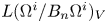 $L(\Omega ^{i}/B_{n}\Omega ^{i})_{V}$ and
 $L(\Omega ^{i-1}/Z_{n}\Omega ^{i-1})_{V}$ are concentrated in degree 0. Indeed, this follows immediately from Lemma 3.5 together with Theorem 3.3(i).
(ii) We again argue by induction on  $n$. The case
 $n=1$ is Theorem 3.3(ii). Note that by part (i) applied to the trivial valuation ring
 $F$, we also have
 $LW_{n}\Omega ^{i}_{F} \simeq W_{n}\Omega ^{i}_{F}$ for all
 $n \geq 1$ and
 $i \geq 0$ and Lemma 3.5 holds with
 $V$ replaced by
 $F$. Using the cofiber sequence (4) and the result of part (i), we see that for the inductive step it suffices to show that
 \[ \pi_{0} L\operatorname{gr}^{n}W\Omega^{i}_{V} \to \pi_{0} L\operatorname{gr}^{n}W\Omega^{i}_{F} \]
is injective for all  $n \geq 0$. Then, using the cofiber sequence of derived functors obtained from (5), we reduce to proving that the maps
 \[ \Omega^{i}_{V}/B_{n}\Omega^{i}_{V} \to \Omega^{i}_{F}/B_{n}\Omega^{i}_{F} \quad \text{and} \quad \Omega^{i}_{V}/Z_{n}\Omega^{i}_{V} \to \Omega^{i}_{F}/Z_{n}\Omega^{i}_{F} \]
are injective for any  $i \geq 0$ and
 $n \geq 1$.
We now prove the latter statement for the higher cycles by induction on  $n$. To simplify notation, we drop the index
 $V$ or
 $F$, whenever a statement holds for both of them. In the case
 $n=1$, the desired injectivity follows from the injectivity of
 $d\colon \Omega ^{i}/Z\Omega ^{i} \to \Omega ^{i+1}$ and of
 $\Omega ^{i+1}_{V} \to \Omega ^{i+1}_{F}$; see Theorem 3.3(ii). Assume we have proven injectivity for some
 $n$. It follows from the definition of higher cycles (2) that the inverse Cartier operator
 $\gamma$ induces an isomorphism
 \[ \Omega^{i}/Z_{n}\Omega^{i} \xrightarrow{\cong} Z\Omega^{i}/Z_{n+1}\Omega^{i}. \]
Combining this isomorphism with the exact sequence
 \[ 0 \to Z\Omega^{i}/Z_{n+1}\Omega^{i} \to \Omega^{i}/Z_{n+1}\Omega^{i} \to \Omega^{i}/Z\Omega^{i} \to 0 \]
and the injectivity for  $n=1$ gives the inductive step. The proof for higher boundaries is the same, replacing
 $Z_{n}$ by
 $B_{n}$ and
 $Z_{n+1}$ by
 $B_{n+1}$ in the above formulas, and using the injection
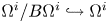 $\Omega ^{i}/B\Omega ^{i} \hookrightarrow \Omega ^{i}$ given by the Cartier operator for the case
 $n=1$.
Corollary 3.7 The  $p$-multiplication
 $p\colon W_{n}\Omega ^{i}_{V} \to W_{n}\Omega ^{i}_{V}$ factors as
 \[ W_{n}\Omega^{i}_{V} \xrightarrow{R} W_{n-1}\Omega^{i}_{V} \xrightarrow{\underline{p}} W_{n}\Omega^{i}_{V} \]
and the induced map  $\underline {p}$ is injective. In particular, the pro-group
 $\{ W_{n}\Omega ^{i}_{V}\}_{n}$ is
 $p$-torsion-free.
Proof. For  $V$ replaced by any smooth
 $\mathbb {F}_{p}$-algebra the same assertion is proved in [Reference IllusieIll79, Proposition I.3.4] and remains true for ind-smooth
 $\mathbb {F}_{p}$-algebras. Hence the
 $p$-multiplication on the derived functor
 $LW_{n}\Omega ^{i}$ factors as
 \[ LW_{n}\Omega^{i} \xrightarrow{R} LW_{n-1}\Omega^{i} \xrightarrow{\underline{p}} LW_{n}\Omega^{i}. \]
Evaluating on  $V$ and using Proposition 3.6(i) gives the desired factorization. Using Proposition 3.6(ii) and Illusie's result for the ind-smooth
 $\mathbb {F}_{p}$-algebra
 $F$ proves the asserted injectivity.
We will use the above results to prove a vanishing result for topological cyclic homology of valuation rings in characteristic  $p$. Recall that for any (simplicial)
 $\mathbb {F}_{p}$-algebra
 $A$ one defines the spectra
 \[ \operatorname{TR}^{n}(A;p) = \operatorname{THH}(A)^{C_{p^{n-1}}} \]
as the genuine fixed points of the topological Hochschild homology spectrum  $\operatorname {THH}(A)$. There are natural maps
 $R, F \colon \operatorname {TR}^{n}(A;p) \to \operatorname {TR}^{n-1}(A;p)$ called restriction and Frobenius, and one defines the spectrum
 $\operatorname {TR}(A;p) = \lim _{R} \operatorname {TR}^{n}(A;p)$. The topological cyclic homology of
 $A$ then sits in a fiber sequence
 \begin{equation} \operatorname{TC}(A) \to \operatorname{TR}(A;p) \xrightarrow{1-F} \operatorname{TR}(A;p). \end{equation}
Hesselholt and Madsen prove in [Reference Hesselholt and MadsenHM97, Proposition 5.4] that  $\operatorname {TR}_{*}^{n}(\mathbb {F}_{p})$ is isomorphic to the polynomial ring
 ${{\mathbb {Z}}}/p^{n}[\sigma _{n}]$ with
 $\sigma _{n}$ of degree 2 and the restriction map sends
 $\sigma _{n}$ to
 $p\sigma _{n-1}$ up to a unit in
 ${{\mathbb {Z}}}/p^{n-1}$. Hesselholt shows in [Reference HesselholtHes96] that for any
 $\mathbb {F}_{p}$-algebra
 $A$ and every
 $n\geq 1$ one gets a naturally induced map of graded rings
 \begin{equation} W_{n}\Omega^{*}_{A} [\sigma_{n}] \to \operatorname{TR}_{*}^{n}(A;p) \end{equation}
and that (7) is an isomorphism provided that  $A$ is smooth over
 $\mathbb {F}_{p}$; see [Reference HesselholtHes96, Theorem B]. Since both sides of (7) commute with filtered colimits, (7) is an isomorphism if
 $A$ is only assumed to be ind-smooth over
 $\mathbb {F}_{p}$.
Proposition 3.8 Let  $V$ be a valuation ring of characteristic
 $p$. Then the map
 \[ W_{n}\Omega^{*}_{V} [\sigma_{n}] \to \operatorname{TR}_{*}^{n}(V;p) \]
from (7) is an isomorphism of graded rings. In particular, the natural map of pro-groups
 \[ \{W_{n}\Omega^{i}_{V} \}_{n} \to \{ \operatorname{TR}^{n}_{i}(V;p)\}_{n} \]
is an isomorphism.
Proof. Let  $P \xrightarrow {\sim } V$ be a simplicial resolution by free
 $\mathbb {F}_{p}$-algebras. As the spectrum valued functor
 $\operatorname {TR}^{n}(-;p)$ on
 $\mathrm {SCR}_{\mathbb {F}_{p}}$ commutes with sifted colimits (this follows inductively from the basic cofiber sequence [Reference HesselholtHes96, (1.3.10)]), we have an equivalence
 $\textrm {colim}_{\Delta ^{\mathrm {op}}} \operatorname {TR}^{n}(P;p) \simeq \operatorname {TR}^{n}(V;p)$ and hence a convergent spectral sequence
 \[ E^{1}_{rs} = \operatorname{TR}^{n}_{s}(P_{r};p) \Longrightarrow \operatorname{TR}^{n}_{r+s}(V;p). \]
By Hesselholt's result above, we have  $W_{n}\Omega ^{s}_{P_{r}}[\sigma _{n}] \cong E^{1}_{rs}$ via the canonical map, and hence
 $\pi _{r}(LW_{n}\Omega ^{s}_{V}[\sigma _{n}]) \cong E^{2}_{rs}$ by the definition of derived functors. So Proposition 3.6 implies
 $E^{2}_{rs} = 0$ for
 $r > 0$ and
 $W_{n}\Omega ^{s}_{V}[\sigma _{n}] \cong E^{2}_{0s}$. This gives the first claim. The second statement follows immediately from the fact that the transition map sends
 $\sigma _{n}$ to
 $p\sigma _{n-1}$ up to a unit.
Remark 3.9 With a similar approach, the result of Proposition 3.8 has been shown by Kelly and Morrow [Reference Kelly and MorrowKM21, § 2.3] for Cartier-smooth  $\mathbb {F}_{p}$-algebras.
Proposition 3.10 Let  $V$ be a valuation ring of characteristic
 $p$ with field of fractions
 $F$. Then
 $TC_{i}(V; {{\mathbb {Z}}}/p) = 0$ for
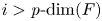 $i > \operatorname {\mathit {p}-dim}(F)$.
Proof. In view of the fiber sequence (6) and the Milnor sequence for  $\operatorname {TR}$, it suffices to show that the pro-group
 $\{\operatorname {TR}^{n}_{i}(V;p,{{\mathbb {Z}}}/p) \}_{n}$ vanishes for
 $i > \operatorname {\mathit {p}-dim}(F)$. From Corollary 3.7 and Proposition 3.8 we deduce an isomorphism
 $\{W_{n}\Omega ^{i}_{V} / p \}_{n} \cong \{ \operatorname {TR}^{n}_{i}(V;p,{{\mathbb {Z}}}/p) \}_{n}$. Since the map
 $W_{n}\Omega ^{i}_{V} \to W_{n}\Omega ^{i}_{F}$ is injective by Proposition 3.6, it now suffices to observe that
 $W_{n}\Omega ^{i}_{F} = 0$ for
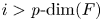 $i>\operatorname {\mathit {p}-dim}(F)$. Indeed, since
 $F$ is ind-smooth over
 $\mathbb {F}_{p}$ and
 $\Omega ^{i}_{F}$ vanishes for
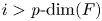 $i>\operatorname {\mathit {p}-dim}(F)$ this follows easily by induction using the exact sequences (3) and (5) (note that
 $\Omega ^{i}_{F} = Z\Omega ^{i}_{F} = \dots = Z_{n}\Omega ^{i}_{F}$ for
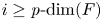 $i \geq \operatorname {\mathit {p}-dim}(F)$).
Here is an alternative proof of Proposition 3.10 indicated to us by a referee. It does not use the computation of  $\operatorname {TR}$ of a valuation ring in Proposition 3.8 and thus avoids the use of the derived de Rham–Witt complex.
Proof. Let  $A$ be a polynomial
 $\mathbb {F}_{p}$-algebra. We define a complete exhaustive decreasing
 ${{\mathbb {Z}}}$-indexed filtration on
 $\operatorname {TC}(A;{{\mathbb {Z}}}/p) = \operatorname {TC}(A)/p$ via
 \[ \operatorname{Fil}^{n}\operatorname{TC}(A; {{\mathbb{Z}}}/p) = \operatorname{fib}(\tau_{{\geq} n}(\operatorname{TR}(A;p)/p) \xrightarrow{1-F} \tau_{{\geq} n}(\operatorname{TR}(A;p)/p)). \]
It follows from Hesselholt's Hochschild–Kostant–Rosenberg theorem [Reference HesselholtHes96, Theorem B] that there is a natural isomorphism  $\operatorname {TR}_{*}(A;p)\cong W\Omega ^{*}_{A}$. Since
 $W\Omega ^{*}_{A}$ is
 $p$-torsion-free [Reference IllusieIll79, Proposition I.3.4], it follows that
 $\pi _{*}(\operatorname {TR}(A;p)/p) \cong W\Omega ^{*}_{A}/p$. For the associated graded of the above filtration on
 $\operatorname {TC}$ we thus obtain
 \[ \operatorname{gr}^{n}\operatorname{TC}(A;{{\mathbb{Z}}}/p) \simeq \operatorname{fib}( W\Omega^{n}_{A}/p \xrightarrow{1-F} W\Omega^{n}_{A}/p )[n]. \]
The square of abelian groups

where the vertical maps are the canonical projections is bicartesian (see the proof of [Reference Clausen, Mathew and MorrowCMM21, Propostion 2.26]), and thus cartesian when viewed as a diagram of spectra. We thus obtain a natural equivalence
 \[ \operatorname{gr}^{n}\operatorname{TC}(A;{{\mathbb{Z}}}/p) \simeq \operatorname{fib}( \Omega^{n}_{A} \xrightarrow{1-C^{{-}1}} \Omega^{n}_{A}/B\Omega^{n}_{A})[n]. \]
As  $\operatorname {TC}(-)/p$ commutes with sifted colimits [Reference Clausen, Mathew and MorrowCMM21, Corollary 2.15], we can derive the above filtration on
 $\operatorname {TC}(-)/p$ of polynomial
 $\mathbb {F}_{p}$-algebras and obtain a filtration on
 $\operatorname {TC}(-)/p$ of an arbitrary
 $\mathbb {F}_{p}$-algebra
 $R$. Notice that this filtration is still complete (as
 $\operatorname {Fil}^{n}\operatorname {TC}(A;{{\mathbb {Z}}}/p)$ is (
 $n-1$)-connective) and exhaustive. By the above, its graded pieces are given by
 \[ \operatorname{gr}^{n}\operatorname{TC}(R;{{\mathbb{Z}}}/p) \simeq \operatorname{fib}( L\Omega^{n}_{R} \xrightarrow{1-C^{{-}1}} L(\Omega^{n}/B\Omega^{n})_{R} ) [n], \]
where, as usual,  $L$ denotes non-abelian derived functors.
Now let  $V$ be a valuation ring of characteristic
 $p$ with field of fractions
 $F$. It follows from Lemma 3.4 that
 $L\Omega ^{n}_{V} \simeq \Omega ^{n}_{V}[0]$ and also that
 $L(\Omega ^{n}/B\Omega ^{n})_{V} = \Omega ^{n}_{V}/B\Omega ^{n}_{V}[0]$ (this is where the Cartier isomorphism for valuation rings is used). Thus
 \[ \operatorname{gr}^{n}\operatorname{TC}(V;{{\mathbb{Z}}}/p) \simeq \operatorname{fib}( \Omega^{n}_{V} \xrightarrow{1-C^{{-}1}} \Omega^{n}_{V}/B\Omega^{n}_{V} ) [n] \]
is concentrated in degrees  $n-1, n$. Furthermore, from Theorem 3.3 we deduce that
 $\Omega ^{n}_{V}$ vanishes for
 $n>\operatorname {\mathit {p}-dim}(F)$ and thus
 \[ \operatorname{gr}^{n}\operatorname{TC}(V;{{\mathbb{Z}}}/p) = 0 \]
for  $n>\operatorname {\mathit {p}-dim}(F)$. Since the filtration is complete (i.e.
 $\lim _{n} \operatorname {Fil}^{n}\operatorname {TC}(V;{{\mathbb {Z}}}/p) = 0$), this implies that
 $\operatorname {Fil}^{n}\operatorname {TC}(V;{{\mathbb {Z}}}/p) = 0$ for
 $n>\operatorname {\mathit {p}-dim}(F)$. Inductively, we then get that
 $\operatorname {Fil}^{n}\operatorname {TC}(V;{{\mathbb {Z}}}/p)$ is concentrated in homotopy degrees up to
 $\operatorname {\mathit {p}-dim}(F)$ for all
 $n\in {{\mathbb {Z}}}$. Since the filtration is exhaustive, we also get that
 $\operatorname {TC}(V;{{\mathbb {Z}}}/p)$ is concentrated in degrees up to
 $\operatorname {\mathit {p}-dim}(F)$.
The following consequence is Theorem E from the introduction.
Corollary 3.11 Let  $V$ be a valuation ring of characteristic
 $p$ with field of fractions
 $F$. Then
 $K_{i}(V; {{\mathbb {Z}}}/p) = 0$ for
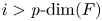 $i > \operatorname {\mathit {p}-dim}(F)$.
Proof. As  $V$ is a local ring, the cyclotomic trace
 $K_{i}(V;{{\mathbb {Z}}}/p)\to TC_{i}(V;{{\mathbb {Z}}}/p)$ is injective by [Reference Clausen, Mathew and MorrowCMM21, Theorem D] and the statement follows from the previous proposition.
Remark 3.12 In the case when  $V=F$ is a field, Corollary 3.11 was proved for
 $\operatorname {\mathit {p}-dim} (K)=0$ in [Reference KratzerKra80, Corollary 5.5] and in [Reference HillerHil81, Theorem 5.4], and in [Reference Geisser and LevineGL00] in general.
4. The main result
Lemma 4.1 Let  $k$ be a field of characteristic
 $p$, and let
 $B=k[x_{1}, \ldots , x_{r}]/(x_{1}, \ldots , x_{r})^{2}$. Let
 $y_{1}, \ldots , y_{s} \in k$ be
 $p$-independent. Then the symbol
 $\{y_{1}, \ldots , y_{s}, 1+x_{1}, \ldots , 1+x_{r}\} \in K_{s+r}(B)$ does not vanish in
 $K_{s+r}(B)/pK_{s+r}(B)$.
Proof. It suffices to check that the image of the symbol under the Dennis trace map  $K_{s+r}(B) \to \operatorname {HH}_{s+r}(B/\mathbb {F}_{p})$ does not vanish. Note that
 $B \cong B_{0} \otimes _{\mathbb {F}_{p}} k$ where
 $B_{0} = \mathbb {F}_{p}[x_{1}, \ldots , x_{r}]/(x_{1}, \ldots , x_{r})^{2}$. By the Künneth formula for Hochschild homology [Reference WeibelWei94, Proposition 9.4.1] and the Hochschild–Kostant–Rosenberg theorem [Reference WeibelWei94, Theorem 9.4.7] we have a natural isomorphism of graded rings
 \[ \operatorname{HH}_{*}(B/\mathbb{F}_{p}) \cong \Omega^{*}_{k} \otimes_{\mathbb{F}_{p}} \operatorname{HH}_{*}(B_{0}/\mathbb{F}_{p}). \]
By [Reference Geisser and HesselholtGH12, Theorem 2.1] the Dennis trace maps the symbol  $\{1+x_{1}, \ldots , 1+x_{r}\} \in K_{r}(B_{0})$ to a non-zero element of
 $\operatorname {HH}_{r}(B_{0}/\mathbb {F}_{p})$. On the other hand, the Dennis trace is a map of graded rings, and the symbol
 $\{y_{1}, \ldots , y_{s}\} \in K_{s}(k)$ is mapped to
 \[ d\log(y_{1}) \cdots d\log(y_{s}) = (y_{1}\cdots y_{s})^{{-}1} dy_{1} \cdots dy_{s} \in \Omega^{s}_{k}, \]
see the proof of [Reference Geisser and HesselholtGH12, Theorem 2.1] and the references given there. The latter element does not vanish since  $y_{1}, \ldots , y_{s}$ are
 $p$-independent, finishing the proof.
Recall that the homotopy  $K$-theory of a scheme
 $X$ is defined as
 \[ KH(X) = \mathop{\textrm{colim}}\limits_{\Delta^\mathrm{op}} K(X\times\Delta^{{\bullet}}) \]
where  $\Delta ^{\bullet }$ is the cosimplicial scheme with
 $\Delta ^{p}=\operatorname {Spec}(\mathbb {Z}[T_0,\ldots ,T_p]/(\sum T_j-1))$ and
 $K(-)$ denotes the non-connective
 $K$-theory spectrum.
Proposition 4.2 Let  $X$ be a noetherian
 $\mathbb {F}_p$-scheme. Then
 $KH_i(X;{{\mathbb {Z}}}/p) = 0$ for
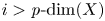 $i>\operatorname {\mathit {p}-dim}(X)$.
Proof. We can assume that  $d=\dim (X)\le \operatorname {\mathit {p}-dim}(X)$ is finite and we use induction on
 $d$. A zero-dimensional noetherian scheme is a finite disjoint union of schemes
 $\operatorname {Spec}(A)$ where
 $A$ is artinian local with residue field
 $k$. As homotopy
 $K$-theory is nil-invariant
 $KH_i(A;\mathbb {Z} /p)\cong KH_i(k;\mathbb {Z} /p)$ and this group vanishes for
 $i>\operatorname {\mathit {p}-dim}(k)$ by Corollary 3.11.
We proceed with the inductive step for  $d>0$. Again by Zariski descent we may assume
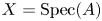 $X=\operatorname {Spec}(A)$ where
 $A$ is a noetherian
 $\mathbb {F}_p$-algebra of finite Krull dimension
 $d$. By cdh descent [Reference CisinskiCis13, Theorem 3.9] and nil-invariance of
 $KH$ we may assume that
 $X$ is integral. Let
 $\pi \colon X'\to X$ be a modification, that is, a proper birational morphism with
 $X'$ integral. There exists a closed subscheme
 $Y$ of
 $X$ with
 $\dim (Y)<\dim (X)$ such that
 $\pi$ is an isomorphism outside
 $Y$. We obtain an abstract blow-up square

inducing a long exact sequence
 \begin{align*} & \cdots\to KH_{i+1}(Y';{{\mathbb{Z}}}/p) \to KH_i(X;{{\mathbb{Z}}}/p)\to \\ &\hspace{13.7pc} \to KH_i(Y;{{\mathbb{Z}}}/p)\oplus KH_i(X';{{\mathbb{Z}}}/p)\to KH_{i}(Y';{{\mathbb{Z}}}/p)\to\cdots. \end{align*}
Let  $i>\operatorname {\mathit {p}-dim}(X)$. Since
 $\operatorname {\mathit {p}-dim}(X)\geq \operatorname {\mathit {p}-dim}(Y)$, the group
 $KH_i(Y;{{\mathbb {Z}}}/p)$ vanishes by the inductive hypothesis. Note that Lemma 2.8 implies that
 $\operatorname {\mathit {p}-dim}(X)\geq \operatorname {\mathit {p}-dim}(X')$. As
 $\operatorname {\mathit {p}-dim}(X')\geq \operatorname {\mathit {p}-dim}(Y')$, the inductive hypothesis yields
 $KH_{i+1}(Y';{{\mathbb {Z}}}/p)=KH_{i}(Y';{{\mathbb {Z}}}/p)=0$. Hence, any modification
 $X'\to X$ induces an isomorphism
 $KH_i(X;{{\mathbb {Z}}}/p) \cong KH_i(X';{{\mathbb {Z}}}/p)$ for all integers
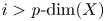 $i>\operatorname {\mathit {p}-dim}(X)$ and consequently an isomorphism
 \begin{equation} KH_i(X;{{\mathbb{Z}}}/p) \cong \mathop{\textrm{colim}}\limits_{\substack{X'\to X \\ \text{modification}}} KH_i(X';{{\mathbb{Z}}}/p). \end{equation}
There is a convergent Zariski descent spectral sequence
 \[ E_2^{st}= H^{s} (X', a_\mathrm{Zar} KH_{{-}q}(-;{{\mathbb{Z}}}/p)) \Longrightarrow KH_{{-}s-t}(X';{{\mathbb{Z}}}/p) \]
where  $a_\mathrm {Zar}$ denotes Zariski sheafification. Note that
 $\dim (X') \leq \dim (X)$ for every modification
 $X' \to X$ and
 $E^{st}_2$ vanishes unless
 $0\le s\le \dim (X')$. Taking the filtered colimit as above of these uniformly bounded spectral sequences yields a convergent spectral sequence
 \[ \mathop{\textrm{colim}}\limits_{\substack{X'\to X \\ \text{modification}}} H^{s} ( X' , a_\mathrm{Zar} KH_{{-}t}(-;{{\mathbb{Z}}}/p) ) \Longrightarrow \mathop{\textrm{colim}}\limits_{\substack{X'\to X \\ \text{modification}}} KH_{{-}s-t}(X';{{\mathbb{Z}}}/p). \]
We can use (8) to identify the right-hand side with  $KH_{-s-t}(X;{{\mathbb {Z}}}/p)$ for
 $-s-t> \operatorname {\mathit {p}-dim}(X)$. We want to show that the left-hand side vanishes for all
 $s\in {{\mathbb {Z}}}$ and
 $-t > \operatorname {\mathit {p}-dim}(X)$. Consider the Zariski–Riemann space
 \[ \textrm{ZR}(X) = \lim_{\substack{X'\to X \\ \text{modification}}} X' \]
where the limit is formed in the category of locally ringed spaces; see [Reference Fujiwara and KatoFK18, Definition E.2.3]. By [Reference Fujiwara and KatoFK18, Proposition 3.1.19] we can rewrite the left-hand side of the above spectral sequence as  $H^{s} (\textrm {ZR}(X), \mathcal {F}_{-t})$ where
 $\mathcal {F}_t$ is the colimit of the sheaves
 $a_\mathrm {Zar} KH_{t}(-;{{\mathbb {Z}}}/p)$ on
 $X'_\mathrm {Zar}$. Consider an integer
 $t > \operatorname {\mathit {p}-dim}(X)$. It suffices to show that the sheaf
 $\mathcal {F}_t$ vanishes on the topological space
 $\textrm {ZR}(X)$. This can be tested on stalks. Hence, by [Reference Fujiwara and KatoFK18, Corollary E.2.13] we must show that
 $\mathcal {F}(V)$ vanishes for every valuation ring
 $V$ of
 $F$ where
 $F$ denotes the function field of
 $X$. As (homotopy)
 $K$-theory commutes with filtered colimits, we have
 $\mathcal {F}(V)\cong KH_t(V;\mathbb {Z} / p)$. Now
 $\operatorname {\mathit {p}-dim}(F)\leq \operatorname {\mathit {p}-dim}(X)$ implies
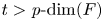 $t>\operatorname {\mathit {p}-dim}(F)$. So the vanishing of
 $KH_t(V;\mathbb {Z} / p)$ follows from Corollary 3.11 and the following Lemma 4.3.
Lemma 4.3 For a valuation ring  $V$ and
 $m\ge 0$ the canonical map
 $K(V ) \to K(V[ X_1,\ldots , X_m ])$ is an equivalence. In particular, we get an equivalence
 $K(V)\simeq KH(V)$.
Proof. We have to show that any element  $\xi \in NK_i(V[X_1,\ldots , X_m])$ vanishes. As
 $V$ is a filtered colimit of noetherian integral subrings and as
 $K$-theory commutes with filtered colimits of rings we can assume that there exist a noetherian ring
 $A\subset V$ and an element
 $\xi _A\in NK_i (A [X_1,\ldots , X_m])$ mapping to
 $\xi$. By [Reference Kerz, Strunk and TammeKST18, Proposition 6.4] there exists a projective birational morphism
 $X'\to \operatorname {Spec} (A)$ such that
 $\xi _A$ maps to
 $0$ in
 $NK_i (X'\times \mathbb {A}^{m})$. As the morphism
 $\operatorname {Spec}(V)\to \operatorname {Spec}(A)$ factors through
 $X'$ by the valuative criterion for properness, we see that
 $\xi =0$.
Remark 4.4 Lemma 4.3 was suggested by Christian Dahlhausen. Kelly and Morrow also prove Lemma 4.3 by a different method; see [Reference Kelly and MorrowKM21, Theorem 3.3].
Let  $n$ be an integer. Recall that a ring
 $A$ is called
 $K_n$-regular if the canonical map
 $K_n(A)\to K_n(A[X_1,\ldots ,X_m])$ is an isomorphism for all positive integers
 $m$, or equivalently, if
 $N^{p}K_n(A)=0$ (see [Reference WeibelWei13, Definition III.3.4]) for all positive integers
 $p$. Vorst and van der Kallen proved that
 $K_n$-regularity implies
 $K_{n-1}$-regularity [Reference Vorst and van der KallenVor79, Corollary 2.1]. In fact, they just consider the case
 $n\geq 1$ and the statement for all integers
 $n$ can be found in [Reference WeibelWei13, Theorem V.8.6]. Together with the spectral sequence
 \[ E^{1}_{st} = N^{s}K_t(A) \Longrightarrow KH_{s+t}(A) \]
from [Reference WeibelWei13, Theorem IV.12.3], this implies that, if  $A$ is
 $K_n$-regular, the canonical map
 \[ K_i(A) \to KH_i(A) \]
is an isomorphism for all integers  $i\leq n$ and surjective for
 $i=n+1$. The next result is Theorem A from the introduction.
Theorem 4.5 Let  $A$ be an excellent
 $\mathbb {F}_p$-algebra such that
 $[k(x):k(x)^{p}]<\infty$ for all points
 $x\in \operatorname {Spec}(A)$. If
 $A$ is
 $K_{\operatorname {\mathit {p}-dim}(A)+1}$-regular, then
 $A$ is regular.
Remark 4.6 Note that a reduced  $\mathbb {F}_p$-algebra
 $A$ which satisfies
 $[k(x):k(x)^{p}]<\infty$ for all maximal points
 $x\in \operatorname {Spec}(A)$ is excellent if and only if it is Frobenius finite, as shown by Kunz and Datta–Smith [Reference Datta and SmithDS18, Corollary 2.6].
Proof. First observe that we can assume without loss of generality that  $A$ has finite Krull dimension. Indeed, we have to show that the finite-dimensional ring
 $A_\mathfrak {p}$ is a regular local ring for all prime ideals
 $\mathfrak {p}\subset A$. But by [Reference Vorst and van der KallenVor79, Corollary 1.9] the localization
 $A_\mathfrak {p}$ is
 $K_{\operatorname {\mathit {p}-dim}(A_\mathfrak {p})+1}$-regular.
We show the statement by induction on the finite Krull dimension  $d$ of
 $A$. For
 $d=0$ the noetherian ring
 $A$ is regular if it is reduced, and this is immediately implied by
 $K_1$-regularity. We proceed with the inductive step for
 $d>0$. By the above observation we can assume that
 $A$ is local.
Next, we want to reduce to the case of complete local  $\mathbb {F}_p$-algebras. Let
 $A\to \widehat A$ be the completion at the maximal ideal
 $\mathfrak {m}$. The ring
 $A$ is regular if and only if
 $\widehat A$ is regular. In order to finish the reduction, we must show that
 $\widehat A$ is
 $K_{\operatorname {\mathit {p}-dim}(\widehat A)+1}$-regular. As
 $\operatorname {\mathit {p}-dim}(\widehat A)\leq \operatorname {\mathit {p}-dim}(A)$ by Lemma 2.7, it suffices to show that
 $\widehat A$ is
 $K_{\operatorname {\mathit {p}-dim}(A)+1}$-regular. For an integer
 $q\geq 1$ and
 $i=\operatorname {\mathit {p}-dim}(A)+1$ consider the commutative diagram

with exact rows, where  $X= \operatorname {Spec}(A)\setminus \{\mathfrak {m}\}$ and
 $\widehat X = \operatorname {Spec}(\widehat A)\setminus \{\mathfrak {m}\}$. We will show that the groups in the corners vanish. Let
 $\mathfrak {p}\not =\mathfrak {m}$ be a prime ideal of
 $A$. As before, the local ring
 $A_{\mathfrak {p}}$ is
 $K_{\operatorname {\mathit {p}-dim}(A_{\mathfrak {p}})+1}$-regular. As
 $\dim (A_{\mathfrak {p}}) < \dim (A)$, the ring
 $A_{\mathfrak {p}}$ is regular by the inductive hypothesis. So
 $X$ is a regular scheme. As
 $A$ is excellent, the morphism
 $\operatorname {Spec}(\widehat A)\to \operatorname {Spec}(A)$ is regular. By [Reference GrothendieckEGA, IV, Scholie (7.8.3)(v)] it follows that also
 $\widehat X$ is regular. Hence, the groups in the corners of the above diagram involving
 $X$ and
 $\widehat X$ vanish. By Thomason–Trobaugh excision [Reference Thomason and TrobaughTT90, Proposition 3.19] for
 $N^{q}K$, the second vertical map is an isomorphism. This implies that the ring
 $\widehat A$ is
 $K_{\operatorname {\mathit {p}-dim}(A)+1}$-regular, which finishes the reduction. We can now assume that
 $A$ is a complete
 $\mathbb {F}_p$-algebra.
Let  $k$ denote the residue field of
 $A$ and set
 $e=\operatorname {\mathit {p}-dim}(A)$. We have
 \begin{equation} e = \operatorname{\mathit{p}-dim}(k) + d \end{equation}
by Lemma 2.7, which is a finite number as  $\operatorname {\mathit {p}-dim}(k)$ is finite by assumption. Since
 $A$ is
 $K_{e+1}$-regular, the fiber of
 $K\to KH$ is
 $(e+1)$-connected by the discussion preceding Theorem 4.5. Hence the fiber of
 $K/p\to KH/p$ is
 $(e+1)$-connected as well and, in particular,
 \[ K_{e+1}(A;{{\mathbb{Z}}}/p) \to KH_{e+1}(A;{{\mathbb{Z}}}/p) \]
is injective. The group on the right-hand side vanishes by Proposition 4.2, and consequently  $K_{e+1}(A;{{\mathbb {Z}}}/p)=0$.
Consider a minimal set of generators  $x_1,\ldots ,x_r$ for the maximal ideal
 $\mathfrak {m}$ of
 $A$. We have
 $r=\dim _k\mathfrak {m}/\mathfrak {m}^{2}\geq d=\dim (A)$ and
 $A$ is regular if and only if equality holds. By Cohen's theorem [Reference MatsumuraMat80, Theorem 28.3] the equicharacteristic complete local ring
 $A$ has a coefficient field, that is, the projection
 $A\to A/\mathfrak {m}=k$ admits a split
 $k\to A$. Hence also
 $k\to A/\mathfrak {m}^{2}\to k$ is the identity and there is a surjection
 $k[X_1,\ldots , X_r]\to A/\mathfrak {m}^{2}$ which induces an isomorphism
 $B=k[X_1,\ldots , X_r]/(X_{1}, \ldots , X_{r})^{2} \cong A/\mathfrak {m}^{2}$.
Finally, we will show that  $K_{i}(A;{{\mathbb {Z}}}/p)\neq 0$ for all
 $i\in \{1,\ldots ,\operatorname {\mathit {p}-dim}(k)+r\}$. This implies
 $\operatorname {\mathit {p}-dim}(k)+r\leq e$ by the vanishing result from before and (10) then gives
 $r\leq d$, whence the regularity of
 $A$. In order to show the non-vanishing, let
 $y_{1}, \ldots , y_{s} \in k$ be
 $p$-independent elements and consider the symbol
 $\bar \xi \in K_{s+r}(B)$ which is given by the image of
 $\{y_{1}, \ldots , y_{s}, 1+X_{1}, \ldots , 1+X_{r}\}$. This has a preimage
 $\xi \in K_{s+r}(A)$ as
 $A\to B$ is surjective. Consider the following diagram.

The image of  $\xi$ in the lower right corner is non-trivial by Lemma 4.1. Hence the image of the element
 $\xi$ in
 $K_{s+r}(A)/p$ is non-trivial. As the canonical map
 $K_{s+r}(A)/p\to K_{s+r}(A;{{\mathbb {Z}}}/p)$ is injective, we obtain
 $K_{s+r}(A;{{\mathbb {Z}}}/p)\neq 0$.
In conjunction with Lemma 2.7 we obtain the following corollary.
Corollary 4.7 Let  $k$ be a perfect field of positive characteristic and let
 $A$ be a
 $k$-algebra of finite type. Suppose that
 $A$ is
 $K_{\dim (A)+1}$-regular. Then
 $A$ is a regular ring.
We close this section by proving that, in characteristic  $0$, Vorst's conjecture can be generalized from affine algebras over fields to all excellent rings. Recall that Vorst's conjecture in characteristic
 $0$ is shown in [Reference Cortiñas, Haesemeyer and WeibelCHW08]. Our generalization is based on the Hironaka–Artin algebraization of isolated singularities. The following result is Theorem B from the introduction.
Theorem 4.8 Let  $A$ be an excellent noetherian ring of characteristic
 $0$. If
 $A$ is
 $K_{\dim (A)+1}$-regular, then
 $A$ is regular.
Proof. As in the proof of Theorem 4.5, we can assume without loss of generality that  $A$ has finite Krull dimension and that it is local. So we prove Theorem 4.8 by induction on
 $d=\dim (A)$. By the induction assumption the localization
 $A_g$ is regular for any
 $g\in A\setminus A^{\times }$, so
 $A$ has at most an isolated singularity at its maximal ideal
 $\mathfrak {m}$. Arguing as in diagram (9), we can also assume that
 $A$ is complete.
Let  $k\subset A$ be a field of coefficients for
 $A$ [Reference Matsumura and ReidMat86, Theorem 28.3]. Then by [Reference GrothendieckEGA,
 $0_{\mathrm {IV}}$ Proposition 22.7.2] the
 $k$-algebra
 $A$ satisfies the assumptions of Hironaka–Artin algebraization [Reference ArtinArt69, Theorem 3.8] so that
 $A$ is the completion of a
 $k$-algebra
 $R$ of finite type at a maximal ideal
 $\mathfrak {m}$. We can assume that
 $R$ is regular away from the ideal
 $\mathfrak {m}$ and that
 $\dim (R)=\dim (A)$. Let
 $X$ be
 $\operatorname {Spec} R\setminus \{\mathfrak {m} \}$,
 $\widehat X = \operatorname {Spec} (A) \setminus {\mathfrak {m}}$, and let
 $q\ge 1$. In the commutative diagram with exact rows

the groups in the corners involving  $X$ and
 $\widehat X$ vanish since these schemes are regular. The second vertical map is an isomorphism by Thomason–Trobaugh excision [Reference Thomason and TrobaughTT90, Proposition 3.19] for
 $N^{q}K$. So for
 $i\le \dim (R)+1 = \dim (A)+1$ the vanishing of
 $N^{q}K_i(A)$ implies the vanishing of
 $N^{q}K_i(R)$. By [Reference Cortiñas, Haesemeyer and WeibelCHW08, Theorem 0.1] the ring
 $R$ is regular, and so is its completion
 $A$.
5. A one-dimensional analog of Vorst's conjecture in mixed characteristic
In this section we prove Theorem C (see Theorem 5.11 below). The proof is based on calculations involving the de Rham–Witt complex in mixed characteristic, which was introduced in [Reference Hesselholt and MadsenHM04, Theorem A]. The key non-vanishing result is Proposition 5.9.
5.1 de Rham–Witt computations
Let  $p$ be an odd prime. For any commutative ring
 $R$ we denote by
 $R[\epsilon ]$ the ring of dual numbers over
 $R$, that is,
 $R[\epsilon ] \cong R[t]/(t^{2})$ with
 $\epsilon$ corresponding to the class of
 $t$. Recall from [Reference Hesselholt and MadsenHM04, Lemma 4.1.1] that every element of the ring
 $W_{n}(R[t])$ of
 $p$-typical Witt vectors of length
 $n$ may be written uniquely as a finite sum
 \begin{equation} \sum_{j\in {{\mathbb{N}}}_{0}} a_{0,j}^{(n)} [t]_{n}^{j} + \sum_{s=1}^{n-1} \sum_{j \in I_{p}} V^{s}\big(a_{s,j}^{(n-s)}[t]_{n-s}^{j}\big) \end{equation}
with  $a_{s,j}^{(n-s)} \in W_{n-s}(R)$. Here
 $I_{p}$ is the set of natural numbers not divisible by
 $p$ and for any ring
 $A$ the symbol
 $[\cdot ]_{n} \colon A \to W_{n}(A)$ denotes the Teichmüller map. The index
 $n$ will usually be clear from the context, and we often drop it from the notation to improve readability. With the same proof as in [Reference Hesselholt and MadsenHM04] one obtains the following lemma.
Lemma 5.1 Any element in  $W_{n}(R[\epsilon ])$ may be written uniquely in the form
 \[ a_{0,0}^{(n)} + a_{0,1}^{(n)}[\epsilon]_{n} + \sum_{s=1}^{n-1} V^{s}(a_{s,1}^{(n-s)}[\epsilon]_{n-s}) \]
with 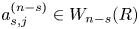 $a_{s,j}^{(n-s)} \in W_{n-s}(R)$. The kernel of the canonical surjection
 $W_{n}(R[t]) \to W_{n}(R[\epsilon ])$ consists of those elements (12) for which
 $a^{(n-s)}_{s,j} = 0$ whenever
 $j =0$ or
 $j=1$.
We now assume that  $R$ is a
 ${{\mathbb {Z}}}_{(p)}$-algebra.
Lemma 5.2 Any element in  $W_{n}\Omega ^{q}_{R[\epsilon ]}$ can be written uniquely as a finite sum of the form
 \begin{equation} a_{0,0}^{(n)} + a_{0,1}^{(n)}[\epsilon]_{n} + b_{0}^{(n)} d[\epsilon]_{n} + \sum_{s=1}^{n-1} \big(V^{s}(a_{s,1}^{(n-s)}[\epsilon]_{n-s} ) + dV^{s} (b_{s}^{(n-s)}[\epsilon]_{n-s} )\big) \end{equation}
where  $a_{s,i}^{(n-s)} \in W_{n-s}\Omega ^{q}_{R}$ and
 $b_{s}^{(n-s)} \in W_{n-s}\Omega ^{q-1}_{R}$. In other words, as an abelian group
 \begin{equation} W_{n}\Omega^{q}_{R[\epsilon]} \cong W_{n}\Omega^{q}_{R} \oplus W_{n}\Omega^{q}_{R} \oplus W_{n}\Omega^{q-1}_{R} \oplus \bigoplus_{s=1}^{n-1} \big(W_{n-s}\Omega^{q}_{R} \oplus W_{n-s}\Omega^{q-1}_{R}\big). \end{equation}
The structure maps of the pro-system  $W_{\bullet }\Omega ^{q}_{R[\epsilon ]}$ are induced by those of
 $W_{\bullet }\Omega ^{q}_{R}$. On the first summand
 $W_{n}\Omega ^{q}_{R}$ the structure maps
 $d$,
 $F$, and
 $V$ are given by the underlying maps of
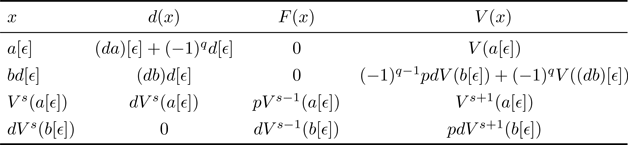
 $W_{\bullet }\Omega ^{*}_{R}$; on the other summands they are given in Table 1.
Structure maps on  $W_{n}\Omega ^{q}_{R[\epsilon ]}$.

The product is given as follows. On the first summand, the product is the one from  $W_{n}\Omega ^{*}_{R}$. The product of two summands from (13) each of which has an
 $[\epsilon ]$ vanishes. Finally, for
 $a' \in W_{n}\Omega ^{q'}_{R}$ the left multiplication with
 $a'$ is given in Table 2.
Multiplication by  $a' \in W_{n}\Omega ^{q'}_{R}$ on
 $W_{n}\Omega ^{q}_{R[\epsilon ]}$.

Proof. By [Reference Geisser and HesselholtGH06b, Lemma 2.4] the canonical map  $W_{n}\Omega ^{*}_{R[t]} \to W_{n}\Omega ^{*}_{R[\epsilon ]}$ is surjective with kernel the dg-ideal generated by the kernel of the map
 $W_{n}(R[t]) \to W_{n}(R[\epsilon ])$. Using the description of this ideal in Lemma 5.1, the lemma now follows directly from the corresponding description of the de Rham–Witt complex of the polynomial ring
 $R[t]$ in [Reference Hesselholt and MadsenHM04, Theorem 4.2.8].
For ease of notation, we introduce the following abbreviation. For any ring  $k/\mathbb {F}_p$ we set
 \[ B(k) = W_{2}(k)[\epsilon]/(p\epsilon). \]
For example,  $B(\mathbb {F}_{p}) = {{\mathbb {Z}}}[\epsilon ]/(p, \epsilon )^{2}$.
Proposition 5.3 For  $n \geq 2$, the element
 $d[1+p]_{n}d[1+\epsilon ]_{n}$ does not vanish in
 $W_{n}\Omega ^{2}_{B(\mathbb {F}_{p})}/p$.
Proof. We write  $\omega _{n,R}^{*}$ for the quotient of
 $W_{n}\Omega ^{*}_{R[\epsilon ]}$ by the dg-ideal
 ${\bigoplus} _{s=1}^{n-1} \big (W_{n-s}\Omega ^{*}_{R} \oplus W_{n-s}\Omega ^{*-1}_{R} \big )$ in (14).
Claim 5.4 We have  $d[1+\epsilon ]_{n} = d[\epsilon ]_{n}$ in
 $\omega ^{1}_{n,R}$.
Proof. In  $W_{n}(R[\epsilon ])$ we have
 $[1+\epsilon ]_{n} = 1 + [\epsilon ]_{n} + V(x)$ for some element
 $x \in W_{n-1}(R[\epsilon ])$. From Lemma 5.1 we see that
 $V(x)$ is of the form
 $V(x_{0}) + \sum _{s=1}^{n-1} V^{s}(x_{s,1}[\epsilon ]_{n-s})$ with
 $x_{0} \in W_{n-1}(R)$ and
 $x_{s,1} \in W_{n-s}(R)$. Since the ring homomorphism
 $W_{n}(R[\epsilon ]) \to W_{n}(R)$ that is induced by
 $\epsilon \mapsto 0$ must send
 $V(x)$ to
 $0$, we find that in fact
 $V(x_{0}) = 0$. Thus
 \[ [1+\epsilon]_{n} = 1 + [\epsilon]_{n} + \sum_{s=1}^{n-1} V^{s}(x_{s,1}[\epsilon]_{n-s}). \]
Applying  $d$, the claim follows.
Claim 5.5 Multiplication by  $[p]_{n}$ is the zero map on
 $W_{n}\Omega ^{1}_{{{\mathbb {Z}}}_{(p)}}$ and hence also on
 $W_{n}\Omega ^{1}_{R}$ where
 $R$ is any quotient of
 ${{\mathbb {Z}}}_{(p)}$.
Proof. By [Reference Hesselholt and MadsenHM04, Example 1.2.4] we have isomorphisms
 \begin{equation} W_{n}({{\mathbb{Z}}}_{(p)}) \cong \bigoplus_{i=0}^{n-1} {{\mathbb{Z}}}_{(p)} \cdot V^{i}(1) \quad \text{and} \quad W_{n}\Omega^{1}_{{{\mathbb{Z}}}_{(p)}} \cong \bigoplus_{i=1}^{n-1} {{\mathbb{Z}}}/p^{i}{{\mathbb{Z}}} \cdot dV^{i}(1), \end{equation}
and for  $i,j \in \{ 0, \ldots , n-1\}$ we have
 $V^{i}(1)dV^{j}(1) = p^{i}dV^{j}(1)$ if
 $i < j$ and
 $=0$ otherwise. For every element
 $x \in {{\mathbb {Z}}}_{(p)}$ we have
 \begin{equation} [x]_{n} = x\cdot [1]_{n} + \sum_{i=1}^{n-1} p^{{-}i}\big(x^{p^{i}} - x^{p^{i-1}}\big) \cdot V^{i}( [1]_{n-i}) \end{equation}
as one checks by computing the ghost components of both sides. By these formulas, the action of  $[p]_{n}$ on
 $dV^{j}(1)$ is given by
 \[ [p]_{n}\cdot dV^{j}(1) = p dV^{j}(1) + \sum_{i=1}^{j-1} \big(p^{p^{i}} - p^{p^{i-1}}\big) dV^{j}(1) = p^{p^{j-1}} dV^{j}(1) = 0 \]
as  $p^{j-1} \geq j$ for every
 $j \geq 1$. This proves the claim.
Claim 5.6 For  $R = {{\mathbb {Z}}}_{(p)}$ or some quotient of it, the projection
 $W_{n}\Omega ^{2}_{R[\epsilon ]} \to \omega _{n,R}^{2}$ factors through the canonical surjection
 $W_{n}\Omega ^{2}_{R[\epsilon ]} \to W_{n}\Omega ^{2}_{R[\epsilon ]/(p\epsilon )}$.
Note that for  $R = {{\mathbb {Z}}}/(p^{2})$,
 $R[\epsilon ]/(p\epsilon ) = B(\mathbb {F}_{p})$.
Proof. The kernel of the surjection  $W_{n}\Omega ^{*}_{R[\epsilon ]} \to W_{n}\Omega ^{*}_{R[\epsilon ]/(p\epsilon )}$ is the dg-ideal generated by the kernel of the map
 $W_{n}(R[\epsilon ]) \to W_{n}(R[\epsilon ]/(p\epsilon ))$. An element of this kernel is of the form
 $\sum _{i=0}^{n-1} V^{i}( [x_{i}p\epsilon ]_{n-i} )$ with
 $x_{i} \in R$. The dg-ideal generated by the elements
 $V^{i}( [x_{i}p\epsilon ]_{n-i})$ for
 $i > 0$ lies in the kernel of
 $W_{n}\Omega ^{*}_{R[\epsilon ]} \to \omega ^{*}_{n,R}$ by definition.
It remains to show that the dg-ideal generated by  $[p\epsilon ]_{n}$ in
 $\omega ^{*}_{n,R}$ vanishes in degree 2. We have
 $d[p\epsilon ] = [p]d[\epsilon ] + [\epsilon ]d[p]$. Hence the vanishing of
 $W_{n}\Omega ^{2}_{R}$ [Reference Hesselholt and MadsenHM04, Example 1.2.4], Claim 5.5, and Lemma 5.2 together imply that the product of
 $d[p\epsilon ]$ with any 1-form in
 $\omega ^{1}_{n,R}$ vanishes. Since every 2-form in
 $\omega ^{*}_{n,R}$ is a multiple of
 $d[\epsilon ]$, the product of
 $[p\epsilon ]$ with any element of
 $\omega ^{2}_{n,R}$ also vanishes. This finishes the proof of the claim.
Claim 5.7 The natural map  $W_{n}\Omega ^{*}_{{{\mathbb {Z}}}_{(p)}} / p \to W_{n}\Omega ^{*}_{{{\mathbb {Z}}}/(p^{2})}/p$ is an isomorphism.
Proof. The kernel of  $W_{n}\Omega ^{*}_{{{\mathbb {Z}}}_{(p)}} \to W_{n}\Omega ^{*}_{{{\mathbb {Z}}}/(p^{2})}$ is the dg-ideal generated by the kernel
 $W_{n}(p^{2}{{\mathbb {Z}}}_{(p)})$ of the canonical map
 $W_{n}({{\mathbb {Z}}}_{(p)}) \to W_{n}({{\mathbb {Z}}}/(p^{2}))$. It is enough to show that
 $W_{n}(p^{2}{{\mathbb {Z}}}_{(p)}) \subset pW_{n}({{\mathbb {Z}}}_{(p)})$. The ideal
 $W_{n}(p^{2}{{\mathbb {Z}}}_{(p)})$ is additively generated by elements of the form
 $V^{i}([xp^{2}]_{n-i})$. Set
 $m = n-i$. In the expression (16) for
 $[xp^{2}]_{m}$ the coefficient of
 $[1]_{m}$ is
 $xp^{2}$. For
 $i > 0$, the coefficient of
 $V^{i}([1]_{m-i})$ is divisible by
 $p^{-i} (p^{2})^{p^{i-1}} = p^{2p^{i-1} - i}$. Since
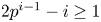 $2p^{i-1} - i \geq 1$ for all
 $i \geq 1$, it is divisible by
 $p$. Thus
 $[xp^{2}]_{m}$ is a multiple of
 $p$ and so is any of its Verschiebungen.
Claim 5.8 The element  $d[1+p]_{2} \in W_{2}\Omega ^{1}_{{{\mathbb {Z}}}_{(p)}}$ is not divisible by
 $p$.
Proof. Using expression (16), we have
 \[ d[1+p]_{2} = p^{{-}1}( (1+p)^{p} - (1+p) ) dV(1). \]
But  $p^{-1}( (1+p)^{p} - (1+p) ) = \sum _{k=1}^{p} \binom {p}{k}p^{k-1} - 1 \equiv -1 \pmod p$. In view of the second isomorphism in (15), this finishes the proof.
We now finish the proof of Proposition 5.3. In order to show that  $d[1+p]_{n}d[1+\epsilon ]_{n}$ does not vanish in
 $W_{n}\Omega ^{2}_{B(\mathbb {F}_{p})}/p$, it suffices by Claim 5.6 to show that the image of
 $d[1+p]_{n}d[1+\epsilon ]_{n}$ in
 $\omega ^{2}_{n,{{\mathbb {Z}}}/(p^{2})}/p$ does not vanish. By Claim 5.4 this image coincides with the image of
 $d[1+p]_{n}d[\epsilon ]_{n}$. By Lemma 5.2 it suffices to show that
 $d[1+p]_{n}$ does not vanish in
 $W_{n}\Omega ^{1}_{{{\mathbb {Z}}}/(p^{2})} / p$; equivalently,
 $d[1+p]_{n} \not = 0$ in
 $W_{n}\Omega ^{1}_{{{\mathbb {Z}}}_{(p)}}/p$ by Claim 5.7. It is clearly enough to show this non-vanishing for
 $n=2$, which is done in Claim 5.8.
Proposition 5.9 Let  $k$ be a
 $\mathbb {F}_{p}$-algebra. The canonical map
 $W_{n}\Omega ^{q}_{B(\mathbb {F}_{p})}/p \to W_{n}\Omega ^{q}_{B(k)}/p$ is injective for every
 $n$ and
 $q$. In particular,
 $d[1+p]_{n}d[1+\epsilon ]_{n}$ does not vanish in
 $W_{n}\Omega ^{2}_{B(k)}/p$ for
 $n\geq 2$.
Proof. The second part of Proposition 5.9 follows from the first part and Proposition 5.3.
Write  $F$ for the functor
 $k \mapsto W_{n}\Omega ^{q}_{B(k)}/p$ from rings over
 $\mathbb {F}_p$ to abelian groups. This functor commutes with filtered colimits. Recall from [Reference van der KallenvdK86, Theorem 2.4] or [Reference BorgerBor11, Proposition 6.9, Theorem 9.2] that if
 $R \to S$ is an étale covering (i.e. étale and faithfully flat), then so is
 $W_{n}(R) \to W_{n}(S)$. Assume that
 $k \to \ell$ is an étale covering. Then
 $B(k) \to B(\ell )$ is also an étale covering by base change. It follows from [Reference HesselholtHes15, Theorem C] that the canonical map
 \[ W_{n}(B(\ell)) \otimes_{W_{n}(B(k))} W_{n}\Omega^{q}_{B(k)}/p \to W_{n}\Omega^{q}_{B(\ell)}/p \]
is an isomorphism. Using the result of van der Kallen and Borger for the map 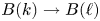 $B(k) \to B(\ell )$, we get that
 $W_{n}(B(k)) \to W_{n}(B(\ell ))$ is an étale covering. Together these results imply that
 $F(k) \to F(\ell )$ is injective. In particular,
 $F(k) \to F(\ell )$ is injective for a finite separable field extension
 $k \to \ell$. Since
 $F$ preserves filtered colimits, the map
 $F(\mathbb {F}_{p}) \to F(\bar{\mathbb{F}}_{p})$ is injective, where
 $\bar{\mathbb{F}}_{p}$ is an algebraic closure of
 $\mathbb {F}_{p}$.
To prove injectivity for a general  $\mathbb {F}_{p}$-algebra
 $k$, it is now enough to show that
 $F(\bar{\mathbb{F}}_{p}) \to F( k \otimes _{\mathbb {F}_{p}} \bar{\mathbb{F}}_{p})$ is injective. We can thus assume that
 $k$ is an
 $\bar{\mathbb{F}}_{p}$-algebra. Write
 $k$ as a filtered colimit of finitely generated
 $\bar{\mathbb{F}}_{p}$-algebras
 $A_{i}$. As
 $\bar{\mathbb{F}}_{p}$ is algebraically closed, each map
 $\bar{\mathbb{F}}_{p} \to A_{i}$ has a section, and hence
 $F(\bar{\mathbb{F}}_{p}) \to F(A_{i})$ is injective. As a filtered colimit of injective maps,
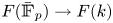 $F(\bar{\mathbb{F}}_{p}) \to F(k)$ is then also injective.
5.2 The mixed characteristic result
The next proposition is a special case of [Reference Geisser and HesselholtGH06a, Propsition B.1.1].
Proposition 5.10 Let  $p\neq 2$ be a prime and
 $A$ a
 ${{\mathbb {Z}}}_{(p)}$-algebra. The natural map
 \[ \begin{array}{rcl} \operatorname{dlog}[-]_n\colon A^{{\times}} & \to & W_n\Omega^{1}_A \\ x & \mapsto & [x]_n^{{-}1} d[x]_n \end{array} \]
satisfies the Steinberg relation  $\operatorname {dlog}[x]_n \operatorname {dlog}[1-x]_n=0$ and hence induces a natural map
 \[ \operatorname{dlog}[-]_n\colon K_2^{\rm M}(A) \to W_n\Omega^{2}_A \]
where the Milnor  $K$-group
 $K_2^{\rm M}(A)$ is defined as
 $A^{\times }\otimes A^{\times }$ modulo the subgroup generated by
 $a\otimes (1-a)$ for units
 $a$ and
 $1-a$.
The following result is Theorem C from the introduction.
Theorem 5.11 Let  $A$ be an excellent noetherian ring with
 $\dim (A)\leq 1$ such that
 $A/\mathfrak {m}$ is perfect of characteristic
 $p> 2$ for every maximal ideal
 $\mathfrak {m} \subset A$. If
 $A$ is
 $K_{2}$-regular, then
 $A$ is regular.
Proof. Let  $A$ be a ring satisfying the assumptions of the theorem. We must show that
 $A$ is regular. As in the proof of Theorem 4.5, we can assume without loss of generality that
 $A$ is local with maximal ideal
 $\mathfrak {m}$.
Once we prove that the strict henselization  $A^\mathrm{sh}$ is regular, we can deduce the regularity of
 $A$; see [Sta19, Lemma 06LN]. As the canonical map
 $A\to A^\mathrm{sh}$ is a filtered colimit of étale morphisms by [Sta19, Lemma 04GN], van der Kallen's result on the
 $NK_n$-groups [Reference van der KallenvdK86, Theorem 3.2] implies that
 $A^\mathrm{sh}$ is still
 $K_2$-regular. Moreover,
 $A^\mathrm{sh}$ is still excellent by [Reference GrecoGre76, Corollary 5.6]. Hence we can assume without loss of generality that
 $A$ is strict henselian and excellent.
Arguing exactly as in the proof of Theorem 4.5, we reduce to the case of  $A$ being a complete local ring with
 $\dim (A)\leq 1$ and maximal ideal
 $\mathfrak {m}$, algebraically closed residue field
 $k=A/\mathfrak {m}$ of characteristic
 $p> 2$, and quotient field
 $F$ of characteristic
 $0$.
Claim 5.12  $K_2(A)/p =0.$
Proof of Claim 5.12 By assumption,  $A$ is a complete noetherian local ring. The
 $K_1$-regularity implies that
 $A$ is also reduced. Thus the normalization
 $A\to \tilde A$ is finite (see, for example, [Sta19, Lemma 032Y]) and we obtain an abstract blow-up square

with  $Y'_\mathrm {red}=\operatorname {Spec}(k)\times \cdots \times \operatorname {Spec}(k)$ as
 $k$ is algebraically closed. Note that
 $\tilde A$ is regular. Descent for
 $KH(-;{{\mathbb {Z}}}/p)$ (see [Reference CisinskiCis13, Theorem 3.9]) yields an exact sequence
 \[ \cdots\to KH_3(Y';{{\mathbb{Z}}}/p) \to KH_2(A;{{\mathbb{Z}}}/p) \to KH_2(\tilde A;{{\mathbb{Z}}}/p) \oplus KH_2(k;{{\mathbb{Z}}}/p) \to\cdots. \]
The group  $KH_3(Y';{{\mathbb {Z}}}/p)= KH_3(Y'_\mathrm {red};{{\mathbb {Z}}}/p)= K_3(Y';{{\mathbb {Z}}}/p)$ and the group
 $KH_2(k;{{\mathbb {Z}}}/p)= K_2(k;{{\mathbb {Z}}}/p)$ vanish by Corollary 3.11.
We have an injection  $K_2(A)/p = KH_2(A)/p \hookrightarrow KH_2(A;{{\mathbb {Z}}}/p)$ where the first isomorphism uses the
 $K_2$-regularity of
 $A$; see [Reference WeibelWei13, Corollary IV.12.3.2]. Hence, the above exact sequence implies that the composite map
 \[ K_2(A)/p \hookrightarrow KH_2(A;{{\mathbb{Z}}}/p) \hookrightarrow KH_2(\tilde A;{{\mathbb{Z}}}/p) = K_2(\tilde A)/p \]
is injective and it suffices to show that 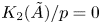 $K_2(\tilde A)/p=0$.
Consider the diagram

where the bottom horizontal line is part of the exact localization sequence of the discrete valuation ring  $\tilde A$. As
 $K_3(k;{{\mathbb {Z}}}/p)=0$ by Corollary 3.11, we deduce that the top horizontal map is injective. So to finish the proof of the claim it suffices to show that
 $K_2(F)/p= 0$.
By the Merkurjev–Suslin theorem [Reference Merkurjev and SuslinMS82], the norm residue homomorphism
 \[ K_2(F)/p \xrightarrow{\cong} H^{2}(F,\mu_p^{{\otimes} 2}) \]
is an isomorphism. The group on the right-hand side vanishes as the field  $F$ has property (
 $C_1$) by [Reference SerreSer02, II.3.3.(c)], invoking Lang's theorem, and hence has cohomological dimension at most
 $1$ by [Reference SerreSer02, II.3.2, Corollary to Proposition 8]. Hence we get
 $K_2(A)/p=0$ as desired. This shows the claim.
Consider a minimal set of generators  $x_1,\ldots ,x_r$ for the maximal ideal
 $\mathfrak {m}$ of
 $A$. The ring
 $A$ is regular if and only if
 $r=1$. We consider two cases.
Suppose first that  $p\in \mathfrak {m}^{2}$ and consider the
 $\mathbb {F}_p$-algebra
 $\bar A:=A/p$. Then the images
 $\bar x_1,\ldots ,\bar x_r$ are still a minimal set of generators for the maximal ideal
 $\bar{\mathfrak{m}}$ of
 $\bar A$. Set
 $\bar B:= \bar A /\bar{\mathfrak{m}}^{2}$. Arguing analogously as in the proof of Theorem 4.5, the image of the symbol
 $\{1+x_1,\ldots ,1+x_r\}\in K_{i}(\bar B)$ in
 $K_{i}(\bar B)/p$ is non-zero and hence
 $K_{i}(A)/p\neq 0$ for all
 $i\in \{1,\ldots ,r\}$. This implies
 $r=1$ by Claim 5.12 and
 $A$ is regular.
For the second case suppose that  $p\notin \mathfrak {m}^{2}$. Then we can assume without loss of generality that
 $x_1=p$. We argue by contradiction and suppose that
 $r\geq 2$. By Cohen's theorem [Reference MatsumuraMat80, Theorem 28.3] the complete local ring
 $A$ has a coefficient ring
 $W(k)$. Hence, the canonical map
 $X_i\mapsto x_i$ induces an isomorphism
 $W(k)[X_2,\ldots , X_r]/(p,X_2,\ldots , X_r)^{2}\cong A/\mathfrak {m}^{2}$. This ring canonically surjects onto the ring
 $W_2(k)[X]/(p,X)^{2}\cong W_{2}(k)[\epsilon ]/(p\epsilon )$ which we denote by
 $B(k)$. Analogously to the first case, it suffices to show that the image of the symbol
 $\{1+p, 1+\epsilon \}$ in
 $K_2(B(k))/p$ does not vanish. By [Reference van der KallenvdK77] and as the residue field
 $k$ is infinite, the canonical map
 $K^{\rm M}_2(B(k))\to K_2(B(k))$ is an isomorphism. Choose some integer
 $n\geq 2$. The
 $\operatorname {dlog}$ map from Proposition 5.10 sends the symbol
 $\{1+p, 1+\epsilon \}$ to the element
 $[1+p]_{n}^{-1}d[1+p]_{n}[1+\epsilon ]_{n}^{-1}d[1+\epsilon ]_{n}$ in
 $W_n\Omega ^{2}_{B(k)}/p$, which does not vanish by Proposition 5.9. Hence
 $K_2(A)/p \neq 0$, which contradicts Claim 5.12. This implies that
 $A$ is regular.
Acknowledgements
We thank Ofer Gabber for sending us an outline of the proof of the Cartier isomorphism mentioned above and for helpful comments on our presentation of his results in the appendix. We are grateful to the referees for a careful reading of our paper and several helpful comments. In particular, they suggested an alternative proof of the vanishing result for the topological cyclic homology of a valuation ring mentioned above.
Appendix. The Cartier isomorphism for valuation rings (after Ofer Gabber)
In this appendix we present a detailed account of results of Gabber about valuations rings in positive characteristic. In particular, we construct the Cartier isomorphism for these rings. The exposition is based on [Reference GabberGab18, Reference Gabber and RameroGR03].
A.1 Elementary extensions
Let  $V\subset W$ be an extension of integral domains of characteristic
 $p$ such that
 $W^{p}\subset V$. For such an extension we get a
 $V$-linear ‘inverse Cartier’ operator
 \begin{equation} \begin{aligned} \gamma_{W/V}: V\otimes_W \Omega_{W/V}^{i} &\xrightarrow{} Z\Omega^{i}_{W/V}/B\Omega^{i}_{W/V} \\ v\otimes b dy_1\wedge \cdots \wedge dy_i &\mapsto v b^{p} y_1^{p-1}dy_1\wedge \cdots \wedge y_i^{p-1}dy_i; \end{aligned} \end{equation}
see [Reference KatzKat70, § 7]. Here  $V$ becomes a
 $W$-module via the Frobenius map. If
 $V=W^{p}$ this map can be identified with the standard
 $W$-linear map on absolute forms, discussed in § 3,
 \[ \gamma_W:\Omega_{W}^{i} \to Z \Omega^{i}_{W}/B\Omega^{i}_{W}, \]
where the Frobenius induces the  $W$-module structure on the right.
We say that the extension  $V\subset W$ is elementary if there exists a finite
 $p$-basis
 $x_1,\ldots , x_r\in W$ of
 $W/V$; see Definition 2.1. Note that
 $x_1,\ldots , x_r\in W$ form a
 $p$-basis of
 $W/V$ if
 $W=V[x_1, \ldots , x_r]$ and if these elements form a
 $p$-basis of the extension of quotient fields
 $Q(W)/Q(V)$. An elementary extension is a flat local complete intersection homomorphism of rings, since we have the presentation
 \begin{equation} W\cong V[X_1,\ldots, X_r]/(X_1^{p}-x_1^{p}, \ldots, X_r^{p}-x_r^{p}). \end{equation}
This presentation also implies that  $\Omega _{W/V}$ is a free
 $W$-module with basis
 $dx_1, \ldots , dx_r$.
By  $\mathbb {L}_{W/V}$ we denote the cotangent complex of the ring extension
 $V\subset W$ and by
 $\mathbb {L}_V$ we denote the cotangent complex of
 $V$ over
 $\mathbb {F}_p$; see § 3.
Proposition A.1
(i) If the extension
$V\subset W$ is elementary, then $\mathbb {L}_{W/V}$ is concentrated in degrees $0$ and $1$, and $H_i(\mathbb {L}_{W/V})$ is a flat $W$-module for $i\in \{0,1\}$.(ii) If
$V\subset V^{1/p}$ is a filtered colimit of elementary extensions $V\subset W$, then $\mathbb {L}_{V}\simeq \Omega _{V}[0]$ and $\Omega _V$ is a flat $V$-module.


Proof. Part (i) is clear from the presentation (A.2) and [Reference IllusieIll71, Corollary III.3.2.7]. The second statement of part (ii) is clear from part (i) as the extension  $V\subset V^{1/p}$ is isomorphic to the extension
 $V^{p}\subset V$ via the Frobenius map and as
 $\Omega _V=\Omega _{V/V^{p}}$.
So it remains to show that  $\mathbb {L}_{V}\simeq \Omega _{V}[0]$ under the assumption of part (ii). Note that then
 $V\subset V^{1/p}$ is faithfully flat. By part (i) the cotangent complex
 $\mathbb {L}_{V^{1/p}/V}$ as well as the isomorphic cotangent complex
 $\mathbb {L}_{V^{1/p^{2}}/V^{1/p}}$ are concentrated in degrees
 $0$ and
 $1$. By the exact triangle
 \[ \mathbb{L}_{V^{1/p}/V }\otimes_{V^{1/p}} V^{1/p^{2}} \to \mathbb{L}_{V^{1/p^{2}}/V } \to \mathbb{L}_{V^{1/p^{2}}/V^{1/p}}, \]
 $\mathbb {L}_{ V^{1/p^{2}}/V}$ is also concentrated in degrees
 $0$ and
 $1$. Arguing inductively, this is also true for the faithfully flat extension
 $V\subset V^{1/p^{\infty }}$.
Note that  $\mathbb {L}_{V^{1/p^{\infty }}}$ is concentrated in degree
 $0$, since the ring
 $V^{1/p^{\infty }}$ is perfect [Reference Gabber and RameroGR03, 6.5.13(i)]. So we conclude by the exact triangle
 \[ \mathbb{L}_V \otimes_V V^{1/p^{\infty}} \to \mathbb{L}_{V^{1/p^{\infty}}} \to \mathbb{L}_{V^{1/p^{\infty}}/V}. \]
Proposition A.2 (Cartier isomorphism)
(i) If the extension
$V\subset W$ is elementary, then the morphism $\gamma _{W/V}$ of (A.1) is an isomorphism.(ii) If
$V\subset V^{1/p}$ is a filtered colimit of elementary extensions $V\subset W$, then the map $\gamma _V$ is an isomorphism.


The isomorphism  $\gamma$ is usually denoted by
 $C^{-1}$ and called the inverse Cartier operator.
Proof. Part (ii) is an immediate consequence of part (i). For part (i) one reduces to  $r=1$ as in the proof of [Reference KatzKat70, Theorem 7.2]. Then one only has to consider
 $i=0$ and
 $i=1$. For
 $i=1$ a
 $V$-basis of the left-hand side of (A.1) is given by
 $dx_1$. A
 $V$-basis of
 $B\Omega ^{1}_{W/V}$ is given by
 $dx_1, x_1 dx_1, \ldots , x_1^{p-2}dx_1$, so a
 $V$-basis of the right-hand side of (A.1) is induced by
 $x_1^{p-1}dx_1=\gamma _{W/V} (dx_1)$.
A.2 Purely inseparable extensions of valued fields
Let  $K\subset K'$ be an extension of valued fields of characteristic
 $p$ with
 $(K')^{p}\subset K$. Let
 $V\subset V'$ be the corresponding extension of valuation rings. A subextension of rings
 $V\subset W\subset V'$ is called elementary if the extension
 $V\subset W$ is elementary in the sense of § A.1.
Theorem A.3 (Gabber) The set  $\mathcal {S}$ of elementary extensions
 $V\subset W\subset V'$ is directed by inclusion and
 \[ \bigcup_{W\in \mathcal{S}} W=V'. \]
Combining Theorem A.3 with Propositions A.1 and A.2, we obtain the following corollary.
Corollary A.4 Let  $V$ be a valuation ring of characteristic
 $p$. Then the following assertions hold.
(i)
$\Omega _V$ is a flat $V$-module.(ii)
$\mathbb {L}_V$ is concentrated in degree $0$.(iii) The ‘inverse Cartier’ operator
$\gamma _V$ from § A.1 is an isomorphism.


Remark A.5 Parts (i) and (ii) of Corollary A.4 are shown in Theorem 6.5.12 and Corollary 6.5.21 in [Reference Gabber and RameroGR03] using related techniques. These techniques are extended in [Reference GabberGab18] to prove Theorem A.3 and Corollary A.4.
We repeatedly need the following well-known result about finite extensions of valuation rings; see [Reference BourbakiBou89, §§ VI.8.3 and VI.8.5].
Lemma A.6 Let  $V\subset V'$ be an extension of valuation rings with the above properties and with
 $q=[K':K]$ finite. Let
 $f$ be the degree of the residue field extension and let
 $e=[|(K')^{\times }|:|K^{\times } |]$ be the ramification index. Then:
(i)
$q\ge e f$, $e|q$ and $f|q$;(ii) if
$f=q$ the extension $V'/V$ is finite and $V' \mathfrak m$ is the maximal ideal of $V'$, where $\mathfrak m$ is the maximal ideal of $V$.


In the proof of Theorem A.3 we use two preliminary reductions based on the following lemmas. Let us call an extension of valuation rings  $V\subset V'$ good if it satisfies the conclusion of Theorem A.3.
Lemma A.7 If  $V\subset V'\subset V''$ are extensions of valuation rings of characteristic
 $p$ with
 $(V'')^{p}\subset V$ such that
 $V\subset V'$ and
 $V'\subset V''$ are good extensions, then
 $V\subset V''$ is also a good extension.
Proof. Let  $\mathbf { x} = (x_1,\ldots , x_r)$ be
 $p$-independent elements in the extension
 $V'/V$ and let
 $\mathbf {y} = (y_1,\ldots , y_s)$ be
 $p$-independent elements in the extension
 $V''/V'$. Then
 $\mathbf {x} , \mathbf {y}$ are
 $p$-independent in the extension
 $V''/V$, so
 $V[\mathbf {x} , \mathbf {y}]$ is an elementary extension of
 $V$.
Consider a finitely generated  $V$-subalgebra
 $A$ of
 $V''$; we have to show that for suitable
 $\mathbf { x}$ and
 $\mathbf {y}$ as above we have
 $A\subset V[\mathbf {x} , \mathbf {y}]$. Indeed, there exist
 $p$-independent elements
 $\mathbf {y}$ in the extension
 $V''/V'$ such that
 $V'A\subset V'[\mathbf {y} ]$. So
 $A\subset B[\mathbf {y} ]$ for a finitely generated
 $V$-subalgebra
 $B$ of
 $V'$. There exist
 $p$-independent elements
 $\mathbf {x}$ in the extension
 $V'/V$ such that
 $B\subset V[\mathbf {x} ]$. Then we get
 $A\subset V[\mathbf {x}, \mathbf {y} ]$ as requested.
Lemma A.8 Let  $V\subset V'$ be an extension of valuation rings as above with
 $[K':K]=p$. Let
 $\mathfrak p'\subset V'$ be a prime ideal lying over a prime ideal
 $\mathfrak p\subset V$. Assume that one of the following two conditions holds:
(a) the residue field extension
$\kappa (\mathfrak p')/\kappa (\mathfrak p)$ is trivial and $V_{\mathfrak p}\subset V'_{\mathfrak p'}$ is good; or(b)
$[\kappa (\mathfrak p'):\kappa (\mathfrak p)]=p$ and $V/\mathfrak p\subset V'/\mathfrak p'$ is good.


Then the extension  $V\subset V'$ is good.
Proof. In both parts of the proof we need the following claim.
Claim A.9 For  $x\in \mathfrak p'$ and
 $t\in V'\setminus \mathfrak p'$ we have
 $x/t\in V'$.
Proof of Claim A.9. If  $x/t$ were not in
 $V'$, then
 $t/x$ would be in
 $V'$, but that would imply
 $t\in \mathfrak p'$, which is a contradiction.
In order to prove Lemma A.8 when condition (a) holds, we start by observing that the assumptions imply that
 \begin{equation} V'_{\mathfrak p'}= \bigcup_{x\in \mathfrak p'} V_{\mathfrak p}[x] \end{equation}
and that the system of elementary extensions of  $V_{\mathfrak p}$ in the union is directed.
We prove that  $V\subset V'$ is good by showing that the elementary extensions of
 $V$ of the form
 $V[x/t]$ with
 $x\in \mathfrak p'$ and
 $t\in V\setminus \mathfrak p$ are directed and that their union is
 $V'$. Note that
 $x/t$ is automatically in
 $V'$ by Claim A.9.
For given  $x\in \mathfrak p'$ we consider the ring
 $R_x=\cup _{t\in V\setminus \mathfrak p} V[x/t]$. Then as
 $R_x=V+V_{\mathfrak p} x + V_{\mathfrak p} x^{2}+\cdots$ we have
 $R_x=V_{\mathfrak p}[x] \cap V'$. So by (A.3) the system of rings
 $R_x$ where
 $x$ runs through
 $\mathfrak p'$ is directed with union
 $V'$.
In order to prove Lemma A.8 when condition (b) holds, we show that there is a canonical map from the set  $\bar {\mathcal {S}}$ of elementary extensions
 $V/\mathfrak p \subsetneq \bar W \subset V'/\mathfrak p'$ to the set
 ${\mathcal {S}}$ of elementary extensions
 $V\subsetneq W\subset V'$ given by
 \[ \Phi\colon \bar{\mathcal{S}} \to {\mathcal{S}}, \quad \Phi(\bar W ) = V'\times_{V'/\mathfrak p'} \bar W. \]
Once we show that  $\Phi$ is well defined and using that
 $V/\mathfrak p\subset V'/\mathfrak p'$ is good, we immediately deduce that the set of elementary extensions
 $\Phi (\bar {\mathcal {S}})$ is directed by inclusion and that
 ${\bigcup} _{\bar W\in \bar {\mathcal {S}} } \Phi (\bar W)=V'$.
In order to show that  $\Phi$ is well defined, consider an elementary extension
 $\bar W= V/\mathfrak p[\bar x]$ and lift
 $\bar x\in V'/\mathfrak p'$ to an element
 $x\in V'$. Clearly, we have the inclusion
 $V[x]\subset \Phi (\bar W)$ and we claim that equality holds. To see this, start with an element
 $y\in \Phi (\bar W)\subset V'$. By subtracting from
 $y$ a lift of
 $\bar y\in \bar W$ to
 $V[x]$ we can assume without loss of generality that
 $y\in \mathfrak p'$. By Lemma A.6 the ring extension
 $V_{\mathfrak p}\subset V'_{\mathfrak p'}$ is finite and
 $V'_{\mathfrak p'}/\mathfrak p V'_{\mathfrak p'} = \kappa (\mathfrak p')$, so by Nakayama's lemma we have
 $V'_{\mathfrak p'}=V_{\mathfrak p} [x]$ and we can write
 $y=a_0 + a_1 x + \cdots + a_{p-1}x^{p-1}$ with
 $a_0,\ldots , a_{p-1}\in V_{\mathfrak p}$. As
 $y\in \mathfrak p'$ we actually have
 $a_0,\ldots , a_{p-1}\in \mathfrak p_{\mathfrak p}$. However,
 $\mathfrak p_{\mathfrak p}\subset V$ by Claim A.9 and therefore
 $y\in V[x]$.
Proof of Theorem A.3 By Lemma A.7 one reduces to  $[K':K]=p$. By writing
 $K$ as a filtered colimit of finitely generated fields we can also assume without loss of generality that the field extension
 $K/\mathbb {F}_p$ is finitely generated. Then the valuation is of finite height; to see this, combine Proposition VI.10.2.3 and Corollary VI.10.3.1 from [Reference BourbakiBou89]. By induction on the height and using Lemma A.8, one reduces to the case of height
 $1$.
From now on we assume that the valuations are given by an absolute value  $|\cdot | : K'\to \mathbb {R}$ and that
 $[K':K]=p$. We distinguish three cases.
Case 1:  $[\kappa (V') : \kappa (V)]=p$. In this case
 $V'$ is finite over
 $V$ and
 $V'/V'\mathfrak {m}= \kappa (V')$ by Lemma A.6, where
 $\mathfrak {m}$ is the maximal ideal of
 $V$. Let
 $x\in V'$ be a lift of a generator of the field extension
 $\kappa (V') / \kappa (V)$. Then
 $V'=V[x]$ by Nakayama's lemma.
Case 2: the valuation is discrete and  $[|(K')^{\times }|:|K^{\times } |]=p$. Choose a uniformizer
 $x\in V'$. Then for any element
 $y=a_0 + a_1 x + \cdots + a_{p-1} x^{p-1}$ in
 $K'$ with
 $a_0,\ldots , a_{p-1}\in K$ we have
 \[ |y|=\max\{|a_0|,\ldots,|a_{p-1}x^{p-1}|\} \]
as the non-zero real numbers in the max are pairwise different (in fact they are pairwise different in  $|(K')^{\times }|/|K^{\times }|\cong \mathbb {Z} /p\mathbb {Z}$). This means that if
 $|y|\le 1$ then
 $a_0,\ldots , a_{p-1}\in V$, since
 $|V|=|K|\cap [0,|x|^{1-p}]$.
Case 3: the remaining cases. Now Gabber's approximation method is applicable, which is explained in the next section. For example, if  $V$ is a discrete valuation ring and the ramification index is
 $1$, then given a sequence
 $(y_n)$ with the property of Proposition A.10 one chooses
 $(w_n)$ such that
 $|w_n|=|x-y_n|$, which is possible by
 $|K'|=|K|$.
If the valuation is not discrete, then given a sequence  $(y_n)$ with the property of Proposition A.10 it is possible to find a sequence
 $(w_n)$ with the requested property by successively choosing
 $w_n\in V$ for
 $n\ge 1$ with
 \[ |x-y_n|\le |w_n|\le \min\bigg\{ |w_{n-1}|, \frac{n+1}{n} |x-y_n|\bigg\}. \]
This can be done since  $|K^{\times }|$ is dense in
 $\mathbb {R}_{\ge 0}$.
A.3 Gabber's approximation method
In this subsection let  $K\subset K'$ be a purely inseparable extension of valued fields of height
 $1$ and of characteristic
 $p$ with
 $[K':K]=p$. Let
 $V\subset V'$ be the corresponding extension of valuation rings. Assume that
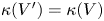 $\kappa (V')=\kappa (V)$. Fix
 $x\in V'\setminus V$, so that
 $K'=K[x]$.
Proposition A.10 (Gabber) Assume that there exist two sequences  $(y_n)_n$ and
 $(w_n)_n$ in
 $V$ with the following properties:
•
$|x-y_n|$ is non-increasing, and for any $y\in V$ we have $|x-y_n|\le |x-y|$ for $n\gg 0$;•
$|w_n|$ is non-increasing, $|x-y_n|\le |w_n|$ for all $n$, and
\[ \lim_{n\to \infty} |x-y_n|/|w_n|=1 . \]


Then
 \[ V'={\bigcup_n} V\bigg[\frac{x-y_n}{w_n}\bigg], \]
and the system of subrings in the union is increasing in  $n$.
Proof. The fact that the rings are increasing is easy and left to the reader. We show that any element  $v\in V'\setminus \{0 \}$ is contained in
 $V[(x-y_n)/w_n]$ for
 $n\gg 0$. As
 $\kappa (V')=\kappa (V)$ we can assume without loss of generality that
 $|v|<1$. Set
 $z_n=x-y_n$ and write
 $v=a_0^{(n)} + \cdots + a_{p-1}^{(n)}z_n^{p-1}$ with
 $a_0^{(n)},\ldots , a_{p-1}^{(n)}\in K$.
Lemma A.11 For  $n\gg 0$ (depending on
 $v$) we have
 \[ |v|=\max\big\{|a_0^{(n)}|, \ldots , |a_{p-1}^{(n)}z_n^{p-1} |\big\} . \]
Proof. Observe that for a separable algebraic extension of valued fields  $K\subset E$ we can without loss of generality replace
 $K$ by
 $E$ and
 $K'$ by
 $E'=K'\otimes _K E$ in the proof of the lemma if the element
 $x$ cannot be approximated more closely by elements in
 $E$ than by elements in
 $K$. Indeed, the latter approximation property implies that the conditions of Proposition A.10 also hold for the extension
 $E'/E$.
Step 1: replace  $K$ by
 $K^{h}$ (henselization). This is feasible because
 $K$ is dense in
 $K^{h}$. So, given
 $y_E\in K^{h}$, find
 $y_K\in K$ with
 $|y_E-y_K|<|y_E-x|$. Then
 $|x-y_E|=|x-y_K|$, so
 $x$ cannot be approximated more closely in
 $K^{h}$ than in
 $K$.
Step 2: replace  $K$ by the splitting field
 $E$ of
 $a_0^{(n)} + \cdots + a_{p-1}^{(n)}X^{p-1}\in K[X]$. Note that the splitting field is independent of
 $n$ and that
 $d=[E:K]$ is prime to
 $p$. Given
 $y_E\in E$, set
 $y_K=\operatorname {tr} (y_E)/d$. Then
 \[ |x-y_K|= \bigg|\frac{1}{d} \sum_{\sigma \in \mathrm{Gal}(E/K)} \sigma(x-y_E)\bigg|\le |x-y_E|, \]
so  $x$ cannot be approximated more closely in
 $E$ than in
 $K$. Here we used that
 $K$ is henselian, which implies that
 $|\sigma z|=|z|$ for any
 $z\in E$ and
 $\sigma \in \mathrm {Gal}(E/K)$.
Now we can assume without loss of generality that the polynomials  $a_0^{(n)} + \cdots + a_{p-1}^{(n)} X^{p-1}$ decompose into linear factors over
 $K$. Then Lemma A.11 is a consequence of [Reference Gabber and RameroGR03, Lemma 6.1.9].
If we write
 \[ v=a_0^{(n)} + (a_1 w_n) \frac{z_n}{w_n} +\cdots +(a_{p-1}^{(n)}w_n^{p-1}) \bigg(\frac{z_n}{w_n}\bigg)^{p-1} \]
the coefficients satisfy  $|a_i^{(n)} w_n^{i}|\le (|w_n|/|z_n|)^{i} |v|$ for
 $n\gg 0$ by Lemma A.11. But
 \[ \lim_{n\to \infty} \bigg(\frac{|w_n|}{|z_n|}\bigg)^{i}|v| =|v|<1, \]
so  $v\in V[(x-y_n)/w_n]$ for
 $n\gg 0$.