


Introduction
Corn and soybean are important components of annual cropping systems throughout much of the United States, accounting for 36.3 and 30.8 million ha planted in 2019 (USDA-NASS 2019), approximately 90% and 94% were herbicide-resistant (HR) hybrids and cultivars, respectively (USDA-ERC 2019). After registration of 2,4-D in the 1940s and dicamba in the 1960s (Busi et al. Reference Busi, Goggin, Heap, Horak, Jugulam, Masters, Napier, Riar, Satchivi, Torra, Westra and Wright2018; EPA 2014, 2019), synthetic auxin herbicides have been commonly used for selective broadleaf weed control in grass crops such as corn, small grains, pasture, and turf. Synthetic auxins represent the third most used herbicide site of action (SOA) globally, accounting for 366 million treated ha (Busi et al. Reference Busi, Goggin, Heap, Horak, Jugulam, Masters, Napier, Riar, Satchivi, Torra, Westra and Wright2018). Approximately 15.8 million corn ha were treated with synthetic auxin herbicides in the United States in 2018 (USDA-NASS 2019). Despite the intensive use of synthetic auxins, resistance has been slow to evolve compared with other herbicide sites of action (Busi et al. Reference Busi, Goggin, Heap, Horak, Jugulam, Masters, Napier, Riar, Satchivi, Torra, Westra and Wright2018). Recently commercialized soybean cultivars with stacked resistance to synthetic auxin herbicides confer resistance to either glyphosate and dicamba (Roundup Ready 2 Xtend®; Bayer Crop Science, St. Louis, MO) or glyphosate, glufosinate, and 2,4-D (Enlist E3™; Corteva Agriscience, Wilmington, DE). Adoption of these novel technologies provide US soybean growers additional options to manage weed populations that have evolved resistance to glyphosate and other herbicides (Behrens et al. Reference Behrens, Mutlu, Chakraborty, Dumitru, Jiang, LaVallee, Herman, Clemente and Weeks2007).
As of 2019, four dicamba products with reduced volatility were registered for use in dicamba-resistant (DR) soybean: XtendiMax® with VaporGrip® technology (Bayer Crop Science), FeXapan® with VaporGrip® technology (Corteva Agriscience), Tavium® with VaporGrip® technology (premix with S-metolachlor; Syngenta, Greensboro, North Carolina), and Engenia® (BASF, Research Triangle Park, NC) (EPA 2019). XtendiMax®, FeXapan®, and Tavium® are formulated as the diglycolamine (DGA) salt with an included acetic acid–acetate buffering system, VaporGrip® (hereafter, DGA+VG), which reduces changes in spray-solution pH by scavenging available protons (Abraham Reference Abraham2018; MacInnes Reference MacInnes2016). The Engenia® formulation contains a novel dicamba salt, N,N-Bis-(3-aminopropyl) methylamine (BAPMA), which is reported to have reduced volatility (Westberg and Adams Reference Westberg and Adams2017). The 2,4-D salt formulation with reduced volatility was approved for use in EnlistTM crops (including Enlist E3™ soybean) in 2019: Enlist One® with Colex-D® technology (Corteva Agriscience) and Enlist Duo® with Colex-D® technology (premix with dimethylammonium salt of glyphosate; Corteva Agriscience) (Simpson Reference Simpson2019). Although POST applications of dicamba and 2,4-D in corn typically occur early in the growing season for much of the U.S. Midwest (i.e., before V5 growth stage) (Anonymous 2010), products approved for use in DR and Enlist E3TM soybean permit applications until R1 or through 45 d after planting, whichever occurs first (with exception of Tavium®, which is approved for use through V4) and through R2, respectively. Additional label restrictions to mitigate potential for off-target movement (OTM) to nontarget vegetation (i.e., weather conditions, nozzle selection, buffer requirements, time-of-day constraints, and language prohibiting applications when susceptible crops are downwind) have been added to reduced volatility products labeled in soybean when compared with products commonly used in corn (Anonymous 2017a, 2017b, 2019a, 2019b). Despite the additional label restrictions, thousands of complaints occurred from 2017 to 2019 in the United States, where the off-target movement of dicamba had affected more than 1.45 million soybean ha in 2017 alone (Bradley Reference Bradley2017). Many states have experienced a growing number of complaints since the introduction of DR-soybean technology, and grower surveys indicate several cases have not been reported (Bradley Reference Bradley2019; Werle et al. Reference Werle, Oliveira, Jhala, Proctor, Rees and Klein2018).
Secondary dicamba movement via volatility is well documented (Behrens and Lueschen Reference Behrens and Lueschen1979; Egan et al. Reference Egan, Barlow and Mortensen2014; Egan and Mortensen Reference Egan and Mortensen2012; Jones et al. Reference Jones, Norsworthy and Barber2019a; Sall et al. Reference Sall, Huang, Pai, Schapaugh, Honegger, Orr and Riter2020; Sciumbato et al. Reference Sciumbato, Chandler, Senseman, Bovey and Smith2004a; Soltani et al. Reference Soltani, Oliveira, Alves, Werle, Norsworthy, Sprague, Young, Reynolds, Brown and Sikkema2020) and may have been the culprit of some nontarget injury complaints over the 2017 through 2019 growing seasons. The seminal paper on dicamba volatility was published in 1979, reporting secondary movement from applications of dimethylamine (DMA) salt of dicamba in corn under field conditions in Minnesota (Behrens and Lueschen Reference Behrens and Lueschen1979). The DGA salt of dicamba has lower volatility than the DMA salt of dicamba (Mueller et al. Reference Mueller, Wright and Remund2013), whereas novel dicamba formulations labeled for use in DR crops (DGA+VG and BAPMA) have lower volatility than the DGA salt (Jones et al. Reference Jones, Norsworthy, Barber, Gbur and Kruger2019b; Mueller and Steckel Reference Mueller and Steckel2019a; Schleier et al. Reference Schleier, Ouse and Gifford2017). Moreover, Bish et al. (Reference Bish, Farrell, Lerch and Bradley2019) reported similar levels of dicamba air concentrations after application of the DGA+VG and BAPMA formulations of dicamba mixed with glyphosate.
The potential for dicamba volatility is strongly influenced by environmental conditions after application; temperature is positively correlated with increased volatility, whereas relative humidity is negatively correlated (Behrens and Lueschen Reference Behrens and Lueschen1979; Bish et al. Reference Bish, Farrell, Lerch and Bradley2019; Mueller et al. Reference Mueller, Wright and Remund2013). The presence of air temperature inversions have also been reported to influence dicamba movement in the air. Bish et al. (Reference Bish, Farrell, Lerch and Bradley2019) reported higher detectable dicamba concentrations for the 0.5 to 8 h after application of DGA+VG plus glyphosate performed in the evening, during stable atmospheric conditions, compared with mid-day application during nonstable atmospheric conditions.
Dicamba is typically tank mixed with other components (e.g., water conditioner, other herbicides with different SOAs, drift reduction agent [DRA], adjuvant) to broaden the spectrum of weed control and improve performance (Anonymous 2019b; Anonymous 2019a; Roskamp et al. Reference Roskamp, Chahal and Johnson2013; Spaunhorst et al. Reference Spaunhorst, Siefert-Higgins and Bradley2014). Glyphosate is a common tank-mix partner used to broaden the spectrum of weed control (e.g., grass species) (Underwood et al. Reference Underwood, Soltani, Hooker, Robinson, Vink, Swanton and Sikkema2017). Glyphosate is a weak acid (Shaner et al. Reference Shaner, Jachetta, Senseman, Burke, Handson, Jugulam, Tan, Reynolds, Strek, McAllister, Green, Glenn, Turner and Pawlak2014) that is formulated as various salts (e.g., isopropylamine, potassium) with low formulation pH. Excess protons present in solution at lower pH levels increase the potential for volatility of dicamba acid once dissociated from the salt (Abraham Reference Abraham2018; Zollinger Reference Zollinger2018). Recent work from Mueller and Steckel (Reference Mueller and Steckel2019b) reported inclusion of glyphosate with either DGA, DGA+VG or BAPMA decreased spray-solution pH; final solution pH depended on the initial pH of the water source. Mueller and Steckel (Reference Mueller and Steckel2019a) further evaluated DGA+VG in a humidome study and reported the addition of glyphosate increased detectable dicamba air concentrations 2.9 to 9.3 times across a series of temperatures. Bish et al. (Reference Bish, Farrell, Lerch and Bradley2019) confirmed these results in a field setting, reporting lower detectable dicamba concentrations in air when DGA+VG was applied without glyphosate.
Dicamba product labels for use in DR crops recommend avoiding low-pH spray mixtures (e.g., pH <5.0), which may warrant addition of a buffering agent under such circumstances (Anonymous 2019a, 2019b). There are many products that may be recommended for use as a buffering agent that are presently listed as approved adjuvants for DR products, although their effect on spray-solution pH, volatility, and efficacy remains unclear and are product specific (Langemeier et al. Reference Langemeier, Li, Price and Browne2020).
Our understanding of the relationship between spray additives and solution pH for other dicamba formulations commonly used in corn (i.e., sodium salt of dicamba with isoxadifen safener premixed with sodium salt of diflufenzopyr [NA+DIF], DGA with cyprosulfamide safener [DGA+CYP], and DGA+CYP premixed with tembotrione [DGA+TMB]) remains limited. A recent survey indicated 30% of Nebraska growers believed injury in non-DR soybean was caused by applications of dicamba in corn (Werle et al. Reference Werle, Oliveira, Jhala, Proctor, Rees and Klein2018). To our knowledge, no research evaluating the effect of spray additives on solution pH with 2,4-D formulation is available in the literature. Furthermore, the interactions among spray-solution pH, spray additives, and environmental conditions on dicamba and 2,4-D volatility and subsequent injury to nontarget sensitive species remain unknown. The objectives of this research were to determine (1) the effect of various spray mix components (glyphosate, clethodim, DRA, Group 15 herbicides, ammonium sulfate [AMS] on solution pH when included with DGA+VG, BAPMA, four dicamba formulations commonly used in corn [DGA, NA+DIF, DGA+CYP, DGA+TMB]), and 2,4-D; (2) the effect of concentration on spray-solution pH by comparing the labeled rate (1×) with the 4× rate commonly used in low-tunnel field volatility experiments; and (3) the effect of glyphosate addition and application time of year on OTM of two dicamba formulations and 2,4-D as measured by injury on non-DR soybean in low-tunnel field volatility experiments. The hypotheses of this research were (1) the addition of glyphosate to four commonly used dicamba formulations (DGA, NA+DIF, DGA+CYP, DGA+TMB) in corn and 2,4-D will lower spray-solution pH, whereas other spray additives will have minimal to no impact on spray-solution pH, (2) higher rates (4×) will have a larger impact on spray-solution pH than the labeled rates (1×); and (3) the addition of glyphosate to the spray mixture will increase injury on soybean due to dicamba- and 2,4-D in low-tunnel field volatility experiments regardless of application timing during the growing season.
Materials and Methods
Four laboratory experiments were conducted to evaluate the impact of various spray components and additives in combination with six commercial formulations of dicamba and 2,4-D on spray-solution pH. Laboratory experiments were conducted from January through August 2019. Select treatments from these laboratory experiments were then evaluated in a replicated low-tunnel field volatility experiment in 2019 to evaluate soybean injury in response to spray-mixture treatment and application time of the year.
Laboratory Experiments
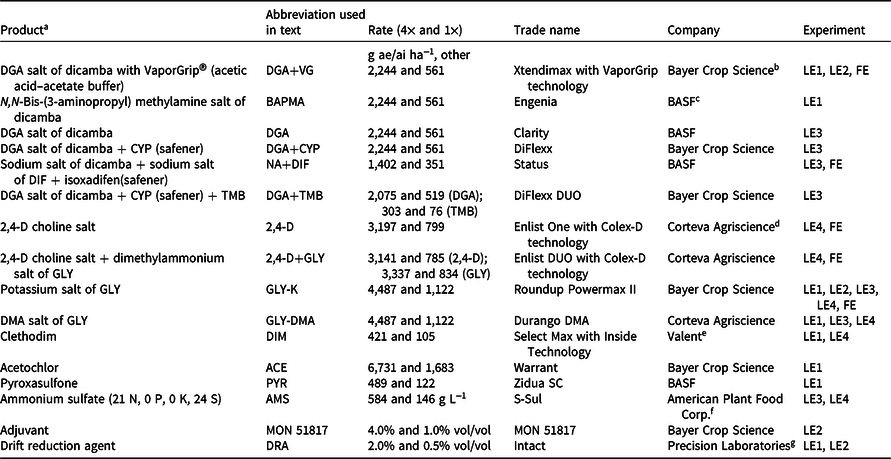
Experiments were conducted under laboratory conditions at the University of Wisconsin-Madison, WI. Herbicide spray solutions were prepared by mixing tap water in a plastic container (26–53 cm3) with additional components according to the label recommendations to a total volume of 100 mL, simulating a 140 L ha−1 carrier volume rate. Treatment solution was thoroughly agitated before pH measurement. The solution pH was measured using an Oakton pHTestr® 50 Waterproof Pocket pH Tester Premium 50 Series probe (Oakton Instruments, Vernon Hills, IL). Between measurements, the electrode was rinsed with distilled water and gently wiped clean of any debris and remaining solution. The pH meter was calibrated daily before use. The National Institute of Standards and Technology (Gaithersburg, MD) buffer standards of 4.01, 7.00, and 10.01 were used. Most pH measurements were within the lowest and highest standards; measurements were completed at an air temperature of 21 C. Products and rates used in experiments are listed in Table 1. Treatments were included at 1× and 4× labeled POST rates. The 4× POST rate has been used previously in low-tunnel dicamba field volatility experiments (Bernards et al. Reference Bernards, Culpepper, Hartzler, Li, Nolte, Oakley, Reynolds, Smeda, Sprague and Werle2020; Osterholt and Young Reference Osterholt and Young2019). Four experiments were conducted and are described in the following paragraphs. Treatments were replicated three times, and each experiment was repeated in time (two experimental runs). Additional components were also tested alone in solution at the simulated 140 L ha−1 carrier volume to evaluate their individual impact on solution pH (Table 2).
Product information for treatments included in the laboratory and low-tunnel field volatility experiments conducted in Wisconsin during 2019 to evaluate the influence of synthetic auxin formulation and additives on spray-solution pH and soybean injury.
a Abbreviations: 2,4-D, 2,4-dichlorophenoxyacetic acid; CYP, cyprosulfamide; DGA, diglycolamine; DIF, diflufenzopyr; DMA, dimethylamine; FE, field experiment; GLY, glyphosate; LE, laboratory experiment; TMB, tembotrione.
b St. Louis, MO.
c Research Triangle Park, NC.
d Wilmington, DE.
e Walnut Creek, CA
f Galena Park, TX.
g Waukegan, IL.
Mean solution pH and 95% CIs for herbicides and additional spray additives in the absence of dicamba and 2,4-D in laboratory experiments. a
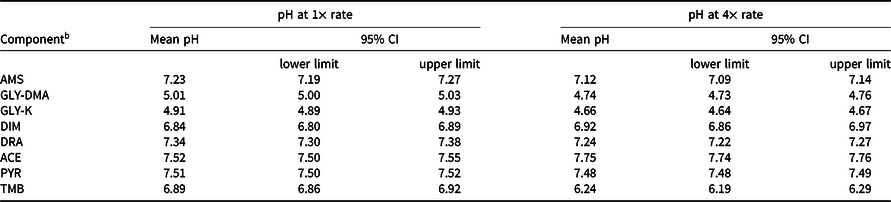
a Average pH of water source used was 7.54.
b Abbreviations: 2,4-D, 2,4-dicholrophenoxyacetic acid; ACE, acetochlor; AMS, ammonium sulfate (21 N; 0 P; 0 K; 24 S); CI, confidence interval; DIM, clethodim; DRA, drift reduction agent; GLY-DMA, dimethylamine salt of glyphosate; GLY-K, potassium salt of glyphosate; PYR, pyroxasulfone; TMB, tembotrione.
Experiment 1: DR-Soybean Dicamba Products + Spray Components
This experiment determined the effect of two DR-soybean dicamba formulations, mix components, and spray additives on spray-solution pH, totaling 32 treatments (including the 1× and 4× rates) in a completely randomized design (CRD). The two dicamba formulations were DGA+VG and BAPMA salts. A component for grass control was included at four levels: no addition, potassium salt of glyphosate (GLY-K), dimethylamine salt of glyphosate (GLY-DMA), and clethodim (DIM). A DRA was included with DGA+VG and BAPMA solutions at two levels of the grass control component: GLY-K and DIM. The effect of a residual component was also determined by including two Group 15 residual herbicides (HG15) based on company portfolios: acetochlor (ACE; Warrant®; Bayer Crop Science) was included with DGA+VG plus GLY-K or DIM plus DRA and pyroxasulfone (PYR; Zidua®; BASF) was included with BAPMA plus GLY-K or DIM plus DRA. The pH values for all experimental units were measured as described earlier under Laboratory Experiments.
Experiment 2: pH Buffer
This experiment determined the role of a pH buffer additive and consisted of eight treatments (including the 1× and 4× rates) in a CRD. Treatments included DGA+VG in combination with a DRA at two levels of glyphosate, including no addition and GLY-K. The final component included no addition or addition of a pH buffer (MON 51817). MON 51817 is currently listed as an approved adjuvant for use with DGA+VG (Anonymous 2019a) and reduced soybean injury from dicamba volatility in previous low-tunnel field volatility experiments (Oakley et al. Reference Oakley, Culpepper, Reynolds, Smeda, Sprague and Werle2020; Werle et al. Reference Werle, Oliveira and Rector2019). The pH values for all experimental units were measured as previously described.
Experiment 3: Corn Dicamba Products + Spray Components + AMS
This experiment determined the effect of several dicamba formulations and additional components commonly used in corn production systems on solution pH, totaling 48 treatments (including the 1× and 4× rates) in a CRD. The four dicamba formulations were DGA, DGA+CYP, DGA+TMB, and NA+DIF. Glyphosate was the second component and was included at three levels: no addition, GLY-K, and GLY-DMA. The final component used was spray-grade AMS. The first component added to the treatment solution was AMS (for treatments with AMS addition). The pH values for all experimental units were measured as previously described.
Experiment 4: 2,4-D + Spray Components
This experiment determined the effect of the new 2,4-D products and additional components approved for use in corn and 2,4-D–resistant soybean, corn, and cotton systems (EnlistTM crops) on spray-solution pH and consisted of 20 treatments (including the 1× and 4× rates) in a CRD. The 2,4-D choline salt (2,4-D) and 2,4-D choline salt premixed with dimethylammonium salt of glyphosate (2,4-D+GLY) were evaluated. A component for grass control was included at four levels: no addition, GLY-K, GLY-DMA, and DIM. The final treatment component used was AMS. The first component added to the treatment solution was AMS (for treatments with AMS addition). The pH values for all experimental units were measured as previously described.
Low-Tunnel Field Volatility Experiment
A low-tunnel field experiment was conducted in 2019 at the University of Wisconsin-Madison Arlington Agricultural Research Station near Arlington, WI (43°18′N, 89°20′W and 43°18′N, 89°19′W), to determine the effect of application time of year, active ingredient, formulation, and addition of glyphosate to the spray solution on volatility via subsequent assessments of dicamba or 2,4-D injury on susceptible soybean. This methodology commonly has been used by academics and industry (e.g., Bayer Crop Science) to study dicamba volatility (Bernards et al. Reference Bernards, Culpepper, Hartzler, Li, Nolte, Oakley, Reynolds, Smeda, Sprague and Werle2020; Browne et al. Reference Browne, Li, Price, Langemeier and Kruger2020; Langemeier et al. Reference Langemeier, Li, Price and Browne2020; Latorre et al. Reference Latorre, Reynolds, Young, Norsworthy, Culpepper, Bradley, Bish, Kruger and Stephenson2017; Long Reference Long2017; Norsworthy and Barber Reference Norsworthy and Barber2019; Oseland et al. Reference Oseland, Bish and Bradley2018; Oseland et al. Reference Oseland, Bish, Steckel and Bradley2020; Osterholt and Young Reference Osterholt and Young2019; Rice and Billman Reference Rice and Billman2019; Young et al. Reference Young, Farrell, Bradley, Latorre, Kruger, Barber, Norsworthy, Scott, Reynolds and Steckel2017; Zaccaro et al. Reference Zaccaro, Norsworthy, Houston and Brabham2019). Similar methodology has also been used to quantify clomazone volatility and sorghum injury (Schreiber et al. Reference Schreiber, De Avila, Scherner, Moura and Martini2016).
The experiment consisted of 14 treatments, replicated three times and organized in a randomized complete block design. Treatments were composed of two main factors: herbicide treatment and application time of year as main factors, resulting in a 7 × 2 factorial, respectively. The experiment consisted of six herbicide treatments (three synthetic auxin herbicides × two levels of glyphosate) and one nontreated control (NTC): (1) DGA+VG, (2) DGA+VG plus GLY-K, (3) NA+DIF, (4) NA+DIF plus GLY-K, (5) 2,4-D, (6) 2,4-D+GLY, and (7) NTC. Commercial formulations and the 4× rate for these herbicides are listed in Table 1. Application time of year was included at two levels: early (mid to late June) and late (early to mid July) in the season. Planting dates were staggered so applications would occur at the V3 to V5 soybean growth stage, regardless of application time of year. The experiment was repeated in space (i.e., in separate, adjacent fields).
A glyphosate-resistant soybean cultivar, DSR-1950 R2Y (Dairyland Seed Co., Inc., West Bend, WI) was planted at 296,400 seeds ha−1 in rows spaced 76 cm apart on May 5 (early application time) and May 31 (late application time) in experiment 1, and on May 7 (early application time) and June 4 (late application time) in experiment 2. Only the center two rows of each 4-row-wide plot were planted, allowing extra space between plots for ease of access and low-tunnel assembly and placement. Field plot size was 1.5 m by 15 m. Plots were maintained weed free throughout the season via mechanical and chemical control measures; acetochlor (1,262 g ai ha−1) + metribuzin (555 g ai ha−1) were applied PRE to the entire experiment area on the early planting date for each experiment, followed by (fb) glyphosate (1,060 g ae ha−1) + S-metolachlor (1,607 g ai ha−1) + AMS (579 g ha−1) applied early POST on June 11 to the entire experiment area.
Low tunnels were constructed using a framework of polyvinyl chloride (PVC) pipe (1.25 cm diam) consisting of five arches, 1.5-m wide by 2.47-m long, and connected by four 1.5-m long PVC pipes between arches parallel with the plot; the tunnel was 6.1 m long when fully assembled (Latorre et al. Reference Latorre, Reynolds, Young, Norsworthy, Culpepper, Bradley, Bish, Kruger and Stephenson2017; Long Reference Long2017). The framework was oriented such that the peak of the arch was centered between the two rows of soybean and the tunnel was parallel to the soybean rows in each 15-m long plot. Corners and center arches were staked to the ground to secure the position of the tunnel. Clear plastic sheeting (6-mL thick) was secured to the PVC framework using spring clamps and plastic cable ties. Excess sheeting parallel to the framework was covered with soil and, to allow air movement, tunnel entrances were not covered. Tunnels were established the day before application and oriented north-south according to soybean row orientation and the predominant wind direction at the field experiment location (Figure 1).
A low-tunnel before treatment application and flat placement in 2019 at University of Wisconsin-Madison Arlington Agricultural Research Station, Arlington, WI.

Treatments were applied using a CO2-pressurized backpack sprayer equipped with a 2.0-m wide, hand-held spray boom with TTI 110015 nozzles (TeeJet Technologies, Spraying Systems Co., Wheaton, IL) on 50.8-cm spacing calibrated to deliver 140 L ha−1 carrier volume at 262 kPa and a walking speed of 4.8 km h−1. Each treatment was applied at an offsite location to six 60- × 30-cm flats filled with soil from the field experiment location (Plano-silt loam; pH, 6.6; 3.5% organic matter; silt loam: 10% sand, 64% silt, 26% clay). Soil in the flats was free of vegetation and watered to field capacity the day before treatments were applied. Three teams of at least two individuals handled distinct tasks for application and placement. Team 1 treated the soil flats, team 2 transported soil flats to the field immediately after treatments were applied, and team 3 placed two soil flats in each low tunnel. Soil flats were placed with the 60-cm edge parallel to and centered between the two soybean rows in the middle of each respective low tunnel by the placement team. The flat-placement protocol was designed to prevent contact of soil flats and personal protective equipment with low tunnels and soybean vegetation. Moreover, all individuals, with exception of the applicator, changed personal protective equipment between treatments.
Early and late treatment timings were June 21 and July 7, 2019, respectively, for experiment 1, and June 26 and July 16, 2019, respectively, for experiment 2. For all treatment timings, soybeans were at V3 to V5 growth stage as previously described. All treatments were applied between 6:30 AM and 9:30 AM. Soil-flat location was demarcated with a stake upon flat removal 48 h after soil-flat placement. Tunnels were removed immediately after soil-flat removal. Tunnel removal on June 23 was delayed 5 h because of weather conditions (rain storm) following the June 21 application (early application time, experiment 1). Weather data were collected using WatchDog 2700 weather station (Spectrum Technologies, Aurora, IL) equipped with internal sensors collecting air temperature, relative humidity, wind speed and direction, and rainfall. The station was also equipped with external sensors collecting soil-flat temperature and air temperature 15 cm above soil flats inside one of the low tunnels. Data were collected at 15-min intervals for the 0 to 24 and 24 to 48 h periods after flat placement for each of the applications (Table 3).
Weather data summary for the 48 h after treatment applications in the low-tunnel volatility experiment conducted in 2019. a
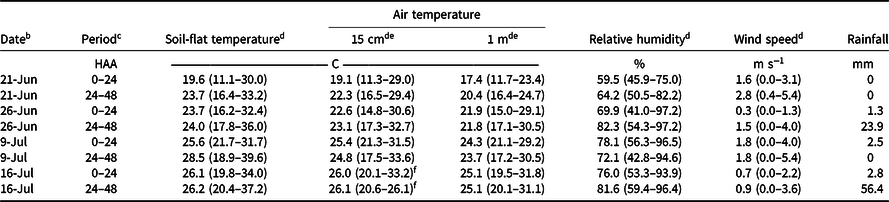
a Weather parameters are summarized as mean(minimum-maximum) values for the corresponding date and period following application.
b Dates presented represent combinations of experiment (1 or 2) and time (early or late) conducted over time.
c Abbreviation: HAA: hours after application.
d Denoted parameters were collected using external sensors and were located within one of the low tunnels for each application timing and experimental run.
e Distance recorded above soil surface.
f Air temperature 15 cm above soil surface not recorded due to sensor error. Values are estimated using the following formula derived from weather data collected over three experiments: y = 0.73010x + 0.30327y – 1.44638, using values for air temperature at 1 m and soil-flat temperature values as x and y, respectively (both predictors were significant in the model, adjusted R 2= 0.949).
Soybean injury was assessed visually on a scale from 0 to 100 (Andersen et al. Reference Andersen, Clay, Wrage and Matthees2004; Behrens and Lueschen Reference Behrens and Lueschen1979) 28 d after treatment (DAT; when injury was most apparent), where 0 represents no injury and 100 represents dead plants, similar to previous work (Egan and Mortensen Reference Egan and Mortensen2012; Jones et al. Reference Jones, Norsworthy, Barber, Gbur and Kruger2019b; Oseland et al. Reference Oseland, Bish, Steckel and Bradley2020). Soybean injury included leaf crinkling, malformation, and cupping of trifoliates that had formed after exposure to treated flats. Soybean were at the R2 to R4 growth stage at the time of data collection. The center of the demarcated flat location was designated as distance zero; the plot was then split into four quadrants by considering each row separately in either direction from distance zero. The quadrant with the most severe and extensive injury was selected for data collection; this quadrant therefore represents the experimental unit in this experiment. Data were collected on soybean plants at distance zero and in 30-cm increments for a total of 3 m evaluated within each low tunnel (a total of 11 plants were evaluated within each experimental unit).
Visual injury is a commonly used method to quantify soybean injury from volatility (Behrens and Lueschen Reference Behrens and Lueschen1979; Egan and Mortensen Reference Egan and Mortensen2012; Oseland et al. Reference Oseland, Bish, Steckel and Bradley2020; Sciumbato et al. Reference Sciumbato, Chandler, Senseman, Bovey and Smith2004a; Sciumbato et al. Reference Sciumbato, Chandler, Senseman, Bovey and Smith2004b; Soltani et al. Reference Soltani, Oliveira, Alves, Werle, Norsworthy, Sprague, Young, Reynolds, Brown and Sikkema2020). The two meta-analyses on dicamba volatility focused on visual injury and soybean yield (Egan et al. Reference Egan, Barlow and Mortensen2014; Kniss Reference Kniss2018). Sall et al. (Reference Sall, Huang, Pai, Schapaugh, Honegger, Orr and Riter2020) recently reported that no impact on plant height or soybean yield was detected after exposure to dicamba volatility in 23 field studies. The low-tunnel methodology used in the current study is a valuable tool to compare the effect of dicamba volatility on soybean.
Statistical Analysis
All analyses were completed with R statistical software, version 4.0.0 (R Foundation for Statistical Computing, Vienna, Austria).
Laboratory Experiments: ANOVA
For each experiment, a linear mixed model with a normal distribution (“lme4” package) was fit to pH data as a two-way factorial with treatment and rate as fixed effects and replications nested within experimental runs as random effects. Model assumptions were evaluated using the Pearson chi-square test for normality (“nortest” package) and the Levene test for homogeneity of variance (“car” package). A two-way ANOVA (“car” package) was performed and means were separated using Tukey honest significant difference (“emmeans” package) when P < 0.05 for the interaction or main effects.
Laboratory Experiments: Random Forest
Because the laboratory experiments were not all designed as complete factorials, main effects could not be tested by multifactor ANOVA; thus, random forest analyses (“tidymodels” package) (Kuhn and Wickham Reference Kuhn and Wickham2020) were performed to determine the effects of tank-mix partners on pH change of treatment solutions. Random forest is a machine-learning algorithm that generates multiple decision trees using a subsample of bootstrapped observations from randomly selected explanatory variables (Breiman Reference Breiman2001). Random forest is a useful tool for variable selection in large and complex data sets for quantitative, discrete, and qualitative variables and has been used for response variables such as Amaranthus spp. resistance (Vieira et al. Reference Vieira, Samuelson, Alves, Gaines, Werle and Kruger2018), weed biomass in cover crops (Baraibar et al. Reference Baraibar, Mortensen, Hunter, Barbercheck, Kaye, Finney, Curran, Bunchek and White2018), soybean yield (Smidt et al. Reference Smidt, Conley, Zhu and Arriaga2016), soybean injury from dicamba (Zhang et al. Reference Zhang, Huang, Reddy and Wang2019), and Goss’s bacterial wilt and leaf blight development (Langemeier et al. Reference Langemeier, Robertson, Wang, Jackson-Ziems and Kruger2017).
We conducted separate random forest analyses for each experiment, with pH unit as the response (continuous) variable, and a number of qualitative explanatory variables specifying assigned levels of factors included in the treatment structure. For these analyses, trees (the number of decision trees) was set to 1000, and mtry (the number of different predictors sampled at each split) and min_n (the minimum number of data points in a node required for additional splits) were tuned during model training and set according to the final model selection (Kuhn and Wickham Reference Kuhn and Wickham2020). The best model was selected using the root mean square error (RMSE) criterion (Bourgoin et al. Reference Bourgoin, Blanc, Bailly, Cornu, Berenguer, Oszwald, Tritsch, Laurent, Hasan, Sist and Gond2018), which is estimated as the square root of the average difference between the observed and the predicted value squared for all observations (Zhou et al. Reference Zhou, Li, Wei, Li, Qiao and Armaghani2019). Lower RMSE scores indicate better model performance (Zhou et al. Reference Zhou, Li, Wei, Li, Qiao and Armaghani2019). Variable importance (VI) scores were determined by the impurity measure (“ranger” package), which provides an estimate of the change in prediction accuracy should the variable be excluded from the model (Wright Reference Wright2020). Higher VI values indicate the variable is important in the model and in explaining variability of the response variable, whereas values near zero indicate the variable is not important (Bourgoin et al. Reference Bourgoin, Blanc, Bailly, Cornu, Berenguer, Oszwald, Tritsch, Laurent, Hasan, Sist and Gond2018; Louppe et al. Reference Louppe, Wehenkel, Sutera and Geurts2013). Variable importance plots were constructed in a way similar to that described by Langemeier et al. (Reference Langemeier, Robertson, Wang, Jackson-Ziems and Kruger2017).
Low-Tunnel Field Volatility Experiments: Area Under the Disease Progress Stairs
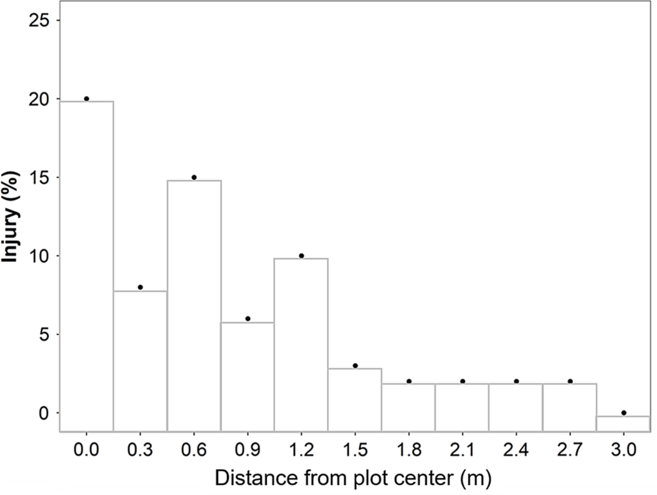
Soybean injury data across distances within an experimental unit collected 28 DAT were used to calculate an adaption of the absolute area under the disease-progress stairs (“agricolae” package), referred to here as area under injury over distance stairs (AUIDS) (Figure 2). This approach has been used commonly in plant pathology to describe disease progression over time (Shaner and Finney Reference Shaner and Finney1977; Simko and Piepho Reference Simko and Piepho2012) and has previously been adapted to describe soybean canopy development (Miller et al. Reference Miller, Schepers, Shapiro, Arneson, Eskridge, Oliveira and Giesler2018), desiccation progress (Zhang et al. Reference Zhang, Johnson and Willenborg2016), and dry-down rate in corn (Yang et al. Reference Yang, Carena and Uphaus2010). Applying the concept of area under the disease-progress stairs to our data set resulted in one value per experimental unit representing symptom severity and consistency of soybean injury over distance. The AUIDS values for experimental units were standardized in reference to respective NTC average value and represent the response variable in the low-tunnel field volatility experiment.
Soybean injury as a function of distance from plot center as determined by area under injury over distance stairs (AUIDS) analysis in the low-tunnel field experiment in 2019. Values were calculated from the equation AUIDS = D × n (n − 1)−1, where D is soybean injury rating and n is distance from plot center. The experimental unit shown received a late application in experiment 2 and had an AUIDS value of 70.
Low-Tunnel Field Volatility Experiments: ANOVA
A linear mixed model with a normal distribution (“lme4” package) was fit to AUIDS data as a 3 × 2 × 2 × 2 factorial with synthetic auxin herbicide, glyphosate level, application time of year, and experiment as fixed effects. Replications nested within experiments were considered random effects. The NTC were not included in the analysis. Model assumptions were evaluated as described for the laboratory experiments ANOVA. A square-root transformation of the response variable satisfactorily met model assumptions of normality and homogeneity of variances. The ANOVA (four-way factorial) and means separations were completed as described for the laboratory experiments. Back-transformed means are presented for ease of interpretation.
Results and Discussion
Laboratory Experiments
pH of Water Source
The pH of the water source used in these experiments ranged from 7.45 to 7.70. This pH range indicates alkalinity and the presence of basic cations, such as calcium and magnesium, which constitute water hardness (Roskamp et al. Reference Roskamp, Chahal and Johnson2013). Approximately 60% of groundwater in the United States is classified as hard or very hard (120–180 and >180 mg L−1 CaCO3, respectively), which is typical for much of the U.S. Midwest (DeSimone et al. Reference DeSimone, McMahon and Rosen2014). Furthermore, 82% of U.S. groundwater sources have a pH ranging from 6.5 to 8.0 (DeSimone et al. Reference DeSimone, McMahon and Rosen2014). Therefore, findings herein are relevant for most private and commercial pesticide applicators from across the U.S. Midwest and other regions using water sources with relatively high pH for herbicide applications. Mueller and Steckel (Reference Mueller and Steckel2019b) reported initial pH levels from several water sources in Tennessee ranged from 4.53 to 8.35 and indicated the initial pH of the water source can affect final spray-solution pH.
Experiment 1: DR Soybean Dicamba Products + Spray Components
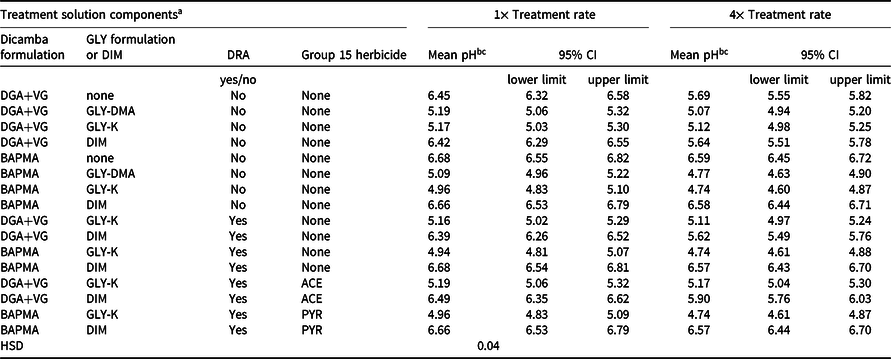
The treatment by rate interaction was significant for all laboratory experiments (P < 0.0001) (Tables 4–7); thus, treatment results are presented by rate for each experiment. The pH of treatment solutions ranged from 4.94 to 6.68 (Table 4).
Mean solution pH and 95% CIs for laboratory experiment 1 as affected by dicamba formulation, GLY formulation, DIM, DRA, and Group 15 herbicide.
a Abbreviations: ACE, acetochlor; BAPMA, N,N-Bis-(3-aminopropyl)methylamine salt of dicamba; CI, confidence interval; DGA, diglycolamine salt of dicamba; DIM, clethodim; DMA, dimethylamine salt; DRA, drift reduction agent; GLY, glyphosate; GLY-K, potassium salt of glyphosate; HSD, honest significant difference; PYR, pyroxasulfone; VG, VaporGrip® (acetic acid-acetate buffer).
b Means separation used was Tukey HSD at P < 0.05.
c Average pH of water source used was 7.46.
Mean solution pH and 95% CIs for laboratory experiment 2 as affected by GLY-K and pH buffer addition.

a Abbreviations: DGA, diglycolamine salt of dicamba; CI, confidence interval; DRA, drift reduction agent; GLY, glyphosate; GLY-K, potassium salt of glyphosate; HSD, honest significant difference; VG, VaporGrip® (acetic acid-acetate buffer).
b Average pH of water source used was 7.70.
c Means separation used was Tukey HSD at P < 0.05.
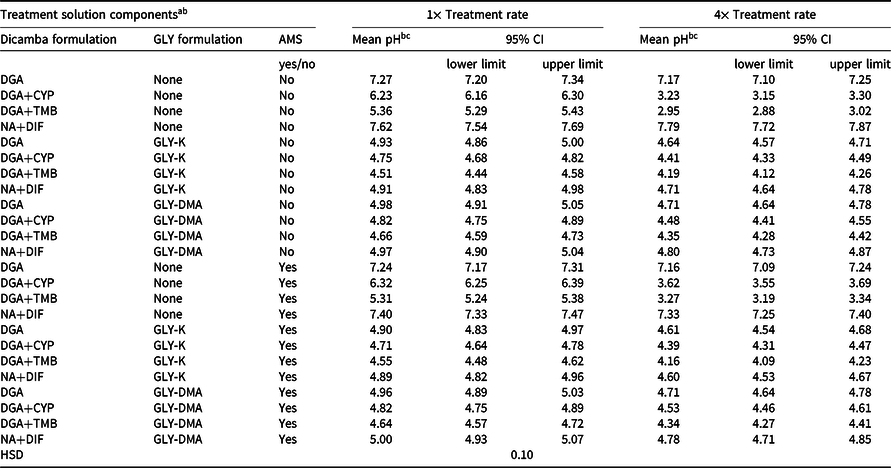
Mean solution pH and 95% CIs for laboratory experiment 3 as affected by dicamba formulation, GLY formulation, and AMS.
a Abbreviations: AMS, ammonium sulfate (21 N, 0 P, 0 K, 24 S); DGA, diglycolamine salt of dicamba; CI, confidence interval; DGA+CYP, diglycolamine salt of dicamba with cyprosulfamide safener; DGA+TMB, diglycolamine salt of dicamba with cyprosulfamide safener premixed with tembotrione; GLY, glyphosate; GLY-K, potassium salt of glyphosate; GLY-DMA, dimethylamine salt of glyphosate; HSD, honest significant difference; NA+DIF, sodium salt of dicamba premixed with sodium salt of diflufenzopyr with isoxadifen safener.
b Average pH of water source used was 7.45.
c Means separation used was Tukey HSD at P < 0.05.
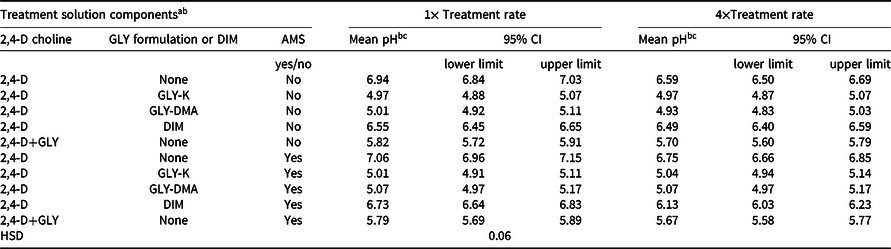
Mean solution pH and 95% CIs for laboratory experiment 4 as affected by 2,4-D, GLY formulation, DIM, and AMS.
a Abbreviations: 2,4-D, 2,4-dichlorophenoxyacetic acid choline salt; 2,4-D+GLY, 2,4-D choline salt premixed with dimethylammonium salt of glyphosate; AMS, ammonium sulfate (21 N, 0 P, 0 K, 24 S); CI, confidence interval; DIM, clethodim; HSD, honest significant difference; GLY, glyphosate; GLY-DMA, dimethylamine salt of glyphosate; GLY-K, potassium salt of glyphosate.
b Average pH of water source used was 7.56.
c Means separation used was Tukey HSD at P < 0.05.
1× Treatment Rate
Treatments that included glyphosate were associated with the lowest solution pH values (Table 4). Inclusion of GLY-DMA was associated with a reduction of 1.26 and 1.59 pH units for DGA+VG and BAPMA, respectively, compared with the dicamba formulations alone. Similar reductions were observed for GLY-K, corroborating the findings of Mueller and Steckel (Reference Mueller and Steckel2019b) for GLY-K and GLY-IPA salts. The GLY-DMA and GLY-IPA salts are ammonia-based formulations and are not approved mix partners for DR-soybean dicamba products (Anonymous 2019a). This label change was due to 2017 reports of ammonia-based glyphosate formulations increasing the potential for dicamba volatility (Latorre et al. Reference Latorre, Reynolds, Young, Norsworthy, Culpepper, Bradley, Bish, Kruger and Stephenson2017; Young et al. Reference Young, Farrell, Bradley, Latorre, Kruger, Barber, Norsworthy, Scott, Reynolds and Steckel2017; Zollinger Reference Zollinger2018). Solution pH for the two dicamba salts plus glyphosate was lower for BAPMA than DGA+VG. This suggests that DGA+VG may maintain a higher spray-solution pH than BAPMA when glyphosate is tank mixed using water sources with a high initial pH (7.46), and the finding is supported by those of Mueller and Steckel (Reference Mueller and Steckel2019b) for deionized and low initial pH water sources.
Treatments with DIM in replacement of a glyphosate formulation had minimal effect on solution pH (0.02–0.03 unit change) compared with the dicamba formulation alone. Inclusion of a DRA in solution with either BAPMA or DGA+VG with DIM had no influence on solution pH. Treatments with DGA+VG and BAPMA with or without GLY-K and a DRA at the 1× rate corroborate findings of Mueller and Steckel (Reference Mueller and Steckel2019b). Treatments with a HG15 had little effect on solution pH, with exception of DGA+VG plus DIM and DRA, in which a 0.10 increase in pH occurred for the ACE treatment. Therefore, inclusion of a DRA or HG15 is not expected to have a major impact on spray-solution pH.
4× Treatment Rate
Treatments that included glyphosate were associated with the lowest solution pH values. Reductions in pH of 0.57 and 0.62 were observed for DGA+VG when GLY-K and GLY-DMA were included, respectively, compared with DGA+VG alone. Reductions of 1.85 and 1.82 were observed for BAPMA when GLY-K and GLY-DMA were included, respectively, compared with BAPMA alone. Solution pH did not differ between the two glyphosate formulations within dicamba formulation type. Only BAPMA treatments with glyphosate had a solution pH lower than 5.0. Treatments with DIM in replacement of a glyphosate formulation had a minimal effect on solution pH, although DGA+VG plus DIM was 0.05 units lower than that of DGA+VG alone. Inclusion of DRA with DGA+VG or BAPMA plus GLY-K or DIM did not affect solution pH. Treatments with a HG15 had a small increase in pH (ACE, 0.06–0.28) or no effect (PYR).
1× and 4× Treatment Rate Comparisons
Comparisons across rates indicated no differences for the treatment DGA+VG with GLY-K, DRA, and ACE at the 1× and 4× rates. For remaining treatments, solution pH was lower for treatments at the 4× rate than the 1× rate. Solution pH was 0.76 units lower for DGA+VG alone and 0.09 units lower for BAPMA alone at the 4× compared with the 1× rate. This finding suggests the solution pH for DGA+VG was more affected when included at a higher rate and could influence the interpretability of low-tunnel dicamba volatility research (which is often conducted at higher rates). Across dicamba formulations, solution pH ranged from 0.12 to 0.32 units lower for GLY-K and 0.05 to 0.22 units lower for GLY-DMA, respectively, at the 4× compared with the 1× rate.
Ranking Importance of Treatment Variables
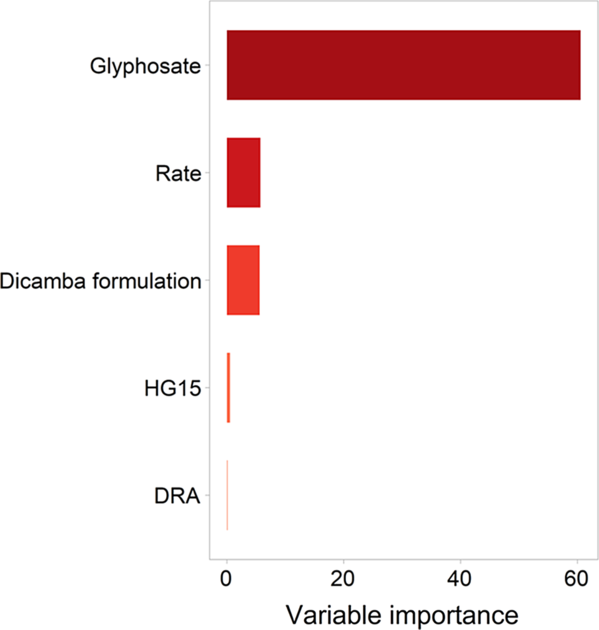
Variability in the data set for solution pH was well explained by inclusion of glyphosate, indicating that glyphosate was the most important variable influencing pH (VI = 60.24) (Figure 3). Rate (VI = 5.73) and dicamba formulation (VI = 5.49) were important, whereas addition of a HG15 (VI = 0.52) or a DRA (VI = 0.12) had minimal to no impact.
Spray solution pH as influenced by dicamba formulations labeled for use in dicamba-resistant soybean, glyphosate, drift reduction agent (DRA), Group 15 herbicide (HG15), and rate, ranked by variable importance, as determined from the random forest analysis for laboratory experiment 1 (root mean square error, 0.15).
Experiment 2: pH Buffer
1× Treatment Rate
The pH of treatment solutions ranged from 4.96 to 6.30 (Table 5). Solution pH was 0.13 and 0.38 pH units higher for treatments with MON 51817 in the absence and presence of GLY-K, respectively, compared to DGA+VG plus DRA alone. Similar to findings of Muller and Steckel (Reference Mueller and Steckel2019b), inclusion of a pH buffer (MON 51817) increased solution pH to higher than 5.0. The only pH buffer studied was MON 51817; therefore, conclusions of this experiment cannot be extended to many other commercial products that may be used to adjust spray-solution pH.
4× Treatment Rate
The pH of treatment solutions ranged from 4.80 to 6.12. Solution pH was 0.64 and 0.62 pH units higher for treatments with MON 51817 in the absence and presence of GLY-K, respectively, compared with DGA+VG plus DRA alone. Solution pH was higher than 5.0 for both treatments with MON 51817.
1× and 4× Treatment Rate Comparisons
Comparisons across rates indicated a higher solution pH (0.08 units) for GLY-K plus MON 51817 at 4× when compared with the 1× rate. For remaining treatments, solution pH was lower for treatments at the 4× than the 1× rate. Solution pH was 0.18 and 0.69 units lower at the 4× rate for treatments without GLY-K, with and without MON 51817, respectively, when compared with the 1× rate. Solution pH was 0.16 units lower at the 4× rate for GLY-K without MON 51817 compared with the 1× rate.
Ranking Importance of Treatment Variables
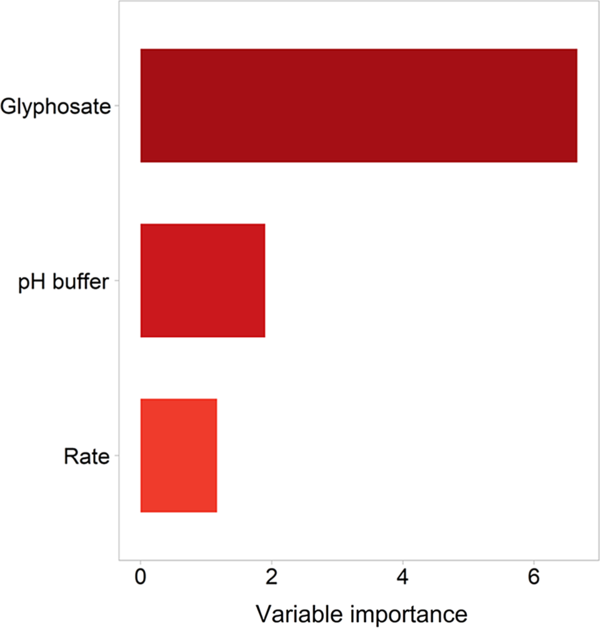
Variability in the data set for solution pH was well explained by inclusion of glyphosate, indicating that glyphosate was the most important variable influencing pH (VI = 6.73) (Figure 4), followed a pH buffer (VI = 1.91) and rate (VI = 1.14).
Spray solution pH of diglycolamine salt of dicamba with Vaporgrip® mixtures as influenced by glyphosate, pH buffer, and rate, ranked by variable importance as determined from the random forest analysis for laboratory experiment 2 (root mean square error, 0.04).
Experiment 3: Corn Dicamba Products + Spray Components + AMS
1× Treatment Rate
The pH of treatment solutions ranged from 4.51 to 7.62 (Table 6). Among dicamba formulations with no additional components, DGA+TMB had the lowest solution pH, fb DGA+CYP and DGA, whereas NA+DIF had a higher solution pH than the initial pH of the water source. Solution pH was not influenced by inclusion of AMS as a water conditioner for DGA, DGA+TMB, and DGA+CYP, whereas the pH of NA+DIF was 0.22 units lower compared with NA+DIF alone. Addition of glyphosate was associated with 0.76 to 2.71 and 0.67 to 2.65 lower pH for GLY-K and GLY-DMA, respectively, across dicamba formulations with no additional components. All treatments with glyphosate had a solution pH no higher than 5.0. Few differences in solution pH were observed between the two glyphosate formulations within dicamba formulation type, although solution pH was greater for DGA+TMB without AMS and GLY-DMA than a GLY-K addition. Across glyphosate formulation types, solution pH levels were greatest for DGA and NA+DIF, fb DGA+CYP and DGA+TMB. Results of treatments evaluating DGA with or without GLY-K corroborated findings of Mueller and Steckel (Reference Mueller and Steckel2019b). Inclusion of AMS in solution with dicamba and glyphosate had no impact on solution pH. Mueller and Steckel (Reference Mueller and Steckel2019b) reported a 0.7 pH–unit decrease after AMS addition and no additional components when using a water source with an initial pH of 6.2. The initial pH of a nontreated source water used in an additional experiment was 7.54 and decreased 0.31 units after a 1× AMS addition (Table 2). Moreover, the minimal impact of AMS on solution pH for DGA, DGA+TMB, DGA+CYP, and NA+DIF reported herein corroborate findings of Mueller and Steckel (Reference Mueller and Steckel2019b) for DGA+VG and BAPMA formulations.
Current labels do not permit inclusion of ammonia-based herbicides and AMS with dicamba products approved for use in DR crops (Anonymous 2019a, 2019b), but such restrictions currently do not apply to dicamba formulations used in corn. When added to solution, AMS has a net neutral charge; as the ammonium dissociates from sulfate, the anionic sulfate binds to cations present in the solution (Roskamp et al. Reference Roskamp, Chahal and Johnson2013). Ammonium is prone to volatilization as ammonia, leaving excess H+ that may lead to minor acidification in solution (Abraham Reference Abraham2018; Mueller and Steckel Reference Mueller and Steckel2019b). Ammonium rapidly adsorbs to leaf and soil surfaces, reducing apoplastic pH and enhancing dissociation from salt and formation of nonionized dicamba acid (Husted and Schjoerring Reference Husted and Schjoerring1995; Ou et al. Reference Ou, Thompson, Stahlman, Bloedow and Jugulam2018; Zollinger Reference Zollinger2018). The presence of nonionized dicamba acid on the leaf surface increases the potential for volatility, which can be further aggravated by high-temperature conditions (Ou et al. Reference Ou, Thompson, Stahlman, Bloedow and Jugulam2018). Inclusion of AMS has been reported to increase volatility of dicamba from plant and soil surfaces (Hayden et al. Reference Hayden, Young, Ghaste, Johnson, Widhalm and Young2019; Latorre et al. Reference Latorre, Reynolds, Young, Norsworthy, Culpepper, Bradley, Bish, Kruger and Stephenson2017).
4× Treatment Rate
The pH of treatment solutions ranged from 2.95 to 7.79. Among dicamba formulations with no additional components, DGA+TMB had the lowest solution pH, fb DGA+CYP and DGA, whereas NA+DIF had a higher solution pH than the initial pH of the water source. Solution pH was not influenced by inclusion of AMS for DGA, whereas solution pH was 0.39 and 0.32 units higher for DGA+CYP and DGA+TMB, respectively, and NA+DIF was 0.46 units lower when compared with the respective dicamba formulations with no additional components. Addition of glyphosate to DGA and NA+DIF was associated with 2.53 to 3.08 and 2.46 to 2.99 lower pH for GLY-K and GLY-DMA, respectively, compared with respective dicamba formulations alone. Conversely, addition of glyphosate to DGA+CYP and DGA+TMB increased solution pH by 1.18 to 1.24 and 1.25 to 1.40 for GLY-K and GLY-DMA, respectively, compared with respective dicamba formulations alone. All treatments with glyphosate had a solution pH lower than 5.0. Solution pH was higher for DGA+CYP, DGA+TMB, and NA+DIF (with AMS), and for DGA+TMB (without AMS) with a GLY-DMA addition compared, with a GLY-K addition. For both glyphosate formulations, DGA and NA+DIF had the highest solution pH levels, fb DGA+CYP and DGA+TMB. Inclusion of AMS in solution with dicamba and glyphosate had no impact on solution pH.
1× and 4× Treatment Rate Comparisons
Solution pH for NA+DIF (with AMS) and DGA (with and without AMS) did not differ between the 1× and 4× treatment rates. The NA+DIF without AMS treatment had a solution pH 0.17 units higher at the 4× rate than for the 1× rate. For remaining treatments, solution pH was lower for treatments at the 4× rate. Solution pH was 2.04 and 3.00 units lower at the 4× rate for DGA+CYP and DGA+TMB alone, respectively, when compared with the 1× rate. Across dicamba formulations, solution pH at the 4× rate ranged from 0.20 to 0.39 units lower for GLY-K and 0.17 to 0.34 units lower for GLY-DMA, respectively, when compared with the 1× rate.
Ranking Importance of Treatment Variables
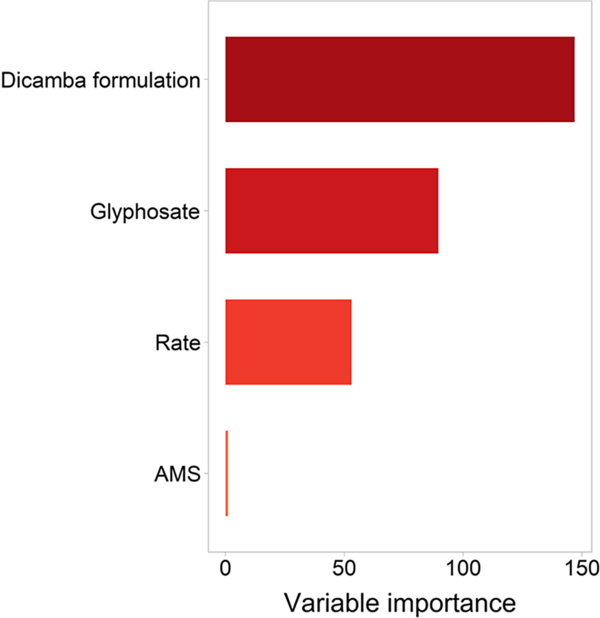
Variability in the data set for solution pH was well explained by dicamba formulation (VI = 146.82) and glyphosate (VI = 88.97), indicating that both variables highly influenced pH (Figure 5), fb rate (VI = 53.4). Inclusion of AMS (VI = 1.07) was not important in influencing pH level.
Spray solution pH as influenced by dicamba formulations labeled for use in corn, glyphosate formulation, ammonium sulfate (AMS), and rate, ranked by variable importance as determined from the random forest analysis for laboratory experiment 3 (root mean square error, 0.08).
Experiment 4: 2,4-D + Spray Components
1×Treatment Rate
The pH of treatment solutions ranged from 4.97 to 7.06 (Table 7). Solution pH was lowered 0.62 units with the addition of 2,4-D. Inclusion of AMS increased solution pH by 0.12 units compared with 2,4-D alone. Treatments that included glyphosate had the lowest solution pH. Reductions in pH of 1.93 to 2.05 were observed for 2,4-D with glyphosate, regardless of glyphosate salt, compared with 2,4-D alone. Only 2,4-D choline plus GLY-K had a solution pH lower than 5.0. The premix 2,4-D+GLY formulation had a solution pH more than 0.81 units higher than that of 2,4-D plus GLY-K or GLY-DMA treatments with no other additional components. The difference in pH between the mixed 2,4-D + glyphosate and premix treatments could be attributed to the differences in glyphosate concentration, which was lower for the premixed formulation than the mixed treatments. Treatments in which DIM replaced a glyphosate formulation had a solution pH 0.33 to 0.39 units lower than 2,4-D alone. Inclusion of AMS did not influence solution pH for most treatments, except for a small increase (0.18 units) for 2,4-D plus DIM.
4× Treatment Rate
The pH of treatment solutions ranged from 4.93 to 6.75. Solution pH was lowered by 0.97 units with the addition of 2,4-D. Inclusion of AMS increased solution pH 0.16 units compared with 2,4-D alone. Treatments that included glyphosate had the lowest solution pH. Reductions in pH of 1.62 to 1.66 pH units were observed for 2,4-D with glyphosate, regardless of glyphosate salt, compared with 2,4-D choline alone. Two treatments with glyphosate (2,4-D choline plus GLY-K or GLY-DMA) had a solution pH lower than 5.0. The premix 2,4-D+GLY formulation had a higher solution pH than 2,4-D plus GLY-K or GLY-DMA treatments. Treatments in which DIM replaced a glyphosate formulation had a solution pH 0.10 to 0.62 units lower than 2,4-D alone. Inclusion of AMS influenced solution pH for most treatments, except the 2,4-D+GLY premix. The addition of AMS increased pH for 2,4-D alone (0.16 units higher) and with glyphosate (0.07 to 0.14 units higher) and decreased pH for 2,4-D plus DIM (0.36 units lower with AMS).
1× and 4× Treatment Rate Comparisons
Solution pH for 2,4-D plus DIM (without AMS), 2,4-D choline plus GLY-K (with and without AMS), and 2,4-D choline plus GLY-DMA (with AMS) treatments did not differ between the 1× and 4× rates. For remaining treatments, solution pH was lower for treatments included at the 4× rate than the 1× rate.
Ranking Importance of Treatment Variables
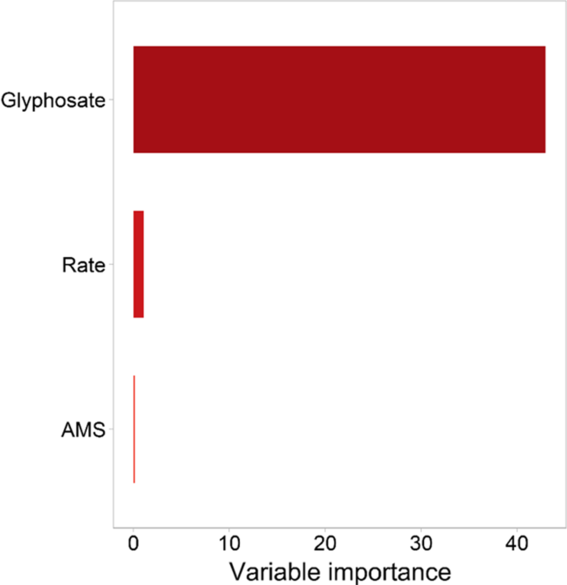
Variability in the data set for solution pH was well explained by inclusion of glyphosate, indicating glyphosate was the most important variable influencing pH (VI = 43.45) (Figure 6), fb rate (VI = 1.10). Inclusion of AMS (VI = 0.14) did not influence pH level.
Spray solution pH of 2,4-D choline mixtures as influenced by glyphosate formulation, ammonium sulfate (AMS), and rate, ranked by variable importance as determined from the random forest analysis for laboratory experiment 4 (root mean square error, 0.31).
Low-Tunnel Field Volatility Experiment
The response variable was calculated as a function of soybean injury intensity over distance from the center of the plot (i.e., AUIDS). The addition of glyphosate was not significant in any interactions (P > 0.05), but the three-way interaction among experiment, application time of year, and synthetic auxin herbicide was significant (P = 0.012); thus, results are presented for each treatment by experiment and application time of year. The addition of glyphosate was also not significant as a main effect (P = 0.366); thus, synthetic auxin herbicides were pooled across glyphosate levels. The potential for glyphosate to affect certain, but not all, synthetic auxin herbicides evaluated was proactively addressed by comparisons between the levels of glyphosate for each synthetic auxin, experiment, and application time-of-year combination (data not shown), which confirmed the results of the ANOVA that glyphosate had no impact on soybean injury. These results likely also were influenced by the pH of the soil used in flats at the research site (pH, 6.6); more acidic soils (pH 4.3 and 5.3) have been demonstrated to further contribute to volatility in low-tunnel volatility experiments (Oseland et al. Reference Oseland, Bish, Steckel and Bradley2020).
Early Application, Experiment 1 (June 21, 2019)
No differences in AUIDS were detected between synthetic auxin herbicides for the early application timing in experiment 1 (P > 0.05) (Table 8). In experiment 1, soybean injury was less than 12% (Supplementary Figure S1). Weather conditions after application included low temperatures, especially for the 0 to 24 h period after application (average 1 m air temperature, 17.4 C), and high average wind speeds (1.6 and 2.8 m s−1 for the 0–24 h and 24–48 h periods, respectively) (Table 3; Supplementary Figure S1).
Area under injury over distance stairs values and SE for treatments applied early and late in the growing season in low-tunnel field experiments conducted in 2019 at University of Wisconsin-Madison Arlington Agricultural Research Station, Arlington, WI. a

a Area under injury over distance stairs values calculated from soybean injury data 28 d after treatment.
b Early applications were completed on June 21 and 26; late applications were completed on July 7 and 16. All applications coincided with V3–V5 soybean growth stages.
c Abbreviations: 2,4-D, 2,4-dichlorophenoxyacetic acid choline salt; AUIDS, area under injury over distance stairs; DGA, diglycolamine salt of dicamba; NA+DIF, sodium salt of dicamba premixed with sodium salt of diflufenzopyr with isoxadifen safener; SAH, synthetic auxin herbicide; VG, VaporGrip® (acetic acid-acetate buffer).
d Means are pooled over levels of GLY.
e Means followed by a different letter within a column and application time of year differ at P < 0.05 according to means separation with Tukey’s honest significant difference.
Early Application, Experiment 2 (June 26, 2019)
In experiment 2, soybean injury ranged from 0% to 30% across treatments (Supplementary Figure S2). Soybean injury was greater after the DGA+VG treatments than after NA+DIF and 2,4-D treatments, for which AUIDS levels were similar (Table 8). Weather conditions after application included average 1-m air temperature of approximately 22 C and low wind speeds (approximately 0.3 and 1.5 m s−1 for the 0–24 h and 24–48 h periods, respectively) after application (Table 3; Supplementary Figure S2).
Late Application, Experiment 1 (July 7, 2019)
In experiment 1, soybean injury was less than 15% (Supplementary Figure S3). Soybean injury levels were similar for DGA+VG and NA+DIF treatments (Table 8). Treatments with DGA+VG had a greater AUIDS than the 2,4-D treatments, whereas NA+DIF and 2,4-D treatments had similar AUIDS levels. The average 1-m air temperature was higher than for the early applications (24.3 and 23.7 C for the 0–24 h and 24–48 h periods, respectively) and high wind speed (1.8 m s−1 for both 0–24 h and 24–48 h periods) (Table 3; Supplementary Figure S3).
Late Application, Experiment 2 (July 16, 2019)
In experiment 2, soybean injury ranged from 0% to 24% (Supplementary Figure S4). Though 30% maximum injury was observed in the early application timing in experiment 2, the soybean injury observed in the late application timing in experiment 2 was the most severe and consistent of all the applications (Table 8; Supplementary Figure S4). Soybean injury levels were similar after DGA+VG and NA+DIF treatments and greater than after the 2,4-D treatments. The 1-m air temperature was greatest (>25 C) for the late application timing in experiment 2, and wind speed (<1 m s−1) was consistently low (Table 3; Supplementary Figure S4).
Environmental conditions during and after herbicide applications influence OTM of synthetic auxins (Behrens and Lueschen Reference Behrens and Lueschen1979; Bish et al. Reference Bish, Farrell, Lerch and Bradley2019; Egan and Mortensen Reference Egan and Mortensen2012; Mueller et al. Reference Mueller, Wright and Remund2013; Mueller and Steckel Reference Mueller and Steckel2019a); therefore, they may help explain the variability of soybean injury as a result of volatility recorded in these experiments. Weather conditions for the 0 to 24 h and 24 to 48 h periods after flat placement are summarized in Table 3 and Supplementary Figures S1–S4. The low tunnels inevitably generate a favorable microclimate for volatilization in the field by restricting air flow and vertical mixing of air, and that must be considered when interpreting weather conditions and subsequent soybean injury after the treatment applications. The low tunnels also protect soil flats from rainfall, which has been reported to reduce volatility of dicamba (Behrens and Lueschen Reference Behrens and Lueschen1979; Jones et al. Reference Jones, Norsworthy, Barber, Gbur and Kruger2019b). For one low-tunnel experiment (early application time of year, experiment 1), no rainfall occurred during the 48-h after application. The occurrence of rainfall for the remaining three low-tunnel experiments was toward the end of the 48-h period. Air temperature was higher for the last three applications occurring on June 26, July 9, and July 16, when maximum 1-m air temperature was higher than 29 C, the 15-cm air temperature positioned inside the low tunnel averaged 22.6 to 26.1 C, and recorded maximum temperatures were higher than 30 C. The two applications with largest AUIDS values were those occurring on June 26 and July 16, when average wind speed was 0.3 and 0.7 m s−1 for the 0 to 24 h, and 1.5 and 0.9 m s−1 for the 24 h to 48 h periods after application, respectively. Relative humidity data did not help explain soybean injury observations among experiments. The combination of higher temperature and lower wind speeds may help explain the higher dicamba-associated injury (AUIDS range, 0–36) observed during the early and late applications for the second experimental run (Table 3, 8; Supplementary Figures S2 and S4). Weather conditions for the early application in experiment 1 (low temperatures and consistent wind speed within range labeled for application), along with minimal soybean injury (AUIDS, <6) for those treatments indicate applications of dicamba can be less prone to volatility under such environmental conditions. These experiments were conducted under conditions typical for the midwestern U.S. region, where greater than 75% and greater than 80% of U.S. corn and soybean are grown, respectively (USDA-NASS 2019) and clearly reflect the risks of applications occurring late in the growing season (mid-July). Some of the variability in soybean injury between NA+DIF and DGA+VG treatments observed across experiments was likely due to the lower dicamba ae concentration with the rate of NA+DIF compared with the DGA+VG treatments. NA+DIF is premixed with diflufenzopyr, which provides enhanced activity on broadleaf weeds comparable to dicamba alone (Ross and Lembi Reference Ross and Lembi2008; Soltani et al. Reference Soltani, VanEerd, Vyn, Shropshire and Sikkema2010), justifying the lower use rate in corn.
Low-tunnel volatility experiments provide a means of comparison across spray mixtures but are not an absolute predictor of dicamba OTM and injury on a landscape level. Compiling findings of humidome experiments, low-tunnel experiments, and large-scale drift trials to derive conclusions and drive recommendations is essential to minimize dicamba OTM. A state- or region-specific enforced cutoff date may not necessarily be a solution unless carefully determined, because adverse weather conditions can be present before the specified cutoff date, just as suitable conditions can be present after the specified cutoff date. Across the U.S. Midwest, an earlier cutoff date combined with temperature restrictions may be more effective in mitigating potential for dicamba OTM via volatility. This strategy had been adopted early by some states (e.g., Minnesota) and since relaxed (MDA 2019; Werle et al. Reference Werle, Oliveira, Jhala, Proctor, Rees and Klein2018), whereas Illinois recently enforced both a cutoff date and temperature after the 2019 growing season (IDOA 2019).
The addition of glyphosate had a significant impact on lowering spray-solution pH and was the most influential spray component in the laboratory experiments for all dicamba formulations tested and 2,4-D. Inclusion of glyphosate as a tank-mix partner with dicamba or 2,4-D did not translate into greater soybean injury to susceptible soybean in the low-tunnel field volatility experiments. This research indicates stark differences in the likelihood of soybean injury from dicamba volatility as compared with 2,4-D, although it is well documented that soybean is more sensitive to dicamba than to 2,4-D (Egan et al. Reference Egan, Barlow and Mortensen2014; Johnson et al. Reference Johnson, Fisher, Jordan, Edmisten, Stewart and York2012; Scholtes et al. Reference Scholtes, Sperry, Reynolds, Irby, Eubank, Barber and Dodds2019; Sciumbato et al. 2004). In the U.S. Midwest region, 2,4-D applications are less likely to result in injury complaints, because there are more tolerant crops (e.g., non-Enlist E3™ soybean) planted than highly sensitive crops (e.g., non-Enlist™ cotton) (Anonymous 2017b, 2017a). Rate frequently affected solution pH; treatments typically had lower solution pH at the 4× rate than the 1× rate. This suggests low-tunnel field volatility experiments using concentrated rates (e.g., a 4× rate) may lead to more conservative results with higher probabilities of treatment differences, thus reinforcing the importance of applicators using the labeled rate to minimize undesired consequences related to off-label rates. Concerns regarding the pH drop associated with a glyphosate addition may lead to recommendations or label restrictions for glyphosate to be applied sequentially instead of mixed with dicamba when applied POST. Additional research is needed to fully understand the impact of glyphosate addition on dicamba volatility in large-scale applications under various weather conditions. Last, our results partially answer the frequently asked question from stakeholders: Why does volatility seem to be more of an issue with dicamba applications in soybean compared with corn across the U.S. Midwest?
Acknowledgments
The authors would like to thank the University of Wisconsin-Madison Cropping Systems Weed Science research group for their technical assistance in establishing field experiments. Funding for S. Striegel’s graduate research assistantship was provided by Bayer Crop Science and the R. Gordon Harvey Distinguished Graduate Fellowship. No conflict of interest has been declared.
Supplementary material
To view supplementary material for this article, please visit https://doi.org/10.1017/wet.2020.89



