Introduction
In this paper we present two tablets with Akkadian wisdom texts from the second millennium b.c. Footnote 2 BM 13928 (96-2-4,28), dated to the Old Babylonian period, is edited below for the first time, and CBS 14235, a Middle Babylonian copy of an Old Babylonian tablet, was last edited by Lambert (Reference Lambert1960: 276, pl. 70). Both texts contain a sequence of monolingual proverbial sayings and admonitions. No other Akkadian examples of tablets with proverbial sayings from the Old Babylonian period are known to us to date.Footnote 3 The colophon of BM 13928, if correctly read as “tenth tablet”, proves, however, that collections of Akkadian proverbs were more common in this period than previously assumed. Thematically, the two texts stress the paramount role of the king in society. This ideological notion was probably the reason for gathering and putting down these proverbial sayings in written form.
BM 13928
Research History
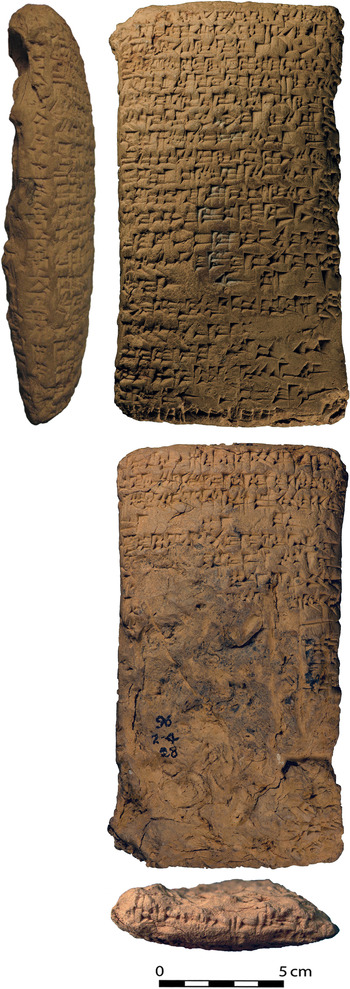
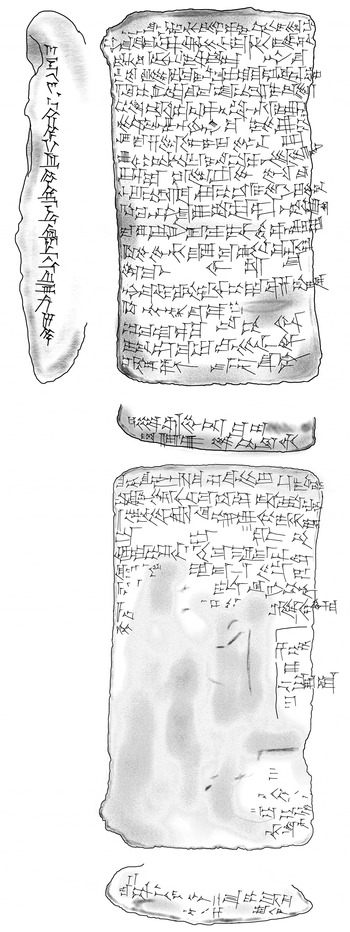
The text BM 13928 has been known to scholars visiting the British Museum for several decades. According to the catalogue of Figulla (Reference Figulla1961: 154), the text is an Old Babylonian “medical text” (probably because its first intelligible line started with šumma). W. von Soden, followed by CAD, quotes three lines of the text in his AHw (see the commentary to ll. 7, 15, 19 below). N.W. examined the tablet on several occasions, and some of the photos he took in the museum were put online and published on the website of the British Museum (www.britishmuseum.org). We know that W.G. Lambert worked on the tablet, but no copy of it exists in his folios.Footnote 4 See Figs. 1–2.
BM 13928, photo: NW (courtesy the British Museum)

BM 13928, copy: NW

Physical Description of the Tablet
The size of the tablet is 70 × 123 × 31 mm. The lower half of the reverse is badly damaged. Text is also found on the lower, left and upper edges. The obverse and the lower edge show several erasures (ll. 6, 17, 21).
Contents
The main protagonists in this tablet are the wolf (on the obverse) and the king (on the reverse). The text does not present a running narrative. Although no separation lines exist,Footnote 5 we believe that the text contains a collection of popular or proverbial sayings thematically connected.Footnote 6 Another support for this is the colophon.Footnote 7
Proverbs concerning wolves are found in the Sumerian Proverb Collection 5,Footnote 8 but none of them offers a close parallel. In our text the wolf is the opponent of the civilized world: restless and constantly roaming around (§§ 2, 6); cunning and dangerous as a snake (§ 3); its hunger is enormous (§§ 2, 3, 5); it threatens the shepherds (§ 5); and although it takes great pain to provide for its house and heir (§§ 1, 2), it has no normal, civilized family (§ 4). The obverse of the tablet ends with the statement that the wolf cannot be overcome by “you” (plural), i.e., the audience (§ 6). The reverse, as far as preserved, presents the protagonist of Mesopotamian civilization, the king. Living in the wilderness, outside his ruling sphere, means suffering (§ 8), but if one follows him, one will “make booty” and prosper (§§ 8, 9). The animal metaphor of the obverse is further developed in § 11: the king is the herder who pastures the cattle, his subjects, defending them against the uncivilized world, just as the shepherds in § 5f. A similar royal ideology is also mirrored in CBS 14235, published below.
Paleography and Orthography
BM 13928 shows a typical Old Babylonian hand with some scribal peculiarities or idiosyncrasies: ŠUM is written in all instances (ll. 2, 3, 7, 16, 47) with only one horizontal wedge instead of two parallel ones, and NIM is written in ll. 3, 18 with one horizontal wedge instead of two slanted ones (but with two parallel horizontal wedges in l. 24). The plene spellings in i-im-˹ma-ar˺ l. 2 and i-ip-pu-uš l. 8 are typically Old Babylonian. pí (l. 11), qí (ll. 29, 47) and qú (ll. 4) point to the north of the Old Babylonian writing area, whereas ṭi (l. 25) is used more in the south.Footnote 9 Noteworthy are the following three spellings: zí-bi-iš l. 5 with zí instead of zi; mu-ut-tá-ag-gi-šum l. 7 with tá instead of ta (elsewhere used in the text, see ll. 9, 18), an uncommon syllabic value in Old Babylonian (more typical to Old Akkadian and Old Assyrian). A syllabic value which should be pointed out is rim in mu-ur-rim l. 23, which so far is attested only from Middle Babylonian onwards (see von Soden Reference von Soden1991: 55 no. 280). The text employs a limited number of logograms: U4 l. 6; (DUMU) UR.BAR.RA ll. 6, 10, 12; ŠÀ l. 10, 12; É ll. 8, 13; SIPA l. 18; LUGAL l. 25, all quite typical for an Old Babylonian literary text.
Language
The vocalic sequence i-a (>â) is still uncontracted, which is another sign for an Old Babylonian date: mu-ši-ia-ti l. 2, li-li-a-tim l. 9. Mimation is not used throughout. Examples with mimation are (not counting CVC-signs): ma-an-nu-um l. 14, mu-ši-im l. 19, re-qú-um l. 23, du-um-qá-am l. 26. The following words show no mimation: mu-ši-ia-ti l. 2, le-e-ma l. 3, qú-ra-di l. 3, ˹ap˺-lu l. 13, ma-ak-ku-ra l. 13, šar-ra l. 28. The text provides three new and unambiguous examples for the terminative -iš in comparative use: zí-bi-iš l. 5, ši-ib-bi-iš ki-ip-pí-iš l. 11. Thus an Old Babylonian date of this function of -iš, already advocated by Streck/Wasserman (Reference Streck and Wasserman2008: 350) ad Papullegara-hymns ll. 24’–25’, is now clear.
“Museum Archaeology”
The 96-4-2 group of tablets in the British Museum (see Figulla Reference Figulla1961: 151–85), altogether 403 tablets, consists almost entirely of texts from the Ur III and Old Babylonian periods (only BM 13129 is said to be Neo-Babylonian). As far as dated, almost all Old Babylonian tablets belong to the “classical” time of the Old Babylonian period (dates of Hammurapi and Samsuiluna of Babylon and their contemporaries Rīm-Sîn of Larsa and Rīmanum of Uruk); only three tablets in this group of tablets bear an early Old Babylonian date (Manabaltiel), and none a late Old Babylonian date. The paleography, orthography and language of BM 13928 as presented above also points to this general time frame, namely the “classical” or central Old Babylonian period.
Interestingly, of the twelve literary and scientific tablets in Figulla (Reference Figulla1961; the volume lists altogether 3000 tablets), nine belong to the 96-4-2 collection: three lexicographical tablets (BM 13128, 13902, 14063), one of three divination texts (BM 13915), three of four hymns and prayers (BM 13930, 13963, 14016), one mathematical tablet (BM 13901), and BM 13928, published here. If this distribution of literary texts catalogued by Figulla is not purely accidental, then we might cautiously suggest that BM 13928 originally belonged to a “library” organized by a scribe.Footnote 10 This subject cannot be pursued further here. As we state in the commentaries to ll. 17 and 23, below, the scribe probably had copied the text from another tablet.
Transliteration
Obverse
1 [x] ˹x x x x (x)˺-ti KU UZ? pa-˹as˺-na-qám i-li-˹ik˺
2 šum-šu ki-ma di-pa-ar mu-ši-ia-ti i-im-˹ma-ar˺
3 it-ti ˹da !˺-pi-nim i-pi-id-du šum-šu
4 ú-te-ru le-e-ma i-na šu-pa-at qú -ra-di uš-˹ša-ab˺
5 a-di bi-ir-ka-šu-ma zí-bi-iš i-da-li-p[a]
6 ˹ul˺-li-iš U4-um uš-pa-aš {erasure}-ša{erasure}-ḫu DUMU UR.BAR!.˹RA!˺
7 mu-ut-tá-ag-gi-šum-ma i-še-eb-bé
8 ù ˹la˺ ṣa-li-lum i-ip-pu-uš É
9 ú-ul ta-mu-ur i-na ṭá !-pa-aš li-li-a-tim
10 UR.BAR.RA e-li-ip bu-bu-ut ˹ŠÀ˺
11 ši-ib-bi-iš ki-ip-pí-iš i-te-né-ep-pu-uš
12 a-na ma-an-ni-šu ú-ša-ka-al aš-ša-tam UR.BAR!.RA
13 ˹ap˺-lu ib-ni É-ma i-ši-iḫ ma-ak-ku-ra
14 a-na bu-bu-ti-šu-ú-ma qá-tam ma-an-nu-um
15 li-ma-aš-ši-iš-šu
16 šum-ma ši-ra-am la še 20-bi ra-ba-ṣa-am i-de
17 a-na bu-bu-ti-šu-ma ˹x˺ [xxx] ˹x x˺
18 um-ma-at SIPA ta-bi-nim
19 i-da-al-ma ka-la mu-ši-im
20 e-li-ku-nu šu-up-šu-uq
Lower edge
21 ˹e ?˺-li-ka !{erasure} pu-uš-qú-um [x x (x)]
22 [i?-]˹ša ?˺-a ?-lu-ú li-bi-˹it˺-ti ?
Reverse
23 šu-up-šu-uq re-qú-um ki mu-ur-rim i-na ša-˹di ?˺-[im?]
24 ˹ša˺-ki-˹in˺ uz-nim-ma ša-al-la-tam i-ša-la-al
25 a-li-ik wa-ar-ki LUGAL ú-ul i-ḫa-aṭ-ṭi
26 du-um-qá-am
27 ù at-ta ˹ri-di-am˺-ma ra-ma-an-ka
28 ki-˹ma˺ ˹a ?˺-˹bi ?˺-˹im ?˺ ra-ma {erasure}šar-ra
29 a-n[a x x x x x] i-na ˹qé˺-er-bi/bé-tim
30 a-d [i] [x x x x] x x e-li mi-im-ma
31 ˹mu˺ […]
32 ˹x x˺ […] | __________
33 (sign traces) | ṣa-bi-tum-
34 (sign traces) | ma
35 (sign traces) | [b]i-˹it ?˺-ra-at-
36 (sign traces) | ma
37–40 (sign traces)
41 […] x x
42 […] ˹x x GA?˺-ta-li
43 (sign traces) -ti-li-˹ka ?˺
Left Edge
44 [(x x)]-ma d˹GÌR iq˺-bi-šum-ma bu-lam na-qí-du-ut sú-ku-lim i-pu-[uš]
Upper edge
45 a […]
46 ˹at˺-ta ˹x x x-a-šu˺ i-˹ba ? -ki ?˺
47 [MU?.B]I? [40] + 4? ˹DUB 10kam˺
Translation
Obverse
§ 1
1 … he went away powerlessly.
2 He looks at his offspring like a torch in the nights:
3 Are they catching his offspring with the mighty one?
§ 2
4 (When) they brought back eating, he sits in the warrior's house,
5 until his knees get restless (again) like a vulture.
6 Then, having calmed the cub, the wolf
7 satisfies himself, roaming around.
8 And not sleeping, he builds a house.
§ 3
9 Did you not see, in the (time of) becoming fat(?) during the night,
10 (how) the wolf is swollen up because of hunger in (his) belly?
11 He constantly acts like a šibbu-snake, like a snare.
§ 4
12 For whom, after all, does the wolf feed a wife?
13 Has (his) son (ever) built a house and become great with respect to possessions?
§ 5
14–15 At his hunger, who could possibly match him as to his hand?
16 If he is not sated with flesh, he knows to lurk.
17 Against his hunger …
18 (could) an army of shepherd(s) (do anything in) the shelter?
§ 6
19 He roams about all night long,
20 he is too hard for you (to catch).
Lower edge
§ 7
21 Hardship for you (sg.) is […]
22 … brickwork.
Reverse
§ 8
23 It is very hard to be far away (from the king) like a foal in the mo[untain].
24 Only he who pays attention (to the king) will make booty.
25–26 Who follows the king will not miss any good.
§ 9
27 And you yourself, follow (the king)!
28 Love the king like a father!
§ 10
29 To … in the middle/on the meadow,
30 until … on something.
31–36 (sign traces)
(box on the right side) It is the gazelle who is outstanding(?).
37–43 (sign traces)
§ 11
Left edge
44 … Sumuqan designated to him the cattle (and) he exercised the pastorship of the herd.
Upper edge
45 …
46 You, … him so that he cries.
47 [It]s [lines]: [4]4, tenth tablet.
Commentary
1: pasnaqum instead of pisnuqum is also attested in Gilg. OB III 156.
3: dapinum probably refers to the king. We tentatively derive i-pi-id-du ? from pâdum “to take captive” (not from padû/pedû, an -i-verb), although the verb is almost always mediae ā; however, a mediae ī variant is attested once in a Neo-Assyrian royal inscription (AHw 808 pâdu G 2a, CAD P 9 pâdu A 1e). The subject of the verb is probably the hunters led by the king. Note the alliteration d-p-p-dd.
6: Note the word order VERB-OBJECT-SUBJECT, which also occurs in l. 12.
7: AHw 689 quotes the line as “mu-ut-ta-ag-gi-šum-ma wird satt”, and CAD M/2, 303 as mu-ut-ta-ag-gi-šum-ma.
9–10: Generally wolves are crepuscular, active in dawn and dusk. In this couplet, the wolf is depicted as looking for food at nightfall.
10: e-li-ip has to be connected with a-li-ip in Finkel (Reference Finkel and Abusch1999: 218) BM 79938 (copy fig. 2 p. 243) l. 3: bu-bu-tam a-li-ip a-ka-lam ˹e˺-[e ṣ] “He is swollen up(?) because of hunger, sho[rt] for bread”. See on this verb also Wasserman (Reference Wasserman2003: 34 with n. 31). We derive the form from elēpum/alāpum “to sprout forth, to flourish”, perhaps in the sense of “to be swollen up”.
12: ana mannišu belongs to the examples of mannum with pron. suffix, see CAD M/1, 216 mannu b. This construction emphasizes the question pronoun.
15: limaššiššu < limaššilšu (court. I. Khait). AHw. 624b and CAD M/1, 360b derived the word from mašāšu.
17: The line ends with an erasure in which the scribe started to write um-ma-at SIPA ta-bi-nim of the next line, thus suggesting that he copied from another tablet.
18: The word ummatu is hyperbolically used.
19: AHw 725 quotes the beginning of the line (l. “19”) as “i-na-al” from nâlu “to lie down”.
23–25: A similar statement is found in ll. 8–14 of CBS 14235, below. The parallel with tišānum strongly suggests that murrum is a variant of the word mūrum and not the plant (although this plant is said to grow in the mountain, see the medical text BAM 1 iii 12: úŠIM.ŠEŠmeš šá KUR).
28: We understand ra-ma not as a pl. but as sg. with ventive and atta as subject.
Box to the right of ll. 32 ff.: Note the rulings on the tablet which indicate that these lines probably continue the broken l. 31.
44: The mentioning of Sumuqan, the god of herds, refers metaphorically to the king's function as a shepherd of the people.
46: This line may continue the text or, if l. 47 contains a colophon, as we believe, might be the title of the composition, namely the first line of the first lost tablet.
47: As we understand it, this line contains a colophon. Colophons in Old Babylonian literary texts are rare, see Hunger (Reference Hunger1968: 25–29). To this add “second tablet” Gilg. OB II 241 and “seventh tablet” Girra and Elamatum 52 (Walker Reference Walker1983: 145 ff.).
CBS 14235
Research History
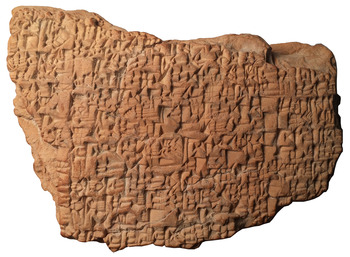
CBS 14235, found in Nippur, was lastly published by Lambert (Reference Lambert1960: 276 ff., with copy on pl. 70). The text has the CDLI no. P269202 (with photos). See Fig. 3.
CBS 14235 (courtesy S. Tinney, Penn Museum)

Physical Description of the Tablet
As BM 13928 published above, CBS 14235, a fragment of a three-column tablet, is also without separation lines. Its back is uninscribed, as can be seen on the photo in CDLI.
Contents
BM 13928 and CBS 14235 show strong thematic parallels. The king (CBS 14235: 13 adds the queen) is contrasted to wild animals (murrum ina šadîm “a foal in the mountain” BM 132928: 23, tišānim … ša šadî ītenettiqu “a mountain goat, which wanders in the mountains” CBS 14235 ii 10–12 and umāmu … rābi ṣ ṣēri “a beast lying in the steppe” CBS 14235 ii 15; see also ṣabītu “a gazelle” BM 132928: 33). The wild animals, in both texts, metaphorically refer to those who are not under the domain of the king. Both texts give advice for a prospering life: šākin uznimma šallatam išallal ālik warki šarrim ul iḫaṭṭi dumqam “Who pays attention (to the king) will make booty. Who follows the king will not miss any good” BM 132928: 24–26 and awīlum adi lā innaḫu ul irašši mimma “A man, as long as he does not exhaust himself, will not get anything” CBS 14235: 8 ff. Lines ii 2–7 seem to speak of a washing ritual performed in front of the king. The moistening of the plants mentioned in ll. 6–7 probably describes the preparation of holy water, known from first-millennium rituals.Footnote 11 The royal washing ritual is the quintessential manifestation of Mesopotamian culture, as opposed to uncivilized life in the wilderness.
Paleography and Orthography
As Lambert (Reference Lambert1960: 276) noted, the mixture of archaic and younger or cursive signs in the text is typical for some Old Babylonian/Middle Babylonian texts from Nippur. We can add the following further examples: AN ii 10, 11 (younger) and i 6, ii 14 (archaic); AM i 2, 6, 7 (gloss) (younger) and 3 (archaic); MI i 5, 7 (gloss) (archaic) and ii 9, 10 archaic; UB i 9 (younger) and ii 4 (archaic). This mixture of sign forms might indicate that the scribe copied the tablet from an older text, an idea confirmed by the gloss in ii 7 where only younger sign forms are found.Footnote 12 An archaic syllabic value is qe 4 ii 3, whereas ṭer in ii 5 is typical for Middle Assyrian. For the unusual si 12 ii 6, see the commentary to the line, below.
Language
There are several arguments for an OB date. The text consistently uses mimation, except for ú-ma-mu ii 15. The vowel sequence i-a remains uncontracted (see ir ?-t]e-di-a-am i 2). The word tišānu in ii 10 is only attested in Old Babylonian texts to date. On the other hand, the form i-na-an-di-iš-šu with dissimilation of the geminate and the dative pron. -šu in ii 11 are typical for post-Old Babylonian texts. Thus the language confirms the idea, already gained from the paleography and orthography of the text, that a Middle Babylonian scribe copied the tablet from an Old Babylonian original.
Transliteration
col. i
1 (traces)
2 ir ?-t]e-di-a-am
3 …]-ra-am
4 ša]-lum-ma-ti-šu
5 …] x -am ? -mi-im
6 …m]a-am-ma-an
7 …] x-gi
8 …] x-rum
9 …]-ša-ár
10–15 (traces)
col. ii
1 x […]
2 un-ne-˹na ˹x˺ [ …]
3 i-le-eq-qe 4 a-˹wi˺-l[u? …]
4 a-šar ṣi-bu !?-tim ub-ba-˹al ?˺-[(x)]
5 iṭ-ṭer i-ṣa-bat i-na pa-ni šar-ri-im
6 Úmeš!? a-na me-si 12 -im ú-la-ba-ak
7 ša-am-mi-ma
8 ù a-wi-lum a-di la i-na-ḫu
9 ú-ul i-ra-aš-ši mi-im-ma
10 ma-an-nu-um mi-nam a-na ti-ša-nim
11 i-na-an-di-iš-šu
12 ša ša-di-i i-te-né-ti-qú im !?-ma-ni-iš
13 ša la i-šu-ú šar-ra-am ù šar-ra-tam
14 be-el-šu ma-an-nu-um
15 šu ? -ú-ma lu ú-ma-mu lu ra-bi-iṣ ˹ṣé-ri˺
16 (traces)
col. iii
1 ṣe-e-r[i ? …
2 i-wi r[a…
3 i-ša-a ḫu a […
4 ú-še-el[-le?
5 a-na ma-a-k[a-li
6 ši-ni-šu i-m[a-…
7 ù at-ta r[a ?-ma?-an?-ka?
8 i-na U4 [..]
9 ú-maš ?-š[a
Translation
col. i
1 …
2 [… he has fo]llowed.
3 …
4 [.. his sple]ndour.
5 …
6 … somebody.
7–15 …
col ii
1 …
2 A supplication …
3 A man takes …
4 To the place he needs he bring[s (it)].
5 He takes (it) away, holding (it). In front of the king,
6–7 he moistens the plants for the washing.
8 And a man, as long as he does not exhaust himself,
9 will not get anything.
10–11 Who will give anything to a mountain-goat,
12 which wanders during the heat in the mountains?
13 He who has no king and no queen,
14 – who is his lord?
15 Such (a man) is either a beast or (an animal) lying in the ˹steppe˺.
16 …
col iii
1 Stepp[e …]
2 He became … […]
3 …
4 He sharpens/raises […]
5 For foo[d …]
6 He […] his teeth/twice.
7 And you …
8 At the day…
9–15 …
Commentary
ii 4: ṭer confirmed by photo. ṣi-bu !?-tim already read by Legrain (Reference Legrain1922: 46).
ii 6: Reading follows CAD L, 8, 2a. The original tablet in front of the scribe probably had a badly written MEŠ which he copied carefully as he saw it. Therefore, the scribe found it necessary to gloss this simple word. Note that the gloss only uses younger sign forms (see above), further strengthening the notion that this is really a gloss. The odd choice in SIG7 = si 12 is perhaps connected to the logographic meaning of the sign, warqum “green”, which echoes šammū “plants”.
ii 10: For tišānu, see Durand (Reference Durand1988b) and Mayer (Reference Mayer1995: 163). tišānu is a sort of mountain goat, or antelope, connected to Heb. דשון.
ii 12: i-te-né-ti-qú with Legrain (Reference Legrain1922: 46) instead of Lambert's i-te-ni-ti-ip ?. Reading im !?-ma-ni-iš with Legrain, ibid. and AHw 378b, s.v. immāniš, “am Tage”, and with Mayer (Reference Mayer1995: 163).
ii 15: ˹ṣé-ri˺ following a suggestion by the late A. Shaffer in his copy of Lambert (Reference Lambert1960).
iii 3: The photo shows a clear ḫu.
iii 7: Our tentative reading is based on atta … ramanka BM 13928: 27.