

Preserved in Special Collections at the Case Western Reserve University Library in Cleveland, Ohio, is an imperfect set of manuscript partbooks (CTB) whose origins are somewhat mysterious. The contents include motets, anthems, fantasies and untexted (and presumably instrumental) versions of Italian madrigals. There is no writing in the books to suggest when or where they were prepared, and this may help to explain why they lay unnoticed in the library for decades.Footnote 1 Not long after first examining them in 1989, I read a paper about the very unusual ordering of the contents,Footnote 2 but the time it has taken me to report on my investigation of the origins of the books is due to various mysteries that I have been unable to solve, even after all this time. A recent study of related repertory,Footnote 3 however, has prompted me to come forward now to share what can be established. The year 2013 also marked the 400th anniversary of when I believe the books were prepared, so this seems like an auspicious time to do so.
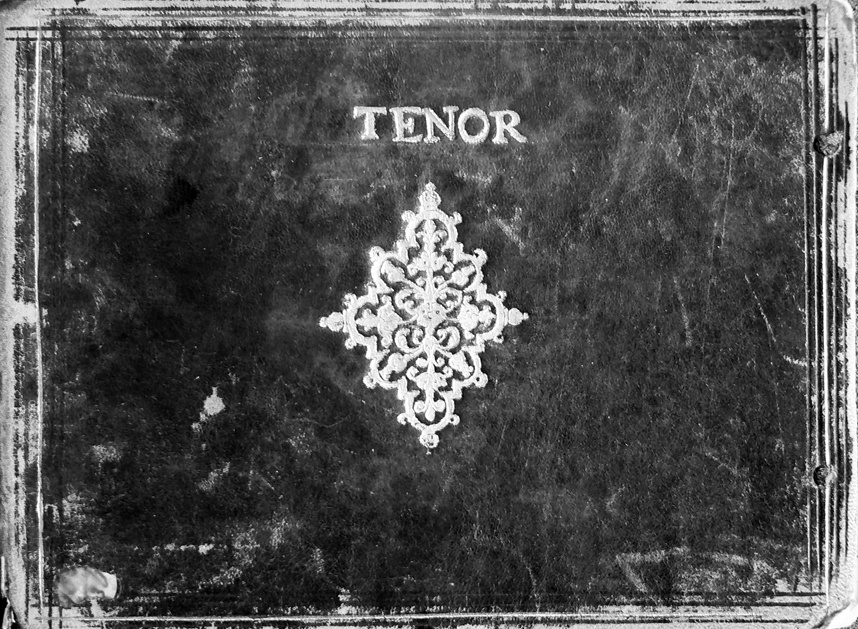
The only writing on the flyleaves is the words Liber Secundus, but any indication of what they were ‘second’ to is lacking. The books were donated to the University in 1938 by Mrs Dudley S. Blossom – of the same family for which the Blossom Music Center, the summer home of the Cleveland Orchestra, is named. Where she got them is not known, but a small bookplate in the front of each saying ‘Ex MVsæo HVthii’ establishes that they were part of the library of the nineteenth-century English book collector Henry Huth, who did most of his collecting between 1849 and his death in 1878. Already imperfect as a set at that time, they were sold at Sotheby's in London on 4 July 1916 to Maggs Bros., the prominent book dealers, for £18.Footnote 4 The cover of the Tenor partbook bears the faint imprint of that price in the top right corner (see Figure 1). Where Henry Huth found them in his customary scouring of London's rare book shops, and how they got from Maggs Bros. to Mrs Dudley Blossom remains a mystery.Footnote 5 I refer to the set as the ‘Blossom Partbooks’ in honour of Mrs Blossom's generosity to the University. Having found them, of course, they seem to me one of the most significant discoveries in Jacobean music in the modern era, but, as will be seen, the evidence for their historical significance is largely circumstantial. All of the circumstantial evidence leads to some intriguing speculation, however.
Blossom Partbooks: cover of the Tenor partbook

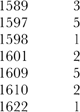
The contents (see Appendix) have concordances in music printed in England between 1589 and 1622, with the numbers for each year represented given here:
The composers represented are given here with the number of selections by each:
Thirteen other English and Italian composers have one each, for a total of fifty-six pieces in forty-nine numbered openings.
The breakdown by genre is as follows:
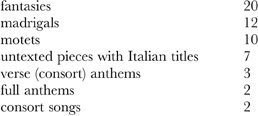
Most of the works, including all of the instrumental selections, are for five voices, the exceptional group being ten works for six voices. This means, of course, that three partbooks have been lost from the set.
The contents make plain that we are dealing with an anthology: a collection of pieces by various composers which someone has copied or caused to be copied for their own future pleasure or as a gift. England produced a few notably assiduous anthologists during the period in question. Edward Paston (1550–1630) was a Norfolk gentleman who used his secretary and other copyists to produce more than forty known collections which he kept in large numbers, but also sometimes distributed among his Catholic recusant friends, including, for example, John Petre, the Essex nobleman and patron of the composer William Byrd.Footnote 6 Coming slightly southward, Thomas Hamond, a Suffolk landowner, owned at least eight large manuscript music anthologies from c. 1615 to 1656, and six of those he copied himself.Footnote 7 In the West Country, John Merro, a lay clerk at Gloucester Cathedral from 1609 to his death in 1639, has left us three substantial anthologies in his own hand.Footnote 8 In London's Fleet prison from 1614 to his death in 1617, the recusant Francis Tregian the Younger reportedly compiled three enormous anthologies including the Fitzwilliam Virginal Book and two equally monumental full-score manuscripts.Footnote 9
Finally, Thomas Myriell, a clergyman who started out in Cambridge in the late sixteenth century and gradually moved southward by way of Barnet to London in 1616, is responsible for at least five manuscripts dating mostly from the dozen or so years before his death in 1625.Footnote 10 The most famous of these collections survives with an engraved title page, dated 1616,Footnote 11 giving the name Tristitiae Remedium (which translates as ‘Melancholy's Remedy’). It has been seen as a kind of barometer of musical taste in Jacobean London from 1615 to 1620, and it brings to mind Burton's voluminous Anatomy of Melancholy, which was published in 1621. Melancholy was endemic in Jacobean England. Not just anthems, but all kinds of secular entertainments like madrigals and lute songs are often tinged with it throughout this period.
Manuscript concordances can be very revealing of the origins of a source, especially where unprinted works are concerned and, in the Blossom Partbooks, only nineteen of the fifty-six pieces were printed in England. The appendix to this article lists manuscript and printed concordances, but the manuscripts with the largest number of concordances are shown here:
Twenty-one concordances with Tristitiae Remedium and seventeen with BL 29427 show the Blossom scribe to have a remarkable affinity to Myriell. In fact, Myriell's manuscript, Oxford, Christ Church MS 44, has no concordances with any other Myriell manuscript but has four with the Blossom Partbooks. And four pieces in the Blossom Partbooks occur in one or more of the Myriell sources, and nowhere else. Unfortunately, the Blossom scribal hand does not match Thomas Myriell's or any other hand in his manuscripts. Two other pieces in the Blossom Partbooks occur only in Tregian's Drexel 4302, and three further works appear in the Blossom Partbooks, in both Myriell and Tregian sources, and nowhere else. But again, the hand does not match that of Francis Tregian or any other known contemporary copyist to my knowledge. This is especially surprising since the hand is so clear, so obviously practised – there is a regular slant to the stems, for example, indicating a fair fluency.
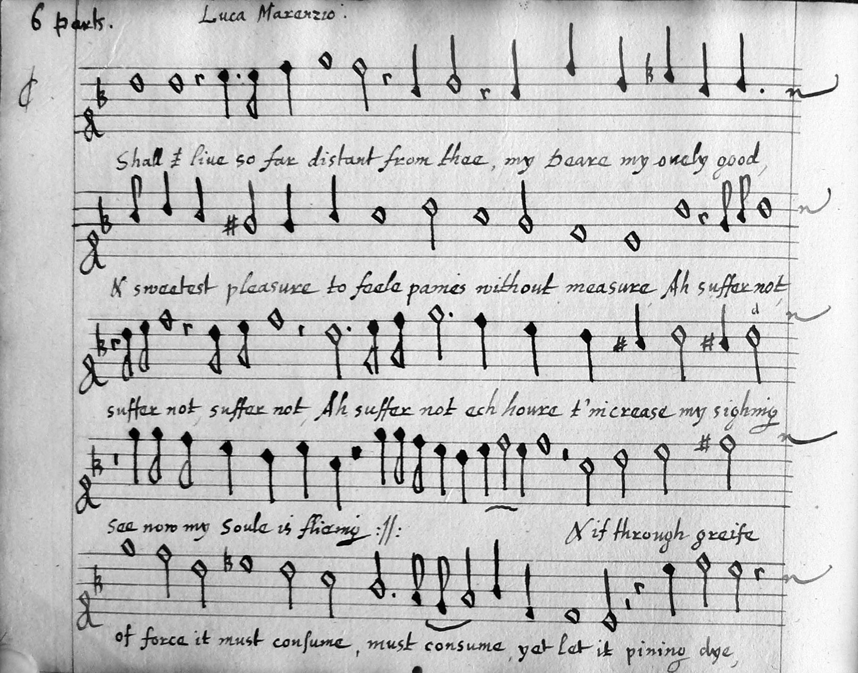
Some idiosyncrasies of the Blossom scribe can be seen in Luca Marenzio's madrigal Shall I live so far distant from the Cantus partbook (Figure 2). The work was originally published in Italy in 1591, then appeared in this English translation in the Second Book of Nicholas Yonge's Musica Transalpina, published in 1597.Footnote 12 To begin with, the designation for the number of voices – ‘6 parts.’ – which our scribe gives only for the six-voice works, is very unusual because it is in English. Almost invariably, 6 voc., Of 6 Voc, or A 6 voc. is found in such places in contemporary manuscripts and prints. So, besides the fact that English and Latin are the only texts provided in the source, the scribe further shows his anglophone proclivities through the use of a non-standard term. For those who have spent time with music sources from this period, it has about the same startling effect as Percy Grainger's shunning of commonplace Italian tempo and expression markings in favour of English.Footnote 13 Next, the form of the G clef seems to be unique – nothing matching it has been found in any contemporary English manuscript. Notice, too, the semiminim rest, which is shaped remarkably like a letter r. Most scribes go either straight across or sweep down and out from the top of the vertical stroke.
Cantus partbook, fol. 14v: Marenzio's Shall I live so far distant
These things look innocent, but these forms are very unusual, and they are totally consistent throughout. That is another unusual thing about the copying of these partbooks: most collections show changes in the hand, as if copying had been carried on over a long period of time – even years. Sometimes there is even different paper or a different person involved in copying, or the collection was assembled from bifolios or single sheets.Footnote 14 Not in this case; one person seems to have done text, music, and numbering of the complete partbooks and, it appears, over a fairly short period of time. Only the manuscripts of Edward Paston consistently suggest a comparably short execution time, but Paston's taste in music was quite different. The text hand of the Blossom Partbooks has idiosyncrasies, too, particularly the capital letter A, where the horizontal stroke has a slight V-shape, and the ampersand, which looks like a hastily executed X.
It is interesting to note, too, that corrections have been made. In the third line, the second and third pairs of the shortest notes have angular flags that have obviously been added later since they differ from the more flowing form visible elsewhere. And the last note of the third line has a little ‘d’ over it, possibly standing for ‘double’, since the note value should actually be twice the length notated. In four other places, however, the ‘d’ appears (invariably in the Cantus part) at a point where some duration correction needs to be made (including halving of the value), suggesting that it may have been a quick notation for something like ‘discord’ – to be checked and corrected later. Note also the slur markings, which are rarely done this thoughtfully.Footnote 15 Obviously, some care was taken to create reliable and readable parts, and that is not true of all manuscripts from the time.
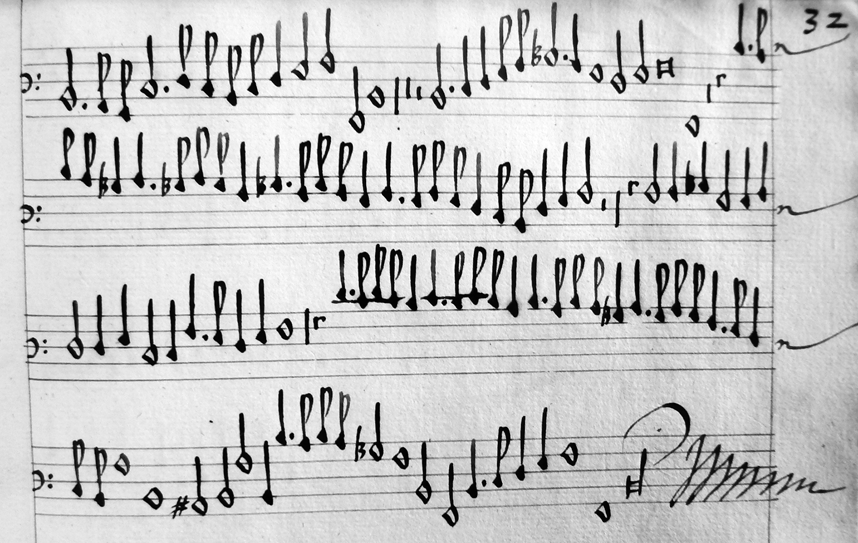
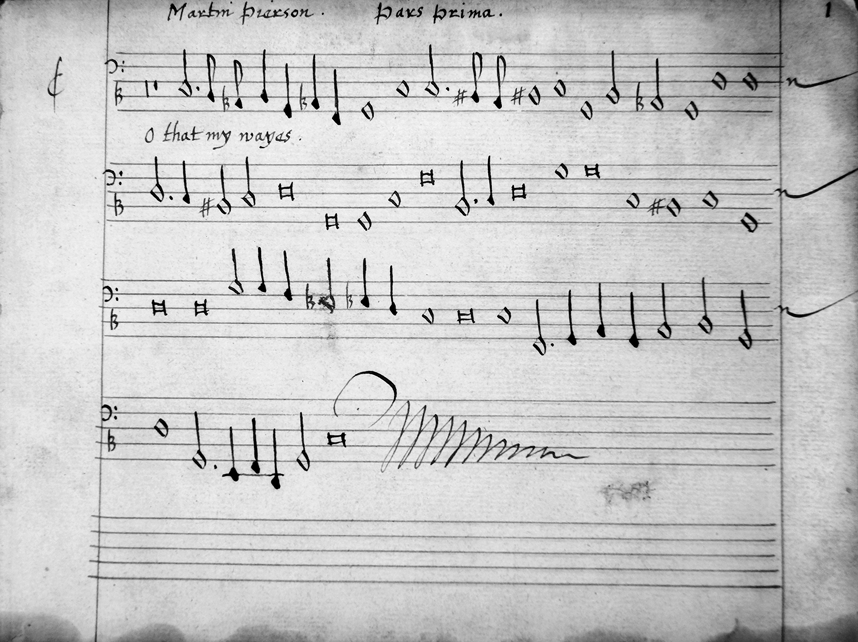
Three other characteristics of the hand are not so uncommon in general terms, but they do indicate a rather old-fashioned scribal approach, one that is unusual for the time. The first is the use of the formal, ‘square’ shapes of the notes used in earlier manuscripts and surviving into the seventeenth century in the prints of East and Snodham. Many contemporary sources, including the autographs of all of the composers well represented here for whom I have been able to find handwriting (Byrd, Lupo, Milton) or music samples (Coprario, Tomkins, Ward), use a much more flowing, rounded hand, obviously better suited to speedy copying of both music and text. The second is the use of the old-fashioned double-lobed flat sign (this occurs in Merro, too, as well as in Och 56–60). The third is the occasional dogged use of upward stems, sometimes even when the music goes above the stave (Figure 3), and the avoidance of beams, even where the scribe seems to be copying from a source which has them. So, whoever he was, the scribe of the Blossom Partbooks seems to have been mature and set in his ways, and also resolutely English. But we still are no closer to a time and a place of origin.
Bassus partbook, fol. 32r: Deering fantasy
One might think that the dates of the works from printed sources would help, and they do to some extent. It was noted earlier that the contents have concordances in music collections printed in England between 1589 and 1622, so 1622 would seem like an obvious candidate. But we cannot be sure that a work was not circulating in manuscript before it was published, and in the case of the single 1622 selection, Tomkins's anthem, It is my well beloved's voice, we know that it was, since it occurs in Tristitiae Remedium and other dated sources from well before 1622. And the version in the Blossom Partbooks shares with those prepublication manuscript sources a pitch one whole tone below the printed version. All other printed concordances were issued by 1610.Footnote 16
The composers represented in manuscripts from this time often betray the provenance even when there are no external signs. The Oxford sources contain works of local composers like Nicolson and Wigthorpe, the Cambridge sources Ramsey and Bearsley, and the West Country sources ‘Mr Hugh Davies of Hereford’, ‘Smith of Gloucester’ and ‘Smith of Salop’. Often, such names do not appear in manuscripts from outside the region of the composer's activity. Interestingly, the Blossom Partbooks do not contain many works by composers whose centre of activity was outside London, particularly among those composers whose works remained unprinted. What is curious in the light of this are the London composers who are conspicuously absent, like Bull, Gibbons, Ravenscroft, Dowland and Alfonso Ferrabosco Jr, although they might all have been healthily represented in the now lost Liber Primus set. It is also true that the most significant concordances are with manuscripts apparently copied in London.Footnote 17 It was noted above that two pieces had single concordances with the Tregian score Drexel 4302, and three others with that source and the Myriell sources. Those concordances, plus one other work which occurs in Tregian and Myriell but not in the Blossom Partbooks, comprise the only known sources for all of the motets of Thomas Lupo, gambist and violinist in the King's Musick.
Another clear connection can be seen in the two consort songs, Cease now vaine thoughts by Giles and Oh thrice blessed by Tomkins, which occur as nos. 39 and 40 in the Blossom Partbooks. These make up two of the four works which have concordances only in Myriell sources, and in one of these, BL 29427, they appear consecutively in the same order, the first texted works in the source. In the later Myriell source Tristitiae Remedium, the attribution of Oh thrice blessed is to ‘John Tomkins’, a change from ‘Thomas Tomkins’ as it appears in Blossom and BL 29427. This again seems to suggest a special connection between Blossom and BL 29427 and points to a copying date for the Blossom set of no later than c. 1614, the apparent starting date for the copying of BL 29427, since the consort songs were among the first works copied into the latter. The other two works which have concordances only in Myriell sources are O that my wayes by Martin Peerson and O woe is me for thee by John Milton Sr.
One other connection with BL 29427 may be seen in the four untexted Italian madrigals, since their English concordances are almost exclusively in BL 29427, the Myriell keyboard score, Oxford, Christ Church MS 67, and with the mysterious BL Add. MSS 37402–6, copied apparently c. 1600. One of these works, Monteverdi's O com'e gran martire, appears additionally as an interfoliated fragment in BL Egerton 995, apparently in the hand of John Ward.
A second Italian work, Quintiani's Al suon d'amata, was actually printed in Musica Transalpina in 1597 as At sound of hir sweet voice. Besides BL 29427 and 37402, its only other untexted source is Cambridge, Fitzwilliam Museum, Mus. MS 782 (olim MS 52.D.25), where it appears in score, untitled and untexted along with several other similarly unlabelled Italian madrigals by Quintiani, Venturi, Eremita, Marenzio, and Ferrabosco I. The similarity in taste to the Blossom scribe's Italian choices is made more enticing by the fact that this volume was once owned by John Bull, as its binding makes abundantly clear: ‘JOHN BULL DOCTER OF MUSIQUE ORGANISTE AND GENTLEMAN OF HER MAJESTIES MOSTE HONORABLE CHAPPELL’. It apparently remained behind when Bull ‘went beyond the seas without licence’, as the Chapel Royal Cheque Book records, in 1613.
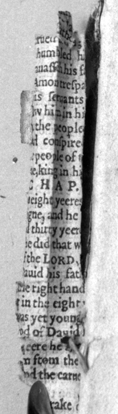
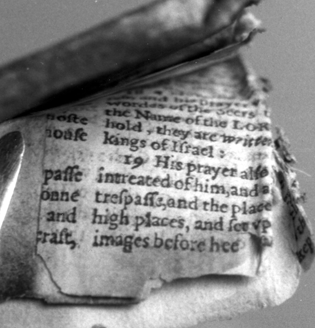
The bindings of the Blossom Partbooks are certainly original, and very fragile, too, since bits of leather flake away from the spines every time they are handled. But this very fragility has afforded an excellent opportunity to examine the fragments of paper which were used in the binding process, and this led to some interesting discoveries. First, all of the fragments are from a Bible with small, roman type. There was enough visible on the strip shown in Figure 4 to enable identification of the passage as 2 Chronicles, the end of chapter 33 and beginning of chapter 34, in the English version authorised by King James and first issued in 1611. That means that the binding was done no earlier than 1611. There were over 300 English editions of the Bible published between 1539 and 1640, counting the Coverdale, Geneva, Bishop's, Douai and Authorised versions, but the typeface and size of these fragments match only a series of small (c. 15×8 cm) duodecimo Bibles which began to be issued in 1617.Footnote 18 So, unless there were duodecimo Bibles which were printed between 1611 and 1617 and never made it to the bookstand, the Blossom Partbooks could not have been bound before 1617.
Duodecimo Bible binding strip
The printing of Bibles was the privilege and responsibility of the King's Printer, who from the 1570s to the 1660s was usually a member of the Barker family. Robert Barker took over from his father Christopher literally as the century turned (his father died on 29 November 1599, and he was sworn in on 8 Janaury 1600) and proceeded to make a small fortune for himself in the service of the monarch and parliament. This remarkably lucrative period ended in 1617 when he was compelled for financial reasons to assign his office temporarily to his partners Bonham Norton and John Bill. Bonham Norton was a prominent Shropshire landowner and cousin of Barker's former partner John Norton who died in November 1612.Footnote 19 In 1618, Bonham Norton and John Bill began issuing Bibles under licence from Robert Barker. More than a year later, they were still issuing Bibles, and Robert Barker sued to recover his office while still occasionally publishing the odd edition himself. The High Court of Chancery decided in Barker's favour in 1619 but John Bill was recognised as a legitimate shareholder. The feud between Robert Barker and Bonham Norton continued for ten years, with Charles I recognising Norton on his accession in 1625, and the High Court finally deciding in Barker's favour in 1629.Footnote 20
With this as a background, it is fascinating to discover that the Bible fragments in the Blossom Partbooks can be identified as coming from a Norton and Bill duodecimo edition of 1619. Of the sixteen or so duodecimo editions of the Authorised Version before 1640, only about ten match another fragment from inside the Cantus book cover in having verse 19 of chapter 33 of 2 Chronicles at the end of a page (Figure 5). (This is overleaf from the passage first identified.) Of these ten editions, many have the word ‘dealt’ at the bottom right corner of the previous column instead of ‘craft’ from ‘witchcraft’, as it is in our fragment. Others show a capital K for the lower case ‘k’ of ‘kings’ in the last line of verse 18. Yet others show ‘he’ for ‘hee’ in the bottom line, and included in that number are the Barker duodecimo editions of 1617 and 1618, the Norton and Bill edition of 1618, and the Barker and Bill edition of 1620.
Binding corner fragment
These issues frame the 1619 edition by Norton and Bill, which matches our fragment. All other duodecimo editions, including all five subsequently issued by Norton and Bill up to 1628, fail to match. Since one of the fragments includes a gutter margin with stitching-holes, it is certain that the source was a dismembered Bible rather than printer's waste. There are many reasons why a book might be used for scrap from any time after its binding: imperfection in number of pages or printing errors; binding, trimming, damage in storage or through use; and the time lag from its printing might be negligible or considerable. The fact remains that the binding of the Blossom Partbooks is very Jacobean rather than Caroline in appearance, but all that can be said is that it was apparently done no earlier than 1619.Footnote 21 It is also true that any binder might have had access to a Bible which was to be scrapped for some reason. However, it is suggestive that both John Bill and Bonham Norton, even though they were booksellers and not binders by trade, seem to have been responsible for arranging to have binding done, both for regular customers and for royalty. For example, Norton complained in a 1622 petition that Barker was selling books in quires, that is, without proper covers. There exist also a few books which show some similarity to the binding of the Blossom Partbooks, particularly in the style of edging with parallel gilt lines and a central gilded tool. They were part of the extensive library of Lord Lumley which, after the nobleman's death in 1609, was rebound and transferred to St James's Palace, forming the nucleus of the library of Henry, Prince of Wales, elder brother of the future Charles I. Henry died on 6 November 1612. It may also be significant that John Norton, Bonham's late cousin from whom he inherited the business, received large sums of money from the royal treasury in 1609 and 1610 for binding, and some of those monies were actually paid to Bonham Norton after John's (and Prince Henry's) death.Footnote 22
It seems certain that this mysterious set was prepared in London, and there is evidence suggesting an origin close to the royal circle and specifically to musicians connected with James's children. Of the composers who are represented by more than one piece, almost all have some association with the court. Thomas Lupo, the best represented, was in the King's Musick, as mentioned above, and until 1612 in the service of Prince Henry. John Coprario taught the viol to Prince Charles. John Ward was musician to Henry Fanshawe, one of Prince Henry's closest friends. Tomkins, it is supposed, had a relationship with the Chapel Royal through this period, although he did not join officially until 1621. Byrd was a Gentleman of the Chapel Royal and Weelkes referred to himself as one, although we have no other evidence that he was.Footnote 23 Only Wilby, Deering, East and Milton were not employed at court during this period.Footnote 24 Milton was a scrivener in St Paul's parish in London, and in that capacity it is possible that he had dealings with St James's or Whitehall Palaces, the London residences of Henry and James respectively. Of the composers with only one composition in the partbooks, two were also directly connected to the court: Joseph Lupo, father of Thomas, was in the King's Musick, the Royal string band, and Nathaniel Giles was Master of the Choristers of the Chapel Royal.
Even more revealing are the unica – the unique works which occur in no other source, and which were thus completely unknown before the discovery of the Blossom Partbooks. There are four: the motets Celebrate Jehovam by Tomkins and O vos omnes by Weelkes, and one fantasy each by Coprario and Milton.Footnote 25 Besides the court connections of three of these composers, other significant aspects can be pointed out. Among the more than 400 works of Tomkins and Weelkes there are only two sacred works with a Latin text, Laboravi in gemitu meo, written by Weelkes presumably in honour of his teacher Thomas Morley's work on the same text, and Tomkins's Domine tu eruisti, which exists in most sources with the English text ‘Why art thou so full of heaviness’.Footnote 26
Moreover, most of Coprario's fantasies occur in many sources; the fewest concordances among his other five-voice fantasies is three, and that is exceptional, so to find a new work is extraordinary in itself. It is worth remembering at this point, too, some of the pieces which, but for the work of one other copyist, would have been unique to the Blossom Partbooks. Foremost among these are the motets Hierusalem and Miserere mei Domine by Thomas Lupo, since in their only other source, Tregian's Drexel 4302, they are textless in all but the bottom voice. To Milton's unique Fantasia and O woe is me for thee from Myriell may be added his two Fantasias, which otherwise occur only in Och 423, making his Blossom showing a remarkable one, considering his small extant oeuvre. And Non fu senza by John Ward has no other concordances before c. 1650, so its Blossom appearance is unique among Jacobean and even Caroline sources.
With the exception of the second of two Lupo motets on the same opening, all of the works in the manuscript bear composer attributions, and all are arguably correct. There is even one fantasy where the scribe wrote ‘Warde’ in one of the partbooks, then scraped it off and wrote ‘Coprario’, the correct attribution according to concordant sources. The two questionable ascriptions occur in the above-mentioned pair of consort songs on the same opening, Cease now, vaine thoughts, ascribed to D. Giles, and Oh thrice blessed earthbed, ascribed to Thomas Tomkins. Given the conflicting attribution of the latter in the Myriell MSS BL 29427 and Tristitiae remedium, Philip Brett preferred the attribution to John Tomkins on the basis of the special friendship between him and the poet, Phineas Fletcher. It is true, however, that Thomas Tomkins knew Fletcher as well, since he dedicated Fusca, in thy starry eyes to him in his Songs of 3. 4. 5. & 6 parts of 1622, although, clearly, we might assume that the later manuscript by the same copyist was ‘correcting’ the earlier source. Whether or not the additional source ascribing the work to Thomas is sufficient to remove it from the canon of John's works (where it is conspicuous as the only work of its type), the shared attribution further emphasises the connection between BL 29427 and the Blossom Partbooks.
The Giles attribution is more problematical since it seems to mistake the composer's first name in a way which occurs in no other source of his music, and this would seem unlikely in a source originating close to the circle of royal musicians, as is argued here. There is, nonetheless, the possibility that the Blossom scribe's usage follows that of sources like Morley's A Plaine and Easie Introduction to Practicall Musicke of 1597, where Robert Fayrfax and Christopher Tye are abbreviated as ‘D. Farfax’ and ‘D. Tie’ in honour of their DMus degrees. This raises another very serious question, since Giles's DMus was not officially granted until 1622, many years after the evidence of the concordances and the repertory generally suggests for the copying of the Blossom Partbooks. However, Giles had supplicated for the degree in 1607 and the University trustees apparently voted to grant it in that year,Footnote 27 even though Giles did not submit the requisite choral composition. Thus, if it is not a mistake, it is conceivable that someone close to the composer, privy to the status of his degree, might have used the title ‘D.’ after 1607 as a mark of special affection and respect. Otherwise, the conclusion would have to be that the partbooks were not copied until at least 1622, a hypothesis which would sit well with the evidence of the binding but with almost none of the other evidence. It is possible, however, that the partbooks were copied c. 1622, preserving the contents of a collection made nearly a decade earlier. We may never know. The evidence of the contents certainly favours the earlier origin.
In that regard, one other detail concerning a work of Thomas Weelkes is significant. His madrigal Cease now, delight, which he published in 1598 as an elegy to Lord Borough (who died in 1597), and which also appears in Myriell and Merro sources, appears here with the text uniquely changed from ‘Sweet Borough’ to ‘Sweet Henrie’ and ‘great Lord’ to ‘great Prince’ – thereby transformed into a counterfeit elegy for the late Prince of Wales.Footnote 28 That gives a terminus post quem of 6 November 1612, at least for the manuscript from that point on, if not for the whole collection. What is so striking about this is not that the scribe wished to commemorate Prince Henry, but that he should have to use a borrowed work to do so.
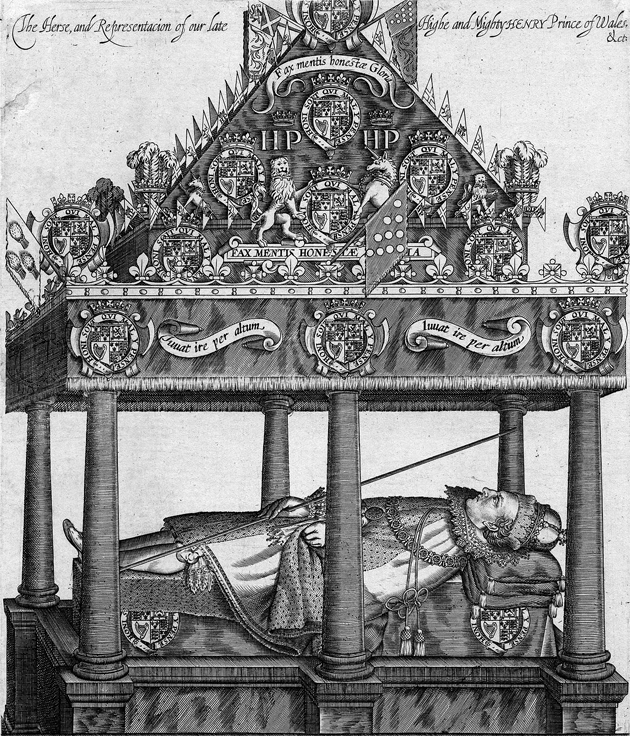
Indeed, never was a death so sudden and so heartfelt by a country (see Figure 6). The obvious modern parallels are those of President Kennedy and Princess Diana.Footnote 29 One contemporary witness described the funeral cortège, saying:
under that [mighty canopy] laye the goodly image of that lovely prince clothed with the richest garments he had, which did so lively represent his person, as that it did not onely draw tears from the severest beholder, but cawsed a fearfull outcrie among the people as if they felt at the present their owne ruine in that loss. I must confess never to have seen such a sight of mortification in my life, nor never so just a sorrowe so well expressed as in all the spectators whose streaming eyes made knowen howe much inwardly their harts did bleed.Footnote 30
William Hole, The Hearse of Henry Frederick, Prince of Wales (1612).
Henry was a model Renaissance prince: by all accounts handsome, brave, strong, virtuous, intelligent, artistic and generous. He was also an outspoken champion of the Protestant faith in the face of his father's equivocation and his mother's Catholic leanings. In this he was seconded by his sister, to whom he was genuinely devoted, and for whom he called in the last intelligible utterance of his typhoid ravings.Footnote 31 So much did the country mourn Prince Henry's death that, besides forty-four poems and sermons printed before the end of 1614, nineteen of the thirty-five English musical elegies surviving from 1613 to c. 1630 are for him.Footnote 32 In addition, as Irving Godt pointed out, none of the fourteen surviving English David/Absalom laments nor the nine David/Jonathan laments can be dated before Henry's death.Footnote 33
Indeed, contemporary writers were quick to point out the parallel between James/Henry and David/Absalom, even to the disclaimers of disloyalty on Henry's part in parallel with the traitorous Absalom: ‘So far was he inclin'd not to rebell, With Absalom, who hellishly did aime His King and father Dauid to expell; So far I say was Henry from this straine; That from his Cradle to his mournfull end, He neuer did his father once offend.’Footnote 34 This is a point worth emphasising since Donna di Grazia has recently proposed that the many surviving Absalom laments from this period were not connected with Henry, and probably date to much later than previously thought, based on her redating of Myriell's Tristitiae Remedium and BL 29427 to a much later date in the second decade of the century. In doing so, she discounts early connections between Henry's death and David–Absalom imagery.Footnote 35
In the days following Henry's death, one of the Prince's chaplains, Daniel Price, gave a sermon in the Chapel of St James's Palace, Henry's residence, that begins as follows: ‘The story sheweth you David the king in a sorrowfull case, weeping, mourning, crying for his sonne, lying all day and night on the earth; He wept, & wept, and would not be comforted.’Footnote 36 A few pages later, the reference is made explicit, and the apparent inspiration for so many David–Absalom laments is quoted:
O Absolon, Absolon my sonne, my sonne, Absolon my sonne! … O entreate the young man Absolon well, and if Absolon die, David will not liue, he wil dissolue into teares, O my sonne Absolon, my sonne, my sonne Absolon, would God I had died for thee o Absolon my sonne, my sonne. Footnote 37
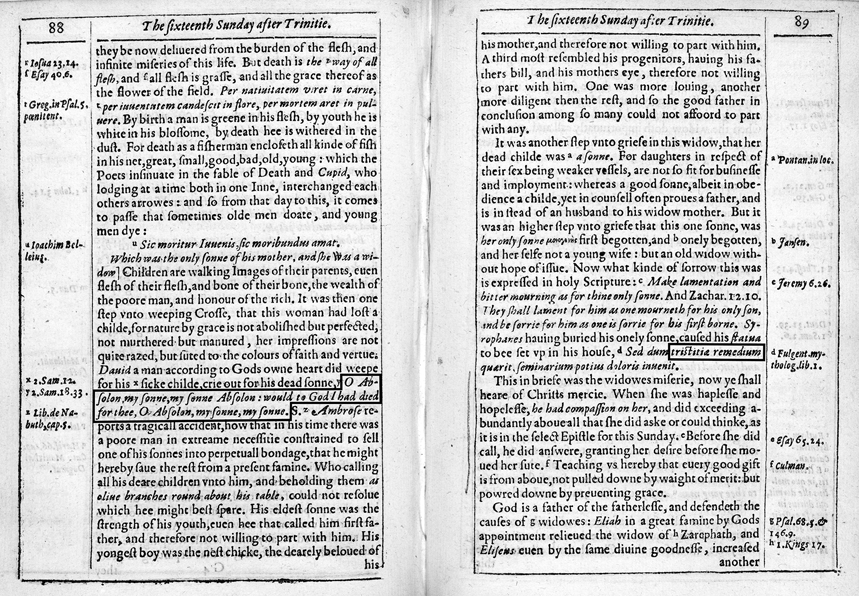
How this might be connected to Myriell, whose Tristitiae Remedium contains so many such laments, may be seen in the opening of a 1612–13 sermon by John Boys, a prominent churchman and favourite of a succession of archbishops of Canterbury, including George Abbot, to whom Myriell himself was later a chaplain (see Figure 7).Footnote 38 There is little doubt Myriell knew this source, and Boys's reference to ‘tristitiae remedium’ (directly across the page) is the sole instance of this phrase identified in all English publications outside Myriell's printed title page. So, even if, as Donna Di Grazia claims on the basis of watermarks, Myriell's title page is centuries newer than the music,Footnote 39 it could simply have replaced a battered original with the same title, and some of the collection's Absalom pieces may actually date from shortly after Henry's death. Indeed, the connection between James-Henry and David-Absalom, and between David-Absalom and tristitiae remedium exists almost from the moment of Henry's death, and suggests a more immediate causal relationship to the many musical settings. This does not mean that the Absalom pieces were composed for Henry's funeral, but that they were inspired by biblical imagery prevalent from the moment of his death, and could well have been composed shortly afterwards.
John Boys, Exposition of the Dominical Epistles and Gospels … Autumne (1612). STC 3460, Houghton Library, Harvard University
In his last sermon in St James's Chapel before Henry's funeral, Daniel Price said: ‘David shall speake for all in his Elegies for Saul, Ionathan, Absolon, Abner, &c’.Footnote 40 In addition to the borrowed lament naming Prince Henry, a Jonathan lament is found in the Blossom Partbooks – that by John Milton Sr., O woe is me for thee. The Jonathan works are ‘brother’ laments rather than ‘father’ laments, and thus would seem to be from the viewpoint of Henry's siblings, Charles and Elizabeth.
There is more than a little impertinence in the use of a borrowed lament for someone so important,Footnote 41 especially since there is no shortage of specific laments that might have been chosen for Henry, some of them even by the likes of Byrd, Coprario, Tomkins and Ward. What seems possible is that these were not chosen either because they were not available to the copyist or simply they had not yet been written. If my reasoning about the date and origin of the collection is correct, the latter seems most likely.
At this point it is necessary to mention two other physical characteristics of these partbooks which set them apart from all other contemporary manuscripts. The first is that every musical opening is separated by a blank opening – ruled but unused – a clear attempt to solve the problem of bleed-through but, nonetheless, an unparalleled extravagance in the use of music paper. The second is that the organisation of the the pieces in the manuscript is unique. Most anthologies group their contents by number of voices: first the three-voice works, then those for four, five and six voices. Within each section there tend to be blocks of pieces by one composer, perhaps all from the same print. This facilitates later use by making it easy to find selections. The Blossom Partbooks contain only five- and six-voice works.Footnote 42 The six-voice works are dispersed throughout the manuscript,Footnote 43 as are the multiple works by individual composers. What is more surprising and apparently unique is the alternation of vocal and instrumental works: a vocal work will appear on the left page of an opening and an instrumental one on the right, or one opening will contain a vocal work, the next an instrumental work, and so on.Footnote 44 Moreover, there is often some kind of modal and/or clef relationship discernible between such implied pairs.
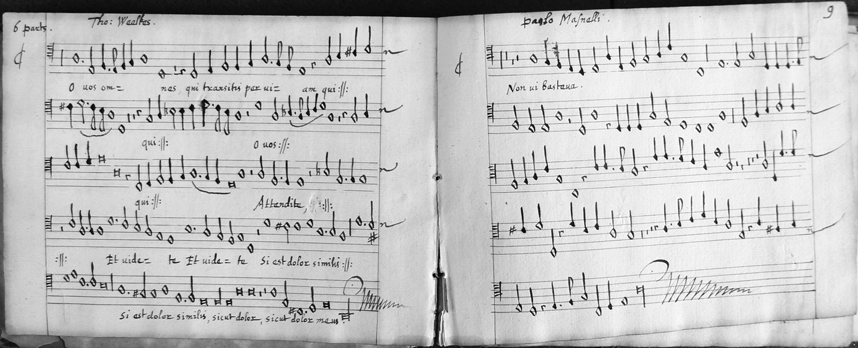
To take one example, the unique Weelkes motet, O vos omnes, is followed by an untexted piece by Paolo Masnelli with the title Non vi bastava (Figure 8). Both pieces have no flats in the key signature and modal finals on a. Furthermore, both show the use of high clefs, where the bass part is written in tenor clef, something which in both English sacred vocal music of the Renaissance and English viol music of this period seems to call for downward transposition. The full implications of these pairings and of various larger groupings for combining voices and instruments, for transposition practices in vocal and instrumental music, and, fundamentally, for our understanding of Jacobean musical taste are the subject of a separate study.Footnote 45 That such an organisation seems so carefully contrived and not at all conducive to later retrieval of individual selections (the obvious purpose of most anthologies), suggests that the order of performance is significant, and leads to the possibility that this manuscript was prepared as a ‘programme’ for a single event or occasion, much like a jazz band's ‘book’, with all the pieces in order ready to go. This would also help to explain why the contents of the Blossom Partbooks seem so homogeneous, even ‘frozen’: not only are they difficult to retrieve – there is no index – but they are not at all retrospective compared to other anthologies (only five-voice fantasies are included, for example, and not a single pavan or Elizabethan In nomine). It might further explain why the scribe chose to break his ‘6v. every tenth piece’ pattern and end with Lupo's five-voice Salva nos domine: no other selection would make such a fitting benediction at the end of an evening's entertainment: ‘Salva nos, domine, vigilantes, custodi nos dormientes: ut vigilemus cum Christo, et requiescamus in pacem.’ (Save us, Lord, while awake, and guard us while asleep: that we may watch with Christ, and rest in peace.)
Bassus partbook, fols. 8v–9r: Weelkes, O vos omnes and Masnelli, Non vi bastava
So what are these books? Why were they copied, for whom, and when? Preparing four or five hours' worth of music for one occasion would seem rather extravagant (especially since the lost Liber Primus set would presumably have added even more). But we have already seen uncommon extravagance in the use of the blank openings. Is there, in fact, an event at the English court important enough to warrant such special treatment, and yet close enough to Prince Henry's death to force the use of a second-hand elegy?
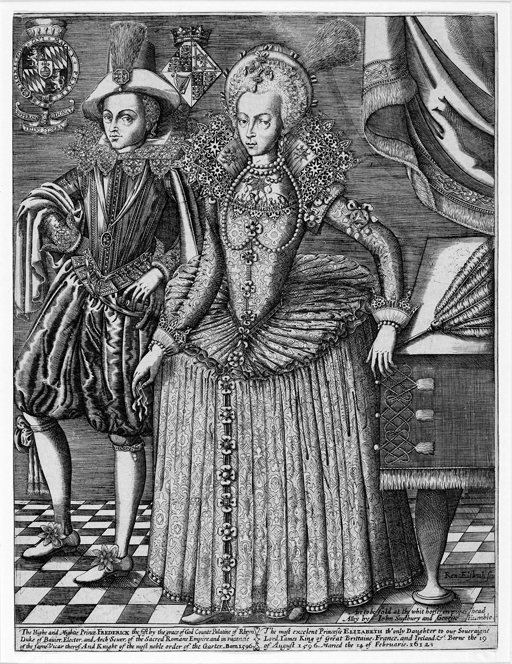
As it happens, there are several possible occasions surrounding the betrothal of Princess Elizabeth, Henry's sister, to the Elector Frederick V of the Palatinate (generally known in England as the ‘Palsgrave’) on 27 December 1612, less than three weeks after Henry's funeral, their subsequent marriage a month and a half later on Valentine's Day, 1613, and their ultimate departure from England in April of that year (see Figure 9). The unseemly haste of the wedding was necessitated by the fact that the groom had already arrived in England before Henry took ill, and King James could not keep him and his 191-person retinue waiting around for long.Footnote 46 Curiously, the day before the betrothal ceremony, and in spite of the excitement of the approaching wedding, the Venetian ambassador reported that King James would occasionally be overcome with grief, ‘and even in the midst of the most important discussions he will burst out with, “Henry is dead, Henry is dead”’.Footnote 47 While there are many ways to mourn a loved one, it is striking that the Cantus part of the borrowed elegy five times in succession uses those very words.
Renold Elstrack, Frederick, Elector Palatine, and Princess Elizabeth (c. 1613).
Chroniclers describe the betrothal ceremony this way:
On St John's-day, the 27th of December, Frederick Count Palatine and Elector was affianced and contracted in the Banquetting-house at Whitehall in the presence of the King sitting in state, in this manner: About two yerdes below the degrees of the State was spread a large Turkie carpett, whereon they strode when they were affianced. The Nobilitie and Prince Charles brought him in, appaireled in a black velvet cloake caped with gold lace. Then followed she in a black velvet gown seemè of crosletts or quatrefoiles of sylver, and a small white feather on her head, accompanied with Ladies. After a short space came in the King, and when he wass sett under the state, they descend to the carpet before said, where, after complimentall courtesies to each other, Sir Thomas Lake reade the formall wordes in the Booke of Common Praier, in French …Footnote 48 which were so badly translated and worse pronounced, that it moved an unseasonable laughter as well in the contractors as the assistants; till the Archbishop of Canterbury very gravely interpos[ed] himself.Footnote 49
It is interesting that Elizabeth dressed in black and silver, as another observer said, ‘to make an even mixture of joy and mourning’.Footnote 50
The wedding on Sunday, 14 February 1613, in the chapel at Whitehall, was perhaps the most dazzling event of James I's reign, and the festivities which lasted for a week afterwards are arguably the last great fling of England's Golden Age. James and Queen Anne together wore jewels valued at £900,000 to £1,000,000.Footnote 51 (A royal musician's yearly salary was about £40.) A contemporary French account notes that the princess wore a ‘gown of silver, embroidered with gold and completely covered with diamonds’, and that the dozen or more young noblewomen who carried her train were ‘so richly dressed in white and covered in jewels that they seemed like so many stars accompanying the moon’.Footnote 52 Again, the sixteen-year-old bride was scarcely able to contain herself, as one observer noted: ‘And while the Arch-Bishop of Canterbury was solemnising the Marriage, some eruscations and lightnings of joy appeared in her Countenance, that expressed more than an ordinary smile, being almost elated to a laughter.’Footnote 53
After the ceremony, the wedding party went back to the banquetting hall where six of the Palsgrave's trumpeters saluted them with a fanfare
and caused thousands to say at that instant time, God giue them ioy, God giue them ioy. Thus preparing for dinner they passed away a certaine time….Footnote 54 The King and Queen, leaving the Bride and Bridegroom in the Great Chamber, went to their privy Lodgings; and the Bride and Bridegroom proceeded to dine in state in the new Banquetting-house with the Prince, the Ambassadors of France, Venice, and the States … and all the Lords and Ladies who had been attendant on the Marriage.Footnote 55 … and after fell to Dancing, Masking, and Reuelling, according to the custome of such Assemblies, which continued all the day, and part of the night in great pleasure.Footnote 56
Indeed, that evening saw the production in the Banquetting House of Thomas Campion and Inigo Jones' ‘The Lords' Maske’, for which, by the way, two of our most prominent Blossom composers, Coprario and Lupo, were paid handsomely as apparent music directors. It is difficult to know how a collection such as the Blossom Partbooks might have fitted into the musical scheme of these celebrations. One solitary but enticing piece of documentary evidence notes that Elizabeth gave 10 shillings ‘to the kinges vyolls the morning after her highnes maryage’.Footnote 57 This is the only documented gift specifically to viol players by any member of the royal family during the entire reign of James I and thus suggests some extraordinary service.
There is also the evidence of The Chymical Wedding of Christian Rosencreutz, purportedly from 1459, but actually written by Johann Valentin Andreæ, and published in the Palatinate in 1616. The story describes a royal wedding with obvious similarities to that of Frederick and Elizabeth. The late seventeenth-century English translation includes this passage:
all on a suddain there began in the Hall such excellent and stately Musick, as all the days of my life I never heard the like…. Now there were in this Musick all sorts of stringed Instruments imaginable, which sounded together in such harmony, that I forgot myself, and sate so unmovably, that those who sate by me were amazed at me…. After half an hour this Musick ceased unexpectedly…; Presently after, before the Door of the Hall began a great noise sounding and beating of Trumpets, Shalms and Kettledrums, also Master-like as if the Emperor of Rome had been entering: whereupon the Door opened of it self, and the noise of the trumpets was so loud, that we were hardly able to indure it.Footnote 58
The approach of the wedding couple was then announced. This implies that music fitting the description of that in the Blossom Partbooks may have been performed in the Whitehall Banqueting House before the fanfare and the appearance of Frederick and Elizabeth after the wedding ceremony.
The serious and even melancholy character of many of the pieces might suggest that the unreservedly joyful wedding ‘reception’ on Valentine's Day was not likely to be the event in question, but it is important not to underestimate the Jacobean taste for melancholy. One modern writer has referred to this era's ‘delight in the pleasures of melancholy’.Footnote 59 John Dowland, who joined the King's Musick in 1611, dedicated his 1604 Lachrimae collection to Elizabeth's mother, Queen Anne, saying, ‘pleasant are the teares which musicke weepes …’. Most revealing, perhaps, is this passage from George Puttenham's Arte of English Poesie. Speaking of lovers, he says:
the poore soules sometimes praying, beseeching, sometime honouring, auancing, praising: an other while railing, reuiling, and cursing: then sorrowing, weeping, lamenting: in the ende laughing, reioysing & solacing the beloued againe, with a thousand delicate deuises, odes, songs, elegies, ballads, sonets and other ditties, moouing one way and another to great compassion.Footnote 60
Elizabeth certainly had more reason than most brides for combining laughing and lamenting. Indeed, an undercurrent of sorrow can be discerned throughout the marriage week. Queen Anne found the ‘running at the ring’ on the day following the wedding ‘unspeakably sad’, since such tournament sports were among Henry's favourite pastimes.Footnote 61
James, for his part, seems to have gone out of his way to avoid scheduling any festivities on the Friday following the wedding. When Tuesday's masque had to be rescheduled, he skipped Wednesday, probably because it was Ash Wednesday, but he also skipped Thursday and Friday, pushing the event back to Saturday even though there seem to have been no notable entertainment conflicts for the intervening days. Friday, 19 February, would have been Henry's nineteenth birthday.
The weeks following the wedding included visits to both Oxford and Cambridge, interminable rounds of gift-giving, and innumerable banquets. And banquets, clearly, are the kind of event suited to a long programme of music, as the following account from the Merchant Taylors' feast given for James and Prince Henry in July 1607 affirms:
At the upper end of the Hall there was set a chair of Estate, where his Majesty sat and viewed the Hall;… and upon either side…, in the windows near the upper end, were galleries or seats, made for music, in either of which were seven singular choice musicians playing on their lutes, and in the ship, which did hang aloft in the Hall, three rare men, and very skilful, who sang to his Majesty; and over the King, cornetts and loude musique, wherein it is to be remembered, that the multitude and noyse was so great, that the lutes nor songs could hardly be heard or understood. And then his Majesty went up into the King's chamber, where he dined alone at a table … in which chamber were placed a very rich pair of organs, whereupon Mr. John Bull, Doctor of Music … did play all the dinnertime; and Mr Nathaniel Gyles, Master of the Children of the King's Chapel, together with … divers singing men and children of the said Chapel, did sing melodious songs at the said dinner.Footnote 62
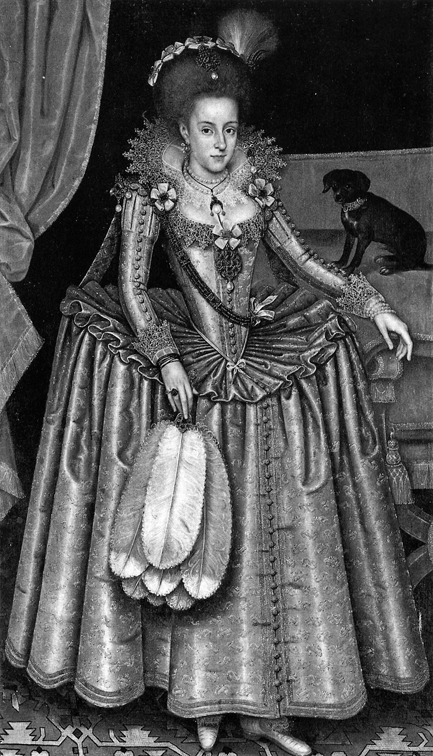
While it has not been possible to specify a time for the use of these partbooks, if in fact they were prepared for the wedding celebrations, the association with Elizabeth would resolve certain mysteries. The first of these concerns the inclusion of two madrigals from The Triumphes of Oriana, a collection published in 1601. We have come to expect to see such selections in anthologies of the second decade, and some composers were still composing new madrigals to honour the dead queen. But again, if my dating is correct, the Blossom Partbooks mark the first anthology of the major Jacobean sources to include Oriana madrigals. I suggest that it was not nostalgia for the departed Elizabeth but rather a transference of her glory to the young and promising princess Elizabeth.Footnote 63 (See Figure 10.) She was only about twelve when she came to court for good in 1608, so people would not have had that strong a sense of her character for a while after that. But by 1612, she was attracting much admiring attention, and parallels with Queen Elizabeth were obvious to all, as in this dedication to Princess Elizabeth from a set of sermons by William Leigh:
Pardon me (gracious lady) if I put this under the shelter of your highnesse protection, Semblance of sexe, name and blood, together with your high place, person, and pietie, craveth no lesse at your Princely hands, than protection of her shrine and Ghost. Shee a King's daughter, so are you; shee a maiden Queene, you a Virgin Prince; her name is yours, her blood is yours, her cariage is yours, her countenance yours …Footnote 64
Marcus Gheeraerts, Princess Elizabeth (c. 1613). Courtesy of the Castello di Racconigi
From Henry Peacham's Minerva Britannia of 1612:
And from Thomas Heywood's A Marriage Triumphe of 1613:
What these passages suggest is that by 1612–13, Princess Elizabeth was becoming enough of a beloved public figure to prompt a revival of some of these ready-made musical tributes; hence the appearance of Oriana madrigals in this and later manuscripts. A specific familial connection may possibly be seen in the choice of the East madrigal since it mentions Phoebus and Zephyr. Besides references to Phoebus and Zephyr in the masques after the wedding, James had been portrayed as Phoebus and Charles portrayed as Zephyr in the Lord Hayes (1607) and Tethys' Festival (1610) court masques respectively,Footnote 67 and East's is the only Oriana madrigal to use that imagery.
Even more interesting is that the first of William Leigh's sermons, from which the dedication was quoted above, is devoted to comparing Elizabeth I to the biblical King David – a parallel which allows us to project from Princess Elizabeth back through to David, and thus see the David/Jonathan laments, at least in the early period immediately following Henry's death when the Princess was highly visible, as a condolence to Elizabeth rather than to Charles. In that regard, it is interesting that the day after Prince Henry's death, the Venetian Ambassador noted in an official dispatch that Elizabeth was indeed not barred from the succession.Footnote 68
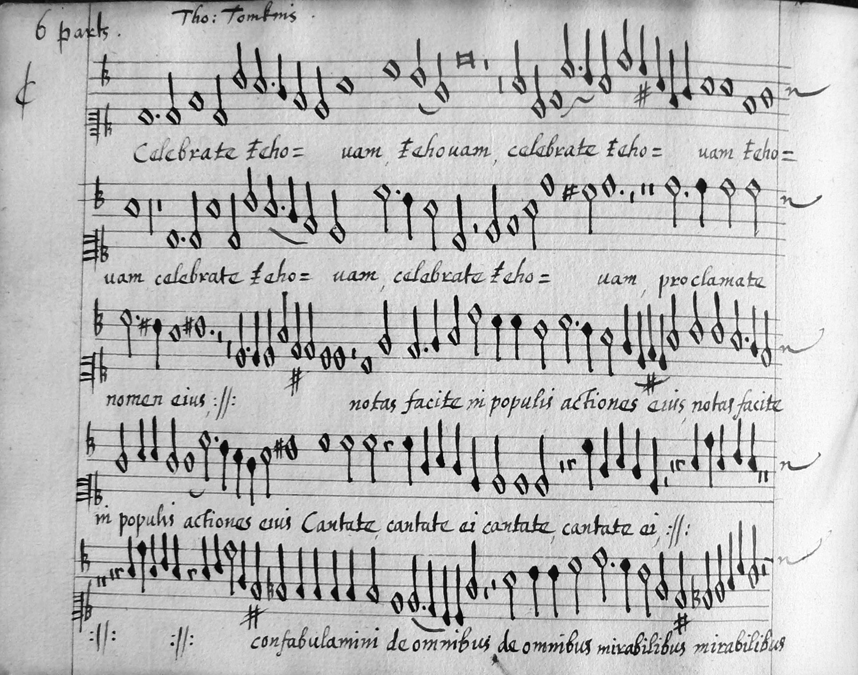
If a date c. 1613 is correct, then the Blossom Partbooks are probably the earliest source, not just for the four unica, but for seventeen other works as well (making a combined total of nearly 40 per cent of the contents). This raises the possibility that there may be other pieces with specific connections to Princess Elizabeth or to the marriage. I believe this to be the case with the unique Tomkins motet, Celebrate Jehovam. The text is from Ps. 105 but, curiously, it is not from the standard Latin version of the Psalms.Footnote 69 (See Figure 11.) Its source is a new Latin translation of the Bible printed in England in 1580, a year after its completed publication in Frankfurt.Footnote 70 The translation was done by Immanuel Tremellius and his younger colleague, Francis Junius: a Ferrarese Jewish convert to Calvinism (and Regius Professor of Hebrew at Cambridge during the reign of Edward VI) and a French Huguenot. The Book of Psalms was excerpted and issued separately four times in England in 1580, and the complete Latin Bible went through fourteen editions up to 1585, two in 1593, one in 1597, and then not again until 1640. So in the second decade of the seventeenth century it seems not to have been much in demand.Footnote 71
Cantus partbook, fol. 6v: Thomas Tomkins, Celebrate Jehovam
Furthermore, the use of a Latin text from outside the normal Psalter would have rendered a motet something of an oddity, and this may account for its failure to be preserved elsewhere. The Tremellius–Junius Bible has been described as ‘the very last word in Protestant Biblical scholarship’,Footnote 72 and even ‘one of the most important works to emerge from the Reformation’.Footnote 73 It seems certain, at least, that the mere use of it was a Protestant statement, since the use of all Bibles but the Vulgate had been banned by the Roman Church. In England, the Tremellius Bible seems further to have been associated with the Puritans, stemming from their focus on the priority of Scripture.Footnote 74
The use of Tremellius by the translators of the new Authorised Version of the Bible may even have been encouraged by James himself, since at the age of eighteen, he published a poetical translation of the Tremellius Latin version of Ps. 104 (obviously the one just before our motet text) – and this in spite of the fact that James's private tutor, the scholar George Buchanan, had published his own Latin version of the Psalms in 1580, the same year as the Tremellius appearance in England.Footnote 75 What is especially striking about this situation, and what provides a possible connection with our proposed event is that Tremellius and Junius worked in Heidelberg under the direction of and, indeed, dedicated their Bible to, the Elector Palatine, Frederick III, great-grandfather to none other than our Palsgrave, Frederick V, bridegroom of Princess Elizabeth.Footnote 76 Indeed, Frederick and Elizabeth left London in April 1613, to take up residence in Heidelberg amidst great pomp and ceremony – the Heidelberg fireworks display on their arrival reportedly lasted two full hours.Footnote 77 Their departure perhaps made ‘orphans’ of our partbooks and this may account for the delay in binding them.
The appearance of Latin sacred music in collections designed for domestic music-making has reinforced a conception of motets in England at this time as pious chamber music rather than as items for liturgical use. Nevertheless, it happens that Ps. 105 is one of the readings for the twenty-first day of each month according to the 1559 Book of Common Prayer, and it may be that Tomkins's motet was written as a musical enhancement to a service on such a day. Sunday, 21 February, was exactly one week after the wedding, and the wedding party was still in residence at Whitehall for services. Later the same day, James gave a banquet for the performers who had had their maske delayed from the Tuesday to the Saturday evening in the previous week. There is thus a possibility that Tomkins's motet was performed at Morning Prayer on that Sunday and perhaps even repeated at the banquet.
It is also curious that in both the Roman and Sarum rites, the beginning of Ps. 105 is used as an Alleluia verse for the nineteenth Sunday after Pentecost, an Introit verse on the Thursday following the fourth Sunday in Lent, and in a cluster on the Monday, Tuesday and Saturday after Easter as an Introit verse each day. The Saturday Introit, in fact, uses a later verse of Ps. 105 for the antiphon as well. It may be mere coincidence, but in 1613 the Saturday after Easter fell on 10 April, the very day the royal couple left London. Whether the Protestant pair would have known or cared about this connection to the Catholic rite and whether Tomkins himself had it in mind can only be imagined. The text of the Saturday antiphon which Tomkins did not set (v. 43) in the King James translation reads ‘So he led forth his people with joy, his chosen ones with singing’. And the sixth verse of the psalm (Tomkins set only the first three) reads ‘O offspring of Abraham his servant, sons of Jacob, his chosen ones!’ The night of Henry's death, James had declared that he would henceforth consider the Elector Frederick his first-born son. So, besides the fact that Tomkins chose the Tremellius–Junius translation, a publication not used for any other of the 200 or so surviving Latin sacred works by English composers from 1580 to c. 1613,Footnote 78 he may have recognised Ps. 105 as most apt for the marriage and departure of Elizabeth and Frederick, though he could hardly have known it would be liturgically proper to the actual day of their departure, as it so transpired.Footnote 79 An interesting parallel use of the ‘offspring of Jacob’ idea occurred in 1623 when Prince Charles returned from his unauthorised and unpopular trip to Spain. As John Chamberlain reported, in a service at St Paul's ‘the singing of a new anthem was specially observed, the 114th Psalm, when Israel came out of Egypt and the house of Jacob from among the barbarous people’.Footnote 80
Another work which may be associated with the bridal pair is Oh thrice blessed by Tomkins. That another work by Tomkins might have this association is in itself interesting, given that we know next to nothing about his London connections in this period, and to find that two of his works have possible connections to Elizabeth is suggestive indeed. The ‘thrice blessed’ imagery seems to have been a popular one at the time, particularly in connection with James's rule of the united England, Scotland, and Ireland.Footnote 81 Ostensibly, the text of this consort song seems somewhat morose for an association with a royal bride: a man laments his dead lover, anticipating a heavenly uniting of their souls, and yet, the imagery of a heavenly uniting of bride and bridegroom was used by one sermoniser on the day of Frederick and Elizabeth's marriage: ‘But the consummation of this heauenly marriage shall be in the world to come, when this Royall Bride shall receive the Kingdom prepared for her … and see her bridgroome face to face …’.Footnote 82 There may also be a connection found through the name of the lost love in Oh thrice blessed.
In the Cantus partbook, where the texted voice appears, her name is given as ‘Palidia’. That name has no significance that I have been able to discover, but its one instance in the book may be a copying error for ‘Palilia’, as it appears in Tristitiae Remedium, the only concordance for the texted solo part. Philip Brett suggested emending this to ‘Pasilia’ in order to correspond to the character of that name mentioned in a Phineas Fletcher poem with a connection to John Tomkins,Footnote 83 reasoning that because of the close similarity between the names, John must have been the composer and the proper form of the name must therefore have been ‘Pasilia’.Footnote 84 However, the same Fletcher poem contains a reference to ‘Fusca’ only two lines later, and that name has a connection to Thomas Tomkins through his dedication to Fletcher in the 1622 publication, as noted above. And I can find no other reference to ‘Pasilia’ in English writings of the time, whereas ‘Palilia’ had clear connotations. It was connected to a Roman festival for the increase of herds described in Ovid's Fasti as dedicated to the deity ‘Pales’. It came to be celebrated on 21 April as the anniversary of the founding of Rome and was known as the day of the Palilia, the female side of the deity Pales.Footnote 85 The Palilia festival was certainly known in England in the sixteenth and seventeenth centuries.Footnote 86 Interestingly, the centre of the celebration was the site of Rome's founding, the mons Palatinus – the Palatine Hill.
Thus, the uniting of Princess Elizabeth and the Elector Palatine could be seen as the founding of a new empire in the Palatinate, a refounding – or perhaps confounding – of Rome,Footnote 87 an idea attractive to Protestants everywhere. To quote again from A Marriage Triumphe by Thomas Heywood:
Of course, it did not work out quite as hoped, with the Holy Roman Habsburg eagle triumphing over Frederick only a few months after he became King of Bohemia later in the decade.
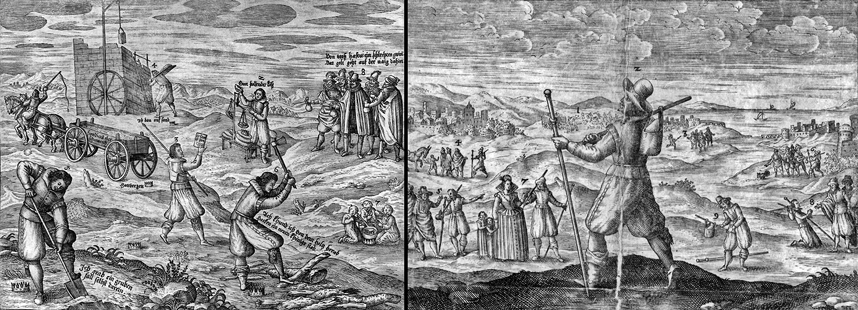
By the early seventeenth century in England, in fact, the day of the Palilia on 21 April had been absorbed by St George's Day, which fell just two days later, on 23 April. St George, of course, had associations with the Order of the Garter and with St George's, the Royal Chapel at Windsor. Frederick's investiture as member of the Order of the Garter at Windsor a week before the wedding was said to be of great importance to him, publicly symbolising the support of his father-in-law in confronting the Habsburgs.Footnote 89 He subsequently wore his bejewelled Garter even in Germany, and it became so much a part of his identity that when he left it behind upon fleeing Prague, and even lost his home in the Palatinate, he was caricatured wandering Europe with one stocking falling down, and doing all kinds of menial tasks in similar deshabillé.Footnote 90 (See Figure 12.) In 1613, Elizabeth and Frederick passed St George's Day at Rochester, just two days before embarking for the Continent.Footnote 91
Deß Pfaltzgraf Scharwerch and Der Pfältzisch Bilgram (both 1621) showing garterless Frederick.
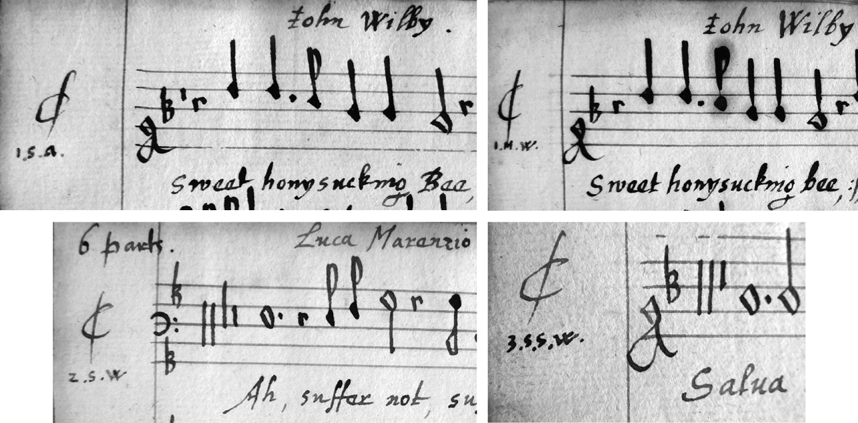
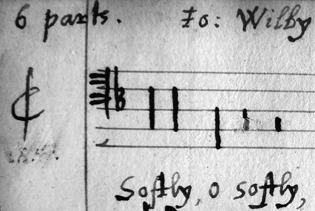
Other mysteries of the Blossom Partbooks remain. Sporadically throughout the manuscript there are abbreviations such as ‘1.s.a or ‘1.M.W’ (see Figure 13). They are always shown in the margin near the mensuration sign at the beginning of a piece, or at a metre change within a piece. There are even some places where someone has taken the trouble to try to scrape them off (see Figure 14). This suggests that they may have some significance for performance practice (for the first performance context at least) and, if so, they would pre-date most other known English markings of this type by about twenty years. Some scholars have suggested to me that, on the contrary, they must be related to the manuscript sources for the Blossom books, just as we know Thomas Hamond used several of ‘Mr. Kirby's books’. But why, then, would the same piece bear different annotations in two partbooks, as can be seen in the Cantus and Quintus parts of Wilby's Sweet honey-sucking bees in Figure 13? That hypothesis would also fail to explain why someone would trouble to scrape an annotation and not replace it.
Four examples of marginal abbreviations in the Blossom Partbooks
Scraped marginal abbreviation
One possibility is that the annotations relate to the same kind of system surmised by Pamela Willetts with regard to the covers of three English manuscripts of the early seventeenth century, where, she speculates, ML, MO and MW refer to Music and Lutes, Music and Organs, and Music and Winds respectively.Footnote 92 It is conceivable that ‘s’ in the Blossom annotations refers in a similar way to Singers, perhaps making recommendations on the performance forces with singers alone (s.a.) or colla parte doubling of musick (that is, string instruments) (M) and wind instruments (W).
Since the annotations occur at the beginnings of pieces and at changes of metre, an alternative is that they relate to tempo, where ‘s’ could stand for ‘semibreve’ and ‘M’ for ‘minim’, with the ‘s’ and ‘W’ calling for tempo adjustments.Footnote 93 Of course, this does not account for the discrepancy in the markings for the Wilby madrigal, unless ‘1.s.a.’ is somehow equivalent to ‘1.M.W’. This is all speculation, of course, and no system has yet been discerned to account for all of the markings. All of the marginal annotations are given in the Inventory at the end of this article.
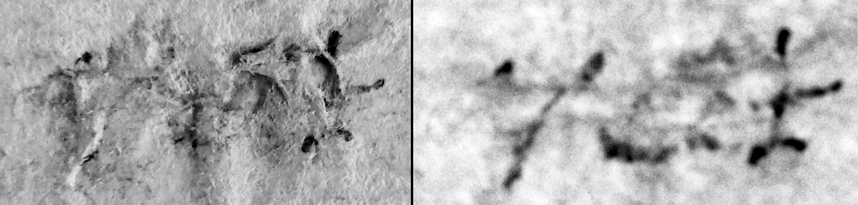
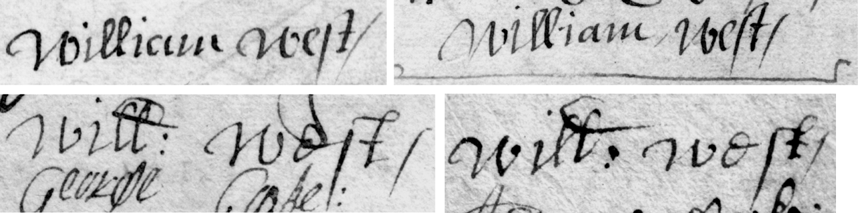
There are also two places where some small bit of writing has been scraped clean or scribbled over. One of these places, on the last page of music in the Cantus partbook, I have been unable to decipher and it may, in any event, be simply a change in the text underlay. The other, below the music on the first page of the Bassus partbook (Figure 15a), with almost nothing visible to the naked eye, appears in an ultraviolet photo to say ‘Vect’ (Figure 15b). This I believe to be the remnants of ‘West’. While such a notation might refer to a direction (perhaps indicating a position in a hall), or be an abbreviation for a place such as Westminster,Footnote 94 it is nonetheless highly suggestive that there was a singer by that name in the Chapel Royal all through this period. Admitted to the Chapel from Canterbury, William West was a Gentleman Extraordinary from August 1604, and in Ordinary from 20 March 1605 until his death around November 1643. And he appears in the list of Gentlemen singing at Henry's funeral, so he was definitely at court then. One possibility, of course, is that he was named on the partbook as a bass singer (though the Bodleian register later described him as a tenor).Footnote 95 His signature (Figure 16) survives in four places in the Chapel Royal Cheque Book and shows some resemblance to the scribal hand.Footnote 96 The Blossom scribe uses a careful italic throughout, but his frequent rendering of the name ‘William’ (Figure 17a) resembles the Chapel Royal signature except for the roman capital. His lower case ‘w’ (Figure 17b) is very similar to West's signature, however, as is his single instance of an ‘s-t’ ligature (Figure 17c), used where he was trying to squeeze extra text onto the end of a page. It is impossible to say conclusively with such a small sampling of West's writing in multiple signatures scattered over seventeen years, but there are definite similarities with the hand of the Blossom books.
Bassus partbook: (a) first music page with scraped word; (b) scraped word detail in regular and UV images
William West: Four Chapel Royal Cheque Book signatures (fols. 25v, 34, 36 and 37). Courtesy of the Chapel Royal, St James's Palace
Handwriting samples in the Blossom Partbooks: (a) ‘William’ (Bassus, fol. 16v); (b) ‘will’ (Tenor, fol. 1v); (c) ‘distr-’ (Cantus, fol. 37r)
As a member of the Chapel Royal, West as the Blossom scribe would meet the criterion of friendship with Nathaniel Giles, if the partbooks are indeed from the second, rather than the third, decade of the century. Moreover, his work as scribe of the Blossom Partbooks would raise some interesting questions about the extent of cooperation between the Chapel Royal and the King's Musick in performances of music for voices and viols at Court.
In that regard, it is noteworthy that two members of the King's Musick, John Miners and Thomas Day, both transferred to the Chapel in 1615, and that Day and William Howes, William West's eventual replacement in the Chapel Royal, as well as Alphonso Marsh, Jr, Howes's eventual replacement, held simultaneous appointments in the Musick during their tenure in the choir.Footnote 97 It may therefore be that in performances like the one at the Merchant Taylors feast described above (and perhaps at the various wedding banquets for Princess Elizabeth), the Gentleman of the Chapel Royal of this period – men like John Baldwin, Bull, Byrd, Gibbons, Giles and Tomkins, all of whom wrote for viols alone as well as for singers – were their own able accompanists. Henry Peacham's famous lines from The Compleat Gentleman of 1622 are seen in a clearer light: ‘I desire no more in you than to sing your part sure, and at the first sight, withall, to play the same upon your Violl.’Footnote 98
Finally, a hypothesis concerning the early history of the Blossom Partbooks: the collection might have been prepared for or have come early into the possession of Robert Carr, Viscount Rochester, a favourite of King James at the time of the Royal Wedding. It was noted earlier that Rochester was where the bridal pair resided while waiting for fair sailing weather. Within a year of this event, Carr was created Earl of Somerset, married the notorious beauty Frances Howard (the divorced Countess of Essex), and with her was arrested and charged with the murder, which occurred just ten days before their wedding, of his secretary Thomas Overbury, who had been actively campaigning against the marriage. The pair was tried, convicted, and ultimately released from prison in 1622, to spend the rest of their lives in forced retirement from court. The reason this connection to the Blossom Partbooks seems plausible is that it would explain the books' apparent close relationship to the Royal family at the time of the wedding and might help to explain the delay in binding them since Carr spent nearly all of the intervening time in prison.
Although watermarks are rarely helpful in precise dating – and the French pot used throughout the books is of such a generalised design that it cannot narrow the dating significantly – the flyleaves used in the binding are of paper with a mark quite closely matching one from the Rochester Papers of 1623 (Heawood 3502).Footnote 99 Since Carr was so isolated even after his release, it might further explain why the unique works remained out of circulation long enough to become too unfashionable to recopy. The connection to William West, if in fact he was the copyist, could be through Carr's residence in Rochester, since it is likely that West was from Kent, as he came to the Chapel Royal through Canterbury.
While this early provenance is speculative, the place of the Blossom Partbooks among important English sources of the early seventeenth century is assured on the basis of the ordering and what that tells us about Jacobean taste and performance practice. Consequently, it is frustrating not to have more definite information on the origins of these fascinating books. What we have is tantalising but mostly circumstantial evidence, and however much it points to the circle of the English royal family shortly after the death of Prince Henry, the books themselves give no unequivocal physical clues. Without further evidence we may never be closer to solving the mystery.
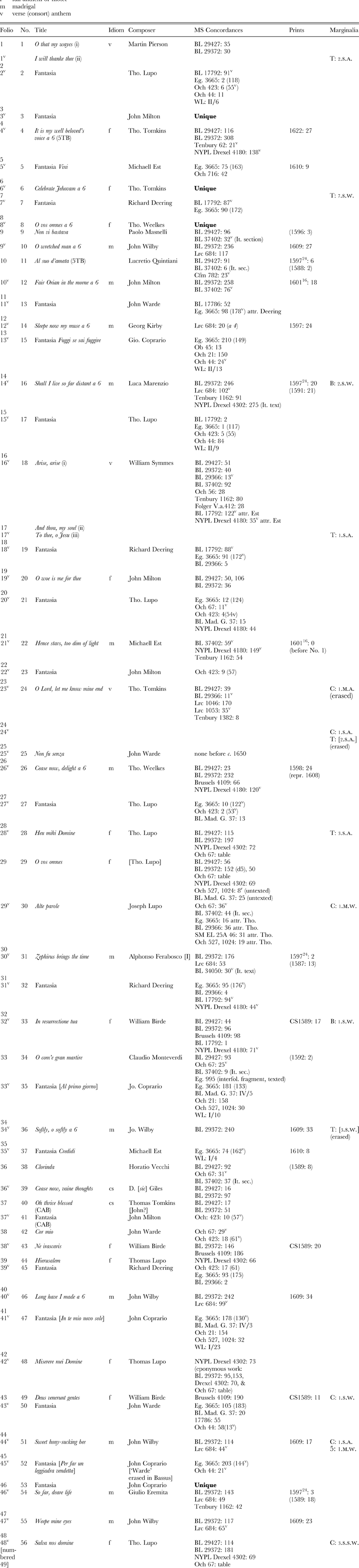
APPENDIX Inventory of the Blossom Partbooks
The list of concordances is selective, focusing on ‘cantus/altus’ secular anthologies with music for voices and viols, rather than manuscripts of exclusively viol music, or ‘superius/medius’ church music manuscripts.*
Key:
- cs
consort song
- f
full anthem or motet
- m
madrigal
- v
verse (consort) anthem