I. INTRODUCTION
Poly(lactic acid) (PLA) is a well-known linear aliphatic polyester, which can be produced from renewable resources (e.g., the fermentation of corn and potato starch and other polysaccharides).Reference Li, Guo, Jiang, Zhang, Xia, Wu, Guo and Zhang1,Reference Sookprasert and Hinchiranan2 In the past decades, PLA has received extensive attention and in-depth research due to its excellent biodegradability, environmental friendliness, and biocompatibility.Reference Yao, Cosme, Xu, Miszuk, Picciani, Fong and Sun3,Reference Hu, Li, Wang, Gao, Dai, Zheng, Liu, Shen, Song and Guo4 Additionally, PLA has proper mechanical and biological properties, making it desirable for biodegradable engineering package and medical instrument uses, such as fibers, films, plates, rods, screws, artificial cartilage, and pharmaceutical devices.Reference Murariu and Dubois5–Reference Tyler, Gullotti, Mangraviti, Utsuki and Brem7 It is considered one of the most important alternatives to nondegradable plastics. However, PLA suffers a low toughness, leading to a highly brittle material at ambient condition. It possesses a high strength and stiffness. For instance, some application areas (e.g., artificial cartilage and flexible packaging material) comprised of biodegradable polymers should not only have sound strength and stiffness but also have suitable ductility and toughness to avoid brittle fracture under application.Reference Nagarajan, Mohanty and Misratt8–Reference Kelnar, Kratochvil, Kapralkova, Zhigunov and Nevoralova10 In this regard, a feasible strategy to increase the toughness is compounding it with other fillers, such as carbon fiber, clay, halloysite, nanoattapulgite, silica, cellulose, etc.Reference Geng, Peng, Jing, Li, Huang, Xu, Chen and Mi11–Reference Zhou, Lei, Yang, Li and Ren16
Blending reinforcement and/or toughening fillers with PLA can improve mechanical and other properties.Reference Iwatake, Nogi and Yano17,Reference Rhim, Park and Ha18 However, fillers, even polymers, form heterogeneous incompatible systems with PLA, resulting in limited performance improvement. This often increases toughness while reduces valuable strength and modulus.Reference Qian and Sheng19 As a result, many chemical and physical strategies were developed to improve the surface compatibility between PLA and fillers.Reference Alippilakkotte and Sreejith20–Reference Jing, Che, Xu, Liu and Fu23 Our previous research studies evaluated the mechanical enhancements of the PLA composite by modifying bamboo particles (BPs) with alkaline treatment,Reference Qian, Mao, Sheng, Lu, Luo and Hou24 maleic anhydride treatment,Reference Qian, Mao, Zarei and Sheng25 hydrothermal treatment,Reference Qian, Wang, Zarei and Sheng26 and silane treatment.Reference Qian and Sheng19 The results show that the alkaline, maleic anhydride, and hydrothermal treatments improved the tensile strength and modulus of PLA up to 20 and 64%, whereas elongation at break decreased; the silane treatment increased the elongation at break to 250.8%, whereas the tensile strength and modulus halved. Liu et al. used N-methylol acrylamide to modify four types of fibers, including bamboo fibers, mechanical and chemical pulp fibers, and raw bamboo fibers, and studied their reinforcing effects on unsaturated polyester (UPE). The interfacial adhesion and mechanical strength of UPE composites were improved, and the toughness weakened. Other studies have also been reported on the surface modification of PLA composites with chemical means such as acids, bases, and surfactants.Reference Liu, Xie, Qiu and Fan27 However, these chemical strategies for surface modifications usually involve toxic and harmful substances, such as chloroform, acetone, alkali, and xylene.Reference Zhang, Yao, Zhang and Sheng28 Additionally, these processes are technologically complicated as well as they emit a large pollution, are of high costs, and are difficult to industrialize in the practical production. In consequence, it is worth to explore a simple and effective toughening enhancement method.
Ultrafine bamboo-char (UFBC) is a kind of particle smaller than 30 μm (>500 mesh).Reference Qian, Sheng, Yao and Yu29 It can be derived from the carbonization of bamboo, which exists abundantly in China. Previous research found that it can be introduced in a polymer matrix to strengthen and/or toughen the biocomposites due to their large surface area, developed porosity, and volume and surface effects.Reference Oral30 You et al. prepared ultra-high molecular weight polyethylene composites by adding different biochars (including bamboo-char) and found, on one hand, that the tensile strength, storage modulus, and creep performance were greatly improvedReference You and Li31,Reference You and Li32 and, on the other hand, enhanced good conductive properties.Reference Li, Li, Chen, Wang, Deng, Gong and Li33 Ho et al. found that the maximum tensile strength, flexural strength, and ductility index of PLA/bamboo-char composites prepared by extrusion molding were 43, 99, and 52% higher than those of pure PLA, but only when the content of bamboo-char was less than 7.5%, the dispersibility could be ensured.Reference Ho, Lau, Wang and Hui34 Previously, we also reported that UFBC had a self-lubricating effect that enhanced the tensile and impact strengths of PLA composites.Reference Qian, Sheng, Yao and Yu29 In many cases, inorganic nanofillers may act as a compatibilizer with an advantage of simultaneous reinforcing effect and improvement of many other material characteristics. Such a hybrid effect of rigid fillers on multicomponent polymer systems can lead to both antagonistic and synergistic effects due to structure modifications, including the formation of hybrid morphologies, interface, interaction, etc. Das et al. found that pine-char enhanced the flexural strength, modulus, and thermal stability of PP/wood/biochar ternary composites because the molten PP immersed in the pores of biochar formed a relatively uniform dispersion and mechanical interlock.Reference Das, Sarmah and Bhattacharyya35 Zhang et al. used UFBC as reinforcements to improve the mechanical properties of PP/BP composites and found the simultaneous reinforcing effects at different blending contents.Reference Zhang, Yao, Zhang and Sheng28 A further advantage is that UFBC is environmentally friendly and easy to prepare; its composites are easy to industrialize. To the best of our knowledge, these effects have so far not been studied in PLA/BP/UFBC systems. UFBC can be added as additives to tailor the mechanical, micromorphology, and thermal properties of the ternary biocomposites.
In this study, UFBC and BP were introduced into a PLA matrix and the new ternary biocomposites were fabricated by melt-blending and mold-compression without any surface modification and other additives. The aim of this investigation is to effectively realize the synergistic effects of reinforcement and toughening of PLA composites through a simple method, making it similar to a ternary structure system of cement, sand, and rebar. The tensile, flexural, and impact properties of the biocomposites were characterized, the morphology and interfacial bonding of the biocomposites were observed by using a scanning electron microscope (SEM), and the crystallization and thermal properties of the biocomposites were analyzed by differential scanning calorimetry (DSC). On the basis of these results, optimal UFBC content and properties in a PLA/BP matrix were obtained. These results will provide a new idea to promote the performances of PLA composites in engineering fields.
II. EXPERIMENTAL
A. Materials
Moso bamboo (Phyllostachys heterocycla) particles, residues after shaping and planing, were supplied by a local bamboo processing factory, Anji, Zhejiang Province, China. The BPs were screened through a mesh size of 20 and dried for further use. The average size was 0.85 mm and aspect ratio was 82. UFBC, with a mesh size of 1500, was purchased from Hainuo-Biochar Co., Ltd., Shanghai, China. The average size was 5.42 μm and aspect ratio was 35. They were dried at 105 °C for further use. PLA (3001D) was obtained from the NatureWorks Corporation (Blair, Nebraska). The density was 1.25 g/cm3 and the relative viscosity was 3.0–3.5.
B. Preparation of PLA/BP/UFBC ternary biocomposites
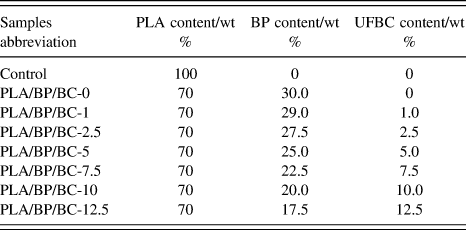
The PLA-to-filler ratio of the biocomposites was kept at 7/3 according to our pre-study and previous studies.Reference Qian, Sheng, Yao and Yu29 The abbreviations and compositions of composites in this study are shown in Table I. Approximately 50.0 g PLA/BP/UFBC blends were melt-blended in a Haake Rheomix600 internal mixer (Thermo Fisher Scientific, Waltham, Massachusetts) at 180 °C for 10 min with a screw RPM of 90. The ternary biocomposites were melt-blended with the incorporation of various UFBC contents, specified as 0, 1.0, 2.5, 5.0, 7.5, 10.0, and 12.5 wt% in the PLA matrix. No processing aids or other additives were used. The ternary biocomposites were melt-compressed to tensile, flexural, and impact property test samples at 180 °C and 2.0 MPa for 5 min. The mold sizes for tensile, flexural, and impact test samples were 165 × 13 × 4 mm3 (dumbbell shape), 127 × 10 × 4 mm3, and 100 × 10 × 4 mm3 (unnotched), according to ASTM D638, ASTM D790, and ASTM D6110, respectively.
Sample abbreviations and compositions in this study.

C. Mechanical tests
Tensile and flexural tests were performed on a universal testing machine at room temperature (CMT4503, MTS Inc. Shenzhen, China). According to ASTM D638 and ASTM D790, the gauge length and the crosshead speed for the tensile test were set to 50 mm and 5 mm/min; the support span and the crosshead speed for the flexural test were set to 60 mm and 5 mm/min. The Charpy impact test was carried out using a pendulum impact testing machine (ZBC1251-B, MTS Inc., Shenzhen, China) according to ASTM D6110. Five specimens were used for each test.
D. DSC
Thermal properties of PLA/BP/UFBC biocomposites were examined using a DSC (200F3, Netzsch, Shanghai, China). Approximately 10.0 mg samples were weighed and hermetically sealed in an aluminum pan. The samples were heated from room temperature to 180 °C at a rate of 10 °C/min, maintained for 3 min, cooled to 0 °C at a rate of 10 °C/min, and heated again to 180 °C at a rate of 10 °C/min. The first and second heating thermograms were recorded for further evaluation. Nitrogen was used as a purging gas at a rate of 50 mL/min. An empty aluminum pan was used as a reference. Cold crystallinity (X cc) was calculated according to the following equation:
 $${X_{{\rm{cc}}}}(\% ) = {{\Delta {H_{{\rm{cc}}}}} \over {\Delta {H_0} \times {X_{{\rm{PLA}}}}}} \times 100\% \quad ,$$
where ΔH cc represents to the cold crystallization enthalpy of PLA/BP/UFBC biocomposites; ΔH 0 refers to the enthalpy value of 93.6 J/g during 100% crystallization of PLA,Reference Li, Chen, Li and Sun36 X PLA refers to the weight ratio of PLA in PLA/BP/UFBC biocomposites.
E. Morphology analysis
The surface morphology of UFBC and the fractural cross-section of composites were observed using a field emission scanning electron microscope (S-8010, Hitachi, Tokyo, Japan). All the samples were coated with gold before the observation. The voltage of the electron microscopy was 4.0 kV.
III. RESULTS AND DISCUSSION
A. Mechanical property analysis
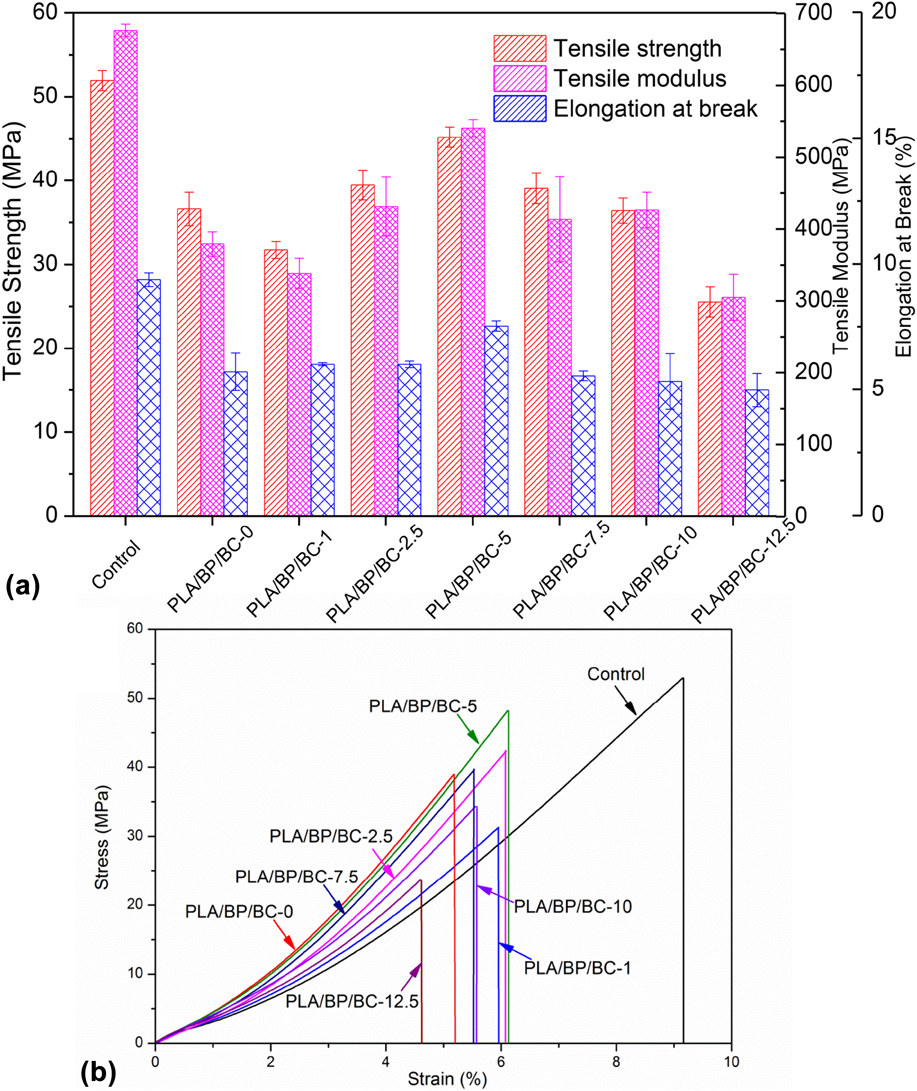
The tensile strength, modulus, elongation at break, and stress–strain curve of pure PLA, PLA/BP, and PLA/BP/UFBC biocomposites are shown in Fig. 1. All the stress–strain curves exhibited brittle rupture features. Pure PLA presented higher strength, modulus, and elongation at break values than the other composites; they are 51.93 MPa, 676.38 MPa, and 9.37%, respectively, comparable to petroleum-based plastics. With the addition of BPs, these values decreased to 36.61 MPa, 379.07 MPa, and 5.7%, respectively. This can be attributed to the weak surface interaction between hydrophilic BP and hydrophobic PLA. Additionally, this phenomenon was also reported in particle-reinforced composites and was concluded that the particle size should have been smaller than 40 meshes to ensure the reinforcing effects.Reference Fu, Feng, Lauke and Mai37 However, the smaller particle size means that more crushing energy is needed, resulting in uneconomical production. When taking UFBC as additives, these tensile parameters increased to 45.20 MPa, 540.50 MPa, and 7.53% at 5.0 wt% UFBC content and the toughness increased to 122.64 J/m3. These values are similar to the performances of pure PLA, in other words, the cost of the material is reduced and the performance of the material is guaranteed. At molecular level, depending on the strength of the interactions, rigid and polyporous UFBC fillers in a polymeric phase were known to restrain the mobility of the chains they were in contact with.Reference Li, Wang, Chen, Zhang, Guidoin and Wang9 Tensile properties were mainly related to the elongation of PLA molecules, and the effect of restraint from the UFBC content increase should be more noticeable because of the similar increase in the chain amount that it had contact with. Moreover, the fact that some PLA molecular chains entered the porous UFBC to form tangles was observed in the following SEM images. These facts increased the tensile deformation resistance of the biocomposites with UFBC. However, when the UFBC content exceeded 7.5 wt%, tensile parameters decreased gradually because the excessive UFBC started to disperse unevenly and agglomerate, leading to stress concentration. Binary PLA and UFBC compound systems have also been reported that the optimal addition should be less than 10%.Reference Ho, Lau, Wang and Hui34
Tensile properties of PLA/BP/UFBC composites (a) and typical stress–strain graph of the composites (b). Toughness (J/m3) was calculated from the areas under the tensile stress–strain curves. They are 202.43, 84.83, 78.33, 105.05, 122.64, 91.28, 80.13, and 46.4 corresponding to Control, PLA/BP/BC-0, PLA/BP/BC-1, PLA/BP/BC-2.5, PLA/BP/BC-5, PLA/BP/BC-7.5, PLA/BP/BC-10, and PLA/BP/BC-12.5 composite, respectively.

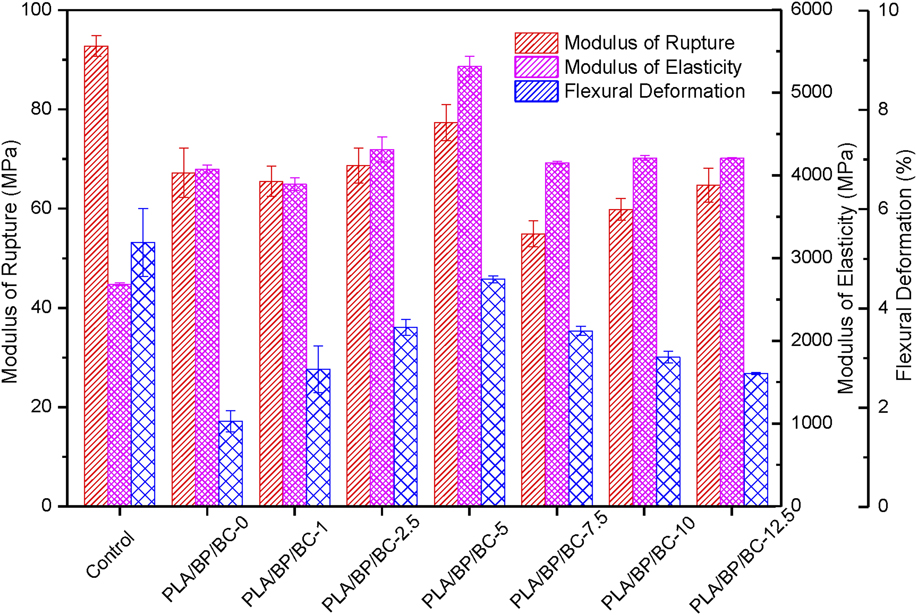
The flexural properties of PLA, PLA/BP, and PLA/BP/UFBC biocomposites are shown in Fig. 2. The modulus of rupture of pure PLA was 92.79 MPa, higher than PLA/BP and PLA/BP/UFBC composites. With the increase of UFBC contents, it increased from 67.25 MPa (0 wt%) to 77.32 MPa (5 wt%), and further decreased when the content exceeded 7.5 wt%. In the case of the particle-reinforced system, the strength and hardness of BP and UFBC themselves were large, and the bending deformation was difficult to occur. Thus, when the flexural strain reached the limit value, these reinforcement particles led to stress concentration and microcrack rather than bending deformation. When UFBC was added, these particles may be located in the gaps of the poor interface between PLA and BP, supporting the bending process.Reference Jin, Zhang, Yao and Park22 As a result, the modulus of elasticity of the PLA/BP/UFBC ternary biocomposites presented an increase trend, when the UFBC contents increased. It typically increased to 5316.1 MPa, approximately 2 times higher than the pure PLA. Another possible reason could be that PLA molecular chains and porous UFBC formed a cross-linked structure, and these molecular chains could be pulled out from these pores during bending deformation, which greatly enhanced the ability of the PLA/BP/UFBC ternary system to resist bending deformation, and this mainly contributed to the increase of flexural properties. In addition, homogeneous filler dispersion during the preparing process also indicated that the biocomposites acquired the improved mechanical properties, compared to the neat PLA matrix. It remains interesting that the fact of using untreated particle reinforcements, which should induce cavitation, however, was accompanied by increasing toughness (flexural deformation) and even increased at 5 wt% UFBC content. Although the above 7.5 wt% UFBC content marked reduction in flexural deformation occured, this represented rather unfavourable deviation from the optimum content of below 10 wt%.Reference Ho, Lau, Wang and Hui34 The results indicate that by increasing the UFBC content, the purpose of upgrading the flexural properties of PLA composites could be achieved, which is better than our previous use of alkali treatment (4.4 GPa)Reference Qian, Mao, Sheng, Lu, Luo and Hou24 and maleic anhydride treatment (4.6 GPa)Reference Qian, Mao, Zarei and Sheng25 to prepare PLA composites.
Flexural properties of PLA/BP/UFBC composites.

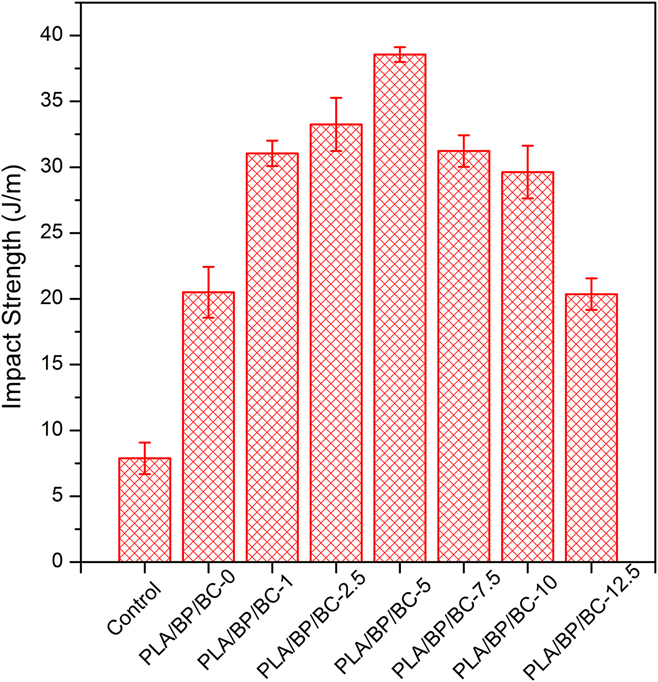
As shown in Fig. 3, the impact strength of PLA/BP/UFBC biocomposites was largely increased in regard to the increase of UFBC content. It reached a maximum value of 38.56 J/m when the UFBC content was 5 wt%, improved by 376% compared with pure PLA of 7.88 J/m and improved by 88% compared with the PLA/BP binary composite of 20.50 J/m. Similar findings were reported by Ho et al. that the total fracture energy of PLA composites was increased by 49.4% when 7.5 wt% bamboo-char were used.Reference Qian, Mao, Zarei and Sheng25 This could be attributed to pure PLA, which is a semicrystalline polymer with weak crystallization ability and relatively low degree of crystallinity. This fact leads to PLA molecular chains having a low resistance ability to withstand impacts.Reference Qian, Sheng, Yao and Yu29 Evidenced by the DSC results, the crystallization of BP and UFBC reinforced biocomposites was significantly enhanced, the crystallinity increased with the increase of UFBC content, and the molecular chain self-arranged to a regular way, forming a large crystalline region and enhancing resistance against the generation of incipient crack.Reference Sookprasert and Hinchiranan2,Reference Iwatake, Nogi and Yano17 In addition, the addition of UFBC filled the gaps between BP and PLA, part of energy was dispersed through filler-matrix debonding to obstruct the propagation of the crack.Reference Qian, Sheng, Yao and Yu29 When UFBC content exceeded 7.5 wt%, excessive rigid UFBC particles caused aggregation, and this could induce stress concentration and reduced incipient energy of crack, resulting in early interfacial debonding between the matrix and filler so as to cause a decrease in impact strength.
Impact property of PLA/BP/UFBC composites.

B. Thermal property analysis
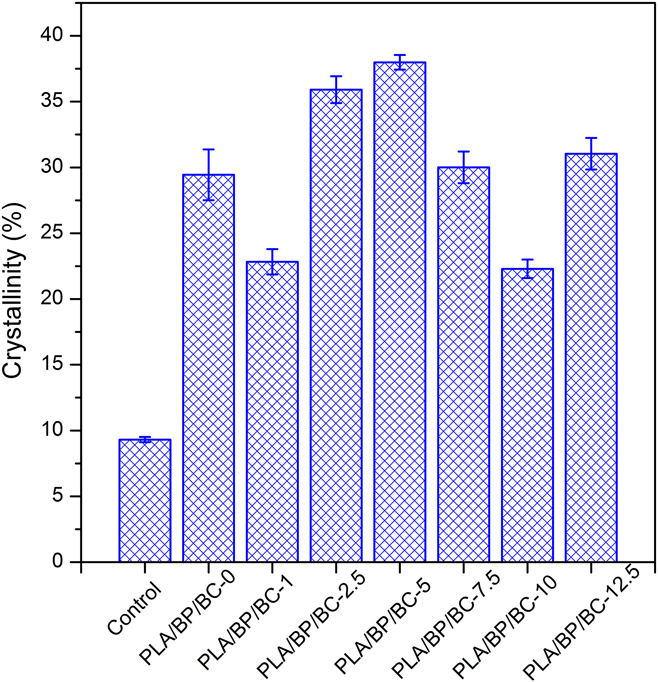
The first heating run crystallinity of the samples was determined to investigate possible correspondence of its variation to changes in mechanical properties, especially in modulus. Thus, the crystallinity of the as-prepared samples was characterized as well (1st heating run) (Fig. 4). The variation trend of biocomposite crystallinity was similar to that of the flexural modulus of elasticity, which indicates that the flexural properties not only related to the three-phase structure but also to the crystallization behavior of PLA, that is, the greater the crystallinity, the higher the flexural modulus.Reference Teymoorzadeh and Rodrigue39 Moreover, tensile modulus correlated less with the crystallization behavior of the composite and probably depended more on the interfacial bonding of the phases.Reference Lanjewar, Bari, Hansora and Mishra40
Crystallinity of PLA and PLA/BP/UFBC biocomposites (1st heating run).

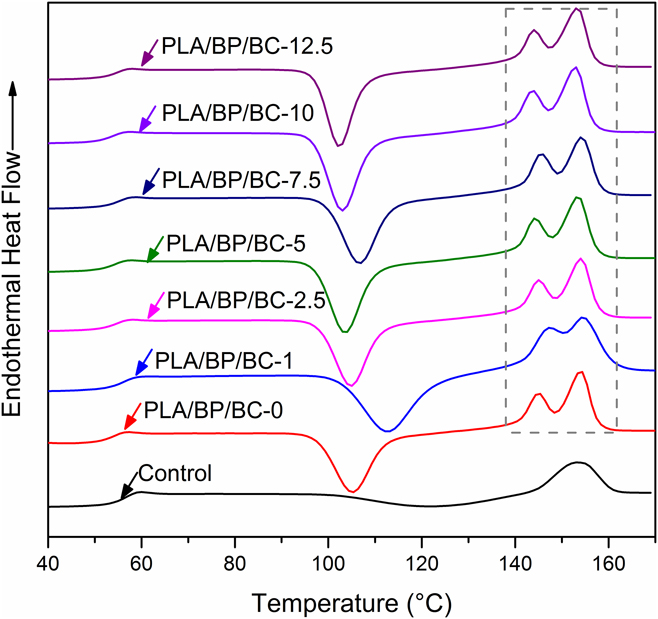
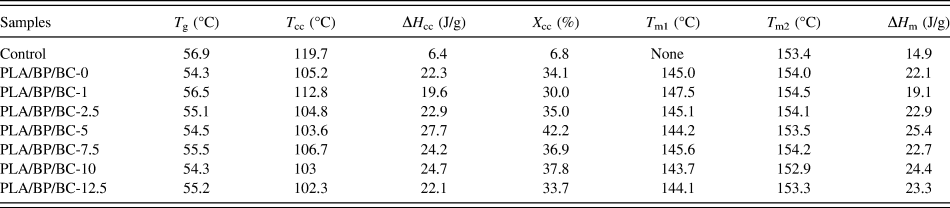
The second heating run DSC curves of pure PLA and PLA/BP/UFBC biocomposites with different UFBC contents are shown in Fig. 5. Table II summarizes the thermal parameters including glass transition temperature (T g), cold crystallization temperature (T cc), crystallization enthalpy (ΔH cc), degree of crystallinity (X cc), and melting temperature (T m). Generally, in the case of a particle-reinforced composite system, the T g of the polymer tends to decrease; similar phenomena were reported in the previous study, which was attributed to the lower energy requirement for molecule movement.Reference Li, Wang, Chen, Zhang, Guidoin and Wang9,Reference Kelnar, Kratochvil, Kapralkova, Zhigunov and Nevoralova10 Therefore, the PLA/BP system showed 2.6 °C decrease corresponding to pure PLA. Notably, the T g increased after UFBC addition and it remained stable with increasing UFBC content. This is probably due to the unique advantage of UFBC, namely self-lubrication, which made up for the steric hindrance of BP on PLA molecular chains.Reference Qian, Sheng, Yao and Yu29 As previously mentioned, this result pointed to improve interactions between the BP and the PLA polymeric molecules they were in contact with, and this, together with the selective location of the UFBC in the PLA phase, helped us to explain the similar high-strength values in tension and flexure. Additionally, after eliminating thermal history, the crystallization capacity of the ternary biocomposites was improved, showing an increased crystallization enthalpy and crystallinity compared with the first heating run. With the addition of BP, the X cc of PLA increased remarkably, which can be attributed to the fact that BP acted as a nucleating agent.Reference Qian, Mao, Sheng, Lu, Luo and Hou24 A similar result was confirmed by Su et al. in the carbon black/PLA system using WAXD, SAXS, and DSC analyses.Reference Su, Huang and Lin38 Both crystal nucleus formation capacity and growing ability were substantially promoted under the effect of heterogeneous nucleation. Furthermore, with the increase of UFBC contents, the X cc increased to 42.2% at an UFBC content of 5.0 wt% followed by a slight decrease. This might be due to fact that the addition of UFBC activated the movement of PLA molecular chains and enhanced their crystallization ability.Reference Sookprasert and Hinchiranan2 Furthermore, double crystallization melting peaks were observed in PLA/BP/UFBC biocomposites rather than the single peak of pure PLA. As previously reported, the peak at the lower temperature was probably related to the melting of the α′ form crystal and its recrystallization into a more stable α form, while the second peak was the melting of the α form crystal. Thus, the melting of the α′ form and the recrystallization of the α form could be considered as an α′–α phase transition.Reference Qian, Sheng, Yao and Yu29 In fact, the incomplete crystal at low melting temperature recrystallized to form a relatively complete crystal and then improved the cold crystallinity. This is consistent with the mechanical property analysis, which showed the optimal UFBC content of 5 wt% for biocomposite preparation.
DSC behaviors of pure PLA and PLA/BP/UFBC biocomposites (2nd heating run).

DSC data of PLA and PLA/BP/UFBC biocomposites (2nd heating run).

C. Morphological analysis
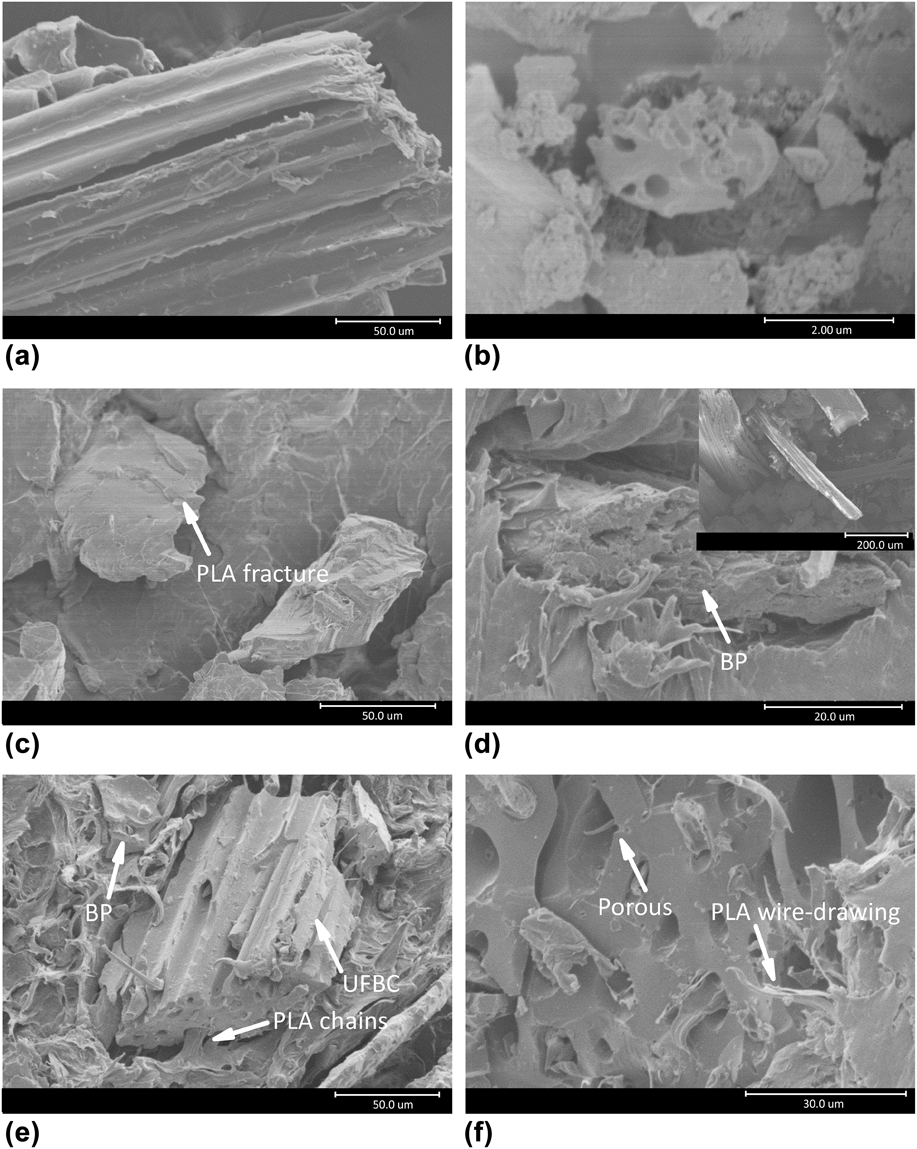
The surface morphology of BP and UFBC is shown in Figs. 6(a) and 6(b). The BP showed an axial fibrous structure. Since the surface treatment was not performed, the bamboo fiber bundles were closely arranged and there was a small amount of microfibrils on the surface. In addition, the BP surface was uneven, which expanded the area of interaction with PLA, and had better interface properties than smooth-surfaced clay and TiO2.Reference Geng, Peng, Jing, Li, Huang, Xu, Chen and Mi11,Reference Li, Chen, Li and Sun36 The characteristic images of BP and UFBC can be found in our previous studies,Reference Qian, Mao, Sheng, Lu, Luo and Hou24,Reference Qian, Mao, Zarei and Sheng25,Reference Qian, Sheng, Yao and Yu29 in which a stripe appearance of BP and two shape populations of UFBC can be seen. As for the relatively large type, the surface was flat with fewer pores and textures, and the length size was much larger than the width, while the relatively small type had rough surface, developed pores, similar to activated charcoal. The flexural fractural surface of pure PLA, PLA/BP, and PLA/BP/UFBC biocomposites with varying UFBC contents is shown in Figs. 6(c)–6(f). Due to the hardness and brittleness of PLA, its fractural surface was smooth and no wire-drawing phenomenon can be seen. After the addition of larger particles of BP, BP broke at the fracture and created cavity around the BP. This indicates that BP exerted a similar steel bar reinforcing effect in the PLA matrix, and thus a large amount of deformation energy and strain were absorbed by the stripping of the PLA matrix in contact with when under bending. Figures 6(e) and 6(f) exhibited the characteristics of the porous UFBC and the PLA matrix; immersion of the PLA molecular chain into the pores of the UFBC was seen and strong physical entanglement and interlocking were observed between the two phases. Especially when the content of UFBC was 5 wt%, the fractural surface of the biocomposite presented a lot of wire-drawing, which is the evidence of ductile fracture. From these results, it can be inferred that UFBC played a role similar to sand in the ternary composite system, resulting in a synergistic effect of toughening and strengthening.
SEM micrograph of (a) BP, (b) UFBC, (c) pure PLA fractured surface, (d) PLA/BP binary biocomposite, (e) PLA/BP/UFBC-1 biocomposite, and (f) PLA/BP/UFBC-5 biocomposite.

D. Toughening mechanism analysis
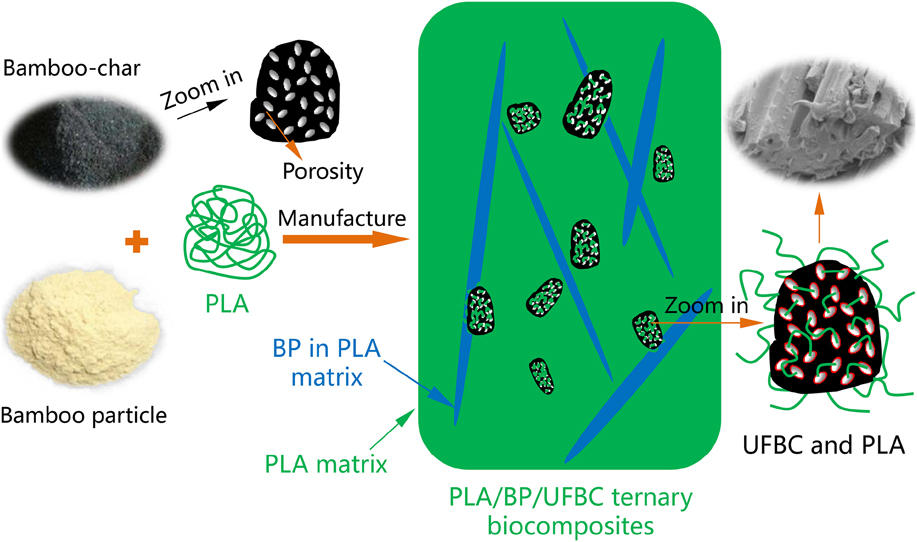
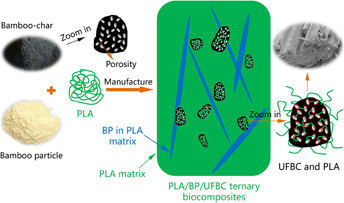
The toughening mechanisms of the PLA/BP/UFBC ternary biocomposites are shown in Fig. 7. Taking into account the observed mechanical property of tension and flexure, we might consider a different reinforcement-toughening mechanism originated from the formation of complex rigid/elastic microstructures, i.e., some content of PLA stacks inside UFBC. Some positive effects of such a structure are namely, an expected easier cavitation via intraparticle debonding that obviously eliminates the negative effect of higher rigidity of UFBC.Reference Li, Wang, Chen, Zhang, Guidoin and Wang9 This is also in concordance with the higher flexural properties and impact strength of the ternary system containing 5 wt% UFBC in comparison with pure PLA and without UFBC containing ones. In addition, another influencing factor that affects the performance of the ternary biocomposites is the aggregate structure of PLA molecular chains. Due to the heterogeneous nucleation and plasticization of the filler, PLA forms epitaxial crystals in the place, where the filler in contact with. The formation of these structures increases the modulus and strength of the biocomposites. This is consistent with the results of the DSC analysis, that is, as the UFBC content increases, the crystallinity increases. Furthermore, the three phases of PLA, BP, and UFBC constitute a concrete-like system, as described above, BP could play a role in reinforcing rebar in it, UFBC could play a nucleating agent and plasticizing, and PLA could provide matrix strength. When stretched, the tensile properties mainly depend on the interfacial characteristics of the ternary system, and when bending, the flexural properties mainly depend on the crystallization behavior of the system.
Schematic illustration of the toughening mechanism of PLA/BP/UFBC biocomposites.

IV. CONCLUSIONS
UFBC reinforced PLA/BP biocomposites were successfully manufactured by melt-blending and mold-compression without any other modifications or additives. The ternary biocomposites presented a high strength with a sound toughness as well, which realized the synergistic effects of reinforcement and toughening of PLA composites through a simple method. The maximum tensile strength, modulus and elongation at break, flexural modulus of elasticity, and impact strength were reached 45.20 MPa, 540.50 MPa, 7.53%, 5316.1 MPa, and 38.56 J/m, respectively, when the UFBC content was 5 wt%. Tensile properties were mainly affected by the interfacial interaction of the ternary system, whereas flexural properties largely depended on the crystallization behavior. A concrete-like microstructure system was confirmed, making PLA, BP, UFBC similar cement, rebar and sand, respectively. These findings verified the performance of the new filler in polymer composites and provided a new conception of high-performance PLA composite manufacture.
ACKNOWLEDGMENTS
The authors are grateful to the National Natural Science Foundation of China (51503068), the Research Funds of NBU (No. ZX2016000752), the Foundation of Ningbo University (No. XYL17025), and the K.C. Wong Magna Fund in Ningbo University for financial support. This work was supported by State Key Laboratory of Pulp and Paper Engineering (201814).