Parties are often treated as unitary actors, in which individual members coalesce to reach common goals. However, individuals or larger factions in parties must overcome a variety of collective action problems in order to co-ordinate.Footnote 1 Many scholars have examined these issues in the context of party formation, but few have considered how factional dynamics can make the unitary actor assumption untenable after the initial formation.
Factions impinge on the process of party position taking. They bind the leader in the choice of party platform, which is not solely determined by the overall policy preferences of individual members. Recent research shows that factional preferences determine party position and influence party change and policy making.Footnote 2 Scholars have shown that factional affiliation and heterogeneous policy preferences generate party disunity in roll-call votes and may explain differences in parliamentary voting behaviour.Footnote 3 Relaxing the unitary actor assumption can also help analyse coalition governments.Footnote 4 On the one hand, factionalized parties may help overcome gridlock in decision making or coalition formation,Footnote 5 but on the other hand factional disputes over portfolio allocation may undermine cabinet stability and survival.Footnote 6
Giannetti and Laver highlight how, ‘In the real political world … it is often difficult to discuss the making and breaking of parties without referring to factions or groupings of some shape and form’.Footnote 7 Accordingly, this article analyses the determinants of party fission, which can potentially alter the nature of party competition and even the party system.
My theoretical framework considers factions to be rational actors that co-ordinate their members’ behaviour in order to maximize their own share of pay-offs. As a consequence, their decision to exit or adhere to the party is based on the estimated policy, office and electoral pay-offs, but also on interaction with the party leader, who alters her responses to minority requests depending on whether her interest lies more in party unity (keeping the party together) or cohesion (enhancing agreement on the party line).
Factionalized parties may be found in several countries, and internal disputes are potential sources of party break-up worldwide.Footnote 8 This article focuses on Italy, which is often seen as the prime example of ‘the politics of faction’.Footnote 9 In both the First (1946–93) and Second (1994–present) Republic, Italian parties faced bitter internal conflicts, which often led to splits and reshuffling of the party system. For instance, the Italian Socialist Party (PSI) experienced several fissions, as factions broke away to create new rival parties like the Italian Communist Party (PCI) and the Italian Socialist Democratic Party (PSDI). In 2011, the People of Freedom (PDL) party split in the wake of internal strife between its main politicians, former Prime Minister Silvio Berlusconi and former Speaker of the Lower Chamber, Gianfranco Fini. The minority faction, led by Fini, broke away in response to sanctions imposed by the core of the party.
Besides the high frequency of party splits, the Italian case has some more advantages. The large number of parties in each Legislature (approximately ten) and the broad number of factions (on average, three within each divided party) make a large-N statistical analysis feasible. Moreover, the high instability rate of Italian cabinets (sixty governments in sixty-five years) allows us to track changes in alliances, party policy positions and intra-party portfolio allocations on a nearly annual basis. Furthermore, the reforms implemented since 1993 allow us to assess the effects of different electoral systems while holding country-level features constant. Thus Italy provides a suitable political laboratory to test hypotheses based on the general theoretical model.Footnote 10
Quantitative text analysis of a large number of documents on the ‘internal life’ of Italian parties allows us to determine the policy preferences of intra-party actors. I create a dataset with information on the ideal points of 254 Italian party factions from 1946 to 2011, based on motions presented during party congresses. This dataset provides new data on intra-party politicsFootnote 11 and allows a broadening of the analysis of party fission beyond offices and electoral motives.Footnote 12
My results support the argument that faction behaviour is driven by several motives and shaped by policy incentives in addition to office and electoral rewards. Strategic portfolio allocation, party loyalty and disproportional electoral systems that increase the exit costs tend to preserve party unity. Conversely, leaders who focus on promoting cohesion over unity will be less likely to respond to internal dissent, thus increasing the likelihood of factional breakaways. In sum, inter-factional disputes and compromises are important sources of party unity and party fission, but internal rules or features of the political system – such as the electoral law or party system competitiveness – also shape intra-party competition.
A Theory of Party Unity and Party Fission
Parties are voluntary associations composed of like-minded individuals who join together to solve collective action and co-ordination problems. Party members and party factions may extract greater pay-offs both in the parliamentary arena (through log-rolling and co-ordinated voting behaviour) and in the electoral market, where enforced cohesion increases the value of the party label and improves a member of parliament's (MP's) prospects for re-election.Footnote 13
However, the party is not a monolithic actor, as members may hold heterogeneous preferences. Members with similar views gather and create factions within a party. From this perspective, a party can be seen as a coalition of factions.Footnote 14
Factions compete against each other to take control of the party and maximize their share of pay-offs while co-operating to produce public goods and party unity, which the leader is responsible for preserving.Footnote 15 Intra-party politics swing between conflict and co-operation, with factions seeking a balance between the two. In the words of Laver and Kato, to the extent that ‘political parties are endogenous, then members of party factions may be seen to belong for as long as it is rational to do so’.Footnote 16 Accordingly, inter-factional struggles and bargaining take place in the shadow of party fission.
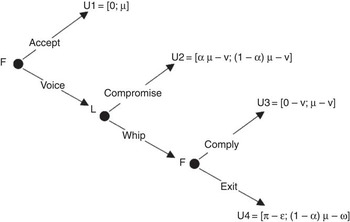
I propose a game-theoretic model based on the ‘Exit, Voice and Loyalty’ framework to shed light on party splits and the determinants of factional breakaways.Footnote 17 Figure 1 presents a game of party unity and party fission, describing factional disputes over pay-off allocations under the threat of party break-up. For simplicity, I consider only two actors: the party leader (L) tied to the mainstream faction (composed of her followers) and a minority faction of dissenting members (F). The minority's size α is the share of congress votes won by the faction (a positive value below 0.5). The total amount of office pay-offs to be shared sum to μ, which is equal to 1, and any strategy undermining party unity imposes costs on the actors. L is in charge of allocating scarce resources such as cabinet spoils (office pay-offs), the party line (policy pay-offs) and candidacies (electoral pay-offs) between the two factions.
Party unity and party fission game Note: μ = value of party unity; α = minority's size;
 $$$\nu $$$
= damage due to public voice; ε = exit cost; π = minority pay-offs after breakaway; ω = loss due to party fission. We assume that: μ = 1; 0 < α < 0.5; ε ∈ (0, 0.5); π ∈ (0, 0.5); ω ∈ (0, 0.5);
 $$$\nu $$$
∈ (0, 0.5) and
 $$$\nu $$$
< α. F = minority faction; L = party leader. Pay-offs are indicated in square brackets and separated by a semicolon. Faction pay-offs are indicated first, followed by leader pay-offs.

The leader needs to reward her supporters to avoid being dismissed. She will exploit her dominant position to retain all of the benefits and propose an unfair deal to the minority. The minority may then accept or use voice. If the faction complies, the gain will be zero (as dissenters are excluded from the allocation of rewards), and the leader's pay-offs will be equal to μ (outcome U1).Footnote
18
If F uses voice, the entire party incurs costs
 $$$\nu $$$
due to the public exposure of internal dissent. L can then propose a new deal. She can either reverse her choice, offering a compromise (in which each faction will be rewarded on the basis of its strength) or use the whip to force the minority to accept her original position. A compromise will give the minority faction F α
μ −
 $$$\nu $$$
, and retain (1 − α) μ −
 $$$\nu $$$
for L (outcome U2). If L uses the whip option, the game reaches a final stage in which the dissenters either comply or leave the party. If they toe the line (outcome U3), they in essence get the same pay-offs as under the first-stage outcome U1 (when F plays ‘accept’) less the cost
 $$$\nu $$$
of displaying intra-party disagreement to the public.Footnote
19
Conversely, if the minority faction breaks away (outcome U4), F receives a pay-off of π − ε – that is, the benefit obtained from creating a new party minus the cost of leaving the current party. In the case of a split, L receives all the benefits less the contribution of the minority faction that is leaving the party. The leader does not incur any cost for party disunity after a split, as the party becomes more cohesive, but suffers a cost ω for the loss in strength and image caused by the party break-up. Her final pay-off will be (1 − α) μ − ω.
A number of results can be shown using backward induction. In the final stage, F faces the choice between ‘exit’ and ‘accept’. For values of ε larger than π, the exit cost is too high compared to the benefit of a breakaway. Unless the cost of party disunity
 $$$\nu $$$
is high as well, the minority has a non-credible threat to split (that is, F's pay-offs are higher inside the party as π − ε < 0 −
 $$$\nu $$$
) and will always accept the whip rather than leave the party. This is the second-best outcome for L (who receives all of the pay-offs minus the cost
 $$$\nu $$$
). F knows that it would be better off by choosing ‘accept’ at the first stage (due to
 $$$\nu $$$
) and agrees to the unfair deal U1. This pattern resembles that of the ‘dictator game’, in which the responder has little choice but to accept the proposal.
On the other hand, when ε is larger than π but
 $$$\nu $$$
is high (so that π − ε > 0 −
 $$$\nu $$$
), F retains a credible weak threat (if it splits, the faction can only minimize its loss).Footnote
20
In this scenario, the outcome could be either U1 or U2 (Agreement). When the cost of party break-up ω is lower than the cost of party disunity
 $$$\nu $$$
for leader L, party fission will be less damaging than bargaining for a compromise. As a consequence, F will accept the unfair deal (U1) to avoid the negative pay-off of a breakaway. Conversely, when ω is greater than
 $$$\nu $$$
, L will focus on preserving unity at any cost to avoid the risk of party fission at the last stage. This induces a compromise and a final outcome U2.
Finally, when ε is relatively small and π is large, F chooses ‘exit’ at the last stage and threatens to leave in order to enhance its bargaining power and obtain a larger share. When ω is sufficiently large, L prefers to negotiate a compromise (U2). However, if ω is lower than
 $$$\nu $$$
, L will seek cohesion even at the expense of party unity and refuse a new deal, using the whip against dissenters and generating a breakaway outcome (U4).
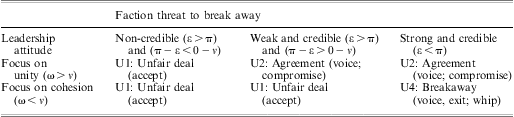
Table 1 summarizes the possible outcomes of the game based on the relationship between the four parameters: π, the pay-offs available to the minority faction after a breakaway; ε, the exit cost;
 $$$\nu $$$
, the cost due to public voice; and ω, the loss due to party fission.
Summary of the Possible Outcomes of the Game and the Strategies Played by the Two Actors Based on the Relationship Between the Parameters

This game highlights the relative power of the party leader (L) and the minority faction (F) and how these affect intra-party distributive dynamics (that is, portfolio allocation and party change). The likelihood of party fission is determined by two key elements: (1) the bargaining power of the minority, demonstrated by its ability to make a credible threat and (2) the party leader's relative interest in unity or cohesion. When the minority makes a non-credible threat, the party leader has no incentive to pursue a compromise, as party unity is not threatened. Potential splinter groups can exploit their bargaining power to demand a fair deal only when they have a credible threat. In turn, the leader will accommodate the minority's requests only if a breakaway will damage the party more than internal dissent. The minority is more likely to split when the pay-offs are greater outside the party than inside (because of unfair distribution) and exit costs are low (for instance, if there is no strong loyalty or the electoral system does not create barriers for new actors). Conversely, the leader will pander to the minority when party unity is an issue at stake and fission would be a huge loss for the party – for example, if a ruling party has a narrow margin over the opposition. A split is more likely when ideological disharmony and internal voice damage the party's image. For example, dominant or ruling parties rarely tolerate dissent when they have a wide parliamentary margin. In such cases, party leaders focus more on cohesion than unity.
These implications suggest a number of specific testable hypotheses related to the parameters of the game. I start by considering attributes that affect the balance between the cost of exit (ε) and the net benefit of a breakaway (π) for potential splinter groups in order to determine when a minority can gain from a breakaway and hence has a credible threat to split off from the party.
Any factor that increases the share of policy, office and electoral pay-offs available to the splinter group after breaking away (π) will make a split more likely. Party members (and factions) incur a cost from party membership.Footnote 21 The cost is large when factions have ideal points far from the bulk of party members and hence fewer pay-offs from policy. A breakaway may thus allow fringe factions to minimize membership costs and establish a party platform with larger policy pay-offs (higher π). Assuming that party position corresponds to the weighted mean of all factions,Footnote 22 I propose the following hypothesis:
Hypothesis 1: A breakaway by faction i is more likely the greater the distance between i and the party position.Footnote 23
Factions are, of course, also interested in office pay-offs and career rewards. They will consider their share of pay-offs within the party and any potential gains after a breakaway. Hence ‘overpaid’ factions with shares of office pay-offs greater than their vote share should be less willing to split.Footnote 24 Conversely, ‘underpaid’ factions have larger expected pay-offs (π) from defecting.
Hypothesis 2: Higher/lower office pay-offs relative to faction size decrease/increase the likelihood of a split.
Factions also consider electoral rewards, for example the number of parliamentary seats they can win in future elections. More disproportional electoral rules preserve party systems and act as barriers to new parties. They increase the exit costs (ε) for dissidentsFootnote 25 and limit their ability to extract additional policy and office pay-offs in the long run, thus decreasing π. These effects should be greater under single-member plurality systems, but can also apply under proportional representation (PR).
Hypothesis 3: A less proportional electoral system decreases the likelihood of a breakaway.
Candidate selection (the way MPs are selected) is another distributional issue that affects party unity. The estimated costs and benefits of a split for potential splinter groups depend on their chances of gaining seats. The party leader tends to retain control over candidate selection under closed-list PR and centralized selection procedures,Footnote 26 and is thus able to exclude dissenting factions. Minority factions that defy the leader fear being excluded from the party list in retaliation. Thus the limited room for dissent should decrease exit costs (ε). Conversely, open-list PR provides factions with access to parliamentary seats through preference voting. This institutionalizes factionalism and decreases the likelihood of splits.
Hypothesis 4: Closed-list PR and centralized candidate selection increase the likelihood of a breakaway.
Party loyalty affects the balance between the costs (ε) and benefits (π) of a breakaway. More specifically, partisan ties to symbols such as logos, labels and the ‘logic of appropriateness’Footnote 27 internalized through participation might dissuade members from leaving.Footnote 28 This is particularly relevant for older parties in which party loyalty is well established, which thus increases the exit cost (ε).
Hypothesis 5: The loyalty effect decreases the likelihood of party fissions in older parties.
In addition to features that provide minority factions with incentives or disincentives to break away, the model also suggests that leaders can have different attitudes to party unity.Footnote
29
Leaders may seek to preserve unity at any cost (when ω >
 $$$\nu $$$
), or seek cohesion over a clear party line, with a willingness to eliminate internal challengers at any cost (ω <
 $$$\nu $$$
). The game illustrates how leaders will accommodate potential splinter groups to decrease the likelihood of party fission. At the same time, if internal dissent is too damaging for the party, leaders will ignore the minority to make it more inclined to leave.
The leadership's attitude is related to internal democracy. Parties with intransigent rules, for instance those organized according to ‘democratic centralism’ (for example, Marxist parties) typically do not tolerate ‘dissent’Footnote
30
because any public expression of internal disagreement could weaken the party in the eyes of its voters. Under ‘democratic centralism’, party members are free to discuss party strategy and ideology, but can only disagree within the party. Once the party has established a position, dissenting members must submit. In this context, the public expression of dissent is costly (higher
 $$$\nu $$$
) and the benefits of party unity lower. Thus the party leader would rather use the whip against the minority than seek a compromise.
Hypothesis 6: The likelihood of a break-up increases in parties ruled through ‘democratic centralism’.Footnote 31
The cost of internal division (
 $$$\nu $$$
) is higher for ruling parties, which face greater public scrutiny than the opposition. The competitiveness of the party system and the margin of the ruling coalition affect the value of unity (ω) and shape the balance between the costs of dissent and splits. When ruling parties have narrow majorities, any split could jeopardize government stability. Leaders will be more concerned with party unity, given the higher cost of a break-up if the party may lose office (large ω). Since a leader will tolerate internal divisions (provided they do not threaten unity), this gives party minorities bargaining leverage to extract substantial shares within the party. Conversely, if the degree of competitiveness is low (small ω) and the dominant coalition has a safe parliamentary margin, there is less need for party unity. Splits no longer threaten government stability and party leaders may be less concerned over party fission. As such, leaders will refuse to accommodate minorities, use the whipping and pursue the intra-party game to the breaking point (as in U4). In other words, leaders trade unity for cohesion to improve government effectiveness and establish party authority.Footnote
32
Hypothesis 7: Fission is less likely among ruling parties when the government has a narrow parliamentary margin and becomes more likely as the margin widens.Footnote 33
Data and Methodology
Party congresses are a competitive arena in which ‘factions organize teams of candidates and appeal to people enjoying the right to vote for one team or another’.Footnote 34 They generally present a policy motion attached to a list of candidates. This motion is an omnibus policy document that aims to shape party strategy and ideology. ‘Hard data’ on party factional structure drawn from party congresses help us determine the size, strength and policy position of factions.Footnote 35
I will use a new dataset with information on the policy positions of Italian party factions, covering both the Italian First and Second Republics, from 1946 to 2011. Party heterogeneity is often measured by analysing roll-call votes, but Benoit, Bräuninger and Debus argue that content analyses of ‘texts drafted by … intra-party groups seem to be the best choice to identify their respective preferences, in particular if the research question deals with changes of the positions of political actors over time’.Footnote 36 The effect of party discipline should also be lower in intra-party debates than in roll-call votes or parliamentary speeches, which ‘may not reflect the true distribution of preferences’Footnote 37 and are thus less well suited for analysing intra-party politics. Conversely, party factions can theoretically express their sincere preferences in a congress motion.
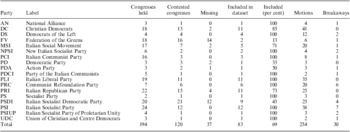
I assess policy positions through the motions submitted by factions for voting in contested congresses.Footnote 38 Missing data prevented us from including a few congresses.Footnote 39 Table 2 summarizes the dataset, which covers 254 motions at eighty-three congresses for eighteen parties.Footnote 40
List of Parties, Number of Congresses, Motions and Breakaways Included in the Analysis

The policy positions were extracted from the motions using Wordfish, an automated scaling model that analyses the frequency of all the words contained in a document.Footnote 41 Wordfish assigns each word a value β and differentiates the texts according to the words used, thus allowing us to distinguish between actors’ policy positions. These positions are estimated along a single dimension, which captures the political content of the texts. Given the nature of the motions (as discussed above), this dimension can be interpreted as a left-right scale.Footnote 42
A key advantage of Wordfish is its ability to produce time-series estimates. These allow us to analyse motions from different points in time, under the assumption that words usage remains constant. Given the large temporal span of the analysis, this assumption could be questioned. To ensure linguistic stability and reliable estimates, the motions were divided into two time periods: before and after 1989.Footnote 43
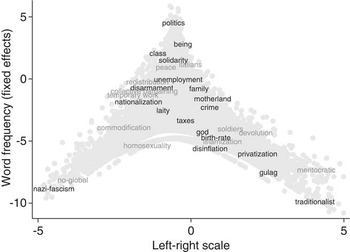
The face validity of the estimates was tested in various ways. The values of the discrimination parameter β provide an output diagnostic. Words with large β values are located at the extremes of the left-right scale. Figure 2 displays the frequency of each word across all documents on the vertical scale (fixed effect),Footnote 44 along with the values of β parameters on the horizontal axis, highlighting some selected words (translated into English).
Diagnostic of words estimates: word frequency (fixed effect) and β values (left-right scale) for the first (black) and second (grey) period

For the first period we find words (shown in black) traditionally associated with conservative values, such as god, motherland and family on the right, and class, solidarity and nationalization on the left. For the second, we observe words (shown in grey) such as no-global and collective bargaining on the left, and meritocratic and devolution on the right wing. Words refer to different issues (for example, economic, social and foreign policies). For instance, concerns about unemployment and redistribution are attributed to left-wing parties, while disinflation and privatization are associated with the right. For social policy, the left stresses laity while the right emphasizes birth rate and words related to law and order such as crime. In foreign policy, the left talks about peace and disarmament while the right expresses support to soldiers. The examples indicate that the β values assigned to words seem to correspond to how they are used in Italian political discourse and that the words appear on the correct side of the left-right scale.
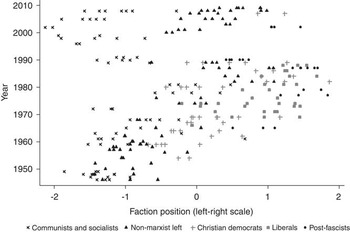
As a second test to demonstrate that faction positions are estimated correctly, Figure 3 plots the policy positions of all the factions in the analysis by congress, using different symbols for the political family. Post-fascist parties (MSI and AN, denoted by black dots) are located on the far right. The liberal-democratic family (PLI), is on the centre-right (grey squares). Christian democrats (grey pluses) are located in the centre during the first period (DC), and shift to the centre-right in the second period (UDC). Social-democratic and non-Marxist left parties (PSDI, PDA, PRI, DS, PD, NPSI, Greens, denoted by black triangles) appear on the centre-left in the first period but shift toward the centre in the 1980s. Finally, socialist and communist parties (PCI, PSI, PSIUP, PRC, PDCI, denoted by an x) are located on the left wing.
Faction positions on the left-right scale (clustered by political family)

There is rarely much overlap among observations across different political families. The wings are properly arrayed; for example, left-wing factions are to the left side and hold notably different positions from the party mainstream.Footnote 45 The weighted means of factions’ positions, measured at each party congress, is positively correlated with other estimates of party position.Footnote 46 Moreover, the faction estimates also track the evolution of the party system, and the key changes in party positions over time. This suggests that the estimates are valid, reliable and consistent with the central findings in the literature on Italian parties.Footnote 47
Analysis and Results
I test the hypotheses through logit regression, using a binary dependent variable Fission, which indicates whether faction i leaves the party.Footnote 48 Data encompasses 30 breakaways for the 254 factions identified over the period 1946–2011.
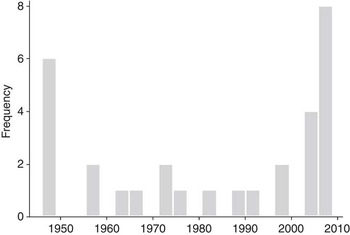
Figure 4 illustrates two peaks in the distribution of Fission over time: one at the beginning of the First Italian Republic and another after the 2006 general elections, when the party system was particularly fluid. Still, nearly one-third of the breakaways occurred from 1960 to 1989, even though the Italian party system was considered relatively more stable during this period.
Distribution of fission over time during the First (1946–1993) and Second Italian Republic (1994–present)

On average, we observe a split every two years. As such, party fissions and factional breakaways are not a rare event, but an ever-present threat posed to the party leadership and an opportunity for minority factions to negotiate a new distribution of pay-offs.Footnote 49 The unit of analysis is factions per cabinet. This allows us to better assess the impact of office pay-offs and parliamentary support, which might vary between party congresses.
Several independent variables were adopted. To test Hypothesis 1, I consider Distance the squared Euclidean distance between faction i's ideal point and the weighted mean of all factions in each congress.Footnote 50 To test Hypothesis 2, I consider the impact of office pay-offs through the Share of Ministers, the difference between faction i's share of ministers and size. I assigned a value of 0 to all parties not in office. To test Hypotheses 3 and 4 on the role of the electoral system, I consider Disproportionality (Hypotheses 3), measured using the Gallagher index, and Closed List (Hypothesis 4), a dummy variable flagging closed-list PR or plurality systems with centralized candidate selection, as opposed to open-list PR.Footnote 51 I test Hypothesis 5 using Party Age, the number of years elapsed since a party's founding, and Hypothesis 6 with a dummy variable for parties ruled by Democratic Centralism.Footnote 52 Finally, I test Hypothesis 7 through an interaction between Ruling Party, which indicates whether the party is in office, and Parliamentary Support, or the inter-electoral party system competitiveness measured by the size of the ruling coalition.
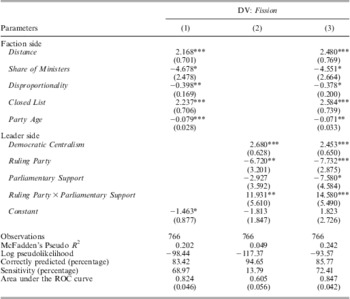
The data are encoded by cabinet. I report robust standard errors clustered by cabinet in each party congress to avoid possible problems from non-independent observations or non-constant variances.Footnote 53 Table 3 presents the results. In Model 1, I only include variables that affect the credibility of the minority faction threat (faction side). In Model 2, I separately estimate the effect of elements concerning the leader's attitude toward internal dissent (leader side). Model 3 includes all the variables. Considering both the faction side and the leader side improves the model fit.Footnote 54
Logit Regression of Faction Breakaway

Note: standard errors clustered by cabinet in each party congress are shown in parentheses. Significance (two tailed): *0.1; **0.05; ***0.01. The percentage of correctly predicted outcomes and sensitivity (percentage of correctly predicted positive outcomes) has been measured according to a 0.05 cut-off point, close to the actual outcome rate (0.04).
The results provide strong support for my hypotheses that factions consider policy and office as well as electoral pay-offs. Higher Distance increases the likelihood of fission. As the cost of membership increases with distance from the core of party members, factions have an incentive to leave to get larger policy pay-offs after a split without suffering large exit costs.Footnote 55 A higher Share of Ministers helps preserve party unity. Overpaid factions with a share of office pay-offs greater than their size are less likely to break away, as they would rarely find better conditions outside the party (and vice versa). In this way, party leaders may use strategic portfolio allocation to avoid fissions and cater to potential splinter groups (Ceron Reference Ceron2013b). Factions jointly weigh policy and office pay-offs as substitutes. A greater-than-proportional share of office pay-offs could counterbalance a lower share of policy pay-offs.Footnote 56
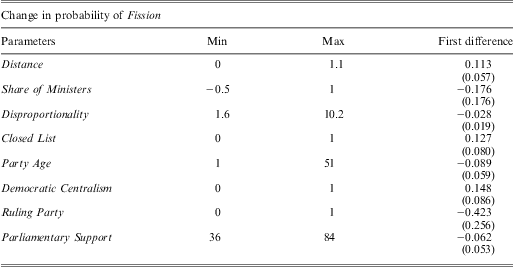
Electoral motivation also matters. Disproportionality and Closed List are both significant and in line with my theory, which suggests that disproportional electoral systems decrease the likelihood of a breakaway by increasing exit costs and lowering the expected electoral pay-offs of splinter groups.Footnote 57 If the electoral system does not guarantee re-election, dissenters prefer to remain within the party. Conversely, closed-list PR and centralized candidate selection methods give leaders more power over selecting MPs, thus restricting the access of minority factions to candidacies and reducing the cost of leaving.Footnote 58 Loyalty restrains minorities from breaking away. After controlling for Share of Ministers, which captures the co-operative patterns that might emerge over time, the coefficient of Party Age is significant. This positive effect of loyalty on unity is due to the ‘logic of appropriateness’ developed during party militancy, beyond the ‘logic of consequentiality’.Footnote 59 On the leader side, I find that Democratic Centralism strongly increases the risk of a split, which is consistent with my claim that ‘voice’ becomes more expensive than a break-up when parties do not tolerate internal dissent. Thus the leader will not accommodate minority factions, forcing splinter groups to accept the party line or break away. Table 4 reports substantive interpretations of the results in terms of the change in probabilities of fission for a change in each variable from the minimum to the maximum value (first difference).
Substantive Effects of Explanatory Variables: First Difference

Note: first differences indicate the change in probabilities of fission when an independent variable changes from its empirical minimum to its maximum, and all other variables are held at their means. When all variables are set at their means, the predicted probability of fission is 0.016 (0.007). Standard errors clustered by cabinet in each party congress are shown in parentheses.
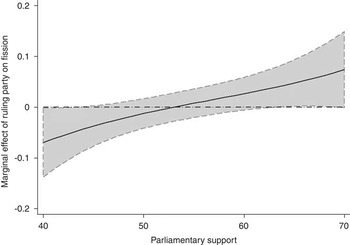
Figure 5 displays the marginal effect of the interaction between Ruling Party and Parliamentary Support. When the margin of the ruling coalition is narrow, parties in office will be concerned about preserving unity, insofar as any breakaway might threaten government stability. Thus the leader will cater to potential splinter groups to keep the party together. Accordingly, the marginal effect is negative for ruling parties when Parliamentary Support is below 44 per cent of the seats. By contrast, party fissions are less damaging to parties in governments that are supported by wide majorities, as leaders are more willing to accept the risk of fission for the sake of promoting government effectiveness through party cohesion. The marginal effect on a breakaway becomes positive and significant for parties in office when Parliamentary Support exceeds 63 per cent of the seats.Footnote 60
Marginal effect of ruling party on fission as parliamentary support changes (with 90 per cent confidence interval)

Conclusion
This article has explored the determinants of party fission. I describe a game-theoretic model of intra-party bargaining dynamics that focuses on the impact of pay-off allocations on faction breakaways from an ‘Exit, Voice and Loyalty’ framework. I create new data on intra-party factional structures of Italian parties through the quantitative content analysis of motions presented during party congresses and test various implications of the theory. The analysis supports my claims that factions consider office and policy, as well as electoral pay-offs. Policy motives seem to drive the breaking (and making) of parties. Subgroups sharing common preferences are more likely to join together, and are more likely to split when intra-party heterogeneity increases. Even factions that are often considered merely office seeking seem to pay attention to policy pay-offs. Conversely, the strategic allocation of portfolios can counterbalance a lower amount of policy pay-offs, and thus contribute to preserving party unity. In turn, other elements – such as party loyalty, disproportional electoral systems and open access to candidacies – increase the exit costs for dissenting factions and decrease the credibility of threats to split. Splinter groups, however, do not make choices in isolation, and must weigh the leadership's attitude to party unity when threatening to defect. Under some conditions, leaders may be willing to compromise to preserve party unity; under others, they may use the whip against dissenters to enhance party cohesion. Consistent with my theory, the level of intra-party democracy and the inter-electoral level of party system competitiveness affect the leader's attitude, even if these factors have only a slight impact on the model's predictive ability. The cost of ‘voice’ is higher in parties ruled through democratic centralism, in which leaders do not tolerate dissent, which makes minorities more inclined to break away. For ruling parties, the cost of a ‘break-up’ increases with a smaller margin over the opposition, thus raising the leader's interest in compromising to preserve party unity. Conversely, leaders in ruling parties focus more on cohesion to enhance government effectiveness as their parliamentary support widens.Footnote 61 The lower cost of a break-up declines below the cost of voice, and splits become more likely.Footnote 62 My findings demonstrate that parties can be considered as minimum winning coalitions of factions, in which all unnecessary subgroups are disregarded by the party leader and must face the choice between compliance or exit.
This article provides strong support for the theory that parties are the product of both intra-party competition and the party system. Both spheres of politics provide incentives for party unity as well as threats to cohesion. When parties are internally polarized, party system fragmentation can be contained through consensual intra-party dynamics, disproportional electoral systems, and preference voting or decentralized candidate selection procedures that favour the institutionalization of party factions (such as primary elections). These aspects are highly relevant for political elites who aim to simplify political supply through party mergers. When a party merger is merely a ‘cold fusion’ process based on instrumental and strategic concerns and without any policy basis, the internal wings will be more likely to break away to undermine elite efforts to decrease the fragmentation. My results highlight how any reform that aims to foster party system stability should include adjustments in the rules of the game to help keep factionalism under control and preserve party unity.
This article also demonstrates how quantitative text analysis techniques can be used to analyse intra-party politics and the policy preferences of factions. This approach could in turn be broadened to assess the effects of intra-party competition on other topics like portfolio allocation, government formation and stability, parliamentary behaviour and the selection of a party platform. Moreover, the game-theoretic model also suggests additional implications for studies on party switching, party merger and party unity in roll-call votes.
Although this article empirically evaluates the implications of the model on party fission in a single country, the theoretical model is general and can be useful for understanding intra-party dynamics in other countries with factional politics (such as Japan) as well as other political systems characterized by heterogeneous intra-party preferences (such as France, Germany or the UK). Future research could pursue a comparative perspective on intra-party politics within different party systems.