I. INTRODUCTION
In the recent years, hollow silica spheres (HSS) have potential applications in chromatography, shield for enzymes or proteins, delivery vehicles of drugs, dyes or inks, photonic crystals, artificial cells, waste removal and large bio molecular release system due to their high chemical and thermal stability, special hollow core structure, mesoporous shell, inner and outer surface, lower density, and high amounts of hydroxyl group on the surface of the spheres, are promising substitutes for the inorganic components in such kind of composite membranes.Reference Zhang, Li, Zhao, Fu, Shi and Na1–Reference Li, Xu, Wen, Liu, Liu, Wang, Sun, Yu and Chen8
The modification of the particles with functional polymer is a creative method to synthesize alternative polymer composite. The importance of this system is connected to its multifunctionality, where the same macromolecule has functional groups reactive with the nanoparticle and functional groups available for further chemical reactions.Reference Sakai, Kajitani, Kim, Hamagami, Oda, Matsuka, Matsumoto and Ishihara9–Reference Taniguchi, Shirai, Saitoh, Yamauchi and Tsubokawa12 The developed strategy allows the functionalization of the nanoparticles by a polymer carrying functional groups capable of reacting with the nanoparticle surface and various molecules such as azole compounds.Reference Kang, Hong, Choe, Park, Rim and Kim13,Reference Che, Xiao, Wang, Pan, Yuan and Wu14
In this context, Hah et al. demonstrated a two-step method to prepare mono disperse HSS. Pu et al. reported the functionalization of HSS and developed composite membrane as proton conducting systems.Reference Hah, Kim, Jeon, Koo and Lee15,Reference Pu, Pan, Qin, Wan and Yuan16 Additionally, Tsyalkovsky et al. have reported the grafting of surface of nanoparticles with Poly(glycidyl methacrylate) (PGMA).Reference Tsyalkovsky, Klep, Ramaratnam, Lupitskyy, Minko and Luzinov17
The special structure in the spheres and functional groups may hold more locked water and reduce the loading of the inorganic components, which may be beneficial for the water retention and improvement on the proton conductivity of the membranes. Due to the advantages of functionalization as a new azole functional polymer composite, the azole based membranes were developed which have dramatically increased due to their fundamental properties of chemical energy conversion in industrial devices such as proton exchange membrane fuel cells.Reference Celik, Bozkurt and Hosseini18–Reference Celik and Bozkurt21 An interesting approach can be the proton solvent comprising functional polymers that are thermally stable and having proton transport pathway. From this point of view, polymer grafting HSS composite membranes including azole units would be interesting where azole units and H3PO4 can be used as the proton charge carriers in the membrane under anhydrous condition.
In the present work, we reported novel bio multifunctional HSS. The structures of the azole functional PGMA-g-HSS were proved by FT-IR. Differential scanning calorimetry (DSC) and scanning electron microscopy (SEM) results illustrated the homogeneity of the materials. Anhydrous proton conducting properties and thermal properties functional and phosphoric acid doped HSPGMA were investigated.
II. EXPERIMENTAL SECTION
A. Chemicals
Glycidyl methacrylate (>97%) was supplied from Sigma Aldrich Chemical Company. Ortho-Phosphoric acid (>99%), Diethlyether (>99.5%), and DMF (>99.5%) were purchased from Merck. Azobisisobutyronitrile (AIBN; Merck) was recrystallized from THF prior to use.
B. Preparation
It is well known that the sol–gel process has been commonly used to prepare silica and other metal oxide particles.Reference Marini, Pourabbas, Pilati and Fabbri11,Reference Taniguchi, Shirai, Saitoh, Yamauchi and Tsubokawa12 In this study, hollow silica particles were prepared by sol–gel process via two-step method. Firstly, HSS particles were prepared according to following procedure have reported by Hah et al.Reference Hah, Kim, Jeon, Koo and Lee15 Then, the hydrolysis of phenyltrimethoxysilane (PTMS) was performed under acidic conditions. Hydrolysis time plays an important role in the formation of hollow particles. In the second step, the condensation of the silane progressed under basic conditions. According to previous procedure reported by Hah, 0.66 3 1022 M HNO3 aqueous solution was placed in water bath at 60 °C. PTMS (0.06 M) added to the solution and the mixture solution was stirred at a rate of 260 rpm for 0.5–4.0 min. In the second step, NH4OH solution (1.44 M) was added to the resultant homogeneous solution for the condensation. The milky solution was continuously stirred for 1 h. The resultant particles were collected with a membrane filter and washed with water and ethanol several times.
HSS was dissolved in DMF and PGMA was grafted by free radical polymerization of glycidyl methacrylate by using AIBN (1 mol%) as initiator.Reference Aslan and Bozkurt20,Reference Celik, Akbey, Graf, Bozkurt and Spiess22 The reaction mixture was purged with nitrogen and the temperature was set to 80 °C (Fig. 1) for 24 h. The HSPGMA was obtained after precipitation with THF and washed with water several times. Then, it was filtered and dried at 70 °C under vacuum and white and rigid polymers were obtained.
Synthesis of HSS and HSS-graft-PGMA (HSPGMA).

To prepare azole functional HSPGMA, the HSPGMA was dissolved in DMF and stoichiometric amounts of azoles were added to the solution. The temperature was set to 100 °C and the mixture was stirred under nitrogen atmosphere for 24 h. The resulting solid mixture was filtered and dialyzed against water to remove excess azoles. The azole functional PGMA grafted HSS materials were dried at 70 °C under vacuum (Fig. 2).
Synthesis of azole functional HSPGMA. (a) 1,2,4-triazole functional PGMA grafted HSS (HSPGMA-Tri). (b) 5-amino-Triazole functional PGMA grafted HSS (HSPGMA-ATri). (c) 5-aminotetrazole functional PGMA grafted HSS (HSPGMA-ATet).
The azole functional polymer was dissolved in hot DMSO and phosphoric acid at different ratios, x = 1, 2 (i.e., x is the number of moles of acid per moles of azole unit in the polymer). The polymer films were cast onto polished PTFE plates, dried under vacuum at 80 °C and then stored in a glove box. Light yellow and free standing films were obtained and prior to all measurements, polymer films were stored in a glove box. The thicknesses of the membranes are approximately 150 μm.
C. Characterizations
Prior to FT-IR spectra measurements, samples were dried under vacuum and stored in a glove box. The IR spectra (4000–400 cm−1, resolution 4 cm−1) were recorded with a Bruker Alpha-P in attenuated total reflection (ATR) system.
The tapping mode AFM images of the membranes were acquired using a Park AFM (XE-100, Park AFM, KANC 4F Suwon, Korea), supported on a Minus-K (25BM-6, Minus-K, Inglewood, CA) vibration isolation base. The AFM parameters to obtain the images were carefully set to minimize the pressure of tip on the membranes.
The TEM images of the membranes were acquired using a FEI Tecnai F20-G2 FEGTEM (Hillsboro, OR). The FEI Tecnai F20 is 200 kV field emission gun (FEG) high resolution and analytical TEM/STEM, like the CM300, the microscope has a super twin objective lens with a Cs of 1.2 mm.
The surface morphology of blend membranes was investigated by SEM (Philips XL30S-FEG, OR). All the samples were sputtered with gold for 150 s before SEM measurements.
Thermal stabilities of the complex polymer electrolytes were examined by thermogravimetry (TG) analysis with a Perkin Elmer STA 6000 (Waltham, MA). The samples (∼10 mg) were heated from room temperature to 700 °C under N2 atmosphere at a heating rate of 10 °C/min.
DSC data were obtained using Perkin Elmer JADE DSC instrument. The measurements were carried out at a rate of 10 °C min−1 under a nitrogen flow.
The proton conductivity studies of the samples were performed using a Novocontrol dielectric impedance analyzer. The samples were sandwiched between platinum blocking electrodes and the conductivities were measured in the frequency range 0.1 Hz–3 MHz at 10 °C intervals. The temperature was controlled with a Novocontrol cryosystem, which is applicable between −100 and 250 °C.
III. RESULTS AND DISCUSSIONS
A. Characterizations
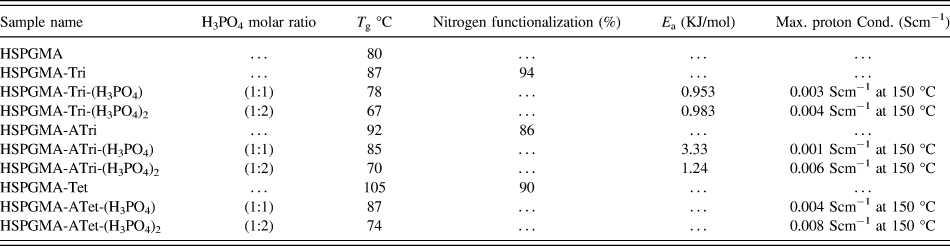
In this study, azole functional HSS-g-PGMA was produced and immobilization of azole which was verified by elemental analysis. Nitrogen contents of the samples were used to calculate azole ratio of the functional polymers. As illustrated from elemental analysis, more than 80% of the epoxide rings were opened by azole units (Table I).
Max. proton conductivity and T g (°C) values for the all membranes.
B. Surface morphology
The selected AFM images of membranes are shown in Fig. 3. When comparing unmodified grafted HSPGMA, bigger granular domains are clearly seen on the surface of azole functional HSPGMA [Fig. 3(b)]. Diameter and level of aggregation of the silica particles were determined from AFM images after their grafting with PGMA the surface of HSS [Fig. 3(a)]. The average vertical distance (diameter) of original particles was about 350 nm. The determination of average diameter was performed by measuring the cross-section of at least 60 single particles. AFM imaging indicates that no significant aggregation occurred (beside the lateral aggregation caused by capillary forces during drying) when the particles were transferred in DMF from the water medium.
AFM pictures (a) HSS-graft-PGMA (HSPGMA) composite membrane. (b) Amino-tetrazole functional HSS-graft-PGMA (HSPGMA-ATet) composite membrane.
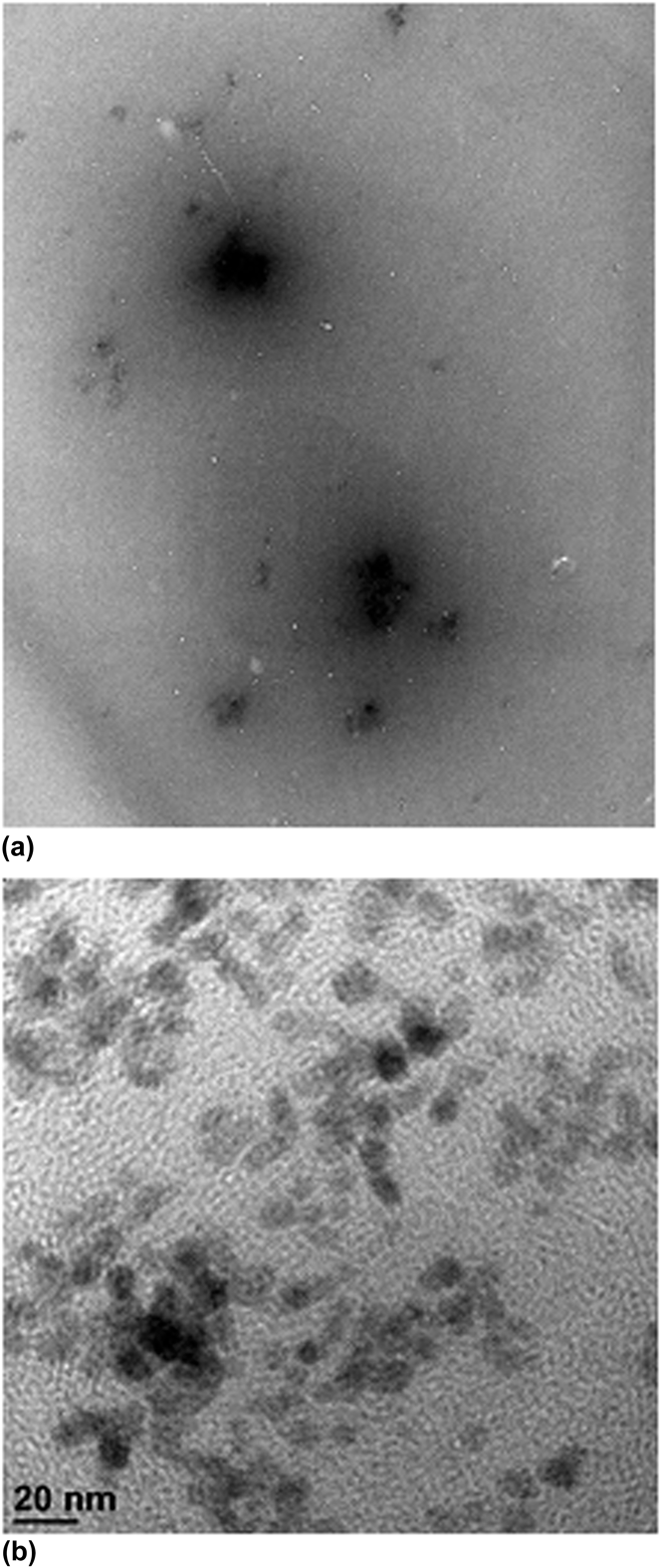
After grafting of PGMA from the silica nanoparticles, TEM images such as that in Fig. 4 show the formation of polymer layer on the 350 nm diameter HSS particles. The 100 nm increase in diameter after polymerization suggests that the polymer layer is 100 nm thick. The particle diameter in TEM images is ∼50 nm after modification with azole units, indicating a ∼100 nm thick polymer layer on the HSS core as seen in the Fig. 4(b), the particles are not aggregated after the modification.
TEM pictures of (a) HSS-graft-PGMA (HSPGMA). (b) Amino-tetrazole functional HSS-graft-PGMA (HSPGMA-ATet) composite membrane.
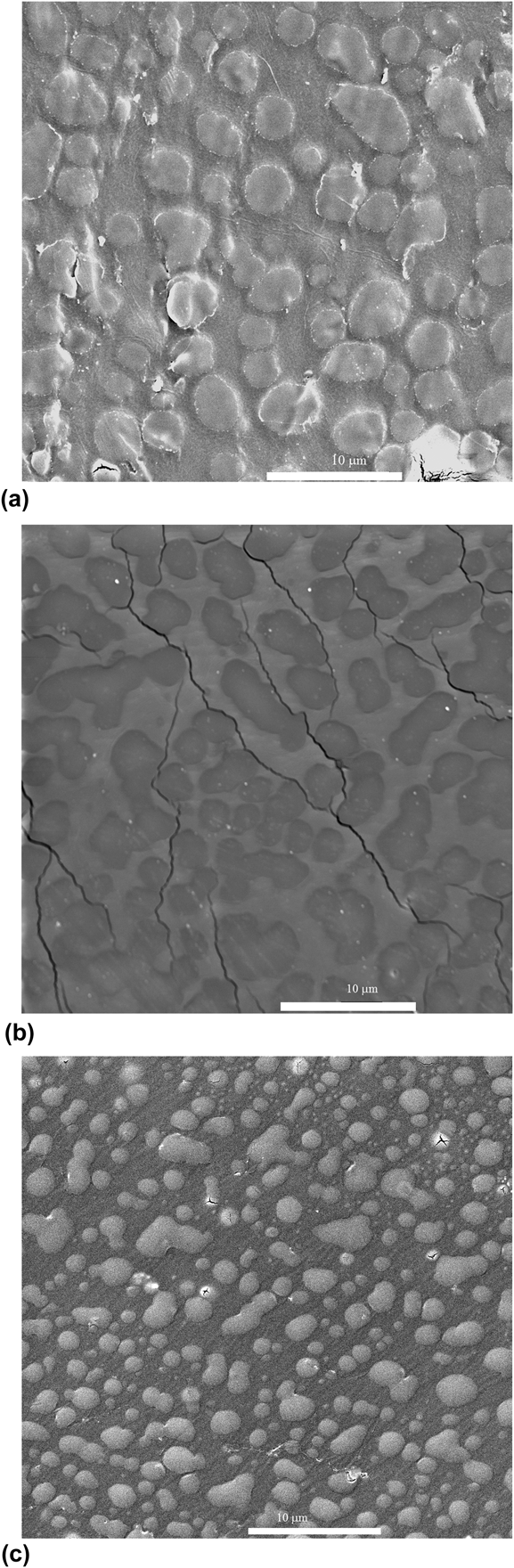
Surface morphologies of HSS HSPGMA HSPGMA-Tri [Fig. 5(a)], HSPGMA-ATri [Fig. 5(b)], and HSPGMA-ATet [Fig. 5(c)] materials were investigated by SEM (Fig. 5). The grafting on the surface of HSS is clearly seen in Fig. 3(b). Here, a pronounced difference is seen when comparing the native and the polymer modified particles. It is clearly seen that the polymer covers the particle surface, although growth has also occurred, as seen in the occurrence of some irregularly shaped particles. At higher grafting levels, these particles attach to polymer forming larger porous agglomerates (>100 μm) composed of hollow silica particles (3.5 μm) held together by a web like polymer structure with micrometer sized interstitial pores. After azole modification, azole units reduced the interaction between the polymer chains so HSS particles diverged. Furthermore, no phase separation occurred during solvent evaporation, hence homogeneous films formed.
SEM pictures (a) Triazole functional HSS-graft-PGMA (HSPGMA-Tri). (b) 5-Amino-Triazole functional HSS-graft-PGMA (HSPGMA-ATri). (c) Amino-tetrazole functional HSS-graft-PGMA (HSPGMA-ATet).
C. Thermal analysis
The glass transition temperature, T g, of the PGMA and HSS-g-PGMA was measured as 47 and 80 °C, respectively. Incorporation of grafting HSS particles with polymer matrix would fill the free volumes and would cause need to more energy for starting segmental motions, which would make T g to increase. Table I shows the DSC curves of Tri, ATri, and ATet functional samples under nitrogen atmosphere at a scan rate of 10 °C/min. The second curves were evaluated. The melting points of pure Tri and ATri compounds are 120 and 157 °C, respectively. The T g of triazole functional HSS-graft-PGMA (HSPGMA-Tri) is around 87 °C, T g of 5-Amino-Triazole functional HSS-graft-PGMA (HSPGMA-ATri) is around 92 °C, and T g of Amino-tetrazole functional HSS-graft-PGMA (HSPGMA-ATet) is 105 °C. After functionalization with azole units, the T g of the samples shifted to higher temperatures.
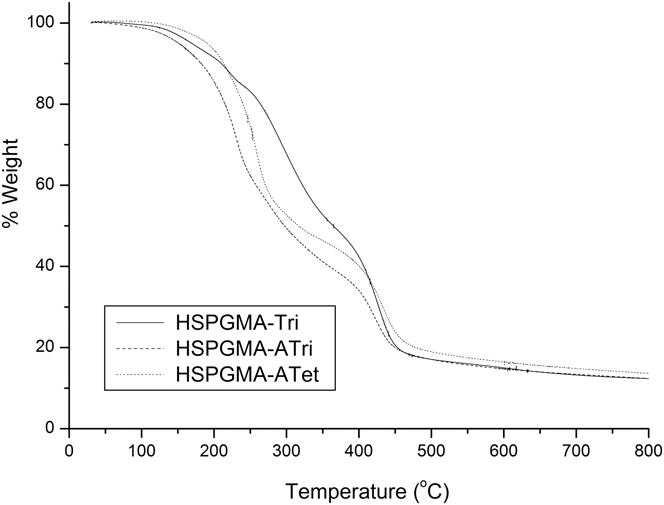
The weight loss in PGMA occurs in two steps within 200–400 °C. TGA plots of weight loss versus temperature provide an estimate of the quantity of polymer grown from the nanoparticles. The coated particles consist of both thermally stable compounds that remain in the residue (silica bound to the polymer) and decomposable polymer brushes and initiators that contribute to weight loss. After the growth of PGMA from the particle, TGA shows a total weight loss of 90%, which corresponds to a PGMA thickness of ∼100 nm. This thickness value agrees reasonably well with the TEM. The TG thermograms of azole functional HSSPGMA showed in Fig. 6. The thermograms of azole functional HSPGMA showed two step decomposition. The weight loss at 200 °C due to decomposition of azole functional polymer chain after 350 °C, HSS particles decomposed. The thermal stability of the composite materials decreased with azole functionalization. This also may be attributed to enlarge the grafting nanoparticle size thus the HSS particles diverged.Reference Pu, Pan, Qin, Wan and Yuan16,Reference Pu, Zhang, Yuan and Yang23,Reference Zhu, Shi, Shen, Dong, Feng, Ruan and Li24
Thermogravimetry (TG) analysis of Triazole functional HSS-graft-PGMA (HSPGMA-Tri), 5-Amino-Triazole functional HSS-graft-PGMA (HSPGMA-ATri), and Amino-tetrazole functional HSS-graft-PGMA (HSPGMA-ATet) composite membranes under nitrogen atmosphere at a heating rate of 10 °C/min.
D. Conductivity measurement
The alternating current conductivities, σac(ω) of the polymers were measured at several temperatures using impedance spectroscopy (supp file). The proton conductivities of anhydrous samples were measured from 20 to 150 °C.
Among phosphoric acid doped HSPGMA-Tri samples HSPGMA-Tri-(H3PO4)2 showed the highest proton conductivity of 0.006 S cm−1 at 150 °C in the anhydrous state in Fig. 7. In the phosphoric acid doped triazole functional HSPGMA systems, the doping ratio is highly effective on the proton conductivity of sample which indicates that major part of proton transport is provided over the H3PO4 as well as over azole units.
Conductivity measurements of H3PO4 doped HSS-graft-PGMA (HSPGMA-Tri-H3PO4) composite membranes versus reciprocal temperature.
As clearly seen in Fig. 8, proton conductivity of HSPGMA-ATri-(H3PO4)2 was measured as 0.004 Scm−1 at 150 °C under anhydrous conditions. The phosphoric doping ratio of 5-Amino-Triazole functional HSPGMA is not impressed on proton conductivity, for HSPGMA-ATri-(H3PO4) proton conductivity was measured as 0.001 Scm−1 at 150 °C under anhydrous conditions.
Conductivity measurements of H3PO4 doped HSS-graft-PGMA (HSPGMA-ATri-H3PO4) composite membranes versus reciprocal temperature.
The proton conductivity of HSPGMA-ATet-(H3PO4)x composite membranes was compared in Fig. 9. Among the phosphoric acid doped Amino-tetrazole functional HSS-graft-PGMA samples HSPGMA-ATet-(H3PO4)2 showed the highest proton conductivity of 0.008 at 150 °C under anhydrous conditions.
Conductivity measurements of H3PO4 doped HSS-graft-PGMA (HSPGMA-ATet-H3PO4) composite membranes versus reciprocal temperature.
Normally, there are two different transport mechanisms that contribute to the proton conductivity in phosphoric acid-doped polymer systems. The first is the structural diffusion (Grotthuss mechanism) in which the conductivity is mainly controlled by proton transport through phosphate ions, i.e.,  ${{\rm{H}}_4}{\rm{PO}}_4^ +$,
 ${{\rm{H}}_2}{\rm{PO}}_4^ -$ (Grotthuss proton transport). The second is the vehicle mechanism where the protons travel through the material on a neutral or charged “vehicle”. Several studies were reported about the contribution of these mechanisms on the proton conductivity of pure phosphoric acid and it was indicated that the former is much more predominant and the conduction mechanism is mainly controlled by the structural diffusion rather than vehicle mechanism. In the current system, the presence of
 ${\rm{HPO}}_4^{2 - }$ and
 ${{\rm{H}}_2}{\rm{PO}}_4^ -$ anions implies that the proton diffusion can also occur throughout these ionized species.Reference Lechner, Dippel, Marx and Lamprecht25,Reference Dippel, Kreuer, Lassegues and Rodriguez26
It seems that the proton hopping from one N–H site to a free nitrogen may contribute to the conductivity of HSPGMA-Azole-(H3PO4)x systems as in the case of imidazole where the long range proton transfer occurs throughout the protonic defects, i.e., protons transport between protonated and unprotonated heterocyclic units.Reference Kreuer, Fuchs, Ise, Spaeth and Maier27–Reference Lin, Cheng, Qiu, Yan, Shang and Lu30 In addition, proton hopping from one N–H site to phosphate ions may also contribute to the conductivity.
In azole functional HSS-graft-PGMA systems, the doping of the phosphoric acid is highly effective on the proton conductivity of sample which indicates that major part of proton transport is provided over the H3PO4 as well as over azole units. Phosphoric acid-doped membranes show Arrhenius behavior at lower acid ratio and Vogel–Tamman–Fulcher type (VTF) behavior at higher acid ratio. For [Figs. 7 and 8], the conductivity isotherm can be fitted with Arrhenius equation Eq. (1);
 $$\ln \sigma = \ln {\sigma _0} - {{{E_{\rm{a}}}} \mathord{\left/ {\vphantom {{{E_{\rm{a}}}} {kT}}} \right. \kern-\nulldelimiterspace} {kT}}\quad ,$$
where σ0 is the pre-exponential terms, E a is the activation energy, and k is the Boltzmann constant. The activation energy was calculated for HSPGMA-Tri-H3PO4 and HSPGMA-ATri-H3PO4 membranes (Table I.)
HSPGMA-ATet-(H3PO4), the curved DC conductivity isotherm follows VTF Eq. (2);
 $$\log \sigma = \log {\sigma _0} - {{{E_{\rm{V}}}} \mathord{\left/ {\vphantom {{{E_{\rm{V}}}} {\left[ {k\left( {T - {T_0}} \right)} \right]}}} \right. \kern-\nulldelimiterspace} {\left[ {k\left( {T - {T_0}} \right)} \right]}}\quad ,$$
where σ0 is the conductivity at infinite temperature, E v is the Vogel activation energy, and T 0 is the Vogel temperature. High accuracy of the VTF parameters for HSPGMA-ATet-(H3PO4)2 indicates the contribution of segmental relaxations to proton conductivity.Reference Celik and Bozkurt21,Reference Dippel, Kreuer, Lassegues and Rodriguez26
From the conductivity and FTIR results, it can be concluded that the host matrix, azole functional HSPGMA includes excess phosphoric acid without significant change in the mechanical properties and conductivity occur throughout the material predominantly by Grotthuss mechanism.
IV. CONCLUSION
In the present work, azole functional HSS graft PGMA polymers have been synthesized via two-step methods. HSS was synthesized with the hydrolysis of PTMS and grafting of PGMA on HSS surface was produced by free radical polymerization of GMA. Azole units were immobilized by ring opening of the epoxide ring. Elemental analysis verified azole immobilization about 80%. The structures of the azole functional PGMA-g-HSS were proved by FT-IR. DSC and SEM results illustrated the homogeneity of the materials. Anhydrous proton conducting properties and thermal properties functional and phosphoric acid doped HSPGMA were investigated. The proton conductivity of the materials increased with phosphoric acid and the temperature. Phosphoric acid doped polymers showed lower T g values. HSPGMA-Tri-(H3PO4)2, HSPGMA-ATri-(H3PO4)2, and HSPGMA-Tet-(H3PO4)2, showed a maximum water-free proton conductivity of approximately 0.004 Scm−1 at 150 °C, 0.006 and 0.008 Scm−1 at 150 °C. Azole functional HSS-g-PGMA membranes can be suggested for application in high temperature polymer electrolyte membrane fuel cells.
Supplementary Material
To view supplementary material for this article, please visit http://dx.doi.org/jmr.2015.222.