Introduction
Dementia was not a health or social care priority until the mid-1970s. Only then, the enormous epidemiological dimension of the disorder (Kay, Reference Kay1964) and the burden it places on informal carers (Gilhooly, Reference Gilhooly, Hanley and Hodge1984; Gilleard, Reference Gilleard1984) became evident. It was also recognized that AD and not arteriosclerotic changes was accountable for the bulk of dementia (Katzman, Reference Katzman1976), and initial reports on the effectiveness of cholinergic therapy in AD appeared (Summers et al., Reference Summers, Viesselmann and Marsh1981). To provide assessment, treatment and advice, but also to contribute to drug development, memory clinics were introduced at that time in the USA, particularly in academic settings. The availability of specialist services and the information disseminated by patient and carer advocacy organizations, which formed around the same time, helped to raise the awareness of dementia in the general public but also in the medical field and among policy makers. In Europe, the first memory clinics opened in London (1983), Munich (1985) and Basel (1986). The first cholinesterase inhibitor (ChE-I) was approved in Germany in 1997 as a specific treatment for AD. It gradually replaced nootropics, herbal extracts, ergot alkaloids, and vasodilators. It may be assumed that increased public awareness of dementia together with the availability of efficacious treatment resulted in older individuals seeking diagnostic evaluation at milder stages of cognitive and functional impairment. To our knowledge, however, only one study has demonstrated a trend towards referral at earlier stages (O’Loughlin and Darley, Reference O’Loughlin and Darley2006).
Aim of the study
In the present study, we examined (1) whether the diagnostic evaluation of persons with presumed cognitive impairment occurred at progressively earlier stages of cognitive decline at a Munich memory clinic between 1985 and 2009, (2) whether there was a trend towards diagnosis of dementia due to AD at earlier disease stages, and (3) whether the shift in severity of cognitive impairment at time of diagnostic evaluation was associated with the availability of efficacious treatment.
Methods
Participants and assessments
The study refers to all individuals who underwent diagnostic evaluation for cognitive impairment between 1985 and 2009 at the Center for Cognitive Disorders, Department of Psychiatry, Klinikum rechts der Isar, Technische Universität München, Munich, Germany. They had been referred by general practitioners, neurologists, psychiatrists, or other institutions, or were self-referred. The diagnostic workup became more extensive over time but always included the MMSE (Folstein et al., Reference Folstein, Folstein and McHugh1975). Participants were included in the present study if a minimal data set was available consisting of the MMSE score at diagnostic evaluation, year of examination, duration of symptoms (estimated on the basis of caregiver information), sex, date of birth, and diagnosis. The diagnosis of dementia due to AD was established according to the National Institute of Neurological and Communicative Disorders and Stroke and Alzheimer's Disease and Related Disorders Association (NINCDS-ADRDA) (McKhann et al., Reference McKhann, Drachman, Folstein, Katzman, Price and Stadlan1984) and the International Statistical Classification of Diseases and Related Health Problems (ICD) criteria (WHO, 2013). WHO criteria changed from the ninth to the tenth edition in 1998 but retained a core set of features which include impairment of memory and other cognitive domains, insidious onset and gradual progression, as well as exclusion of other cerebral or systemic causes.
Following diagnostic evaluation, a treatment scheme was suggested to the referring physician which in patients diagnosed with dementia due to AD usually included the recommendation of an anti-dementia drug.
For this retrospective analysis, the approval from the ethics committee of the Faculty of Medicine of the Technische Universität München was received.
Statistical analysis
-
1. To examine whether the initial diagnostic evaluation occurred at earlier stages of cognitive decline between 1985 and 2009, a linear regression analysis was performed on the entire patient sample using the MMSE score as the dependent variable and the year of the initial examination as the independent variable, controlling for sex and age. A parallel analysis was also calculated using the duration of symptoms instead of the MMSE score as an alternative indicator of disease stage.
-
2. To determine whether there was a trend towards a diagnosis of dementia due to AD at earlier disease stages, a linear regression analysis was performed in individuals diagnosed with dementia due to AD using the MMSE score as dependent variable, and examination year, age, and sex as independent variables.
-
3. To determine whether the presumed trend towards establishing the diagnosis of dementia due to AD at milder degrees of cognitive impairment at the time of diagnostic evaluation was associated with the availability of treatment with ChE-I in 1997, a linear regression analysis was performed in individuals diagnosed with dementia due to AD. The MMSE score was used as dependent variable, and the period of initial examination, dichotomizing the year of diagnostic evaluation with 1997 as a cut-off, age, and sex as independent variables. An additional linear regression analysis was calculated splitting the sample into patients who had been evaluated before or after 1997, respectively, replacing the dichotomized variable “before/after 1997” by the year of diagnostic evaluation as a continuous variable.
For calculating the recommendation rates of ChE-I treatment, a descriptive approach was chosen by visualizing rates in a line chart.
The level of significance was set to 0.05 for all hypotheses tested.
Patients being assessed between 1985 and 1990 were pooled because the number of referrals was relatively low in those years. To determine possible interactions between variables within the different models, interaction terms were used.
Results
Characteristics of patient sample
3,951 individuals with presumed cognitive impairment were assessed between 1985 and 2009. 1,821 of those patients were diagnosed with dementia due to AD. Patients’ characteristics are shown in Tables 1 and 2.
Characteristics of whole patient sample

Legend to Table 1 SD: standard deviation; MMSE: Mini-Mental State examination.
Characteristics of patients with dementia due to AD

Legend to Table 2 ChE-I: Cholinesterase inhibitors; SD: standard deviation; MMSE: Mini-Mental State examination.
Association between severity of cognitive impairment and year of initial examination: Diagnostic evaluation occurs at progressively earlier stages of cognitive decline
The regression model was statistically significant (p < 0.001) with an adjusted R 2 of 0.209 and a significant (p < 0.001) standardized coefficient β for “yearIE” of 0.266. The standardized coefficients β for the control variables were also statistically significant (−0.085 for sex, p < 0.001, −0.328 for age, p < 0.001). This indicates, that the model, controlled for age and sex, explained 20.9% of the variance of the MMSE score at initial examination. Higher MMSE scores indicating less severe cognitive impairment were significantly associated with more recent years of examination.
The alternative analysis using the estimated duration of symptoms instead of the MMSE score as an indicator of disease stage was also statistically significant (p = 0.007) with an adjusted R 2 of 0.003 and a significant (p = 0.001) standardized coefficient β for yearIE of −0.055. β of the control variables sex and age were not significant (p = 0.335 and p = 0.263, respectively).
This indicates that the additional analysis explained 0.3% of the variance of duration of symptoms. Shorter duration of symptoms used as an alternative indicator of earlier stages of cognitive decline was significantly associated with more recent years of examination.
Association between severity of cognitive impairment and year of initial examination in patients diagnosed with dementia due to AD: A trend towards diagnosis of dementia due to AD at earlier disease stages
The regression model of the association between the MMSE score and the yearIE in patients diagnosed with dementia due to AD was statistically significant (p < 0.001) with an adjusted R 2 of 0.079 and a significant (p < 0.001) standardized coefficient β for yearIE of 0.230. In addition, the standardized coefficients β for control variables “sex” were −0.120 (p < 0.001) and for “age” −0.075 (p = 0.001), respectively. This indicates that the model, controlling for age and sex explained 7.9% of the variance of the MMSE. Dementia due to AD was diagnosed at higher MMSE scores indicating earlier stages of dementia in more recent years.
Relationship between diagnosis of dementia due to AD at earlier disease stages and availability of efficacious anti-dementia drugs (approved in Germany in 1997)
The regression model of the association between the MMSE score and period of initial examination (before versus after 1997) in patients diagnosed with dementia due to AD was statistically significant (p < 0.001) with an adjusted R 2 of 0.064 and a significant (p < 0.001) standardized coefficient β for the period of examination of 0.195. In addition, standardized coefficients β for the control variables were significant (−0.124, p < 0.001 for sex and −0.068, p = 0.003 for age, respectively). This indicates that the model, controlled for age and sex, explained 6.4% of the variance of the MMSE. Dementia due to AD was diagnosed at higher MMSE scores indicating earlier stages of dementia after 1997.
The regression model of the association between the MMSE score as a measure of clinical severity and the year of examination was statistically significant (p < 0.001, adjusted R 2 of 0.029) in the subsample of patients who had been evaluated before the introduction of the first ChE-I in 1997. The standardized coefficient β for the year of examination was 0.089 (p = 0.019). The regression model was also statistically significant (p < 0.001, adjusted R 2 of 0.038) in the subsample of patients who had been evaluated after 1997. In this subsample, the standardized coefficient β for the year of examination was 0.133 (p < 0.001) The higher β of the latter analysis underscores the increase of mean MMSE scores after 1997 indicating earlier stages of dementia at time of evaluation.
None of the interaction terms included in the above mentioned linear regression analyses were statistically significant. This indicated no significant interaction between the used independent variables.
The recommendation rates of ChE-I treatment
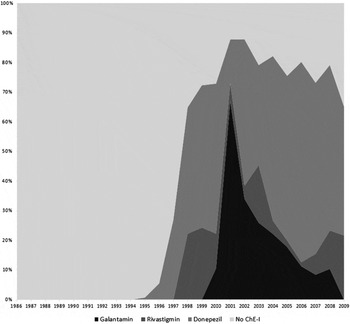
Figure 1 shows the recommendation rates for treatment with ChE-I in dementia due to AD patients between 1985 and 2009. Treatment with donepezil was most commonly recommended followed by galantamine and rivastigmine.
Recommendation rates of ChE-I in dementia due to AD between 1985 and 2009. Legend to Figure 1. ChE-I: Cholinesterase inhibitors.

Discussion
In this study, we first aimed to determine whether the diagnostic evaluation of older individuals with suspected dementia occurred at progressively earlier stages of cognitive decline between 1985 and 2009. We found a significant association between the severity of cognitive impairment as indicated by the MMSE score at the initial examination and the year of examination. Consistently, there was also a significant inverse association between the estimated duration of symptoms and the year of examination. These relationships suggest that at this particular memory clinic older adults presenting with suspected dementia underwent diagnostic evaluation at progressively earlier degrees of cognitive impairment and shorter duration of symptoms over time. The present study does not speak to the reasons for this association. Growing public awareness of dementing disorders due to information campaigns, increased internet access, or by heightened sensibility regarding cognitive impairment of referring physicians would be possible explanations. This finding is in line with the sole previous study in which MMSE scores of patients referred to the old age psychiatry service were higher in 2003 than in 1996 (O’Loughlin and Darley, Reference O’Loughlin and Darley2006).
The second question addressed in this study was whether there was a trend specifically towards a diagnosis of dementia due to AD at earlier disease stages. We were able to demonstrate that this diagnosis was established at increasingly higher MMSE scores indicating progressively earlier degrees of cognitive impairment over time. One reason why physicians diagnosed dementia due to AD at milder stages over time might be in order for them to facilitate the commencement of ChE-I treatment sooner. However, a trend towards earlier referrals might be an alternative explanation.
Third, we asked whether the trend towards an earlier diagnosis of dementia due to AD was associated with the availability of efficacious pharmacological treatment which started in Germany in 1997 when the first ChE-I was approved. Correspondingly, the MMSE scores of the patients diagnosed with dementia due to AD were higher and increased more rapidly after 1997. These findings could be explained by a change of diagnostic standards, i.e. patients were diagnosed with dementia due to AD already at the stage of milder symptoms, or physicians referring persons earlier due to the availability of efficacious treatment. In addition, while a higher percentage of females was seen in a memory clinic and the majority of patients diagnosed with dementia due to AD were female, we observed a significant increase of the proportion of men seeking advice in the memory clinic and in the patients diagnosed with dementia due to AD. This could be interpreted as an increase of awareness of cognitive impairment in male patients by themselves, their families, or referring physicians.
With regards to the recommendation rates of the different ChE-I (Figure 1), it appears that there was an impact of marketing strategies since there was an obvious shift towards the substance newly introduced into market, i.e. rivastigmine in 1998 and galantamine in 2000.
The strengths of the current study are the large number of cases and the long 25 years interval assessed. However, data of only one memory clinic are included, thus results might not be generalizable.
In conclusion, our results are compatible with the view that diagnostic evaluation at a Munich memory clinic occurred at progressively earlier stages of cognitive decline from 1985–2009, that dementia due to AD was diagnosed at earlier disease stages, and this trend was associated with the availability of efficacious treatment.
Conflict of interest
None.
Description of authors’ roles
T. Grimmer, S. Beringer, and V. Kehl designed the analyses, S. Beringer performed statistical analyses, T. Grimmer and S. Beringer drafted the manuscript. All authors participated in interpretation of data and approved the final version.