Introduction
Metal matrix composites (MMCs) typically incorporate hard (usually ceramic) reinforcement into a metal matrix, enabling mechanical properties that are unattainable with the individual constituents of either the filler material or the metal matrix. Traditional methods such as solid-solution and precipitate strengthening can significantly increase the strength of an alloy, but often do not cause a pronounced change in modulus, which is a direct measure of the chemical bond stiffness of the metal. In MMCs, on the other hand, the reinforcing agent effectively improves the modulus as a result of its load-bearing capability upon mechanical loading.
The development of MMCs is always accompanied by the search, discovery, and subsequent use of more advanced reinforcements. In the past decade, with the emergence of nanocarbon materials such as carbon nanotubes (CNTs), graphene, and their derivatives, research efforts have been dedicated to the fabrication and characterization of nanocarbon-reinforced MMCs.Reference Tjong1–Reference Baig, Mamat and Mustapha3 In their pristine, single-crystalline form, nanocarbon materials are reported to have extremely high strengths (130 GPa)Reference Lee, Wei, Kysar and Hone4 and high Young’s modulus (1 TPa).Reference Lee, Wei, Kysar and Hone4 Even if these nanocarbon materials contain a certain concentration of crystalline defects, their intrinsic properties still prevail over those of conventional fiber and particle reinforcements.Reference Li, Guo, Li, Fan, Xiong, Su, Zhang and Zhang5 Furthermore, property enhancement from the nanocarbon reinforcements can well exceed that predicted by the “rule-of-mixture,” owing to the confinement of dislocations imposed by the interface between the metal matrix and the nanocarbon fillers.Reference Kim, Lee, Yeom, Shin, Kim, Cui, Kysar, Hone, Jung, Jeon and Han6–Reference Chen, Shen, Ye, Jia, Li, Umeda, Takahashi and Kondoh8
This article highlights and reviews recent important research progress in the field of the mechanical behavior of nanocarbon-reinforced MMCs. State-of-the-art developments regarding the fabrication and processing of these composites are discussed. Particular emphasis is given to the structure and properties relation of the nanocarbon–metal interfaces, since the interfaces not only transfer external load from the matrix to the reinforcement, but also affect the deformation mechanism of the composite.Reference Kim, Lee, Yeom, Shin, Kim, Cui, Kysar, Hone, Jung, Jeon and Han6–Reference Chen, Shen, Ye, Jia, Li, Umeda, Takahashi and Kondoh8 Finally, perspectives and challenges are proposed and identified for the further advancement of this field.
Fabrication and processing
The greatest difficulty in fabricating nanocarbon-reinforced MMCs is the uniform dispersion of these nanoscale reinforcements in the metal matrix. The high surface-to-volume ratio of CNTs and graphene is a “double-edged sword,” which may lead to much better stiffening and strengthening efficiencies than conventional reinforcements,Reference Li, Guo, Li, Fan, Xiong, Su, Zhang and Zhang5 but may also cause easy agglomeration as a result of the strong van der Waals interaction between the nanocarbon reinforcements.Reference Liang, Huang, Zhang, Wang, Ma, Guo and Chen9 This situation becomes worse if the metal surface and the nanocarbon are chemically incompatible (i.e., lacking chemical interactions). The initially uniformly dispersed nanocarbon in solvents may re-agglomerate on metal surfaces during composite fabrication, preferentially at the fringes and cavities on the metal surface. In addition, because the mechanical properties of CNTs and graphene are highly anisotropic, it becomes critical to align the nanocarbon reinforcements in their load-sharing orientations for optimum mechanical performance. In order to tackle these issues, different composite fabrication routes have been developed and implemented. These can be divided primarily into two types of approaches.
Powder-metallurgy-based composite fabrication
Powder-metallurgy (usually represented as ball-milling) processing is characterized by high strain rates, resulting in severe plastic deformation in the milled materials. It is an important approach for the fabrication of nonequilibrium alloys and nanocrystalline metals.Reference Suryanarayana10–Reference Witkin and Lavernia12 In the past decade, numerous studies have reported the attainment of uniformly distributed CNTs and graphene nanosheets inside a metal matrix using ball-milling processes. The advantages of ball-milling include its simplicity, high efficiency, and general applicability. However, the high-energy process and severe deformation upon milling may give rise to fracture and damage of the nanocarbon reinforcement, and introduce various defects. The formation of brittle intermetallic phases may also occur owing to the chemical reaction at the nanocarbon/metal interfaces during ball-milling. Therefore, it has been considered that simple co-milling of CNTs or graphene together with metal powders can hardly realize the mechanical property enhancement in nanocarbon-reinforced MMCs.Reference Tjong1,Reference Li, Guo, Li, Fan, Xiong, Su, Zhang and Zhang5
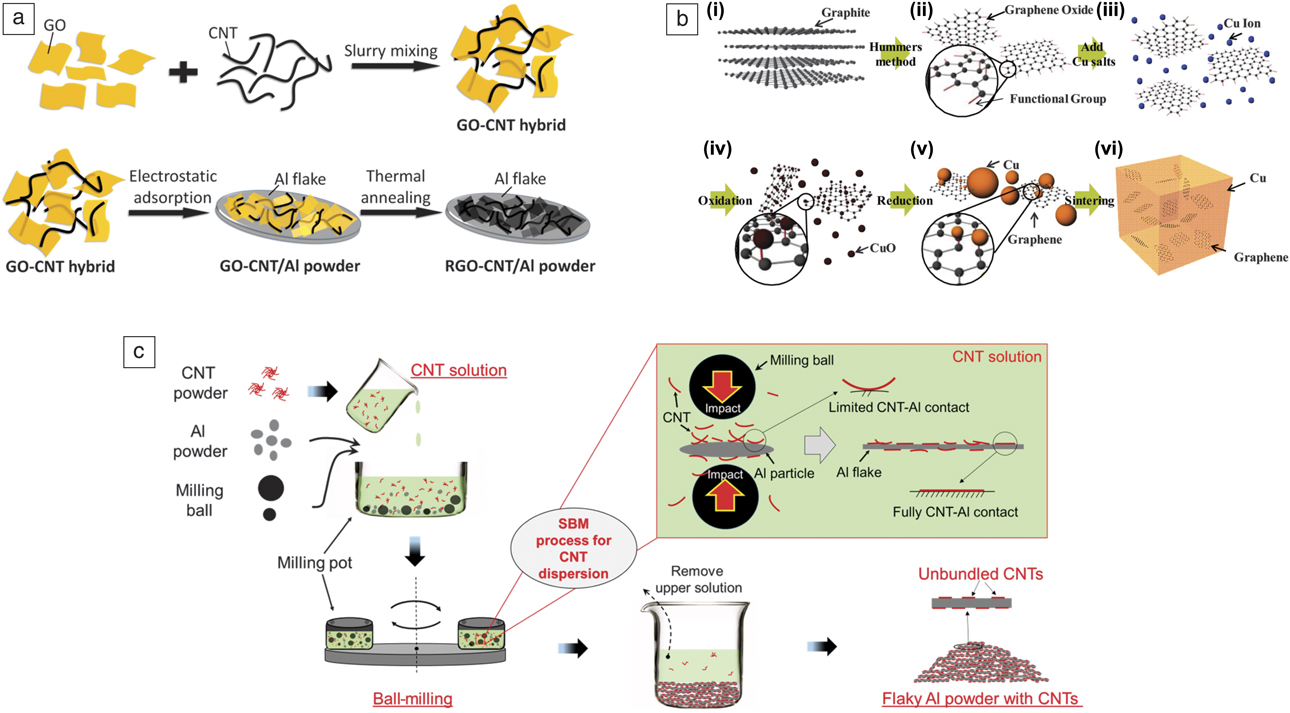
To minimize the damage caused by high-energy ball-milling, different modified powder-metallurgy approaches have been attempted to fabricate nanocarbon-metal composites. Li et al.Reference Li, Guo, Li, Fan, Xiong, Su, Zhang and Zhang5,Reference Li, Fan, Guo, Li, Su and Zhang13 developed a processing route (Figure 1a), where instead of co-milling nanocarbon (CNTs and reduced graphene oxide) and aluminum (Al) powders together, only the spherical Al powders go through the milling procedure. The initially spherical metal powders are then converted into platelets having thicknesses varying from hundreds of nanometers to microns. The CNTs and graphene are then absorbed on the platelet surfaces in an organic solvent. Bulk composite samples suitable for macroscopic tensile tests are subsequently obtained by the drying and sintering of the composite powders followed by final deformation processing.Reference Li, Guo, Li, Fan, Xiong, Su, Zhang and Zhang5,Reference Li, Fan, Guo, Li, Su and Zhang13 Since high-energy milling is not used in this case, the structural integrity is maintained, thus rendering an excellent strengthening and stiffening effect in the sample.
Fabrication of nanocarbon-reinforced composites using a powder-metallurgy-based approach. (a) Fabrication procedure of Al-matrix composite reinforced by carbon nanotube (CNT)-reduced graphene oxide (RGO) hybrids, using the flake powder-metallurgy route.Reference Li, Fan, Guo, Li, Su and Zhang13 (b) Fabrication of RGO-Cu composite, using the molecular-level mixing approach.Reference Hwang, Yoon, Jin, Lee, Kim, Hong and Jeon14 (c) Schematic of the solution ball-milling process for preparation of CNTs/Al composite powders.Reference Chen, Li, Jia, Umeda, Takahashi and Kondoh15 Note: GO, graphene oxide; SBM, solution ball-milling.

An alternative approach is molecular-level mixing,Reference Hwang, Yoon, Jin, Lee, Kim, Hong and Jeon14 as demonstrated in Figure 1b, where functionalized graphene flakes were uniformly dispersed and chemically bonded to the metal-matrix ions. Subsequently, the graphene functional groups and the metal oxide were thermally reduced and the composite powders were sintered and consolidated to form the bulk composite. This process confers a robust interfacial bonding between the nanocarbon reinforcements and the metal matrix, although reducibility of the metal may limit the material systems that are eligible for such a process.
Chen et al.Reference Chen, Li, Jia, Umeda, Takahashi and Kondoh15 developed a solution ball-milling approach to homogeneously disperse and coat CNTs on Al powder surfaces (Figure 1c) as a third process to prepare CNT-metal composite powders. This process integrates the strategies of solution coating by zwitterionic surfactants,Reference Kondoh, Threrujirapapong, Imai, Umeda and Fugetsu16 mechanical ball-milling, and Al flakes, achieving a uniform dispersion of CNTs in the Al matrix as well as a robust adhesion at the CNT-Al interfaces. Specifically, mechanical impact renders a strong interface between CNTs and Al, as compared to their limited contact before impact. After milling, the slurry was transferred to settle the CNT-Al powders, which were then dried in an oven.
Layer-by-layer deposition
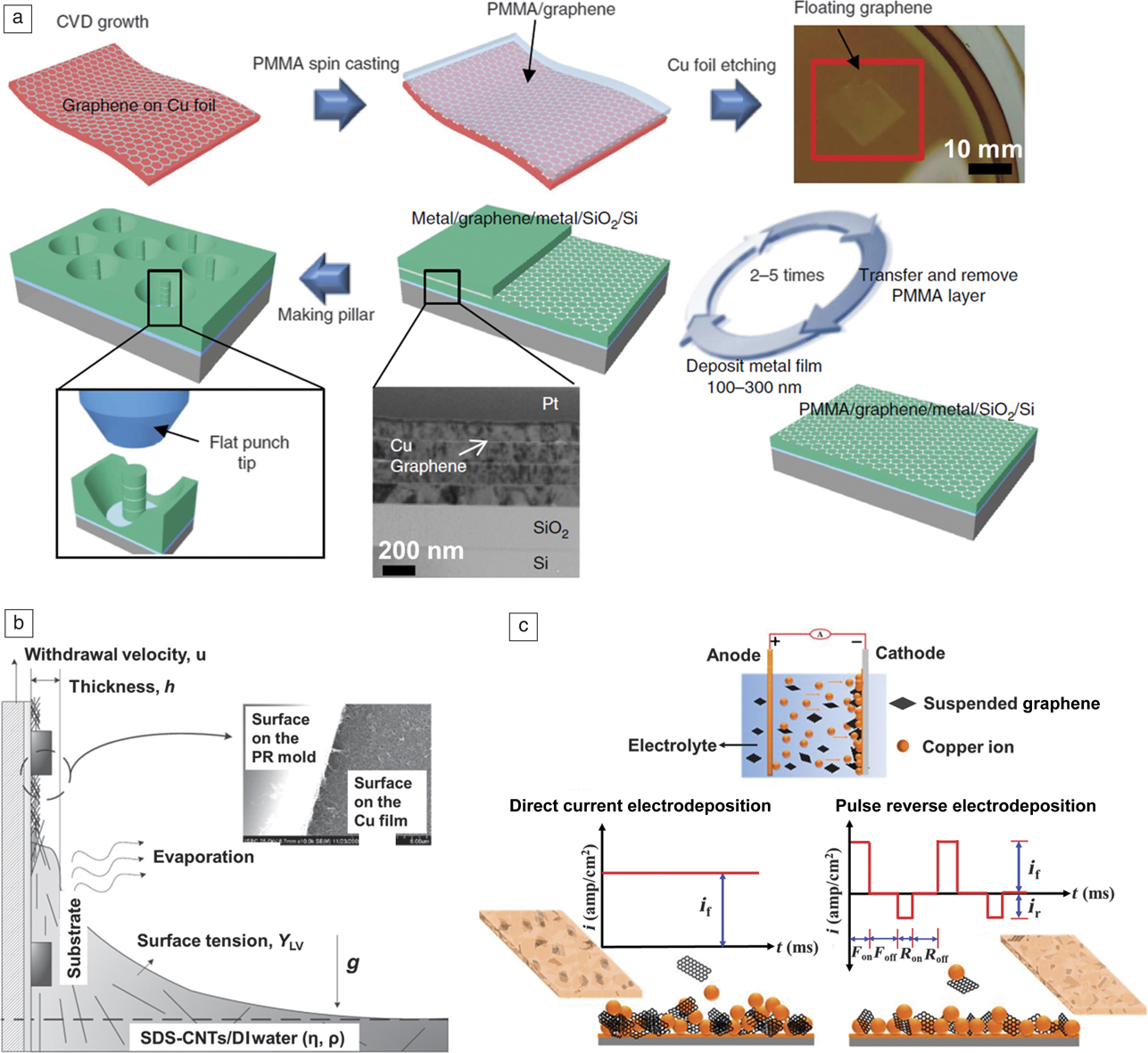
Kim et al.Reference Kim, Lee, Yeom, Shin, Kim, Cui, Kysar, Hone, Jung, Jeon and Han6 fabricated graphene-Cu and graphene-Ni nanolaminated composite multilayers by alternately evaporating metal thin films and transferring monolayer or bilayer graphene onto the metal-deposited substrate, as schematically illustrated in Figure 2a. Uniaxial compression tests on nanopillars fabricated from the composite films showed that the nanolayered composite pillars have extremely high strengths, reaching above 30% and 50% of the theoretical strength of Cu and Ni, respectively, which can be attributed to the obstruction of dislocations by the graphene layers. Alternatively, selective dip coating (Figure 2b)Reference Kang, Yoon, Kim, Kum, Huh, Hahn, Moon, Lee and Kim17 and electrochemical deposition (Figure 2c)Reference Pavithra, Sarada, Rajulapati, Rao and Sundararajan18 can also be used to fabricate nanocarbon–metal laminates with improved mechanical properties. As compared to the powder metallurgy route, the layer-by-layer deposition approach allows for a precise control over the thickness down to the nanoscale and the orientation of nanocarbon reinforcements. There are limitations, however, in large-scale production, where roll-to-roll based processing development is underway to improve upon scalability; the metal-graphene nanolaminates are essentially only applicable for thin-film- or foil-type samples in its current state.
Fabrication of nanocarbon-reinforced composites based on a layer-by-layer approach. (a) Fabrication and mechanical characterization of graphene/Cu composite nanolaminates.Reference Kim, Lee, Yeom, Shin, Kim, Cui, Kysar, Hone, Jung, Jeon and Han6 (b) Fabrication of CNT-Cu laminated composite by selective dip coating. Reprinted with permission from Reference Reference Kang, Yoon, Kim, Kum, Huh, Hahn, Moon, Lee and Kim17. © 2007 Wiley. (c) Experimental setup for the electrodeposition of graphene/Cu composite foil. Reprinted with permission from Reference Reference Pavithra, Sarada, Rajulapati, Rao and Sundararajan18. © 2014 Nature Publishing Group. Note: CNTs, carbon nanotube; PMMA, poly(methyl methacrylate); CVD, chemical vapor deposition; PR, pulse reverse; SDS, sodium dodecyl sulfate; DI, deionized water.

Interfaces and deformation mechanisms
The mechanical behavior of MMCs depends on the intrinsic properties of the matrix and the reinforcement, as well as the structure and characteristics of their interfaces. The MMCs containing CNTs or graphene can be mostly classified as discontinuously reinforced MMCs (DRMMCs), in contrast to the composites reinforced by long fibers that pass through their entire gauge length. In DRMMCs, the external mechanical load is transferred from the metal matrix to the reinforcement (CNTs or graphene in this case) via shear stresses developed at the reinforcement/matrix interfaces; this mechanism is called the shear-lag framework.Reference Jackson, Vincent and Turner19 Therefore, the maximum load shared by CNTs or graphene layers and the failure mechanism of the composite strongly depend on the shear strength of the nanocarbon/metal interfaces, the magnitude of the shear strength relative to the shear yield strength of the matrix, and the geometry of the CNTs and graphene layers (most significantly, the aspect ratio).Reference Kim, Lee, Yeom, Shin, Kim, Cui, Kysar, Hone, Jung, Jeon and Han6,Reference Chen, Shen, Ye, Jia, Li, Umeda, Takahashi and Kondoh8
Chen et al.Reference Chen, Shen, Ye, Jia, Li, Umeda, Takahashi and Kondoh8 found that in the case of Al composites reinforced with CNTs having various aspect ratios, the strengthening was governed by load transfer when the CNTs had an aspect ratio greater than 40, whereas it became dominated by CNT-dislocation interactions (Orowan-type mechanism) when the aspect ratio was reduced to less than 10. In other words, effective tailoring of the mechanical properties of the composites requires proper design and accurate measurement of the interfacial properties. Fortunately, along with the recent development of mechanical testing methodologies at the micro-/nanoscale,Reference Greer, Oliver and Nix20,Reference Greer and De Hosson21 the CNT (graphene)/metal interfacial strength can be determined with good precision, using micro-/nanopillar testsReference Feng, Guo, Li, Fan, Li, Xiong, Su, Tan, Zhang and Zhang22 or tensile testing right at the interface, where mechanical load is directly applied to the interface.Reference Cao, Xiong, Tan, Ji, Amin-Ahmadi, Guo, Fan, Guo, Li and Zhang23
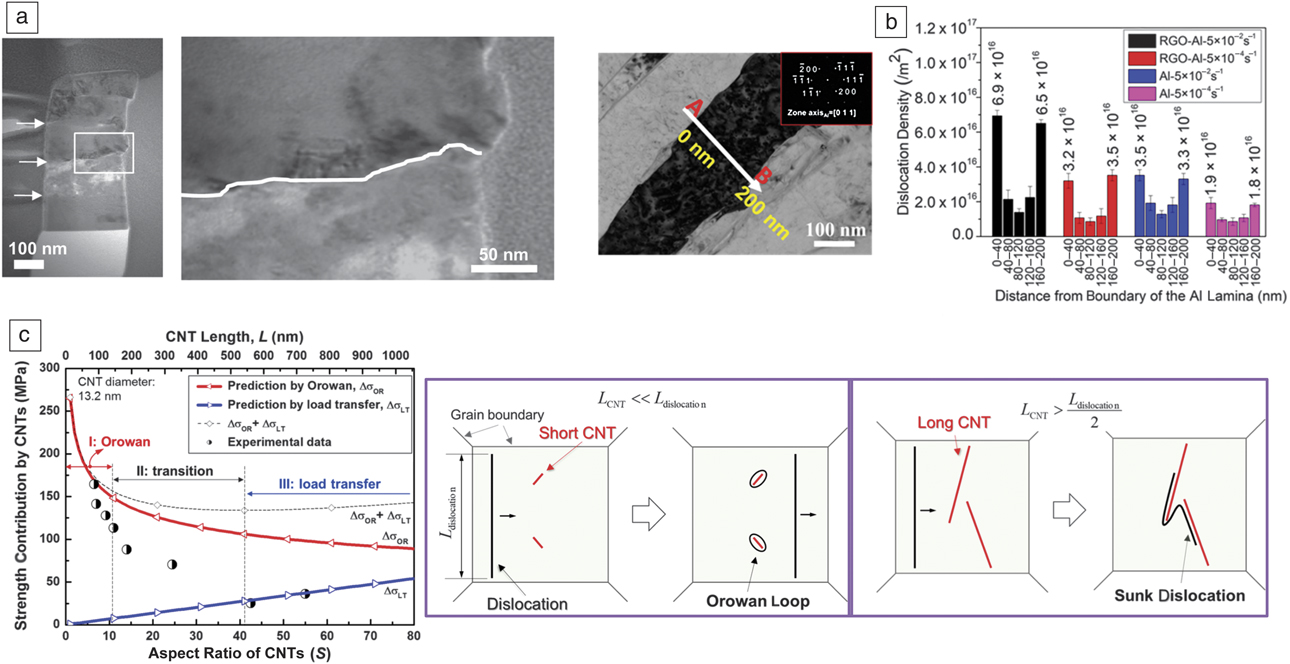
The strengthening and deformation mechanisms in nanocarbon-reinforced MMCs are usually complex due to the simultaneous occurrence of multiple potential mechanisms. CNTs and graphene are at the same length scale (at least in one dimension) as the conventional shear-resistant precipitates or the cluster of solute atoms in a solid-solution matrix of metal alloys. Thus, much like the precipitates and solutes, nanocarbons are expected to have similar interactions with dislocations in the metal matrix during deformation, whose effect may well dominate those caused by the load-sharing of the reinforcements.Reference Kim, Lee, Yeom, Shin, Kim, Cui, Kysar, Hone, Jung, Jeon and Han6,Reference Chen, Shen, Ye, Jia, Li, Umeda, Takahashi and Kondoh8 In the case of graphene and graphene derivatives (typically appearing as discontinuous nanosheets in the composites), the nanosheets would normally segregate into the matrix grain boundaries because of their two-dimensional geometry and relatively large lateral dimension, especially to the interlamellar boundaries in graphene-metal laminated composites.Reference Li, Guo, Li, Fan, Xiong, Su, Zhang and Zhang5,Reference Li, Zhao, Guo, Li, Fan, Guo and Zhang24 It has been extensively reported that these graphene layers at the boundaries would obstruct dislocation motion and lead to significant strengthening in the composites (Figure 3a–b).Reference Kim, Lee, Yeom, Shin, Kim, Cui, Kysar, Hone, Jung, Jeon and Han6,Reference Zhao, Guo, Li, Li, Fan, Xiong, Su, Zhang, Tan and Zhang7 In the case of metal-graphene nanolayered composites with nanoscale layer spacing, the graphene interface has also been reported to hinder crack propagation, resulting in robustness against embrittlement or fatigue-induced failure.Reference Hwang, Kim, Kim, Lee, Lim, Kim, Oh, Ryu and Han25,Reference Kim, Baek, Kim, Kim, Ryu, Jeon and Han26
Deformation mechanisms in nanocarbon-reinforced metal matrix composites. (a) Obstruction of dislocations at a graphene/Cu interface in a deformed composite nanopillar.Reference Kim, Lee, Yeom, Shin, Kim, Cui, Kysar, Hone, Jung, Jeon and Han6 (b) Left: transmission electron microscope (TEM) image of an Al grain tilted to [011] zone axis. The white arrow represents the direction when taking the successive five high-resolution TEM images for dislocation density measurement. A and B indicate the boundaries on either side of the selected lamella, respectively. The inset is the selected-area electron diffraction pattern of the dark grain in the left image. Right: Typical dislocation density distribution across lamella thickness in a ∼200-nm-thick Al lamella, in deformed reduced graphene oxide (RGO)-Al nanolaminated composite and pure Al pillars compressed at the strain rates of 5 × 10⁻⁴ s–1 and 5 × 10⁻² s–1.Reference Zhao, Guo, Li, Li, Fan, Xiong, Su, Zhang, Tan and Zhang7 Dislocation pileups become more significant at the interlamellar boundaries with the incorporation of RGO at the boundaries and/or increasing strain rate. (c) Dependence of strength contribution by carbon nanotubes (CNTs) on the aspect ratio (or length) of CNTs, and interaction between matrix dislocations and CNTs with small and large lengths in metal grains.Reference Chen, Shen, Ye, Jia, Li, Umeda, Takahashi and Kondoh8

For CNT-reinforced MMCs, in addition to the possible previously mentioned deformation mechanisms, since the CNTs have at least two dimensions at the nanoscale, if they are incorporated in the interior of matrix grains, they would contribute to Orowan-typed strengthening, via a mechanism similar to dispersion/precipitate strengthening in age-hardenable alloys.Reference da Costa Teixeira, Cram, Bourgeois, Bastow, Hill and Hutchinson27 Comparing the experimental and predicted strengthening effect versus the aspect ratio of CNTs (Figure 3c),Reference Chen, Shen, Ye, Jia, Li, Umeda, Takahashi and Kondoh8 the predictions made by Orowan strengthening and load-transfer mechanisms have opposite trends when the length of the CNTs varies: with increasing CNTs length (i.e., increasing aspect ratio, S), the strength contribution from load transfer shows a linear increase, while the contribution from Orowan strengthening exhibits a considerable reducing trend.
From this comparison between experiment and theory, the strengthening behavior exhibits three distinct regimes. In regime I, where the aspect ratio is small (i.e., close to or smaller than 10), the strength of the Al-CNTs composites can generally be fitted to the Orowan mechanism. In regime II, the experimental strength values are located between the strengths predicted by Orowan strengthening and the load-transfer model. The strengths are noticeably lower than the predictions by Orowan strengthening and yet, they are still much larger than the values predicted by the load-transfer model, indicating that the composites’ strength in this regime is affected by both mechanisms. On the other hand, in regime III, the moderate increase in strength fits well with the load-transfer mechanism and is much smaller than that predicted by the Orowan mechanism. In other words, in this regime, load transfer becomes the dominant strengthening mechanism, whereas Orowan strengthening plays only a secondary or even just a minor role in strength contribution.
Perspectives and challenges
The development of nanocarbon-reinforced MMCs is still at an early stage. For bulk composites produced from the powder metallurgy approach, to compete with conventional alloys and composites, scalable fabrication routes at reasonable cost have to be developed, as the incorporation and uniform dispersion of CNTs and graphene in the metal matrix require tremendous processing effort and further process optimization. For thin-film-type nanocarbon–metal composites, the application area may lie in flexible and stretchable electronics. For these composites to be used in actual structural applications, both fundamental and applied research needs to be carried out on their mechanical performance under service conditions. In this regard, several research groups have made pioneering studies, by investigating the mechanical behavior under cyclicReference Kim, Baek, Kim, Kim, Ryu, Jeon and Han26 and irradiationReference Kim, Baek, Kim, Kim, Ryu, Jeon and Han26,Reference So, Chen, Kushima, Li, Kim, Yang, Wang, Park, Lee, Gonzalez, Kiwi, Bringa, Shao and Li28 conditions.
Acknowledgments
This work was financially supported by the National Key Research and Development Program of China (Nos. 2017YFB0703103 and 2016YFE0130200), the National Natural Science Foundation of China (No. 51771111), the Science & Technology Committee of Shanghai Municipality (No. 17520712400), JSPS KAKENHI Grant (No. JP16H02408), and the National Research Foundation of Korea Grant (No. 2016R1A2B3011473). Q.G. would like to acknowledge L. Zhao for her assistance in manuscript preparation.

Qiang Guo is an associate professor in the State Key Lab of Metal Matrix Composites, Shanghai Jiao Tong University, China. He received his BSc degree in microelectronics from Peking University, China, in 2005, and his MEng degree in materials science and engineering from the Massachusetts Institute of Technology (MIT), in 2006. He obtained his PhD degree in advanced materials in 2010 from the National University of Singapore, under the Singapore-MIT Alliance Program. From 2010 to 2012, he was a postdoctoral researcher in the Division of Engineering and Applied Sciences at the California Institute of Technology. His current research focuses on the mechanical behavior of metal matrix composites. Guo can be reached by email at guoq@sjtu.edu.cn.

Katsuyoshi Kondoh has been a professor at the Joining and Welding Research Institute, Osaka University, Japan, since 2006, and is a vice executive director at Osaka University, in the Department of International Affairs. He obtained his PhD degree at Osaka University in 1998, and was an associate professor at The University of Tokyo, Japan, for six years. His research focuses on materials and processing of powder metallurgy, in particular nonferrous metals such as titanium, magnesium, aluminum, and their nanocomposites. He has a journal publication number of more than 290 and citation index of more than 3000. Kondoh can be reached by email at kondoh@jwri.osaka-u.ac.jp.

Seung Min J. Han has been with the Korea Advanced Institute of Science and Technology (KAIST), Republic of Korea, since 2010. She is currently an associate professor in the Department of Materials Science and Engineering at KAIST. She received her PhD degree at Stanford University in 2006 and was an acting assistant professor at Stanford University for four years before joining KAIST. Her research focuses on the deformation behavior of nanolayered composites ranging from coherent/incoherent metal-based systems to metal-graphene nanolayered composites. Han can be reached by email at smhan01@kaist.ac.kr.