Introduction
Historically, savanna communities have been an important component of the world's landscape, occurring on nearly every continentReference Werner, Walker and Stott1. This ecosystem in the upper Midwest USA is characterized by widely scattered oak trees with an understory of herbaceous prairie grass, sedge and forb speciesReference Packard and Mutel2. It is estimated that 3 million ha of oak savanna existed in the upper Midwest prior to the arrival of Europeans, but less than 1% of this ecosystem remains todayReference Nuzzo3. The loss of prairie and oak savanna can be attributed to two separate causes: agriculture/urban development and woody encroachment due to lack of proper grazing and/or fire managementReference Schaffner4–Reference Bowles and McBride7. Without fire or moderate grazing, woody plant encroachment poses a major threat to grazing lands worldwideReference Archibald, Bond, Stock and Fairbanks8–Reference Moleele11.
The reintroduction of fire or grazing has potential interest for savanna restoration as both are less labor intensive/expensive than hand-thinning or treating the shrubs with herbicides. Fire is not always successful at reducing dense shrubs, primarily due to lack of fuel beneath themReference Haney, Apfelbaum, Stearns and Holland12, and it may subject farmers to serious liability issues. Managed (rotational) grazing with moderate stocking densities, however, has rarely been tested in restoring oak savanna structure. Hence, managed grazing may be a potential conservation management tool if the initial shrub quantity and quality can contribute to maintaining animal performance. Williams and Bronny suggest that using managed grazing has potential to clear out the overgrown understory of the oak savanna and restore its structureReference Williams13, Reference Bronny14.
Uncultivated tree and shrub leaves are not commonly considered as cattle feed in the USA. Researchers have generally found that browse makes up only a small part of cattle diet on the rangeReference Everitt, Gonzalez, Scott and Dahl15, and although it can be of high qualityReference Turner, Foster, Phillips and Terrill16, Reference Gonzalez and Everitt17, it often contains anti-nutritional elements such as tannins, phenolics or saponinsReference Balogun, Jones and Holmes18–Reference Jung20, all which can reduce digestibility or cause metabolic problems. However, others report that herbivores are able to offset negative effects of these anti-quality factors and increase intake when given a diverse selection of plants to choose fromReference Lyman, Provenza and Villalba21.
In the USA, grazing has been tested to reduce shrub density and it may also serve as potential method to increase species diversity within the opened areasReference Howe22, Reference Knapp, Blair, Briggs, Collins, Hartnett, Johnson and Towne23. Observational information suggests that Scottish Highland cattle are good browsers, making them a possible management tool for opening rough habitat such as the overgrown shrub layer of degraded oak savanna. This cattle species is known for thriving in the rugged conditions of the Scottish HighlandsReference van der Bilt24, Reference van Wieren25. Since most oak savanna exists on private land, the challenge is to determine whether cattle grazing behavior can be managed so that it will restore the savanna community structure with minimal impact on remnant native plant species and whether this process is of economic value to livestock producers. Three separate land managers interested in using grazing as a management tool wanted to open up the oak savanna on the edge of their grazing fields because they thought it would provide some forage, offer the animals some shelter in the hottest and coldest days, and be aesthetically pleasing. As part of a larger research project to measure the impact of grazing on the oak savanna vegetationReference Harrington and Kathol26 and its effect on animal performanceReference Hedtcke, Posner, Rosemeyer, Egan and Harrington27, the objectives of this study were to: (1) measure shrub quality and variability; and (2) monitor behavior by Scottish Highland cattle when confronted with plant species common in degraded oak savannas. Our hypothesis is that if palatable, this shrub layer of the overgrown oak savanna could provide a supplemental feed source. This information on browse acceptability and feed value would help livestock owners and land managers to design feeding and supplementation strategies when expanding managed grazing acreage to include overgrown oak savanna remnants.
Methods
Site characterization
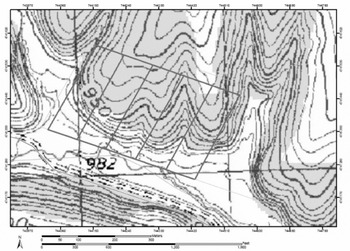
To compare the impact of grazing with no grazing on overgrown oak savanna, the study was established at three sites all within 20 km of each other, in the Driftless (unglaciated) region of southwestern Wisconsin. The three sites are Yellowstone Lake Wildlife Area (YLWA) in Lafayette County (43°02′N, 89°90′W), owned and managed by the Wisconsin Department of Natural Resources; and on two private farms: Prairie Oaks Farm (POF), also in Lafayette County (42°48′N, 89°55′W); and Craig-Is-Daru Farm (CIDF) in Iowa County (42°54′N, 89°52′W). POF and YLWA are typical (degraded) oak woodlands, dominated by bur and/or white oak (Quercus macrocarpa Michx. and Quercus alba L., respectively) with well-drained, shallow silt loam soils. CIDF is a (degraded) oak savanna with more shallow, sandy soil. These types of sites are often all that ‘escaped the plow’ due to their rough and steep terrain (Fig. 1).
Topographical map with the experimental design laid over the top of one of the sites (YLWA) in the study. All three sites had similar steep slopes. The shaded areas represent wooded canopy from trees and shrubs while the white areas represent open areas covered with herbaceous grass and forbs.

The vegetation type was similar across the three study sites and is reflective of dry calcareous savanna as described by Will-Wolf and StearnsReference Will-Wolf, Stearns, Anderson, Fralish and Baskin28. Specifically, each site has remnant prairie patches including some native grasses such as little bluestem (Schizachyrium scoparium [Michx.] Nash), Indiangrass (Sorghastrum nutans L. Nash) and prairie dropseed (Sporobolus heterolepis [A. Gray]). Over all, 38 oak savanna indicator species were found in our baseline vegetation surveysReference Bader29. However, these sites have been invaded by Eurasian temperate grasses such as smooth bromegrass (Bromus inermis Leyss) and Kentucky bluegrass (Poa pratensis L.) in the open areas. The most abundant shrub species, based on stem densities prior to the study, were red raspberry (Rubus strigosus Michx Foche), blackberry (Rubus allegheniensis Porter), and black raspberry (Rubus occidentalis L.)—collectively 30%; goose berry (Ribes missouriense Nutt.) 29%; hazelnut (Corylus americana Walter) 8%; prickly ash (Zanthoxylum americanum Mill) 8%; and gray dogwood (Cornus racemosa Lam.) 7%.
Experimental design
At each site, the experimental design was a randomized complete block with five replicates. This design was used in a concurrent study to measure the impact of cattle grazing on the vegetation, employing random transects and repeated measures on defined quadratsReference Harrington and Kathol26. The trial was blocked according to topography and vegetation zones that included open grassland or prairie, shrub and tree-canopied zones. Each plot contained roughly two-thirds of canopied area (upslope) and one-third of open grassy area (downslope) to ensure adequate feed availability. Auto-filling water tanks were provided at the downslope end of each plot. The cattle were allowed to roam throughout the vegetation zones within a plot and were on a plot for 1 to 3 days per month.
Livestock and rotation schedule
All cattle for the study were sourced from the two collaborating farms, POF and CIDF, where cattle were typically managed on cool-season grass pasture adjacent to overgrown woodlands/savannas. Each year of the study, a unique group of six cow–calf pairs on each farm, or 12 yearling steers at YLWA, were rotationally grazed through the plots at a stocking rate of 15 animal units ha−1 site−1. Plots at each site (0.4 ha each) were grazed for 1–3 days per month in 2–3 and 3–4 cycles per season on-farm and at YLWA, respectively, by a cohort of Scottish Highland cattle. In each block, the treatments consisted of grazing and an ungrazed check plot. The cattle were provided 1 day of grazing on open pasture between movements from block to block for a 25-day grazing cycle. If plots needed more time to recover after each rotation, the animals were grazed in an adjacent non-study area to maintain similar grazing situations. This eliminated the need for re-acclimation to the plots. To facilitate daily cattle management, yearling steers (approximately 230 kg) were used at YLWA, while cow–calf pairs (cow weight approximately 455 kg) were kept at the two on-farm sites. For this reason, comparison of behavior between cows and steers was not possible. For more detail on stocking rates and rotation schedules, see the concurrent research summariesReference Harrington and Kathol26, Reference Hedtcke, Posner, Rosemeyer, Egan and Harrington27.
Forage quality analysis
The most prevalent shrub species from each site were sampled in late June 2001 and 2002 for nutritional analysis. To simulate cattle browsing, leaf/petiole samples (and occasionally juvenile stems and canes from raspberry) were hand-plucked from the distal half of the younger branches within 2 m of the ground. The shrub species sampled at YLWA were prickly ash, gooseberry and gray dogwood. The species sampled from POF were prickly ash and multiflora rose (Rosa multiflora Thunb. ex Murr.), and at CIDF were red or black raspberry and wild parsnip (Pastinaca sativa L.). Although wild parsnip is not a shrub, it was included because of its phyto-phototoxicity notoriety among herbaceous plants, and cattle readily grazed it. Samples were analyzed for crude protein (CP) using the macro-Kjeldahl method to determine total nitrogen (N), then multiplying N by 6.2530. Neutral detergent fiber (NDF) analysis followed Goering and Van SoestReference Goering and van Soest31 and Van Soest et al.Reference van Soest, Robertson and Lewis32 with methods modified by MertensReference Mertens33. In-vitro true digestibility (IVTD) (stage 1) was used to measure forage digestibility (2001 samples only). The IVTD assay is similar to (apparent) in-vitro dry matter digestibility (stage 1) but goes one step further by refluxing the incubated residue in NDF solution to measure the bacterial component and digestible fiber of the cell wallReference Goering and van Soest31, Reference Tilley and Terry34, Reference Marten, Barnes, Pigden, Balch and Graham35. To satisfy our curiosity, we compared IVTD between breeds using rumen fluid from Highland cattle as well as from Angus cattle (Bos taurus spp.), a common beef breed in the area. Rumen fluid was collected at a slaughterhouse in the area from one Angus and one Highland cow. Phosphorus (P) was analyzed as dry ash by spectrophotometer; potassium (K), calcium (Ca) and magnesium (Mg) were determined as dry ash by atomic absorption. Alfalfa was chosen as a reference species since it is often referred to as the ‘queen’ of forages, its quality is well documented, and we had a long history of data from our laboratory to test alongside our more atypical samples. Besides being compared to shrubs, the alfalfa reference material was tested alongside the shrub samples to provide quality control of the assays.
Monitoring cattle activity
Cattle observations were taken throughout the summer as the cattle moved across the grazing treatments and from block to block. Four trained observers using binoculars and stopwatches, and well-acquainted with the shrub species present at each site, monitored the cattle. Cattle behavior or activity (rubbing, trampling, standing, drinking and ruminating) and feeding choice (grass, forbs, shrub or tree) data were recorded throughout the season, with most observations from the six site-years consistently being recorded in mid-June and late August. The first set of observations each year was done after the animals had been on the plots for a week. To ensure the data represented cattle preferences, observations were collected in the early morning or late afternoon when it was relatively coolReference Mitchell and Rodgers36, and shortly after the animals were introduced to a new plot, when there was the greatest grazing selection. Each of six animals was observed in turn for a 5 min period. Observations were recorded every 15 s (20 total observation points) noting the location, behavior and, if eating, the feed choice of each animal. This was repeated four times per session, making the observations last about 2 h per day which allowed time for animals to move about and survey the plot. These data were expressed as a percent of the total number of observations. The 2 years, 3 research sites and 2–4 grazing periods per season resulted in a total of 1000 animal-monitoring periods and over 20,000 data points recorded. On-farm observations from the baby calves were excluded from the analysis since most of their nourishment came from their nursing mothers.
Statistical analyses
For the forage quality analysis reported in this paper, the mean of five spring plant samples (one per block) per year over 2 years is provided and standard error (SE) of the mean is shown for each species as a measure of within-species variability. A preliminary analysis of the cattle observations showed homogeneous errors for years, so a combined analysis is presented. Cattle observation data, however, are analyzed and discussed by site because of the variable shrub distribution between sites and different classes of grazing animals (cows and steers). To compare spring and summer cattle diet selection at each site, the chi-square test (with two degrees of freedom) was used with forbs, browse and grass.
Results and Discussion
Shrub feeding value
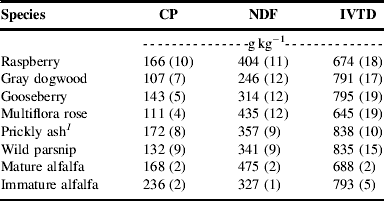
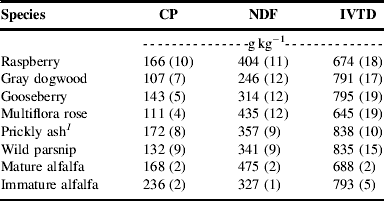
Forage quality of the shrubs, in terms of protein, digestibility and fiber, is characterized in Table 1. Although CP was highest for immature alfalfa, prickly ash and raspberry were comparable to that of mature alfalfa, and therefore good-quality forage for most classes of livestock (Table 1). Gray dogwood and multiflora rose ranked lowest in CP. Other researchers working with multiflora rose reported similar findingsReference Turner, Foster, Phillips and Terrill16. According to the National Research Council's Nutrient Requirements of Beef Cattle37, growing or finishing cattle gaining over 0.9 kg day−1 generally need a concentration of 120–130 g kg−1 of CP (on a dry matter basis) in the feed they consume. It appears therefore that quite a few of these shrubs, in early summer, contain adequate protein content to meet this requirement if biomass availability and selection is not limiting. A note of caution, however, is that an analysis of anti-quality factors, such as lignin and tannins, was not conducted. However, the digestible fraction of the forage, measured as IVTD, was also high across species, averaging 763 g kg−1, suggesting that the nutrients in these shrubs were not restricted by anti-quality traits. Furthermore, according to our animal performance dataReference Hedtcke, Posner, Rosemeyer, Egan and Harrington27, protein did not appear to be limiting in the animals' diets. All except multiflora rose were comparable or higher than mature alfalfa in IVTD. Prickly ash was much higher in IVTD than the other shrubs, as was wild parsnip, ranking higher than the immature alfalfa. A higher proportion of stems or juvenile canes mixed in the sample might explain the lower IVTD for raspberry versus mostly leaves in the sample of the other shrub species. Likewise, NDF levels of the shrubs at these sites fell between the range of the high quality (immature) alfalfa and the mature alfalfa, with the exception of gray dogwood (Table 1). No difference was found in IVTD between the Angus and Highland breeds, suggesting that the rumen microbial species were similar between breeds.
Mean (N=10) of quality parameters of various shrub species averaged across years, with SE in parentheses. Alfalfa reference samples shown for comparison.
1 Prickly ash was sampled at two sites so N=20.
CP, crude protein; NDF, neutral detergent fiber; IVTD, in-vitro true digestibility.
Shrub macro mineral (P, Ca, K and Mg) concentrations
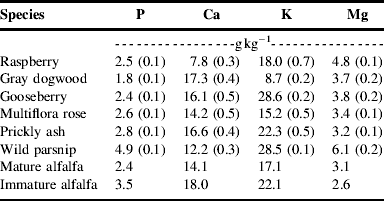
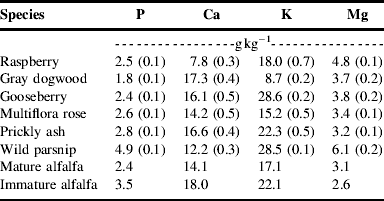
The macro-elements found in the shrub foliage were at levels similar to those found in alfalfa, but individual shrub species showed considerable variation (Table 2). Similar to the CP and NDF assays, gray dogwood was exceptionally low in P while the other shrubs were more comparable to alfalfa. Calcium levels across shrub species were similar to alfalfa, with the exception of wild parsnip and especially raspberry, which were low or very low in Ca: a reflection of the acidic, sandy soils on which these species were grown. Very low K levels were also found in gray dogwood while gooseberry had the highest K. Prickly ash ranked lowest of all shrubs in Mg. Wild parsnip was particularly high in Mg and tested more than two times higher than alfalfa and had higher levels than the 4.0 g kg−1 level recommended per day by the NRC37. Overall, most species tested had adequate concentrations of the macro minerals for beef cattle.
Mean (N=10) of macro nutrient concentration of various shrub species averaged across years, with SE in parentheses. Alfalfa reference samples shown for comparison.Footnote 1
1 Data from National Research Council 199637.
P, phosphorus; Ca, calcium; K, potassium; Mg, magnesium.
Cattle observations
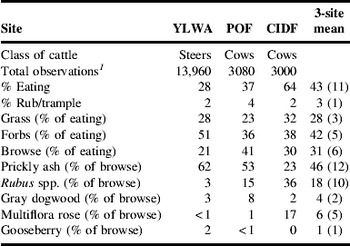
Of the total observations for each site, the cattle spent between 28 and 64% of the time eating, with about a third (31%) of that time browsing (Table 3). Shrub abundance likely influenced browsing choice as prickly ash was observed regularly in all the plots while gooseberry and gray dogwood were observed less frequently. These cattle ate leaves of most shrubs present but prickly ash was browsed most frequently at two of the sites (53–62% at POF and YLWA) while Rubus spp. were most often browsed at CIDF (36%). Gooseberry was the least browsed, likely due to its heavily thorned and small-leafed characteristics. It remains unclear why gray dogwood, an unthorned species, was rarely browsed. The remaining time was spent browsing miscellaneous tree species such as hickory (Carya ovata), elm (Ulmus spp.), cherry and plum (Prunus spp.) and hazelnut. While on the study, the cows essentially maintained their body weight and condition and their nursing calves and the steers had similar weight gains as the control group on pastureReference Hedtcke, Posner, Rosemeyer, Egan and Harrington27. This supports the hypothesis that browse provided significant nutritional support. Hence, grazing shrub-infested savannas or woodlands could play a role in extending the cool-season pasture at a time of the season when this forage is typically quasi-dormant and lower in quality.
Frequency of cattle in various activities and % of time eating five shrubs by site over 2 years, with SE in parentheses.

1 There were more observations at YLWA because there were more grazing cycles each year at this location.
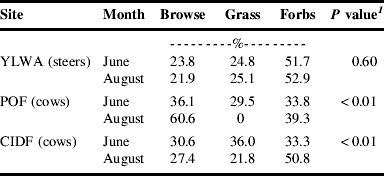
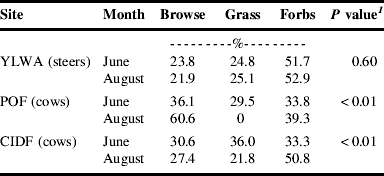
Early and late seasonal observation data are presented in Table 4. With relatively abundant feed resources in June, we observed that the cows chose a diet fairly evenly distributed between grass, browse and forbs. However, by late August, the proportion of feedstuff in the cows' diets shifted from grass to either forbs or browse. The steers consumed a higher percentage of forbs in both June and August, with no shift in categories (Table 4); the herbaceous understory likely provided a higher energy dense diet for the growing steers. Ganskopp et al., working on rangeland, reported that Julian date and in vitro organic matter digestibility of the grasslands accounted for 98% of the variation in rates of use of shrubs by cattleReference Ganskopp, Svejcar, Taylor, Farstvedt and Paintner38. Yet when we looked at the frequency data analysis for August, a time of year when cool-season grasses are typically lush and vegetativeReference Barnes, Miller and Nelson39, Reference Moser, Buxton and Casler40, the cattle were still consuming significant amounts of browse (22–61%). It is interesting to note that of over 250 observations at POF taken in the morning in late August, no grass was observed to be eaten. Another interesting observation was that wild parsnip, commonly encountered at CIDF, accounted for 14% of the forbs eaten there in June while no wild parsnip was observed to be eaten at any site in August.
Comparison of cattle spring and summer observational percentage-of-eating data by site over 2 years. Percentage of time eating browse, grass and forbs.
1 Chi-square analysis was used to compare months.
In addition to eating the shrubs, cows further opened the canopy by occasionally trampling and rubbing on trees and shrubs (3% of observations). Similar behavior was observed in cattle in Idaho forestlandsReference Mitchell and Rodgers36 and bisonReference Coppedge and Shaw41. Further, in our study, cows would sometimes use their horns to knock down small trees (<4 cm diameter) to reach the leaves. Similarly, Mitchell and Rodgers observed cattle trampling and pulling down branches of willow (Salix spp.) so the leaves could be consumedReference Mitchell and Rodgers36. Results from the companion study on the ecological impact of grazing confirm that the animals did browse in the wooded area: Harrington and Kathol found that this grazing regime of 2 days per month for 3 or 4 cycles per year during the summer months resulted in significantly reduced density and height of Rubus spp., hazelnut and prickly ashReference Harrington and Kathol26.
One could expect that with the partial opening of the canopy from managed grazing and, if necessary, reseeding, a more abundant and diverse savanna flora would develop (Tom and Kathy Brock, personal communication, 2004). This could result in a more open and attractive park-like appearance for the oak savanna perimeter of these pastures.
Conclusions
With the cessation of fire and grazing, succession of woody species has led to a degraded state of most of the remnant oak savanna, once an important ecosystem covering vast areas of pre-settlement Midwest USA. Managed grazing with the Scottish Highland cattle in these degraded savannas can effectively reduce the shrub layer while serving the dual purpose of providing feed and shelter to the livestock and creating a more aesthetically pleasing, open and more diverse savanna for humans and wildlife. The feed value of many of the understory shrubs are adequate to supplement a beef cattle diet and, when confronted with pasture and degraded oak savanna, Scottish Highland cattle will still spend significant amounts of time browsing. Our expectation is that with repeated managed grazing episodes, and perhaps some mechanical thinning, light would penetrate the understory, releasing the native vegetation associated with healthy savannas. Further research is necessary to evaluate differences between cattle breeds on their browsing ability and behavior when confronted with an overgrown thicket, and to test the quality and acceptability of additional species such as the invasive buckthorn (Frangula alnus) or garlic mustard (Alliaria petiolata). Furthermore, the impact of grazing degraded oak savannas and woodlands on biodiversity, such as insects, grassland birds and small mammal populations, would be important information to acquire.
Acknowledgements
The authors express appreciation to our collaborators on the project, including Ron and Sally Niemann and Peter and Mary Rathbun, cattle and land owners; Bruce Folley and Jackie Curry, Wis DNR, YLWA land managers; Peggy Compton, UW Extension; Emily Kathol and Devin Biggs, UW-Madison Graduate students at the time of the study; John Harrington and Ed Bures, UW-Madison; Tom Hunt and Marlene Sorenson, UW-Platteville. This research was funded in part by: Multi-Agency Land and Water Education Grant Program/Environmental Quality Incentives Program (USDA-NRCS), Partnership for Wildlife Program (WI DNR) and University of Wisconsin System Consortium Grant Program.