Introduction
Despite public and media concern about increased risk of offending by individuals with a mental illness, much remains to be understood about the association between mental illness and crime. Across the range of studies, inconsistent research findings have been attributed to the use of varied, sometimes flawed methodologies and biased samples such as in-patient and prison samples (Link & Stueve, Reference Link and Stueve1995; Walsh et al. Reference Walsh, Buchanan and Fahy2002). Large, population-based studies (e.g. Wallace et al. Reference Wallace, Mullen and Burgess2004; Fazel et al. Reference Fazel, Langstrom, Hjern, Grann and Lichtenstein2009b) provide more consistent results but tend to focus on violent offending alone, or are restricted to selected diagnostic categories, most notably schizophrenia. The risk of violent offending has been estimated to be three to seven times higher in people with severe mental illness compared to the general population (Joyal et al. Reference Joyal, Dubreucq, Gendron and Millaud2007; Fazel et al. Reference Fazel, Gulati, Linsell, Geddes and Grann2009a). However, debate continues as to whether increased risk of violence is attributable to the presence of co-morbid substance abuse (Steadman et al. Reference Steadman, Mulvey, Monahan, Robbins, Appelbaum, Grisso, Roth and Silver1998; Van Dorn et al. Reference Van Dorn, Volavka and Johnson2012). The review by Joyal et al. (Reference Joyal, Dubreucq, Gendron and Millaud2007) concluded that major mental illness was associated with an increased risk of violence, independently of substance abuse. Meta-analyses by Fazel et al. (Reference Fazel, Gulati, Linsell, Geddes and Grann2009a) also found that psychotic illness was associated with an increased risk of violence; however, although co-morbid substance use increased this risk substantially, the risk in psychosis with substance abuse was not significantly greater than the risk associated with substance abuse alone.
Our study used a methodologically sound, whole-of-population research design to provide reliable data on the association between mental illness and offending. This approach has enabled the inclusion of all psychiatric disorders and offence categories within the one study design. The aims were (i) to estimate the prevalence of offending in people with a psychiatric illness compared to the general population; (ii) to describe patterns of offending in people with a psychiatric illness compared to the general population; and (iii) to compare people with schizophrenia with those with a psychiatric illness other than schizophrenia.
Method
Data sources
The study used record linkage (Kelman et al. Reference Kelman, Bass and Holman2002) between two computerized, administrative databanks covering all of Western Australia: the psychiatric case register and the arrestee database. Both registers have comprehensive coverage of their respective areas. The psychiatric case register, established in 1966, covers public and private in-patient admissions and out-patient/ambulatory care in public mental health services in Western Australia. The arrestee database includes basic demographic data on all offenders since 1945, with full arrest details available electronically from 1985. Information on arrests prior to 1985 were available from court outcomes data for people arrested from 1985 onwards, and from police microfiche records for people with no further arrests after 1984. Police microfiche records were also used to extract qualitative details of the offence narrative: location of offence, relationship between offender and victim, and whether the offence was committed alone or in the company of others.
At the time of the linkage in 1997, there were 172 962 individuals on the psychiatric case register meeting criteria for an ICD-9 Chapter 5 diagnosis of mental illness; WHO, 1979) and 388 127 individuals on the arrestee database.
Study populations
Whole-of-population cohort
The whole-of-population data cover the psychiatric case register and the arrestee database. Linkage between the two registers permitted ascertainment of people on both registers. To account for differences in age distribution, the cohort was restricted to individuals born between 1955 and 1969. Detailed electronic arrest data, including offence type, were available for the period 1985–1996 for this cohort. Over the years 1985 to 1996, the average population of Western Australia was 1.6 million.
Sampled birth cohorts
Three birth cohorts (birth years 1955–1959, 1960–1964 and 1965–1969) were selected for detailed analysis of offending trends and offender characteristics over time. All available electronic and microfiche data sources were used to ensure all offences were included. All offenders with a diagnosis of schizophrenia were identified. Comparison groups were offenders with a psychiatric illness other than schizophrenia, and offenders with no recorded contact with mental health services. Because of the large size of the comparison groups and the laborious method of manual data extraction from police microfiche records, random sampling stratified by birth cohort was used to select the comparison groups. The size of each stratum was determined by the size of the stratum for offenders with schizophrenia within each birth cohort, using a 1:1 ratio.
Sampled birth cohort: violent subset
Because of the amount of time required to access and abstract additional descriptive data on violent offences from police microfiche records, a 20% random sample of individuals was drawn, stratified by psychiatric case status: schizophrenia, psychiatric illness other than schizophrenia, and no history of psychiatric illness. Offending histories were examined and those with any violent offences were retained. Data on all offences, including violent offences, were extracted and supplemented with qualitative data obtained manually from police microfiches. This included details of the offence such as location, relationship between the offender and the victim, and whether the offender was acting alone. For offences committed in the company of others, the microfiche contained information on individual charges.
Classification of diagnosis, offence and socio-economic status
The most recent available clinician-rated diagnosis on the psychiatric register was used to allocate a study diagnosis. Three-digit ICD-9-CM diagnostic codes (WHO, 1979) were used to aggregate ICD-9 Chapter 5 diagnoses into broader categories: schizophrenia (ICD-9 295); affective psychoses (ICD-9 296); other non-organic psychoses (ICD-9 297, 298); neurotic disorders (ICD-9 300); personality disorders (ICD-9 301); substance use disorders (ICD-9 291, 292, 303–305); depressive disorder, not elsewhere classified (ICD-9 311); and the category ‘other mental disorders’, which covered all other codes between 290 and 318, namely ICD-9 diagnostic groups 290, 293, 294, 299, 302, 306–310 and 312–318. For some analyses, diagnoses were further aggregated into two categories: schizophrenia, and psychiatric illness other than schizophrenia. The reliability of the register diagnoses has been published elsewhere (Jablensky et al. Reference Jablensky, Morgan, Zubrick, Bower and Yellachich2005; Morgan et al. Reference Morgan, Valuri, Croft, Griffith, Shah, Young and Jablensky2011).
Offences were classified using the three-digit Australian Bureau of Statistics Australian National Classification of Offences (ANCO) offence categories (ABS, 1985). The results presented here are based on five broad categories: offences against the person that were predominantly violent offences (ANCO 111–299); property offences (ANCO 300–499); offences against good order (ANCO 500–599); drug offences (ANCO 600–699); and other offences (ANCO 700–911).
Sociodemographic variables included sex, race, date of birth, postcode of residence and postcode of the offence location.
Data analysis
Frequency distributions and Pearson χ2 calculations were computed using SPSS version 18 (SPSS Inc., USA). Three non-overlapping populations were of interest in the cohort born between 1955 and 1969: the schizophrenia population, the population with a psychiatric illness other than schizophrenia, and the population with no mental illness. We calculated the number of individuals arrested at least once in each of the years 1985 to 1996 for each population and tested the goodness of fit and regression slopes using three separate linear regression models.
Results
Whole-of-population cohort: arrest history for the period 1985–1996
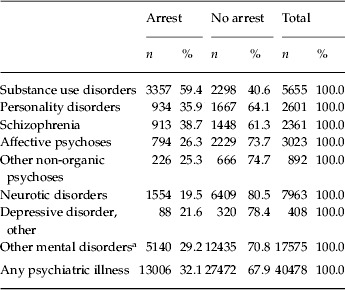
After linkage, the study population was limited to people born 1955–1969. There were 116 656 individuals on the arrestee database with an arrest history between 1985 and 1996. There were 40 478 people on the psychiatric case register with an ICD-9 Chapter 5 mental illness; 13 006 (32.1%) of these had an arrest history.
Table 1 shows the period prevalence of arrests for all people on the psychiatric case register by diagnostic category. The diagnostic category with the highest proportion of offenders was substance use disorders (59.4% of people with a substance use disorder had an arrest history), followed by schizophrenia (38.7%) and personality disorder (35.9%).
Arrest prevalence in the period 1985–1996 for individuals with psychiatric illness born 1955–1969 by diagnostic category

a Other mental disorders covers ICD-9 diagnostic groups 290, 293, 294, 299, 302, 306–310 and 312–318 , including common, less severe disorders, predominantly adjustment disorders, and also childhood disorders.
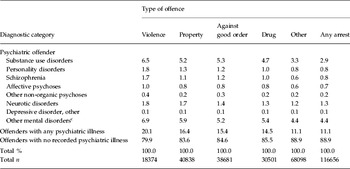
Table 2 shows the prevalence of mental illness among all people arrested 1985–1996, by offence type. One in 10 (11.1%) of all offenders had a psychiatric history; 4.4% of the total were in the ‘other mental disorders’ group, 2.9% had a substance use disorder, 0.8% had a personality disorder and a further 0.8% had schizophrenia. Women made up 27.9% of psychiatric offenders, compared to 20.6% of offenders with no history of psychiatric illness (data not shown); this difference was significant (p < 0.000).
Prevalence of psychiatric illness among offendersa born 1955–1969 with an arrest in 1985–1996 (% within offence typeb by diagnostic category)

a A person is counted more than once if they have been arrested for offences in more than one offence category.
b ‘Violence’ includes homicide, serious and less serious assault, serious and less serious sex assault, robbery and extortion, and other against person offences; ‘Property’ includes breaking and entering, theft, property damage; ‘Against good order’ includes drunkenness, possession of weapons, resisting arrest, breaching court orders; ‘Drug’ includes drug possession, dealing and manufacturing; ‘Other’ includes traffic, licence, motor vehicle and regulatory offences.
c Other mental disorders covers ICD-9 diagnostic groups 290, 293, 294, 299, 302, 306–310 and 312–318, including common, less severe disorders, predominantly adjustment disorders, and also childhood disorders.
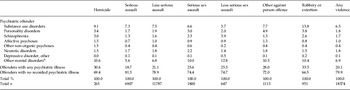
Table 3 provides a finer level of breakdown for those offenders classified as violent in Table 2. Across all violent offence types, 79.9% of those arrested did not have a psychiatric illness, 6.9% were in the group with ‘other mental disorders’, 6.5% had a substance use disorder, 1.8% had a personality disorder and 1.7% had schizophrenia. In the most serious of the violent offence categories, homicide, 69.4% did not have a psychiatric illness, 10.6% were in the group with ‘other mental disorders’, 9.1% had a substance use disorder, 3.4% had a personality disorder and 3.0% had schizophrenia.
Prevalence of psychiatric illness among offendersa born 1955–1969 with an arrest for a violent offence in 1985–1996 (% within offence type by diagnostic category)

a A person will be counted more than once if they have been arrested for offences in more than one violent offence category.
b Other mental disorders covers ICD-9 diagnostic groups 290, 293, 294, 299, 302, 306–310 and 312–318, including common, less severe disorders, predominantly adjustment disorders, and also childhood disorders.
Fig. 1 depicts the distribution of the annual number of arrests for the years 1985–1996 for the three population cohorts born 1955–1969. The mean percentage annual change in the number of arrests relative to no change over the period was 1.8% [95% confidence interval (CI) −1.5 to 5.1] for offenders with schizophrenia, 1.4% (95% CI 0.4–2.4) for offenders with a psychiatric illness other than schizophrenia and −7.1% (95% CI −8.2 to −6.0) for offenders with no psychiatric illness.
Annual number of arrests 1985–1996 for offenders born 1955–1969 by psychiatric status [(a) schizophrenia, (b) psychiatric illness other than schizophrenia, (c) no mental illness] and sex.

Sampled birth cohort
Three birth cohorts were selected from the whole-of-population arrest data to enable an analysis of time and period effects using full arrest histories, including arrests prior to 1985. The final numbers for analysis were: 1103 offenders with schizophrenia (371 born 1955–1959, 386 born 1960–1964 and 346 born 1965–1969); 1102 offenders with a psychiatric illness other than schizophrenia (373, 383 and 346 in each respective birth cohort); and 1102 offenders with no recorded contact with mental health services (375, 381 and 346 in each respective birth cohort).
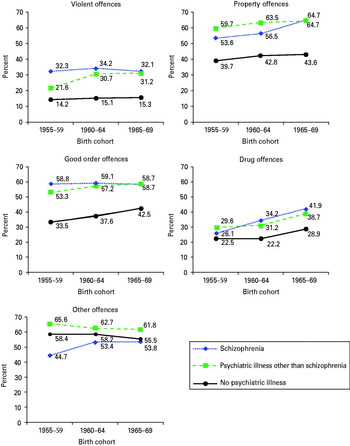
Fig. 2 shows the percentage of offenders with schizophrenia arrested for offences within specific offence categories compared to offenders with a psychiatric illness other than schizophrenia and offenders with no history of psychiatric illness. Separate figures are given for each of the three birth cohorts: 1955–1959, 1960–1964 and 1965–1969. For example, 32–34% (depending on the birth cohort) of schizophrenia offenders had committed a violent offence compared to 22–31% of offenders with a psychiatric illness other than schizophrenia and 14–15% of offenders with no psychiatric illness. Of note, although the percentage with a violent offence was relatively stable over time for people with schizophrenia, the cumulative lifetime prevalence up to 1996 increased by nine percentage points for people with a psychiatric illness other than schizophrenia. The percentage with a drug-related arrest increased over that period in all three categories of offenders, even though the younger cohorts had less opportunity to offend. The greatest increase in such arrests was in the schizophrenia group, with an increase of 16 percentage points compared to nine percentage points for those with a psychiatric illness other than schizophrenia and six percentage points for those with no psychiatric illness. The percentage of people arrested for a property offence also increased over time in all three groups. By contrast, the percentage arrested for good order offences remained steady in the schizophrenia group, albeit high at around 59%, but rose in the other two groups.
Proportion of offenders arrested up to the end of 1996 within each mental health status category (schizophrenia, psychiatric illness other than schizophrenia, no recorded psychiatric illness) and birth cohort (1955–1959, 1960–1964 and 1965–1969) by type of offence.

Several studies have found that risk of offending in schizophrenia is augmented by substance abuse. The arrestee database does not include data on drug or alcohol use at the time of the offence. To examine the impact of substance abuse, we flagged all individuals with schizophrenia who also had a co-morbid substance use disorder recorded on the psychiatric case register (ICD-9 codes 291, 292 and 303–305). In the schizophrenia birth cohorts, we found that 36.2% of the schizophrenia sample with a co-morbid substance use disorder had committed at least one violent offence compared to 31.7% of those with schizophrenia and no substance use disorder (χ2 = 5.185, z = 0.023, p < 0.05).
Temporal relationship between first arrest and illness onset
Using the birth cohort data, we looked at the percentage of psychiatric offenders who had been arrested prior to their first contact with mental health services. Where both contacts occurred on the same day, the arrest event was assumed to have come first. On average, 66.4% of schizophrenia offenders and 61.6% of offenders with a psychiatric illness other than schizophrenia had been arrested prior to engagement with mental health services. The proportion increased over time for those with schizophrenia, with 64.9% in the 1955–1959 birth cohort, 64.5% in the 1960–1964 birth cohort, and 69.9% in the 1965–1969 birth cohort; the trend for those with a psychiatric illness other than schizophrenia was in the opposite direction, where the corresponding figures were 69.8, 59.1 and 55.7%. The difference between the two groups was statistically significant for the 1965–1969 birth cohort (χ2 = 15.101, z = 0.0001, p < 0.01). A proportion of people with a mental illness had been arrested prior to their first contact with mental health services. Of these, 19.0% of those with schizophrenia and 13.3% of those with a psychiatric illness other than schizophrenia had made contact with mental health services within a year of the first arrest. Among those persons engaging with mental health services within a year of the first arrest, for one-third (33.3%) of those with schizophrenia this occurred within a month of the first arrest; the figure for those with a psychiatric illness other than schizophrenia was 22.2%.
Sampled birth cohort: violent subset
The social ecology of offending in people with a history of violent offending
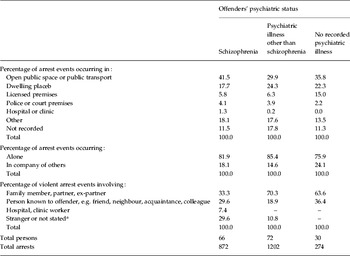
Details of the social setting of offending were extracted from police microfiches for a subsample of offenders with at least one violent offence, who were randomly selected from the birth cohort sample. These data are presented in Table 4, where the unit of analysis is the arrest event, not the person. Offences by people with schizophrenia were more likely to occur in open spaces compared to those by offenders with no recorded mental history (41.5% v. 35.8%), and less likely to occur in dwelling places (17.7% v. 22.3%) or in licensed premises (5.8% v. 15.0%). They were also less likely to take place in the company of others (18.1 v. 24.1%). Furthermore, offences by people with schizophrenia were less likely to occur where they lived, either in their postcode of residence (38.5% v. 49.3%) or in their much larger administrative region of residence (57.1% v. 69.0%). Violent offences by offenders with schizophrenia were much less likely to involve family members or partners compared to those by offenders with no psychiatric history (33.3% v. 63.6%).
The social ecology of all arrest events up to the end of 1996, including non-violent offences in a subsample of offenders born 1955–1969 with a history of violent offending

a Some of the arrest events in the schizophrenia group and, to a lesser extent, in the group with psychiatric illness other than schizophrenia did not have a victim–offender relationship recorded; although the microfiched narratives suggest that many of these were indeed strangers, it is possible that some were persons known but not identified clearly as such in the notes.
Discussion
A recurring question in forensic psychiatry is whether individuals with a severe mental illness are more likely to offend than people in the general community. Much of the media coverage of this topic has encouraged stereotyping and stigmatization of individuals with mental illness and exaggerated the threat associated with these disorders (Link & Stueve, Reference Link and Stueve1995; Pescosolida et al. Reference Pescosolida, Monahan, Link, Stueve and Kikuzawa1999). These attitudes have policy and legislative implications in both mental health and criminological arenas. The issue of dangerousness is particularly important in an era of community-based management of mental illness. In light of this, there is an urgent imperative for well-designed epidemiological studies to provide a rational basis for understanding the association between criminal offending and mental illness.
Prevalence of arrest in people with a psychiatric illness
Our study found that 32.1% of people born in Western Australia between 1955 and 1969 who were on the psychiatric case register had been arrested at least once during the period 1985–1996. This needs to be considered in the light of the large window of opportunity for offending under consideration, along with the comprehensiveness of the arrestee database, which covers both minor and serious offences. The few population prevalence figures for offending available for comparison are high: 29% of males and 13% of females born in 1972 had contact with South Australian juvenile justice between the ages of 10 and 17 (Morgan & Gardner, Reference Morgan and Gardner1992), and 47% of Philadelphia males born in 1972 offended between the ages of 10 and 30 (Wolfgang et al. Reference Wolfgang, Figlio and Sellin1972). In our study, arrest prevalence was differentially distributed, depending on lifetime diagnosis. In keeping with numerous other studies, people with substance use disorders had the highest arrest prevalence (59.4%). The percentage for schizophrenia was 38.7%, with the presence of co-morbid substance use disorders significantly increasing the risk of arrest in people with schizophrenia. For personality disorders, the figure was 35.9%. Arrest prevalence among people classified as having ‘other mental disorders’ was 29.2%, slightly lower than the 32.1% for people with any psychiatric illness and markedly lower than 59.4% for substance use disorders. This category covered a mixture of diagnoses, but the greater proportion of individuals had common, less severe disorders, predominantly adjustment disorders, in addition to childhood disorders.
Our data support the growing number of studies highlighting the role of substance abuse, both independent of and co-occurring with schizophrenia, as a key risk factor for criminal offending (Modestin & Ammann, Reference Modestin and Ammann1995; Steadman et al. Reference Steadman, Mulvey, Monahan, Robbins, Appelbaum, Grisso, Roth and Silver1998; Fazel et al. Reference Fazel, Langstrom, Hjern, Grann and Lichtenstein2009b). This is a matter of particular importance for the clinical management of schizophrenia and other psychotic disorders, where rates of substance abuse are greatly elevated (Regier et al. Reference Regier, Farmer, Rae, Locke, Keith, Judd and Goodwin1990; Morgan et al. Reference Morgan, Waterreus, Jablensky, Mackinnon, McGrath, Carr, Bush, Castle, Cohen, Harvey, Galletly, Stain, Neil, McGorry, Hocking, Shah and Saw2012). Notably, Coid et al. (Reference Coid, Yang, Roberts, Ullrich, Moran, Bebbington, Brugha, Jenkins, Farrell, Lewis and Singleton2006) calculated the population attributable risk for violent offending in the British household survey of psychiatric morbidity and found that eliminating hazardous drinking would reduce the attributable risk by half whereas eliminating psychosis would have a negligible impact. Indeed, our data show that most people with schizophrenia do not commit violent crimes and the absolute numbers of violent offenders are very small. Of 2361 people with schizophrenia, 304 individuals (12.9%) had committed a violent crime. This proportion is comparable to other published rates. For example, Joyal et al. (Reference Joyal, Dubreucq, Gendron and Millaud2007) reported a history of violent community-based offending in 7–15% of schizophrenia patients compared to 12.9% in our study. Similar to the figure reported by Fazel et al. (Reference Fazel, Gulati, Linsell, Geddes and Grann2009a) in their systematic review of schizophrenia and violence, only eight individuals (0.3%) in our study had been arrested for homicide.
Prevalence of psychiatric illness among offenders
One in 10 (11.1%) offenders had a history of psychiatric illness. This proportion rose to 14.5, 15.4 and 16.4% for drug, good order and property offenders respectively. One in five (20.1%) violent offenders had a psychiatric illness. People with substance use disorders made up 6.5% of violent offenders. The percentages for personality disorders and schizophrenia were 1.8% and 1.7% respectively. With respect to homicides, 9.1% of all people arrested for homicide had a history of substance use disorders, 3.4% had personality disorders and 3.0% had schizophrenia. Although percentages for the category ‘other mental disorders’ were high within each offence category, this reflects the large number of people in this category. As seen in Table 1, the actual arrest prevalence was lower in this group.
The percentage annual change in the number of arrests showed a statistically significant decrease over the period 1985–1996 for the population without mental illness born 1955–1969. The percentage decline in arrest numbers was 7.1% per year around the mean and the linear regression model provided a good fit to the data (R 2 = 0.956). This reflects both the drop in arrest rates that is expected as a population ages and a general reduction in arrest rates for the whole population in Western Australia over the same years (data available from the authors). The percentage annual change for schizophrenia offenders and offenders with a psychiatric illness other than schizophrenia did not decline. For offenders with other mental illnesses there was a statistically significant but modest increase in arrest numbers (an increase of 1.4% per year around the mean and R 2 = 0.493); for those with schizophrenia the increase failed to attain statistical significance (an increase of 1.8% per year and R 2 = 0.132). For offenders with schizophrenia, the pattern showed some volatility, with numbers of arrests peaking in 1991, 1992 and 1993 when the cohorts were aged 22–36, 23–37 and 24–38 years respectively; these peaks contribute to the trend for increasing percentage annual change in the number of arrests over time for this cohort. These data suggest that offenders with a psychiatric history are more likely to offend in older age than their peers without such a history. It is also likely that, for offenders with schizophrenia, deinstitutionalization may have played some role in these statistics because people with severe mental illness were relocated from hospitals into community mental health services, which at that time were ill-resourced to meet the burgeoning clinical and social needs of this growing group of service users (Burdekin, Reference Coid, Yang, Roberts, Ullrich, Moran, Bebbington, Brugha, Jenkins, Farrell, Lewis and Singleton1993).
Temporal relationship between onset of offending and onset of psychiatric illness
In the current study, onset of offending predated onset of illness for the majority of people with schizophrenia, and this proportion was increasing over time, contrary to the trend for people with other psychiatric illnesses. The percentages for the three birth cohorts combined were 69.1% for men and 53.4% for women. Moreover, when first arrest predated schizophrenia onset, first contact with mental health services followed shortly afterwards for a substantial minority. These data support the contention that early offending and antisocial behaviour are not simply a consequence of illness but may be a manifestation of the prodromal phase, alerting family and authorities to impending illness onset and leading to clinical assessment and initiation of treatment. Several recent papers have looked at the timing of onset of offending relative to the timing of illness onset. Hodgins et al. (Reference Hodgins, Calem, Shimel, Williams, Harleston, Morgan, Dazzan, Fearon, Morgan, Lappin, Zanelli, Reichenberg and Jones2011) found, in a sample of 301 first-episode patients, that 40% of men had at least one conviction and 20% had a conviction for violence; the respective percentages for women were 10% and 5%. A meta-analysis of six studies (total n = 1187) found the pooled estimate for violence prior to the first episode to be 35.4% (Large & Nielssen, Reference Large and Nielssen2011). Register-based studies have tended to report higher percentages. Using Australian registers, Wallace et al. (Reference Wallace, Mullen and Burgess2004) found that 73% of schizophrenia patients had had a conviction prior to contact with psychiatric services. Munkner et al. (Reference Munkner, Haastrup, Joergensen and Kramp2003), using Danish registers, reported a similar percentage to ours for men (71%) but found that the figure for women was considerably lower at 37%. It is possible that the increase over time that we have observed in the proportion of individuals with schizophrenia whose first arrest predated their first contact with mental health services is associated with the increased frequency of drug-related arrests in this diagnostic group. Arrests for drug offences increased by 160% in the schizophrenia offender group, compared to 131% for people with a psychiatric illness other than schizophrenia and 128% for offenders with no recorded psychiatric illness (Fig. 2). It may be that easier access to substances over time, combined with elevated levels of substance abuse, possibly as a form of self-medication in the pre-morbid phase of illness, put this group at greater risk of early contact with the criminal justice system.
Social ecology of the arrest event
Only 33.3% of victims of violent offences committed by people with schizophrenia were family members compared to 70.3% of victims of offenders with a psychiatric illness other than schizophrenia and 63.6% of those of non-psychiatric offenders. Furthermore, home was less likely to be the offence location for schizophrenia offenders (17.7% of offences were committed in the home) compared to those with a psychiatric illness other than schizophrenia (24.3%) and those with no psychiatric history (22.3%); a large proportion of offences took place in open spaces (41.5%, compared to 29.9% and 35.8%, respectively). Our data showing that offenders with schizophrenia are more likely than non-psychiatric offenders to act alone, in public places and within eyeshot of witnesses support the view that, to some extent at least, higher arrest rates among psychiatric populations may partially reflect higher detection rates (Robertson, Reference Robertson1988). However, our findings are not consistent with a common perception that people with schizophrenia are more likely to be violent towards family members and more likely to be violent in the home. There are few recent studies reporting on these variables that also have comparison statistics for offenders with other psychiatric illness or non-psychiatric offenders. Probably the most influential study has been the MacArthur study (Steadman et al. Reference Steadman, Mulvey, Monahan, Robbins, Appelbaum, Grisso, Roth and Silver1998). This study found that, compared to a community comparison sample, a higher proportion of patients committed violent acts against family/friends, a lower proportion targeted strangers, and a lower proportion acted in open spaces and licensed premises. However, none of these findings were statistically significant. Although the data presented by Swanson et al. (Reference Swanson, Swartz, Van Dorn, Elbogen, Wagner, Rosenheck, Stroup, McEvoy and Lieberman2006) are restricted to patients with schizophrenia from the National Institute of Mental Health Clinical Antipsychotic Trials of Intervention Effectiveness (CATIE), they provide valuable insights into the complex relationship between offenders and their families. These may be confounded by the lower likelihood for people with severe mental illness to be in long-term relationships. Methodological reasons may also underlie reported differences. Interview-based studies, especially those using multiple informants, are more likely to record intra-familial offending that may not be reported to the police. By contrast, studies such as ours that use administrative registers are more likely to identify less serious against-person offences outside the family that may be overlooked in the interview or that may not be known to family members.
Methodological issues
The design of the current study offers several advantages for the collection of reliable data on the association between mental illness and offending. First, the study was able to link two comprehensive, population-based registers without the need to sample, ensuring the availability of whole-of-population data for the main analysis. Using prospectively collected data stored on state registers minimizes cohort attrition and eliminates reliance on retrospective recall of events that can result in recall bias. The Western Australian psychiatric case register has especially broad coverage of mental illness in the population compared to many other registers as it includes out-patient/ambulatory contacts in addition to in-patient admissions, and covers both private and public hospitals (Morgan et al. Reference Morgan, Valuri, Croft, Griffith, Shah, Young and Jablensky2011). Our algorithm for extracting a diagnosis from a case register has been validated against independently collected clinical case-notes (Jablensky et al. Reference Jablensky, Morgan, Zubrick, Bower and Yellachich2005; Morgan et al. Reference Morgan, Valuri, Croft, Griffith, Shah, Young and Jablensky2011). The arrestee database compares exceptionally well with other highly regarded criminal registers as it is not restricted to convictions, it includes individuals from the age of 10 years, and retains criminal records indefinitely. Nonetheless, there are some limitations. First, the psychiatric register will miss milder cases of mental illness seen by general practitioners alone and, although multiple fields are available for recording diagnosis, co-morbid substance abuse may be under-reported where it is not the primary diagnosis. Second, categorization of mental illness is based on a lifetime diagnosis rather than the diagnosis at the time of offence. Third, police arrest data tend to undercount offences such as domestic violence and property offences, which are not always reported to police. Fourth, the data available for analysis did not include important sociodemographic and other covariates that may confound the relationship between mental illness and criminal behaviour. This has made it impossible to use our dataset to determine whether the elevated risk in people with psychiatric illness was related to greater exposure to individual and family risk factors (Loeber et al. Reference Loeber, Farrington, Waschbusch, Loeber and Farrington1998) and their interaction with the broader social environment (Wikstrom & Loeber, Reference Wikstrom and Loeber2000). In previously reported data (Morgan et al. Reference Morgan, Morgan, Clare, Valuri, Woodman, Ferrante, Castle and Jablensky2008), we showed that the same area-level variables that are risk factors for offending in the general population, particularly disadvantage, inequality, ethnic homogeneity and residential mobility, are also risk factors for individuals with schizophrenia, with no evidence of an additive effect. However, compared to the general population, individuals with schizophrenia are more likely to be exposed to these area-level predictors of offending (Lögdberg et al. Reference Lögdberg, Nilsson, Levander and Levander2004) and their life histories are marked by long-term educational and economic disadvantage, homelessness, social marginalization and high levels of victimization (Morgan et al. Reference Morgan, Waterreus, Jablensky, Mackinnon, McGrath, Carr, Bush, Castle, Cohen, Harvey, Galletly, Stain, Neil, McGorry, Hocking, Shah and Saw2012).
Conclusions
This study contributes to current knowledge about criminal offending and mental illness. One key feature is its capacity to use whole-of-population register data to compare the period prevalence and patterns of offending across psychiatric and non-psychiatric populations, covering the range of offence types and including breakdowns by diagnosis. The inclusion of multiple data sources not only allows us to describe rates of offending but also provides some insight into offence types and the social ecology of offending. In addition, it has been possible to examine the temporal aspects of contact with criminal justice and mental health systems, and to take into account period–age effects. It seems that being arrested and being diagnosed with severe mental illness are not independent events. On the one hand, arrest may bring an offender with incipient mental illness to the attention of mental health services whereas, on the other, events related to a psychiatric admission may bring a person with a mental illness to the attention of the criminal justice system. Given a growing proportion of schizophrenia offenders being arrested prior to their first contact with psychiatric services, there are important implications for mental health and criminal justice policy and practice. By providing a reliable evidence base for policy development at the intersect of criminal justice and mental health systems, our findings point to the need for an informed, cross-jurisdictional approach to the management of offenders with schizophrenia and other severe mental illness.
Acknowledgements
This study was supported by the Criminology Research Council (CRC 30/04-05) and the National Health and Medical Research Council (974122).
Declaration of Interest
None.