Introduction
In a review of language development in children with diverse early language experiences, including delayed and enriched language exposure and an absence of oral language input during the first year of life, Pierce, Genesee, Delcenserie, and Morgan (Reference Pierce, Genesee, Delcenserie and Morgan2017) hypothesized that early language experiences affect language learning via their effects on phonological memory – and phonological working memory (WM) in particular. They argued that the first year of life is a particularly sensitive period during which the phonological building blocks of language are established. As a result, they conjectured, it might be expected that the timing, quality and/or quantity of language input a child gets during this sensitive period or their ability to process that input shapes the quality of phonological representations. This, in turn, could influence the development of phonological memory and subsequent language learning (Gathercole, Reference Gathercole2006; Pierce et al., Reference Pierce, Genesee, Delcenserie and Morgan2017; Werker & Tees, Reference Werker and Tees1999; Reference Werker and Tees2002) and, moreover, these effects will have long lasting effects on development. They also argued that the effects of early language experiences can be difficult to detect in typically-developing (TD) monolingual children because variation in experience early in life among TD learners may be too small to reveal significant effects. Thus, they reviewed research on children who had experienced clearly different early experiences; namely (1) deaf children of hearing parents who were totally deprived of early oral language input after birth (children with cochlear implants), (2) children with repeated bouts of otitis media, (3) children with delayed acquisition of a second language (L2) early in life accompanied by discontinued exposure to and acquisition of the birth language (IA children), and (4) TD second language learners with delayed exposure to an L2 early in life, but who continued their exposure to and their acquisition of their birth language.
Their review provided some evidence that, indeed, the development of language in children who have difficulties accessing or perceiving linguistic input during their first year of life as well as that of children with delayed first (L1) or second (L2) language input differs from that of children with more typical early language experiences. Of particular importance, they noted that researchers have reported that these learners’ language learning differences were also associated with differences in the development of phonological memory. However, the evidence reported by Pierce and colleagues (Reference Pierce, Genesee, Delcenserie and Morgan2017) was only inferential insofar as it was based on a review of extant studies that included learners at different ages, who were assessed using different tests and who were compared only to TD monolingual children.
Recently, Delcenserie, Genesee, Trudeau, and Champoux (Reference Delcenserie, Genesee, Trudeau and Champoux2019) investigated Pierce et al.'s (Reference Pierce, Genesee, Delcenserie and Morgan2017) hypothesis more directly in a study that examined the language abilities of multiple groups of young learners with different early language experiences using a common battery of language tests. The groups included internationally-adopted children (IA) and children with cochlear implants (CI), children with developmental language disorder (DLD), previously referred to as specific language impairment (SLI), as well as typically-developing monolingual (MON) and second language (L2) learners. Although they were not part of Pierce et al.'s (Reference Pierce, Genesee, Delcenserie and Morgan2017) review, children with DLD were included in Delcenserie et al.'s (Reference Delcenserie, Genesee, Trudeau and Champoux2019) study as well as in the present study. They are of particular interest because they are thought to have a language-specific genetic disorder that makes language learning difficult. A widely proposed explanation of their difficulties implicates difficulties processing linguistic input (e.g., Archibald & Gathercole, Reference Archibald and Gathercole2006; Leonard, Reference Leonard2014; Torrens & Yagüe, Reference Torrens and Yagüe2018), although other accounts have claimed that the difficulties observed in DLD children are due to limitations in attentional control (e.g., Dodwell & Bavin, Reference Dodwell and Bavin2008; Spaulding, Plante & Vance, Reference Spaulding, Plante and Vance2008), deficits in the temporary storage of novel phonological information (e.g., Horohov & Oetting, Reference Horohov and Oetting2004), and procedural memory deficits (e.g., Lum, Conti-Ramsden, Page & Ullman, Reference Lum, Conti-Ramsden, Page and Ullman2012), among other hypotheses. In any case, inclusion of the children with DLD made it possible to situate the performance of the CI and IA children as well as the L2 children on a “continuum” ranging from monolingual children with typical development to monolingual children with a clinical language disorder.
Delcenserie et al. (Reference Delcenserie, Genesee, Trudeau and Champoux2019) found that the groups with the most significant differences in language outcomes in comparison to the MON group were the CI group and the children with DLD arguably because of lack of access to sensory/linguistic information at birth in the case of the children with CI and impairment in the neuro-cognitive mechanisms that underlie language learning in the case of the children with DLD. The groups with DLD and CI also scored significantly lower than the IA and L2 groups who had experienced early L1 input but delayed exposure to an L2. The IA group scored as well as the L2 group, suggesting that discontinued exposure to a birth language, as in the case of the IA children, is less consequential for language development than delay since the IA and L2 groups had different L1 experiences but both experienced delay and scored the same in their L2. In line with previous studies, the IA children performed significantly lower than the MON group, suggesting that delayed onset of exposure to their L2 negatively affect their long-term language outcomes (Delcenserie & Genesee, Reference Delcenserie and Genesee2014). Finally, the L2 group performed significantly lower on the language tests than the MON group suggesting that continued acquisition and use of the birth language were not sufficient to completely mitigate the effects of delayed exposure to an L2.
However, Delcenserie et al.'s (Reference Delcenserie, Genesee, Trudeau and Champoux2019) study still leaves open the question of the role of phonological memory in the language development of these learners. The present study is a follow-up of that study. Specifically, it reports the results of the same five groups of children who had participated in the Delcenserie et al.'s (Reference Delcenserie, Genesee, Trudeau and Champoux2019) study and had also been administered a battery of phonological and nonverbal memory tests. This allowed us to examine possible group differences in phonological memory and its relationship to the language outcomes of these groups. The logic of including these five groups was as follows. Inclusion of the DLD and CI groups allowed us to examine the development of phonological memory as well as the links between memory and language in two groups with difficulties accessing and/or processing language input during the sensitive period for phonological fine-tuning, that is, during the first few months of life (e.g., 10–12 months; Kuhl, Reference Kuhl2000). Inclusion of the IA group allowed us to compare the effects of the very early experiences of the DLD and CI groups to that of a group of learners who experienced early, albeit discontinued, input in the birth language (IA children) but delayed exposure to what would become their only functional language.
Inclusion of an L2 group who experienced normal input to the first language before exposure to the L2 allowed us to examine the effects of delayed exposure to language further. Specifically, if the IA and L2 groups exhibit the same language and phonological memory outcomes in the present study, despite differences in exposure to the birth language, this would argue that language experiences that occur after the first year or two of life can also be consequential for the development of both language and phonological memory. Indeed, in a fMRI study using a task that involved WM in French, Pierce, Chen, Delcenserie, Genesee, and Klein (Reference Pierce, Chen, Delcenserie, Genesee and Klein2015) found that IA children with French as the adopted language and bilingual children who had learned French as a second language around the same age as the IA children (M = 13;7 years of age) activated the same areas of the brain and that their activation patterns differed from those of native speakers of French. Pierce et al. (Reference Pierce, Chen, Delcenserie, Genesee and Klein2015) argued that areas of the brain typically associated with the early development of phonological memory were not sufficient when the IA and L2 children engaged in a task that called for processing the L2 because phonological fine-tuning and the emergence of phonological memory during the first year of life in these groups had occurred in response to exposure to a language (Chinese) that differed phonologically from the target language (French) (see also Pierce, Klein, Chen, Delcenserie & Genesee, Reference Pierce, Klein, Chen, Delcenserie and Genesee2014). Thus, in contrast to Pierce et al.'s (Reference Pierce, Genesee, Delcenserie and Morgan2017) hypothesis which focuses on experiences during the first year of life, in the present study, we examined the hypothesis that early language experiences after the first year of life can also affect language and phonological development. Finally, inclusion of the MON group provided a “typical baseline” for comparison with all other groups.
While the goal of the present study was to examine possible effects of these between-group differences on memory and language development, it is likely that there are within-group differences in each of these groups and these should also be explored in future research. However, notwithstanding the possibility of such within-group variation, the children in each of these groups share common background or learner characteristics that are the basis for much empirical, diagnostic, clinical, and other practical purposes. Thus, comparing their phonological memory abilities directly and looking at how their language and phonological memory abilities are related is potentially useful. With this in mind, we now review research relating to the early language experiences of these groups and how these experiences may be related to the development of phonological memory. More detailed discussion of language outcomes for these groups is presented in Delcenserie et al. (Reference Delcenserie, Genesee, Trudeau and Champoux2019).
Children with cochlear implants
Children who are born with profound bilateral hearing loss are unable to hear the acoustic-phonetic cues that are essential for speech recognition (Niparko, Tobey, Thal, Eisenberg, Wang, Quittner, Fink & CDaCI Investigative Team, Reference Niparko, Tobey, Thal, Eisenberg, Wang, Quittner and Fink2010) and to perceive auditory sensory information that is essential for oral language learning. Moreover, and as a result, they cannot take part in experiences involving oral communication (e.g., Geers, Brenner & Davidson, Reference Geers, Brenner and Davidson2003). Following cochlear implantation, these children have access to oral language input although the effectiveness of the implant is not immediate. Children with CIs born to hearing parents with no competence in sign language are of interest in the present study because they are a case of delayed language exposure without prior sensory input in oral language. Although significant advances in auditory screening of newborns have made it possible to reduce the age of implantation, most children born deaf still receive their implant only after 12 months of age – the closure of the sensitive period for phonological fine-tuning (Pierce et al., Reference Pierce, Genesee, Delcenserie and Morgan2017). Moreover, implanted children go through a period of several months during which the implant is not fully operational and, as a result, they have no or limited access to oral language input immediately after implantation.
Research on CI children's memory abilities suggests that, as a group, they perform around one standard deviation below the mean for TD hearing children on measures of phonological STM and WM, including forward and backward digit recall and non-word repetition (e.g., Soleymani, Amidfar, Dadgar & Jalaie, Reference Soleymani, Amidfar, Dadgar and Jalaie2014). These difficulties persist into adulthood. Even when provided appropriate support and intervention, fewer than half of CI children manage to increase their performance on tests of forward and backward digit recall and close the gap with TD hearing children, even 10 years after implantation (Caselli, Rinaldi, Varuzza, Giulani & Burdo, Reference Caselli, Rinaldi, Varuzza, Giulani and Burdo2012; Pisoni & Cleary, Reference Pisoni and Cleary2003; Pisoni, Kronenberger, Roman & Geers, Reference Pisoni, Kronenberger, Roman and Geers2011). Of particular interest, evidence suggests that CI children's memory lags are not restricted to phonological memory but appear to be domain-general. Specifically, it has been reported that CI children have difficulties with nonverbal WM tasks, particularly those that involve serial recall (see Conway, Karpicke, Anaya, Henning, Kronenberger & Pisoni, Reference Conway, Karpicke, Anaya, Henning, Kronenberger and Pisoni2011 for a discussion).
Children with developmental language disorder
Developmental Language Disorder (DLD) is a neuro-developmental disorder that affects about 6% of girls and 8% of boys (Conti-Ramsden & Durkin, Reference Conti-Ramsden, Durkin, Skuse, Bruce, Dowdney and Mrazek2011; Leonard, Reference Leonard2014). DLD is defined as a failure to make normal progress in language in the absence of other impairments, including hearing, intellectual, neurological, social, and/or emotional problems (Bishop, Reference Bishop2002). DLD is a long-term disorder that affects children from birth (see Leonard, Reference Leonard2014, for a detailed review) and that changes with age and development, both within and across linguistic domains (Bishop, Reference Bishop2006). Although there is currently no consensus on the specific cause(s) of the linguistic and memory difficulties of children with DLD, it has been widely proposed that they have a neuro-cognitive impairment, arguably a reflection of an underlying genetic etiology, that is associated with difficulties processing linguistic input (e.g., Archibald & Gathercole, Reference Archibald and Gathercole2006; see also Horohov & Oetting, Reference Horohov and Oetting2004; and Lum et al., Reference Lum, Conti-Ramsden, Page and Ullman2012, for additional hypotheses about DLD).
Although they have been found to make developmental progress on measures of phonological STM and WM, DLD children have consistently been found to perform below standardized test norms and age-matched children on several measures of phonological memory, including digit recall, listening recall, and non-word repetition (e.g., Thordardottir & Brandeker, Reference Thordardottir and Brandeker2013; Vugs, Hendricks, Cuperus & Verhoeven, Reference Vugs, Hendriks, Cuperus and Verhoeven2014). Phonological memory difficulties have become a central diagnostic feature of DLD and, in fact, tests of phonological memory abilities, such as non-word repetition, are often used as specific and sensitive markers of DLD (e.g., Thordardottir & Brandeker, Reference Thordardottir and Brandeker2013). Recent evidence suggests that, similar to children with CIs, children with DLD also experience difficulties with nonverbal WM (Henry, Messer & Nash, Reference Henry, Messer and Nash2012; Vugs et al., Reference Vugs, Hendriks, Cuperus and Verhoeven2014), indicating that their memory difficulties are not restricted to the verbal domain.
Internationally-adopted children
Similar to children with CIs, IA children experience delayed exposure to what ultimately becomes their only language, often referred to as a “second first language”. In the case of the IA children from East Asian countries who participated in the present study, the delay is often between 12–24 months of age. However, unlike children with CIs, IA children have access to oral language from birth although they experience behavioral attrition of that language soon after adoption (Delcenserie, Genesee & Gauthier, Reference Delcenserie, Genesee and Gauthier2013). Few detailed studies of IA children's memory abilities have been performed. However, the evidence reported to date indicates that IA children perform significantly lower on tests of phonological short-term and working memory than TD non-adopted children matched on age, gender, and socioeconomic status (SES). These effects have been documented on tests of forward and backward digit recall, non-word repetition, sentence recall, and listening recall (e.g., Delcenserie & Genesee, Reference Delcenserie and Genesee2014; Eigsti, Weitzman, Schuh, De Marchena & Casey, Reference Eigsti, Weitzman, Schuh, De Marchena and Casey2011). IA children's memory weaknesses have been found to be specific to the verbal domain and, thus, to affect only their phonological memory abilities (Delcenserie et al., Reference Delcenserie, Genesee and Gauthier2013; Delcenserie & Genesee, Reference Delcenserie and Genesee2014).
A few studies have examined the potential causes of IA children's memory results. As reported by Delcenserie et al. (Reference Delcenserie, Genesee, Trudeau and Champoux2019), IA children are generally found to receive sufficient and adequate input in the adopted language (Pierce, Genesee, Gauthier & DuBois, Reference Pierce, Genesee, Gauthier and DuBois2014), as evidenced by their performance in the typical range on standardized language and memory tests. However, their weaknesses in phonological memory persist over time and may even get larger with age, suggesting that insufficient exposure to the adopted language is an unlikely explanation of their phonological results (Delcenserie & Genesee, Reference Delcenserie and Genesee2014). Of interest, in a fMRI study of IA children, Pierce, Klein, Chen, Delcenserie, and Genesee (Reference Pierce, Klein, Chen, Delcenserie and Genesee2014) compared the activation patterns during a phonological working memory task of Chinese of IA children from China who had not been exposed to Chinese for approximately 12 years, on average, to that of native speakers of Chinese who acquired French as an L2 at the same time as the IA children, and to monolingual French speakers. The participants, who were between 10–17 years of age at the time of testing, were scanned while discriminating Chinese pseudo-words that differed in tone. They found that both the native Chinese speakers who had acquired French as an L2 and the IA children recruited left hemisphere temporal regions when discriminating between the pseudo-words in Chinese. In contrast the monolingual native speakers of French recruited right hemisphere regions. These findings indicate that there had not been neuro-cognitive attrition of the birth language among the IA participants, suggesting that their lags in language and phonological memory are not due to neuro-cognitive attrition of the birth language. Overall, the most likely explanation for their performance lies in delayed onset of exposure to the adopted language and/or to residual neuro-cognitive traces of the birth language. Other studies that have looked at the effects of delayed onset of exposure to the adopted language on the memory abilities of IA children have also found that age at the time of adoption is significantly and negatively correlated with performance on tests of phonological memory, including non-word repetition (e.g., Hough, Reference Hough2005).
Second language learners
Second language learners acquire a second language after the L1 has been established. While there is some debate on how early in development acquisition of an additional language constitutes L2 learning in contrast to simultaneous acquisition of more than one language, Pierce et al. (Reference Pierce, Chen, Delcenserie, Genesee and Klein2015) provide evidence of neuro-cognitive differences between L1 learners of French and children who had acquired French as a second language before 3 years of age while arguments for using one year of age as a cut-off for distinguishing L2 learners (or sequential bilinguals) from simultaneous bilinguals are offered by De Houwer (Reference De Houwer2009) and Werker and Hensch (Reference Werker and Hensch2015). One year of age was used as a cut-off to identify the L2 group in the present study.
The effects of age of acquisition are probably interrelated with L2 proficiency; that is to say, L2 learners may perform more poorly than L1 learners because the former often do not achieve the same levels of proficiency as the latter. In a recent study of the relationship between age of L2 acquisition and memory controlling for proficiency, Delcenserie and Genesee (Reference Delcenserie and Genesee2017) examined three groups of bilinguals – children who had acquired two languages simultaneously from birth; children who had acquired English as-a-second-language between 3 to 6 years of age (early L2 learners); and children who had acquired English-as-a-second language after 6 years of age (late L2 learners). All bilingual groups were compared to a group of monolinguals on a battery of memory tasks that included both STM and WM as well as both phonological and nonverbal short-term and working memory. Of particular importance, there were no significant differences between any of the bilingual groups and the monolingual comparison group with respect to proficiency in the target language, English. All bilingual groups outperformed the monolingual learners of English on phonological WM, arguing for a bilingual advantage. However, the simultaneous bilinguals significantly outperformed the early and late L2 learners –despite the fact that all groups had equally high proficiency. These results suggest that even early delays in exposure to an L2 can be consequential for the development of phonological memory even when L2 proficiency is controlled and advanced (see also Vejnovic, Milin & Zdravkovic, Reference Vejnovic, Milin and Zdravkovic2010).
Young L2 learners are of interest in the present study because they experience delayed onset of exposure to the L2, like IA children. However, unlike IA children, they continue to acquire and use their L1 after onset of L2 acquisition. Moreover, unlike deaf children who are born to hearing parents and have no exposure to oral language before CI, as was the case of the children with CIs in the present study, L2 learners have auditory/sensory input of a linguistic nature prior to the onset of L2 acquisition. Inclusion of a group of TD L2 learners who had benefited from extensive, high quality input in the L2 from an early age thus made it possible to make two sets of interesting comparisons. First, we were able to examine the effects of delayed L2 input with and without prior linguistic exposure (i.e., L2 learners versus children with CIs). Second, it was possible to examine delayed input to an L2 with retention versus behavioral attrition of the L1 (i.e., L2 learners versus IA children). As well, including early and highly proficient L2 learners allowed us to examine memory abilities in L2 learners controlling for the possible limiting effects of lower vocabulary scores on phonological storage in the L2, a factor that confounds many other studies of WM in bilinguals (see Appendix 1 for performance of the current L2 learners on measures of general language ability).
The present study
Two broad questions were at issue in the present study:
1) Do the groups of interest exhibit differences in phonological memory in comparison to one another and to a typically-developing monolingual group?
2) Are the relationships between phonological memory and language the same in the groups of interest and in comparison to a typically-developing monolingual group?
With respect to question 1, if Pierce et al.'s (Reference Pierce, Genesee, Delcenserie and Morgan2017) hypothesis is correct, then it would be expected that the CI and DLD groups would perform more poorly on tasks of phonological memory than the MON group and also significantly more poorly than the IA and L2 groups because they faced challenges during the sensitive period for phonological fine-tuning that impeded the early development of phonological memory that, in turn underpins acquisition of language. In line with previous findings, we also expected that the IA group would perform more poorly than the MON group (Delcenserie & Genesee, Reference Delcenserie and Genesee2014), but we did not expect the IA and L2 groups to differ since both had linguistic input during the first year of life and experienced equivalent delays in exposure to the L2. Concerning the L2 children's performance in comparison to the MON controls, we expected no significant differences in their phonological memory abilities following the results of Delcenserie and Genesee (Reference Delcenserie and Genesee2017) who found that early successive bilinguals who acquire an L2 early in life, before three years of age, and have benefited from extensive, high quality input in the L2 can perform as well as MON children on measures of phonological memory.
With respect to question 2, Gathercole, Willis, Emslie, and Baddeley (Reference Gathercole, Willis, Emslie and Baddeley1992) found that phonological memory is a significant predictor of vocabulary development until 4 to 5 years of age, after which a shift is observed such that vocabulary knowledge becomes a predictor of phonological memory (Gathercole et al., Reference Gathercole, Willis, Emslie and Baddeley1992). After 8 years of age, no significant association between these outcomes is usually found (e.g., Gathercole et al., Reference Gathercole, Willis, Emslie and Baddeley1992). However, recent evidence suggests that the relation between memory and language differs in learners with delayed onset of language acquisition in comparison to the results found by Gathercole and colleagues (see also Conway, Pisoni & Kronenberger, Reference Conway, Pisoni and Kronenberger2009; Delcenserie & Genesee, Reference Delcenserie and Genesee2014; Pierce et al., Reference Pierce, Genesee, Delcenserie and Morgan2017; Pisoni et al., Reference Pisoni, Kronenberger, Roman and Geers2011). If language were found to predict memory abilities in the groups of interest in the present study, this would mean that they display the same general pattern seen in TD monolingual children, as reported by Gathercole et al. and others. This, in turn, would support the argument that the types of early language experiences under discussion here do not significantly affect the memory-language link. In contrast, if memory abilities were found to predict language abilities in the groups of interest, this would support Pierce et al.'s (Reference Pierce, Genesee, Delcenserie and Morgan2017) general argument that early language experiences affect language learning via their effects on phonological memory.
Several aspects of memory were assessed, including phonological and nonverbal short-term (STM) and working memory (WM). Although there is debate concerning how to best characterize and assess phonological memory, for purposes of the present study, we operationally defined phonological STM as the ability to temporarily store verbal information while phonological WM is defined as the ability to temporarily store and process verbal information (see Pierce et al., Reference Pierce, Genesee, Delcenserie and Morgan2017 for a discussion). We use the term “phonological memory” to refer to both phonological STM and WM. Assessing both STM and WM allowed us to look at different components of phonological memory (see Baddeley, Reference Baddeley2000; Reference Baddeley2003, for a review). Examining both phonological and nonverbal memory made it possible to examine whether the effects of different early language-learning experiences were domain-general or language specific.
Methods
Participants
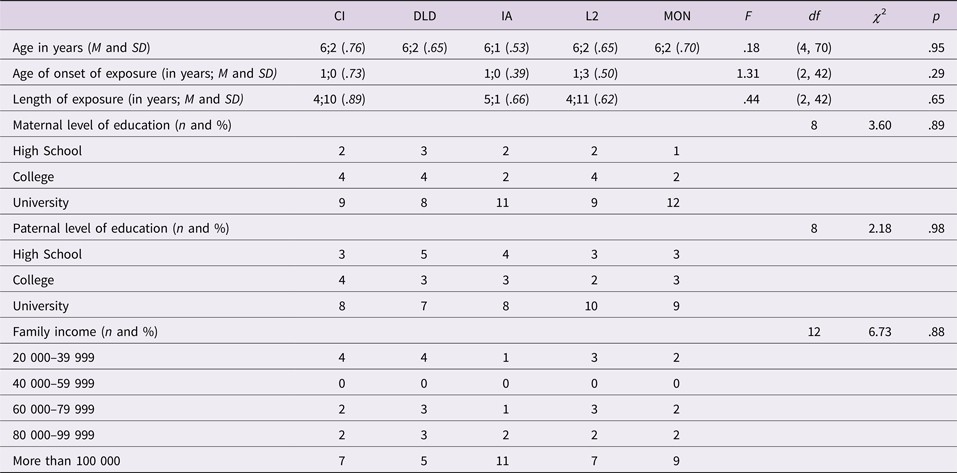
Fifteen children (i.e., nine girls and six boys) were included in each of the five groups (75 in total). The children were between 5;0 and 7;3 years of age at the time of testing (see Appendix 2 for complete demographic information). All groups were matched on chronological age, gender, and SES – factors that have been found to influence language and cognitive outcomes (e.g., Hoff, Reference Hoff2006). The CI, IA, and L2 groups were also matched on onset of exposure to French to control for amount of exposure to this language. This information was collected using questionnaires described in the next section. The children were assessed in French, an L1 for the CI, DLD, and MON groups and an L2 for the IA and L2 groups (more information can be found about these groups in Delcenserie et al., Reference Delcenserie, Genesee, Trudeau and Champoux2019).
Children with CIs
The children with CIs were recruited through “readaptation” centers in Montreal. All had had a bilateral profound sensorineural hearing loss from birth and had hearing parents. Their parents reported that their children's deafness was due to either hereditary factors (n = 2), a physical malformation (n = 2), or unknown causes (n = 11). They had been diagnosed between 0;1 and 2;0 years of age (M = 0;11 years; SD = .73). Twelve children had bilateral implantation; they received their first implant at 1;0 year of age, on average (range: 0;8–2;0 years, SD = .74) and their second implant between 1;3 and 4;6 years of age (M = 2;7 years, SD = 1.17). Three children had unilateral implantation – two were implanted at 2;0 years of age and one was implanted at 3;0 years of age. All the children received implants similar in type (Nucleus 4, Nucleus 5, Nucleus 6, Nucleus Freedom, Nucleus C810) and their operations were performed in the same children's hospitals in greater Montreal.
The parents of the children with CIs reported they had no auditory ability prior to the activation of their implant(s) and that none of them had used hearing aids prior to implantation. Parents also reported that, prior to implantation, their children were unable to communicate, to produce sounds and/or to communicate with signs. None of the parents was proficient in sign language at the time of their children's birth so the children had no exposure to sign language during the first year of life. These children were tested using only spoken language. All the participants had been receiving speech-language therapy for 3;9 years, on average (range: 1;7–6;7 years; SD = 1.30), which is common for implanted children.
Children with DLD
These children were recruited through the same “readaptation” centers as the children with CIs. They received a diagnosis of DLD by a licensed speech-language pathologist around 3;2 years of age (range: 2;0–4;0 years; SD = .81) and had been receiving therapy for 3;1 years of age, on average (range: 0;8–5;0; SD = 1.06). Parent reports indicated that the children had primary difficulties with vocabulary (n = 5), phonology (n = 8), syntax (n = 6), morphology (n = 4), receptive language (n = 1), and phonological memory (n = 1), with some children having difficulties in more than one area. These difficulties were reported to be present at the time of testing. Parents were unable to provide more detailed information about their child's language abilities at the time of diagnosis.
IA children
The IA children were recruited through adoption agencies in the Montreal region. All these children had been adopted from East Asian countries by monolingual French-speaking families in Quebec when they were between 0;7 and 2;0 years of age (M = 1;0 year; SD = .39). The countries of adoption included China (n = 5), South Korea (n = 3), Vietnam (n = 3), Philippines (n = 2), Thailand (n = 1), and Taiwan (n = 1). Because East Asian countries have been found to provide adoptees with relatively favorable pre-adoptive rearing environment (see Delcenserie, Reference Delcenserie, Genesee and Delcenserie2016, and Pomerleau, Malcuit, Chicoine, Séguin, Belhumeur, Germain, Amyot & Jéliu, Reference Pomerleau, Malcuit, Chicoine, Séguin, Belhumeur, Germain, Amyot and Jéliu2005, for discussions of this issue), selecting children adopted from these countries made it possible to reduce the possibility that weaknesses in language and memory development, if any, would be due to pre-adoptive deprivations. One adoptee was reported to be receiving speech-language therapy at the time of testing, but this child's parents expressed only mild concerns about her language development. None of these children had exposure to their birth language post-adoption.
L2 learners of French
The L2 learners were recruited through a suburban public French language school outside Montreal. According to parental report, the children had first been exposed to French intensively at home beginning around 1;3 years of age, on average (range: 0;6–2;0 years; SD = .50). Thus, they had been exposed to French-as-an-L2 for 4;11 years, on average (rang: 4;1–6;6 years; SD = .62). The parents of all L2 learners were very proficient in French and were able to provide them with high quality input at home. This was confirmed by the finding that the L2 participants performed within age-appropriate levels for monolingual speakers of French on all the measures of general language ability administered in Delcenserie et al. (Reference Delcenserie, Genesee, Trudeau and Champoux2019) (see Appendix 1).
Detailed parental reports indicated that, on average, the L2 learners had daily exposure to French of about 49% (range: 45–65%; SD = 7.66). The L2 learners were tested only in French, their L2. However, all parents emphasized that their child was very proficient in both languages. As well, none of these participants was receiving speech-language therapy at the time of testing. Most of the L2 learners had English as their L1 (n = 10), but two children had Mandarin; two had Spanish, and one had Arabic as their L1. In contrast to the other language groups, the L2 learners had learned and were continuing to use and manage two languages. As a result, it might be expected that their performance on the L2 tests might be affected by cross-linguistic interference or facilitation from the L1. If true, the L2 learners would be expected to perform significantly differently from the other typically-developing groups (the IA and MON groups). However, it will be seen in the Results section that the L2 group did not differ significantly from either of these groups arguing that possible cross-linguistic influences from their L1 was not consequential, at least for the general language proficiency measures used in this study. That cross-linguistic effects would likely be non-significant in group-wise comparisons also arises from the fact that the L2 participants spoke different L1s. As a result, any possible positive or negative effects of cross-linguistic influences from the L1 of the L2 participants would be expected to wash-out in the group analyses, especially in view of our use of general language outcomes measures which are likely to be insensitive to cross-linguistic transfer.
Monolinguals
The monolingual participants were recruited through a French language school in suburban Montreal. None of these children had received more than 25% exposure to a language other than French or had been evaluated for or ever received speech-language therapy.
Exclusionary criteria for all groups included presence of psychiatric, cognitive or neurological antecedents; intellectual deficiency; premature birth; serious health, motor or behavior problems, including attention deficit hyperactivity disorder (ADHD); and more than 25% exposure to another language, with the exception of the L2 learners.
Questionnaires
Information about the children's health, behavior, general development, language ability, and socio-emotional adjustment was collected using a Developmental Questionnaire (e.g., Delcenserie & Genesee, Reference Delcenserie and Genesee2014).
Participants’ socio-emotional adjustment at home was assessed using a parent-report questionnaire, the Child Behavior Checklist (Achenbach & Rescorla, Reference Achenbach and Rescorla2000). The items of this report evaluate children's behavior and social competence. Two versions of the questionnaire were used, one for children above six years of age and one for younger children.
Information about the children's history of language exposure was collected using a Language Exposure Questionnaire (Delcenserie & Genesee, Reference Delcenserie and Genesee2014). This allowed us to make sure that the L2 learners of French received at least 45% of exposure to French and that the other groups had limited exposure to an L2 (no more than 25%).
Assessment materials
Memory tests
Phonological STM and WM were assessed using two tests to ensure that the results would not be due to use of a specific test. The tests used in the present study have been extensively used in similar research on these particular groups (see also Delcenserie & Genesee, Reference Delcenserie and Genesee2014, Semel, Wiig & Secord, Reference Semel, Wiig and Secord2009, and Vugs et al., Reference Vugs, Hendriks, Cuperus and Verhoeven2014, for empirical evidence supporting the selection of the specific memory tasks).
Phonological STM
A non-word repetition test (Courcy, Reference Courcy2000) was used that had been designed specifically for native French speakers in Quebec. It required participants to repeat 20 non-words, ranging from two to five syllables in length, spoken by the examiner. They all had uniform stress patterns with equal stress on each syllable, no consonant clusters, no diphthongs, and all were consonant-vowel syllables (Thordardottir & Brandeker, Reference Thordardottir and Brandeker2013). A score of one was given for each item correctly recalled and a score of zero was attributed for each item that contained an error.
The Forward Digit Recall subtest of the Clinical Evaluation of Language Fundamentals for French-speaking Canadians (CELF-CDN-F; Semel et al., Reference Semel, Wiig and Secord2009) was also administered. The children were required to repeat sequences of numbers, ranging from two to nine; there were two trials at each sequence length. The numbers were presented by the experimenter at the rate of one per second. A score of 1 was attributed for each sequence correctly repeated and a score of zero was given when at least one error was made. Testing was discontinued when a child failed both trials of a given sequence length.
Phonological WM
A non-word repetition test was created to assess phonological WM. Twenty additional non-words from the Courcy test, with the same properties as the non-words included in the phonological STM test, were included in this WM version. The experimenter said a non-word to each child. The child was then shown an image of a common object or an animal, such as ball, dog, and bird; the name of each image was less than 2 syllables long. The experimenter asked the child two short questions about each image – Is it an animal? Do you own one? The child was then asked to recall the non-word that had been presented prior to the image. A score of one was given for each word correctly recalled and a score of zero otherwise.
The Backward Digit Recall subset of the CELF-CDN-F was also administered. The stimuli and administration procedure of this test were similar to that of the Forward Digit Recall subtest except that the sequences of numbers had to be repeated in the reverse order.
Nonverbal STM
The Spatial Span Forward subtest of the Wechsler Non-Verbal IQ test (WNV; Wechsler & Naglieri, Reference Wechsler and Naglieri2006) was used to assess nonverbal STM. Before starting the test, the experimenter showed each child pictorial directions to illustrate how to perform the test. After the instructions, the experimenter tapped a series of blocks at the rate of one block per second. The blocks were presented on a rectangular Spatial Span board, provided with the WNV, that includes 10 randomly organized blocks. There were two trials at each sequence length, ranging from 2 to 9. The child was asked to tap the same sequence of blocks in the correct order. A score of 1 was attributed to each sequence correctly recalled and a score of zero was given when one or more errors had been made. Testing was discontinued when a child failed both trials at a given sequence length.
Nonverbal WM
This was assessed using the Spatial Span Backward subtest of the Wechsler Nonverbal IQ test (Wechsler & Naglieri, Reference Wechsler and Naglieri2006). The test stimuli and test administration procedures rules were similar to those of the Spatial Span Forward test, except that the children had to tap the blocks in the reverse order.
Language tests
Expressive language was assessed using French versions of the Expressive One-Word Picture Vocabulary Test (Brownell, Reference Brownell2000) and of the Formulated Sentences subtest of the CELF-CDN-F. Receptive language was assessed using the Échelle de Vocabulaire en Image Peabody (Dunn, Theriault-Whalen & Dunn, Reference Dunn, Theriault-Whalen and Dunn1993) and the Sentence Structures subtest of the CELF-CDN-F.
The French versions of the Word Structure and the Phonological Awareness subtests of the CELF-CDN-F were used to assess the children's knowledge of morphology and knowledge of the sound structure of French, respectively.
Additional information about the language tests can be found in Delcenserie et al. (Reference Delcenserie, Genesee, Trudeau and Champoux2019).
Control measures
The Matrices and Coding subtests of the Wechsler Nonverbal IQ test (Wechsler & Naglieri, Reference Wechsler and Naglieri2006) and the Attention Auditive (“Auditory Attention”) subtest of the NEPSY (A Developmental Neuropsychological Assessment; Korkman, Kirk & Kemp, Reference Korkman, Kirk and Kemp2007) were used to assess fluid intelligence, speed of processing, and selective auditory attention, respectively (see Delcenserie et al., Reference Delcenserie, Genesee, Trudeau and Champoux2019, for the administration procedures of these tests).
Because the goal of the study was to compare performance among the groups and because the groups had been carefully matched on important variables, use of raw scores in the statistical analyses, instead of standard scores, was considered appropriate.
Procedure
At the beginning of the first session, the experimenter explained the study to the parents and presented them the questionnaires. The experimenter then answered parents’ questions, if any, and asked them to sign the consent form and to complete the Developmental Questionnaire, the Language Exposure Questionnaire as well as the age-appropriate CBCL. If parents requested to be present with their child during testing, they were asked to remain silent and to refrain from giving help. Testing was done either in three one-hour sessions or in two ninety-minute sessions, depending on the child's fatigue and motivation as well as parents’ schedules. The order of test administration was counterbalanced to avoid order and fatigue effects.
Demographic information and performance on the control measures
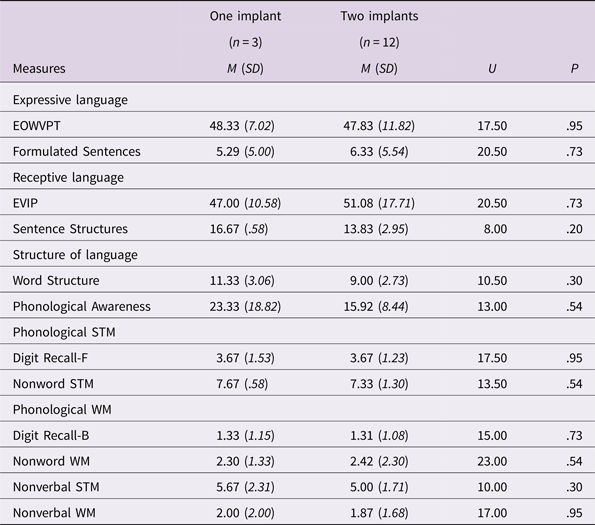
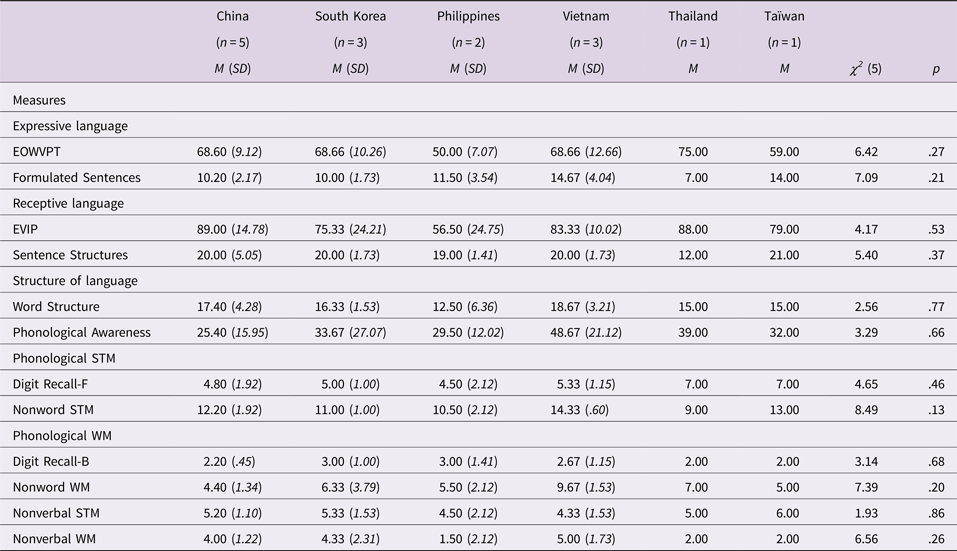
As reported in Delcenserie et al. (Reference Delcenserie, Genesee, Trudeau and Champoux2019), statistical analyses, including analyses of variance (ANOVAs), using group as a between-group factor, and chi-square tests, indicated no significant differences among the groups with respect to chronological age, maternal and paternal levels of education, and family income (see Appendix 2). Similarly, no significant differences were found between the IA, CI, and L2 groups on age at the onset and length of exposure to French (see Appendix 2). These results indicate that the groups had been well matched. Similarly, no significant differences were found on any of the variables between countries of origin for the IA children, between children with unilateral or bilateral implantation for the children with CIs or between first languages for the L2 learners (see Appendices 3 to 5). Finally, since no significant differences were found between the boys and the girls in any of the analyses, results were collapsed across gender (see Appendix 6).
As well, no differences were found between the groups on socio-emotional adjustment, nonverbal IQ, speed of processing, and auditory attention – control measures that have been administered to control for potential differences between the groups (see Appendix 7 for groups’ performance on the control measures).
Results
Research Question 1
Do the groups of interest exhibit differences in phonological memory in comparison to one another and to the typically-developing monolingual group?
In order to examine possible differences in memory between the groups, a MANOVA was carried out on the scores of the tests of phonological and nonverbal memory. Prior to data analysis, MANOVA assumptions were assessed. Levene's and Box's M tests confirmed that the assumptions of homogeneity of variance and covariance were met (p > .05). It was also determined that normality and linearity assumptions were met by visual examination of the histograms, Q-Q plots, and scatterplots. The design of the study ensured that independence of observations was controlled for.
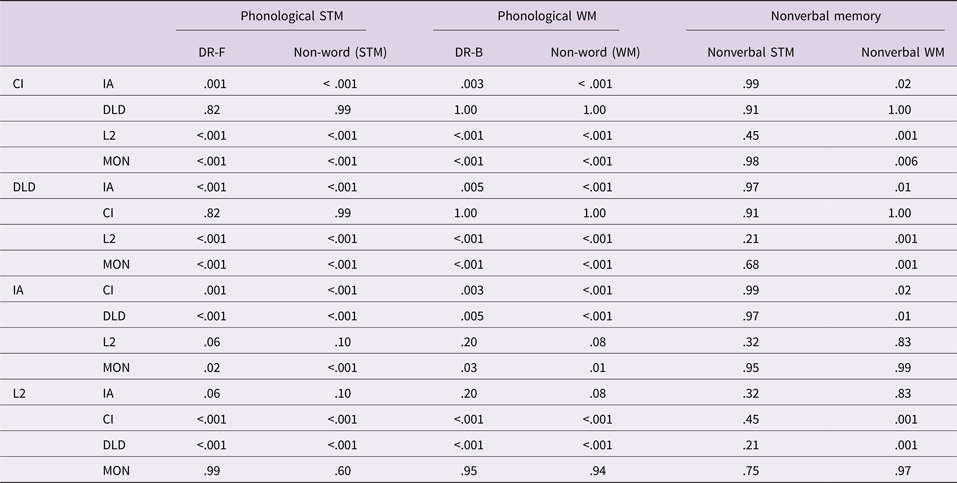
The MANOVA indicated that the effect of group membership was statistically significant (Wilk's lambda: F(24, 254) = 13.36, p < .001; η 2 =.56; Bonferroni correction: p = .008). The groups differed significantly on all tests, with the exception of nonverbal STM (see Table 1). Post hoc analyses were performed using Tukey HSD tests (Table 2). These analyses indicated that the CI and DLD groups did not differ significantly on measures of phonological STM and WM, but they performed significantly lower than the IA, L2 and MON groups. The IA group scored significantly lower than the MON children but did not differ significantly from the L2 group. The L2 and MON groups did not differ significantly.
Group scores and results of statistical analyses of results on the tests of phonological and nonverbal memory

Note. CI = children with cochlear implants; DLD = children with developmental disorder; DR-F = digit recall forward; DR-B = digit recall backward; IA = internationally-adopted children from East Asian countries; L2 = second language learners of French; MON = typically-developing monolingual French-speaking children; NWR = non-word repetition.
Results of the Tukey HSD post-hoc tests (p values)

Note. CI = children with cochlear implants; DLD = children with developmental disorder; DR-F = digit recall forward; DR-B = digit recall backward; IA = internationally-adopted children from East Asian countries; L2 = second language learners of French; MON = typically-developing monolingual French-speaking children.
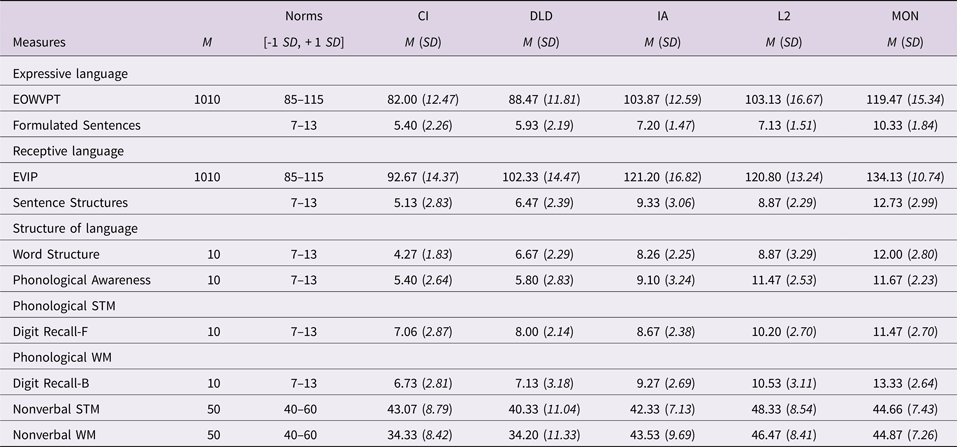
As mentioned earlier, the groups did not differ significantly on nonverbal STM, but differed on nonverbal WM, suggesting vulnerabilities with the manipulation and/or processing of nonverbal information rather than simply with the storage of this information. On the latter measure, the IA, L2, and MON groups did not differ from one another, but they performed significantly better than the children with CIs and DLD, who did not differ significantly from one another (group performances in comparison to test norms, where available, can be found in Appendix 1).
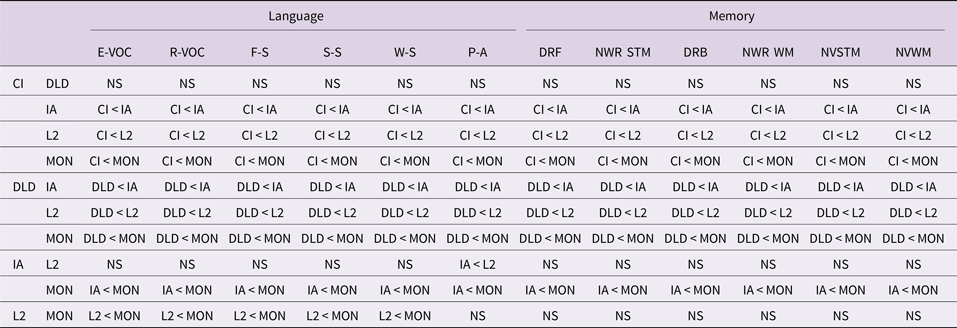
A table summarizing the groups’ results on the language and memory tasks shows that, overall, the pattern of performance of the CI, DLD, IA, and MON groups in comparison to one another was the same (see Table 3). The only notable exception is the performance of the L2 learners in comparison to the MON group. In this case, the L2 learners performed significantly lower than the MON group on the measures of language ability, but did not differ significantly from the MON group on any of the memory measures.
Summary of the Group Differences on Measures of Language and Memory (see also Delcenserie et al., Reference Delcenserie, Genesee, Trudeau and Champoux2019)

Note. CI = children with cochlear implants; DLD = children with developmental language disorder; DRB = digit recall backward; DRF = digit recall forward; RE-VOC = expressive vocabulary; F-S = Formulated Sentences; IA = internationally-adopted children; L2 = second language learners; MON = typically-developing monolingual French-speaking children; NVSTM = nonverbal short-term memory; NV WM = nonverbal working memory; NWR STM = non-word repetition (short-term memory); NWR WM = non-word repetition (working memory); P-A = Phonological Awareness; R-S = Recalling Sentences; R-VOC = receptive vocabulary; S-S = Sentence Structures; W-S = Word Structure.
Research Question 2
Are the relationships between phonological memory and language the same in the groups of interest and in comparison to the typically-developing monolingual group?
Prior to running regression analyses examining the relation between language and memory, Pearson correlations (alpha = .05) were carried out to determine whether additional variables should be included as predictors in the regression analyses. The children's scores on all tests were first converted to z scores. Composite scores were created in order to decrease the number of variables. The composite scores for language and memory were created using guidelines from the CELF manual (Semel et al., Reference Semel, Wiig and Secord2009) as well as the results from our previous studies which included similar or, sometimes, the exact same tasks (see Delcenserie & Genesee, Reference Delcenserie and Genesee2014; Reference Delcenserie and Genesee2017).
To create the first composite score (i.e., phonological STM), children's z scores on the Forward Digit Recall and the non-word repetition task assessing STM were added to create a total composite score. The same procedure was used for the other composite scores. Children's scores on the Backward Digit Recall and the non-word repetition task assessing WM were similarly added to create the second composite score – phonological WM. In terms of language ability, a composite score for expressive language combined children's scores on the EOWPVT, assessing expressive vocabulary, and the Formulated Sentences subtest, assessing expressive grammar. Similarly, a composite score for receptive language combined scores on receptive vocabulary (i.e., EVIP) as well as those for the Sentence Structure subtest. The last composite score, structure of language, was calculated by combining scores on the Word Structure subtest, assessing morphology, and the Phonological Awareness subtest.
First, we performed Pearson correlations between group membership, age, gender, L1 (1 = French; 2 = language other than French), SES (i.e., family income, level of education of the mother, and level of education of the father) and children's performance on the control measures as well as on the different composite scores (see Appendix 6). These correlations were performed combining the results of children from all five groups to examine the overall importance of group membership and other background variables on children's performance. No significant correlations were found between age, gender, L1 or SES and the composite memory and language scores or group membership, confirming that our groups were well matched and that there was no statistical need or justification to enter these variables as predictors in the regressions. Of importance, the results showed that group membership was significantly correlated with children's performance on all the composite memory and language scores, but not on the control measures. We interpreted this significant effect of group membership as confirmation that the composite scores of language and memory abilities might be differentially related within each group. Accordingly, we performed regression analyses within each group separately to look into this possibility.
Before doing so, Pearson correlations were performed within each group to determine if background variables specific to each group should be added as predictors in the regression analyses (i.e., age at adoption, age at implantation, age at the time of diagnostic, length of speech-language therapy, age and amount of exposure to the L2). Because the goal of the correlation analyses was first and foremost to select the right predictors for our regression analyses and given that the number of variables was reduced by the creation of composite scores (i.e., 12 variables), we did not adjust the alpha level for multiple correlation analyses.
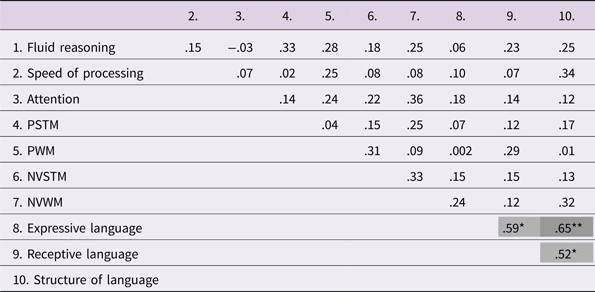
Although some correlation coefficients were relatively high numerically, no significant correlations were found between scores on the language and memory tasks, on the one hand, and the children's scores on the control measures and background variables, on the other hand (see Appendices 8 to 12). Thus, these control and background variables did not warrant inclusion in subsequent regression analyses.
Regression analyses
In order to examine potential developmental links between language and memory in the groups of interest and in the MON group we performed multiple regression analyses using the same composite scores that were used in the correlational analyses. The regressions, performed on each group separately, allowed us to examine whether language and memory were differentially related in the five groups and, as well, if the memory-language link differs from the pattern found for the TD children examined by Gathercole et al. (Reference Gathercole, Willis, Emslie and Baddeley1992). Performing multiple regressions required us to look at multicollinearity. This was done by examining tolerance values and variance inflation factors (VIFs). None of the VIFs and tolerance values reached levels indicating problems. All VIFs were between 1.73 and 3.23 while all tolerance values were between .30 and .43.
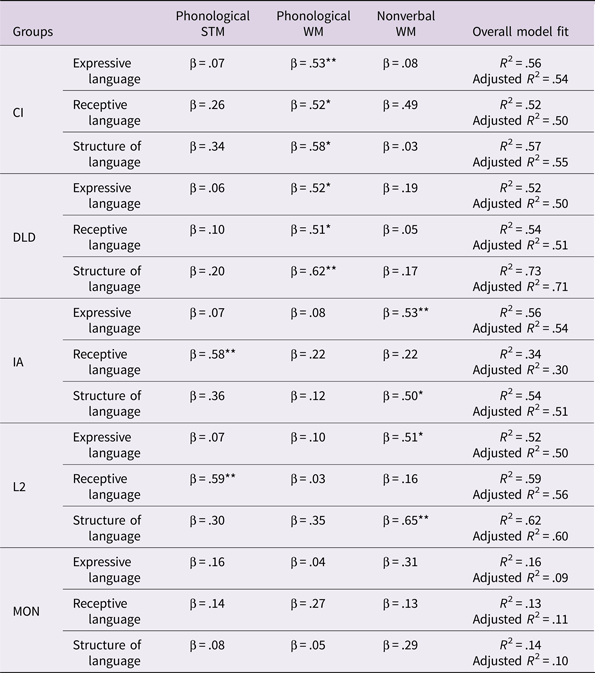
Two sets of regression analyses were run. First, multiple analyses were carried out to look at whether memory abilities significantly predicted language abilities in any of the groups. The outcome variables included the composite scores of expressive and receptive language as well as structure of language, and the predictor variables were the composite scores of phonological STM, phonological WM, and nonverbal WM (see Table 4). Nonverbal STM was not included in these analyses because the groups did not differ significantly on this measure, and also because no significant correlations were found between nonverbal STM and performance on the measures of language abilities.
Results of the Multiple Regression Analyses Using Memory Scores as Predictors

Notes. CI = children with cochlear implants; DLD = children with developmental disorder; IA = internationally-adopted children from East Asian countries; L2 = second language learners of French; MON = typically-developing monolingual French-speaking children; STM = short-term memory; WM = working memory.
* p < .05
** p < .01
For the CI and DLD groups, phonological WM was found to be a significant predictor of all language outcomes. In contrast, for the IA and L2 groups, phonological STM was found to be the best predictor of their receptive language scores while nonverbal WM was a significant predictor of performance on tests of expressive language as well as structure of language (i.e., morphology and phonological awareness). In contrast, none of the memory scores was a significant predictor of MON children's language scores.
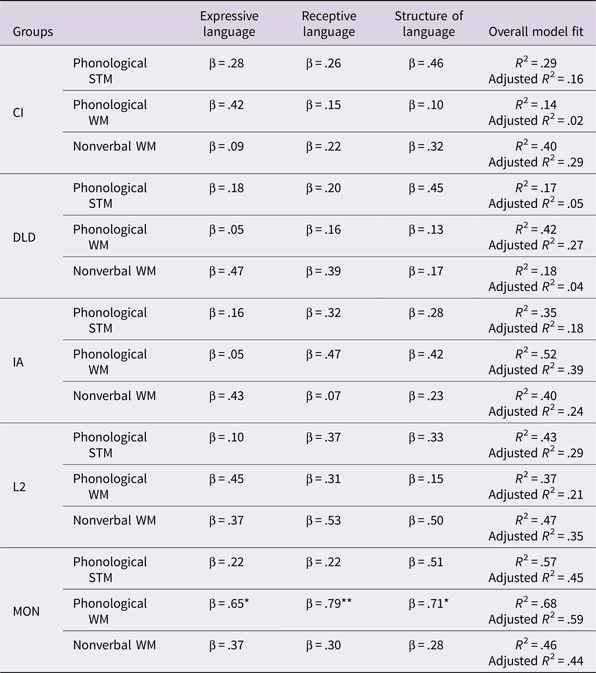
Multiple regression analyses were then performed to look at whether language abilities would significantly predict memory abilities. The outcome variables included the composite scores of phonological STM, phonological WM, and nonverbal WM and the predictor variables were the composite scores of expressive and receptive language as well as structure of language (see Table 5). For the IA, CI, DLD, and L2 groups, language ability scores did not significantly predict any of the memory ability scores. For the MON children, however, their performance on expressive and receptive language as well as on structure of language was found to significantly predict their phonological WM abilities.
Results of the Multiple Regression Analyses Using Language scores as Predictors

Notes. CI = children with cochlear implants; DLD = children with developmental disorder; IA = internationally-adopted children from East Asian countries; L2 = second language learners of French; MON = typically-developing monolingual French-speaking children; STM = short-term memory; WM = working memory.
* p < .05
** p < .01
Discussion
Early experience and the development of phonological memory
The results of the present study provide support for Pierce et al.'s (Reference Pierce, Genesee, Delcenserie and Morgan2017) hypothesis insofar as the two groups who experienced challenges during the sensitive period for phonological fine-tuning, the CI and DLD groups, performed the most poorly on the tasks of phonological memory. This would suggest that early experiences associated with the absence of or impoverished language input from birth and limited ability to process input from birth are more consequential for the development of phonological memory and, in turn, language than challenges that happen early but after the sensitive period for phonological development – like delayed exposure to a second language (see also Abrahamsson & Hyltenstam, Reference Abrahamsson and Hyltenstam2009). In this regard, the two groups who had early input to language from birth but experienced delayed exposure to an L2 (the IA and L2 groups) performed at the same level as one another and significantly better than the DLD and CI groups. These results suggest early language experiences that occur after the first year of life can also be consequential for phonological memory and, in turn, language development. That the IA and L2 groups exhibited the same phonological memory abilities is consistent with Pierce et al.'s (Reference Pierce, Chen, Delcenserie, Genesee and Klein2015) finding that IA children engage the same brain areas for processing the adoption language as L2 learners when performing tests of phonological WM involving the L2. That Pierce et al. (Reference Pierce, Chen, Delcenserie, Genesee and Klein2015) also found a lack of difference between the IA and L2 groups even though they had the same L1 (Chinese) and the same L2 (French) would argue that differences in the L1s of our L2 participants in contrast to the IA children, all of whom shared the same or variations of the same L1 (Chinese), was inconsequential for their performance.
That the IA group scored significantly lower on the tests of phonological memory, both STM and WM, than the MON group suggests that even early delays in second language input after the first year or two of life can have consequences for the development of phonological memory if the first language is not maintained. In contrast, but as hypothesized, the L2 group of learners did not differ significantly from the MON group on any measure of phonological memory even though the L2 group, like the IA group, had experienced delayed exposure to the L2. As argued by Pierce et al. (Reference Pierce, Genesee, Delcenserie and Morgan2017), it could be that exposure to and development of more than one language could lead to cognitive benefits because L2 learners must manage two phonological systems. Other researchers have also argued that acquisition of more than one language can result in advantages in executive functioning, including phonological and nonverbal memory (e.g., Blom, Küntay, Messer, Verhagen & Leseman, Reference Blom, Küntay, Messer, Verhagen and Leseman2014; Delcenserie & Genesee, Reference Delcenserie and Genesee2017; Kudo & Lee Swanson, Reference Kudo and Lee Swanson2014). Indeed, this has been found but only under certain circumstances – including bilinguals with extensive L2 exposure, advanced L2 proficiency, and early onset of L2 acquisition (Baum & Titone, Reference Baum and Titone2014; Delcenserie & Genesee, Reference Delcenserie and Genesee2017; Parra, Hoff & Core, Reference Parra, Hoff and Core2010; Thorn & Gathercole, Reference Thorn and Gathercole1999). The present group of young L2 learners had had such exposure both at home and in school and had achieved age-appropriate levels of L2 proficiency (see Delcenserie et al., Reference Delcenserie, Genesee, Trudeau and Champoux2019). Thus, they may have had somewhat superior WM, including phonological WM, than the other groups of interest allowing them to achieve parity with the MON group. The question arises as to why the L2 learners were able to score at the same level as the MON children on the memory tasks but not on language (see Delcenserie et al., Reference Delcenserie, Genesee, Trudeau and Champoux2019). We have no explanation for this at this time. A longitudinal evaluation of the L2 children's performance in comparison to the other groups might prove useful to answer this question. It is indeed possible that, given that the L2 learners were still relatively young, additional exposure to the L2 might close the language gap with the MON group.
The present results suggest an additional interesting finding. Specifically, the groups with CI and DLD scored significantly lower than the other three groups on both phonological and nonverbal WM, suggesting that challenges to language development during the first year of life may have domain-general effects on the development of memory. Although it is not possible to know why this is the case, speculatively, it could be that early difficulty accessing or processing language in the first year of life not only affects language per se but also more general domains of cognitive functioning because of its effects on learners’ ability to engage in interpersonal communication and, more generally, to interact with one's environment. That the CI and DLD groups scored lower than the other groups on nonverbal WM and not on nonverbal STM suggests further that domain-general vulnerabilities resulting from these very early experiences lie with the manipulation/processing component of memory (i.e., central executive; Baddeley, Reference Baddeley2000) above and beyond the simple storage of information. In contrast, the experiences of the IA and L2 learners, which did not happen during the first year of life, resulted in language-specific memory effects only, arguably because their early interactions with others and engagement in social activities was relatively unaffected. These latter groups scored within age appropriate levels and similar to those of the MON group on the tests of nonverbal WM. Clearly, these are unresolved issues that call for much more research.
Developmental relationship between memory and language
Turning to the developmental relationship between memory and language, the results of the regression analyses offer evidence of differential developmental relationships between phonological memory and language in these groups. These results reinforce the hypothesis that early language experiences influence later language outcomes via phonological memory. Evidence of these differential relationships comes from the finding that, on the one hand, memory was not a significant predictor of language in the MON group but, in contrast, language abilities were found to significantly predict their phonological WM abilities. This is consistent with Gathercole et al. who found that, after 4–5 years of age, it is language that predicts memory abilities in typically-developing children given that, at this age, their vocabulary knowledge becomes sufficiently important to support memory. On the other hand, phonological memory significantly predicted the language abilities of the IA, CI, DLD, and L2 groups. In other words, phonological memory predicted language outcomes longer in the groups of interest in comparison to the typically-developing monolingual group (Gathercole et al., Reference Gathercole, Willis, Emslie and Baddeley1992).
We also found that the relationship between specific components of memory and language differed among the groups of interest. In particular, phonological WM was a significant predictor of language abilities in the CI and DLD groups whereas nonverbal WM predicted the results of the IA and L2 children for the expressive language and structure of language composite scores while their receptive vocabulary scores were predicted by their phonological STM abilities. The present results do not allow us to provide precise or definitive explanations for these results and, as a result, the explanations we offer are speculative. Nevertheless, looking first at children who experienced an absence of or difficulties processing early language input, namely the CI and DLD children, it was found that their language abilities were predicted primarily by phonological WM. This could be interpreted to suggest that the language tasks were particularly demanding, requiring these groups of learners to recruit both the storage and manipulation components of memory (see Baddeley, Reference Baddeley2000, for a complete description of WM). In comparison, the IA and L2 children's performance on the tests of expressive language and structure of language was significantly predicted by nonverbal WM. It could be that the IA and L2 children recruited nonverbal WM during the performance of the language tests in order to overcome possible phonological memory limitations that arise from learning a second language after exposure to a first language.
In this regard, and as noted earlier, the fMRI evidence from Pierce et al. (Reference Pierce, Chen, Delcenserie, Genesee and Klein2015) showed that IA children who had begun to acquire French as an adopted (or second) language between 12–24 months of age engaged the same areas of the brain as Chinese-French bilingual children during a phonological WM task in their L2 (French), but they differed significantly from monolingual French participants. While the monolingual group exhibited significantly greater activation than the other groups in areas of the brain that have been found to be related to phonological WM, the IA and L2 groups also activated regions associated with general cognitive processing, including attention and cognitive control. These results suggest that learners who experience even short delays in language input (i.e., IA or L2 children) recruit additional cognitive resources when required to perform tasks in the L2 that entail phonological WM because areas of the brain that have become tuned to the L1 are not sufficient.
Also in contrast to the CI and DLD groups, the IA and L2 children's receptive language scores were significantly predicted by their phonological STM scores and not by phonological WM. That phonological STM predicted the language outcomes of the IA and L2 groups suggests that they displayed a pattern that would be expected of children below 4–5 years of age (Gathercole et al., Reference Gathercole, Willis, Emslie and Baddeley1992). Moreover, the recruitment of phonological STM and not WM could mean that, for the IA and L2 children, processing during receptive language tasks is less demanding than for same-age DLD and CI children. More research, however, needs to be done to confirm these speculations.
An alternative explanation of these findings is that the CI, DLD, IA, and L2 groups are simply delayed in their language milestones and that, with more exposure to French, these groups would eventually exhibit the typical memory-language linkFootnote 1. To verifying this possibility calls for follow-up longitudinal testing. However, even if delay is implicated, this begs the question of what neuro-cognitive mechanism(s) underlies the effects of delay. Moreover, extant evidence suggests that it is not simply a matter of delay. To be more specific, Delcenserie (Reference Delcenserie, Genesee and Delcenserie2016) found that IA children's phonological memory difficulties increased with age and, as a result, they continued to perform significantly more poorly than their non-adopted peers over time. As well, it has been found that more than half of the CI population is unable to reach the phonological memory abilities of typically-developing hearing children even 10 years after implantation (Caselli et al., Reference Caselli, Rinaldi, Varuzza, Giulani and Burdo2012; Pisoni & Cleary, Reference Pisoni and Cleary2003; Pisoni et al., Reference Pisoni, Kronenberger, Roman and Geers2011). Finally, adults with DLD have been found to exhibit long-term phonological memory difficulties (McGregor, Gordon, Eden, Arbisi-Kelm & Oleson, Reference McGregor, Gordon, Eden, Arbisi-Kelm and Oleson2017). As mentioned earlier, in the case of L2 learners, evidence has shown that successive bilinguals who acquire an L2 early in life, before three years of age, and have benefited from extensive, high quality input in the L2 can perform as well as MON children on measures of phonological memory (e.g., Delcenserie & Genesee, Reference Delcenserie and Genesee2017). Although these studies did not address the long-term relationship between memory and language directly, it is not unreasonable to speculate that phonological memory difficulties that persist in the later stages of development would continue to affect language development.
Limitations
The present study has limitations that should be taken into account when interpreting these results and planning future studies. The present study is a cross-sectional examination of the short-term development of language and phonological memory in several groups of young language learners. Clearly, long-term longitudinal research is called for. It is possible that, with further development, the differences in memory reported for some of the groups examined here will diminish and even disappear. Notwithstanding between-group differences, the results reported in the present study do not mean that children in these groups cannot acquire advanced levels of memory and language ability, but long-term studies are needed to examine this issue more deeply.
Second, the characterizations of the nature of the early language experiences of the groups of interest are simplified in this report since some of these groups experience multiple differences in comparison to TD monolingual children. For example, the children with CIs not only experience an absence of early sensory input during the first year of life and delayed language input, but also non-typical exposure to oral language following implantation. Indeed, cochlear implants usually provide a reduced version of the auditory signal, meaning that the oral input of children with CIs may remain impoverished to some degree (see Pierce et al., Reference Pierce, Genesee, Delcenserie and Morgan2017). As well, we have argued that the children with DLD experience difficulty learning language because of difficulties in processing language input. However, other explanation of the difficulties of children with DLD have been proposed; for example, limitations in attentional control, procedural memory or phonological storage (e.g., Archibald & Gathercole, Reference Archibald and Gathercole2006; Dodwell & Bavin, Reference Dodwell and Bavin2008; Horohov & Oetting, Reference Horohov and Oetting2004; Lum et al., Reference Lum, Conti-Ramsden, Page and Ullman2012). Future research needs to explore these possibilities as well.
Third, despite the fact that statistically significant differences were found between our broadly-defined groups of learners, there is undoubtedly within-group variation that distinguishes the children in each group – this within-group variation deserves future attention. Specifically, analyses of within-group variation in early language experiences that are more detailed and specific to each group, using larger samples than was possible in the current investigation, are called for to form a complete picture of the effects of varied aspects of early experience. In some cases, examining more specific aspects of early language experience may be difficult because parents are often unable to provide or recall details of their child's early language experiences and, in some cases, detailed information about early experiences may not be available (e.g., IA children; Delcenserie et al., Reference Delcenserie, Genesee, Trudeau and Champoux2019).
In addition, although the results of the present study suggest that phonological memory has a moderating effect on the language learning of some groups of learners, they do not indicate causality. Other variables may mediate the relation between early language experiences, phonological memory, and later language outcomes. Future studies should look at additional factors that could have an impact on language development beyond children's early language experiences, including executive functions, low-level phonological abilities, specific aspects of the quality and quantity of L1 input experienced by IA and L2 children, and possible differences in the nature of the L1 and the L2 in the case of IA and L2 children (e.g., L1 typology, cross-linguistic transfer).
Conclusions
To conclude, overall, the present findings, along with those reported by Delcenserie et al. (Reference Delcenserie, Genesee, Trudeau and Champoux2019), suggest that early language experiences during the first year of life or shortly after the closure of the sensitive period for phonological development may influence later language learning via their effects on phonological memory. More specifically, the present findings suggest that early experiences associated with the absence of and/or impaired processing of language input during the first year of life, as experienced by the CI and DLD groups, respectively, have particularly important consequences for language development, not only via their effects on the development of phonological memory, but also nonverbal WM in some cases. These results also suggest that very early experiences that affect exposure to or processing language input in the first year of life may extend the importance of phonological memory for language development beyond what is usually found in typically-developing monolingual children
That the IA children performed significantly lower than the MON group suggests that significant changes in language relatively early in life but after the sensitive period for phonological fine-tuning, including discontinued exposure to a birth language as well as delayed onset of exposure to a L2, might also have long-term consequences for the development of memory, although less important than experiences that occur during the critical period for phonological fine-tuning.
Finally, the lack of differences between the L2 children and the MON group suggests that continued acquisition and use of the birth language might serve as an enrichment that mitigates the effects of delayed exposure to an L2. This is the first study to show that different experiences with language early in life have differential effects on the developmental relationship between memory and language.
Acknowledgements
The authors would like to thank Lara Pierce and Gary Morgan for their helpful comments. We would also like to thank Lélia Farout, Deborah Angelus, and Manon Rivest for their help with recruitment as well as Kristina Maiorino and Cynthia Ayvazian for their help with testing.
Average Language and Memory Scores of the Groups Relative to Test Norms (see also Delcenserie et al., Reference Delcenserie, Genesee, Trudeau and Champoux2019)

Demographic information (from Delcenserie, Genesee, Trudeau & Champoux, Reference Delcenserie, Genesee, Trudeau and Champoux2019)

Comparison of the CI Children With Unilateral vs Bilateral Cochlear Implants

Comparison of the IA Children According to Their Country of Origin

Comparison of the L2 Learners According to Their L1

Correlations Between Group Membership, Age, L1, SES, And the Composite Scores (for all Five Groups)

Groups’ performance on the control measures (see also Delcenserie et al., Reference Delcenserie, Genesee, Trudeau and Champoux2019)

Correlations between the variables for the MON children

Correlations between the variables for the IA children

Correlations between the variables for the children with CIs

Correlations between the variables for the children with DLD

Correlations between the variables for the L2 learners